Spice production and processing
Submitted to – Er Madhu
Submitted by- Anuharsh Gaur
(15/IFT/011) and Tushar Tyagi
(15/IFT/010)
Content that will spice you up
• Introduction and history
• The majority division
• The pre processing processes
• The technological aspect
a) grinding
b) sterilization process
• Spice Oleoresins
• Conclusion
• References
The “MASALE”
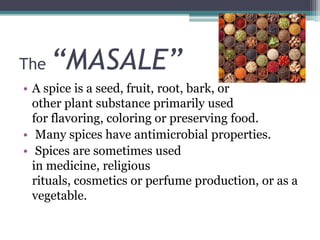
• A spice is a seed, fruit, root, bark, or
other plant substance primarily used
for flavoring, coloring or preserving food.
• Many spices have antimicrobial properties.
• Spices are sometimes used
in medicine, religious
rituals, cosmetics or perfume production, or as a
vegetable.
THE “SPICY” HISTORY
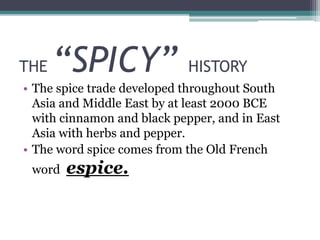
• The spice trade developed throughout South
Asia and Middle East by at least 2000 BCE
with cinnamon and black pepper, and in East
Asia with herbs and pepper.
• The word spice comes from the Old French
word espice.
cont….
• Spices were among the most demanded and
expensive products available in Europe in
the Middle Ages ,the most common being black
pepper, cinnamon
• Spices were all imported from plantations in
Asia and Africa, which made them expensive.
• The control of trade routes and the spice-
producing regions were the main reasons
that Portuguese navigator Vasco da Gama sailed
to India in 1499.
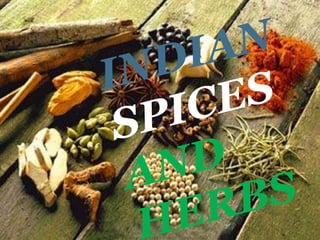
INDIAN SPICES AND HERBS
IN INDIA
• With the discovery of the New World came new
spices, including allspice, chili peppers, vanilla,
and chocolate.
• It is the main reason why the BRITISHERS and
PORTUGESE rule us more than 200 years
• A context of spices is seen in early Vedas and
RAMAYANA and is considered as old as human
civilization
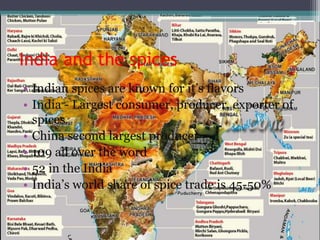
India and the spices
• Indian spices are known for it’s flavors
• India - Largest consumer, producer, exporter of
spices.
• China second largest producer
• 109 all over the word
• 52 in the India
• India’s world share of spice trade is 45-50%
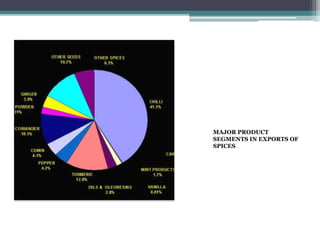
MAJOR PRODUCT
SEGMENTS IN EXPORTS OF
SPICES
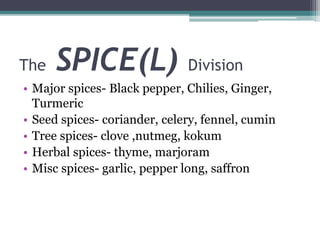
The SPICE(L) Division
• Major spices- Black pepper, Chilies, Ginger,
Turmeric
• Seed spices- coriander, celery, fennel, cumin
• Tree spices- clove ,nutmeg, kokum
• Herbal spices- thyme, marjoram
• Misc spices- garlic, pepper long, saffron
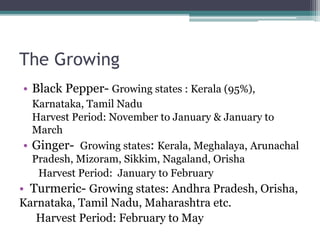
The Growing
• Black Pepper- Growing states : Kerala (95%),
Karnataka, Tamil Nadu
Harvest Period: November to January & January to
March
• Ginger- Growing states: Kerala, Meghalaya, Arunachal
Pradesh, Mizoram, Sikkim, Nagaland, Orisha
Harvest Period: January to February
• Turmeric- Growing states: Andhra Pradesh, Orisha,
Karnataka, Tamil Nadu, Maharashtra etc.
Harvest Period: February to May
Cont…….
• Red Chilies – Growing states: Andhra Pradesh,
Maharashtra, Karnataka etc.
Harvest Period: December to May
• Nutmeg - Growing states: Kerala, Tamil Nadu
Harvest Period: May to August
• Cumin - Growing states: Gujrat & Rajasthan
Harvest Period: February to May
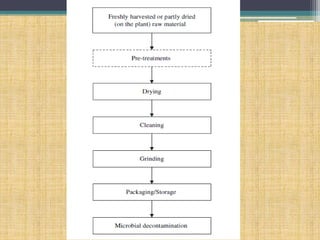
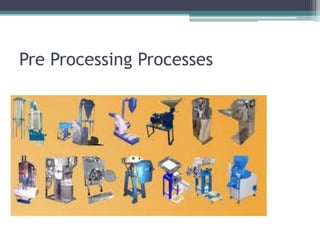
Pre Processing Processes
Cleaning
• The crop should be cleaned before processing.
The first stage is to remove dust and dirt using a
winnowing basket.
• After winnowing the crop needs to be washed in
water
• The water must be changed regularly to prevent
recontamination of spices by dirty water
Drying
• This is by far the most important stage in the
process to ensure good quality spices. Inadequately
dried produce will lead to mould growth.
• During the dry season, sun drying is usually
adequate to dry the produce.
• During the wet season or times of high humidity,
which often coincides with the harvest of the spices,
a solar dryer or sun drying cannot be used
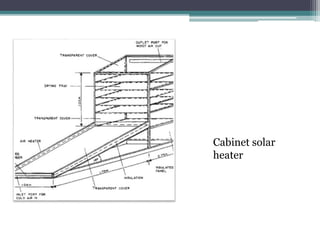
effectively. An artificial dryer that uses a cheap
energy sourceis necessary.
Cabinet solar
heater
Grading
• Spices can be graded by size, density, colour,
shape and flavour. Machines are available for
larger scale production units.
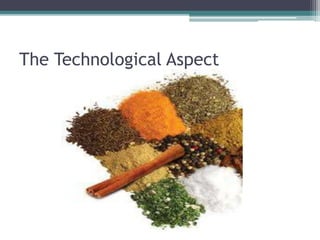
The Technological Aspect
Degree of Processing
• Spices are produced from large variety of plant
parts such as rhizomes, barks, leaves, fruits,
seeds etc
• Few spices can be incorporated directly into
food.
• The degree of fitness of processed spices depend
on its ultimate use.
Grinding
• The word GRIND means reducing the matter to
small particles or powder by crushing it
• Grinding of spices is a process which reduces
the solid matter of spices to small or powdery
form
• Grinding may also add value to the spices
Products which can be formed after
GRINDING PRODUCTS
• Straight spice powders (eg. Chilli powder,
Turmeric powder, Coriander powder, Pepper
powder, Cumin Powder, etc.,)
• Culinary Powders (eg. Samabr Powder, Rasam
Powder etc)
• Masala blends (eg. Garama Masala, Chicken
Masala, Meat masala etc)
• Seasonings and Tastemakers (eg. Snacks
seasonings (Masala munch, Green chilli masala,
sour cream onion, mint etc., and Pasta and
noodles tastemakers etc.,)
• Soup mixes blends ( Soup powders)
Production level
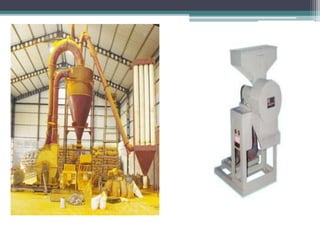
• For small-scale production (up to 100kg/day)
manual grinders are adequate. Small Chinese
or Indian models designed for domestic spice
grinding are suitable.
• For larger scale production a small, powered
grinding mill is needed and models are
available that can grind 25kg/hour. A grinding
mill needs to be placed in a separate and well
ventilated room because of the dust.
Cryogenic grinding can be useful
• It is the process of powdering of spices at sub
zero temperature ranging from -17.77 to -56
degree Celsius
• Spices are frozen with liquid nitrogen
• Normal grinding process do not use cooling
system and can reach up to 93.33 degree Celsius
• Solid materials are reduced to fine particles by
hammer.
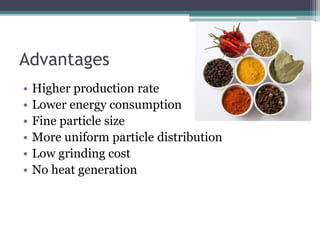
Advantages
• Higher production rate
• Lower energy consumption
• Fine particle size
• More uniform particle distribution
• Low grinding cost
• No heat generation
Problems associated with spice
production
•High microbial load
•losses of valuable compounds
due to enzymes activity
•Losses of valuable compounds
due to conventional processing
and storage
Sterilization of spices
•Fumigation with ethylene
oxide(ETO)
•Irradiation
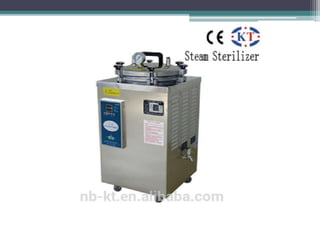
•Steam treatment
•High hydrostatic pressures
 Appearance and flavors are important factors for any
spice and must be remain intact in after any kind of
sterilization.
ETO treatment
• Ethylene oxide serves as a disinfectant ,fumigant
and insecticide
• It prevents humans microbial contaminants
such as E.Coli and salmonella
• It is highly effective in reducing and eliminating
pathogens reducing bacterial load yeast and
mold
• It has no major impact on flavour and apperance
Disadvantages of ETO
• Ethylene oxide (ETO) is banned in many
countries (e.g., Japan, and some European
countries) due to its reaction with spice
components to form ethylene chlorohydrin and
ethylene bromohydrin
• Ethylene chlorohydrin is a known carcinogen
that persists in the spice for many months
• Ethylene oxide also has been labelled as a
carcinogen by the W.H.O.
Irradiation of spices
• Gamma rays, electron beam X-Rays are
important and effective methods for spice
decontamination
• Doses of 3-10kGy is used to ensure the microbial
safety of spices
• Irradiation is allowed for decontamination of
dried herbs, spices and vegetable seasoning
• There may be the formation of low molecular
weight volatile or non volatile radiolysis
products emanating from packaging material.
Steam Treatment
• Usually high temperature steam is to whole
spices used before grinding
• The moisture condensed on the surface of the
particle needs to be removed after treatment to
prevent unwanted mould growth
• The treatment may hurt the volatile profile
colour physical state
High Hydrostatic Pressure
• High hydrostatic pressures ranging from 100 to
1000 Mpa is used for fruits and vegetable
products
• The inactivation of microorganisms is strongly
dependent on water activity
• Spice samples with water activity less than 0.66
shows no reduction in microbial count
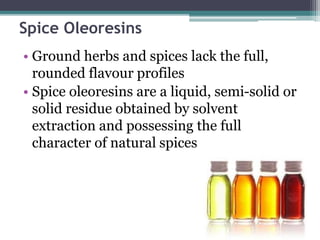
Spice Oleoresins
• Ground herbs and spices lack the full,
rounded flavour profiles
• Spice oleoresins are a liquid, semi-solid or
solid residue obtained by solvent
extraction and possessing the full
character of natural spices
Conclusion
• Wide variety of flavours and food ingredients
can be produced
• Innovative processes may pivotally contribute to
HACCP concepts in the food industry.
• Decrease the number of food-borne diseases
caused by spices and thus to ensure food safety.
• Success of new processes and products will
ultimately depend on their consumer acceptance
REFRENCES
• WIKIPEDIA
• Appropedia.org
• INDIANSPICES.COM
• SLIDESHARE.COM
THANKYOU

New microsoft office power point presentation

  • 1.
    Spice production andprocessing Submitted to – Er Madhu Submitted by- Anuharsh Gaur (15/IFT/011) and Tushar Tyagi (15/IFT/010)
  • 2.
    Content that willspice you up • Introduction and history • The majority division • The pre processing processes • The technological aspect a) grinding b) sterilization process • Spice Oleoresins • Conclusion • References
  • 3.
    The “MASALE” • Aspice is a seed, fruit, root, bark, or other plant substance primarily used for flavoring, coloring or preserving food. • Many spices have antimicrobial properties. • Spices are sometimes used in medicine, religious rituals, cosmetics or perfume production, or as a vegetable.
  • 4.
    THE “SPICY” HISTORY •The spice trade developed throughout South Asia and Middle East by at least 2000 BCE with cinnamon and black pepper, and in East Asia with herbs and pepper. • The word spice comes from the Old French word espice.
  • 5.
    cont…. • Spices wereamong the most demanded and expensive products available in Europe in the Middle Ages ,the most common being black pepper, cinnamon • Spices were all imported from plantations in Asia and Africa, which made them expensive. • The control of trade routes and the spice- producing regions were the main reasons that Portuguese navigator Vasco da Gama sailed to India in 1499.
  • 6.
  • 7.
    IN INDIA • Withthe discovery of the New World came new spices, including allspice, chili peppers, vanilla, and chocolate. • It is the main reason why the BRITISHERS and PORTUGESE rule us more than 200 years • A context of spices is seen in early Vedas and RAMAYANA and is considered as old as human civilization
  • 8.
    India and thespices • Indian spices are known for it’s flavors • India - Largest consumer, producer, exporter of spices. • China second largest producer • 109 all over the word • 52 in the India • India’s world share of spice trade is 45-50%
  • 9.
    MAJOR PRODUCT SEGMENTS INEXPORTS OF SPICES
  • 10.
    The SPICE(L) Division •Major spices- Black pepper, Chilies, Ginger, Turmeric • Seed spices- coriander, celery, fennel, cumin • Tree spices- clove ,nutmeg, kokum • Herbal spices- thyme, marjoram • Misc spices- garlic, pepper long, saffron
  • 12.
    The Growing • BlackPepper- Growing states : Kerala (95%), Karnataka, Tamil Nadu Harvest Period: November to January & January to March • Ginger- Growing states: Kerala, Meghalaya, Arunachal Pradesh, Mizoram, Sikkim, Nagaland, Orisha Harvest Period: January to February • Turmeric- Growing states: Andhra Pradesh, Orisha, Karnataka, Tamil Nadu, Maharashtra etc. Harvest Period: February to May
  • 13.
    Cont……. • Red Chilies– Growing states: Andhra Pradesh, Maharashtra, Karnataka etc. Harvest Period: December to May • Nutmeg - Growing states: Kerala, Tamil Nadu Harvest Period: May to August • Cumin - Growing states: Gujrat & Rajasthan Harvest Period: February to May
  • 14.
  • 15.
    Cleaning • The cropshould be cleaned before processing. The first stage is to remove dust and dirt using a winnowing basket. • After winnowing the crop needs to be washed in water • The water must be changed regularly to prevent recontamination of spices by dirty water
  • 16.
    Drying • This isby far the most important stage in the process to ensure good quality spices. Inadequately dried produce will lead to mould growth. • During the dry season, sun drying is usually adequate to dry the produce. • During the wet season or times of high humidity, which often coincides with the harvest of the spices, a solar dryer or sun drying cannot be used effectively. An artificial dryer that uses a cheap energy sourceis necessary.
  • 17.
  • 18.
    Grading • Spices canbe graded by size, density, colour, shape and flavour. Machines are available for larger scale production units.
  • 19.
  • 20.
    Degree of Processing •Spices are produced from large variety of plant parts such as rhizomes, barks, leaves, fruits, seeds etc • Few spices can be incorporated directly into food. • The degree of fitness of processed spices depend on its ultimate use.
  • 21.
    Grinding • The wordGRIND means reducing the matter to small particles or powder by crushing it • Grinding of spices is a process which reduces the solid matter of spices to small or powdery form • Grinding may also add value to the spices
  • 23.
    Products which canbe formed after GRINDING PRODUCTS • Straight spice powders (eg. Chilli powder, Turmeric powder, Coriander powder, Pepper powder, Cumin Powder, etc.,) • Culinary Powders (eg. Samabr Powder, Rasam Powder etc) • Masala blends (eg. Garama Masala, Chicken Masala, Meat masala etc) • Seasonings and Tastemakers (eg. Snacks seasonings (Masala munch, Green chilli masala, sour cream onion, mint etc., and Pasta and noodles tastemakers etc.,) • Soup mixes blends ( Soup powders)
  • 24.
    Production level • Forsmall-scale production (up to 100kg/day) manual grinders are adequate. Small Chinese or Indian models designed for domestic spice grinding are suitable. • For larger scale production a small, powered grinding mill is needed and models are available that can grind 25kg/hour. A grinding mill needs to be placed in a separate and well ventilated room because of the dust.
  • 25.
    Cryogenic grinding canbe useful • It is the process of powdering of spices at sub zero temperature ranging from -17.77 to -56 degree Celsius • Spices are frozen with liquid nitrogen • Normal grinding process do not use cooling system and can reach up to 93.33 degree Celsius • Solid materials are reduced to fine particles by hammer.
  • 26.
    Advantages • Higher productionrate • Lower energy consumption • Fine particle size • More uniform particle distribution • Low grinding cost • No heat generation
  • 27.
    Problems associated withspice production •High microbial load •losses of valuable compounds due to enzymes activity •Losses of valuable compounds due to conventional processing and storage
  • 28.
    Sterilization of spices •Fumigationwith ethylene oxide(ETO) •Irradiation •Steam treatment •High hydrostatic pressures  Appearance and flavors are important factors for any spice and must be remain intact in after any kind of sterilization.
  • 29.
    ETO treatment • Ethyleneoxide serves as a disinfectant ,fumigant and insecticide • It prevents humans microbial contaminants such as E.Coli and salmonella • It is highly effective in reducing and eliminating pathogens reducing bacterial load yeast and mold • It has no major impact on flavour and apperance
  • 30.
    Disadvantages of ETO •Ethylene oxide (ETO) is banned in many countries (e.g., Japan, and some European countries) due to its reaction with spice components to form ethylene chlorohydrin and ethylene bromohydrin • Ethylene chlorohydrin is a known carcinogen that persists in the spice for many months • Ethylene oxide also has been labelled as a carcinogen by the W.H.O.
  • 31.
    Irradiation of spices •Gamma rays, electron beam X-Rays are important and effective methods for spice decontamination • Doses of 3-10kGy is used to ensure the microbial safety of spices • Irradiation is allowed for decontamination of dried herbs, spices and vegetable seasoning • There may be the formation of low molecular weight volatile or non volatile radiolysis products emanating from packaging material.
  • 32.
    Steam Treatment • Usuallyhigh temperature steam is to whole spices used before grinding • The moisture condensed on the surface of the particle needs to be removed after treatment to prevent unwanted mould growth • The treatment may hurt the volatile profile colour physical state
  • 34.
    High Hydrostatic Pressure •High hydrostatic pressures ranging from 100 to 1000 Mpa is used for fruits and vegetable products • The inactivation of microorganisms is strongly dependent on water activity • Spice samples with water activity less than 0.66 shows no reduction in microbial count
  • 35.
    Spice Oleoresins • Groundherbs and spices lack the full, rounded flavour profiles • Spice oleoresins are a liquid, semi-solid or solid residue obtained by solvent extraction and possessing the full character of natural spices
  • 36.
    Conclusion • Wide varietyof flavours and food ingredients can be produced • Innovative processes may pivotally contribute to HACCP concepts in the food industry. • Decrease the number of food-borne diseases caused by spices and thus to ensure food safety. • Success of new processes and products will ultimately depend on their consumer acceptance
  • 37.
    REFRENCES • WIKIPEDIA • Appropedia.org •INDIANSPICES.COM • SLIDESHARE.COM
  • 38.