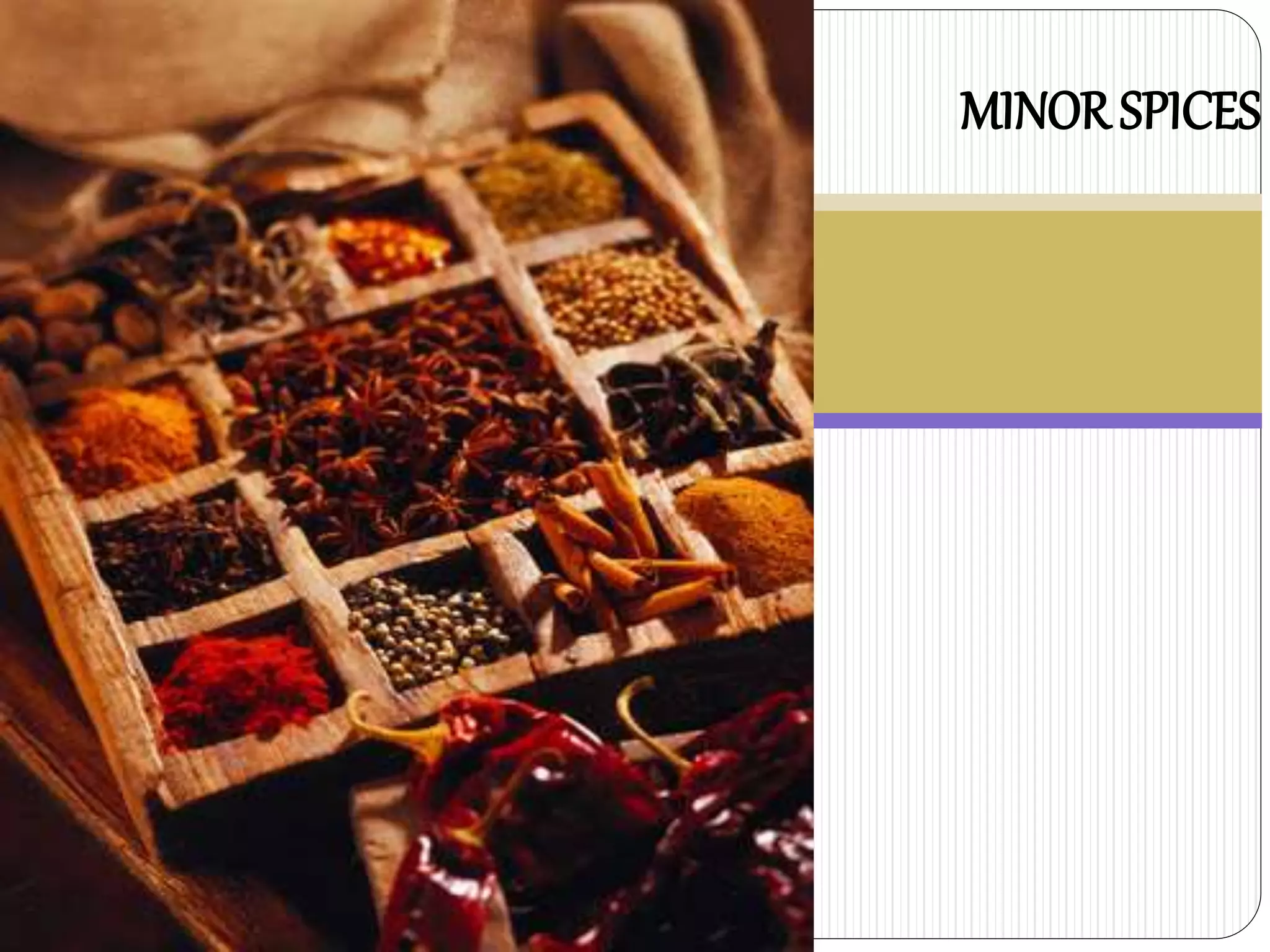
MINORSPICES
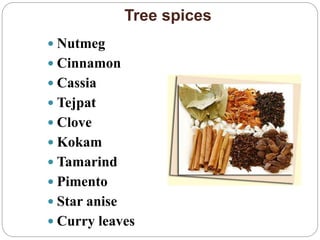
Tree spices
 Nutmeg
 Cinnamon
 Cassia
 Tejpat
 Clove
 Kokam
 Tamarind
 Pimento
 Star anise
 Curry leaves
Seed Spices
Coriander
Cumin
Fennel
Fenugreek
Ansie
Celery
Dill
Mustard
Poppy
Caraway
Ajowan or Bishop’s weed
Pomegranate
Herbal Spices
oMarjoram
oSavory
oTarragon
oThyme
oOriganum
oSage
oBasil
oPepper Mint
oParsley
oRosemary
oLovage
Other Spices
• Garlic
• Asafoetida
• Greater Galanga
• Saffron
• Sweet Flag
• Long Pepper
• Horse Radish
• Hyssop
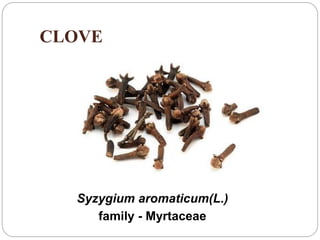
CLOVE
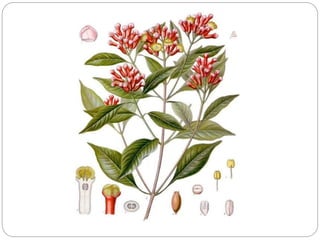
Syzygium aromaticum(L.)
family - Myrtaceae
Clove
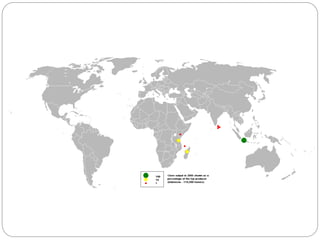
 Indigenous : volcanic islands of north molucca, Indonesia
 Cloves : Indonesia, India, Madagascar, Zanzibar, Pakistan and Sri Lanka
 India: Tamil nadu, Kerala, Karnataka
 Tree: Syzigium aromaticum
 First introduced to India around 1800 AD by the East India company
 Tropical plant and requires warm humid climate, tree is of medium size,
evergreen, reaching up to 20m in height and varies in its canopy shape
from cylindrical to pyramidal
 Temp: 20-30°C, rainfall: 1500-2000 mm
 Soil: deep red loam, sandy soil, black soil and deep gravelly soil are
suitable but water logged conditions are undesirable.
 Fully grown but unopened dried flower buds- whole buds range from ½ to
¾ inch in length and have spike like shape. Popular for flavor.
 Clove flavor is also available in Clove oil, clove leaf oil and clove stem
oil
 Dried bulbs yield 14-21% oil: eugenol (70-90%), eugenol acetate (5-
12)
 Water distillation- 81 % eugenol(suitable for perfumery)
 Dry distillation- strong oil with 95% eugenol
 Volatile oil at low Maturity stages- high eugenol acetate and less
eugenol, Fully mature clove – eugenol conc increases and eugenol
acetate conc decreases.
 Yield: 4th year of planting and full bearing:after 15 years.
 Flower buds are formed on young flush. It takes about 4-6 months for
the buds to become ready for harvest (3-4 kg, hand picking)
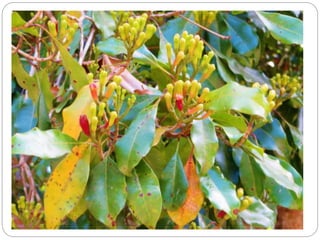
 Harvesting: colour of unopened buds at the young stage is usually
green, turning to flushed pink (before opening of the bud) maturity
index. (78-91 days after fruit set –optimum harvesting time)
 At that stage the stamens are still inside and covered by the petals
which form the head of the dried cloves.
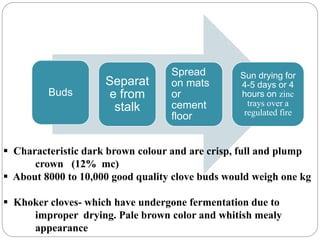
Buds
Separat
e from
stalk
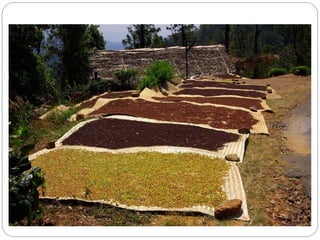
Spread
on mats
or
cement
floor
Sun drying for
4-5 days or 4
hours on zinc
trays over a
regulated fire
 Characteristic dark brown colour and are crisp, full and plump
crown (12% mc)
 About 8000 to 10,000 good quality clove buds would weigh one kg
 Khoker cloves- which have undergone fermentation due to
improper drying. Pale brown color and whitish mealy
appearance
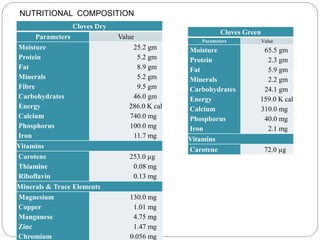
NUTRITIONAL COMPOSITION
Cloves Dry
Parameters Value
Moisture
Protein
Fat
Minerals
Fibre
Carbohydrates
Energy
Calcium
Phosphorus
Iron
25.2 gm
5.2 gm
8.9 gm
5.2 gm
9.5 gm
46.0 gm
286.0 K cal
740.0 mg
100.0 mg
11.7 mg
Vitamins
Carotene
Thiamine
Riboflavin
253.0 µg
0.08 mg
0.13 mg
Minerals & Trace Elements
Magnesium
Copper
Manganese
Zinc
Chromium
130.0 mg
1.01 mg
4.75 mg
1.47 mg
0.056 mg
Cloves Green
Parameters Value
Moisture
Protein
Fat
Minerals
Carbohydrates
Energy
Calcium
Phosphorus
Iron
65.5 gm
2.3 gm
5.9 gm
2.2 gm
24.1 gm
159.0 K cal
310.0 mg
40.0 mg
2.1 mg
Vitamins
Carotene 72.0 µg
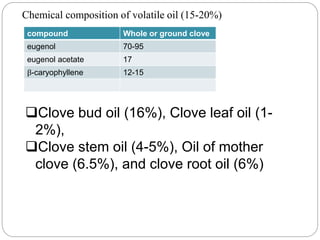
compound Whole or ground clove
eugenol 70-95
eugenol acetate 17
β-caryophyllene 12-15
Clove bud oil (16%), Clove leaf oil (1-
2%),
Clove stem oil (4-5%), Oil of mother
clove (6.5%), and clove root oil (6%)
Chemical composition of volatile oil (15-20%)
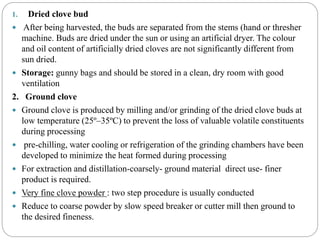
1. Dried clove bud
 After being harvested, the buds are separated from the stems (hand or thresher
machine. Buds are dried under the sun or using an artificial dryer. The colour
and oil content of artificially dried cloves are not significantly different from
sun dried.
 Storage: gunny bags and should be stored in a clean, dry room with good
ventilation
2. Ground clove
 Ground clove is produced by milling and/or grinding of the dried clove buds at
low temperature (25º–35ºC) to prevent the loss of valuable volatile constituents
during processing
 pre-chilling, water cooling or refrigeration of the grinding chambers have been
developed to minimize the heat formed during processing
 For extraction and distillation-coarsely- ground material direct use- finer
product is required.
 Very fine clove powder : two step procedure is usually conducted
 Reduce to coarse powder by slow speed breaker or cutter mill then ground to
the desired fineness.
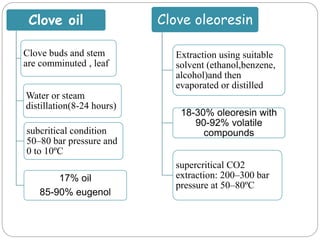
Clove oil
Clove buds and stem
are comminuted , leaf
Water or steam
distillation(8-24 hours)
subcritical condition
50–80 bar pressure and
0 to 10ºC
17% oil
85-90% eugenol
Clove oleoresin
Extraction using suitable
solvent (ethanol,benzene,
alcohol)and then
evaporated or distilled
18-30% oleoresin with
90-92% volatile
compounds
supercritical CO2
extraction: 200–300 bar
pressure at 50–80ºC
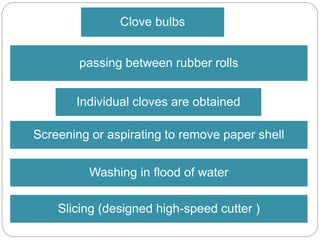
Clove bulbs
passing between rubber rolls
Individual cloves are obtained
Screening or aspirating to remove paper shell
Washing in flood of water
Slicing (designed high-speed cutter )
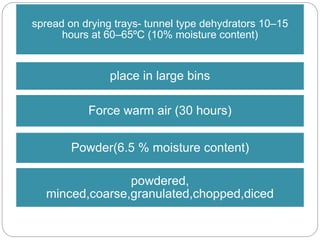
spread on drying trays- tunnel type dehydrators 10–15
hours at 60–65ºC (10% moisture content)
place in large bins
Force warm air (30 hours)
Powder(6.5 % moisture content)
powdered,
minced,coarse,granulated,chopped,diced
Use
 Aid in digestion, cure stomach disorders and helps in pain
relief
 Eugenol has antiseptic & antioxidant properties(1.4-1.8%)
 Clove oil- inflamed oral and pharyngeal mucous and for
topical anesthesia in dentistry, potent bactericide,
nematicide and fungicide
 Balm with clove oil soothing pain caused by rheumatism
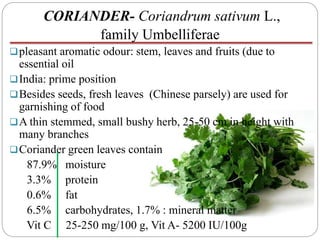
CORIANDER- Coriandrum sativum L.,
family Umbelliferae
pleasant aromatic odour: stem, leaves and fruits (due to
essential oil
India: prime position
Besides seeds, fresh leaves (Chinese parsely) are used for
garnishing of food
A thin stemmed, small bushy herb, 25-50 cm in height with
many branches
Coriander green leaves contain
87.9% moisture
3.3% protein
0.6% fat
6.5% carbohydrates, 1.7% : mineral matter
Vit C 25-250 mg/100 g, Vit A- 5200 IU/100g
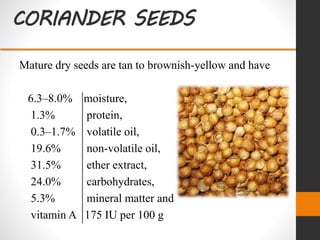
CORIANDER SEEDS
Mature dry seeds are tan to brownish-yellow and have
6.3–8.0% moisture,
1.3% protein,
0.3–1.7% volatile oil,
19.6% non-volatile oil,
31.5% ether extract,
24.0% carbohydrates,
5.3% mineral matter and
vitamin A 175 IU per 100 g
• Coriander : A tropical crop – requires cool and comapratively
dry frost free climate
• Cultivated either as a pure corp. or as mixed crop under
irrigated or rain fed condition
Unripe: aliphatic aldehydes imparts fetid-like aroma
Ripened: more pleasant and sweet odour- linalool
Dried ripe coriander seeds: steam-volatile oil and fixed oil (clear,
colourless to light yellow liquid)
Aroma: warm, spicy-aromatic, sweet and fruity
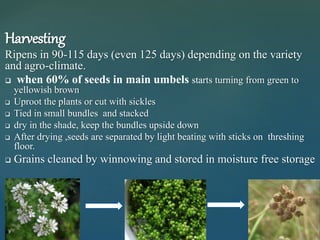
Harvesting
Ripens in 90-115 days (even 125 days) depending on the variety
and agro-climate.
 when 60% of seeds in main umbels starts turning from green to
yellowish brown
 Uproot the plants or cut with sickles
 Tied in small bundles and stacked
 dry in the shade, keep the bundles upside down
 After drying ,seeds are separated by light beating with sticks on threshing
floor.
 Grains cleaned by winnowing and stored in moisture free storage
Dual Purpose varieties– the foliage is plucked when crop is 60 to 70 days old
Yield: 1.0 – 1.5 t/ha (irrigated condition)
0.4- 0.5 t/ha (rain fed condition)
0.15- 0.30 t/h (mixed crop)
Processed Products
Whole coriander, ground coriander (powder)
Coriander seed oil, coriander herb oil
Coriander oleoresins
Fresh green plant – used as a flavorant in chutneys and soups.
Seeds extensively used as condiment with or without roasting
In medicine carminative, refrigerant, diuretic and aphrodisiac
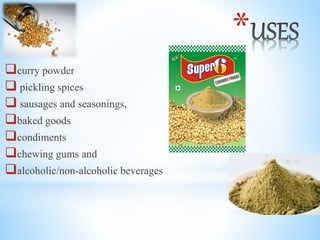
*
curry powder
 pickling spices
 sausages and seasonings,
baked goods
condiments
chewing gums and
alcoholic/non-alcoholic beverages
References
• www.spiceindia.com
• Spices: E. V. Nybe, N. Mini Raj, K.V. Peter
• Handbook of Herbs and Spices Vol I, edited by K.V.
Peter
• Handbook of Herbs and Spices Vol II, edited by K.V.
Peter
• www.indianspices.com

3.bc. clove coriander

  • 1.
  • 2.
    Tree spices  Nutmeg Cinnamon  Cassia  Tejpat  Clove  Kokam  Tamarind  Pimento  Star anise  Curry leaves
  • 3.
  • 4.
  • 5.
    Other Spices • Garlic •Asafoetida • Greater Galanga • Saffron • Sweet Flag • Long Pepper • Horse Radish • Hyssop
  • 6.
  • 7.
    Clove  Indigenous :volcanic islands of north molucca, Indonesia  Cloves : Indonesia, India, Madagascar, Zanzibar, Pakistan and Sri Lanka  India: Tamil nadu, Kerala, Karnataka  Tree: Syzigium aromaticum  First introduced to India around 1800 AD by the East India company  Tropical plant and requires warm humid climate, tree is of medium size, evergreen, reaching up to 20m in height and varies in its canopy shape from cylindrical to pyramidal  Temp: 20-30°C, rainfall: 1500-2000 mm  Soil: deep red loam, sandy soil, black soil and deep gravelly soil are suitable but water logged conditions are undesirable.  Fully grown but unopened dried flower buds- whole buds range from ½ to ¾ inch in length and have spike like shape. Popular for flavor.  Clove flavor is also available in Clove oil, clove leaf oil and clove stem oil
  • 10.
     Dried bulbsyield 14-21% oil: eugenol (70-90%), eugenol acetate (5- 12)  Water distillation- 81 % eugenol(suitable for perfumery)  Dry distillation- strong oil with 95% eugenol  Volatile oil at low Maturity stages- high eugenol acetate and less eugenol, Fully mature clove – eugenol conc increases and eugenol acetate conc decreases.  Yield: 4th year of planting and full bearing:after 15 years.  Flower buds are formed on young flush. It takes about 4-6 months for the buds to become ready for harvest (3-4 kg, hand picking)  Harvesting: colour of unopened buds at the young stage is usually green, turning to flushed pink (before opening of the bud) maturity index. (78-91 days after fruit set –optimum harvesting time)  At that stage the stamens are still inside and covered by the petals which form the head of the dried cloves.
  • 12.
    Buds Separat e from stalk Spread on mats or cement floor Sundrying for 4-5 days or 4 hours on zinc trays over a regulated fire  Characteristic dark brown colour and are crisp, full and plump crown (12% mc)  About 8000 to 10,000 good quality clove buds would weigh one kg  Khoker cloves- which have undergone fermentation due to improper drying. Pale brown color and whitish mealy appearance
  • 14.
    NUTRITIONAL COMPOSITION Cloves Dry ParametersValue Moisture Protein Fat Minerals Fibre Carbohydrates Energy Calcium Phosphorus Iron 25.2 gm 5.2 gm 8.9 gm 5.2 gm 9.5 gm 46.0 gm 286.0 K cal 740.0 mg 100.0 mg 11.7 mg Vitamins Carotene Thiamine Riboflavin 253.0 µg 0.08 mg 0.13 mg Minerals & Trace Elements Magnesium Copper Manganese Zinc Chromium 130.0 mg 1.01 mg 4.75 mg 1.47 mg 0.056 mg Cloves Green Parameters Value Moisture Protein Fat Minerals Carbohydrates Energy Calcium Phosphorus Iron 65.5 gm 2.3 gm 5.9 gm 2.2 gm 24.1 gm 159.0 K cal 310.0 mg 40.0 mg 2.1 mg Vitamins Carotene 72.0 µg
  • 15.
    compound Whole orground clove eugenol 70-95 eugenol acetate 17 β-caryophyllene 12-15 Clove bud oil (16%), Clove leaf oil (1- 2%), Clove stem oil (4-5%), Oil of mother clove (6.5%), and clove root oil (6%) Chemical composition of volatile oil (15-20%)
  • 16.
    1. Dried clovebud  After being harvested, the buds are separated from the stems (hand or thresher machine. Buds are dried under the sun or using an artificial dryer. The colour and oil content of artificially dried cloves are not significantly different from sun dried.  Storage: gunny bags and should be stored in a clean, dry room with good ventilation 2. Ground clove  Ground clove is produced by milling and/or grinding of the dried clove buds at low temperature (25º–35ºC) to prevent the loss of valuable volatile constituents during processing  pre-chilling, water cooling or refrigeration of the grinding chambers have been developed to minimize the heat formed during processing  For extraction and distillation-coarsely- ground material direct use- finer product is required.  Very fine clove powder : two step procedure is usually conducted  Reduce to coarse powder by slow speed breaker or cutter mill then ground to the desired fineness.
  • 17.
    Clove oil Clove budsand stem are comminuted , leaf Water or steam distillation(8-24 hours) subcritical condition 50–80 bar pressure and 0 to 10ºC 17% oil 85-90% eugenol Clove oleoresin Extraction using suitable solvent (ethanol,benzene, alcohol)and then evaporated or distilled 18-30% oleoresin with 90-92% volatile compounds supercritical CO2 extraction: 200–300 bar pressure at 50–80ºC
  • 18.
    Clove bulbs passing betweenrubber rolls Individual cloves are obtained Screening or aspirating to remove paper shell Washing in flood of water Slicing (designed high-speed cutter )
  • 19.
    spread on dryingtrays- tunnel type dehydrators 10–15 hours at 60–65ºC (10% moisture content) place in large bins Force warm air (30 hours) Powder(6.5 % moisture content) powdered, minced,coarse,granulated,chopped,diced
  • 20.
    Use  Aid indigestion, cure stomach disorders and helps in pain relief  Eugenol has antiseptic & antioxidant properties(1.4-1.8%)  Clove oil- inflamed oral and pharyngeal mucous and for topical anesthesia in dentistry, potent bactericide, nematicide and fungicide  Balm with clove oil soothing pain caused by rheumatism
  • 21.
    CORIANDER- Coriandrum sativumL., family Umbelliferae pleasant aromatic odour: stem, leaves and fruits (due to essential oil India: prime position Besides seeds, fresh leaves (Chinese parsely) are used for garnishing of food A thin stemmed, small bushy herb, 25-50 cm in height with many branches Coriander green leaves contain 87.9% moisture 3.3% protein 0.6% fat 6.5% carbohydrates, 1.7% : mineral matter Vit C 25-250 mg/100 g, Vit A- 5200 IU/100g
  • 22.
    CORIANDER SEEDS Mature dryseeds are tan to brownish-yellow and have 6.3–8.0% moisture, 1.3% protein, 0.3–1.7% volatile oil, 19.6% non-volatile oil, 31.5% ether extract, 24.0% carbohydrates, 5.3% mineral matter and vitamin A 175 IU per 100 g
  • 23.
    • Coriander :A tropical crop – requires cool and comapratively dry frost free climate • Cultivated either as a pure corp. or as mixed crop under irrigated or rain fed condition Unripe: aliphatic aldehydes imparts fetid-like aroma Ripened: more pleasant and sweet odour- linalool Dried ripe coriander seeds: steam-volatile oil and fixed oil (clear, colourless to light yellow liquid) Aroma: warm, spicy-aromatic, sweet and fruity
  • 24.
    Harvesting Ripens in 90-115days (even 125 days) depending on the variety and agro-climate.  when 60% of seeds in main umbels starts turning from green to yellowish brown  Uproot the plants or cut with sickles  Tied in small bundles and stacked  dry in the shade, keep the bundles upside down  After drying ,seeds are separated by light beating with sticks on threshing floor.  Grains cleaned by winnowing and stored in moisture free storage
  • 25.
    Dual Purpose varieties–the foliage is plucked when crop is 60 to 70 days old Yield: 1.0 – 1.5 t/ha (irrigated condition) 0.4- 0.5 t/ha (rain fed condition) 0.15- 0.30 t/h (mixed crop) Processed Products Whole coriander, ground coriander (powder) Coriander seed oil, coriander herb oil Coriander oleoresins Fresh green plant – used as a flavorant in chutneys and soups. Seeds extensively used as condiment with or without roasting In medicine carminative, refrigerant, diuretic and aphrodisiac
  • 26.
    * curry powder  picklingspices  sausages and seasonings, baked goods condiments chewing gums and alcoholic/non-alcoholic beverages
  • 27.
    References • www.spiceindia.com • Spices:E. V. Nybe, N. Mini Raj, K.V. Peter • Handbook of Herbs and Spices Vol I, edited by K.V. Peter • Handbook of Herbs and Spices Vol II, edited by K.V. Peter • www.indianspices.com