Origin from tropical region in Africa- 
Ethiopia, Sudan, Uganda, Liberia and Ivory 
Coast 
The first coffee was brought to Malaysia in 
1779 and the first type is Arabica followed 
by 1875 is Liberica. 
Due to the disease infection, the Robusta 
was introduced in 1900 because of the 
disease resistance.
The coffee was used before is to relief the 
pain by chewing the leafs and beans in 
Africa.
Coffee is the family of Rubiaceae and the 
genus is Coffea 
The species can be differentiate through 
fruit characteristic, leaf, and tree 
Coffee have 66 spp. but only 3 types of 
species has been commercialize: 
Coffea arabica (arabica) 
Coffea canephora (robusta) 
Coffea liberica (liberica) 
.
For liberica, 
• the primer roots was 0.5-2.0m 
• Secondary roots can be growth 2-3m 
Robusta and Arabica 
• The primer roots was shorter than liberica
Coffee have dwirmorfism branches 
characteristic 
2 types of branches; 
• 1) orthothropic 
• 2) plagiothropic.
The stem and shoots show vegetative 
growth. 
Every stem will produced couple of leave. 
The water shoot also will growth 
orthothropic. 
The robusta water shoots was more than 
other varieties
Primary (stem), secondary and tertiary 
branches will be growth at plagiothropic . 
4 -6 buds will growth at every stem and 
branches. 
Every 3-4 buds will be produced 
reproduction flowers
ARABICA LIBERICA 
ROBUSTA
Leaf 
The leaf was growth with couple of leave 
at every branch and stem. 
Liberica and arabica leaves are dark 
green. 
Robusta leave is a pale green. 
Every varieties have different size of leave.
Coffee leaves
Inflorescens 
The bunch of flowers will growth at first 3- 
4 buds. 
For liberica 1 bunch of flowers contain 1-4 
flowers. 
Every buds contain 1-3 bunch of flowers. 
Robusta and arabica have 3-4 bunch / 
buds and 2-4 flowers every bunch
The flowers was formed with the influence 
duration of lights and weather. 
The flowers are white . 
The stigma are yellows . The stigma will 
turn to black after pollination occurred.
Coffee flowers
The flowers will be opened in the early 
morning. 
High efficiency of pollination during good 
weather and sunlight. 
The pollination will be decreased if the 
weather are cloudy. 
The pollination process within 24 hours. 
Wind and bees are pollination agent. 
The maximum distance for wind pollination 
within 100meters. But the recommended 
distance for good pollination is 35meter
ARABICA 
Very fast growing and strong stem. 
The tree can grow 5 -6 meter. 
The leaf formed in spheres and narrow at 
the end and silver color for young leaf. 
The beans thick yellow reddish. 
Bean ratio 5:1
Arabica tree Arabica beans
Robusta 
Origin from Congo ( Zaire). 
The trees are straight and can grow until 
3m. 
The trees have umbrella shape and the 
branches can touched to the ground. 
The leave was broad and crinkled and 
thinner than liberica. 
The beans was thick red when ripe. 
The bean ratio 3.5:1
Robusta tree 
Robusta beans
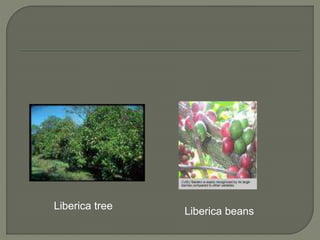
Liberica 
Origin from West Africa . 
The leave bigger than other species and 
shining. 
The beans size within 2.5-3.0 cm long and 
yellow to red when ripe. 
The skin are thicker than other species.
Liberica tree 
Liberica beans
Fruits(berries) are green when unripe . 
The Arabica was fallen during ripe compare 
with other species. 
Normally the fruits contain 2 beans. 
Two types of fruits: 
A) peaberry 
contain 1 beans. This occurred due to the 
pollination incomplete. 
B) Polliembrony 
The beans have 2 embryo
Rainfall and temperature is a biggest 
contribution of growth of coffee. 
Arabica need 1200-1800mm rainfall. 
Liberica and Robusta need 2000-3000mm 
rainfall. 
Dry season are necessities' to form the 
flower . 
Arabica 15-22°c and semi- tropical at 
highland area.
1000-1200 from sea level. 
The growth will be stunted at 23°c and the 
photosynthesis process will be stopped at 
34°c. 
Robusta and liberica temperature 18°- 
28°c. The shoots will be dried <34°c. 
Humidity 70%-90%
Sandy loam 100cm depth and good 
drainage and aeration. 
Soil ph 4.5-6.5. 
Soil series rengam,lambak ,ulu dong, 
taitak,
BREEDING AND NURSERY 
A) Seeds 
The seed must be selected from the parent 
trees. 
The weaknesses the tree from the seed 
sometimes not follow from the parent 
characteristic. 
The seed must be selected from the fully ripe 
fruits. 
The skin must be peeled and soak to the 
water 24- 48 hours.
The seeds which float must be eradicated. 
The seeds must be treated with Thiram.
Seeds requirement per hectare 
Planting distance Total trees per 
hectare 
Total seeds / kg 
Robusta 
2.5m x2.5m 
1845 715 
Liberica 
3.0mx3.0 
1282 233
The seeds can be sowed in germination 
bed or the polybags. 
The size of polybags 6” x 9”. 
The germination bed width 4 feet x 10feet.( 
based on hectarage) 
Sandy loam soil ( 1 sand 2 loam soil) for 
germination seeds. 
50% of shade
Polybag Nursery
GERMINATION BED
The seeds start germinated after 4-6 
weeks. 
The seedlings can be transferred after 4-6 
months after germinated
Vegetative propagation 
2 types of vegetative propagation : 
A)Cuttings 
B) budding 
CUTTINGS 
Cutting will be taken from the water shoots 
from the Orthothropic stem. 
The shoots girth must be 10cm
Cutting
BUDDINGS 
The root stocks will be retained 6-8 
months. 
The budding can be carried out by using 
A)water shoots 
B) buds 
The root stocks will be cut 15cm from 
ground after sucessful budding and the 
buds will be selected from 3 old months 
buds.
Advantages vegetative propagation: 
A) uniform growth and the quality yield. 
B)uniform maturity and early maturity. 
C)To sustain the clone characteristic and 
varieties. 
D) ability to rehabilate the unproductive 
clone or trees in the plantation.
Disadvantages 
A) the root stock and bud not suit. 
B)high cost and need skill worker. 
C) clone not resistance with disease and 
environment.
LAND PREPARATION 
Jungle Clearing 
All the stump must be extracted and 
excavate. 
The stump must be stacked before 
ploughing and harrowing commence
Planting distance. 
Liberica 
3m x3m (1280 trees / hec) 
Robusta / Arabica 
2.5m x 2.75m ( 1450 trees/ hec) 
lining
Holing 
0.4mx0.4mx0.4m and 110grams CIRP 
Shading 
A) gliricidia 
B) leucaena 
Liberica can be planted without shade
Advantages 
A) To avoid over fruiting and shoots die 
B) To Prolong the yield production 
C) To reduce weeds density
Disadvantages 
A) competition of water and nutrients. 
B) decrease of flower growth if over shade. 
C)Inefficiency of pollination. 
D)Need good supervision
Mulching 
Can apply by using Imperata cylindrica or 
empty fruit bunch
Pruning 
To maintain the growth and to maintain the 
height . 
To prune the main stem , branches to 
stimulate the fruits production 
To balance the tree canopy. 
To eradicate the water shoots
Type of pruning 
Main stem pruning 
Agobiado pruning
Pruning and water shoots pruning
Manuring 
The application fertilizers must be 
commensurate with the growth and 
weather condition. 
The nutrient increase during the vegetative 
growth and reproductive growth( fruits and 
flowering)
Coffee integration 
Banana 
Coconut 
Petai
Coffee& pineapple Banana & coffee
Fruit Borer (Hypothenemus hampei Ferr)
This fruit borer is the main pest for cocoa . 
The small weevil from the family Scolitidae
Stem borer( Xylosandras compactus) 
Kumbang kaboi ( Apogonia)
musang
DISEASE 
A) coffee rust 
Hemilea vastatrix 
B) Thread –blight 
Marasmius spp
The coffee berries must be handling 
properly due to easy rotten. 
This is to ensure the standard and quality 
and the flavors not effected. 
The coffee bean can be produced from 
coffee berries through the process: 
A) Dry Method 
B) Wet Method
The coffee bean quality influenced: 
A) ripeness stage 
B)harvesting method 
C) processing technique
HARVESTING 
Only harvest the ripe beans and avoid to 
harvest the under ripe berries. 
The not uniform ripeness can caused the 
quality and the flavors. 
The harvested berries must be process 
within 24-36 hours.
First stage processing 
A) Dry method 
This process was normally used in 
Malaysia and used the separator machine. 
In 1hour can processed 3mt coffee berries. 
The separator bean will be dried under the 
sun at 4cm thick. This bean will be 
scrapped 4-5 days to ensure all the beans 
totally dry. This process take 10-12 days 
and 12% humidity.
DRY METHOD
Wet Method 
The wet method can reduce and shorter 
the drying process. This process can 
increase the coffee flavors. This process 
need to do the fermentation process. After 
the coffee berries separate the beans will 
be fermented 27 hours. The beans will be 
washed and soak in the water within 24 
hours and dry 6-7 days
WET METHOD
STORAGE 
The dry bean must be put in the gunny 
sack. And must be stored under shade. 
The coffee beans can be stored more than 
1 year with the condition the temperature 
must be supervised.
Second stage processing ( coffee powder) 
This process is to process the coffee 
beans to end product . 
The process involved roasting and mixture 
of caramel and magarines. 
The roasting 180˚c- 200˚c at duration 15 
minutes at every 10 kilogrammes
Second stage processing ( coffee powder) 
This process is to process the coffee 
beans to end product . 
The process involved roasting and mixture 
of caramel and magarines. 
The roasting 180˚c- 200˚c at duration 15 
minutes at every 10 kilogrammes
ROASTED 
COFFE

Coffee

  • 2.
    Origin from tropicalregion in Africa- Ethiopia, Sudan, Uganda, Liberia and Ivory Coast The first coffee was brought to Malaysia in 1779 and the first type is Arabica followed by 1875 is Liberica. Due to the disease infection, the Robusta was introduced in 1900 because of the disease resistance.
  • 3.
    The coffee wasused before is to relief the pain by chewing the leafs and beans in Africa.
  • 4.
    Coffee is thefamily of Rubiaceae and the genus is Coffea The species can be differentiate through fruit characteristic, leaf, and tree Coffee have 66 spp. but only 3 types of species has been commercialize: Coffea arabica (arabica) Coffea canephora (robusta) Coffea liberica (liberica) .
  • 6.
    For liberica, •the primer roots was 0.5-2.0m • Secondary roots can be growth 2-3m Robusta and Arabica • The primer roots was shorter than liberica
  • 7.
    Coffee have dwirmorfismbranches characteristic 2 types of branches; • 1) orthothropic • 2) plagiothropic.
  • 8.
    The stem andshoots show vegetative growth. Every stem will produced couple of leave. The water shoot also will growth orthothropic. The robusta water shoots was more than other varieties
  • 9.
    Primary (stem), secondaryand tertiary branches will be growth at plagiothropic . 4 -6 buds will growth at every stem and branches. Every 3-4 buds will be produced reproduction flowers
  • 10.
  • 11.
    Leaf The leafwas growth with couple of leave at every branch and stem. Liberica and arabica leaves are dark green. Robusta leave is a pale green. Every varieties have different size of leave.
  • 12.
  • 13.
    Inflorescens The bunchof flowers will growth at first 3- 4 buds. For liberica 1 bunch of flowers contain 1-4 flowers. Every buds contain 1-3 bunch of flowers. Robusta and arabica have 3-4 bunch / buds and 2-4 flowers every bunch
  • 14.
    The flowers wasformed with the influence duration of lights and weather. The flowers are white . The stigma are yellows . The stigma will turn to black after pollination occurred.
  • 15.
  • 16.
    The flowers willbe opened in the early morning. High efficiency of pollination during good weather and sunlight. The pollination will be decreased if the weather are cloudy. The pollination process within 24 hours. Wind and bees are pollination agent. The maximum distance for wind pollination within 100meters. But the recommended distance for good pollination is 35meter
  • 17.
    ARABICA Very fastgrowing and strong stem. The tree can grow 5 -6 meter. The leaf formed in spheres and narrow at the end and silver color for young leaf. The beans thick yellow reddish. Bean ratio 5:1
  • 18.
  • 19.
    Robusta Origin fromCongo ( Zaire). The trees are straight and can grow until 3m. The trees have umbrella shape and the branches can touched to the ground. The leave was broad and crinkled and thinner than liberica. The beans was thick red when ripe. The bean ratio 3.5:1
  • 20.
  • 21.
    Liberica Origin fromWest Africa . The leave bigger than other species and shining. The beans size within 2.5-3.0 cm long and yellow to red when ripe. The skin are thicker than other species.
  • 22.
  • 23.
    Fruits(berries) are greenwhen unripe . The Arabica was fallen during ripe compare with other species. Normally the fruits contain 2 beans. Two types of fruits: A) peaberry contain 1 beans. This occurred due to the pollination incomplete. B) Polliembrony The beans have 2 embryo
  • 25.
    Rainfall and temperatureis a biggest contribution of growth of coffee. Arabica need 1200-1800mm rainfall. Liberica and Robusta need 2000-3000mm rainfall. Dry season are necessities' to form the flower . Arabica 15-22°c and semi- tropical at highland area.
  • 26.
    1000-1200 from sealevel. The growth will be stunted at 23°c and the photosynthesis process will be stopped at 34°c. Robusta and liberica temperature 18°- 28°c. The shoots will be dried <34°c. Humidity 70%-90%
  • 27.
    Sandy loam 100cmdepth and good drainage and aeration. Soil ph 4.5-6.5. Soil series rengam,lambak ,ulu dong, taitak,
  • 28.
    BREEDING AND NURSERY A) Seeds The seed must be selected from the parent trees. The weaknesses the tree from the seed sometimes not follow from the parent characteristic. The seed must be selected from the fully ripe fruits. The skin must be peeled and soak to the water 24- 48 hours.
  • 29.
    The seeds whichfloat must be eradicated. The seeds must be treated with Thiram.
  • 30.
    Seeds requirement perhectare Planting distance Total trees per hectare Total seeds / kg Robusta 2.5m x2.5m 1845 715 Liberica 3.0mx3.0 1282 233
  • 31.
    The seeds canbe sowed in germination bed or the polybags. The size of polybags 6” x 9”. The germination bed width 4 feet x 10feet.( based on hectarage) Sandy loam soil ( 1 sand 2 loam soil) for germination seeds. 50% of shade
  • 32.
  • 33.
  • 34.
    The seeds startgerminated after 4-6 weeks. The seedlings can be transferred after 4-6 months after germinated
  • 35.
    Vegetative propagation 2types of vegetative propagation : A)Cuttings B) budding CUTTINGS Cutting will be taken from the water shoots from the Orthothropic stem. The shoots girth must be 10cm
  • 36.
  • 37.
    BUDDINGS The rootstocks will be retained 6-8 months. The budding can be carried out by using A)water shoots B) buds The root stocks will be cut 15cm from ground after sucessful budding and the buds will be selected from 3 old months buds.
  • 38.
    Advantages vegetative propagation: A) uniform growth and the quality yield. B)uniform maturity and early maturity. C)To sustain the clone characteristic and varieties. D) ability to rehabilate the unproductive clone or trees in the plantation.
  • 39.
    Disadvantages A) theroot stock and bud not suit. B)high cost and need skill worker. C) clone not resistance with disease and environment.
  • 41.
    LAND PREPARATION JungleClearing All the stump must be extracted and excavate. The stump must be stacked before ploughing and harrowing commence
  • 42.
    Planting distance. Liberica 3m x3m (1280 trees / hec) Robusta / Arabica 2.5m x 2.75m ( 1450 trees/ hec) lining
  • 43.
    Holing 0.4mx0.4mx0.4m and110grams CIRP Shading A) gliricidia B) leucaena Liberica can be planted without shade
  • 44.
    Advantages A) Toavoid over fruiting and shoots die B) To Prolong the yield production C) To reduce weeds density
  • 45.
    Disadvantages A) competitionof water and nutrients. B) decrease of flower growth if over shade. C)Inefficiency of pollination. D)Need good supervision
  • 46.
    Mulching Can applyby using Imperata cylindrica or empty fruit bunch
  • 47.
    Pruning To maintainthe growth and to maintain the height . To prune the main stem , branches to stimulate the fruits production To balance the tree canopy. To eradicate the water shoots
  • 48.
    Type of pruning Main stem pruning Agobiado pruning
  • 50.
    Pruning and watershoots pruning
  • 51.
    Manuring The applicationfertilizers must be commensurate with the growth and weather condition. The nutrient increase during the vegetative growth and reproductive growth( fruits and flowering)
  • 52.
  • 53.
  • 54.
  • 55.
    This fruit boreris the main pest for cocoa . The small weevil from the family Scolitidae
  • 56.
    Stem borer( Xylosandrascompactus) Kumbang kaboi ( Apogonia)
  • 57.
  • 58.
    DISEASE A) coffeerust Hemilea vastatrix B) Thread –blight Marasmius spp
  • 61.
    The coffee berriesmust be handling properly due to easy rotten. This is to ensure the standard and quality and the flavors not effected. The coffee bean can be produced from coffee berries through the process: A) Dry Method B) Wet Method
  • 62.
    The coffee beanquality influenced: A) ripeness stage B)harvesting method C) processing technique
  • 63.
    HARVESTING Only harvestthe ripe beans and avoid to harvest the under ripe berries. The not uniform ripeness can caused the quality and the flavors. The harvested berries must be process within 24-36 hours.
  • 64.
    First stage processing A) Dry method This process was normally used in Malaysia and used the separator machine. In 1hour can processed 3mt coffee berries. The separator bean will be dried under the sun at 4cm thick. This bean will be scrapped 4-5 days to ensure all the beans totally dry. This process take 10-12 days and 12% humidity.
  • 65.
  • 66.
    Wet Method Thewet method can reduce and shorter the drying process. This process can increase the coffee flavors. This process need to do the fermentation process. After the coffee berries separate the beans will be fermented 27 hours. The beans will be washed and soak in the water within 24 hours and dry 6-7 days
  • 67.
  • 68.
    STORAGE The drybean must be put in the gunny sack. And must be stored under shade. The coffee beans can be stored more than 1 year with the condition the temperature must be supervised.
  • 69.
    Second stage processing( coffee powder) This process is to process the coffee beans to end product . The process involved roasting and mixture of caramel and magarines. The roasting 180˚c- 200˚c at duration 15 minutes at every 10 kilogrammes
  • 70.
    Second stage processing( coffee powder) This process is to process the coffee beans to end product . The process involved roasting and mixture of caramel and magarines. The roasting 180˚c- 200˚c at duration 15 minutes at every 10 kilogrammes
  • 71.