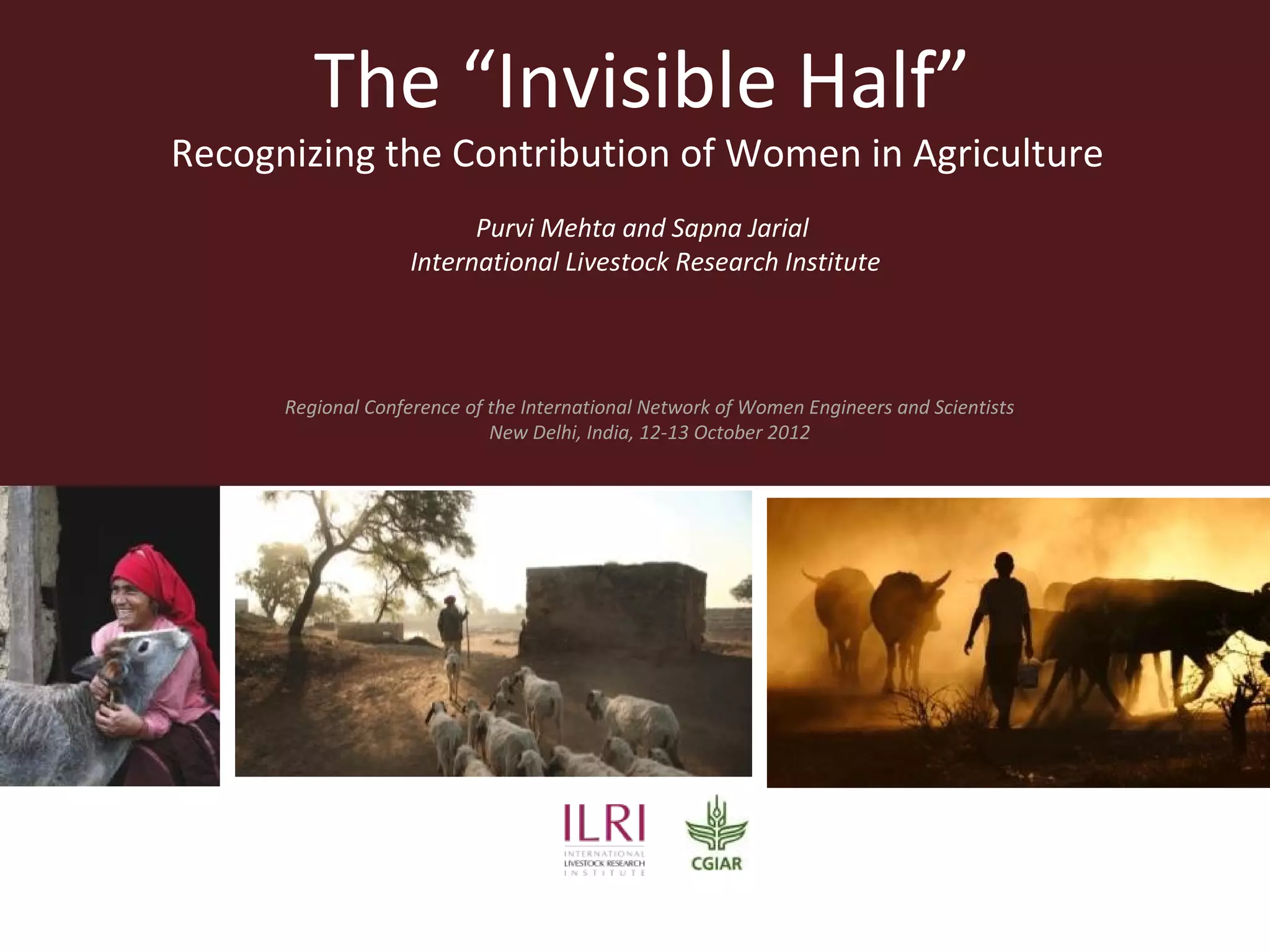
The “Invisible Half”
Recognizing the Contribution of Women in Agriculture
                          Purvi Mehta and Sapna Jarial
                    International Livestock Research Institute


      Regional Conference of the International Network of Women Engineers and Scientists
                             New Delhi, India, 12-13 October 2012
Outline
•   The Invisible Farmers and Need of Acknowledgement

•   Progress

•   Recommendations
The Invisible Farmers and Need of Acknowledgement
 The InvisibleFarm
               Farmers and Need of Acknowledgement
               Farm


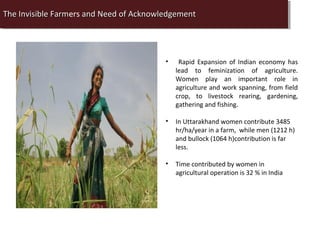
                                         •    Rapid Expansion of Indian economy has
                                             lead to feminization of agriculture.
                                             Women play an important role in
                                             agriculture and work spanning, from field
                                             crop, to livestock rearing, gardening,
                                             gathering and fishing.

                                         •   In Uttarakhand women contribute 3485
                                             hr/ha/year in a farm, while men (1212 h)
                                             and bullock (1064 h)contribution is far
                                             less.

                                         •   Time contributed by women in
                                             agricultural operation is 32 % in India
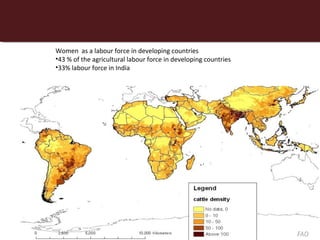
Women as a labour force in developing countries
•43 % of the agricultural labour force in developing countries
•33% labour force in India


                                                                 FAO
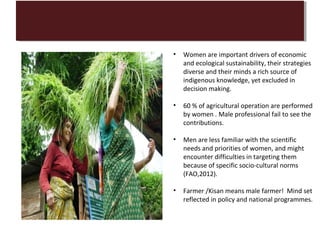
•   Women are important drivers of economic
    and ecological sustainability, their strategies
    diverse and their minds a rich source of
    indigenous knowledge, yet excluded in
    decision making.

•   60 % of agricultural operation are performed
    by women . Male professional fail to see the
    contributions.

•   Men are less familiar with the scientific
    needs and priorities of women, and might
    encounter difficulties in targeting them
    because of specific socio-cultural norms
    (FAO,2012).

•   Farmer /Kisan means male farmer! Mind set
    reflected in policy and national programmes.
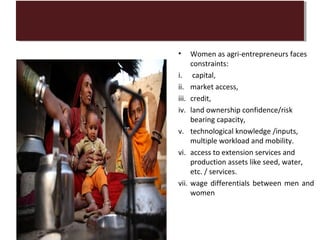
•      Women as agri-entrepreneurs faces
       constraints:
i.      capital,
ii.    market access,
iii.   credit,
iv.    land ownership confidence/risk
       bearing capacity,
v.     technological knowledge /inputs,
       multiple workload and mobility.
vi.    access to extension services and
       production assets like seed, water,
       etc. / services.
vii.   wage differentials between men and
       women
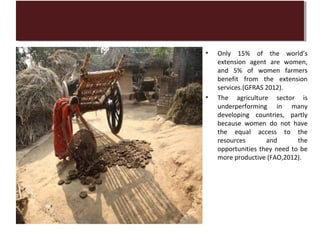
•   Only 15% of the world’s
    extension agent are women,
    and 5% of women farmers
    benefit from the extension
    services.(GFRAS 2012).
•   The agriculture sector is
    underperforming in many
    developing countries, partly
    because women do not have
    the equal access to the
    resources       and       the
    opportunities they need to be
    more productive (FAO,2012).
Progress
Progress

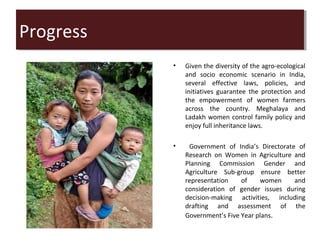
           •   Given the diversity of the agro-ecological
               and socio economic scenario in India,
               several effective laws, policies, and
               initiatives guarantee the protection and
               the empowerment of women farmers
               across the country. Meghalaya and
               Ladakh women control family policy and
               enjoy full inheritance laws.

           •    Government of India’s Directorate of
               Research on Women in Agriculture and
               Planning Commission Gender and
               Agriculture Sub-group ensure better
               representation    of    women     and
               consideration of gender issues during
               decision-making activities, including
               drafting and assessment of the
               Government’s Five Year plans.
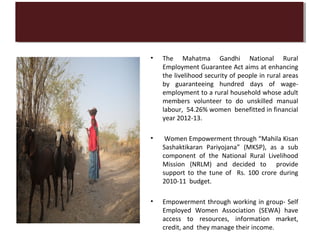
•   The Mahatma Gandhi National Rural
    Employment Guarantee Act aims at enhancing
    the livelihood security of people in rural areas
    by guaranteeing hundred days of wage-
    employment to a rural household whose adult
    members volunteer to do unskilled manual
    labour, 54.26% women benefitted in financial
    year 2012-13.

•   Women Empowerment through “Mahila Kisan
    Sashaktikaran Pariyojana” (MKSP), as a sub
    component of the National Rural Livelihood
    Mission (NRLM) and decided to provide
    support to the tune of Rs. 100 crore during
    2010-11 budget.

•   Empowerment through working in group- Self
    Employed Women Association (SEWA) have
    access to resources, information market,
    credit, and they manage their income.
Recommendation
Recommendation
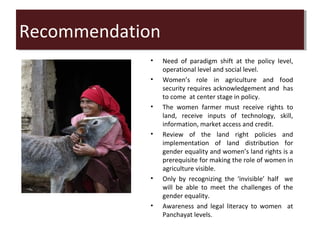
            •   Need of paradigm shift at the policy level,
                operational level and social level.
            •   Women’s role in agriculture and food
                security requires acknowledgement and has
                to come at center stage in policy.
            •   The women farmer must receive rights to
                land, receive inputs of technology, skill,
                information, market access and credit.
            •   Review of the land right policies and
                implementation of land distribution for
                gender equality and women’s land rights is a
                prerequisite for making the role of women in
                agriculture visible.
            •   Only by recognizing the ‘invisible’ half we
                will be able to meet the challenges of the
                gender equality.
            •   Awareness and legal literacy to women at
                Panchayat levels.
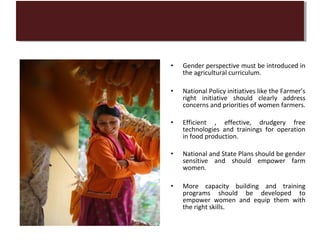
•   Gender perspective must be introduced in
    the agricultural curriculum.

•   National Policy initiatives like the Farmer’s
    right initiative should clearly address
    concerns and priorities of women farmers.

•   Efficient , effective, drudgery free
    technologies and trainings for operation
    in food production.

•   National and State Plans should be gender
    sensitive and should empower farm
    women.

•   More capacity building and training
    programs should be developed to
    empower women and equip them with
    the right skills.
Conclusion
Conclusion


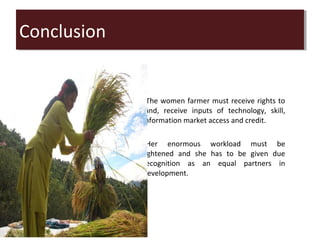
             •The women farmer must receive rights to
             land, receive inputs of technology, skill,
             information market access and credit.
             •
             •Her enormous workload must be
             lightened and she has to be given due
             recognition as an equal partners in
             development.
Better lives through livestock


                                               ilri.org


  The presentation has a Creative Commons licence. You are free to re-use or distribute this work, provided credit is given to ILRI.

The 'Invisible Half': Recognizing the contribution of women in agriculture

  • 1.
    The “Invisible Half” Recognizingthe Contribution of Women in Agriculture Purvi Mehta and Sapna Jarial International Livestock Research Institute Regional Conference of the International Network of Women Engineers and Scientists New Delhi, India, 12-13 October 2012
  • 2.
    Outline • The Invisible Farmers and Need of Acknowledgement • Progress • Recommendations
  • 3.
    The Invisible Farmersand Need of Acknowledgement The InvisibleFarm Farmers and Need of Acknowledgement Farm • Rapid Expansion of Indian economy has lead to feminization of agriculture. Women play an important role in agriculture and work spanning, from field crop, to livestock rearing, gardening, gathering and fishing. • In Uttarakhand women contribute 3485 hr/ha/year in a farm, while men (1212 h) and bullock (1064 h)contribution is far less. • Time contributed by women in agricultural operation is 32 % in India
  • 4.
    Women as alabour force in developing countries •43 % of the agricultural labour force in developing countries •33% labour force in India FAO
  • 5.
    Women are important drivers of economic and ecological sustainability, their strategies diverse and their minds a rich source of indigenous knowledge, yet excluded in decision making. • 60 % of agricultural operation are performed by women . Male professional fail to see the contributions. • Men are less familiar with the scientific needs and priorities of women, and might encounter difficulties in targeting them because of specific socio-cultural norms (FAO,2012). • Farmer /Kisan means male farmer! Mind set reflected in policy and national programmes.
  • 6.
    Women as agri-entrepreneurs faces constraints: i. capital, ii. market access, iii. credit, iv. land ownership confidence/risk bearing capacity, v. technological knowledge /inputs, multiple workload and mobility. vi. access to extension services and production assets like seed, water, etc. / services. vii. wage differentials between men and women
  • 7.
    Only 15% of the world’s extension agent are women, and 5% of women farmers benefit from the extension services.(GFRAS 2012). • The agriculture sector is underperforming in many developing countries, partly because women do not have the equal access to the resources and the opportunities they need to be more productive (FAO,2012).
  • 8.
    Progress Progress • Given the diversity of the agro-ecological and socio economic scenario in India, several effective laws, policies, and initiatives guarantee the protection and the empowerment of women farmers across the country. Meghalaya and Ladakh women control family policy and enjoy full inheritance laws. • Government of India’s Directorate of Research on Women in Agriculture and Planning Commission Gender and Agriculture Sub-group ensure better representation of women and consideration of gender issues during decision-making activities, including drafting and assessment of the Government’s Five Year plans.
  • 9.
    The Mahatma Gandhi National Rural Employment Guarantee Act aims at enhancing the livelihood security of people in rural areas by guaranteeing hundred days of wage- employment to a rural household whose adult members volunteer to do unskilled manual labour, 54.26% women benefitted in financial year 2012-13. • Women Empowerment through “Mahila Kisan Sashaktikaran Pariyojana” (MKSP), as a sub component of the National Rural Livelihood Mission (NRLM) and decided to provide support to the tune of Rs. 100 crore during 2010-11 budget. • Empowerment through working in group- Self Employed Women Association (SEWA) have access to resources, information market, credit, and they manage their income.
  • 10.
    Recommendation Recommendation • Need of paradigm shift at the policy level, operational level and social level. • Women’s role in agriculture and food security requires acknowledgement and has to come at center stage in policy. • The women farmer must receive rights to land, receive inputs of technology, skill, information, market access and credit. • Review of the land right policies and implementation of land distribution for gender equality and women’s land rights is a prerequisite for making the role of women in agriculture visible. • Only by recognizing the ‘invisible’ half we will be able to meet the challenges of the gender equality. • Awareness and legal literacy to women at Panchayat levels.
  • 11.
    Gender perspective must be introduced in the agricultural curriculum. • National Policy initiatives like the Farmer’s right initiative should clearly address concerns and priorities of women farmers. • Efficient , effective, drudgery free technologies and trainings for operation in food production. • National and State Plans should be gender sensitive and should empower farm women. • More capacity building and training programs should be developed to empower women and equip them with the right skills.
  • 12.
    Conclusion Conclusion •The women farmer must receive rights to land, receive inputs of technology, skill, information market access and credit. • •Her enormous workload must be lightened and she has to be given due recognition as an equal partners in development.
  • 13.
    Better lives throughlivestock ilri.org The presentation has a Creative Commons licence. You are free to re-use or distribute this work, provided credit is given to ILRI.