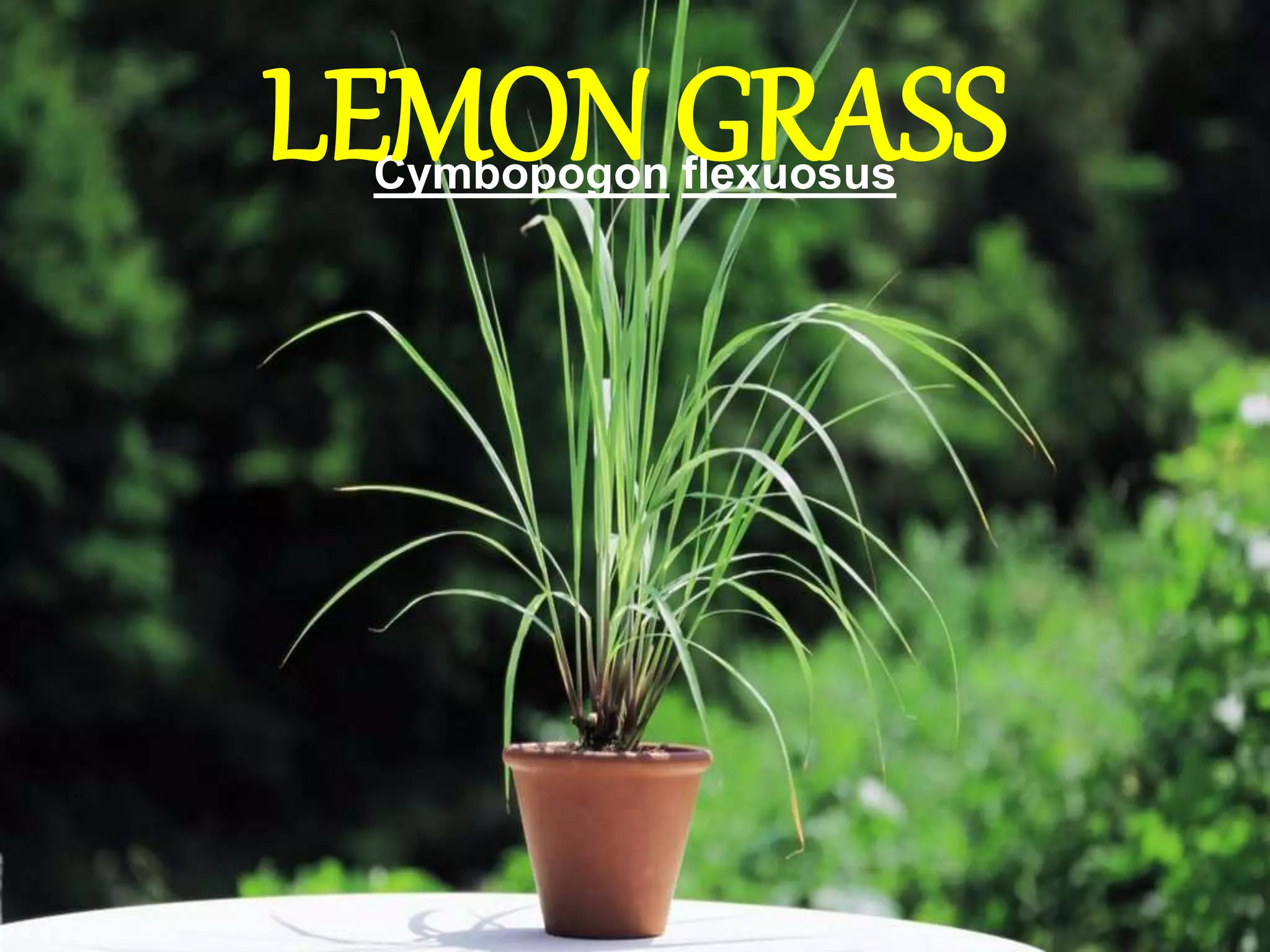
Cymbopogon flexuosus
LEMON GRASS
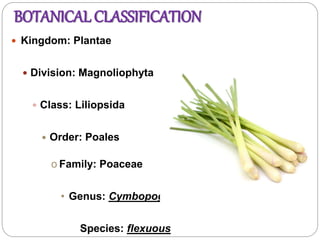
BOTANICAL CLASSIFICATION
 Kingdom: Plantae
 Division: Magnoliophyta
 Class: Liliopsida
 Order: Poales
o Family: Poaceae
• Genus: Cymbopogon
Species: flexuous
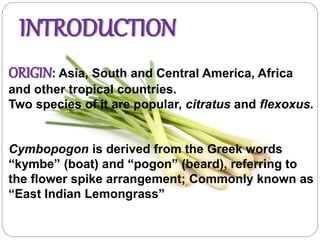
INTRODUCTION
ORIGIN: Asia, South and Central America, Africa
and other tropical countries.
Two species of it are popular, citratus and flexoxus.
Cymbopogon is derived from the Greek words
“kymbe” (boat) and “pogon” (beard), referring to
the flower spike arrangement; Commonly known as
“East Indian Lemongrass”
Basedon colour of stem:
A) C. flexuosus var. flexuosus.
Stem and leaf sheath are reddish or purple.
Oil content : 0.3 to 0.5%.
Citral : 80-86%
Oil has good solubility in alcohol and hence is superior in
quality. It is recognized as true lemongrass and is
commercially cultivated.
B) C. flexuosus var. albescens “white grass ”
Stem and leaf sheath are white in color
Oil content : 0.4 to 0.7%.
Citral : 55-70%
Oil has poor solubility in alcohol and hence is inferior in
quality.
It is normally seen wild.
.
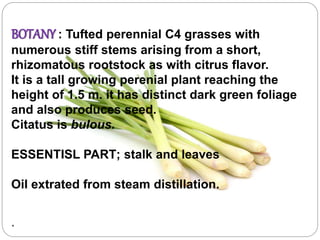
BOTANY : Tufted perennial C4 grasses with
numerous stiff stems arising from a short,
rhizomatous rootstock as with citrus flavor.
It is a tall growing perenial plant reaching the
height of 1.5 m. it has distinct dark green foliage
and also produces seed.
Citatus is bulous.
ESSENTISL PART; stalk and leaves
Oil extrated from steam distillation.
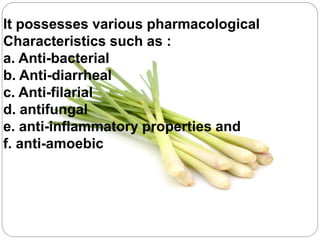
It possesses various pharmacological
Characteristics such as :
a. Anti-bacterial
b. Anti-diarrheal
c. Anti-filarial
d. antifungal
e. anti-inflammatory properties and
f. anti-amoebic
SOIL
TEMPERATUR
E
RAINFALL
Rich loams to poor laterite,
best on sandy loam.
High temperature and
plenty of sunshine
Warm humid; 1800 to
3000 mm; water logged
condition should be
avoided.
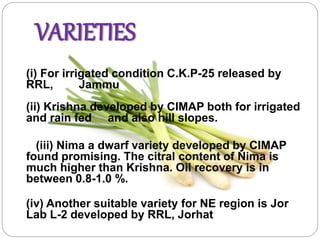
VARIETIES
(i) For irrigated condition C.K.P-25 released by
RRL, Jammu
(ii) Krishna developed by CIMAP both for irrigated
and rain fed and also hill slopes.
(iii) Nima a dwarf variety developed by CIMAP
found promising. The citral content of Nima is
much higher than Krishna. Oil recovery is in
between 0.8-1.0 %.
(iv) Another suitable variety for NE region is Jor
Lab L-2 developed by RRL, Jorhat
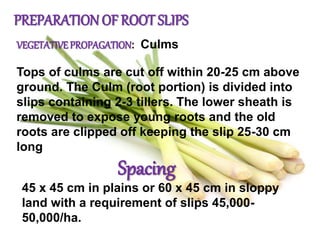
PREPARATION OF ROOT SLIPS
VEGETATIVEPROPAGATION: Culms
Tops of culms are cut off within 20-25 cm above
ground. The Culm (root portion) is divided into
slips containing 2-3 tillers. The lower sheath is
removed to expose young roots and the old
roots are clipped off keeping the slip 25-30 cm
long
Spacing
45 x 45 cm in plains or 60 x 45 cm in sloppy
land with a requirement of slips 45,000-
50,000/ha.
PLANTING
PLANTING TIME : May-June;
For irrigated planting all round the year, except
December-January
PLANTING DEPTH: 5-8 cm, 2 slips/hole-
transplanted.
PLANTING METHOD: Ridges and furrow
Plants get established well within 25-30 days after
planting.
MANURES AND FERTILIZER APPLICATION
 FYM: 10 t/ha ; at the time of final land
preparation.
 N, P205 & K 20-150: 60: 60 kg/ha/year .
 BASAL: Full dose of P and K
 SPLIT DOSES: N-six equal split doses at two
monthly intervals.
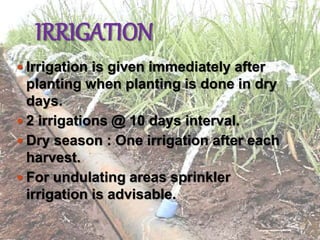
IRRIGATION
 Irrigation is given immediately after
planting when planting is done in dry
days.
 2 irrigations @ 10 days interval.
 Dry season : One irrigation after each
harvest.
 For undulating areas sprinkler
irrigation is advisable.
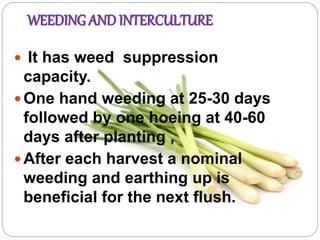
WEEDING AND INTERCULTURE
 It has weed suppression
capacity.
 One hand weeding at 25-30 days
followed by one hoeing at 40-60
days after planting ,
 After each harvest a nominal
weeding and earthing up is
beneficial for the next flush.
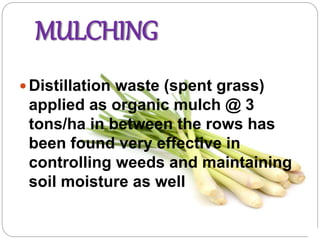
MULCHING
 Distillation waste (spent grass)
applied as organic mulch @ 3
tons/ha in between the rows has
been found very effective in
controlling weeds and maintaining
soil moisture as well
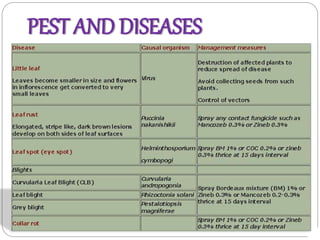
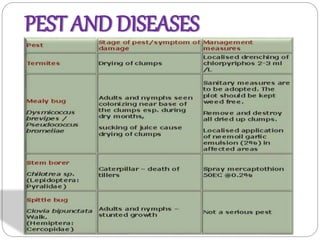
PEST AND DISEASES
PEST AND DISEASES
HARVESTING
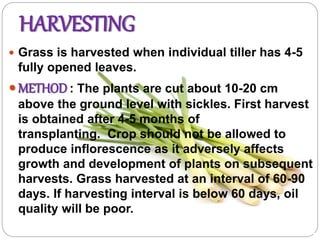
 Grass is harvested when individual tiller has 4-5
fully opened leaves.
 METHOD : The plants are cut about 10-20 cm
above the ground level with sickles. First harvest
is obtained after 4-5 months of
transplanting. Crop should not be allowed to
produce inflorescence as it adversely affects
growth and development of plants on subsequent
harvests. Grass harvested at an interval of 60-90
days. If harvesting interval is below 60 days, oil
quality will be poor.
HARVESTING
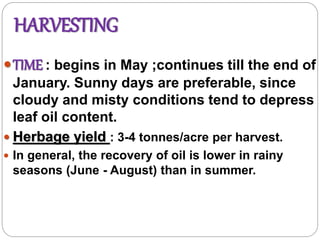
TIME : begins in May ;continues till the end of
January. Sunny days are preferable, since
cloudy and misty conditions tend to depress
leaf oil content.
 Herbage yield : 3-4 tonnes/acre per harvest.
 In general, the recovery of oil is lower in rainy
seasons (June - August) than in summer.
DISTILLATION
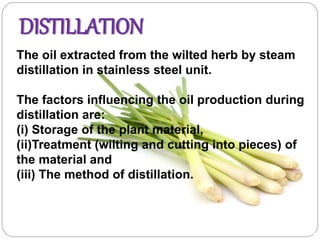
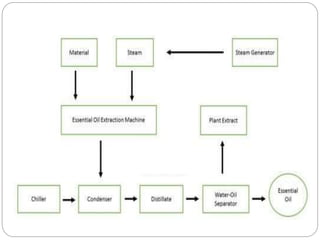
The oil extracted from the wilted herb by steam
distillation in stainless steel unit.
The factors influencing the oil production during
distillation are:
(i) Storage of the plant material,
(ii)Treatment (wilting and cutting into pieces) of
the material and
(iii) The method of distillation.
There are two types of distillation:
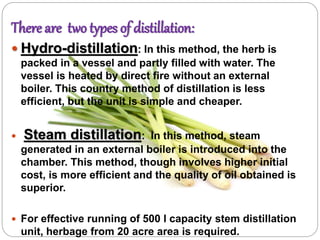
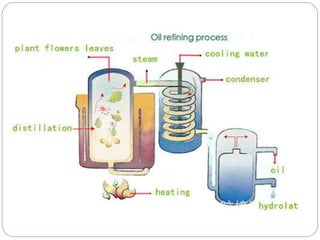
 Hydro-distillation: In this method, the herb is
packed in a vessel and partly filled with water. The
vessel is heated by direct fire without an external
boiler. This country method of distillation is less
efficient, but the unit is simple and cheaper.
 Steam distillation: In this method, steam
generated in an external boiler is introduced into the
chamber. This method, though involves higher initial
cost, is more efficient and the quality of oil obtained is
superior.
 For effective running of 500 l capacity stem distillation
unit, herbage from 20 acre area is required.
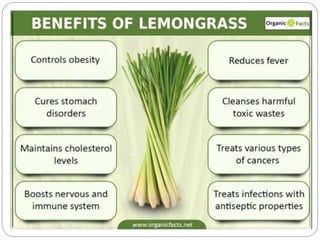
MEDICINAL USES
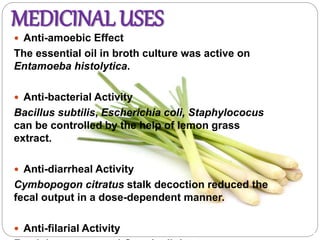
 Anti-amoebic Effect
The essential oil in broth culture was active on
Entamoeba histolytica.
 Anti-bacterial Activity
Bacillus subtilis, Escherichia coli, Staphylococus
can be controlled by the help of lemon grass
extract.
 Anti-diarrheal Activity
Cymbopogon citratus stalk decoction reduced the
fecal output in a dose-dependent manner.
 Anti-filarial Activity
 Anti-fungal Activity
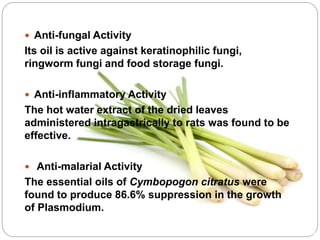
Its oil is active against keratinophilic fungi,
ringworm fungi and food storage fungi.
 Anti-inflammatory Activity
The hot water extract of the dried leaves
administered intragastrically to rats was found to be
effective.
 Anti-malarial Activity
The essential oils of Cymbopogon citratus were
found to produce 86.6% suppression in the growth
of Plasmodium.
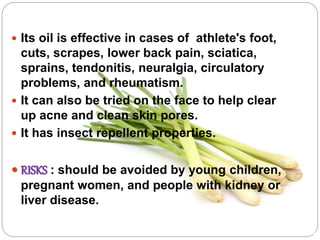
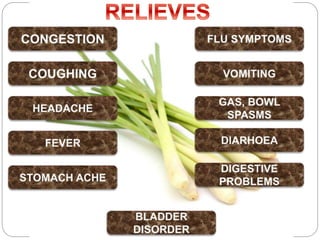
 Its oil is effective in cases of athlete's foot,
cuts, scrapes, lower back pain, sciatica,
sprains, tendonitis, neuralgia, circulatory
problems, and rheumatism.
 It can also be tried on the face to help clear
up acne and clean skin pores.
 It has insect repellent properties.
 RISKS : should be avoided by young children,
pregnant women, and people with kidney or
liver disease.
OPPORTUNITIES
Export
Drug manifacturing
companies
Teaching profession
Pharmacogonist
Cosmetics
Economic development
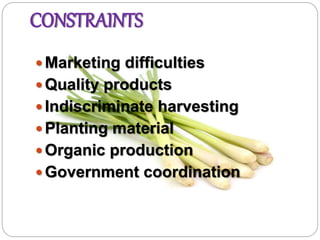
CONSTRAINTS
 Marketing difficulties
 Quality products
 Indiscriminate harvesting
 Planting material
 Organic production
 Government coordination
Lemon grass, Cymbopogan flexousus.

Lemon grass, Cymbopogan flexousus.

  • 1.
  • 2.
    BOTANICAL CLASSIFICATION  Kingdom:Plantae  Division: Magnoliophyta  Class: Liliopsida  Order: Poales o Family: Poaceae • Genus: Cymbopogon Species: flexuous
  • 3.
    INTRODUCTION ORIGIN: Asia, Southand Central America, Africa and other tropical countries. Two species of it are popular, citratus and flexoxus. Cymbopogon is derived from the Greek words “kymbe” (boat) and “pogon” (beard), referring to the flower spike arrangement; Commonly known as “East Indian Lemongrass”
  • 4.
    Basedon colour ofstem: A) C. flexuosus var. flexuosus. Stem and leaf sheath are reddish or purple. Oil content : 0.3 to 0.5%. Citral : 80-86% Oil has good solubility in alcohol and hence is superior in quality. It is recognized as true lemongrass and is commercially cultivated. B) C. flexuosus var. albescens “white grass ” Stem and leaf sheath are white in color Oil content : 0.4 to 0.7%. Citral : 55-70% Oil has poor solubility in alcohol and hence is inferior in quality. It is normally seen wild.
  • 5.
    . BOTANY : Tuftedperennial C4 grasses with numerous stiff stems arising from a short, rhizomatous rootstock as with citrus flavor. It is a tall growing perenial plant reaching the height of 1.5 m. it has distinct dark green foliage and also produces seed. Citatus is bulous. ESSENTISL PART; stalk and leaves Oil extrated from steam distillation.
  • 6.
    It possesses variouspharmacological Characteristics such as : a. Anti-bacterial b. Anti-diarrheal c. Anti-filarial d. antifungal e. anti-inflammatory properties and f. anti-amoebic
  • 7.
    SOIL TEMPERATUR E RAINFALL Rich loams topoor laterite, best on sandy loam. High temperature and plenty of sunshine Warm humid; 1800 to 3000 mm; water logged condition should be avoided.
  • 8.
    VARIETIES (i) For irrigatedcondition C.K.P-25 released by RRL, Jammu (ii) Krishna developed by CIMAP both for irrigated and rain fed and also hill slopes. (iii) Nima a dwarf variety developed by CIMAP found promising. The citral content of Nima is much higher than Krishna. Oil recovery is in between 0.8-1.0 %. (iv) Another suitable variety for NE region is Jor Lab L-2 developed by RRL, Jorhat
  • 10.
    PREPARATION OF ROOTSLIPS VEGETATIVEPROPAGATION: Culms Tops of culms are cut off within 20-25 cm above ground. The Culm (root portion) is divided into slips containing 2-3 tillers. The lower sheath is removed to expose young roots and the old roots are clipped off keeping the slip 25-30 cm long Spacing 45 x 45 cm in plains or 60 x 45 cm in sloppy land with a requirement of slips 45,000- 50,000/ha.
  • 11.
    PLANTING PLANTING TIME :May-June; For irrigated planting all round the year, except December-January PLANTING DEPTH: 5-8 cm, 2 slips/hole- transplanted. PLANTING METHOD: Ridges and furrow Plants get established well within 25-30 days after planting.
  • 12.
    MANURES AND FERTILIZERAPPLICATION  FYM: 10 t/ha ; at the time of final land preparation.  N, P205 & K 20-150: 60: 60 kg/ha/year .  BASAL: Full dose of P and K  SPLIT DOSES: N-six equal split doses at two monthly intervals.
  • 13.
    IRRIGATION  Irrigation isgiven immediately after planting when planting is done in dry days.  2 irrigations @ 10 days interval.  Dry season : One irrigation after each harvest.  For undulating areas sprinkler irrigation is advisable.
  • 14.
    WEEDING AND INTERCULTURE It has weed suppression capacity.  One hand weeding at 25-30 days followed by one hoeing at 40-60 days after planting ,  After each harvest a nominal weeding and earthing up is beneficial for the next flush.
  • 15.
    MULCHING  Distillation waste(spent grass) applied as organic mulch @ 3 tons/ha in between the rows has been found very effective in controlling weeds and maintaining soil moisture as well
  • 16.
  • 17.
  • 18.
    HARVESTING  Grass isharvested when individual tiller has 4-5 fully opened leaves.  METHOD : The plants are cut about 10-20 cm above the ground level with sickles. First harvest is obtained after 4-5 months of transplanting. Crop should not be allowed to produce inflorescence as it adversely affects growth and development of plants on subsequent harvests. Grass harvested at an interval of 60-90 days. If harvesting interval is below 60 days, oil quality will be poor.
  • 19.
    HARVESTING TIME : beginsin May ;continues till the end of January. Sunny days are preferable, since cloudy and misty conditions tend to depress leaf oil content.  Herbage yield : 3-4 tonnes/acre per harvest.  In general, the recovery of oil is lower in rainy seasons (June - August) than in summer.
  • 20.
    DISTILLATION The oil extractedfrom the wilted herb by steam distillation in stainless steel unit. The factors influencing the oil production during distillation are: (i) Storage of the plant material, (ii)Treatment (wilting and cutting into pieces) of the material and (iii) The method of distillation.
  • 21.
    There are twotypes of distillation:  Hydro-distillation: In this method, the herb is packed in a vessel and partly filled with water. The vessel is heated by direct fire without an external boiler. This country method of distillation is less efficient, but the unit is simple and cheaper.  Steam distillation: In this method, steam generated in an external boiler is introduced into the chamber. This method, though involves higher initial cost, is more efficient and the quality of oil obtained is superior.  For effective running of 500 l capacity stem distillation unit, herbage from 20 acre area is required.
  • 24.
    MEDICINAL USES  Anti-amoebicEffect The essential oil in broth culture was active on Entamoeba histolytica.  Anti-bacterial Activity Bacillus subtilis, Escherichia coli, Staphylococus can be controlled by the help of lemon grass extract.  Anti-diarrheal Activity Cymbopogon citratus stalk decoction reduced the fecal output in a dose-dependent manner.  Anti-filarial Activity
  • 25.
     Anti-fungal Activity Itsoil is active against keratinophilic fungi, ringworm fungi and food storage fungi.  Anti-inflammatory Activity The hot water extract of the dried leaves administered intragastrically to rats was found to be effective.  Anti-malarial Activity The essential oils of Cymbopogon citratus were found to produce 86.6% suppression in the growth of Plasmodium.
  • 26.
     Its oilis effective in cases of athlete's foot, cuts, scrapes, lower back pain, sciatica, sprains, tendonitis, neuralgia, circulatory problems, and rheumatism.  It can also be tried on the face to help clear up acne and clean skin pores.  It has insect repellent properties.  RISKS : should be avoided by young children, pregnant women, and people with kidney or liver disease.
  • 29.
  • 30.
    CONSTRAINTS  Marketing difficulties Quality products  Indiscriminate harvesting  Planting material  Organic production  Government coordination