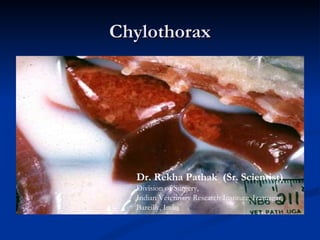
Chylothorax


  Dr. Rekha Pathak (Sr. Scientist)
  Division of Surgery,
  Indian Veterinary Research Institute, Izatnagar,
  Bareilly, India
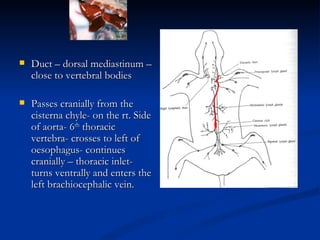
   Duct – dorsal mediastinum –
    close to vertebral bodies

   Passes cranially from the
    cisterna chyle- on the rt. Side
    of aorta- 6th thoracic
    vertebra- crosses to left of
    oesophagus- continues
    cranially – thoracic inlet-
    turns ventrally and enters the
    left brachiocephalic vein.
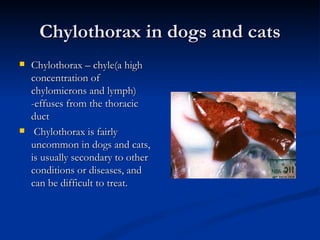
Chylothorax in dogs and cats
   Chylothorax – chyle(a high
    concentration of
    chylomicrons and lymph)
    -effuses from the thoracic
    duct
    Chylothorax is fairly
    uncommon in dogs and cats,
    is usually secondary to other
    conditions or diseases, and
    can be difficult to treat.
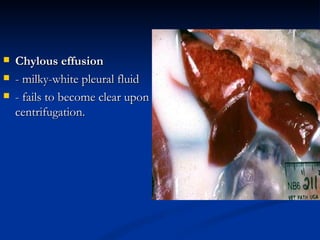
   Chylous effusion
   - milky-white pleural fluid
   - fails to become clear upon
    centrifugation.
   Pseudochylous effusion -
    chronic inflammatory thoracic
    disease.


   Pseudochylous effusions do not
    contain chylomicra, clear upon
    centrifugation,
   Dietary lipids- break to form chylomicrons –
    finally absorbed by lymphatics (chyle)- carried to
    different body parts.
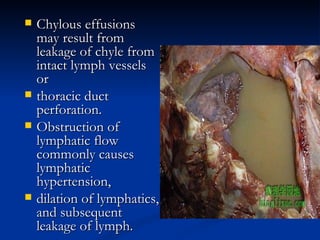
   Chylous effusions
    may result from
    leakage of chyle from
    intact lymph vessels
    or
   thoracic duct
    perforation.
   Obstruction of
    lymphatic flow
    commonly causes
    lymphatic
    hypertension,
   dilation of lymphatics,
    and subsequent
    leakage of lymph.
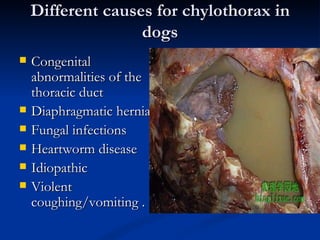
Different causes for chylothorax in
                   dogs
   Congenital
    abnormalities of the
    thoracic duct
   Diaphragmatic hernia
   Fungal infections
   Heartworm disease
   Idiopathic
   Violent
    coughing/vomiting .
   Lung lobe torsion
   Lymphangiectasia
   Neoplasia
   Trauma and rupture
    of thoracic duct
   Venous thrombi
   Mediastinal neoplasia
    Incidence:
    No gender predisposition
    Age does seem to be a factor,
4.   trauma-related,
5.   idiopathic, and
6.   congenital causes of chylothorax tend to
     occur in younger dogs.
    Chylothorax associated with neoplasia
     and heart disease tend to occur in older
     animals.
 A breed predisposition
 purebred cats,

 Afghan Hounds, and

 Mastiffs
Diagnosis
   Diagnosis is made based on


   Physical examination,
   Clinical signs,
   Thoracic radiographs, and
   Pleural fluid analysis.
Diagnosis
1.   clinical signs,

    dyspnea and coughing.
    weight loss,
    anorexia, lethargy
 regurgitation,
 vomiting,

 exercise intolerance, and salivation.
  Abnormal physical findings most
  commonly include dyspnea, muffled
  heart sounds,
Diagnosis

   Physical examination,
   Bronchovesicular sounds, and tachycardia.

   Thoracic radiographs
   Radiographs typically reveal pleural effusion
    which may be unilateral or bilateral,
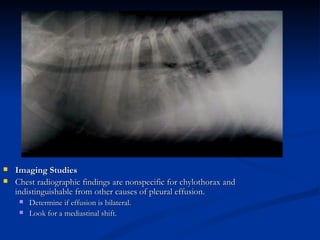
   Imaging Studies
   Chest radiographic findings are nonspecific for chylothorax and
    indistinguishable from other causes of pleural effusion.
        Determine if effusion is bilateral.
        Look for a mediastinal shift.
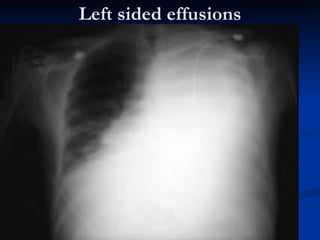
Left sided effusions
   . Ultrasonography and echocardiography
    may be useful in identifying an underlying
    cause of the effusion, such as
    cardiomyopathy or mediastinal neoplasia.
Lab diagnosis


   The complete blood count

   mature neutrophilia due to inflammation
   lymphopenia from the loss of lymphocytes into
    the fluid.
   The serum chemistry profile

 Hypoalbuminemia,- protein loss in the
  fluid
 Hyponatremia- electrolyte loss in fluid
 Hyperkalemia. Hyperkalemia may be due
  to hypovolemia and/or renal secretion
  defects of potassium.
   Pleural fluid analysis
    is required for the
    diagnosis of
    chylothorax. Grossly,
    chylous effusion is
    milky white or pink,
    depending on the
    degree of hemorrhage
    associated with the
    effusion
   Chylous effusions
    should not clot or
    have an odor, and
    should be free of
    particulate
    matter.
   Collecting the
    fluid into an
    EDTA tube
    allows for cell
    counts on the
    sample.
   A culture and sensitivity

   The effusion should form a cream layer

   Upon centrifugation, the sample should become
    white following centrifugation if red blood cells
    are present (although the presence of hemolyzed
    erythrocytes will result in a fluid that remains red
    or pink following centrifugation), and should
    remain opaque.
Cytologic and Chemical Characteristics

   Laboratory analyses that may be performed on the fluid
    include determination of
   specific gravity,
   TP
   TLC,DLC
   cholesterol and triglyceride concentrations
   ratio of cholesterol to triglyceride.
   Predominance of small
    lymphocytes - considered
    characteristic of chylous
    effusion;
   However, increase in
    neutrophils and macrophages
    may be associated with
    chronicity.(chyle is irritant to
    pleura)
   Pseudochylothorax
     Chylothorax must be distinguished from
      pseudochylothorax, or cholesterol pleurisy,
      which results from accumulation of
      cholesterol crystals in a chronic existing
      effusion.
     The most common cause of
      pseudochylothorax is chronic pneumonia,
      pleuritis and lymphosarcoma
Serum/chylous/pseudochylous

   . Chylous effusions
   Less cholesterol more triglycerides than serum
    C:T= <1
   Fluid: serum triglycerides = >3:1,
   Usually encountered 10-20:1

   Pseudochylous – more cholesterol and
    triglycerides less or equal to serum
   An ether clearance test
   take effusion in 2 tubes+ 10% KOH
   First tube+equal water (control)
   Second tube+equal ether
   Invert- chylomicrons dissolve completely in ether
   The first tube should appear diluted, but second
    tube should become clear. This test is not
    routinely performed.
Treatment and Prognosis

   depends on the underlying cause

   Medical therapy:

   Thoracocentesis-needle/ chest tube drainage

   Dietary management- low fat diet-to decrease
    lipids in intestinal absorption
   Drug therapy

   loss of fat-soluble vitamins, lipids, and protein-
    rich lymph fluid may contribute to a state of
    malnourishment in the animal.
    Parenteral nutrition can bypass the
    gastrointestinal system and decrease lymphatic
    flow.
Surgical management

   Not v. successful
   ligation of the thoracic duct-feed fat/oil prior-
    canulate superficial lymphatic in hindlimb- inject
    dye- locate the duct and point of rupture
   1% Evans blue dye can either be injected
    into the web space of the toes for uptake
    into the lymphatic space to increase
    visualization.
 9th i.c.(right) space-an open right
  thoracotomy or through a thoracoscope.
 locate duct- ligate cranial and caudal to
  rupture
 Collaterals build
 Place the chest tube and close
 pleuroperitoneal or pleurovenous shunts.
   Positive contrast mesenteric lymphangiography
    is useful to determine lymphatic anatomy and
    post-ligation success.
    Pleuroperitoneal or pleurovenous shunts may
    be beneficial, but are associated with
    complications such as infection, adhesions, and
    clogging of the implants
Poor prognosis

   Regardless of the cause, chylothorax has been
    associated with poor survival rates in dogs and
    cats.
    A common sequela to chylothorax is restrictive
    pleuritis, resulting in an inability to expand the
    lungs.

Chylothorax

  • 1.
    Chylothorax Dr.Rekha Pathak (Sr. Scientist) Division of Surgery, Indian Veterinary Research Institute, Izatnagar, Bareilly, India
  • 2.
    Duct – dorsal mediastinum – close to vertebral bodies  Passes cranially from the cisterna chyle- on the rt. Side of aorta- 6th thoracic vertebra- crosses to left of oesophagus- continues cranially – thoracic inlet- turns ventrally and enters the left brachiocephalic vein.
  • 4.
    Chylothorax in dogsand cats  Chylothorax – chyle(a high concentration of chylomicrons and lymph) -effuses from the thoracic duct  Chylothorax is fairly uncommon in dogs and cats, is usually secondary to other conditions or diseases, and can be difficult to treat.
  • 5.
    Chylous effusion  - milky-white pleural fluid  - fails to become clear upon centrifugation.
  • 6.
    Pseudochylous effusion - chronic inflammatory thoracic disease.  Pseudochylous effusions do not contain chylomicra, clear upon centrifugation,
  • 7.
    Dietary lipids- break to form chylomicrons – finally absorbed by lymphatics (chyle)- carried to different body parts.
  • 8.
    Chylous effusions may result from leakage of chyle from intact lymph vessels or  thoracic duct perforation.  Obstruction of lymphatic flow commonly causes lymphatic hypertension,  dilation of lymphatics, and subsequent leakage of lymph.
  • 9.
    Different causes forchylothorax in dogs  Congenital abnormalities of the thoracic duct  Diaphragmatic hernia  Fungal infections  Heartworm disease  Idiopathic  Violent coughing/vomiting .
  • 10.
    Lung lobe torsion  Lymphangiectasia  Neoplasia  Trauma and rupture of thoracic duct  Venous thrombi  Mediastinal neoplasia
  • 11.
    Incidence:  No gender predisposition  Age does seem to be a factor, 4. trauma-related, 5. idiopathic, and 6. congenital causes of chylothorax tend to occur in younger dogs.  Chylothorax associated with neoplasia and heart disease tend to occur in older animals.
  • 12.
     A breedpredisposition  purebred cats,  Afghan Hounds, and  Mastiffs
  • 13.
    Diagnosis  Diagnosis is made based on  Physical examination,  Clinical signs,  Thoracic radiographs, and  Pleural fluid analysis.
  • 14.
    Diagnosis 1. clinical signs,  dyspnea and coughing.  weight loss,  anorexia, lethargy
  • 15.
     regurgitation,  vomiting, exercise intolerance, and salivation. Abnormal physical findings most commonly include dyspnea, muffled heart sounds,
  • 16.
    Diagnosis  Physical examination,  Bronchovesicular sounds, and tachycardia.  Thoracic radiographs  Radiographs typically reveal pleural effusion which may be unilateral or bilateral,
  • 17.
    Imaging Studies  Chest radiographic findings are nonspecific for chylothorax and indistinguishable from other causes of pleural effusion.  Determine if effusion is bilateral.  Look for a mediastinal shift.
  • 18.
  • 19.
    . Ultrasonography and echocardiography may be useful in identifying an underlying cause of the effusion, such as cardiomyopathy or mediastinal neoplasia.
  • 20.
    Lab diagnosis  The complete blood count  mature neutrophilia due to inflammation  lymphopenia from the loss of lymphocytes into the fluid.
  • 21.
    The serum chemistry profile  Hypoalbuminemia,- protein loss in the fluid  Hyponatremia- electrolyte loss in fluid  Hyperkalemia. Hyperkalemia may be due to hypovolemia and/or renal secretion defects of potassium.
  • 22.
    Pleural fluid analysis is required for the diagnosis of chylothorax. Grossly, chylous effusion is milky white or pink, depending on the degree of hemorrhage associated with the effusion
  • 23.
    Chylous effusions should not clot or have an odor, and should be free of particulate matter.
  • 24.
    Collecting the fluid into an EDTA tube allows for cell counts on the sample.
  • 25.
    A culture and sensitivity  The effusion should form a cream layer  Upon centrifugation, the sample should become white following centrifugation if red blood cells are present (although the presence of hemolyzed erythrocytes will result in a fluid that remains red or pink following centrifugation), and should remain opaque.
  • 26.
    Cytologic and ChemicalCharacteristics  Laboratory analyses that may be performed on the fluid include determination of  specific gravity,  TP  TLC,DLC  cholesterol and triglyceride concentrations  ratio of cholesterol to triglyceride.
  • 27.
    Predominance of small lymphocytes - considered characteristic of chylous effusion;  However, increase in neutrophils and macrophages may be associated with chronicity.(chyle is irritant to pleura)
  • 28.
    Pseudochylothorax  Chylothorax must be distinguished from pseudochylothorax, or cholesterol pleurisy, which results from accumulation of cholesterol crystals in a chronic existing effusion.  The most common cause of pseudochylothorax is chronic pneumonia, pleuritis and lymphosarcoma
  • 29.
    Serum/chylous/pseudochylous  . Chylous effusions  Less cholesterol more triglycerides than serum C:T= <1  Fluid: serum triglycerides = >3:1,  Usually encountered 10-20:1  Pseudochylous – more cholesterol and triglycerides less or equal to serum
  • 30.
    An ether clearance test  take effusion in 2 tubes+ 10% KOH  First tube+equal water (control)  Second tube+equal ether  Invert- chylomicrons dissolve completely in ether  The first tube should appear diluted, but second tube should become clear. This test is not routinely performed.
  • 31.
    Treatment and Prognosis  depends on the underlying cause  Medical therapy:  Thoracocentesis-needle/ chest tube drainage  Dietary management- low fat diet-to decrease lipids in intestinal absorption
  • 32.
    Drug therapy  loss of fat-soluble vitamins, lipids, and protein- rich lymph fluid may contribute to a state of malnourishment in the animal.  Parenteral nutrition can bypass the gastrointestinal system and decrease lymphatic flow.
  • 33.
    Surgical management  Not v. successful  ligation of the thoracic duct-feed fat/oil prior- canulate superficial lymphatic in hindlimb- inject dye- locate the duct and point of rupture
  • 34.
    1% Evans blue dye can either be injected into the web space of the toes for uptake into the lymphatic space to increase visualization.
  • 35.
     9th i.c.(right)space-an open right thoracotomy or through a thoracoscope.  locate duct- ligate cranial and caudal to rupture  Collaterals build  Place the chest tube and close  pleuroperitoneal or pleurovenous shunts.
  • 36.
    Positive contrast mesenteric lymphangiography is useful to determine lymphatic anatomy and post-ligation success.  Pleuroperitoneal or pleurovenous shunts may be beneficial, but are associated with complications such as infection, adhesions, and clogging of the implants
  • 37.
    Poor prognosis  Regardless of the cause, chylothorax has been associated with poor survival rates in dogs and cats.  A common sequela to chylothorax is restrictive pleuritis, resulting in an inability to expand the lungs.