Sutures, Suture materials and
suturing patterns
Prepared by
Ganga Prasad Yadav
MVSc
(Vety. Surgery and radiology)
Sutures
A suture is a thread used for uniting wound edges.
Suture material is used for a number of purposes during surgery:
 Closure of tissues.
 Ligation of blood vessels.
 Anchoring of drains and tubes.
 Atraumatic tissue manipulation with stay sutures.
Selection criteria for suture: type of suture material and
suture pattern depends on
1. Physical and biological properties of sutures
2. Condition of wound
3. Healing characters of tissues
4. Tensile strength of the tissue
Suture holding power of tissues
Depends on kind of tissue, its density,
direction in which sutures are applied and
distance between sutures.
Among soft tissues, skin and fascia have
maximum suture holding power while fat has
minimum.
Distance between sutures:
a. For large animals: 1.5 cm;
b. For small animal: 0.75 cm
Properties/qualities of suture materials
1. Tensile strength: the ability of a suture material to withstand
breakage on stretching it.
2. Functional strength: the strength that it maintains in tissues when
used as a suture.
3. Non-capillarity
4. Non-reactivity
5. Should be tolerated by tissues.
6. Flexibility and elasticity
7. Easy to handle
8. Knotable
9. Uniformity
10.Absorbality
11.Smooth surface
12.Economical and readily available
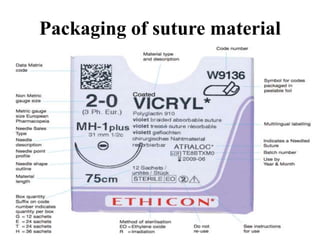
Packaging of suture material
Types of Suture Materials
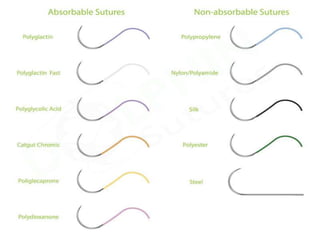
• Nonabsorbable Sutures- Nonabsorbable sutures are not dissolved by
the body and therefore must be removed. They are less scarring than
absorbable sutures if removed in a timely manner and are primarily
suited for use on the skin. Examples: Nylon (Ethilon) and
Polypropylene (Prolene).
• Absorbable Sutures- Absorbable tissues are dissolved by the body's
tissues and therefore do not need to be removed. They are best suited
for use under the skin as they produce a pronounced scar if used
externally. They can also be used if there is concern a patient may not
return for suture removal. Examples: Polyglecaprone (Monocryl),
Polyglactin-910 (Vicryl), Polyglycolic acid (Dexon), Gut and Chronic
Gut.
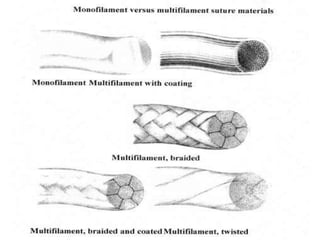
• Braided Sutures- Braided sutures are comprised of several small
strands twisted together. They can be easier to tie than nonbraided
sutures however the tiny gaps between suture strands can harbor
bacteria increasing risk of infection.
• Nonbraided Sutures- Nonbraided sutures, also known as
monofilament, are made of single strand. These types of sutures are
typically used in skin closure and in wounds where there is risk of
infection.
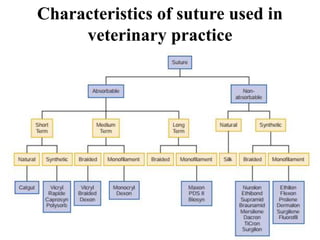
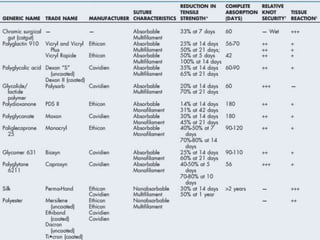
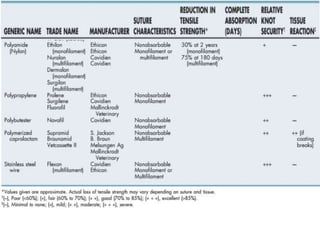
Characteristics of suture used in
veterinary practice
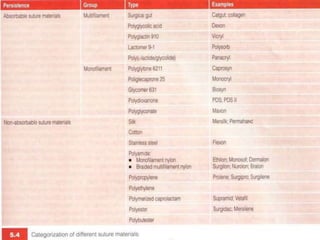
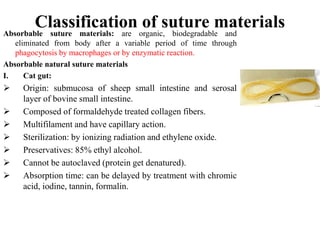
Classification of suture materialsAbsorbable suture materials: are organic, biodegradable and
eliminated from body after a variable period of time through
phagocytosis by macrophages or by enzymatic reaction.
Absorbable natural suture materials
I. Cat gut:
 Origin: submucosa of sheep small intestine and serosal
layer of bovine small intestine.
 Composed of formaldehyde treated collagen fibers.
 Multifilament and have capillary action.
 Sterilization: by ionizing radiation and ethylene oxide.
 Preservatives: 85% ethyl alcohol.
 Cannot be autoclaved (protein get denatured).
 Absorption time: can be delayed by treatment with chromic
acid, iodine, tannin, formalin.
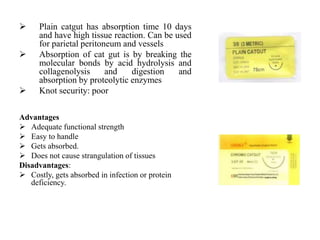
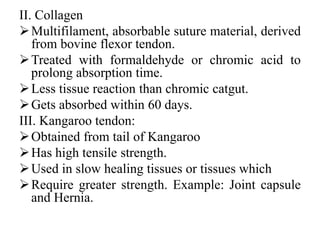
 Plain catgut has absorption time 10 days
and have high tissue reaction. Can be used
for parietal peritoneum and vessels
 Absorption of cat gut is by breaking the
molecular bonds by acid hydrolysis and
collagenolysis and digestion and
absorption by proteolytic enzymes
 Knot security: poor
Advantages
 Adequate functional strength
 Easy to handle
 Gets absorbed.
 Does not cause strangulation of tissues
Disadvantages:
 Costly, gets absorbed in infection or protein
deficiency.
II. Collagen
Multifilament, absorbable suture material, derived
from bovine flexor tendon.
Treated with formaldehyde or chromic acid to
prolong absorption time.
Less tissue reaction than chromic catgut.
Gets absorbed within 60 days.
III. Kangaroo tendon:
Obtained from tail of Kangaroo
Has high tensile strength.
Used in slow healing tissues or tissues which
Require greater strength. Example: Joint capsule
and Hernia.
IV. Fascia lata: Obtained from bovine fascia lata.
V. Cargile membrane: Obtained from bovine
caecum.
VI. Amniotic membrane: Obtained from
amniotic membrane of fetus and is used to
repair gap in body tissues.
Absorbable synthetic suture materials
1. Polyglycolic acid (Dexon): synthetic, non-
collagenous, braided, multifilament polymer of
glycolic acid. Have less tissue reaction. Absorption by
hydrolysis.
2. Polyglactin 910 (Vicryl): Braided, synthetic,
multifilament material composed of glycolic and lactic
acid in a ratio of 9:1. Absorption by hydrolysis.
Excellent strength, easy to handle, stable in
contaminated wounds and have minimum tissue
reaction.
Vicryl Rapide: polyglactin 910 that loses its tensile
streng more rapid. It has approximately 2/3rd of tensile
strength of polyglactin 910 and losses all tensile
strength at 10-14 days.
3. Polydioxanone (PDS II):
Synthetic, monofilament
More flexible than PGA and Polyglactin.
Sterilized by ethylene oxide.
Absorbed by hydrolysis.
Minimum tissue reaction and good knot
security.
4. Polyglyconate: synthetic, monofilament,
copolymer of glycolic acid and trimethylene
carbonate. Its properties are similar to
polydioxanone.
Non-absorbable suture materials
• Resists biodegradation and maintain tensile strength for much
longer time, get encapsulated with fibrous tissue (when used
inside body).
Organic or Natural:
1. Silk: natural fibre obtained from cocoon of the silkworm.
 Available as a twisted or braided, multifilament suture
material and may be coated with beeswax or silicone to
reduce tissue drag and capillarity. Although classified as non-
absorbable, absorbed by proteolysis and often undetectable in
wound by 2 years.
 Advantages: cheap, readily available, autoclavable, have high
knot security.
 Disadvantages: high tissue reaction (bind with γ-globulin to
induce inflammation); in contaminated wound, increases
bacterial proliferation by holding blood.
2. Cotton: less irritating, stable to sterilization
and has high knot security.
Has high capillary reaction.
3. Umbilical tape: ¼ cm wide cotton tape
sutures, used to tie umbilical cord of young
one, vulvar sutures (vagina/uterus prolapses)
and abdominal hernias.
4. Linen: braided material obtained from
vegetable fibres. Good knot security but poor
handling characteristics.
Synthetic non-absorbable sutures
1. Nylon (Polyamide): mono or multifilament,
synthesized from polymerization of
hexamethylenediamine and adipic acid.
 Advantages: Inert, minimum tissue reaction, cheap.
 Disadvantages: cut sharp ends, can cause trauma if
used in serosa; poor knot security.
2. Vetafil (polymerized caprolactum): twisted,
multifilament, polyamide suture of nylon
family and has high tensile strength.
3. Polyester: braided, multifilament; plain or
coated with Teflon, silicon or
polybutylate.
4. Polypropylene (surgilene): multifilament,
polymer of propylene.
5. Polypropylene (prolene/surgilene):
synthetic monofilament composed of
polymerized propylene and sterilized by
ethylene oxide and maintains tensile
strength for upto 2 years.
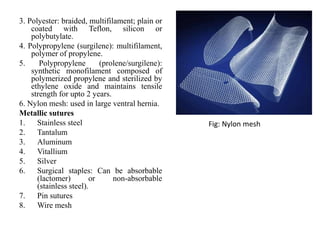
6. Nylon mesh: used in large ventral hernia.
Metallic sutures
1. Stainless steel
2. Tantalum
3. Aluminum
4. Vitallium
5. Silver
6. Surgical staples: Can be absorbable
(lactomer) or non-absorbable
(stainless steel).
7. Pin sutures
8. Wire mesh
Fig: Nylon mesh
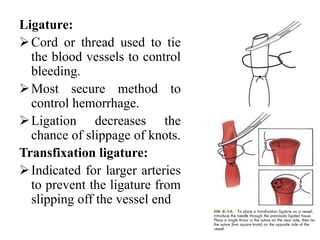
Ligature:
Cord or thread used to tie
the blood vessels to control
bleeding.
Most secure method to
control hemorrhage.
Ligation decreases the
chance of slippage of knots.
Transfixation ligature:
Indicated for larger arteries
to prevent the ligature from
slipping off the vessel end
Suturing Techniques
Basic principles for suturing
1. All sutures should be approximated well with least
trauma.
2. Tissues should be handled gently.
3. As far as possible small size suture material and
needle should be used.
4. Stitches should be placed a li ttle away from incision
edges without including large tissue mass.
5. Tight placed sutures are prone to high tension and
ischemia.
6. Proper obliteration of the dead spaces should be
ensured.
7. Knots should be simple, secure and placed on one side
of the incision to avoid interference in healing.
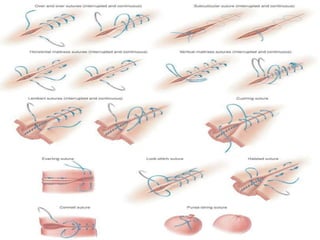
Suture patterns
• Broadly classified into interrupted and continuous
suture patterns.
• These are further classified into six categories:
1. Apposition sutures
2. Inversion sutures
3. Eversion sutures
4. Purse-string sutures
5. Relaxation/Tension sutures
6. Miscellaneous sutures
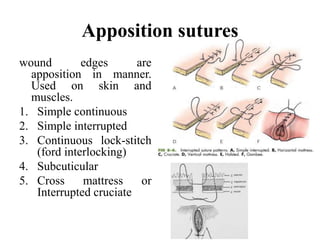
Apposition sutures
wound edges are
apposition in manner.
Used on skin and
muscles.
1. Simple continuous
2. Simple interrupted
3. Continuous lock-stitch
(ford interlocking)
4. Subcuticular
5. Cross mattress or
Interrupted cruciate
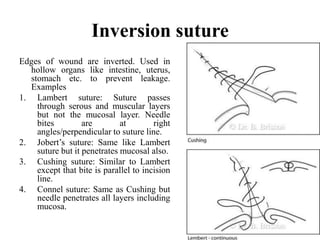
Inversion suture
Edges of wound are inverted. Used in
hollow organs like intestine, uterus,
stomach etc. to prevent leakage.
Examples
1. Lambert suture: Suture passes
through serous and muscular layers
but not the mucosal layer. Needle
bites are at right
angles/perpendicular to suture line.
2. Jobert’s suture: Same like Lambert
suture but it penetrates mucosal also.
3. Cushing suture: Similar to Lambert
except that bite is parallel to incision
line.
4. Connel suture: Same as Cushing but
needle penetrates all layers including
mucosa.
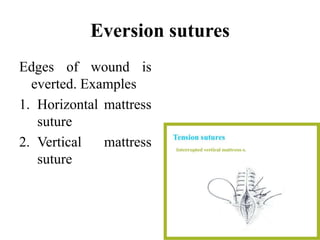
Eversion sutures
Edges of wound is
everted. Examples
1. Horizontal mattress
suture
2. Vertical mattress
suture
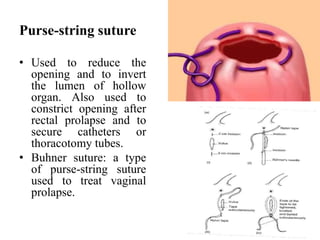
Purse-string suture
• Used to reduce the
opening and to invert
the lumen of hollow
organ. Also used to
constrict opening after
rectal prolapse and to
secure catheters or
thoracotomy tubes.
• Buhner suture: a type
of purse-string suture
used to treat vaginal
prolapse.
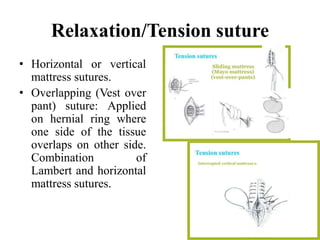
Relaxation/Tension suture
• Horizontal or vertical
mattress sutures.
• Overlapping (Vest over
pant) suture: Applied
on hernial ring where
one side of the tissue
overlaps on other side.
Combination of
Lambert and horizontal
mattress sutures.
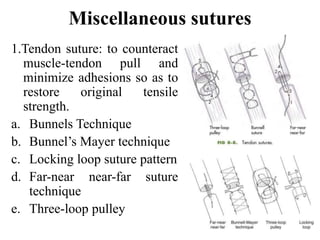
Miscellaneous sutures
1.Tendon suture: to counteract
muscle-tendon pull and
minimize adhesions so as to
restore original tensile
strength.
a. Bunnels Technique
b. Bunnel’s Mayer technique
c. Locking loop suture pattern
d. Far-near near-far suture
technique
e. Three-loop pulley
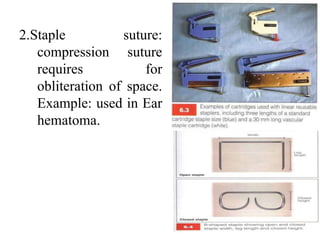
2.Staple suture:
compression suture
requires for
obliteration of space.
Example: used in Ear
hematoma.
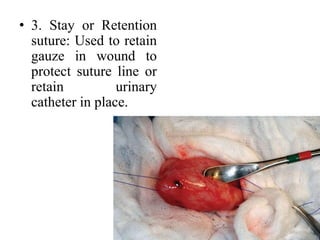
• 3. Stay or Retention
suture: Used to retain
gauze in wound to
protect suture line or
retain urinary
catheter in place.
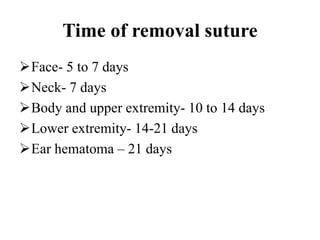
Time of removal suture
Face- 5 to 7 days
Neck- 7 days
Body and upper extremity- 10 to 14 days
Lower extremity- 14-21 days
Ear hematoma – 21 days
Suture needles
Ideal suture needle should be:
• Of high quality stainless steel
• Of the smallest diameter possible
• Stable in the grasp of needle holder
• Capable of allowing passage of suture material with
minimal trauma
• Sharp enough to pass through tissue with minimal
resistance
• Sterile
• Resistant to corrosion
• Strong enough to resist deformation during normal
working conditions
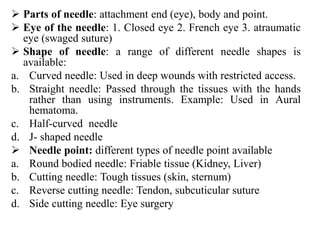
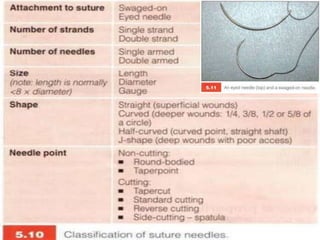
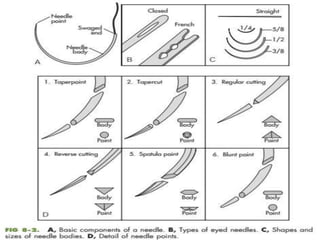
 Parts of needle: attachment end (eye), body and point.
 Eye of the needle: 1. Closed eye 2. French eye 3. atraumatic
eye (swaged suture)
 Shape of needle: a range of different needle shapes is
available:
a. Curved needle: Used in deep wounds with restricted access.
b. Straight needle: Passed through the tissues with the hands
rather than using instruments. Example: Used in Aural
hematoma.
c. Half-curved needle
d. J- shaped needle
 Needle point: different types of needle point available
a. Round bodied needle: Friable tissue (Kidney, Liver)
b. Cutting needle: Tough tissues (skin, sternum)
c. Reverse cutting needle: Tendon, subcuticular suture
d. Side cutting needle: Eye surgery
Surgical knots
• Surgical knots are the knots used to
bind suture materials together while
binding tissue in surgery.
Types of surgical knots:
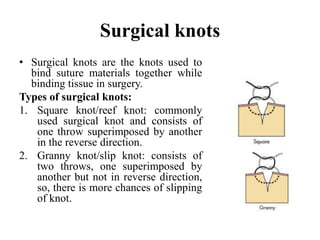
1. Square knot/reef knot: commonly
used surgical knot and consists of
one throw superimposed by another
in the reverse direction.
2. Granny knot/slip knot: consists of
two throws, one superimposed by
another but not in reverse direction,
so, there is more chances of slipping
of knot.
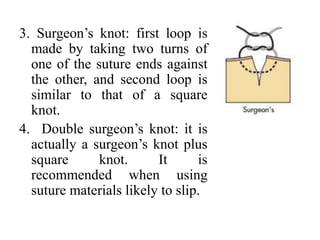
3. Surgeon’s knot: first loop is
made by taking two turns of
one of the suture ends against
the other, and second loop is
similar to that of a square
knot.
4. Double surgeon’s knot: it is
actually a surgeon’s knot plus
square knot. It is
recommended when using
suture materials likely to slip.

Sutures, sutures materials and suturing patterns

  • 1.
    Sutures, Suture materialsand suturing patterns Prepared by Ganga Prasad Yadav MVSc (Vety. Surgery and radiology)
  • 2.
    Sutures A suture isa thread used for uniting wound edges. Suture material is used for a number of purposes during surgery:  Closure of tissues.  Ligation of blood vessels.  Anchoring of drains and tubes.  Atraumatic tissue manipulation with stay sutures. Selection criteria for suture: type of suture material and suture pattern depends on 1. Physical and biological properties of sutures 2. Condition of wound 3. Healing characters of tissues 4. Tensile strength of the tissue
  • 3.
    Suture holding powerof tissues Depends on kind of tissue, its density, direction in which sutures are applied and distance between sutures. Among soft tissues, skin and fascia have maximum suture holding power while fat has minimum. Distance between sutures: a. For large animals: 1.5 cm; b. For small animal: 0.75 cm
  • 4.
    Properties/qualities of suturematerials 1. Tensile strength: the ability of a suture material to withstand breakage on stretching it. 2. Functional strength: the strength that it maintains in tissues when used as a suture. 3. Non-capillarity 4. Non-reactivity 5. Should be tolerated by tissues. 6. Flexibility and elasticity 7. Easy to handle 8. Knotable 9. Uniformity 10.Absorbality 11.Smooth surface 12.Economical and readily available
  • 5.
  • 8.
    Types of SutureMaterials • Nonabsorbable Sutures- Nonabsorbable sutures are not dissolved by the body and therefore must be removed. They are less scarring than absorbable sutures if removed in a timely manner and are primarily suited for use on the skin. Examples: Nylon (Ethilon) and Polypropylene (Prolene). • Absorbable Sutures- Absorbable tissues are dissolved by the body's tissues and therefore do not need to be removed. They are best suited for use under the skin as they produce a pronounced scar if used externally. They can also be used if there is concern a patient may not return for suture removal. Examples: Polyglecaprone (Monocryl), Polyglactin-910 (Vicryl), Polyglycolic acid (Dexon), Gut and Chronic Gut. • Braided Sutures- Braided sutures are comprised of several small strands twisted together. They can be easier to tie than nonbraided sutures however the tiny gaps between suture strands can harbor bacteria increasing risk of infection. • Nonbraided Sutures- Nonbraided sutures, also known as monofilament, are made of single strand. These types of sutures are typically used in skin closure and in wounds where there is risk of infection.
  • 11.
    Characteristics of sutureused in veterinary practice
  • 15.
    Classification of suturematerialsAbsorbable suture materials: are organic, biodegradable and eliminated from body after a variable period of time through phagocytosis by macrophages or by enzymatic reaction. Absorbable natural suture materials I. Cat gut:  Origin: submucosa of sheep small intestine and serosal layer of bovine small intestine.  Composed of formaldehyde treated collagen fibers.  Multifilament and have capillary action.  Sterilization: by ionizing radiation and ethylene oxide.  Preservatives: 85% ethyl alcohol.  Cannot be autoclaved (protein get denatured).  Absorption time: can be delayed by treatment with chromic acid, iodine, tannin, formalin.
  • 16.
     Plain catguthas absorption time 10 days and have high tissue reaction. Can be used for parietal peritoneum and vessels  Absorption of cat gut is by breaking the molecular bonds by acid hydrolysis and collagenolysis and digestion and absorption by proteolytic enzymes  Knot security: poor Advantages  Adequate functional strength  Easy to handle  Gets absorbed.  Does not cause strangulation of tissues Disadvantages:  Costly, gets absorbed in infection or protein deficiency.
  • 17.
    II. Collagen Multifilament, absorbablesuture material, derived from bovine flexor tendon. Treated with formaldehyde or chromic acid to prolong absorption time. Less tissue reaction than chromic catgut. Gets absorbed within 60 days. III. Kangaroo tendon: Obtained from tail of Kangaroo Has high tensile strength. Used in slow healing tissues or tissues which Require greater strength. Example: Joint capsule and Hernia.
  • 18.
    IV. Fascia lata:Obtained from bovine fascia lata. V. Cargile membrane: Obtained from bovine caecum. VI. Amniotic membrane: Obtained from amniotic membrane of fetus and is used to repair gap in body tissues.
  • 19.
    Absorbable synthetic suturematerials 1. Polyglycolic acid (Dexon): synthetic, non- collagenous, braided, multifilament polymer of glycolic acid. Have less tissue reaction. Absorption by hydrolysis. 2. Polyglactin 910 (Vicryl): Braided, synthetic, multifilament material composed of glycolic and lactic acid in a ratio of 9:1. Absorption by hydrolysis. Excellent strength, easy to handle, stable in contaminated wounds and have minimum tissue reaction. Vicryl Rapide: polyglactin 910 that loses its tensile streng more rapid. It has approximately 2/3rd of tensile strength of polyglactin 910 and losses all tensile strength at 10-14 days.
  • 20.
    3. Polydioxanone (PDSII): Synthetic, monofilament More flexible than PGA and Polyglactin. Sterilized by ethylene oxide. Absorbed by hydrolysis. Minimum tissue reaction and good knot security. 4. Polyglyconate: synthetic, monofilament, copolymer of glycolic acid and trimethylene carbonate. Its properties are similar to polydioxanone.
  • 21.
    Non-absorbable suture materials •Resists biodegradation and maintain tensile strength for much longer time, get encapsulated with fibrous tissue (when used inside body). Organic or Natural: 1. Silk: natural fibre obtained from cocoon of the silkworm.  Available as a twisted or braided, multifilament suture material and may be coated with beeswax or silicone to reduce tissue drag and capillarity. Although classified as non- absorbable, absorbed by proteolysis and often undetectable in wound by 2 years.  Advantages: cheap, readily available, autoclavable, have high knot security.  Disadvantages: high tissue reaction (bind with γ-globulin to induce inflammation); in contaminated wound, increases bacterial proliferation by holding blood.
  • 22.
    2. Cotton: lessirritating, stable to sterilization and has high knot security. Has high capillary reaction. 3. Umbilical tape: ¼ cm wide cotton tape sutures, used to tie umbilical cord of young one, vulvar sutures (vagina/uterus prolapses) and abdominal hernias. 4. Linen: braided material obtained from vegetable fibres. Good knot security but poor handling characteristics.
  • 23.
    Synthetic non-absorbable sutures 1.Nylon (Polyamide): mono or multifilament, synthesized from polymerization of hexamethylenediamine and adipic acid.  Advantages: Inert, minimum tissue reaction, cheap.  Disadvantages: cut sharp ends, can cause trauma if used in serosa; poor knot security. 2. Vetafil (polymerized caprolactum): twisted, multifilament, polyamide suture of nylon family and has high tensile strength.
  • 24.
    3. Polyester: braided,multifilament; plain or coated with Teflon, silicon or polybutylate. 4. Polypropylene (surgilene): multifilament, polymer of propylene. 5. Polypropylene (prolene/surgilene): synthetic monofilament composed of polymerized propylene and sterilized by ethylene oxide and maintains tensile strength for upto 2 years. 6. Nylon mesh: used in large ventral hernia. Metallic sutures 1. Stainless steel 2. Tantalum 3. Aluminum 4. Vitallium 5. Silver 6. Surgical staples: Can be absorbable (lactomer) or non-absorbable (stainless steel). 7. Pin sutures 8. Wire mesh Fig: Nylon mesh
  • 25.
    Ligature: Cord or threadused to tie the blood vessels to control bleeding. Most secure method to control hemorrhage. Ligation decreases the chance of slippage of knots. Transfixation ligature: Indicated for larger arteries to prevent the ligature from slipping off the vessel end
  • 26.
    Suturing Techniques Basic principlesfor suturing 1. All sutures should be approximated well with least trauma. 2. Tissues should be handled gently. 3. As far as possible small size suture material and needle should be used. 4. Stitches should be placed a li ttle away from incision edges without including large tissue mass. 5. Tight placed sutures are prone to high tension and ischemia. 6. Proper obliteration of the dead spaces should be ensured. 7. Knots should be simple, secure and placed on one side of the incision to avoid interference in healing.
  • 27.
    Suture patterns • Broadlyclassified into interrupted and continuous suture patterns. • These are further classified into six categories: 1. Apposition sutures 2. Inversion sutures 3. Eversion sutures 4. Purse-string sutures 5. Relaxation/Tension sutures 6. Miscellaneous sutures
  • 29.
    Apposition sutures wound edgesare apposition in manner. Used on skin and muscles. 1. Simple continuous 2. Simple interrupted 3. Continuous lock-stitch (ford interlocking) 4. Subcuticular 5. Cross mattress or Interrupted cruciate
  • 30.
    Inversion suture Edges ofwound are inverted. Used in hollow organs like intestine, uterus, stomach etc. to prevent leakage. Examples 1. Lambert suture: Suture passes through serous and muscular layers but not the mucosal layer. Needle bites are at right angles/perpendicular to suture line. 2. Jobert’s suture: Same like Lambert suture but it penetrates mucosal also. 3. Cushing suture: Similar to Lambert except that bite is parallel to incision line. 4. Connel suture: Same as Cushing but needle penetrates all layers including mucosa.
  • 31.
    Eversion sutures Edges ofwound is everted. Examples 1. Horizontal mattress suture 2. Vertical mattress suture
  • 32.
    Purse-string suture • Usedto reduce the opening and to invert the lumen of hollow organ. Also used to constrict opening after rectal prolapse and to secure catheters or thoracotomy tubes. • Buhner suture: a type of purse-string suture used to treat vaginal prolapse.
  • 33.
    Relaxation/Tension suture • Horizontalor vertical mattress sutures. • Overlapping (Vest over pant) suture: Applied on hernial ring where one side of the tissue overlaps on other side. Combination of Lambert and horizontal mattress sutures.
  • 34.
    Miscellaneous sutures 1.Tendon suture:to counteract muscle-tendon pull and minimize adhesions so as to restore original tensile strength. a. Bunnels Technique b. Bunnel’s Mayer technique c. Locking loop suture pattern d. Far-near near-far suture technique e. Three-loop pulley
  • 35.
    2.Staple suture: compression suture requiresfor obliteration of space. Example: used in Ear hematoma.
  • 36.
    • 3. Stayor Retention suture: Used to retain gauze in wound to protect suture line or retain urinary catheter in place.
  • 38.
    Time of removalsuture Face- 5 to 7 days Neck- 7 days Body and upper extremity- 10 to 14 days Lower extremity- 14-21 days Ear hematoma – 21 days
  • 39.
    Suture needles Ideal sutureneedle should be: • Of high quality stainless steel • Of the smallest diameter possible • Stable in the grasp of needle holder • Capable of allowing passage of suture material with minimal trauma • Sharp enough to pass through tissue with minimal resistance • Sterile • Resistant to corrosion • Strong enough to resist deformation during normal working conditions
  • 40.
     Parts ofneedle: attachment end (eye), body and point.  Eye of the needle: 1. Closed eye 2. French eye 3. atraumatic eye (swaged suture)  Shape of needle: a range of different needle shapes is available: a. Curved needle: Used in deep wounds with restricted access. b. Straight needle: Passed through the tissues with the hands rather than using instruments. Example: Used in Aural hematoma. c. Half-curved needle d. J- shaped needle  Needle point: different types of needle point available a. Round bodied needle: Friable tissue (Kidney, Liver) b. Cutting needle: Tough tissues (skin, sternum) c. Reverse cutting needle: Tendon, subcuticular suture d. Side cutting needle: Eye surgery
  • 43.
    Surgical knots • Surgicalknots are the knots used to bind suture materials together while binding tissue in surgery. Types of surgical knots: 1. Square knot/reef knot: commonly used surgical knot and consists of one throw superimposed by another in the reverse direction. 2. Granny knot/slip knot: consists of two throws, one superimposed by another but not in reverse direction, so, there is more chances of slipping of knot.
  • 44.
    3. Surgeon’s knot:first loop is made by taking two turns of one of the suture ends against the other, and second loop is similar to that of a square knot. 4. Double surgeon’s knot: it is actually a surgeon’s knot plus square knot. It is recommended when using suture materials likely to slip.