



Chronic Suppurative Otitis Media
By
Lt Col Saeed Ullah
ENT, Head and Neck
Surgeon.
CMH Quetta
Definition
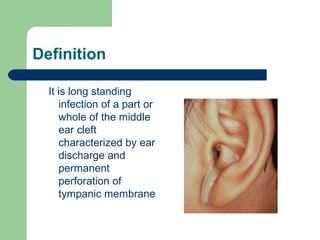
It is long standing
infection of a part or
whole of the middle
ear cleft
characterized by ear
discharge and
permanent
perforation of
tympanic membrane
Types of CSOM
 Tubo-tympanic
– Safe type
– Mucosal disease
 Attico-antral
– Un safe
– Squamous disease
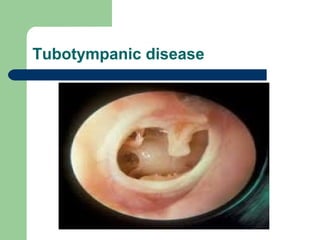
Tubotympanic disease
Pathology
 Localized to the middle ear
 Process of destruction
 Process of healing
 Virulence of organism
 Immunity of host
Pathology
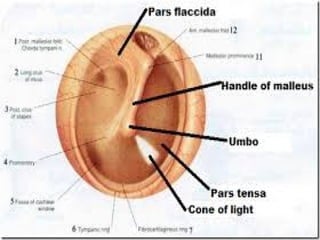
 Perforation
– Central perforation
– Pars tensa
 Middle ear mucosa
 Ossicular chain
 Fibrosisi and adhesions
 tympanosclerosis
Microbiology
 Pseudomonas aeruginosa
 Proteus mirabilis
 Staphylococcus aureus
 Peptostrpptococcus
 Bacteroides fragilis
 Klebsiella pneumoniae, and diphtheroids
Clinical features
 Ear discharge
 Hearing loss
Discharge (Mucosal disease)
 Profuse
 Mucopurulent
 Odor less
 Continous
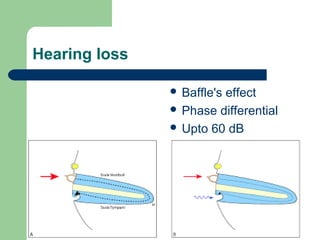
Hearing loss
 Baffle's effect
 Phase differential
 Upto 60 dB
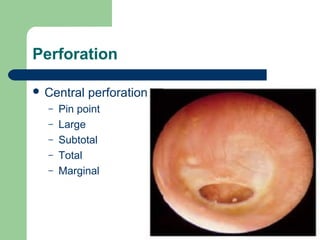
Perforation
 Central perforation
– Pin point
– Large
– Subtotal
– Total
– Marginal
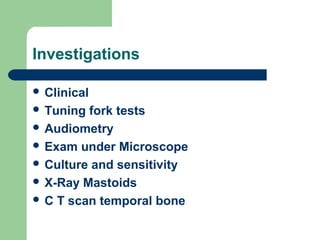
Investigations
 Clinical
 Tuning fork tests
 Audiometry
 Exam under Microscope
 Culture and sensitivity
 X-Ray Mastoids
 C T scan temporal bone
Treatment
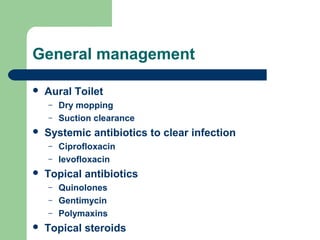
General management
 Aural Toilet
– Dry mopping
– Suction clearance
 Systemic antibiotics to clear infection
– Ciprofloxacin
– levofloxacin
 Topical antibiotics
– Quinolones
– Gentimycin
– Polymaxins
 Topical steroids
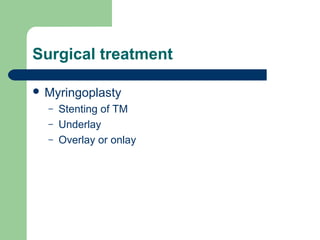
Surgical treatment
 Myringoplasty
– Stenting of TM
– Underlay
– Overlay or onlay
Attico-antral disease
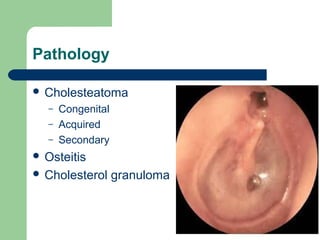
Pathology
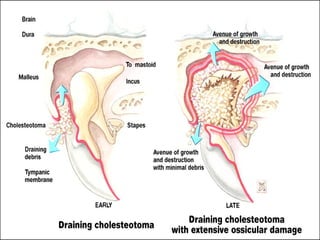
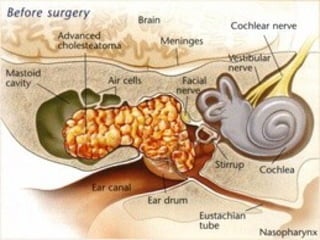
 Cholesteatoma
– Congenital
– Acquired
– Secondary
 Osteitis
 Cholesterol granuloma
Cholesteatoma
 A three dimentional epithelial and connective
tissue mass usually in the form of a sac
with a lining of stratified squamous epitheliu
m, filled with desquamating debris frequently
containing cholesterol.
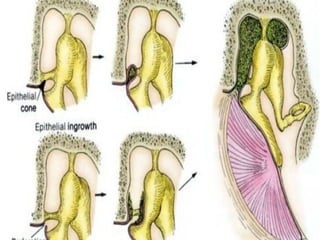
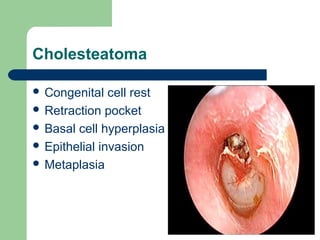
Cholesteatoma
 Congenital cell rest
 Retraction pocket
 Basal cell hyperplasia
 Epithelial invasion
 Metaplasia
Mechanism of destruction
 Enzymatic destruction
– Collagenase
– Phosphatase
– Proteolytic enzymes
 Osteitis
Clinical features
 Hearing loss
 Discharge
Discharge ( attico-antral disease)
 Scanty
 Intermittent
 Purulent
 Foul smelling
Features indicating complications
 Persistent headache
 Vertigo
 Facial weakness
 Fever, nausea, weakness
 Diplopia
Investigations
 Clinical
 Tuning fork tests
 Audiometry
 Exam under Microscope
 Culture and sensitivity
 X-Ray Mastoids
 C T scan temporal bone
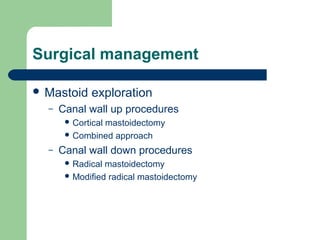
Surgical management
 Mastoid exploration
– Canal wall up procedures
 Cortical mastoidectomy
 Combined approach
– Canal wall down procedures
 Radical mastoidectomy
 Modified radical mastoidectomy
Conservative management
 Aural toilet
 Local antibiotics
 Systemic antibiotics
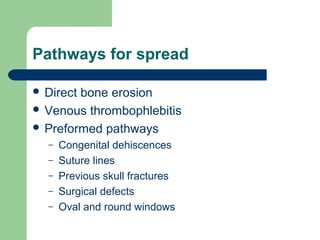
Pathways for spread
 Direct bone erosion
 Venous thrombophlebitis
 Preformed pathways
– Congenital dehiscences
– Suture lines
– Previous skull fractures
– Surgical defects
– Oval and round windows
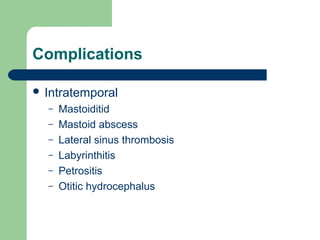
Complications
 Intratemporal
– Mastoiditid
– Mastoid abscess
– Lateral sinus thrombosis
– Labyrinthitis
– Petrositis
– Otitic hydrocephalus
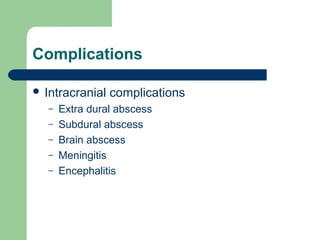
Complications
 Intracranial complications
– Extra dural abscess
– Subdural abscess
– Brain abscess
– Meningitis
– Encephalitis
Thank you

Chronic suppurative otitis media