CHRONIC SUPPURATIVE
OTITIS MEDIA
(CSOM)
NUR FARRA NAJWA BINTI ABDUL
AZIM
082015100035
LEARNING OBJECTIVE
By the end of seminar student should be able to
• Know what is CSOM
• Type of CSOM
– Etiology
– Pathology
– Feature
– Investigation
– Treatment
INTRODUCTION
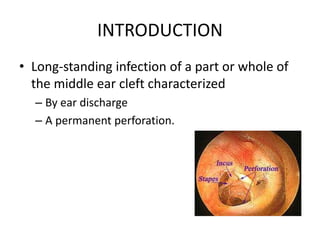
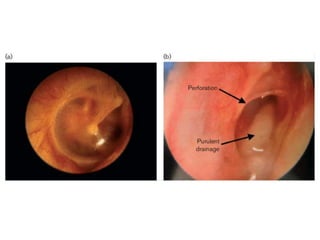
• Long-standing infection of a part or whole of
the middle ear cleft characterized
– By ear discharge
– A permanent perforation.
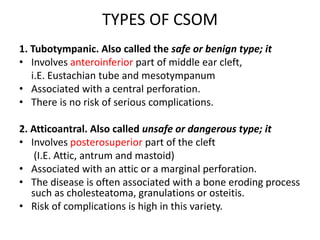
TYPES OF CSOM
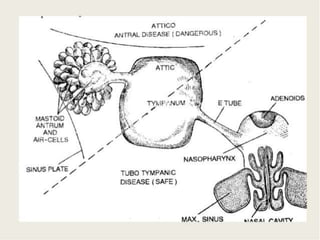
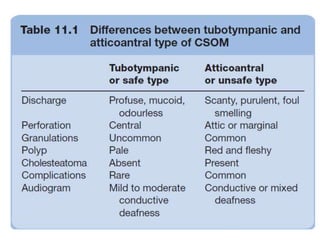
1. Tubotympanic. Also called the safe or benign type; it
• Involves anteroinferior part of middle ear cleft,
i.E. Eustachian tube and mesotympanum
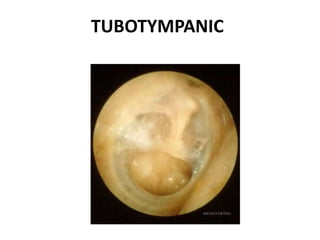
• Associated with a central perforation.
• There is no risk of serious complications.
2. Atticoantral. Also called unsafe or dangerous type; it
• Involves posterosuperior part of the cleft
(I.E. Attic, antrum and mastoid)
• Associated with an attic or a marginal perforation.
• The disease is often associated with a bone eroding process
such as cholesteatoma, granulations or osteitis.
• Risk of complications is high in this variety.
TUBOTYMPANIC
AETIOLOGY
• The disease starts in childhood
• It is the sequela of acute otitis.
– The perforation central and becomes permanent and
permits repeated infection from the external ear.
• Ascending infections via the eustachian tube.
– Infection from tonsils, adenoids and infected sinuses
may be responsible for persistent or recurring
otorrhoea.
• Persistent mucoid otorrhoea is sometimes the
result of allergy to ingestants such as milk, eggs,
fish, etc.
PATHOLOGY
1. Perforation of pars tensa.
2. Middle ear mucosa.
It is oedematous and velvety when disease is active.
3. Polyp.
It is usually pale in contrast to pink, fleshy polyp seen in
atticoantral disease
4. Ossicular chain.
It is usually intact and mobile but may show some degree of
necrosis, particularly of the long process of incus.
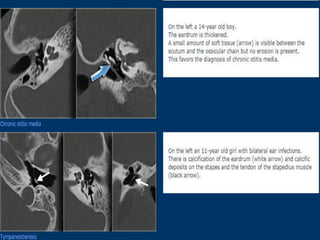
5. Tympanosclerosis.
It is seen as white chalky deposit on the promontory, ossicles,
joints, tendons and oval and round windows and interfere with
the mobility of these structures and cause conductive deafness.
6. Fibrosis and adhesions.
BACTERIOLOGY
• Pus culture in both types of aerobic and
anaerobic CSOM
• Common aerobic organisms
– Pseudomonas aeruginosa,
– Proteus,
– Escherichia coli
– Staphylococcus aureus,
• Anaerobes include Bacteroides fragilis and
anaerobic Streptococci.
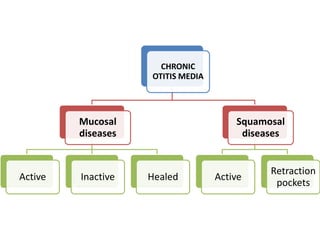
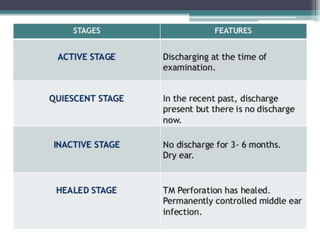
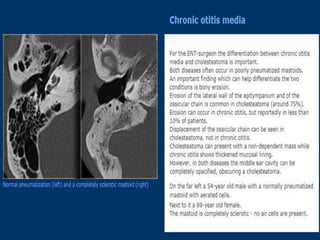
CHRONIC
OTITIS MEDIA
Mucosal
diseases
Active Inactive Healed
Squamosal
diseases
Active
Retraction
pockets
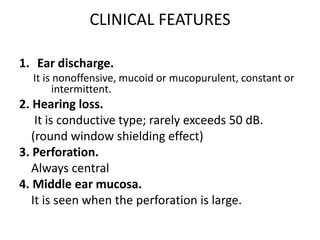
CLINICAL FEATURES
1. Ear discharge.
It is nonoffensive, mucoid or mucopurulent, constant or
intermittent.
2. Hearing loss.
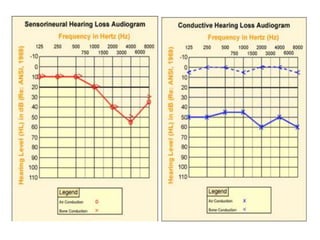
It is conductive type; rarely exceeds 50 dB.
(round window shielding effect)
3. Perforation.
Always central
4. Middle ear mucosa.
It is seen when the perforation is large.
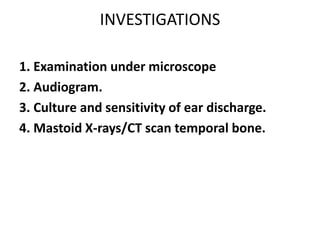
INVESTIGATIONS
1. Examination under microscope
2. Audiogram.
3. Culture and sensitivity of ear discharge.
4. Mastoid X-rays/CT scan temporal bone.
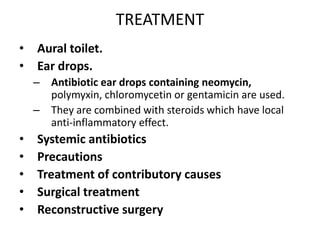
TREATMENT
• Aural toilet.
• Ear drops.
– Antibiotic ear drops containing neomycin,
polymyxin, chloromycetin or gentamicin are used.
– They are combined with steroids which have local
anti-inflammatory effect.
• Systemic antibiotics
• Precautions
• Treatment of contributory causes
• Surgical treatment
• Reconstructive surgery
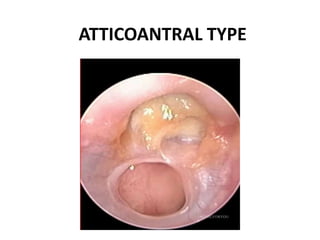
ATTICOANTRAL TYPE
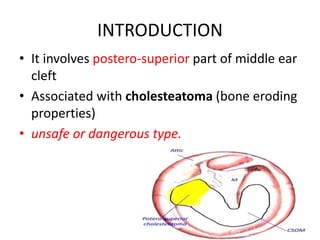
INTRODUCTION
• It involves postero-superior part of middle ear
cleft
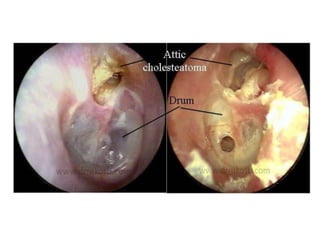
• Associated with cholesteatoma (bone eroding
properties)
• unsafe or dangerous type.
AETIOLOGY
• Aetiology of atticoantral disease is same as of
cholesteatoma and has been discussed earlier.
• It is seen in sclerotic mastoid.
PATHOLOGY
1. Cholesteatoma.
2. Osteitis and granulation tissue.
3. Ossicular necrosis (cholesteatoma hearer)
4. Cholesterol granuloma.
BACTERIOLOGY
• Same as in tubo-tympanic type.
SYMPTOMS
1. Ear discharge.
Usually scanty, but always foul-smelling due to bone
destruction
2. Hearing loss.
Hearing is normal when ossicular chain is intact or
when cholesteatoma, having destroyed the ossicles,
bridges the gap caused by destroyed ossicles
(cholesteatoma hearer).
3. Bleeding.
From granulations or the polyp when cleaning the ear.
SIGN
1. Perforation.
It is either attic or postero-superior marginal
type.
2. Retraction pocket.
An invagination of tympanic membrane is seen in
the attic or posterosuperior area of pars tensa.
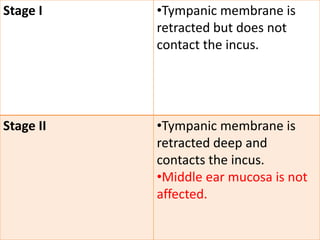
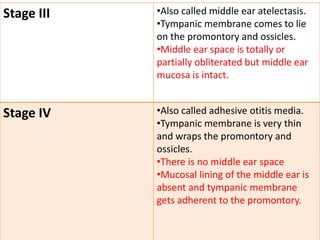
There are four stages of tympanic membrane
retraction.
3. Cholesteatoma.
Stage I •Tympanic membrane is
retracted but does not
contact the incus.
Stage II •Tympanic membrane is
retracted deep and
contacts the incus.
•Middle ear mucosa is not
affected.
Stage III •Also called middle ear atelectasis.
•Tympanic membrane comes to lie
on the promontory and ossicles.
•Middle ear space is totally or
partially obliterated but middle ear
mucosa is intact.
Stage IV •Also called adhesive otitis media.
•Tympanic membrane is very thin
and wraps the promontory and
ossicles.
•There is no middle ear space
•Mucosal lining of the middle ear is
absent and tympanic membrane
gets adherent to the promontory.
INVESTIGATIONS
1. Examination under microscope
2. Tuning fork tests and audiogram.
3. X-ray mastoids/CT scan temporal bone.
4. Culture and sensitivity of ear discharge.
FEATURES INDICATING
COMPLICATIONS IN CSOM
1. Pain
2. Vertigo
3. Persistent headache.
4. Facial weakness indicates erosion of facial canal.
5. A listless child refusing to take feeds and easily going to
sleep (extradural abscess).
6. Fever, nausea and vomiting (intracranial infection).
7. Irritability and neck rigidity (meningitis).
8. Diplopia (Gradenigo syndrome) petrositis.
9. Ataxia (labyrinthitis or cerebellar abscess).
10. Abscess round the ear (mastoiditis).
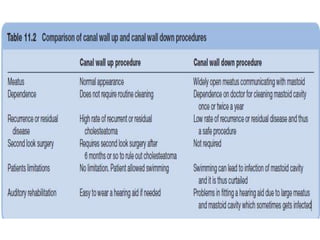
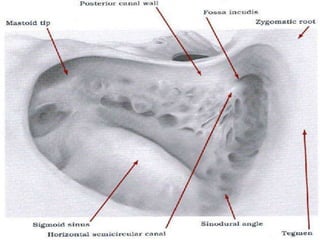
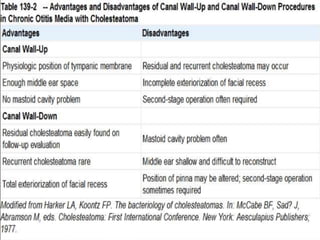
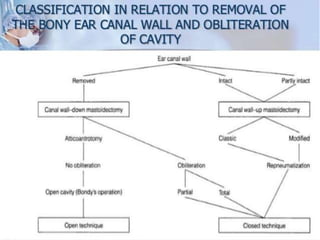
TREATMENT
1. Surgical
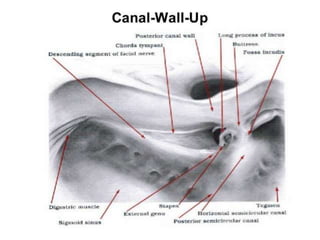
(a)Canal wall down procedures
(b) Canal wall up procedures.
2. Reconstructive surgery. Hearing can be
restored by myringoplasty or tympanoplasty.
3. Conservative treatment.
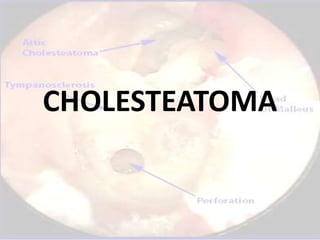
CHOLESTEATOMA
LEARNING OBJECTIVE
• What is cholesteatoma
• Origin
• Classification
INTRODUCTION
• Normally, middle ear cleft is lined by different types of
epithelium in different regions
• It is the presence of keratinizing squamous epithelium in
the middle ear or mastoid.
• “Skin in the wrong place.”
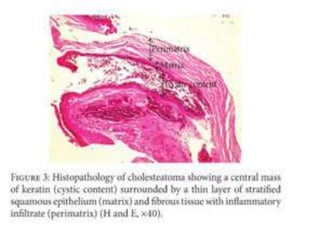
• Essentially, cholesteatoma consists of two parts:
(i) the matrix, which is made up of keratinizing squamous
epithelium resting on a thin stroma of fibrous tissues and
(ii) a central white mass, consisting of keratin debris
produced by the matrix .
• Also been named epidermosis or keratoma.
ORIGIN
1. Presence of congenital cell rests.
2. Invagination of tympanic membrane from the
attic or posterosuperior part of pars tensa in
the form of retraction pockets (Wittmaack’s
theory).
3. Basal cell hyperplasia (Ruedi’s theory).
4. Epithelial invasion (Habermann’s theory).
5. Metaplasia (Sade’s theory).
CLASSIFICATION OF CHOLESTEATOMA
• The cholesteatoma is classified into:
1. Congenital
2. Acquired, primary
3. Acquired, secondary
1. CONGENITAL CHOLESTEATOMA.
• It arises from the embryonic epidermal cell rests
• 3 important sites:
– Middle ear
– Petrous apex
– And the cerebellopontine angle
• Presents as a white mass behind an intact tympanic
membrane and causes conductive hearing loss.
• It may sometimes be discovered on routine examination
of children or at the time of myringotomy.
• It may also spontaneously rupture
• Present with a discharging ear indistinguishable from a
case of chronic suppurative otitis media.
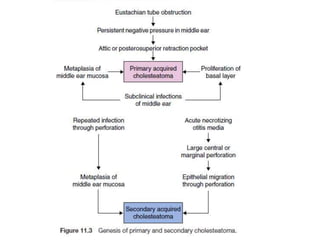
2. PRIMARY ACQUIRED
CHOLESTEATOMA
• No history of previous otitis media or a pre-
existing perforation.
• Theories on its genesis are:
(A) invagination of pars flaccida.
(B) basal cell hyperplasia.
(C) squamous metaplasia.
3. SECONDARY ACQUIRED
CHOLESTEATOMA
• Already a pre-existing perforation in pars
tensa.
• This is often associated with posterosuperior
marginal perforation or sometimes large
central perforation.
• Theories on its genesis
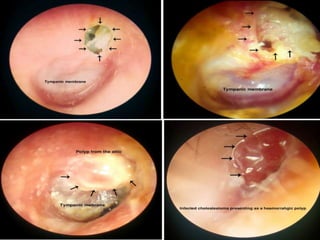
(A) migration of squamous epithelium.
(B) Keratinizing squamous metaplasia
EXPANSION OF CHOLESTEATOMA AND
DESTRUCTION OF BONE
• It invades the surrounding structures, first the path of least resistance, and then
by enzymatic bone destruction.
• An attic cholesteatoma may extend
– Backwards into the aditus, antrum and mastoid;
– Downwards into the mesotympanum;
– Medially, it may surround the incus and/or head of malleus.
– Cause destruction of ear ossicles,
– Erosion of bony labyrinth,
– Canal of facial nerve,
– Sinus plate or tegmen tympani
• Attributed to various enzymes such as
– Collagenase,
– Acid phosphatase and proteolytic enzymes,
• Liberated by osteoclasts and mononuclear inflammatory cells,
• Seen in association with cholesteatoma.
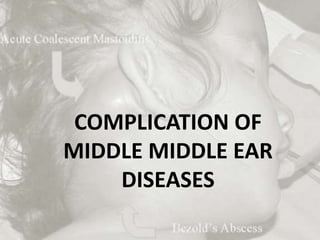
COMPLICATION OF
MIDDLE MIDDLE EAR
DISEASES
FACTORS INFLUENCING DEVELOPMENT OF
COMPLICATIONS
1. Age.
2. Poor socioeconomic group.
– overcrowding,
– poor health education
– poor personal hygiene,
– limited access to healthcare play an important
part.
3. Virulence of organisms.
Cont.
4. Immune-compromised host.
5. Preformed pathways.
– Infection can easily travel beyond the middle ear
cleft if preformed pathways exist,
6. Cholesteatoma.
PATHWAYS OF SPREAD OF INFECTION
1. Direct bone erosion
2. Venous thrombophlebitis.
3. Preformed pathways
(a) Congenital dehiscences, e.g. in bony facial canal,
floor of middle ear over the jugular bulb.
(b) Patent sutures, e.g. petrosquamous suture.
(c) Previous skull fractures. The fracture sites heal only by fibrous scar
which permits infection.
(d) Surgical defects, e.g. stapedectomy, fenestration and mastoidectomy
with exposure of dura.
(e) Oval and round windows.
(f) Infection from labyrinth can travel along internal acoustic meatus,
aqueducts of the vestibule and that of the cochlea to the meninges.
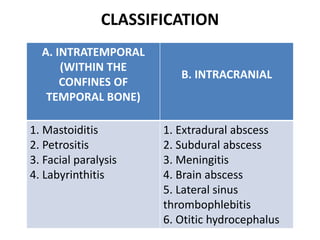
CLASSIFICATION
A. INTRATEMPORAL
(WITHIN THE
CONFINES OF
TEMPORAL BONE)
B. INTRACRANIAL
1. Mastoiditis
2. Petrositis
3. Facial paralysis
4. Labyrinthitis
1. Extradural abscess
2. Subdural abscess
3. Meningitis
4. Brain abscess
5. Lateral sinus
thrombophlebitis
6. Otitic hydrocephalus
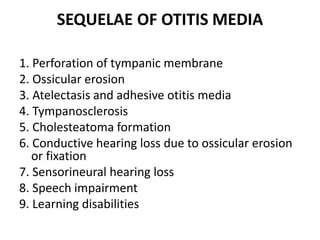
SEQUELAE OF OTITIS MEDIA
1. Perforation of tympanic membrane
2. Ossicular erosion
3. Atelectasis and adhesive otitis media
4. Tympanosclerosis
5. Cholesteatoma formation
6. Conductive hearing loss due to ossicular erosion
or fixation
7. Sensorineural hearing loss
8. Speech impairment
9. Learning disabilities
SUMMARY
• CSOM
• CHOLESTEATOMA
• COMPLICATION OF MIDDLE EAR INFECTION
REFERENCES
• Diseases of Ear, Nose, and Throat & Head and
Neck Surgery, PL Dhingra, Shruti Dhingra, 6th
Edition
• http://www.radiologyassistant.nl/en/p49c62a
be0880e/temporal-bone-pathology.html
Csom, cholesteatoma

Csom, cholesteatoma

  • 1.
    CHRONIC SUPPURATIVE OTITIS MEDIA (CSOM) NURFARRA NAJWA BINTI ABDUL AZIM 082015100035
  • 2.
    LEARNING OBJECTIVE By theend of seminar student should be able to • Know what is CSOM • Type of CSOM – Etiology – Pathology – Feature – Investigation – Treatment
  • 3.
    INTRODUCTION • Long-standing infectionof a part or whole of the middle ear cleft characterized – By ear discharge – A permanent perforation.
  • 5.
    TYPES OF CSOM 1.Tubotympanic. Also called the safe or benign type; it • Involves anteroinferior part of middle ear cleft, i.E. Eustachian tube and mesotympanum • Associated with a central perforation. • There is no risk of serious complications. 2. Atticoantral. Also called unsafe or dangerous type; it • Involves posterosuperior part of the cleft (I.E. Attic, antrum and mastoid) • Associated with an attic or a marginal perforation. • The disease is often associated with a bone eroding process such as cholesteatoma, granulations or osteitis. • Risk of complications is high in this variety.
  • 8.
  • 9.
    AETIOLOGY • The diseasestarts in childhood • It is the sequela of acute otitis. – The perforation central and becomes permanent and permits repeated infection from the external ear. • Ascending infections via the eustachian tube. – Infection from tonsils, adenoids and infected sinuses may be responsible for persistent or recurring otorrhoea. • Persistent mucoid otorrhoea is sometimes the result of allergy to ingestants such as milk, eggs, fish, etc.
  • 10.
    PATHOLOGY 1. Perforation ofpars tensa. 2. Middle ear mucosa. It is oedematous and velvety when disease is active. 3. Polyp. It is usually pale in contrast to pink, fleshy polyp seen in atticoantral disease 4. Ossicular chain. It is usually intact and mobile but may show some degree of necrosis, particularly of the long process of incus. 5. Tympanosclerosis. It is seen as white chalky deposit on the promontory, ossicles, joints, tendons and oval and round windows and interfere with the mobility of these structures and cause conductive deafness. 6. Fibrosis and adhesions.
  • 11.
    BACTERIOLOGY • Pus culturein both types of aerobic and anaerobic CSOM • Common aerobic organisms – Pseudomonas aeruginosa, – Proteus, – Escherichia coli – Staphylococcus aureus, • Anaerobes include Bacteroides fragilis and anaerobic Streptococci.
  • 12.
    CHRONIC OTITIS MEDIA Mucosal diseases Active InactiveHealed Squamosal diseases Active Retraction pockets
  • 14.
    CLINICAL FEATURES 1. Eardischarge. It is nonoffensive, mucoid or mucopurulent, constant or intermittent. 2. Hearing loss. It is conductive type; rarely exceeds 50 dB. (round window shielding effect) 3. Perforation. Always central 4. Middle ear mucosa. It is seen when the perforation is large.
  • 15.
    INVESTIGATIONS 1. Examination undermicroscope 2. Audiogram. 3. Culture and sensitivity of ear discharge. 4. Mastoid X-rays/CT scan temporal bone.
  • 16.
    TREATMENT • Aural toilet. •Ear drops. – Antibiotic ear drops containing neomycin, polymyxin, chloromycetin or gentamicin are used. – They are combined with steroids which have local anti-inflammatory effect. • Systemic antibiotics • Precautions • Treatment of contributory causes • Surgical treatment • Reconstructive surgery
  • 17.
  • 18.
    INTRODUCTION • It involvespostero-superior part of middle ear cleft • Associated with cholesteatoma (bone eroding properties) • unsafe or dangerous type.
  • 19.
    AETIOLOGY • Aetiology ofatticoantral disease is same as of cholesteatoma and has been discussed earlier. • It is seen in sclerotic mastoid.
  • 20.
    PATHOLOGY 1. Cholesteatoma. 2. Osteitisand granulation tissue. 3. Ossicular necrosis (cholesteatoma hearer) 4. Cholesterol granuloma.
  • 22.
    BACTERIOLOGY • Same asin tubo-tympanic type.
  • 23.
    SYMPTOMS 1. Ear discharge. Usuallyscanty, but always foul-smelling due to bone destruction 2. Hearing loss. Hearing is normal when ossicular chain is intact or when cholesteatoma, having destroyed the ossicles, bridges the gap caused by destroyed ossicles (cholesteatoma hearer). 3. Bleeding. From granulations or the polyp when cleaning the ear.
  • 24.
    SIGN 1. Perforation. It iseither attic or postero-superior marginal type. 2. Retraction pocket. An invagination of tympanic membrane is seen in the attic or posterosuperior area of pars tensa. There are four stages of tympanic membrane retraction. 3. Cholesteatoma.
  • 25.
    Stage I •Tympanicmembrane is retracted but does not contact the incus. Stage II •Tympanic membrane is retracted deep and contacts the incus. •Middle ear mucosa is not affected.
  • 26.
    Stage III •Alsocalled middle ear atelectasis. •Tympanic membrane comes to lie on the promontory and ossicles. •Middle ear space is totally or partially obliterated but middle ear mucosa is intact. Stage IV •Also called adhesive otitis media. •Tympanic membrane is very thin and wraps the promontory and ossicles. •There is no middle ear space •Mucosal lining of the middle ear is absent and tympanic membrane gets adherent to the promontory.
  • 27.
    INVESTIGATIONS 1. Examination undermicroscope 2. Tuning fork tests and audiogram. 3. X-ray mastoids/CT scan temporal bone. 4. Culture and sensitivity of ear discharge.
  • 31.
    FEATURES INDICATING COMPLICATIONS INCSOM 1. Pain 2. Vertigo 3. Persistent headache. 4. Facial weakness indicates erosion of facial canal. 5. A listless child refusing to take feeds and easily going to sleep (extradural abscess). 6. Fever, nausea and vomiting (intracranial infection). 7. Irritability and neck rigidity (meningitis). 8. Diplopia (Gradenigo syndrome) petrositis. 9. Ataxia (labyrinthitis or cerebellar abscess). 10. Abscess round the ear (mastoiditis).
  • 32.
    TREATMENT 1. Surgical (a)Canal walldown procedures (b) Canal wall up procedures. 2. Reconstructive surgery. Hearing can be restored by myringoplasty or tympanoplasty. 3. Conservative treatment.
  • 38.
  • 40.
    LEARNING OBJECTIVE • Whatis cholesteatoma • Origin • Classification
  • 41.
    INTRODUCTION • Normally, middleear cleft is lined by different types of epithelium in different regions • It is the presence of keratinizing squamous epithelium in the middle ear or mastoid. • “Skin in the wrong place.” • Essentially, cholesteatoma consists of two parts: (i) the matrix, which is made up of keratinizing squamous epithelium resting on a thin stroma of fibrous tissues and (ii) a central white mass, consisting of keratin debris produced by the matrix . • Also been named epidermosis or keratoma.
  • 43.
    ORIGIN 1. Presence ofcongenital cell rests. 2. Invagination of tympanic membrane from the attic or posterosuperior part of pars tensa in the form of retraction pockets (Wittmaack’s theory). 3. Basal cell hyperplasia (Ruedi’s theory). 4. Epithelial invasion (Habermann’s theory). 5. Metaplasia (Sade’s theory).
  • 44.
    CLASSIFICATION OF CHOLESTEATOMA •The cholesteatoma is classified into: 1. Congenital 2. Acquired, primary 3. Acquired, secondary
  • 45.
    1. CONGENITAL CHOLESTEATOMA. •It arises from the embryonic epidermal cell rests • 3 important sites: – Middle ear – Petrous apex – And the cerebellopontine angle • Presents as a white mass behind an intact tympanic membrane and causes conductive hearing loss. • It may sometimes be discovered on routine examination of children or at the time of myringotomy. • It may also spontaneously rupture • Present with a discharging ear indistinguishable from a case of chronic suppurative otitis media.
  • 46.
    2. PRIMARY ACQUIRED CHOLESTEATOMA •No history of previous otitis media or a pre- existing perforation. • Theories on its genesis are: (A) invagination of pars flaccida. (B) basal cell hyperplasia. (C) squamous metaplasia.
  • 47.
    3. SECONDARY ACQUIRED CHOLESTEATOMA •Already a pre-existing perforation in pars tensa. • This is often associated with posterosuperior marginal perforation or sometimes large central perforation. • Theories on its genesis (A) migration of squamous epithelium. (B) Keratinizing squamous metaplasia
  • 48.
    EXPANSION OF CHOLESTEATOMAAND DESTRUCTION OF BONE • It invades the surrounding structures, first the path of least resistance, and then by enzymatic bone destruction. • An attic cholesteatoma may extend – Backwards into the aditus, antrum and mastoid; – Downwards into the mesotympanum; – Medially, it may surround the incus and/or head of malleus. – Cause destruction of ear ossicles, – Erosion of bony labyrinth, – Canal of facial nerve, – Sinus plate or tegmen tympani • Attributed to various enzymes such as – Collagenase, – Acid phosphatase and proteolytic enzymes, • Liberated by osteoclasts and mononuclear inflammatory cells, • Seen in association with cholesteatoma.
  • 50.
  • 51.
    FACTORS INFLUENCING DEVELOPMENTOF COMPLICATIONS 1. Age. 2. Poor socioeconomic group. – overcrowding, – poor health education – poor personal hygiene, – limited access to healthcare play an important part. 3. Virulence of organisms.
  • 52.
    Cont. 4. Immune-compromised host. 5.Preformed pathways. – Infection can easily travel beyond the middle ear cleft if preformed pathways exist, 6. Cholesteatoma.
  • 53.
    PATHWAYS OF SPREADOF INFECTION 1. Direct bone erosion 2. Venous thrombophlebitis. 3. Preformed pathways (a) Congenital dehiscences, e.g. in bony facial canal, floor of middle ear over the jugular bulb. (b) Patent sutures, e.g. petrosquamous suture. (c) Previous skull fractures. The fracture sites heal only by fibrous scar which permits infection. (d) Surgical defects, e.g. stapedectomy, fenestration and mastoidectomy with exposure of dura. (e) Oval and round windows. (f) Infection from labyrinth can travel along internal acoustic meatus, aqueducts of the vestibule and that of the cochlea to the meninges.
  • 54.
    CLASSIFICATION A. INTRATEMPORAL (WITHIN THE CONFINESOF TEMPORAL BONE) B. INTRACRANIAL 1. Mastoiditis 2. Petrositis 3. Facial paralysis 4. Labyrinthitis 1. Extradural abscess 2. Subdural abscess 3. Meningitis 4. Brain abscess 5. Lateral sinus thrombophlebitis 6. Otitic hydrocephalus
  • 55.
    SEQUELAE OF OTITISMEDIA 1. Perforation of tympanic membrane 2. Ossicular erosion 3. Atelectasis and adhesive otitis media 4. Tympanosclerosis 5. Cholesteatoma formation 6. Conductive hearing loss due to ossicular erosion or fixation 7. Sensorineural hearing loss 8. Speech impairment 9. Learning disabilities
  • 56.
    SUMMARY • CSOM • CHOLESTEATOMA •COMPLICATION OF MIDDLE EAR INFECTION
  • 57.
    REFERENCES • Diseases ofEar, Nose, and Throat & Head and Neck Surgery, PL Dhingra, Shruti Dhingra, 6th Edition • http://www.radiologyassistant.nl/en/p49c62a be0880e/temporal-bone-pathology.html