
1
Dr Harjitpal Singh
Assistant Professor(ENT),
Dr RKGMC, Hamirpur
CSOM
 Long standing infection of a part or whole of the middle
ear cleft characterized by ear discharge and permanent
perforation
2
 Developing countries: more
 Both sexes
 All age groups
 Prevalence rate: 46 per thousands (rural), 16 per
thousands (urban)
3
4
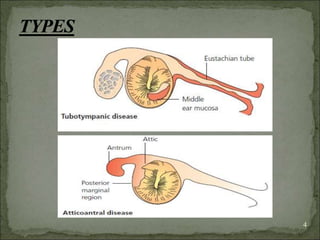
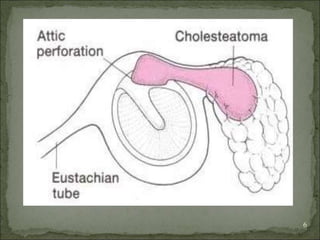
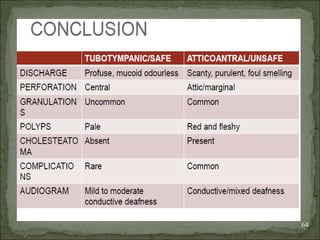
 It is also called unsafe or dangerous type of
CSOM, because dangerous intra-or-extracranial
complications can occur
 In this the disease spreads to bony walls of
epitympanum, aditus, antrum and adjoining
mastoid cells.
 Associated with cholesteotoma.
 Risk of complications is higher
5
6
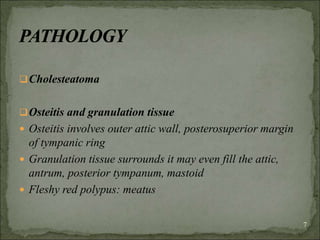
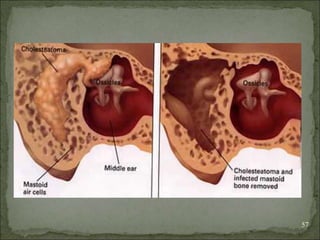
Cholesteatoma
Osteitis and granulation tissue
 Osteitis involves outer attic wall, posterosuperior margin
of tympanic ring
 Granulation tissue surrounds it may even fill the attic,
antrum, posterior tympanum, mastoid
 Fleshy red polypus: meatus
7
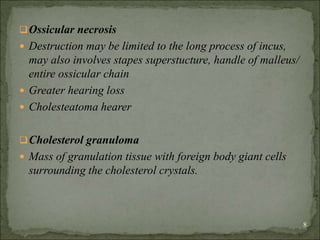
Ossicular necrosis
 Destruction may be limited to the long process of incus,
may also involves stapes superstucture, handle of malleus/
entire ossicular chain
 Greater hearing loss
 Cholesteatoma hearer
Cholesterol granuloma
 Mass of granulation tissue with foreign body giant cells
surrounding the cholesterol crystals.
8
 MISNOMER:
 Neither it contains cholesterol crystals
 Nor it is benign neoplasia to merit suffix “oma”
 Various names have been given to it such as:
 Cholesteatosis (Young)
 Epidermosis (1961, Tumarkin)
 Keratosis (1963, McGuckin)
 Keratoma (1974, Schuknecht), which is thought to be
most appropriate.
9
 Skin at a wrong place is the simplest definition
of cholesteatoma.
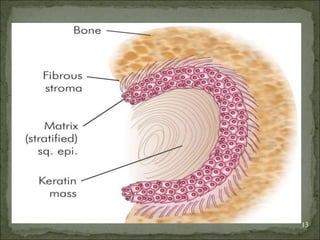
 It may be defined as a cystic structure lined by
keratinized squamous epithelium resting on a
fibrous stroma
 Consists of two parts
Matrix- Keratinizing squamous
epithelium resting on thin fibrous tissue
central white mass- keratin debris
produced by matrix
10
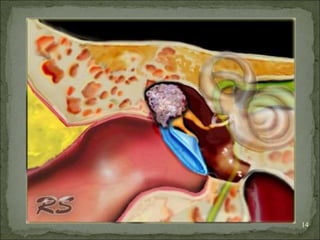
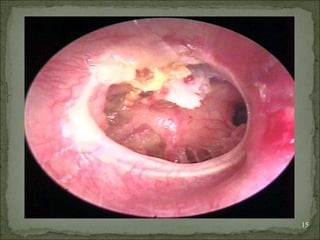
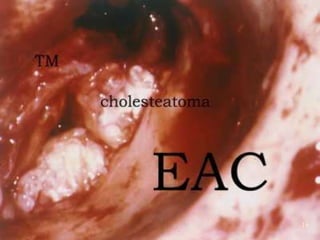
 Macroscopically cholesteatoma looks like a soft
pultaceous mass resembling tooth paste
contained in a sac or cholesteatoma appears to be
a rounded pearly white mass often surrounded by
friable granulation tissue from infected bone
 Microscopically cholesteatoma is a benign
keratinizing squamous cell cyst
 Epithelial matrix of acquired cholesteatoma has
10 to 15 layers, while congenital cholesteatoma
has only 5 layers of matrix
11
 In simpler terms, cholesteatoma is squamous
epithelium in an abnormal site in the middle ear
which possesses bone eroding properties.
 The bone erosion is due to two things
 a) Pressure effects produced by bone
remodelling,
 b) Enzymatic activity at the margins of the
cholesteatoma which greatly
increases the speed of bone erosion.
 The levelsof these osteoclastic enzymes increase in
the presence of bacterial infection.
12
13
14
15
16
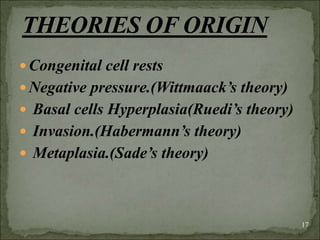
Congenital cell rests
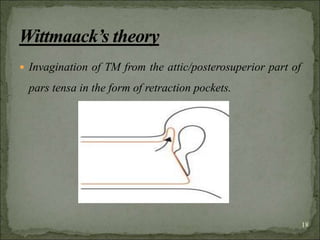
Negative pressure.(Wittmaack’s theory)
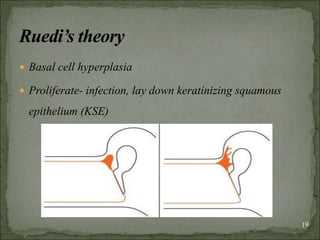
 Basal cells Hyperplasia(Ruedi’s theory)
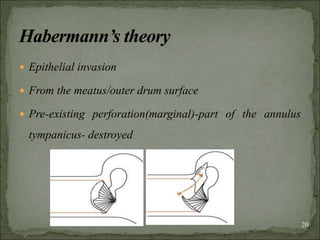
 Invasion.(Habermann’s theory)
 Metaplasia.(Sade’s theory)
17
 Invagination of TM from the attic/posterosuperior part of
pars tensa in the form of retraction pockets.
18
 Basal cell hyperplasia
 Proliferate- infection, lay down keratinizing squamous
epithelium (KSE)
19
 Epithelial invasion
 From the meatus/outer drum surface
 Pre-existing perforation(marginal)-part of the annulus
tympanicus- destroyed
20
 Because of repeated infections, squamous metaplasia of
the low cuboidal epithelium of the middle ear occurs
 This subsequently leads to development of cholesteatoma
 This theory did not find much favor.
21
22
CONGENITAL
ACQUIRED
 PRIMARY
 SECONDARY
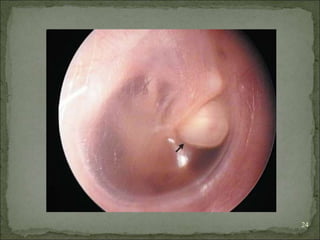
 Embroyonic epidermal cell rests in the middle ear cleft/
temporal bone
 Middle ear, petrous apex,cerebellopontine angle
 Middle ear: white mass behind an intact tympanic
membrane -> conductive hearing loss
 Discovered: routine exam/myringotomy
 May spontaneously rupture- TM -> discharging ear
23
24
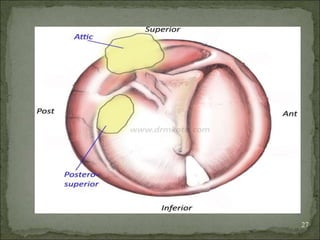
 No h/o previous OM/ pre-existing perforation
 Invagination of pars flaccida
 Persistent negative pressure in the attic -> retraction
pocket which accumulates keratin debris.
 Infected -> expand -> middle ear
 Basal cell hyperplasia
 Proliferation of the basal layers of PF induced by
subclinical childhood infection
 Squamous metaplasia
 Normal pavement epithelium of attic undergoes
metaplasia, keratinizing squamous epithelium
25
 Already a pre-existing perforation in pars tensa
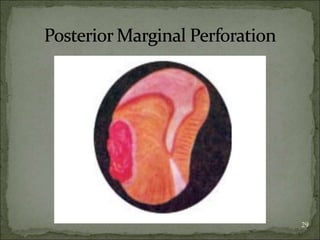
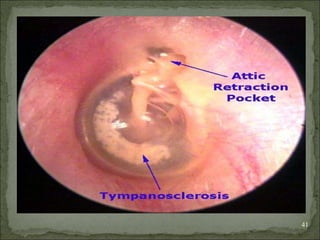
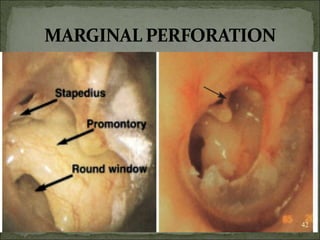
 Associated with posterosuperior marginal perforation
 Migration of squamous epithelium
 KSE of EAC/ outer surface of TM migrates through the
perforation into the middle ear
 Metaplasia: repeated infections of middle ear- preexisting
perforation
26
27
28
29
30
 Invades surrounding
structures.
 Bone destruction by
various enzymes.
 Collagenases
 Acid phosphatase
 Proteolytic enzymes
 Cause destruction of ear
ossicles, erosion of bony
labyrinth, canal of facial
nerve, sinus plate, tegmen
tympani.
 Causes serious
complication.
31
AEROBES
Ps.aeruginosa.
B.proteus.
E.coli.
Staph.aureus.
ANAEROBES
Bacteroides.
Streptococci.
32
DISCHARGE:
 Scanty
 Purulent
 Foul-smelling
 Blood-stained
 Continuous
 not associated with
URTI.
 Mostly conductive
 May be sensorineural.
 Sometimes normal as
cholesteotoma bridges
gap caused by destroyed
ossicles (Cholesteotoma
hearer)
HEARING LOSS:
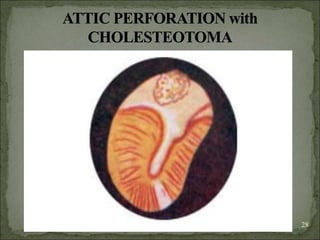
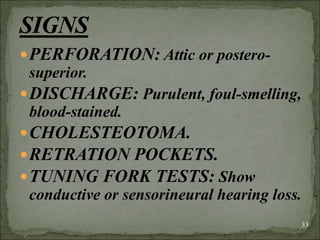
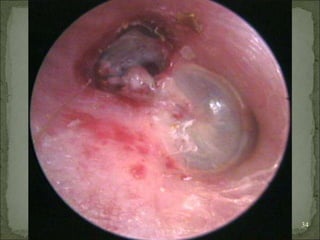
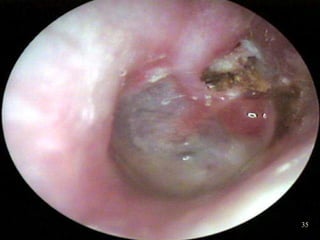
PERFORATION: Attic or postero-
superior.
DISCHARGE: Purulent, foul-smelling,
blood-stained.
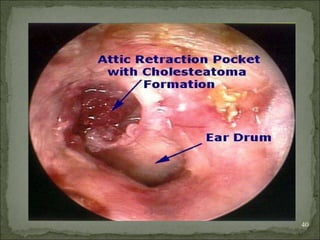
CHOLESTEOTOMA.
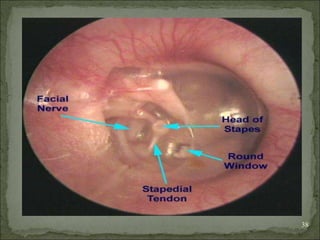
RETRATION POCKETS.
TUNING FORK TESTS: Show
conductive or sensorineural hearing loss.
33
34
35
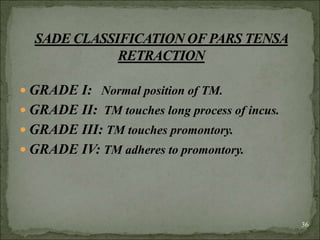
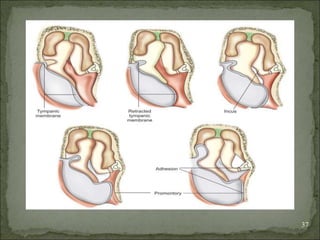
 GRADE I: Normal position of TM.
 GRADE II: TM touches long process of incus.
 GRADE III: TM touches promontory.
 GRADE IV: TM adheres to promontory.
36
37
38
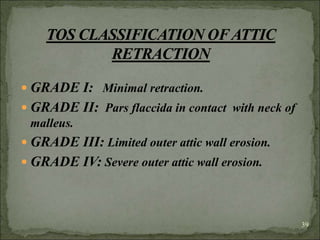
 GRADE I: Minimal retraction.
 GRADE II: Pars flaccida in contact with neck of
malleus.
 GRADE III: Limited outer attic wall erosion.
 GRADE IV: Severe outer attic wall erosion.
39
40
41
42
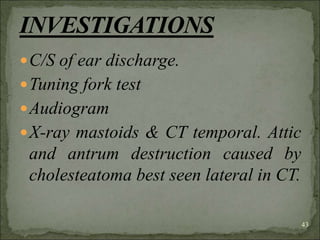
C/S of ear discharge.
Tuning fork test
Audiogram
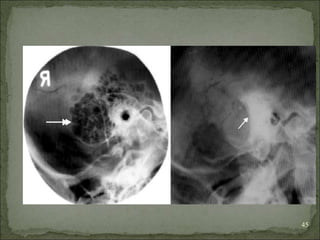
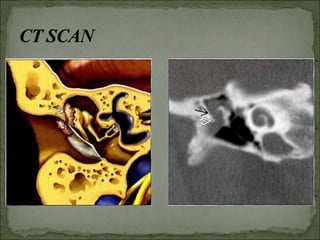
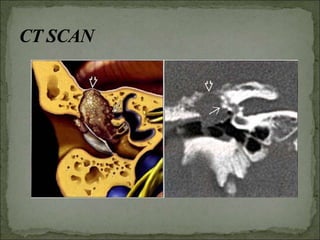
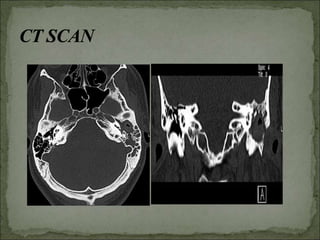
X-ray mastoids & CT temporal. Attic
and antrum destruction caused by
cholesteatoma best seen lateral in CT.
43
45
46
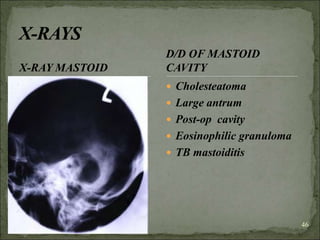
X-RAY MASTOID
 Cholesteatoma
 Large antrum
 Post-op cavity
 Eosinophilic granuloma
 TB mastoiditis
D/D OF MASTOID
CAVITY
 Pain.
 Vertigo.
 Persistent headache.
 Facial weakness.
 Listless child refuses to feed.
 Fever, nausea, vomiting.
 Irritability and neck stiffness.
 Diplopia.
 Ataxia.
 Abscess round the ear.
50
51
EXTRA-CRANIAL
 Mastoiditis.
 Abscesses.
 Petrositis.
 Facial paralysis.
 Labyrinthitis.
INTRA-CRANIAL
 Extradural abscess.
 Subdural abscess.
 Brain abscess.
 Meningitis.
 Lateral sinus
thrombophlebitis.
 Otitic hydrocephalus.
SURGICAL
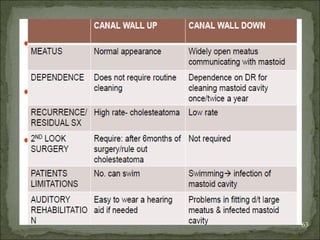
CANAL WALL UP
CANAL WALL DOWN
RECONSTRUCTIVE SURGERY
 Myringoplasty/ tympanoplasty
 Primary surgery/ 2nd stage procedure
CONSERVATIVE
52
53
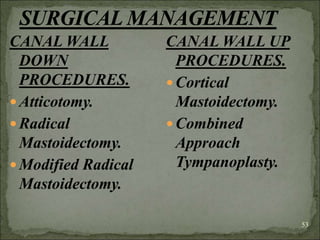
CANAL WALL
DOWN
PROCEDURES.
Atticotomy.
Radical
Mastoidectomy.
Modified Radical
Mastoidectomy.
CANAL WALL UP
PROCEDURES.
Cortical
Mastoidectomy.
Combined
Approach
Tympanoplasty.
 A canal wall down procedure performed
to remove all or part of outer attic wall
and adjacent deep posterior meatal wall
to expose the attic and when necessary
the aditus and antrum in order to gain
access to these sites and their contents
and/or remove disease limited to these
sites.
54
A canal wall down procedure in which
we remove all disease from mastoid and
middle ear by lowering bridge making it
a single cavity, remove all ossicles except
foot-plate of stapes, remove remains of
tympanic membrane, obliterate the
eustachian tube, and exteriorized this
cavity to EAM by doing meatoplasty.
55
A canal wall down procedure in which
we remove disease from mastoid and
middle ear by lowering bridge making it
a single cavity, remove only diseased
ossicles, donot remove remains of
tympanic membrane, donot obliterate the
eustachian tube, and exteriorized this
cavity to EAM by doing meatoplasty.
56
57
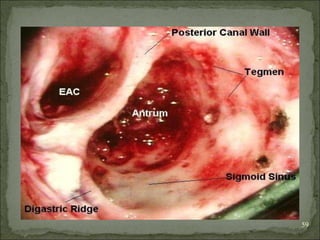
A canal wall up procedure performed
to remove disease from mastoid antrum
and air cell system and aditus &
antrum, with preservation of an intact
posterior bony external auditory canal
wall, without disturbing the existing
middle ear contents.
58
59
 Operation performed to remove disease
from middle ear and mastoid by way of
a) Mastoid.
b) Posterior Tympanotomy.
c) Transcanal route.
followed by reconstruction of middle
ear transformer mechanism.
60
An operation performed to eradicate
disease in the middle ear and to
reconstruct the hearing mechanism,
without mastoid surgery, with or without
tympanic membrane grafting.
61
 Cholesteatoma is small, easily accesible to suction
clearance under microscope
 Elderly >65 years old
 Unfit for GA/ refused
 Polyps,granulation tissue: cup forceps/ cauterized by
chemical agents (silver nitrate/ trichloroacetic acid)
 Aural toilet, dry ear precautions
62
63
64
THANKS
65

ATTICO-ANTRAL CSOM

  • 1.
    1 Dr Harjitpal Singh AssistantProfessor(ENT), Dr RKGMC, Hamirpur
  • 2.
    CSOM  Long standinginfection of a part or whole of the middle ear cleft characterized by ear discharge and permanent perforation 2
  • 3.
     Developing countries:more  Both sexes  All age groups  Prevalence rate: 46 per thousands (rural), 16 per thousands (urban) 3
  • 4.
  • 5.
     It isalso called unsafe or dangerous type of CSOM, because dangerous intra-or-extracranial complications can occur  In this the disease spreads to bony walls of epitympanum, aditus, antrum and adjoining mastoid cells.  Associated with cholesteotoma.  Risk of complications is higher 5
  • 6.
  • 7.
    Cholesteatoma Osteitis and granulationtissue  Osteitis involves outer attic wall, posterosuperior margin of tympanic ring  Granulation tissue surrounds it may even fill the attic, antrum, posterior tympanum, mastoid  Fleshy red polypus: meatus 7
  • 8.
    Ossicular necrosis  Destructionmay be limited to the long process of incus, may also involves stapes superstucture, handle of malleus/ entire ossicular chain  Greater hearing loss  Cholesteatoma hearer Cholesterol granuloma  Mass of granulation tissue with foreign body giant cells surrounding the cholesterol crystals. 8
  • 9.
     MISNOMER:  Neitherit contains cholesterol crystals  Nor it is benign neoplasia to merit suffix “oma”  Various names have been given to it such as:  Cholesteatosis (Young)  Epidermosis (1961, Tumarkin)  Keratosis (1963, McGuckin)  Keratoma (1974, Schuknecht), which is thought to be most appropriate. 9
  • 10.
     Skin ata wrong place is the simplest definition of cholesteatoma.  It may be defined as a cystic structure lined by keratinized squamous epithelium resting on a fibrous stroma  Consists of two parts Matrix- Keratinizing squamous epithelium resting on thin fibrous tissue central white mass- keratin debris produced by matrix 10
  • 11.
     Macroscopically cholesteatomalooks like a soft pultaceous mass resembling tooth paste contained in a sac or cholesteatoma appears to be a rounded pearly white mass often surrounded by friable granulation tissue from infected bone  Microscopically cholesteatoma is a benign keratinizing squamous cell cyst  Epithelial matrix of acquired cholesteatoma has 10 to 15 layers, while congenital cholesteatoma has only 5 layers of matrix 11
  • 12.
     In simplerterms, cholesteatoma is squamous epithelium in an abnormal site in the middle ear which possesses bone eroding properties.  The bone erosion is due to two things  a) Pressure effects produced by bone remodelling,  b) Enzymatic activity at the margins of the cholesteatoma which greatly increases the speed of bone erosion.  The levelsof these osteoclastic enzymes increase in the presence of bacterial infection. 12
  • 13.
  • 14.
  • 15.
  • 16.
  • 17.
    Congenital cell rests Negativepressure.(Wittmaack’s theory)  Basal cells Hyperplasia(Ruedi’s theory)  Invasion.(Habermann’s theory)  Metaplasia.(Sade’s theory) 17
  • 18.
     Invagination ofTM from the attic/posterosuperior part of pars tensa in the form of retraction pockets. 18
  • 19.
     Basal cellhyperplasia  Proliferate- infection, lay down keratinizing squamous epithelium (KSE) 19
  • 20.
     Epithelial invasion From the meatus/outer drum surface  Pre-existing perforation(marginal)-part of the annulus tympanicus- destroyed 20
  • 21.
     Because ofrepeated infections, squamous metaplasia of the low cuboidal epithelium of the middle ear occurs  This subsequently leads to development of cholesteatoma  This theory did not find much favor. 21
  • 22.
  • 23.
     Embroyonic epidermalcell rests in the middle ear cleft/ temporal bone  Middle ear, petrous apex,cerebellopontine angle  Middle ear: white mass behind an intact tympanic membrane -> conductive hearing loss  Discovered: routine exam/myringotomy  May spontaneously rupture- TM -> discharging ear 23
  • 24.
  • 25.
     No h/oprevious OM/ pre-existing perforation  Invagination of pars flaccida  Persistent negative pressure in the attic -> retraction pocket which accumulates keratin debris.  Infected -> expand -> middle ear  Basal cell hyperplasia  Proliferation of the basal layers of PF induced by subclinical childhood infection  Squamous metaplasia  Normal pavement epithelium of attic undergoes metaplasia, keratinizing squamous epithelium 25
  • 26.
     Already apre-existing perforation in pars tensa  Associated with posterosuperior marginal perforation  Migration of squamous epithelium  KSE of EAC/ outer surface of TM migrates through the perforation into the middle ear  Metaplasia: repeated infections of middle ear- preexisting perforation 26
  • 27.
  • 28.
  • 29.
  • 30.
    30  Invades surrounding structures. Bone destruction by various enzymes.  Collagenases  Acid phosphatase  Proteolytic enzymes  Cause destruction of ear ossicles, erosion of bony labyrinth, canal of facial nerve, sinus plate, tegmen tympani.  Causes serious complication.
  • 31.
  • 32.
    32 DISCHARGE:  Scanty  Purulent Foul-smelling  Blood-stained  Continuous  not associated with URTI.  Mostly conductive  May be sensorineural.  Sometimes normal as cholesteotoma bridges gap caused by destroyed ossicles (Cholesteotoma hearer) HEARING LOSS:
  • 33.
    PERFORATION: Attic orpostero- superior. DISCHARGE: Purulent, foul-smelling, blood-stained. CHOLESTEOTOMA. RETRATION POCKETS. TUNING FORK TESTS: Show conductive or sensorineural hearing loss. 33
  • 34.
  • 35.
  • 36.
     GRADE I:Normal position of TM.  GRADE II: TM touches long process of incus.  GRADE III: TM touches promontory.  GRADE IV: TM adheres to promontory. 36
  • 37.
  • 38.
  • 39.
     GRADE I:Minimal retraction.  GRADE II: Pars flaccida in contact with neck of malleus.  GRADE III: Limited outer attic wall erosion.  GRADE IV: Severe outer attic wall erosion. 39
  • 40.
  • 41.
  • 42.
  • 43.
    C/S of eardischarge. Tuning fork test Audiogram X-ray mastoids & CT temporal. Attic and antrum destruction caused by cholesteatoma best seen lateral in CT. 43
  • 45.
  • 46.
    46 X-RAY MASTOID  Cholesteatoma Large antrum  Post-op cavity  Eosinophilic granuloma  TB mastoiditis D/D OF MASTOID CAVITY
  • 50.
     Pain.  Vertigo. Persistent headache.  Facial weakness.  Listless child refuses to feed.  Fever, nausea, vomiting.  Irritability and neck stiffness.  Diplopia.  Ataxia.  Abscess round the ear. 50
  • 51.
    51 EXTRA-CRANIAL  Mastoiditis.  Abscesses. Petrositis.  Facial paralysis.  Labyrinthitis. INTRA-CRANIAL  Extradural abscess.  Subdural abscess.  Brain abscess.  Meningitis.  Lateral sinus thrombophlebitis.  Otitic hydrocephalus.
  • 52.
    SURGICAL CANAL WALL UP CANALWALL DOWN RECONSTRUCTIVE SURGERY  Myringoplasty/ tympanoplasty  Primary surgery/ 2nd stage procedure CONSERVATIVE 52
  • 53.
    53 CANAL WALL DOWN PROCEDURES. Atticotomy. Radical Mastoidectomy. Modified Radical Mastoidectomy. CANALWALL UP PROCEDURES. Cortical Mastoidectomy. Combined Approach Tympanoplasty.
  • 54.
     A canalwall down procedure performed to remove all or part of outer attic wall and adjacent deep posterior meatal wall to expose the attic and when necessary the aditus and antrum in order to gain access to these sites and their contents and/or remove disease limited to these sites. 54
  • 55.
    A canal walldown procedure in which we remove all disease from mastoid and middle ear by lowering bridge making it a single cavity, remove all ossicles except foot-plate of stapes, remove remains of tympanic membrane, obliterate the eustachian tube, and exteriorized this cavity to EAM by doing meatoplasty. 55
  • 56.
    A canal walldown procedure in which we remove disease from mastoid and middle ear by lowering bridge making it a single cavity, remove only diseased ossicles, donot remove remains of tympanic membrane, donot obliterate the eustachian tube, and exteriorized this cavity to EAM by doing meatoplasty. 56
  • 57.
  • 58.
    A canal wallup procedure performed to remove disease from mastoid antrum and air cell system and aditus & antrum, with preservation of an intact posterior bony external auditory canal wall, without disturbing the existing middle ear contents. 58
  • 59.
  • 60.
     Operation performedto remove disease from middle ear and mastoid by way of a) Mastoid. b) Posterior Tympanotomy. c) Transcanal route. followed by reconstruction of middle ear transformer mechanism. 60
  • 61.
    An operation performedto eradicate disease in the middle ear and to reconstruct the hearing mechanism, without mastoid surgery, with or without tympanic membrane grafting. 61
  • 62.
     Cholesteatoma issmall, easily accesible to suction clearance under microscope  Elderly >65 years old  Unfit for GA/ refused  Polyps,granulation tissue: cup forceps/ cauterized by chemical agents (silver nitrate/ trichloroacetic acid)  Aural toilet, dry ear precautions 62
  • 63.
  • 64.
  • 65.