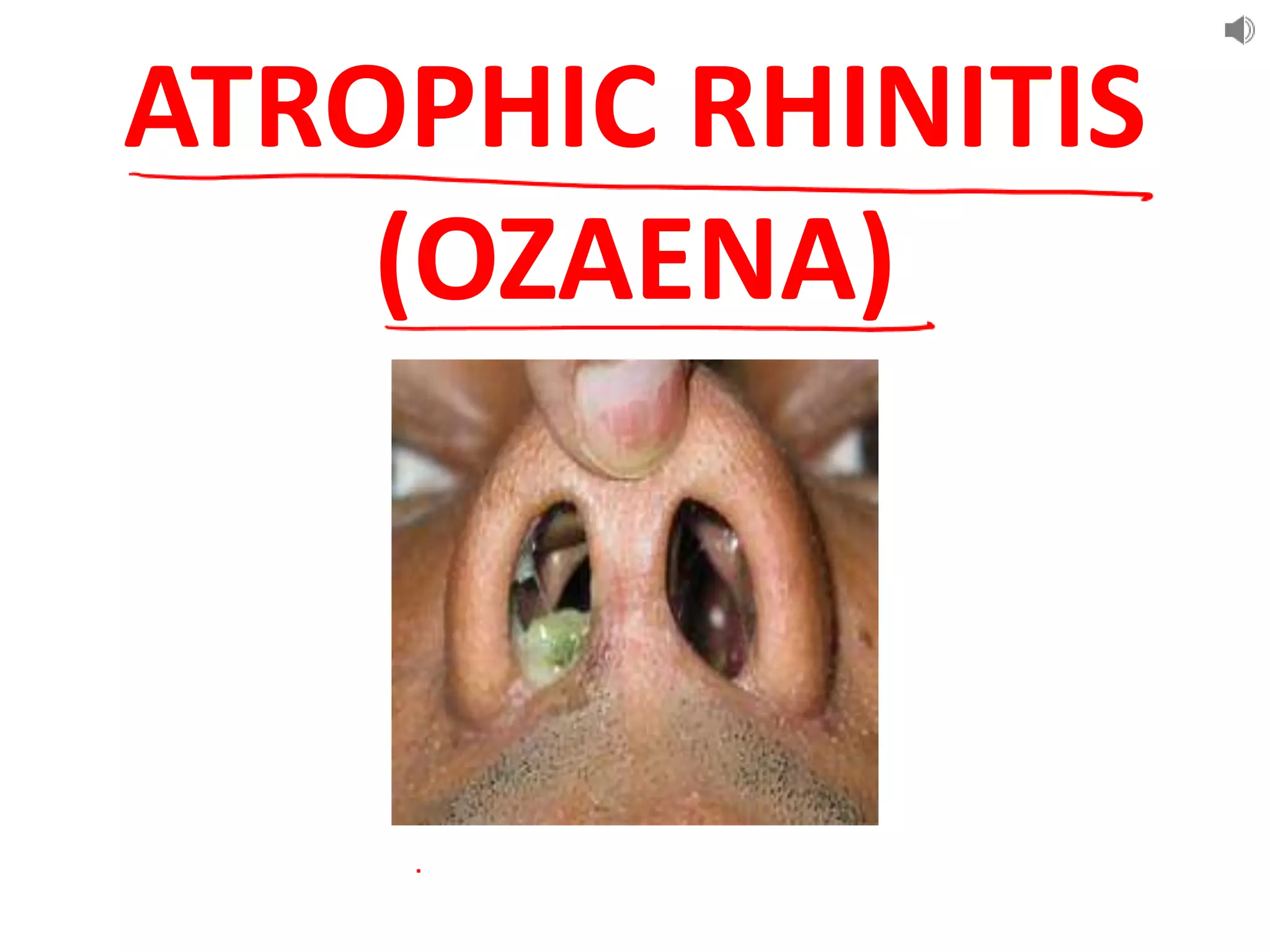
ATROPHIC RHINITIS
(OZAENA)
• DEFINITION: It is a chronic inflammation of
the nasal mucosa resulting in atrophy ,
squamous metaplasia and crust formation
due to periarterial fibrosis and end arteritis.
• Key-points:
– Atrophy of the nasal mucosa and turbinate.
– Scanty viscid secretion
– Loss of ciliated columnar epithelium
– Crust formation
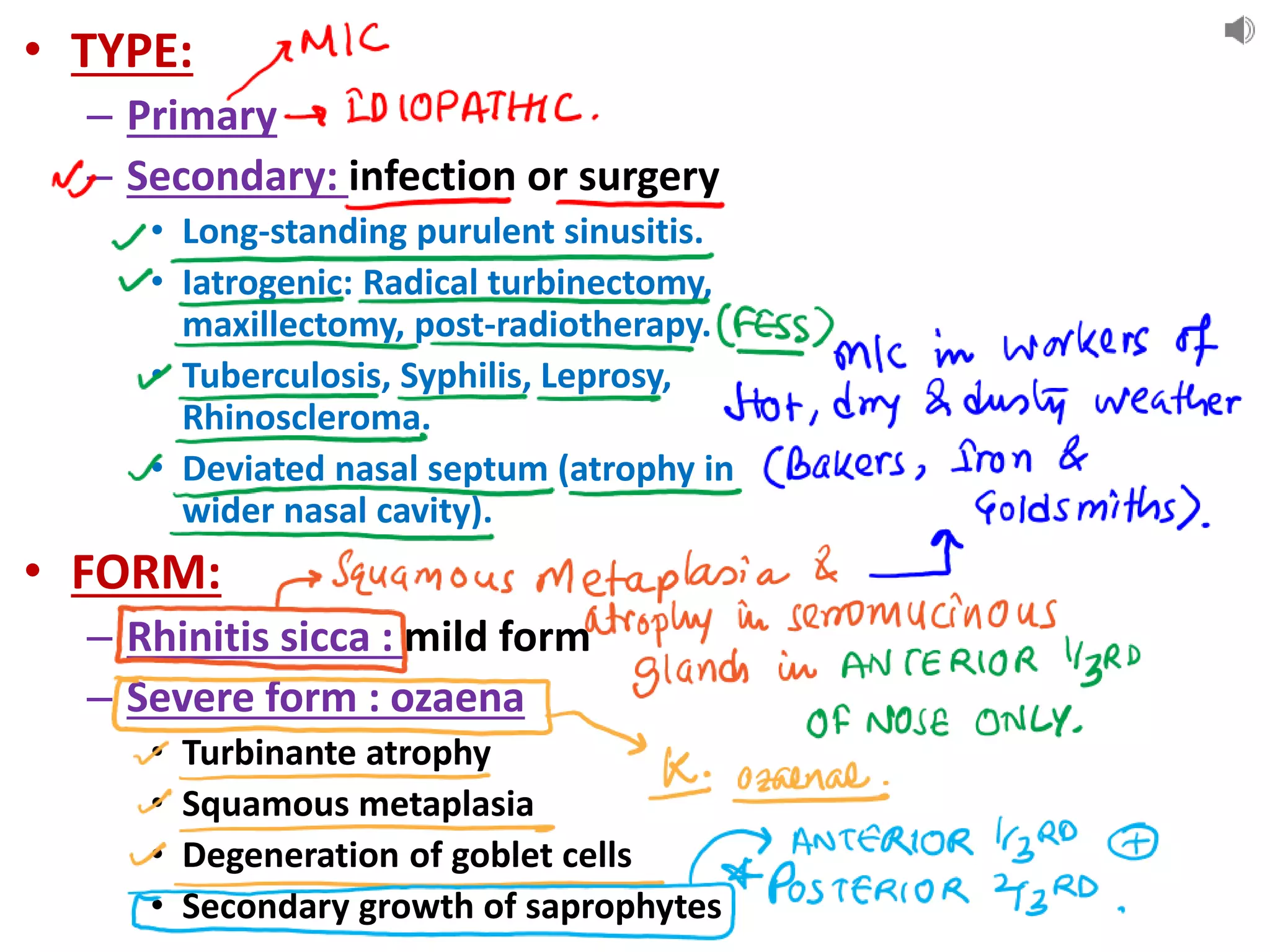
• TYPE:
– Primary
– Secondary: infection or surgery
• Long-standing purulent sinusitis.
• Iatrogenic: Radical turbinectomy,
maxillectomy, post-radiotherapy.
• Tuberculosis, Syphilis, Leprosy,
Rhinoscleroma.
• Deviated nasal septum (atrophy in
wider nasal cavity).
• FORM:
– Rhinitis sicca : mild form
– Severe form : ozaena
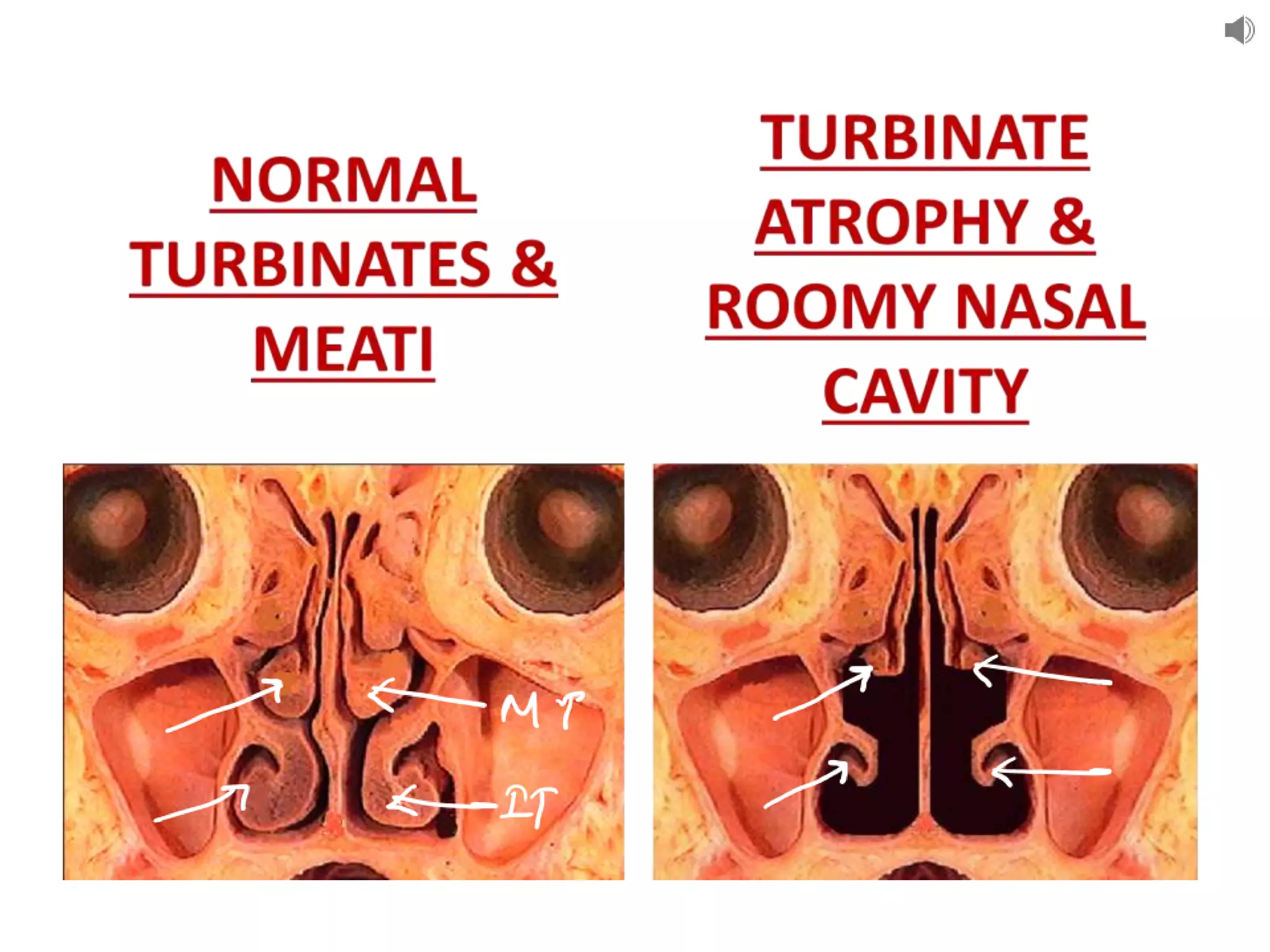
• Turbinante atrophy
• Squamous metaplasia
• Degeneration of goblet cells
• Secondary growth of saprophytes
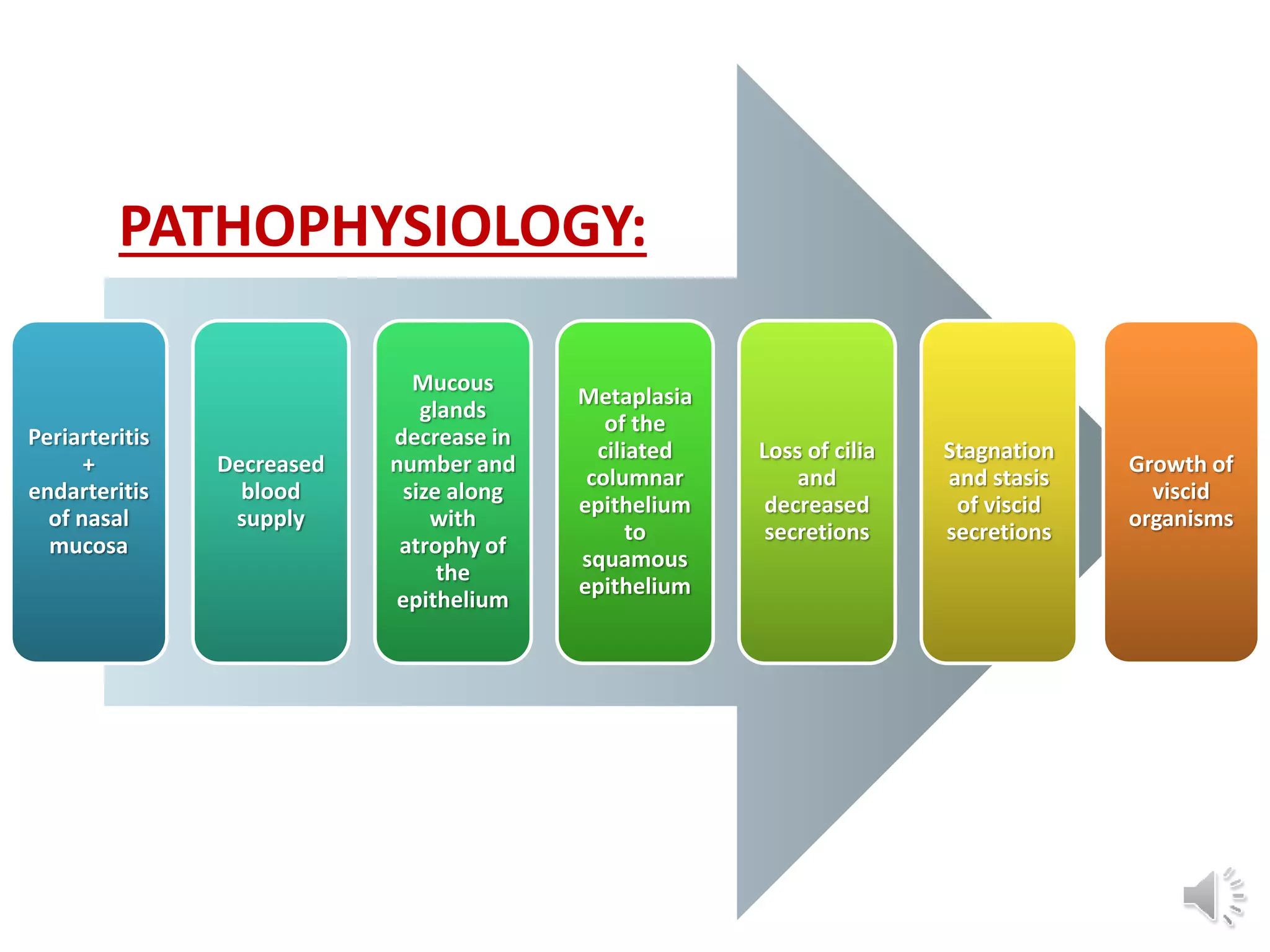
Periarteritis
+
endarteritis
of nasal
mucosa
Decreased
blood
supply
Mucous
glands
decrease in
number and
size along
with
atrophy of
the
epithelium
Metaplasia
of the
ciliated
columnar
epithelium
to
squamous
epithelium
Loss of cilia
and
decreased
secretions
Stagnation
and stasis
of viscid
secretions
Growth of
viscid
organisms
PATHOPHYSIOLOGY:
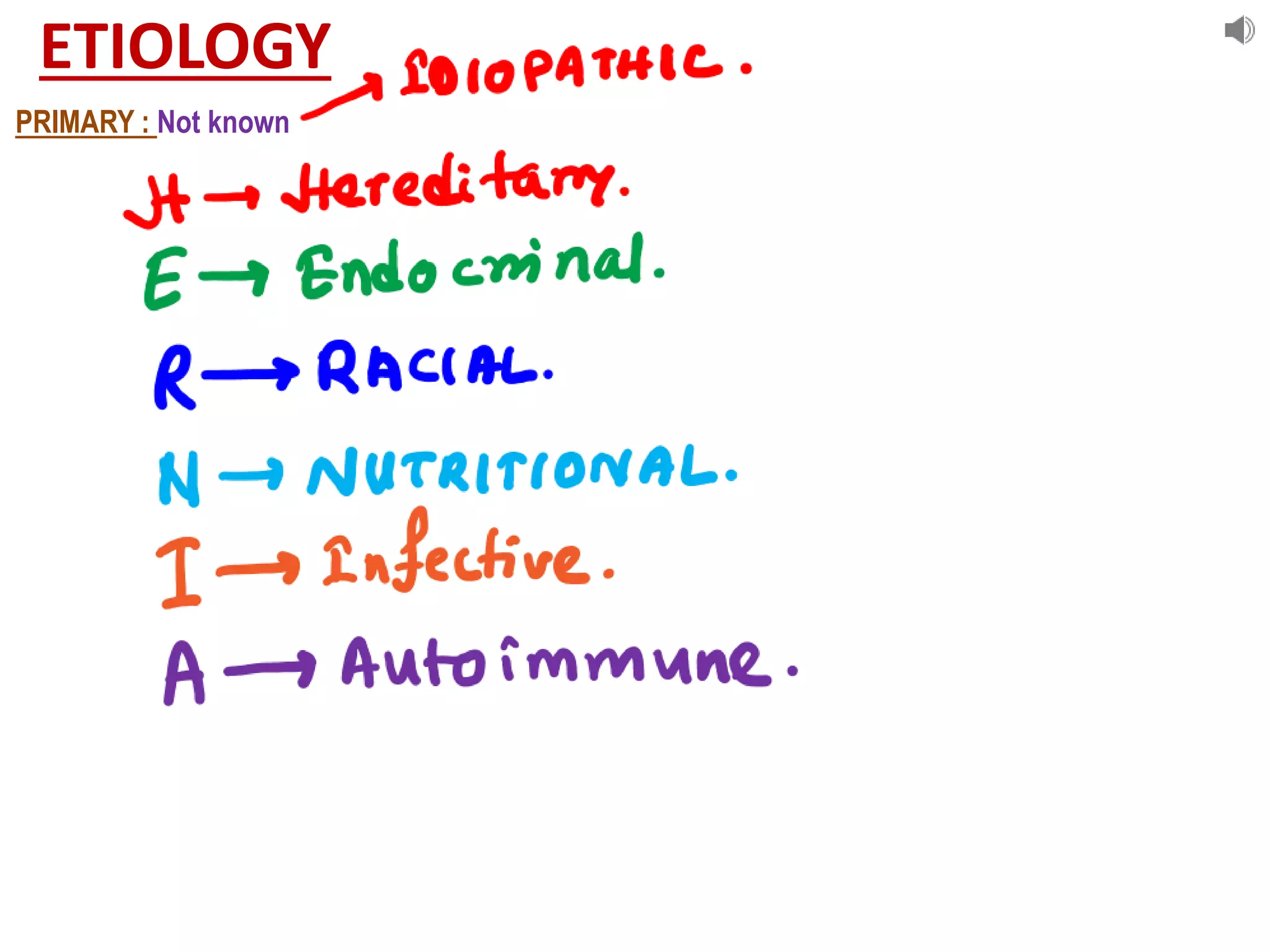
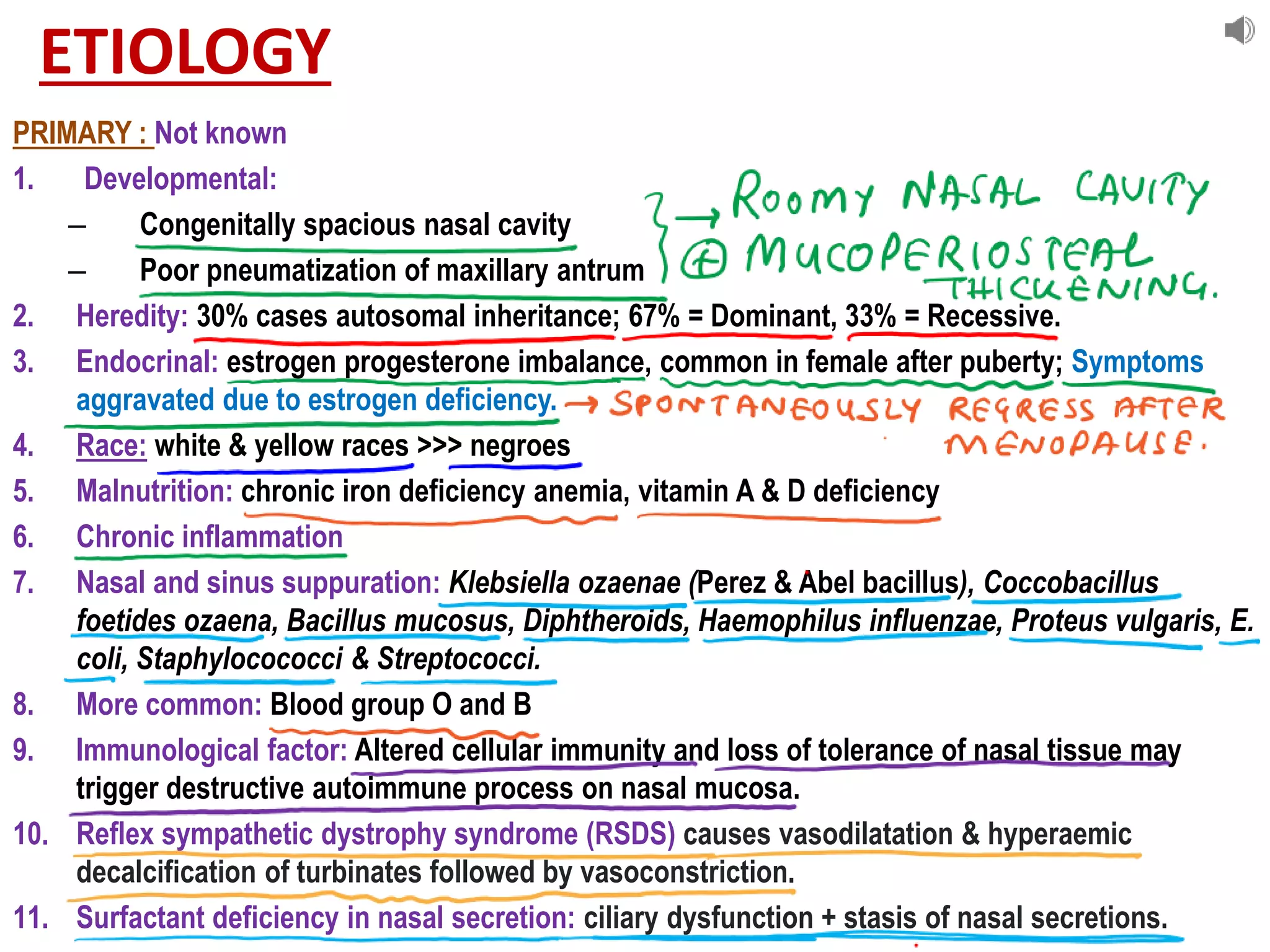
ETIOLOGY
PRIMARY : Not known
ETIOLOGY
PRIMARY : Not known
1. Developmental:
– Congenitally spacious nasal cavity
– Poor pneumatization of maxillary antrum
2. Heredity: 30% cases autosomal inheritance; 67% = Dominant, 33% = Recessive.
3. Endocrinal: estrogen progesterone imbalance, common in female after puberty; Symptoms
aggravated due to estrogen deficiency.
4. Race: white & yellow races >>> negroes
5. Malnutrition: chronic iron deficiency anemia, vitamin A & D deficiency
6. Chronic inflammation
7. Nasal and sinus suppuration: Klebsiella ozaenae (Perez & Abel bacillus), Coccobacillus
foetides ozaena, Bacillus mucosus, Diphtheroids, Haemophilus influenzae, Proteus vulgaris, E.
coli, Staphylocococci & Streptococci.
8. More common: Blood group O and B
9. Immunological factor: Altered cellular immunity and loss of tolerance of nasal tissue may
trigger destructive autoimmune process on nasal mucosa.
10. Reflex sympathetic dystrophy syndrome (RSDS) causes vasodilatation & hyperaemic
decalcification of turbinates followed by vasoconstriction.
11. Surfactant deficiency in nasal secretion: ciliary dysfunction + stasis of nasal secretions.
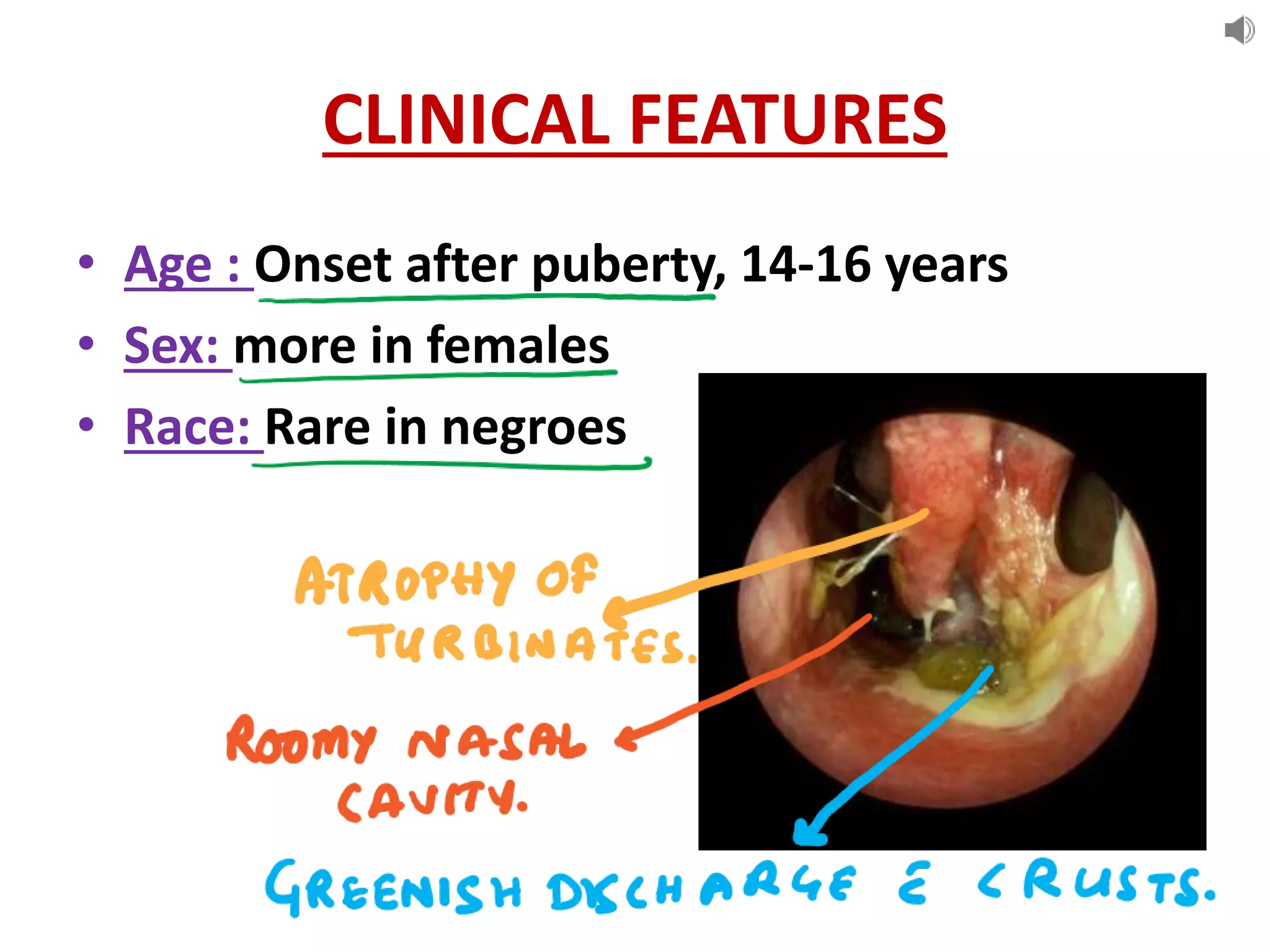
CLINICAL FEATURES
• Age : Onset after puberty, 14-16 years
• Sex: more in females
• Race: Rare in negroes
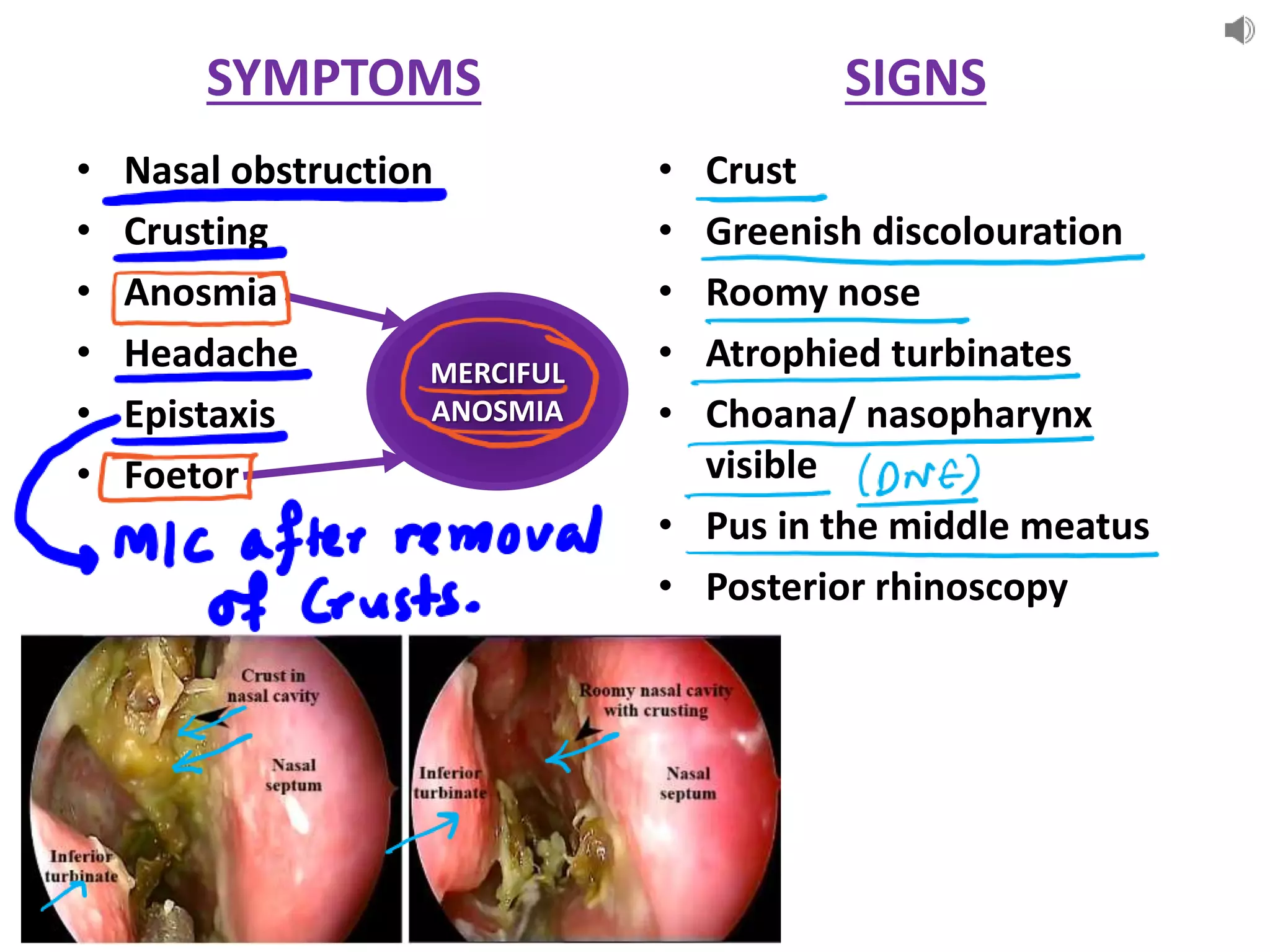
SYMPTOMS
• Nasal obstruction
• Crusting
• Anosmia
• Headache
• Epistaxis
• Foetor
SIGNS
• Crust
• Greenish discolouration
• Roomy nose
• Atrophied turbinates
• Choana/ nasopharynx
visible
• Pus in the middle meatus
• Posterior rhinoscopy
MERCIFUL
ANOSMIA
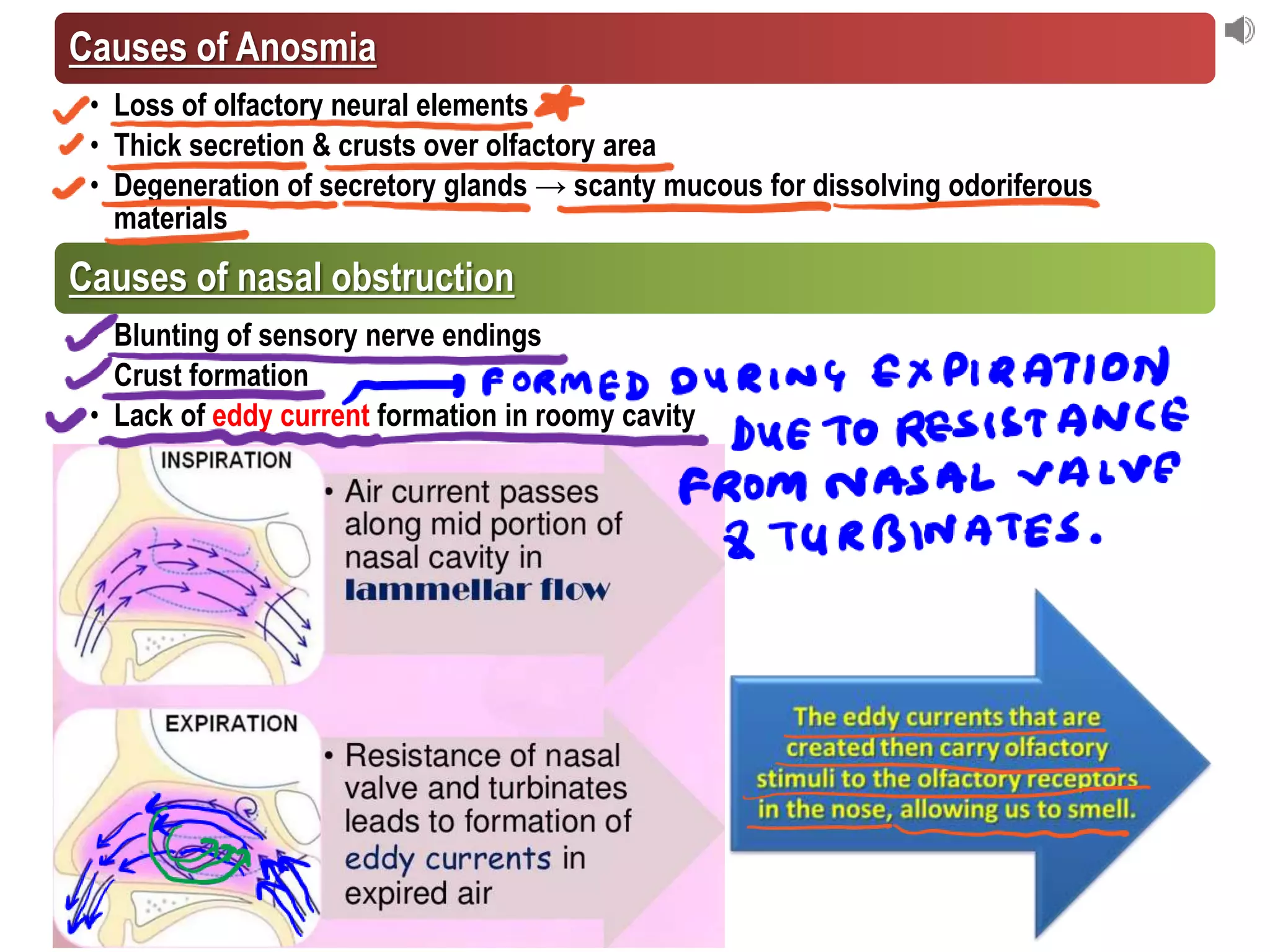
Causes of Anosmia
• Loss of olfactory neural elements
• Thick secretion & crusts over olfactory area
• Degeneration of secretory glands → scanty mucous for dissolving odoriferous
materials
Causes of nasal obstruction
• Blunting of sensory nerve endings
• Crust formation
• Lack of eddy current formation in roomy cavity
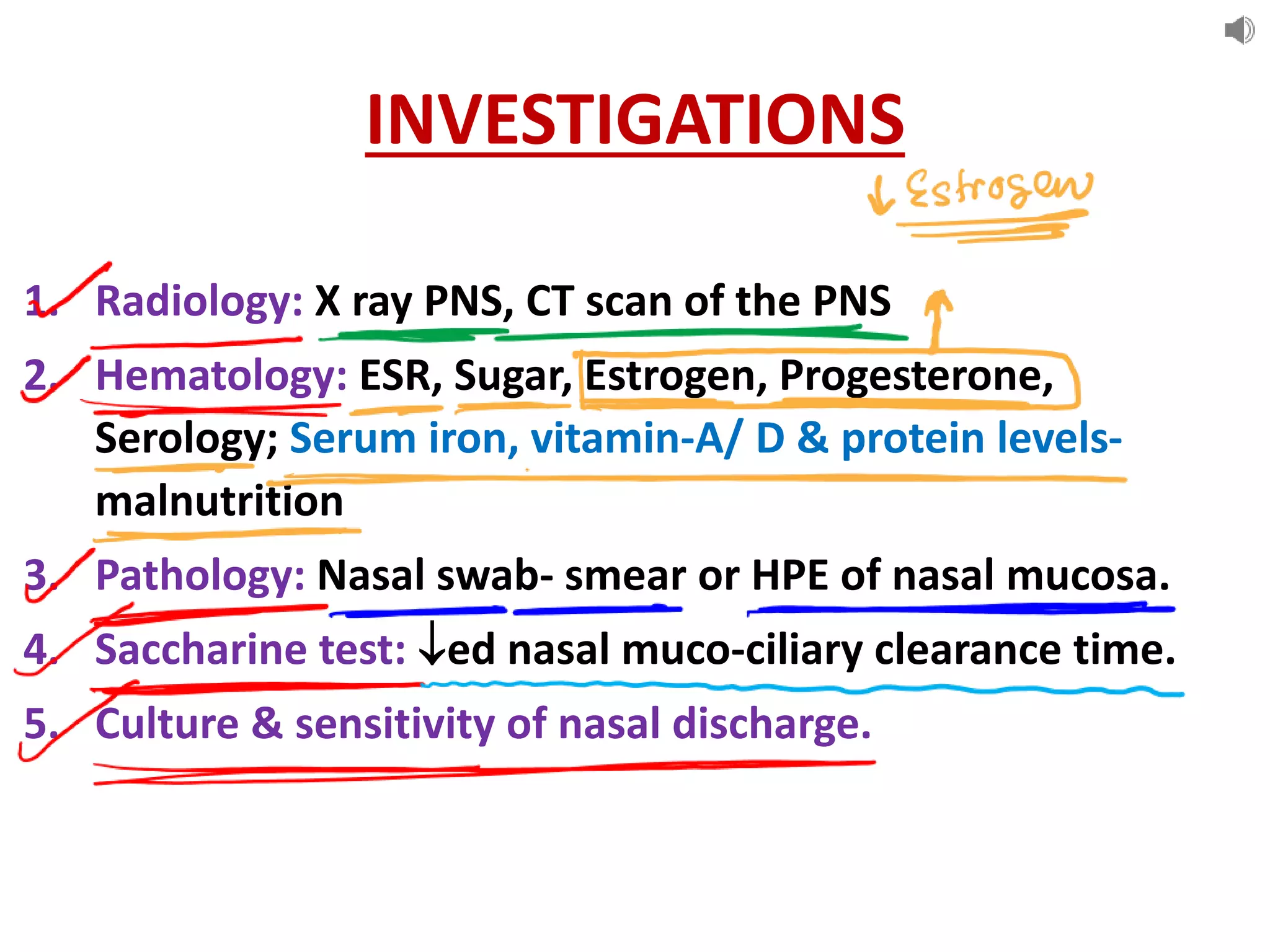
INVESTIGATIONS
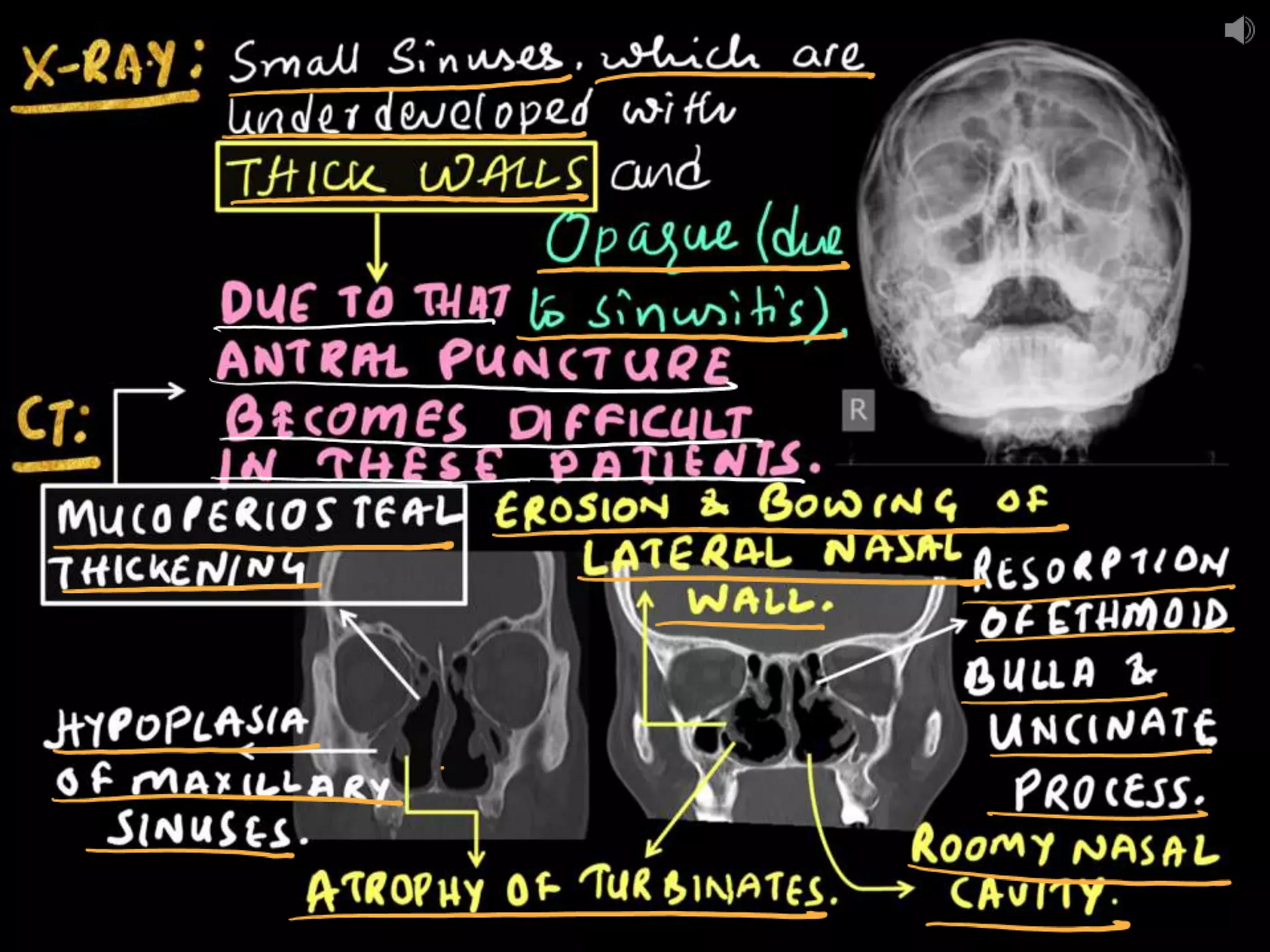
1. Radiology: X ray PNS, CT scan of the PNS
2. Hematology: ESR, Sugar, Estrogen, Progesterone,
Serology; Serum iron, vitamin-A/ D & protein levels-
malnutrition
3. Pathology: Nasal swab- smear or HPE of nasal mucosa.
4. Saccharine test: ed nasal muco-ciliary clearance time.
5. Culture & sensitivity of nasal discharge.
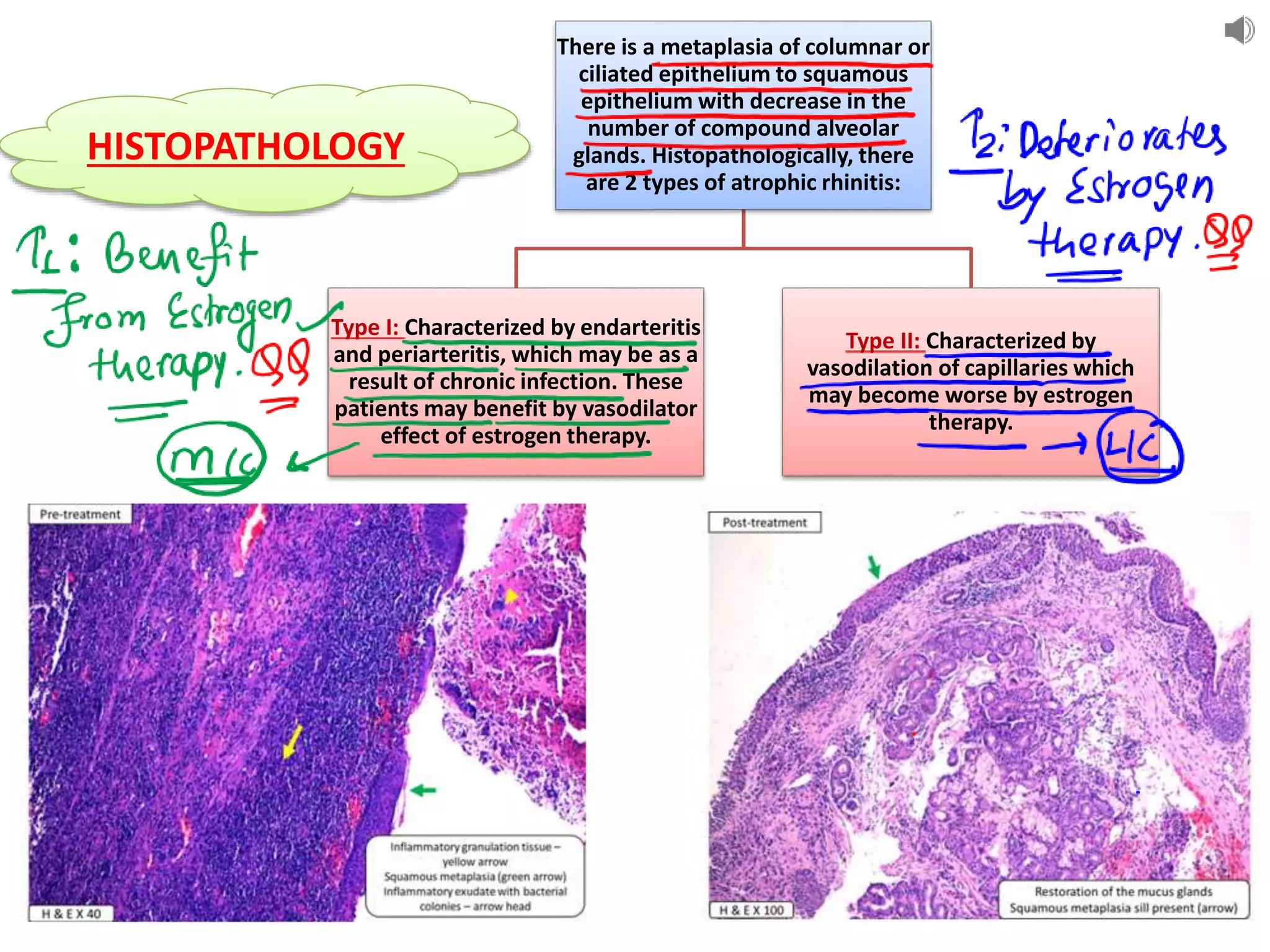
There is a metaplasia of columnar or
ciliated epithelium to squamous
epithelium with decrease in the
number of compound alveolar
glands. Histopathologically, there
are 2 types of atrophic rhinitis:
Type I: Characterized by endarteritis
and periarteritis, which may be as a
result of chronic infection. These
patients may benefit by vasodilator
effect of estrogen therapy.
Type II: Characterized by
vasodilation of capillaries which
may become worse by estrogen
therapy.
HISTOPATHOLOGY
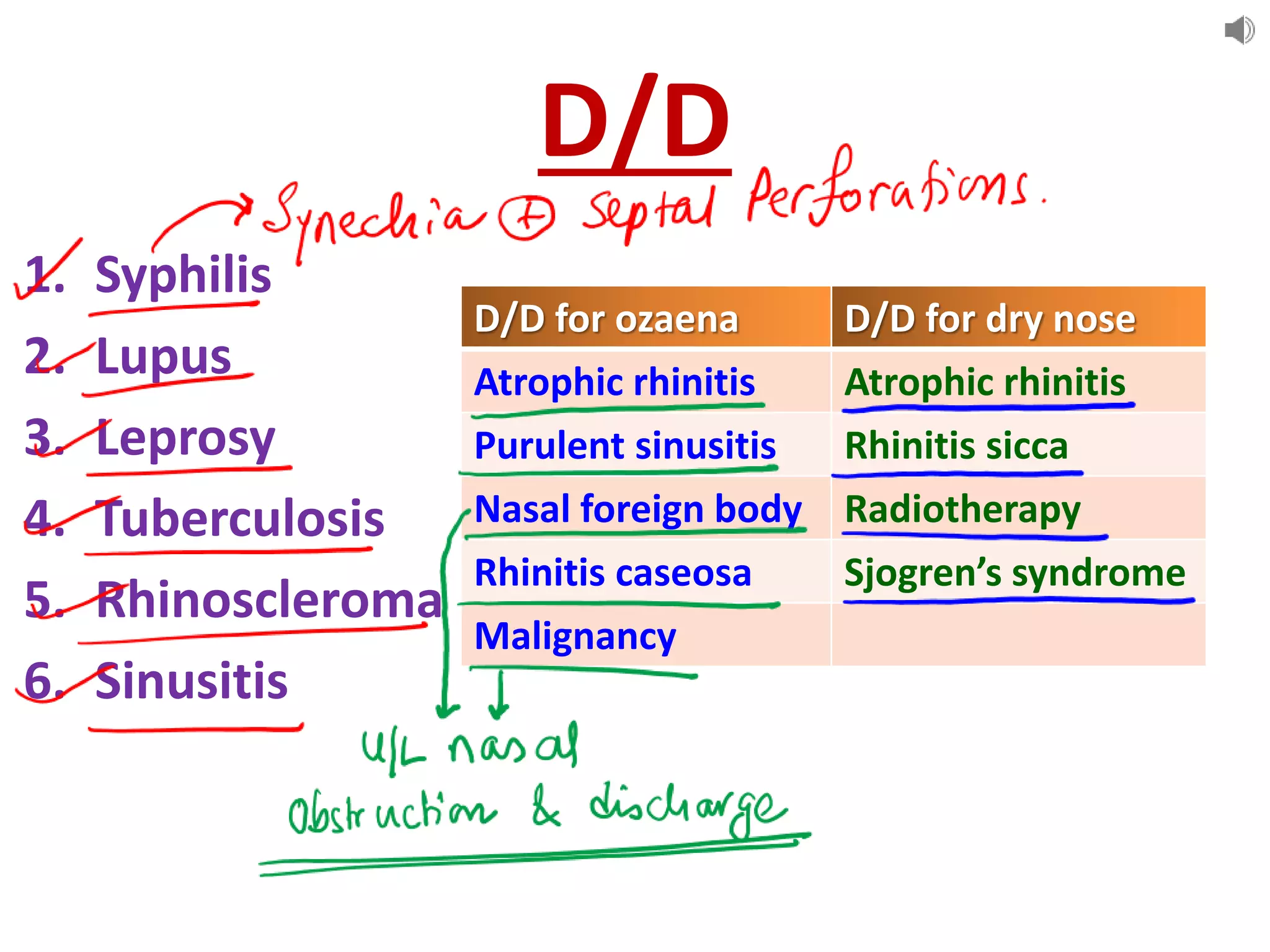
D/D
1. Syphilis
2. Lupus
3. Leprosy
4. Tuberculosis
5. Rhinoscleroma
6. Sinusitis
D/D for ozaena D/D for dry nose
Atrophic rhinitis Atrophic rhinitis
Purulent sinusitis Rhinitis sicca
Nasal foreign body Radiotherapy
Rhinitis caseosa Sjogren’s syndrome
Malignancy
SPECIFIC INVESTIGATIONS TO RULE OUT OTHER D/Ds:
1. Chest X-ray: T.B., bronchiectasis, lung abscess
2. Serology for syphilis: V.D.R.L., T.P.H.A., T.P.I.
3. Sputum for AFB, Mantoux test: T.B.
4. Nasal smear study: Leprosy
5. Complement fixation test & biopsy: Rhinoscleroma
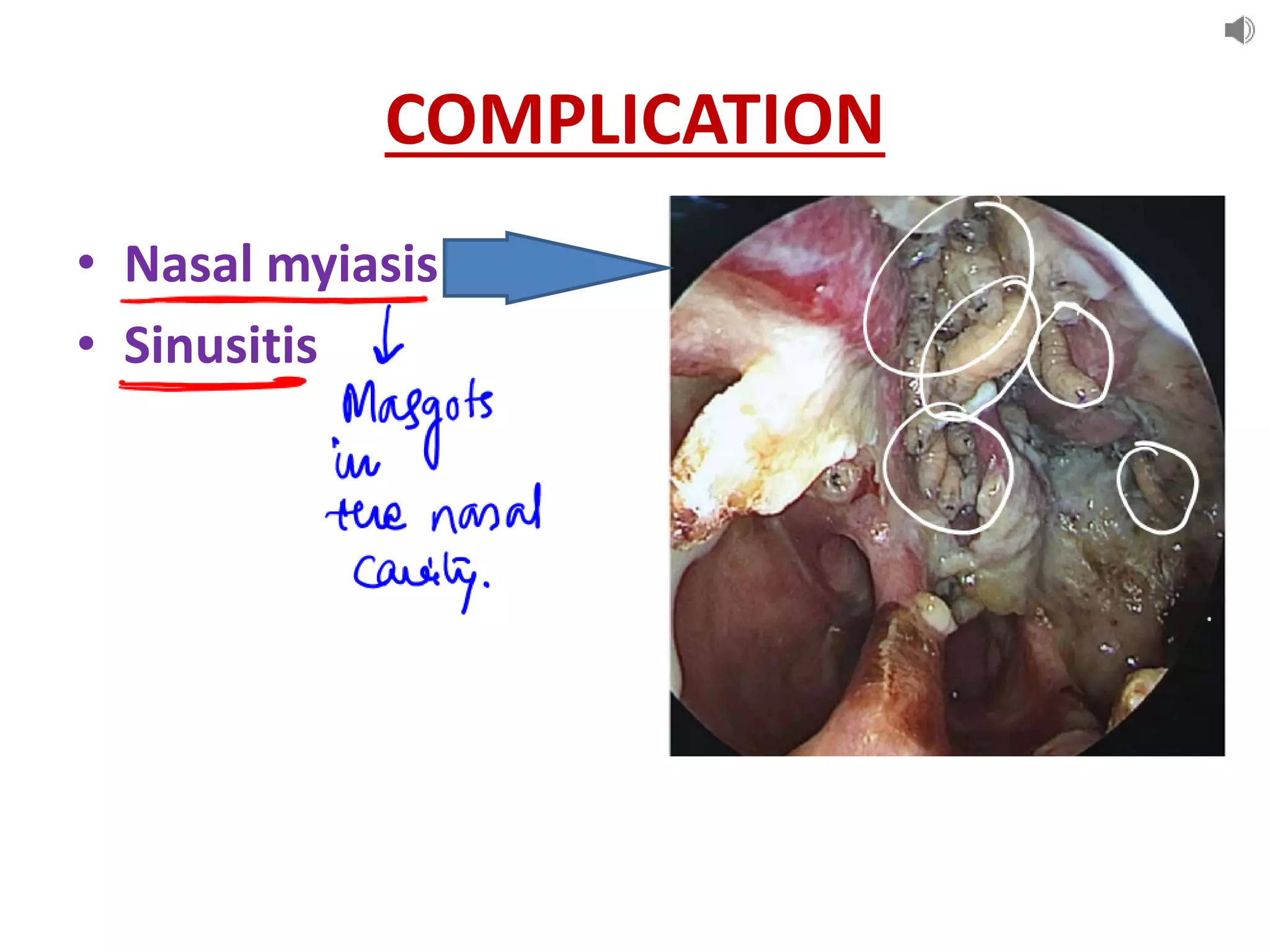
COMPLICATION
• Nasal myiasis
• Sinusitis
TREATMENT
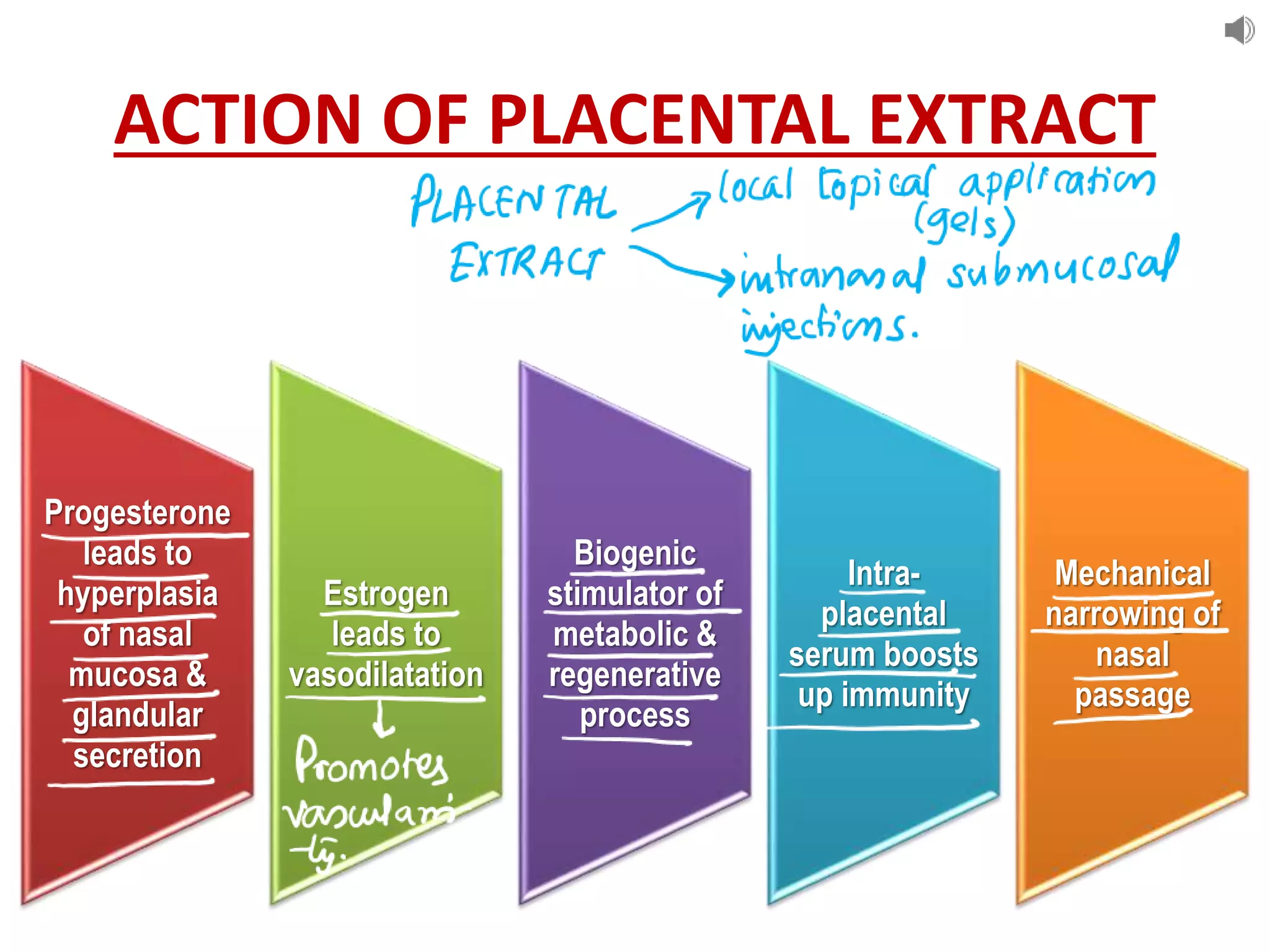
ACTION OF PLACENTAL EXTRACT
Progesterone
leads to
hyperplasia
of nasal
mucosa &
glandular
secretion
Estrogen
leads to
vasodilatation
Biogenic
stimulator of
metabolic &
regenerative
process
Intra-
placental
serum boosts
up immunity
Mechanical
narrowing of
nasal
passage
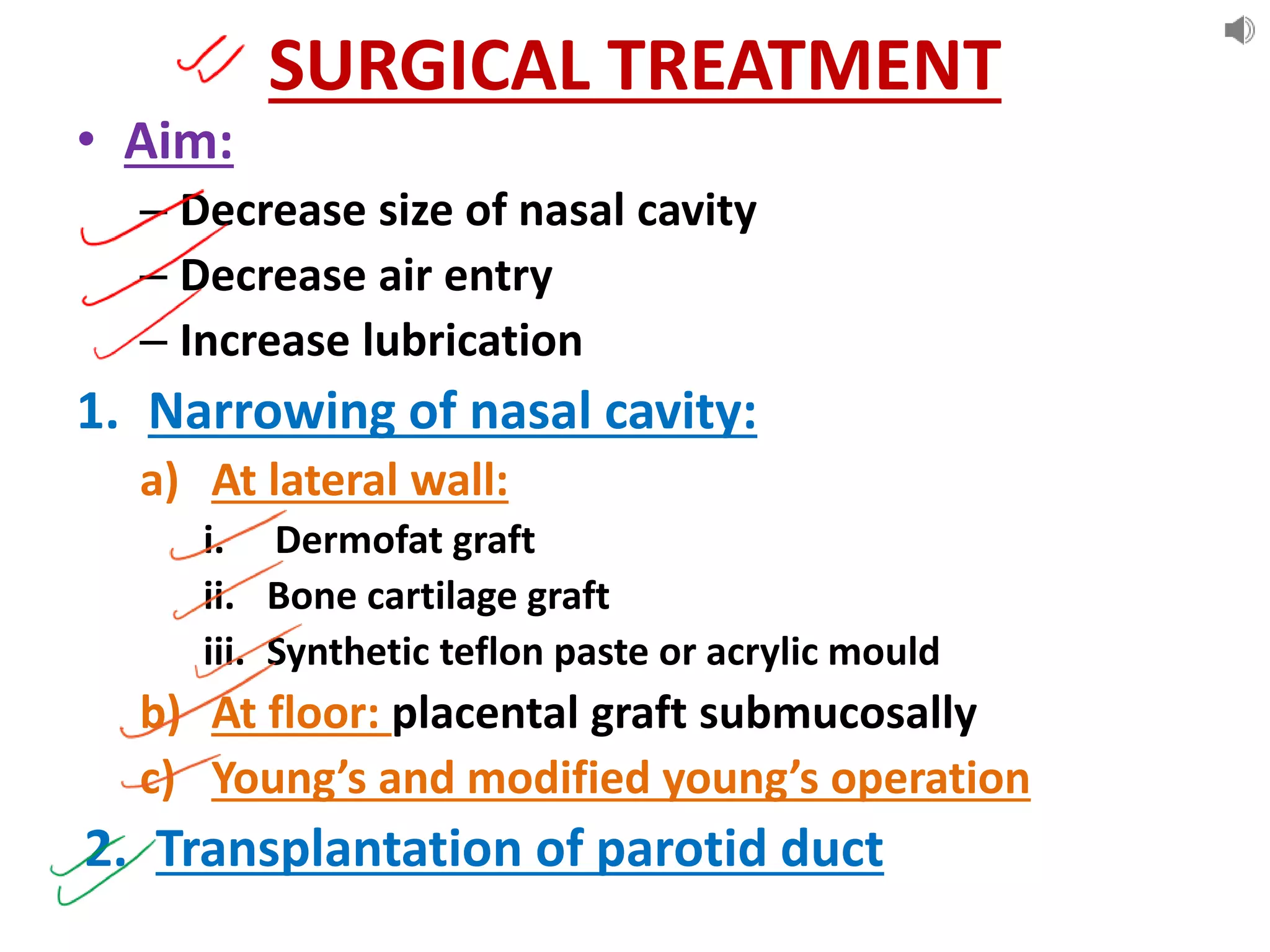
SURGICAL TREATMENT
• Aim:
– Decrease size of nasal cavity
– Decrease air entry
– Increase lubrication
1. Narrowing of nasal cavity:
a) At lateral wall:
i. Dermofat graft
ii. Bone cartilage graft
iii. Synthetic teflon paste or acrylic mould
b) At floor: placental graft submucosally
c) Young’s and modified young’s operation
2. Transplantation of parotid duct
TYPES OF SURGERY
NASAL
CLOSURE
Young
Modified
Young
VOLUME
REDUCTION
Lautenslager
Wilson
Sublabial
implants
Vestibuloplasty
DENERVATION
Cervical
sympathectomy
Stellate
ganglion
block
Sphenopalatine
ganglion block
SALIVARY
IRRIGATION
Parotid duct
implantation
AIM OF SURGERY
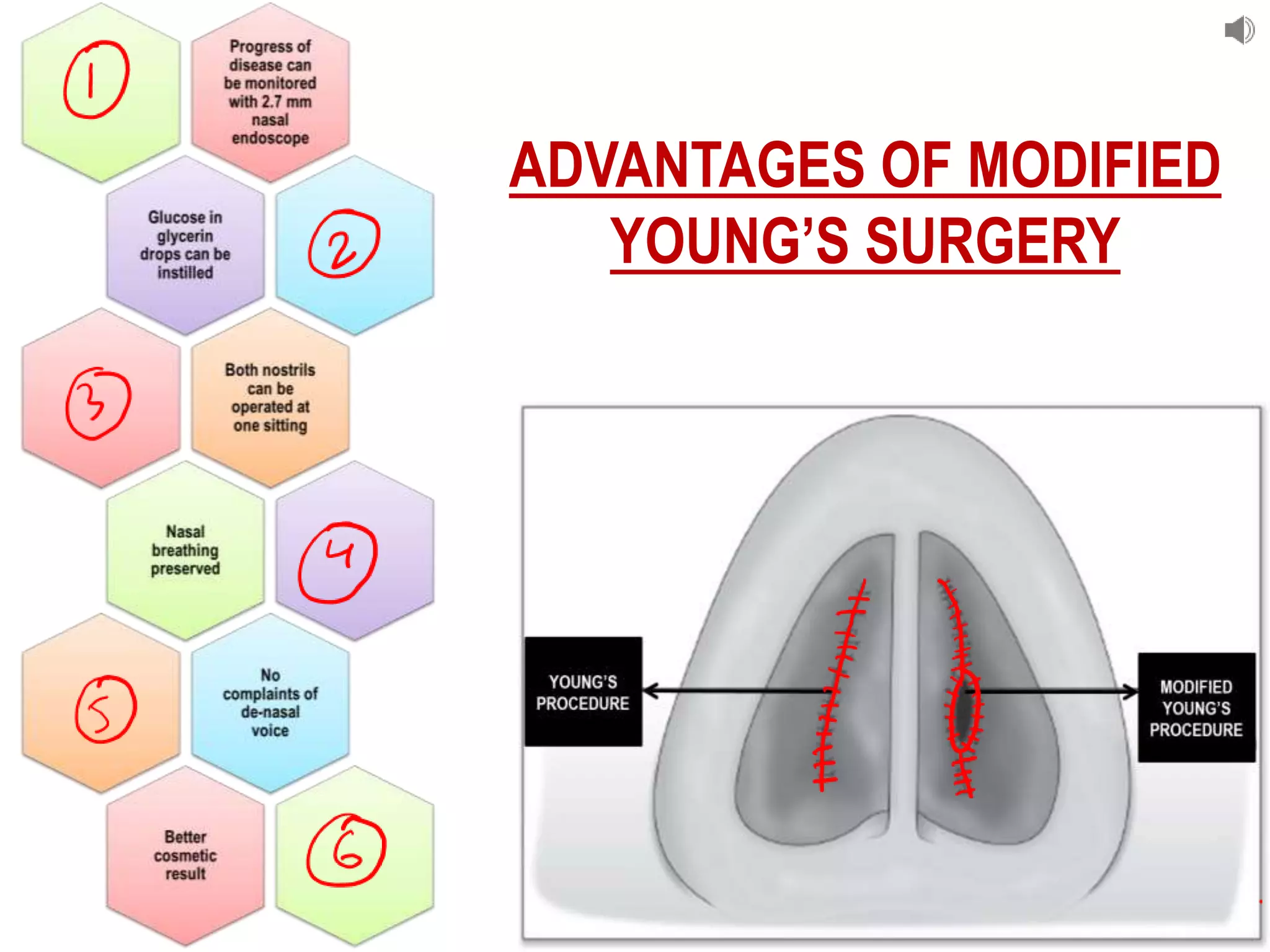
ADVANTAGES OF MODIFIED
YOUNG’S SURGERY
Atrophic rhinitis.pptx

Atrophic rhinitis.pptx

  • 1.
  • 2.
    • DEFINITION: Itis a chronic inflammation of the nasal mucosa resulting in atrophy , squamous metaplasia and crust formation due to periarterial fibrosis and end arteritis. • Key-points: – Atrophy of the nasal mucosa and turbinate. – Scanty viscid secretion – Loss of ciliated columnar epithelium – Crust formation
  • 3.
    • TYPE: – Primary –Secondary: infection or surgery • Long-standing purulent sinusitis. • Iatrogenic: Radical turbinectomy, maxillectomy, post-radiotherapy. • Tuberculosis, Syphilis, Leprosy, Rhinoscleroma. • Deviated nasal septum (atrophy in wider nasal cavity). • FORM: – Rhinitis sicca : mild form – Severe form : ozaena • Turbinante atrophy • Squamous metaplasia • Degeneration of goblet cells • Secondary growth of saprophytes
  • 4.
    Periarteritis + endarteritis of nasal mucosa Decreased blood supply Mucous glands decrease in numberand size along with atrophy of the epithelium Metaplasia of the ciliated columnar epithelium to squamous epithelium Loss of cilia and decreased secretions Stagnation and stasis of viscid secretions Growth of viscid organisms PATHOPHYSIOLOGY:
  • 5.
  • 6.
    ETIOLOGY PRIMARY : Notknown 1. Developmental: – Congenitally spacious nasal cavity – Poor pneumatization of maxillary antrum 2. Heredity: 30% cases autosomal inheritance; 67% = Dominant, 33% = Recessive. 3. Endocrinal: estrogen progesterone imbalance, common in female after puberty; Symptoms aggravated due to estrogen deficiency. 4. Race: white & yellow races >>> negroes 5. Malnutrition: chronic iron deficiency anemia, vitamin A & D deficiency 6. Chronic inflammation 7. Nasal and sinus suppuration: Klebsiella ozaenae (Perez & Abel bacillus), Coccobacillus foetides ozaena, Bacillus mucosus, Diphtheroids, Haemophilus influenzae, Proteus vulgaris, E. coli, Staphylocococci & Streptococci. 8. More common: Blood group O and B 9. Immunological factor: Altered cellular immunity and loss of tolerance of nasal tissue may trigger destructive autoimmune process on nasal mucosa. 10. Reflex sympathetic dystrophy syndrome (RSDS) causes vasodilatation & hyperaemic decalcification of turbinates followed by vasoconstriction. 11. Surfactant deficiency in nasal secretion: ciliary dysfunction + stasis of nasal secretions.
  • 7.
    CLINICAL FEATURES • Age: Onset after puberty, 14-16 years • Sex: more in females • Race: Rare in negroes
  • 8.
    SYMPTOMS • Nasal obstruction •Crusting • Anosmia • Headache • Epistaxis • Foetor SIGNS • Crust • Greenish discolouration • Roomy nose • Atrophied turbinates • Choana/ nasopharynx visible • Pus in the middle meatus • Posterior rhinoscopy MERCIFUL ANOSMIA
  • 9.
    Causes of Anosmia •Loss of olfactory neural elements • Thick secretion & crusts over olfactory area • Degeneration of secretory glands → scanty mucous for dissolving odoriferous materials Causes of nasal obstruction • Blunting of sensory nerve endings • Crust formation • Lack of eddy current formation in roomy cavity
  • 11.
    INVESTIGATIONS 1. Radiology: Xray PNS, CT scan of the PNS 2. Hematology: ESR, Sugar, Estrogen, Progesterone, Serology; Serum iron, vitamin-A/ D & protein levels- malnutrition 3. Pathology: Nasal swab- smear or HPE of nasal mucosa. 4. Saccharine test: ed nasal muco-ciliary clearance time. 5. Culture & sensitivity of nasal discharge.
  • 13.
    There is ametaplasia of columnar or ciliated epithelium to squamous epithelium with decrease in the number of compound alveolar glands. Histopathologically, there are 2 types of atrophic rhinitis: Type I: Characterized by endarteritis and periarteritis, which may be as a result of chronic infection. These patients may benefit by vasodilator effect of estrogen therapy. Type II: Characterized by vasodilation of capillaries which may become worse by estrogen therapy. HISTOPATHOLOGY
  • 14.
    D/D 1. Syphilis 2. Lupus 3.Leprosy 4. Tuberculosis 5. Rhinoscleroma 6. Sinusitis D/D for ozaena D/D for dry nose Atrophic rhinitis Atrophic rhinitis Purulent sinusitis Rhinitis sicca Nasal foreign body Radiotherapy Rhinitis caseosa Sjogren’s syndrome Malignancy
  • 15.
    SPECIFIC INVESTIGATIONS TORULE OUT OTHER D/Ds: 1. Chest X-ray: T.B., bronchiectasis, lung abscess 2. Serology for syphilis: V.D.R.L., T.P.H.A., T.P.I. 3. Sputum for AFB, Mantoux test: T.B. 4. Nasal smear study: Leprosy 5. Complement fixation test & biopsy: Rhinoscleroma
  • 16.
  • 17.
  • 18.
    ACTION OF PLACENTALEXTRACT Progesterone leads to hyperplasia of nasal mucosa & glandular secretion Estrogen leads to vasodilatation Biogenic stimulator of metabolic & regenerative process Intra- placental serum boosts up immunity Mechanical narrowing of nasal passage
  • 19.
    SURGICAL TREATMENT • Aim: –Decrease size of nasal cavity – Decrease air entry – Increase lubrication 1. Narrowing of nasal cavity: a) At lateral wall: i. Dermofat graft ii. Bone cartilage graft iii. Synthetic teflon paste or acrylic mould b) At floor: placental graft submucosally c) Young’s and modified young’s operation 2. Transplantation of parotid duct
  • 20.
  • 21.
  • 23.