Dr. Chandni P Engoor
PG Resident
Dept of ENT
CHOLESTEATOMA & ATTICO
ANTRAL DISEASE
CHRONIC SUPPURATIVE
OTITIS MEDIA (CSOM)
Long standing infection of a part or whole of the middle
ear cleft characterized by ear discharge and permanent
perforation
EPIDEMIOLOGY
 Developing countries: more
 Both sexes
 All age groups
 Prevalence rate: 46 per thousands (rural), 16 per
thousands (urban)
TYPES
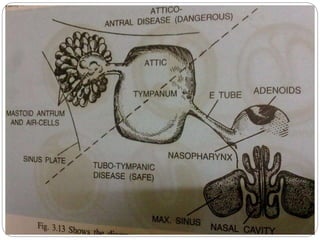
TUBOTYMPANIC
ATTICOANTRAL
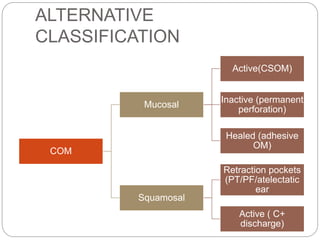
ALTERNATIVE
CLASSIFICATION
COM
Mucosal
Active(CSOM)
Inactive (permanent
perforation)
Healed (adhesive
OM)
Squamosal
Retraction pockets
(PT/PF/atelectatic
ear
Active ( C+
discharge)
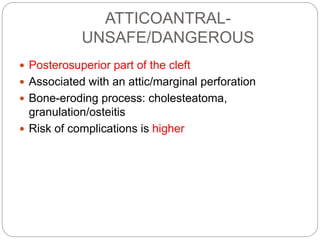
ATTICOANTRAL-
UNSAFE/DANGEROUS
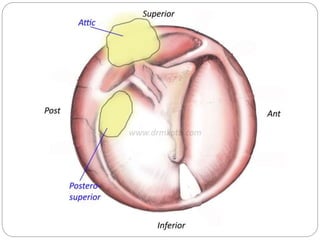
 Posterosuperior part of the cleft
 Associated with an attic/marginal perforation
 Bone-eroding process: cholesteatoma,
granulation/osteitis
 Risk of complications is higher
AETIOLOGY
• It is seen in sclerotic mastoid
• cholesteatoma
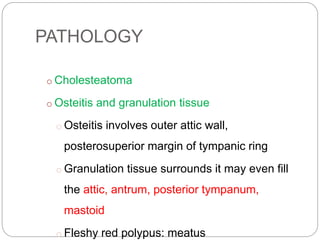
PATHOLOGY
o Cholesteatoma
o Osteitis and granulation tissue
o Osteitis involves outer attic wall,
posterosuperior margin of tympanic ring
o Granulation tissue surrounds it may even fill
the attic, antrum, posterior tympanum,
mastoid
o Fleshy red polypus: meatus
PATHOLOGY
o Ossicular necrosis
o Destruction may be limited to the long
process of incus, may also involves stapes
superstucture, handle of malleus/ entire
ossicular chain
o Greater hearing loss
o Cholesteatoma hearer
o Cholesterol granuloma
o Mass of granulation tissue with foreign body
giant cells surrounding the cholesterol
crystals.
CHOLESTEATOMA -
DEFINITION
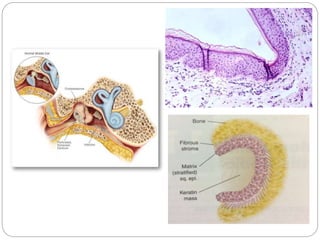
 presence of keratinizing squamous
epithelium in the middle ear or mastoid
 “skin in the wrong place”
 2 parts
 Matrix
 Central white mass
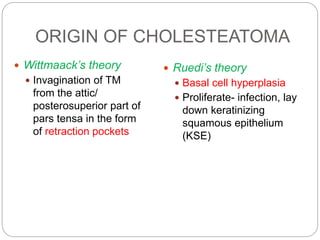
ORIGIN OF CHOLESTEATOMA
Congenital cell rests
Wittmaack’s theory
Ruedi’s theory
Habermann’s theory
Sade’s theory
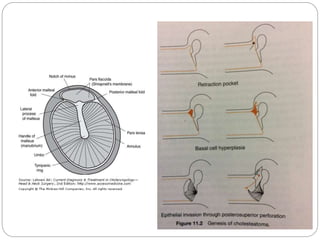
ORIGIN OF CHOLESTEATOMA
 Ruedi’s theory
 Basal cell hyperplasia
 Proliferate- infection, lay
down keratinizing
squamous epithelium
(KSE)
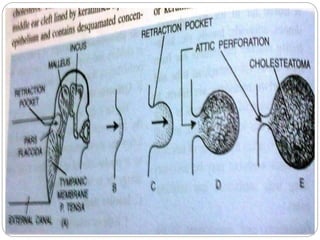
 Wittmaack’s theory
 Invagination of TM
from the attic/
posterosuperior part of
pars tensa in the form
of retraction pockets
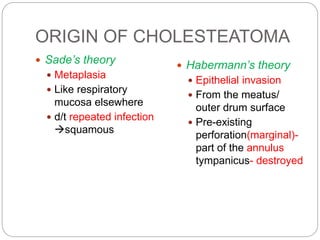
ORIGIN OF CHOLESTEATOMA
 Sade’s theory
 Metaplasia
 Like respiratory
mucosa elsewhere
 d/t repeated infection
squamous
 Habermann’s theory
 Epithelial invasion
 From the meatus/
outer drum surface
 Pre-existing
perforation(marginal)-
part of the annulus
tympanicus- destroyed
CLASSIFICATION
CONGENITAL
ACQUIRED, 1’
ACQUIRED,2’
CONGENITAL
CHOLESTEATOMA
 Embroyonic epidermal cell rests in the middle ear
cleft/ temporal bone
 Middle ear, petrous apex,
cerebellopontine angle
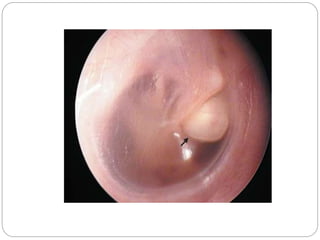
 Middle ear: white mass behind an intact tympanic
membrane conductive hearing loss
 Discovered: routine exam/myringotomy
 May spontaneously rupture- TM discharging
ear
PRIMARY ACQUIRED
CHOLESTEATOMA
 No h/o previous OM/ pre-existing perforation
 Invagination of pars flaccida
 Persistent negative pressure in the attic retraction
pocket which accumulates keratin debris.
 Infected expand middle ear
 Basal cell hyperplasia
 Proliferation of the basal layers of PF induced by
subclinical childhood infection
 Squamous metaplasia
 Normal pavement epithelium of attic undergoes
metaplasia, keratinizing squamous epithelium
SECONDARY ACQUIRED
CHOLESTEATOMA
 Already a pre-existing perforation in pars
tensa
 Associated with posterosuperior marginal
perforation
 Migration of squamous epithelium
 KSE of EAC/ outer surface of TM migrates through
the perforation into the middle ear
 Metaplasia: repeated infections of middle ear- pre-
existing perforation
Bone erosion
• By liberation of chemical
• Ischaemic necrosis theory
• Enzymatic theory: collagenase, acid
phoaphate and proteolytic enzyme
• Passes from aditus to antrum of mastoid further
spread causing many complication
• Hence called as dangerous om
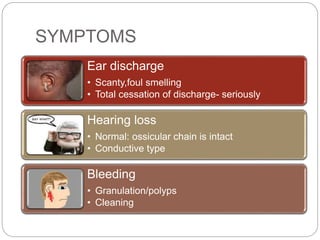
SYMPTOMS
Ear discharge
• Scanty,foul smelling
• Total cessation of discharge- seriously
Hearing loss
• Normal: ossicular chain is intact
• Conductive type
Bleeding
• Granulation/polyps
• Cleaning
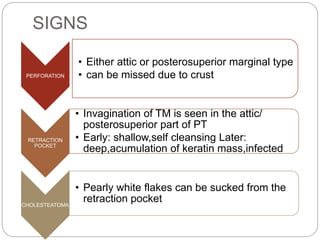
SIGNS
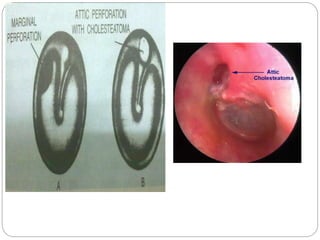
PERFORATION
• Either attic or posterosuperior marginal type
• can be missed due to crust
RETRACTION
POCKET
• Invagination of TM is seen in the attic/
posterosuperior part of PT
• Early: shallow,self cleansing Later:
deep,acumulation of keratin mass,infected
CHOLESTEATOMA
• Pearly white flakes can be sucked from the
retraction pocket
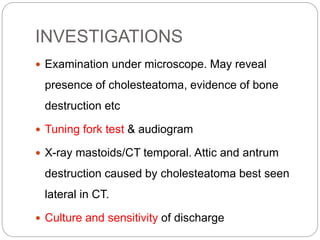
INVESTIGATIONS
 Examination under microscope. May reveal
presence of cholesteatoma, evidence of bone
destruction etc
 Tuning fork test & audiogram
 X-ray mastoids/CT temporal. Attic and antrum
destruction caused by cholesteatoma best seen
lateral in CT.
 Culture and sensitivity of discharge
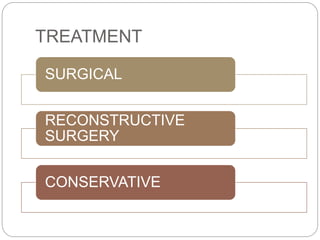
TREATMENT
SURGICAL
RECONSTRUCTIVE
SURGERY
CONSERVATIVE
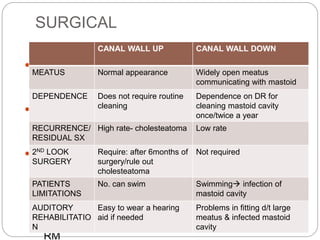
SURGICAL
 Primary aim is to
remove disease,
render ear safe
 Secondary aim to
preserve or reconstruct
hearing
 CWD:
 Mastoid cavity open
 Diseased area is fully
exteriorized
 Atticotomy,modified
radical mastoidectomy,
RM
CWU
Approach by meatus,
mastoid but retained
the posterior bony
meatal wall intact
Dry ears, permits
easy reconstruction of
hearing mechanism
CANAL WALL UP CANAL WALL DOWN
MEATUS Normal appearance Widely open meatus
communicating with mastoid
DEPENDENCE Does not require routine
cleaning
Dependence on DR for
cleaning mastoid cavity
once/twice a year
RECURRENCE/
RESIDUAL SX
High rate- cholesteatoma Low rate
2ND LOOK
SURGERY
Require: after 6months of
surgery/rule out
cholesteatoma
Not required
PATIENTS
LIMITATIONS
No. can swim Swimming infection of
mastoid cavity
AUDITORY
REHABILITATIO
N
Easy to wear a hearing
aid if needed
Problems in fitting d/t large
meatus & infected mastoid
cavity
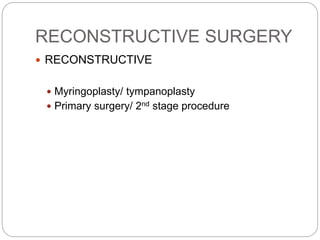
RECONSTRUCTIVE SURGERY
 RECONSTRUCTIVE
 Myringoplasty/ tympanoplasty
 Primary surgery/ 2nd stage procedure
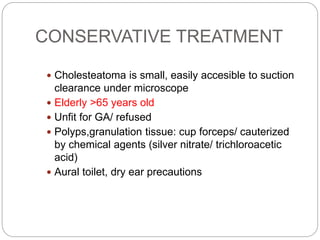
CONSERVATIVE TREATMENT
 Cholesteatoma is small, easily accesible to suction
clearance under microscope
 Elderly >65 years old
 Unfit for GA/ refused
 Polyps,granulation tissue: cup forceps/ cauterized
by chemical agents (silver nitrate/ trichloroacetic
acid)
 Aural toilet, dry ear precautions
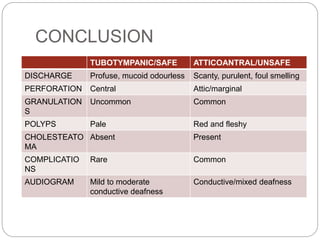
CONCLUSION
TUBOTYMPANIC/SAFE ATTICOANTRAL/UNSAFE
DISCHARGE Profuse, mucoid odourless Scanty, purulent, foul smelling
PERFORATION Central Attic/marginal
GRANULATION
S
Uncommon Common
POLYPS Pale Red and fleshy
CHOLESTEATO
MA
Absent Present
COMPLICATIO
NS
Rare Common
AUDIOGRAM Mild to moderate
conductive deafness
Conductive/mixed deafness

Attico antral disease

  • 1.
    Dr. Chandni PEngoor PG Resident Dept of ENT CHOLESTEATOMA & ATTICO ANTRAL DISEASE
  • 2.
    CHRONIC SUPPURATIVE OTITIS MEDIA(CSOM) Long standing infection of a part or whole of the middle ear cleft characterized by ear discharge and permanent perforation
  • 3.
    EPIDEMIOLOGY  Developing countries:more  Both sexes  All age groups  Prevalence rate: 46 per thousands (rural), 16 per thousands (urban)
  • 4.
  • 5.
  • 6.
    ATTICOANTRAL- UNSAFE/DANGEROUS  Posterosuperior partof the cleft  Associated with an attic/marginal perforation  Bone-eroding process: cholesteatoma, granulation/osteitis  Risk of complications is higher
  • 7.
    AETIOLOGY • It isseen in sclerotic mastoid • cholesteatoma
  • 8.
    PATHOLOGY o Cholesteatoma o Osteitisand granulation tissue o Osteitis involves outer attic wall, posterosuperior margin of tympanic ring o Granulation tissue surrounds it may even fill the attic, antrum, posterior tympanum, mastoid o Fleshy red polypus: meatus
  • 9.
    PATHOLOGY o Ossicular necrosis oDestruction may be limited to the long process of incus, may also involves stapes superstucture, handle of malleus/ entire ossicular chain o Greater hearing loss o Cholesteatoma hearer o Cholesterol granuloma o Mass of granulation tissue with foreign body giant cells surrounding the cholesterol crystals.
  • 10.
    CHOLESTEATOMA - DEFINITION  presenceof keratinizing squamous epithelium in the middle ear or mastoid  “skin in the wrong place”  2 parts  Matrix  Central white mass
  • 12.
    ORIGIN OF CHOLESTEATOMA Congenitalcell rests Wittmaack’s theory Ruedi’s theory Habermann’s theory Sade’s theory
  • 13.
    ORIGIN OF CHOLESTEATOMA Ruedi’s theory  Basal cell hyperplasia  Proliferate- infection, lay down keratinizing squamous epithelium (KSE)  Wittmaack’s theory  Invagination of TM from the attic/ posterosuperior part of pars tensa in the form of retraction pockets
  • 16.
    ORIGIN OF CHOLESTEATOMA Sade’s theory  Metaplasia  Like respiratory mucosa elsewhere  d/t repeated infection squamous  Habermann’s theory  Epithelial invasion  From the meatus/ outer drum surface  Pre-existing perforation(marginal)- part of the annulus tympanicus- destroyed
  • 17.
  • 18.
    CONGENITAL CHOLESTEATOMA  Embroyonic epidermalcell rests in the middle ear cleft/ temporal bone  Middle ear, petrous apex, cerebellopontine angle  Middle ear: white mass behind an intact tympanic membrane conductive hearing loss  Discovered: routine exam/myringotomy  May spontaneously rupture- TM discharging ear
  • 20.
    PRIMARY ACQUIRED CHOLESTEATOMA  Noh/o previous OM/ pre-existing perforation  Invagination of pars flaccida  Persistent negative pressure in the attic retraction pocket which accumulates keratin debris.  Infected expand middle ear  Basal cell hyperplasia  Proliferation of the basal layers of PF induced by subclinical childhood infection  Squamous metaplasia  Normal pavement epithelium of attic undergoes metaplasia, keratinizing squamous epithelium
  • 21.
    SECONDARY ACQUIRED CHOLESTEATOMA  Alreadya pre-existing perforation in pars tensa  Associated with posterosuperior marginal perforation  Migration of squamous epithelium  KSE of EAC/ outer surface of TM migrates through the perforation into the middle ear  Metaplasia: repeated infections of middle ear- pre- existing perforation
  • 23.
    Bone erosion • Byliberation of chemical • Ischaemic necrosis theory • Enzymatic theory: collagenase, acid phoaphate and proteolytic enzyme • Passes from aditus to antrum of mastoid further spread causing many complication • Hence called as dangerous om
  • 25.
    SYMPTOMS Ear discharge • Scanty,foulsmelling • Total cessation of discharge- seriously Hearing loss • Normal: ossicular chain is intact • Conductive type Bleeding • Granulation/polyps • Cleaning
  • 26.
    SIGNS PERFORATION • Either atticor posterosuperior marginal type • can be missed due to crust RETRACTION POCKET • Invagination of TM is seen in the attic/ posterosuperior part of PT • Early: shallow,self cleansing Later: deep,acumulation of keratin mass,infected CHOLESTEATOMA • Pearly white flakes can be sucked from the retraction pocket
  • 28.
    INVESTIGATIONS  Examination undermicroscope. May reveal presence of cholesteatoma, evidence of bone destruction etc  Tuning fork test & audiogram  X-ray mastoids/CT temporal. Attic and antrum destruction caused by cholesteatoma best seen lateral in CT.  Culture and sensitivity of discharge
  • 29.
  • 30.
    SURGICAL  Primary aimis to remove disease, render ear safe  Secondary aim to preserve or reconstruct hearing  CWD:  Mastoid cavity open  Diseased area is fully exteriorized  Atticotomy,modified radical mastoidectomy, RM CWU Approach by meatus, mastoid but retained the posterior bony meatal wall intact Dry ears, permits easy reconstruction of hearing mechanism CANAL WALL UP CANAL WALL DOWN MEATUS Normal appearance Widely open meatus communicating with mastoid DEPENDENCE Does not require routine cleaning Dependence on DR for cleaning mastoid cavity once/twice a year RECURRENCE/ RESIDUAL SX High rate- cholesteatoma Low rate 2ND LOOK SURGERY Require: after 6months of surgery/rule out cholesteatoma Not required PATIENTS LIMITATIONS No. can swim Swimming infection of mastoid cavity AUDITORY REHABILITATIO N Easy to wear a hearing aid if needed Problems in fitting d/t large meatus & infected mastoid cavity
  • 31.
    RECONSTRUCTIVE SURGERY  RECONSTRUCTIVE Myringoplasty/ tympanoplasty  Primary surgery/ 2nd stage procedure
  • 32.
    CONSERVATIVE TREATMENT  Cholesteatomais small, easily accesible to suction clearance under microscope  Elderly >65 years old  Unfit for GA/ refused  Polyps,granulation tissue: cup forceps/ cauterized by chemical agents (silver nitrate/ trichloroacetic acid)  Aural toilet, dry ear precautions
  • 33.
    CONCLUSION TUBOTYMPANIC/SAFE ATTICOANTRAL/UNSAFE DISCHARGE Profuse,mucoid odourless Scanty, purulent, foul smelling PERFORATION Central Attic/marginal GRANULATION S Uncommon Common POLYPS Pale Red and fleshy CHOLESTEATO MA Absent Present COMPLICATIO NS Rare Common AUDIOGRAM Mild to moderate conductive deafness Conductive/mixed deafness