Chronic pancreatitis
Presentation, investigations and
medical management
Dr Manoj K Ghoda
Consultant Gastroenterologist
This lecture and many more interesting GI topics
are available on our facebook account
Gujarat Gastro Group
Clinical presentation
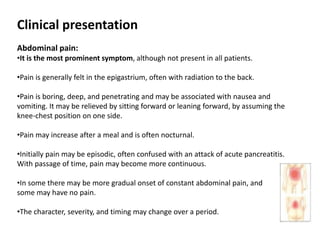
Abdominal pain:
•It is the most prominent symptom, although not present in all patients.
•Pain is generally felt in the epigastrium, often with radiation to the back.
•Pain is boring, deep, and penetrating and may be associated with nausea and
vomiting. It may be relieved by sitting forward or leaning forward, by assuming the
knee-chest position on one side.
•Pain may increase after a meal and is often nocturnal.
•Initially pain may be episodic, often confused with an attack of acute pancreatitis.
With passage of time, pain may become more continuous.
•In some there may be more gradual onset of constant abdominal pain, and
some may have no pain.
•The character, severity, and timing may change over a period.
Weight loss:
•Anorexia leading to weight loss and malnutrition.
•May be seen during painful attacks, which prevent adequate
oral intake.
•Weight loss may also occur owing to the development of a
concomitant disease such as small bowel bacterial overgrowth
or pancreatic or extrapancreatic malignancy.
Steatorrhea:
•Is a feature of far-advanced chronic pancreatitis.
•Pancreatic lipase output decreases earlier and more substantially compared to other
pancreatic enzymes. As bicarbonate secretion decreases in chronic pancreatitis and
duodenal pH drops, lipase is particularly inactivated.
•It takes about 10-15 years before the exocrine deficiency becomes manifest and it
may be present in up to 80% of people after about 30 years of the disease.
•These patients may present with diarrhea or weight loss but a large number of watery
stools is not a feature of chronic pancreatitis.
•Stool may be bulky, foul-smelling with frank oil droplets
• Fat-soluble vitamins’ deficiency may develop in patients with pancreatic steatorrhea
in a rare case.
•Protein or carbohydrate digestion is not usually affected.
Endocrine insufficiency:
•Involves both insulin and glucagon with secondary diabetes.
•Deficiency of both insulin and glucagon leads to a brittle diabetes and insulin in
these patients may lead to prolonged and severe hypoglycemia.
•Diabetes mellitus may become manifest within 10 years in some patients but
ultimately, 40-70% of patients will develop diabetes after prolonged illness.
Diagnosis:
The diagnosis may be difficult in many cases because lack of
histological proof.
•It has two aspects, one being the functional aspect and the
other being the structural aspect.
•Both may be absent in early course of the illness.
Functional diagnosis (“Pancreatic function
tests”):
Evaluation of Exocrine function:
•Fecal fat estimation: A 72-hour measurement of fecal fat excretion is the
gold standard but it is abnormal in advanced disease only. A 72-hour
collection of stool while the patient is consuming a 100 g/day fat diet;
should show fecal fat excretion to be less than 7 g of fat. Although, it must
be said that, it has never become popular.
•The qualitative analysis of fecal fat can also be performed with a Sudan III
stain of a random specimen of stool. More than six globules per high-
power field is considered to be positive. It is positive only in patients with
substantial steatorrhea.
•The pancreolauryl test measures the presence of pancreatic arylesterases
within the gut lumen. It is accurate only in advanced chronic pancreatitis,
with sensitivities of 80- 100%.
Evaluation of endocrine functions:
Glucose tolerance test: This may show mild to severe brittle
diabetes
Structural diagnosis:
Plain X-ray abdomen:
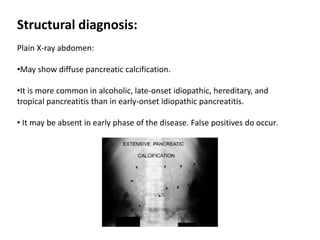
•May show diffuse pancreatic calcification.
•It is more common in alcoholic, late-onset idiopathic, hereditary, and
tropical pancreatitis than in early-onset idiopathic pancreatitis.
• It may be absent in early phase of the disease. False positives do occur.
USG:
USG findings indicative of chronic pancreatitis include;
• dilation of the pancreatic duct,
•pancreatic ductal stones,
•gland atrophy or enlargement, irregular gland margins,
•pseudocyst, and
•changes in the parenchymal echo texture.
Sensitivity and specificity in the range of 50-80%, with of 80-
90%.
CT:
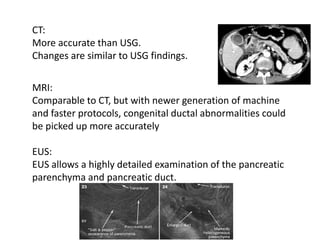
More accurate than USG.
Changes are similar to USG findings.
MRI:
Comparable to CT, but with newer generation of machine
and faster protocols, congenital ductal abnormalities could
be picked up more accurately
EUS:
EUS allows a highly detailed examination of the pancreatic
parenchyma and pancreatic duct.
Treatment:
Consists of the following,
•Removing the underlying etiology.
•Correcting the exocrine deficiency: This is achieved by
pancreatic supplements.
•Medium chain triglycerides (MCT), which do not require
pancreatic lipase helps.
•Correcting the endocrine deficiency: Oral hypoglycemics
and if required insulin for diabetes.
Pancreatic enzyme replacement therapy (PERT) is indicated
for patients who;
• loose weight,
•those with daily fecal fat excretion exceeding 7 to 15 grams
while on a diet that contains 100 grams of fat per day, and
•those with clinically significant symptoms of steatorrhea.
The goals of pharmacotherapy are
• to improve the digestion and absorption of nutrients,
•to reduce morbidity, and
•to prevent complications
The Cystic Fibrosis Foundation provides guidance for weight-based
enzyme dosing that recommends
• 1000 lipase units per kilogram per meal for children under 4 years of
age and 500 units per kilogram per meal for those 4 years and older.
•Older patients may require lower doses of lipase units per kilogram per
meal since they weigh more, but are likely to ingest less fat per kilogram.
•Half the standard dose is given with snacks, and the total daily dose
should be based on approximately 3 meals and 2 to 3 snacks per day.5
•It is estimated that a dose of 50,000 IU of lipase per day will result in a
45% decrease in steatorrhea, while decreases of 60% to 70% are
expected for patients taking 100,000 IU and 150,000 IU, respectively.
• “best way to take the enzymes is throughout the meal or at the
beginning, during, and end of the meal so they mix as much as they can
with the food and travel along the digestive system with the food.”
•Pain is controlled with appropriate analgesics.
•Simple analgesics are started first but morphine or its
derivatives may also be required but there is a real danger of
developing addiction.
•Celiac plexus block may help in selected patients.
•If there are stones or strictures, appropriate consultation
may be obtained to see if, tackling these could offer any
improvement in the pain.
Lastly….
•Complications like pseudocyst or malignancy are tackled
appropriately.
•ERCP may be useful in selected cases of obstructive chronic
pancreatitis, pancreatic stricture and stones and certain
congenital abnormalities.
•Surgery may be required in certain cases like pseudocyst,
difficult stones or extensive calcification of pancreatic head,
where a head coring pancreatectomy may be required.
This lecture and many more interesting GI
topics are available on our facebook
account
Gujarat Gastro Group
Thank you

Chronic pancreatitis

  • 1.
    Chronic pancreatitis Presentation, investigationsand medical management Dr Manoj K Ghoda Consultant Gastroenterologist
  • 2.
    This lecture andmany more interesting GI topics are available on our facebook account Gujarat Gastro Group
  • 4.
    Clinical presentation Abdominal pain: •Itis the most prominent symptom, although not present in all patients. •Pain is generally felt in the epigastrium, often with radiation to the back. •Pain is boring, deep, and penetrating and may be associated with nausea and vomiting. It may be relieved by sitting forward or leaning forward, by assuming the knee-chest position on one side. •Pain may increase after a meal and is often nocturnal. •Initially pain may be episodic, often confused with an attack of acute pancreatitis. With passage of time, pain may become more continuous. •In some there may be more gradual onset of constant abdominal pain, and some may have no pain. •The character, severity, and timing may change over a period.
  • 5.
    Weight loss: •Anorexia leadingto weight loss and malnutrition. •May be seen during painful attacks, which prevent adequate oral intake. •Weight loss may also occur owing to the development of a concomitant disease such as small bowel bacterial overgrowth or pancreatic or extrapancreatic malignancy.
  • 6.
    Steatorrhea: •Is a featureof far-advanced chronic pancreatitis. •Pancreatic lipase output decreases earlier and more substantially compared to other pancreatic enzymes. As bicarbonate secretion decreases in chronic pancreatitis and duodenal pH drops, lipase is particularly inactivated. •It takes about 10-15 years before the exocrine deficiency becomes manifest and it may be present in up to 80% of people after about 30 years of the disease. •These patients may present with diarrhea or weight loss but a large number of watery stools is not a feature of chronic pancreatitis. •Stool may be bulky, foul-smelling with frank oil droplets • Fat-soluble vitamins’ deficiency may develop in patients with pancreatic steatorrhea in a rare case. •Protein or carbohydrate digestion is not usually affected.
  • 7.
    Endocrine insufficiency: •Involves bothinsulin and glucagon with secondary diabetes. •Deficiency of both insulin and glucagon leads to a brittle diabetes and insulin in these patients may lead to prolonged and severe hypoglycemia. •Diabetes mellitus may become manifest within 10 years in some patients but ultimately, 40-70% of patients will develop diabetes after prolonged illness.
  • 8.
    Diagnosis: The diagnosis maybe difficult in many cases because lack of histological proof. •It has two aspects, one being the functional aspect and the other being the structural aspect. •Both may be absent in early course of the illness.
  • 9.
    Functional diagnosis (“Pancreaticfunction tests”): Evaluation of Exocrine function: •Fecal fat estimation: A 72-hour measurement of fecal fat excretion is the gold standard but it is abnormal in advanced disease only. A 72-hour collection of stool while the patient is consuming a 100 g/day fat diet; should show fecal fat excretion to be less than 7 g of fat. Although, it must be said that, it has never become popular. •The qualitative analysis of fecal fat can also be performed with a Sudan III stain of a random specimen of stool. More than six globules per high- power field is considered to be positive. It is positive only in patients with substantial steatorrhea. •The pancreolauryl test measures the presence of pancreatic arylesterases within the gut lumen. It is accurate only in advanced chronic pancreatitis, with sensitivities of 80- 100%.
  • 10.
    Evaluation of endocrinefunctions: Glucose tolerance test: This may show mild to severe brittle diabetes
  • 11.
    Structural diagnosis: Plain X-rayabdomen: •May show diffuse pancreatic calcification. •It is more common in alcoholic, late-onset idiopathic, hereditary, and tropical pancreatitis than in early-onset idiopathic pancreatitis. • It may be absent in early phase of the disease. False positives do occur.
  • 12.
    USG: USG findings indicativeof chronic pancreatitis include; • dilation of the pancreatic duct, •pancreatic ductal stones, •gland atrophy or enlargement, irregular gland margins, •pseudocyst, and •changes in the parenchymal echo texture. Sensitivity and specificity in the range of 50-80%, with of 80- 90%.
  • 13.
    CT: More accurate thanUSG. Changes are similar to USG findings. MRI: Comparable to CT, but with newer generation of machine and faster protocols, congenital ductal abnormalities could be picked up more accurately EUS: EUS allows a highly detailed examination of the pancreatic parenchyma and pancreatic duct.
  • 14.
    Treatment: Consists of thefollowing, •Removing the underlying etiology. •Correcting the exocrine deficiency: This is achieved by pancreatic supplements. •Medium chain triglycerides (MCT), which do not require pancreatic lipase helps. •Correcting the endocrine deficiency: Oral hypoglycemics and if required insulin for diabetes.
  • 15.
    Pancreatic enzyme replacementtherapy (PERT) is indicated for patients who; • loose weight, •those with daily fecal fat excretion exceeding 7 to 15 grams while on a diet that contains 100 grams of fat per day, and •those with clinically significant symptoms of steatorrhea. The goals of pharmacotherapy are • to improve the digestion and absorption of nutrients, •to reduce morbidity, and •to prevent complications
  • 16.
    The Cystic FibrosisFoundation provides guidance for weight-based enzyme dosing that recommends • 1000 lipase units per kilogram per meal for children under 4 years of age and 500 units per kilogram per meal for those 4 years and older. •Older patients may require lower doses of lipase units per kilogram per meal since they weigh more, but are likely to ingest less fat per kilogram. •Half the standard dose is given with snacks, and the total daily dose should be based on approximately 3 meals and 2 to 3 snacks per day.5 •It is estimated that a dose of 50,000 IU of lipase per day will result in a 45% decrease in steatorrhea, while decreases of 60% to 70% are expected for patients taking 100,000 IU and 150,000 IU, respectively. • “best way to take the enzymes is throughout the meal or at the beginning, during, and end of the meal so they mix as much as they can with the food and travel along the digestive system with the food.”
  • 17.
    •Pain is controlledwith appropriate analgesics. •Simple analgesics are started first but morphine or its derivatives may also be required but there is a real danger of developing addiction. •Celiac plexus block may help in selected patients. •If there are stones or strictures, appropriate consultation may be obtained to see if, tackling these could offer any improvement in the pain.
  • 18.
    Lastly…. •Complications like pseudocystor malignancy are tackled appropriately. •ERCP may be useful in selected cases of obstructive chronic pancreatitis, pancreatic stricture and stones and certain congenital abnormalities. •Surgery may be required in certain cases like pseudocyst, difficult stones or extensive calcification of pancreatic head, where a head coring pancreatectomy may be required.
  • 19.
    This lecture andmany more interesting GI topics are available on our facebook account Gujarat Gastro Group Thank you