
Diagnostics for Malaria
Abdullatif Sami Al Rashed
Clinical Microbiology Resident.
King Fahd Hospital of the University.
Teaching Assistant, Department of Microbiology, Imam Abdulrahman
Bin Faisal University, Dammam, Saudi Arabia.
Objectives
To Present an up-to-date summary of
the best microbiology practice related
to malaria diagnostics
Introduction
• Prompt and accurate diagnosis of malaria is very
critical for implementation of appropriate
treatment to reduce associated morbidity and
mortality.
• Accurate detection of malaria is also important
for:
– Epidemiological screening and surveillance to inform
malaria control strategies,
– Research purposes in testing efficacy of antimalarial
drugs and vaccines, and
– Blood bank screening.
Introduction
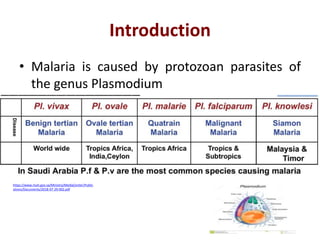
• Malaria is caused by protozoan parasites of
the genus Plasmodium
https://www.moh.gov.sa/Ministry/MediaCenter/Public
ations/Documents/2018-07-29-002.pdf
Introduction
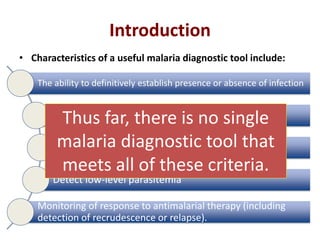
• Characteristics of a useful malaria diagnostic tool include:
The ability to definitively establish presence or absence of infection
Determine which species of malaria is/are present
Quantify parasitemia
Detect low-level parasitemia
Monitoring of response to antimalarial therapy (including
detection of recrudescence or relapse).
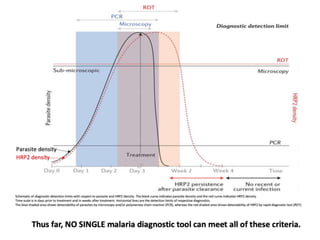
Thus far, there is no single
malaria diagnostic tool that
meets all of these criteria.
When To Suspect Malaria
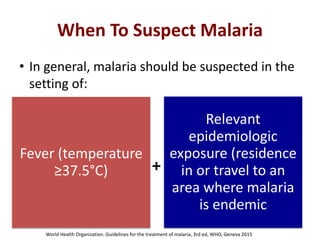
• In general, malaria should be suspected in the
setting of:
Fever (temperature
≥37.5°C)
Relevant
epidemiologic
exposure (residence
in or travel to an
area where malaria
is endemic
+
World Health Organization. Guidelines for the treatment of malaria, 3rd ed, WHO, Geneva 2015
When To Suspect Malaria
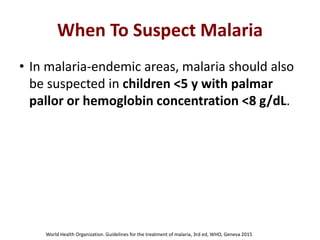
• In malaria-endemic areas, malaria should also
be suspected in children <5 y with palmar
pallor or hemoglobin concentration <8 g/dL.
World Health Organization. Guidelines for the treatment of malaria, 3rd ed, WHO, Geneva 2015
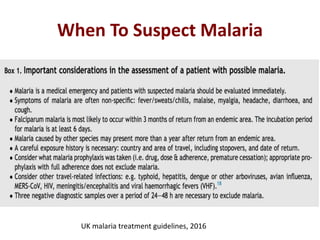
When To Suspect Malaria
UK malaria treatment guidelines, 2016
Diagnostic Approaches
• Suspected malaria should be confirmed with a
parasitologic diagnosis whenever possible.
• If parasite-based diagnostic tools are NOT
readily available and there is clinical suspicion
for malaria, especially Plasmodium falciparum
infection, it is reasonable to make a
presumptive diagnosis of malaria and initiate
empiric therapy.
World Health Organization. Guidelines for the treatment of malaria, 3rd ed, WHO, Geneva 2015
Parasite-Based Diagnosis
• Clinical tools for parasite-based diagnosis
include:
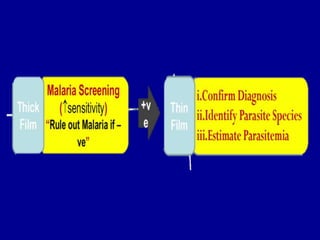
1. Microscopy (visualization of parasites in stained
blood smears) and
2. Rapid diagnostic tests (RDTs; which detect
antigen or antibody).
Guideline: the laboratory diagnosis of malaria. General Haematology Task Force of the British Committee for Standards in Haematology.
• Smear examination via light microscopy is
the standard tool for diagnosis of malaria;
• RDTs should be used if microscopy is not
readily available.
Parasite-Based Diagnosis
• Molecular techniques for detection of genetic
material are limited to reference labs and
research settings
Guideline: the laboratory diagnosis of malaria. General Haematology Task Force of the British Committee for Standards in Haematology.
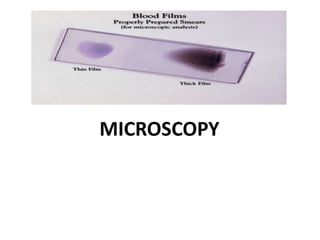
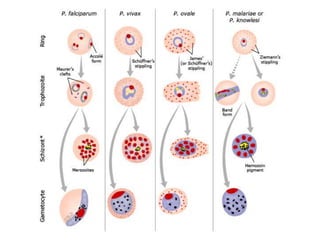
MICROSCOPY
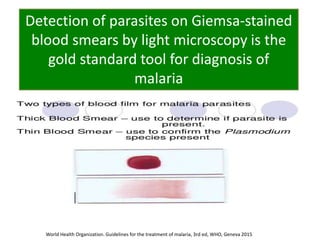
Detection of parasites on Giemsa-stained
blood smears by light microscopy is the
gold standard tool for diagnosis of
malaria
World Health Organization. Guidelines for the treatment of malaria, 3rd ed, WHO, Geneva 2015
In Expert Hands:
• The sensitivity of microscopy can be
excellent, with detection of malaria
parasites at densities as low as 4 to 20
parasites/mcL of blood (approximately
0.0001 to 0.0005 percent parasitemia)
Dowling MA et al. A comparative study of thick and thin blood films in the diagnosis of scanty
malaria parasitaemia.
Drawbacks of Microscopy
1. Labor intensive and requires substantial training
and expertise.
2. The sensitivity and specificity of malaria
microscopy in resource-limited settings is often
below levels achievable in reference or research
laboratories.
3. Microscopy cannot reliably detect very low
parasitemia (<5 to 10 parasites/mcL) or cases
where the majority of the parasite biomass is
sequestered (eg, in the case of placental
sequestration during pregnancy)
Kilian AH et al; Malaria diagnosis: memorandum from a WHO meeting.
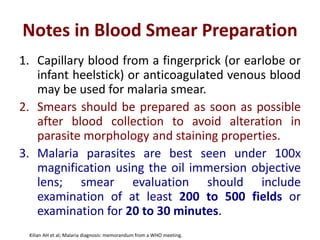
Notes in Blood Smear Preparation
1. Capillary blood from a fingerprick (or earlobe or
infant heelstick) or anticoagulated venous blood
may be used for malaria smear.
2. Smears should be prepared as soon as possible
after blood collection to avoid alteration in
parasite morphology and staining properties.
3. Malaria parasites are best seen under 100x
magnification using the oil immersion objective
lens; smear evaluation should include
examination of at least 200 to 500 fields or
examination for 20 to 30 minutes.
Kilian AH et al; Malaria diagnosis: memorandum from a WHO meeting.
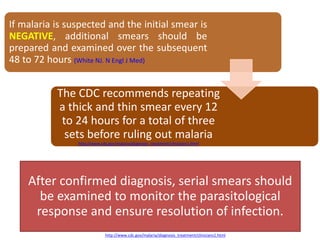
If malaria is suspected and the initial smear is
NEGATIVE, additional smears should be
prepared and examined over the subsequent
48 to 72 hours (White NJ. N Engl J Med)
The CDC recommends repeating
a thick and thin smear every 12
to 24 hours for a total of three
sets before ruling out malaria
http://www.cdc.gov/malaria/diagnosis_treatment/clinicians1.html
After confirmed diagnosis, serial smears should
be examined to monitor the parasitological
response and ensure resolution of infection.
http://www.cdc.gov/malaria/diagnosis_treatment/clinicians1.html
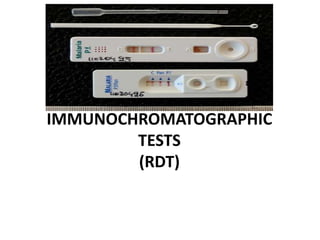
RAPID DIAGNOSTIC TEST
IMMUNOCHROMATOGRAPHIC
TESTS
(RDT)
RDTs for detection of malaria parasite antigens are
increasingly important diagnostic tools in resource-limited
endemic settings due to their accuracy and ease of use.
They require no electricity or laboratory infrastructure, give
results within 15 to 20 minutes, and can be performed
successfully even by health workers with limited training.
RDTs provide a qualitative result but cannot provide
quantitative information regarding parasite density.
 The approach to RDT selection depends on the
epidemiology of infection and goals for control in
the region where the test is used.
 In regions where infection is primarily caused by P.
falciparum, use of an assay that detects P. falciparum
only may be sufficient and cost-effective.
 In regions where falciparum and non-falciparum
parasites coexist or where P. vivax predominates, use
of an RDT that can detect and distinguish between
these species is warranted
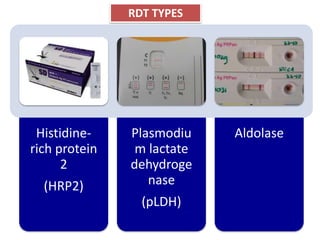
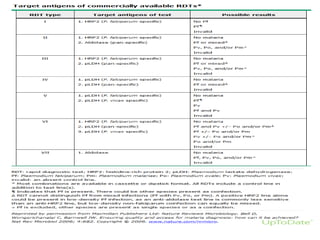
Histidine-
rich protein
2
(HRP2)
Plasmodiu
m lactate
dehydroge
nase
(pLDH)
Aldolase
RDT TYPES
HRP2 RDT
• Histidine-rich protein 2 is part of a family of P.
falciparum histidine-rich proteins that is only
produced by P. falciparum
• Use of HRP2-based RDTs is appropriate in
regions where P. falciparum is the
predominant species
– (eg, much of sub-Saharan Africa).
• Combination tests may be useful in areas
endemic for multiple Plasmodium species.
Rakotonirina et al, 2007
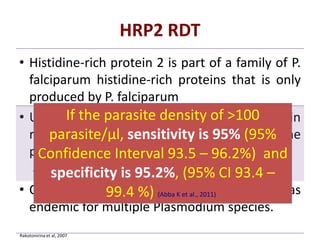
If the parasite density of >100
parasite/μl, sensitivity is 95% (95%
Confidence Interval 93.5 – 96.2%) and
specificity is 95.2%, (95% CI 93.4 –
99.4 %) (Abba K et al., 2011)
Drawbacks of HRP2 RDT
1. Detectable HRP2 antigen may persist in the
bloodstream for a few days to several weeks
after parasitemia is no longer present.
– In the absence of good quality confirmatory
microscopy, there is currently no way to distinguish
HRP2 positive test resulting from a new infection or
persistent infection (ie, resulting from treatment
failure) from antigenemia persisting from a recently
treated infection.
– Some endemic countries' national guidelines therefore
advise that a positive HRP2 result should be
considered to represent a new infection only if the
specimen was drawn 7 to 14 days or longer following a
previously treated infection
Rakotonirina et al, 2007
Drawbacks of HRP2 RDT
2. Deletions in the genes encoding for HRP2
(and the similar HRP3 protein), leading to
false-negative RDT results, have been
identified in P. falciparum parasites from the
Peruvian Amazon; therefore, HRP2-based
tests are not reliable for infections contracted
in this area.
– More recently, reports have emerged of pfhrp2
and pfhrp3 mutations or deletions in Africa and
India leading to false-negative RDT results in
some cases
Rakotonirina et al, 2007
Drawbacks of HRP2 RDT
3. Rarely, false-negative HRP2 results may occur
at very high levels of antigenemia or
parasitemia due to a prozone-like effect
Rakotonirina et al, 2007
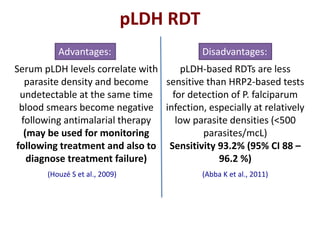
pLDH RDT
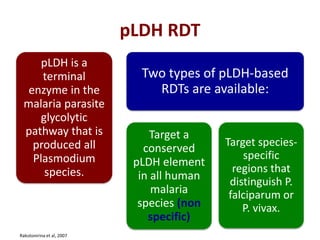
pLDH is a
terminal
enzyme in the
malaria parasite
glycolytic
pathway that is
produced all
Plasmodium
species.
Two types of pLDH-based
RDTs are available:
Target a
conserved
pLDH element
in all human
malaria
species (non
specific)
Target species-
specific
regions that
distinguish P.
falciparum or
P. vivax.
Rakotonirina et al, 2007
Serum pLDH levels correlate with
parasite density and become
undetectable at the same time
blood smears become negative
following antimalarial therapy
(may be used for monitoring
following treatment and also to
diagnose treatment failure)
pLDH-based RDTs are less
sensitive than HRP2-based tests
for detection of P. falciparum
infection, especially at relatively
low parasite densities (<500
parasites/mcL)
Sensitivity 93.2% (95% CI 88 –
96.2 %)
Advantages: Disadvantages:
(Abba K et al., 2011)(Houzé S et al., 2009)
pLDH RDT
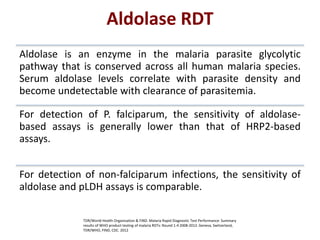
Aldolase is an enzyme in the malaria parasite glycolytic
pathway that is conserved across all human malaria species.
Serum aldolase levels correlate with parasite density and
become undetectable with clearance of parasitemia.
For detection of P. falciparum, the sensitivity of aldolase-
based assays is generally lower than that of HRP2-based
assays.
For detection of non-falciparum infections, the sensitivity of
aldolase and pLDH assays is comparable.
Aldolase RDT
TDR/World Health Organization & FIND. Malaria Rapid Diagnostic Test Performance: Summary
results of WHO product testing of malaria RDTs: Round 1-4 2008-2012. Geneva, Switzerland,
TDR/WHO, FIND, CDC. 2012
One RDT has been approved by the US
Food and Drug Administration (FDA):
BinaxNOW Malaria. The test is a
combination assay with antibodies for
detection of HRP2 and aldolase.
Screening Blood Donors?
• RDTs should not be used for screening
donated blood, since the thresholds of
detection are not sufficiently sensitive to
detect low parasite density. (Murray CK et al., 2008; Seed CR et al., 2005)
• Malaria antibody detection for by using the
indirect fluorescent antibody (IFA) test is used
for screening blood donors involved in cases
of transfusion-induced malaria to overcome
the undetectable level of parasitemia by blood
film examination & RDTs.
Rakotonirina et al, 2007
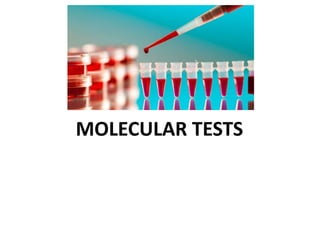
MOLECULAR TESTS
Use of molecular tests for malaria detection is
generally limited to reference laboratories and
is primarily for research and epidemiologic
purposes.
The CDC offers PCR confirmation of species and
identification of drug resistance mutations for
malaria cases diagnosed in the United States
http://www.cdc.gov/malaria/features/ars.html
Molecular Testing
• Nested PCR is the most sensitive and specific
nucleic acid amplification technology.
• Commonly used PCR assays target genus-
specific and species-specific sequences of the
18S small-subunit ribosomal RNA,
circumsporozoite surface protein (a nuclear
gene encoding a cysteine protease), and the
cytochrome b gene
Mixson-Hayden T et al., 2010
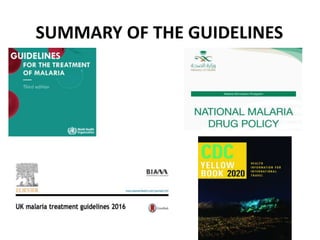
SUMMARY OF THE GUIDELINES
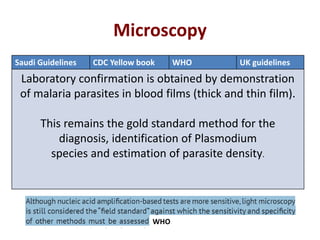
Microscopy
Saudi Guidelines CDC Yellow book WHO UK guidelines
Laboratory confirmation is obtained by demonstration
of malaria parasites in blood films (thick and thin film).
This remains the gold standard method for the
diagnosis, identification of Plasmodium
species and estimation of parasite density.
WHO
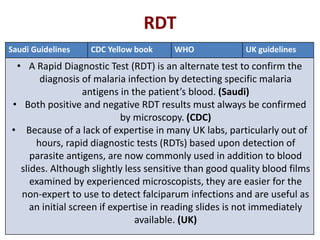
RDT
Saudi Guidelines CDC Yellow book WHO UK guidelines
• A Rapid Diagnostic Test (RDT) is an alternate test to confirm the
diagnosis of malaria infection by detecting specific malaria
antigens in the patient’s blood. (Saudi)
• Both positive and negative RDT results must always be confirmed
by microscopy. (CDC)
• Because of a lack of expertise in many UK labs, particularly out of
hours, rapid diagnostic tests (RDTs) based upon detection of
parasite antigens, are now commonly used in addition to blood
slides. Although slightly less sensitive than good quality blood films
examined by experienced microscopists, they are easier for the
non-expert to use to detect falciparum infections and are useful as
an initial screen if expertise in reading slides is not immediately
available. (UK)
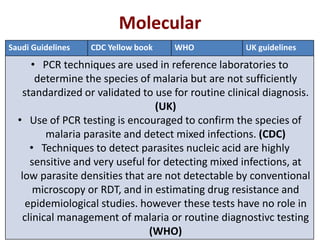
Molecular
Saudi Guidelines CDC Yellow book WHO UK guidelines
• PCR techniques are used in reference laboratories to
determine the species of malaria but are not sufficiently
standardized or validated to use for routine clinical diagnosis.
(UK)
• Use of PCR testing is encouraged to confirm the species of
malaria parasite and detect mixed infections. (CDC)
• Techniques to detect parasites nucleic acid are highly
sensitive and very useful for detecting mixed infections, at
low parasite densities that are not detectable by conventional
microscopy or RDT, and in estimating drug resistance and
epidemiological studies. however these tests have no role in
clinical management of malaria or routine diagnostivc testing
(WHO)
References
• Goswami ND, LoBue PA. INFECTIOUS AGENT. CDC
Yellow Book 2020: Health Information for
International Travel. 2019 May 14;87(6):355.
• Lalloo DG, Shingadia D, Bell DJ, Beeching NJ, Whitty
CJ, Chiodini PL. UK malaria treatment guidelines
2016. Journal of Infection. 2016 Jun 1;72(6):635-49.
• World Health Organization (WHO): Guidelines for the
treatment of malaria, 3rd edition (2015)
• NATIONAL MALARIA DRUG POLICY SAUDI ARABIA
Malaria Diagnostics

Malaria Diagnostics

  • 1.
    Diagnostics for Malaria AbdullatifSami Al Rashed Clinical Microbiology Resident. King Fahd Hospital of the University. Teaching Assistant, Department of Microbiology, Imam Abdulrahman Bin Faisal University, Dammam, Saudi Arabia.
  • 2.
    Objectives To Present anup-to-date summary of the best microbiology practice related to malaria diagnostics
  • 3.
    Introduction • Prompt andaccurate diagnosis of malaria is very critical for implementation of appropriate treatment to reduce associated morbidity and mortality. • Accurate detection of malaria is also important for: – Epidemiological screening and surveillance to inform malaria control strategies, – Research purposes in testing efficacy of antimalarial drugs and vaccines, and – Blood bank screening.
  • 4.
    Introduction • Malaria iscaused by protozoan parasites of the genus Plasmodium https://www.moh.gov.sa/Ministry/MediaCenter/Public ations/Documents/2018-07-29-002.pdf
  • 5.
    Introduction • Characteristics ofa useful malaria diagnostic tool include: The ability to definitively establish presence or absence of infection Determine which species of malaria is/are present Quantify parasitemia Detect low-level parasitemia Monitoring of response to antimalarial therapy (including detection of recrudescence or relapse). Thus far, there is no single malaria diagnostic tool that meets all of these criteria.
  • 6.
    When To SuspectMalaria • In general, malaria should be suspected in the setting of: Fever (temperature ≥37.5°C) Relevant epidemiologic exposure (residence in or travel to an area where malaria is endemic + World Health Organization. Guidelines for the treatment of malaria, 3rd ed, WHO, Geneva 2015
  • 7.
    When To SuspectMalaria • In malaria-endemic areas, malaria should also be suspected in children <5 y with palmar pallor or hemoglobin concentration <8 g/dL. World Health Organization. Guidelines for the treatment of malaria, 3rd ed, WHO, Geneva 2015
  • 8.
    When To SuspectMalaria UK malaria treatment guidelines, 2016
  • 9.
    Diagnostic Approaches • Suspectedmalaria should be confirmed with a parasitologic diagnosis whenever possible. • If parasite-based diagnostic tools are NOT readily available and there is clinical suspicion for malaria, especially Plasmodium falciparum infection, it is reasonable to make a presumptive diagnosis of malaria and initiate empiric therapy. World Health Organization. Guidelines for the treatment of malaria, 3rd ed, WHO, Geneva 2015
  • 10.
    Parasite-Based Diagnosis • Clinicaltools for parasite-based diagnosis include: 1. Microscopy (visualization of parasites in stained blood smears) and 2. Rapid diagnostic tests (RDTs; which detect antigen or antibody). Guideline: the laboratory diagnosis of malaria. General Haematology Task Force of the British Committee for Standards in Haematology. • Smear examination via light microscopy is the standard tool for diagnosis of malaria; • RDTs should be used if microscopy is not readily available.
  • 11.
    Parasite-Based Diagnosis • Moleculartechniques for detection of genetic material are limited to reference labs and research settings Guideline: the laboratory diagnosis of malaria. General Haematology Task Force of the British Committee for Standards in Haematology.
  • 12.
  • 13.
    Detection of parasiteson Giemsa-stained blood smears by light microscopy is the gold standard tool for diagnosis of malaria World Health Organization. Guidelines for the treatment of malaria, 3rd ed, WHO, Geneva 2015
  • 15.
    In Expert Hands: •The sensitivity of microscopy can be excellent, with detection of malaria parasites at densities as low as 4 to 20 parasites/mcL of blood (approximately 0.0001 to 0.0005 percent parasitemia) Dowling MA et al. A comparative study of thick and thin blood films in the diagnosis of scanty malaria parasitaemia.
  • 16.
    Drawbacks of Microscopy 1.Labor intensive and requires substantial training and expertise. 2. The sensitivity and specificity of malaria microscopy in resource-limited settings is often below levels achievable in reference or research laboratories. 3. Microscopy cannot reliably detect very low parasitemia (<5 to 10 parasites/mcL) or cases where the majority of the parasite biomass is sequestered (eg, in the case of placental sequestration during pregnancy) Kilian AH et al; Malaria diagnosis: memorandum from a WHO meeting.
  • 17.
    Notes in BloodSmear Preparation 1. Capillary blood from a fingerprick (or earlobe or infant heelstick) or anticoagulated venous blood may be used for malaria smear. 2. Smears should be prepared as soon as possible after blood collection to avoid alteration in parasite morphology and staining properties. 3. Malaria parasites are best seen under 100x magnification using the oil immersion objective lens; smear evaluation should include examination of at least 200 to 500 fields or examination for 20 to 30 minutes. Kilian AH et al; Malaria diagnosis: memorandum from a WHO meeting.
  • 18.
    If malaria issuspected and the initial smear is NEGATIVE, additional smears should be prepared and examined over the subsequent 48 to 72 hours (White NJ. N Engl J Med) The CDC recommends repeating a thick and thin smear every 12 to 24 hours for a total of three sets before ruling out malaria http://www.cdc.gov/malaria/diagnosis_treatment/clinicians1.html After confirmed diagnosis, serial smears should be examined to monitor the parasitological response and ensure resolution of infection. http://www.cdc.gov/malaria/diagnosis_treatment/clinicians1.html
  • 20.
  • 21.
    RDTs for detectionof malaria parasite antigens are increasingly important diagnostic tools in resource-limited endemic settings due to their accuracy and ease of use. They require no electricity or laboratory infrastructure, give results within 15 to 20 minutes, and can be performed successfully even by health workers with limited training. RDTs provide a qualitative result but cannot provide quantitative information regarding parasite density.
  • 22.
     The approachto RDT selection depends on the epidemiology of infection and goals for control in the region where the test is used.  In regions where infection is primarily caused by P. falciparum, use of an assay that detects P. falciparum only may be sufficient and cost-effective.  In regions where falciparum and non-falciparum parasites coexist or where P. vivax predominates, use of an RDT that can detect and distinguish between these species is warranted
  • 23.
  • 24.
    HRP2 RDT • Histidine-richprotein 2 is part of a family of P. falciparum histidine-rich proteins that is only produced by P. falciparum • Use of HRP2-based RDTs is appropriate in regions where P. falciparum is the predominant species – (eg, much of sub-Saharan Africa). • Combination tests may be useful in areas endemic for multiple Plasmodium species. Rakotonirina et al, 2007 If the parasite density of >100 parasite/μl, sensitivity is 95% (95% Confidence Interval 93.5 – 96.2%) and specificity is 95.2%, (95% CI 93.4 – 99.4 %) (Abba K et al., 2011)
  • 25.
    Drawbacks of HRP2RDT 1. Detectable HRP2 antigen may persist in the bloodstream for a few days to several weeks after parasitemia is no longer present. – In the absence of good quality confirmatory microscopy, there is currently no way to distinguish HRP2 positive test resulting from a new infection or persistent infection (ie, resulting from treatment failure) from antigenemia persisting from a recently treated infection. – Some endemic countries' national guidelines therefore advise that a positive HRP2 result should be considered to represent a new infection only if the specimen was drawn 7 to 14 days or longer following a previously treated infection Rakotonirina et al, 2007
  • 26.
    Drawbacks of HRP2RDT 2. Deletions in the genes encoding for HRP2 (and the similar HRP3 protein), leading to false-negative RDT results, have been identified in P. falciparum parasites from the Peruvian Amazon; therefore, HRP2-based tests are not reliable for infections contracted in this area. – More recently, reports have emerged of pfhrp2 and pfhrp3 mutations or deletions in Africa and India leading to false-negative RDT results in some cases Rakotonirina et al, 2007
  • 27.
    Drawbacks of HRP2RDT 3. Rarely, false-negative HRP2 results may occur at very high levels of antigenemia or parasitemia due to a prozone-like effect Rakotonirina et al, 2007
  • 28.
    pLDH RDT pLDH isa terminal enzyme in the malaria parasite glycolytic pathway that is produced all Plasmodium species. Two types of pLDH-based RDTs are available: Target a conserved pLDH element in all human malaria species (non specific) Target species- specific regions that distinguish P. falciparum or P. vivax. Rakotonirina et al, 2007
  • 29.
    Serum pLDH levelscorrelate with parasite density and become undetectable at the same time blood smears become negative following antimalarial therapy (may be used for monitoring following treatment and also to diagnose treatment failure) pLDH-based RDTs are less sensitive than HRP2-based tests for detection of P. falciparum infection, especially at relatively low parasite densities (<500 parasites/mcL) Sensitivity 93.2% (95% CI 88 – 96.2 %) Advantages: Disadvantages: (Abba K et al., 2011)(Houzé S et al., 2009) pLDH RDT
  • 30.
    Aldolase is anenzyme in the malaria parasite glycolytic pathway that is conserved across all human malaria species. Serum aldolase levels correlate with parasite density and become undetectable with clearance of parasitemia. For detection of P. falciparum, the sensitivity of aldolase- based assays is generally lower than that of HRP2-based assays. For detection of non-falciparum infections, the sensitivity of aldolase and pLDH assays is comparable. Aldolase RDT TDR/World Health Organization & FIND. Malaria Rapid Diagnostic Test Performance: Summary results of WHO product testing of malaria RDTs: Round 1-4 2008-2012. Geneva, Switzerland, TDR/WHO, FIND, CDC. 2012
  • 32.
    One RDT hasbeen approved by the US Food and Drug Administration (FDA): BinaxNOW Malaria. The test is a combination assay with antibodies for detection of HRP2 and aldolase.
  • 33.
    Screening Blood Donors? •RDTs should not be used for screening donated blood, since the thresholds of detection are not sufficiently sensitive to detect low parasite density. (Murray CK et al., 2008; Seed CR et al., 2005) • Malaria antibody detection for by using the indirect fluorescent antibody (IFA) test is used for screening blood donors involved in cases of transfusion-induced malaria to overcome the undetectable level of parasitemia by blood film examination & RDTs. Rakotonirina et al, 2007
  • 34.
  • 35.
    Use of moleculartests for malaria detection is generally limited to reference laboratories and is primarily for research and epidemiologic purposes. The CDC offers PCR confirmation of species and identification of drug resistance mutations for malaria cases diagnosed in the United States http://www.cdc.gov/malaria/features/ars.html
  • 36.
    Molecular Testing • NestedPCR is the most sensitive and specific nucleic acid amplification technology. • Commonly used PCR assays target genus- specific and species-specific sequences of the 18S small-subunit ribosomal RNA, circumsporozoite surface protein (a nuclear gene encoding a cysteine protease), and the cytochrome b gene Mixson-Hayden T et al., 2010
  • 38.
    SUMMARY OF THEGUIDELINES
  • 39.
    Microscopy Saudi Guidelines CDCYellow book WHO UK guidelines Laboratory confirmation is obtained by demonstration of malaria parasites in blood films (thick and thin film). This remains the gold standard method for the diagnosis, identification of Plasmodium species and estimation of parasite density. WHO
  • 40.
    RDT Saudi Guidelines CDCYellow book WHO UK guidelines • A Rapid Diagnostic Test (RDT) is an alternate test to confirm the diagnosis of malaria infection by detecting specific malaria antigens in the patient’s blood. (Saudi) • Both positive and negative RDT results must always be confirmed by microscopy. (CDC) • Because of a lack of expertise in many UK labs, particularly out of hours, rapid diagnostic tests (RDTs) based upon detection of parasite antigens, are now commonly used in addition to blood slides. Although slightly less sensitive than good quality blood films examined by experienced microscopists, they are easier for the non-expert to use to detect falciparum infections and are useful as an initial screen if expertise in reading slides is not immediately available. (UK)
  • 41.
    Molecular Saudi Guidelines CDCYellow book WHO UK guidelines • PCR techniques are used in reference laboratories to determine the species of malaria but are not sufficiently standardized or validated to use for routine clinical diagnosis. (UK) • Use of PCR testing is encouraged to confirm the species of malaria parasite and detect mixed infections. (CDC) • Techniques to detect parasites nucleic acid are highly sensitive and very useful for detecting mixed infections, at low parasite densities that are not detectable by conventional microscopy or RDT, and in estimating drug resistance and epidemiological studies. however these tests have no role in clinical management of malaria or routine diagnostivc testing (WHO)
  • 42.
    References • Goswami ND,LoBue PA. INFECTIOUS AGENT. CDC Yellow Book 2020: Health Information for International Travel. 2019 May 14;87(6):355. • Lalloo DG, Shingadia D, Bell DJ, Beeching NJ, Whitty CJ, Chiodini PL. UK malaria treatment guidelines 2016. Journal of Infection. 2016 Jun 1;72(6):635-49. • World Health Organization (WHO): Guidelines for the treatment of malaria, 3rd edition (2015) • NATIONAL MALARIA DRUG POLICY SAUDI ARABIA