Tips on using my ppt.
1. You can freely download, edit, modify and put your
name etc.
2. Don’t be concerned about number of slides. Half the
slides are blanks except for the title.
3. First show the blank slides (eg. Aetiology ) > Ask
students what they already know about ethology of
today's topic. > Then show next slide which enumerates
aetiologies.
4. At the end rerun the show – show blank> ask questions >
show next slide.
5. This will be an ACTIVE LEARNING SESSION x
three revisions.
6. Good for self study also.
7. See notes for bibliography.
Learning Objectives
Learning Objectives
1. Introduction & History
2. Relevant Anatomy, Physiology
3. Aetiology
4. Pathophysiology
5. Pathology
6. Classification
7. Clinical Features
8. Investigations
9. Management
10. Prevention
11. Guidelines
12. Take home messages
Introduction & History.
•
Chronic Pancreatitis
• Chronic pancreatitis is defined as incurable,
continuing chronic inflammatory process of the
pancreas, characterized by irreversible morphological
changes.
• This chronic inflammation can lead to chronic
abdominal pain and/or impairment of endocrine and
exocrine function of the pancreas.
Spectrum of Pancreatitis
1. Acute pancreatitis
2. Recurrent acute pancreatitis
3. Chronic pancreatitis
4. Acute on chronic pancreatitis
Acute Pancreatitis
• By definition, chronic pancreatitis is a completely
different process from acute pancreatitis. In acute
pancreatitis, the patient presents with acute and
severe abdominal pain, nausea, and vomiting.
• The pancreas is acutely inflamed (neutrophils and
edema), and the serum levels of pancreatic enzymes
(amylase and lipase) are elevated.
Etiology
•
Etiology
• Idiopathic
• Congenital/ Genetic
• Nutritional Deficiency/excess
• Traumatic
• Infections /Infestation
• Autoimmune
• Neoplastic (Benign/Malignant)
• Degenerative / lifestyle
• Iatrogenic
• Psychosomatic
• Poisoning/ Toxins/ Drug induced
Etiology
• Idiopathic
• Congenital/ Genetic
• Nutritional Deficiency/excess
• Traumatic
• Infections /Infestation
• Autoimmune
• Neoplastic (Benign/Malignant)
• Degenerative / lifestyle/ Metabolic
• Iatrogenic
• Psychosomatic
• Poisoning/ Toxins/ Drug induced
Etiology
• Alcohol, 70%
• Idiopathic (including tropical), 20%
• Other, 10%
– Hereditary
– Hyperparathyroidism
– Hypertriglyceridemia
– Autoimmune pancreatitis
– Obstruction -Trauma Pancreas divisum
Classification
Classification
• Chronic Calcific Pancreatitis
• Chronic Obstructive Pancreatitis
• Chronic Inflammatory Pancreatitis
• Chronic Autoimmune Pancreatitis
• Asymptomatic Pancreatic Fibrosis
Aetiology:
I-Metabolic:
0 1-Excessive alcohol consumption is the most
common cause, accounting for about 60% of all
cases.
Aetiology:
I-Metabolic
2-Hyperlipidemia may cause chronic pancreatitis;
however, it usually presents with repeated attacks
of acute pancreatitis.
3-Hypercalcemia due to hyperparathyroidism now is
a rare cause of chronic pancreatitis, probably
because automation of serum chemistries reveals
hypercalcemia before it results in pancreatitis.
Nutritional or tropical, chronic
pancreatitis
• It is an important cause of disease in poorer parts
of the world.
• ?Tapioca – cyanide poisoning.
II-Genetic:
1-Hereditaty pancreatitis Autosomal dominant
disorder accounting for about 1% of cases.
2-Cystic fibrosis is one of the most common genetic
abnormalities, is an autosomal recessive disorder
accounting for a small percent of patients with
chronic pancreatitis.
Mutations SPNK1,
III-Idiopathic chronic
pancreatitis:
Accounts for approximately 30% of cases, has been
subdivided into early-onset and late-onset forms.
The cause is not yet known.
IV-Obstruction
of the flow of pancreatic juice can cause chronic
pancreatitis:
• Congenital abnormalities such as pancreas
divisum.
• Acquired obstructive forms result from blunt
abdominal trauma, stones or tumours.
V-Autoimmune pancreatitis:
• Is uncommon and accounts probably for less than
1% of cases of chronic pancreatitis.
• Increased circulating levels of gamma globulin
(igg4),
• The presence of autoantibodies,
• Association with other autoimmune diseases.
Pathophysiology
Pathophysiology
• Inflammation
• Fibrosis
• Stone
• Duct distortion
• Burnt out disease
Pathology
•
Pathology
• Parencymal changes
• Ductal changes
Pathology
• Recurrent Acute Pancreatitis> fibrosis>
calcification
Clinical Features
•
Clinical Features
• Demography
• Symptoms
• Signs
• Prognosis
• Complications
Demography
Demography
• Incidence & Prevalence
• Geographical distribution.
• Race
• Age
• Sex
• Socioeconomic status
• Temporal behaviour
Clinical features
Clinical features
• Abdominal pain
• Steatarrohoea
• Weight loss
• Diabetes mellitus.
Clinical picture:
• Abdominal pain:
• The most common symptom.
• The patient experiences intermittent attacks of
severe pain, often in the mid or left upper
abdomen and occasionally radiating to the back
and lasting for several hours.
• A small percentage of patients (20%) have
painless chronic pancreatitis and present with
signs or symptoms of pancreatic exocrine or
endocrine insufficiency.
• Other symptoms associated with chronic
pancreatitis include diarrhea and weight loss.
This may be due either to fear of eating (eg,
postprandial exacerbation of pain) or due to
pancreatic exocrine insufficiency and
steatorrhea).
• Occasionally, a tender fullness or mass may be
palpated in the epigastrium, suggesting the
presence of a pseudocyst or an inflammatory mass
in the abdomen.
• Patients with advanced disease (ie, patients with
steatorrhea) exhibit decreased subcutaneous fat,
temporal wasting, sunken supraclavicular fossa,
and other physical signs of malnutrition.
• Pseudoaneurysm of splenic artery.
• Diabetes mellitus is a late manifestation in
about one third of patients. The tendency to
develop ketoacidosis is low.
Prognosis
Prognosis
• Morbidity
• Mortality rate
• 5 year survival in Malignancy
Complications
Complications
• Inflalmatory head mass
• Pseudocyst
• Carcinoma
Investigations
•
Investigations
• Laboratory Studies
– Routine
– Special
• Imaging Studies
• Tissue diagnosis
– Cytology
• FNAC
– Histology
– Germ line Testing and Molecular Analysis
• Diagnostic Laparotomy.
Diagnostic Studies
Imaging Studies
•
Diagnostic Studies
Imaging Studies
• X-Ray
• USG
• CT
• Angiography
• MRI
• Endoscopy
• Nuclear scan
Lab Investigations:
1-Blood tests-
• Serum amylase and lipase levels may be
slightly elevated in chronic pancreatitis; high
levels are found only during acute attacks of
pancreatitis.
• Diabetes mellitus
• Fecal fat fecal elastase
4-Imaging studies:
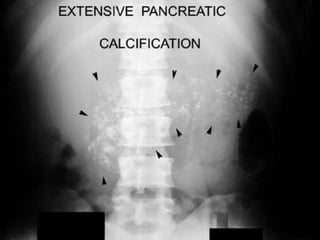
Abdominal x-ray:
Pancreatic calcifications, often considered
pathognomonic of chronic pancreatitis, are
observed in approximately 30% of cases.
Abdominal US:
• Can reveal pancreatic duct dilatation,
calcifications, pseudocysts, pancreatic ductal
stones.
Plain CT
• Pseudocysts, calcifications and pancreatic duct
dilatation can be observed in chronic
pancreatitis.
MRCP:
• Noninvasive
• It can assess both pancreatic parenchyma and
ducts at the same time.
• It can detect pancreatic duct dilatation, ductal
narrowing and filling defects.
EUS and Lap.US
• Most sensitive.
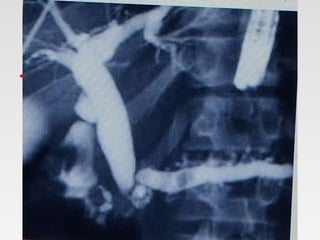
ERCP:
• Provides the most accurate visualization of the
pancreatic ductal system and has been
regarded as the criterion standard for
diagnosing chronic pancreatitis.
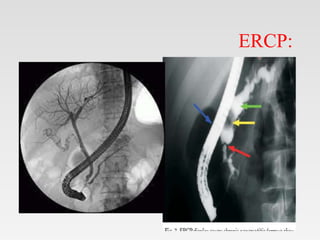
• Findings include characteristic “chain of
lakes” beading of the main pancreatic duct,
and intraductal filling defects.
ERCP:
•
ERCP:
•
Treatment:
Treatment:
1-Behavior modification:
Cessation of alcohol consumption and tobacco
smoking are important. In early-stage alcohol-
induced chronic pancreatitis, lasting pain relief can
occur after abstinence from alcohol, but, in
advanced stages, abstinence does not always lead
to symptomatic improvement.
Medical treatment:
• Analgesics: to relieve abdominal pain.
• Avoid opioids high chances of addiction.
• NSAIDs
• Tramodol
• Gabapentin
Medical treatment:
Antidepressants: (Amitriptyline hydrochloride)
• In addition to alleviating coexistent depression,
tricyclic antidepressants may ameliorate pain and
potentiate the effects of opiates.
Medical treatment:
Pancreas enzyme supplements:
• Used as a dietary supplement to aid digestion in
patients with pancreatic enzyme deficiency. Several
preparations are available.
• When exogenous pancreatic enzymes are taken with a
meal, CCK-releasing factors are degraded and CCK
release in response to a meal is reduced. This
decreases pancreatic stimulation and pain.
Acute attack Medical treatment:
• Nil Orally
• IV fluids
• Analgesics
• No Antibiotics
• NO PPIs
• No Octride
• No repeated CT
3-Endoscopic treatment:
I-Papillary stenosis: In appropriately selected patients,
a pancreatic duct sphincterotomy will facilitate
drainage, reduce ductal pressures, and may help
alleviate pain
II-Pancreatic duct strictures: performing a pancreatic
sphincterotomy, dilating the stricture, and placing a
stent. While technical success is achieved in more
than 90% of patients, nearly 20% will have a
complication.
3-Endoscopic treatment:
III-Pancreatic duct stones:
• Requires a pancreatic duct sphincterotomy and
stricture dilation to enable their extraction.
• In addition to various endoscopic techniques,
extracorporeal shockwave lithotripsy often is
necessary to break up impacted or large stones
into smaller pieces suitable for removal.
4-Surgical treatment:
I-Pancreatic duct drainage: In patients with a dilated
pancreatic duct, pancreaticojejunostomy is indicated.
The operative mortality rate is about 3%, and pain
relief is obtained in approximately 75% of patients.
4-Surgical treatment:
II-Pancreatic resection: If the disease is limited to
the head of the pancreas, a Whipple operation
(pancreaticoduodenectomy) can produce good
results.
• In patients with intractable pain and diffuse
disease with nondilated ducts, a subtotal or total
pancreatectomy can be offered.
4-Surgical treatment:
• Celiac ganglion blockade can be considered for pain
relief.
4-Surgical treatment:
III-Total pancreatectomy and islet
autotransplantation:
In selected patients, the long-term morbidity
caused by diabetes following total pancreatectomy
can be avoided.
• This involves harvesting the islets from the
resected pancreas and injecting them into the
portal system, which then lodges them in the liver.
Complications of Chronic
Pancreatitis
Intrapancreatic complications
• Pseudocysts
• Duodenal or gastric obstruction
• Thrombosis of splenic vein
• Abscess
• Perforation
• Erosion into visceral artery
• Inflammatory mass in head of pancreas
• Bile duct stenosis
• Portal vein thrombosis ………
Complications of Chronic
Pancreatitis
• Duodenal obstruction
• Duct strictures and/or stones
• Ductal hypertension and dilatation
• Pancreatic carcinoma
Complications of Chronic
Pancreatitis
Complications of Chronic
Pancreatitis
Extrapancreatic complications
• Pancreatic duct leak with ascites or fistula
• Pseudocyst extension beyond lesser sac into
mediastinum, retroperitoneum, lateral
pericolic spaces, pelvis, or adjacent viscera
Prevention
Prevention
• Screening
• Risk reduction
Mythbusters
Myths Facts
Guidelines
Take home messages
• Chronic pancreatitis is destruction of
pancreas.
• Triad of chronic pancreatitis
– recurrent abdominal pain
– steatorrhea
– diabetes mellitus.
• treat by pancreatic enzymes analgesics
insulin
• No role of of octreotide , PPIs,, antibiotics
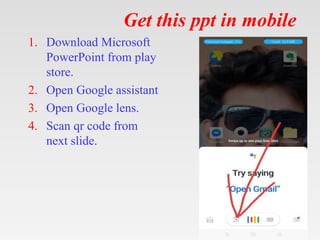
Get this ppt in mobile
1. Download Microsoft
PowerPoint from play
store.
2. Open Google assistant
3. Open Google lens.
4. Scan qr code from
next slide.
Get this ppt in mobile
Get my ppt collection
• https://www.slideshare.net/drpradeeppande/
edit_my_uploads
• https://www.dropbox.com/sh/x600md3cvj8
5woy/AACVMHuQtvHvl_K8ehc3ltkEa?dl
=0
• https://www.facebook.com/doctorpradeeppa
nde/?ref=pages_you_manage

Chronic pancreatitis.pptx

  • 1.
    Tips on usingmy ppt. 1. You can freely download, edit, modify and put your name etc. 2. Don’t be concerned about number of slides. Half the slides are blanks except for the title. 3. First show the blank slides (eg. Aetiology ) > Ask students what they already know about ethology of today's topic. > Then show next slide which enumerates aetiologies. 4. At the end rerun the show – show blank> ask questions > show next slide. 5. This will be an ACTIVE LEARNING SESSION x three revisions. 6. Good for self study also. 7. See notes for bibliography.
  • 2.
  • 3.
    Learning Objectives 1. Introduction& History 2. Relevant Anatomy, Physiology 3. Aetiology 4. Pathophysiology 5. Pathology 6. Classification 7. Clinical Features 8. Investigations 9. Management 10. Prevention 11. Guidelines 12. Take home messages
  • 4.
  • 5.
  • 6.
    Chronic Pancreatitis • Chronicpancreatitis is defined as incurable, continuing chronic inflammatory process of the pancreas, characterized by irreversible morphological changes. • This chronic inflammation can lead to chronic abdominal pain and/or impairment of endocrine and exocrine function of the pancreas.
  • 7.
  • 8.
    Spectrum of Pancreatitis 1.Acute pancreatitis 2. Recurrent acute pancreatitis 3. Chronic pancreatitis 4. Acute on chronic pancreatitis
  • 9.
    Acute Pancreatitis • Bydefinition, chronic pancreatitis is a completely different process from acute pancreatitis. In acute pancreatitis, the patient presents with acute and severe abdominal pain, nausea, and vomiting. • The pancreas is acutely inflamed (neutrophils and edema), and the serum levels of pancreatic enzymes (amylase and lipase) are elevated.
  • 10.
  • 11.
    Etiology • Idiopathic • Congenital/Genetic • Nutritional Deficiency/excess • Traumatic • Infections /Infestation • Autoimmune • Neoplastic (Benign/Malignant) • Degenerative / lifestyle • Iatrogenic • Psychosomatic • Poisoning/ Toxins/ Drug induced
  • 12.
    Etiology • Idiopathic • Congenital/Genetic • Nutritional Deficiency/excess • Traumatic • Infections /Infestation • Autoimmune • Neoplastic (Benign/Malignant) • Degenerative / lifestyle/ Metabolic • Iatrogenic • Psychosomatic • Poisoning/ Toxins/ Drug induced
  • 13.
    Etiology • Alcohol, 70% •Idiopathic (including tropical), 20% • Other, 10% – Hereditary – Hyperparathyroidism – Hypertriglyceridemia – Autoimmune pancreatitis – Obstruction -Trauma Pancreas divisum
  • 14.
  • 15.
    Classification • Chronic CalcificPancreatitis • Chronic Obstructive Pancreatitis • Chronic Inflammatory Pancreatitis • Chronic Autoimmune Pancreatitis • Asymptomatic Pancreatic Fibrosis
  • 16.
    Aetiology: I-Metabolic: 0 1-Excessive alcoholconsumption is the most common cause, accounting for about 60% of all cases.
  • 17.
    Aetiology: I-Metabolic 2-Hyperlipidemia may causechronic pancreatitis; however, it usually presents with repeated attacks of acute pancreatitis. 3-Hypercalcemia due to hyperparathyroidism now is a rare cause of chronic pancreatitis, probably because automation of serum chemistries reveals hypercalcemia before it results in pancreatitis.
  • 18.
    Nutritional or tropical,chronic pancreatitis • It is an important cause of disease in poorer parts of the world. • ?Tapioca – cyanide poisoning.
  • 19.
    II-Genetic: 1-Hereditaty pancreatitis Autosomaldominant disorder accounting for about 1% of cases. 2-Cystic fibrosis is one of the most common genetic abnormalities, is an autosomal recessive disorder accounting for a small percent of patients with chronic pancreatitis. Mutations SPNK1,
  • 20.
    III-Idiopathic chronic pancreatitis: Accounts forapproximately 30% of cases, has been subdivided into early-onset and late-onset forms. The cause is not yet known.
  • 21.
    IV-Obstruction of the flowof pancreatic juice can cause chronic pancreatitis: • Congenital abnormalities such as pancreas divisum. • Acquired obstructive forms result from blunt abdominal trauma, stones or tumours.
  • 22.
    V-Autoimmune pancreatitis: • Isuncommon and accounts probably for less than 1% of cases of chronic pancreatitis. • Increased circulating levels of gamma globulin (igg4), • The presence of autoantibodies, • Association with other autoimmune diseases.
  • 23.
  • 24.
    Pathophysiology • Inflammation • Fibrosis •Stone • Duct distortion • Burnt out disease
  • 25.
  • 26.
  • 27.
    Pathology • Recurrent AcutePancreatitis> fibrosis> calcification
  • 28.
  • 29.
    Clinical Features • Demography •Symptoms • Signs • Prognosis • Complications
  • 30.
  • 31.
    Demography • Incidence &Prevalence • Geographical distribution. • Race • Age • Sex • Socioeconomic status • Temporal behaviour
  • 32.
  • 33.
    Clinical features • Abdominalpain • Steatarrohoea • Weight loss • Diabetes mellitus.
  • 34.
    Clinical picture: • Abdominalpain: • The most common symptom. • The patient experiences intermittent attacks of severe pain, often in the mid or left upper abdomen and occasionally radiating to the back and lasting for several hours.
  • 35.
    • A smallpercentage of patients (20%) have painless chronic pancreatitis and present with signs or symptoms of pancreatic exocrine or endocrine insufficiency.
  • 36.
    • Other symptomsassociated with chronic pancreatitis include diarrhea and weight loss. This may be due either to fear of eating (eg, postprandial exacerbation of pain) or due to pancreatic exocrine insufficiency and steatorrhea).
  • 37.
    • Occasionally, atender fullness or mass may be palpated in the epigastrium, suggesting the presence of a pseudocyst or an inflammatory mass in the abdomen. • Patients with advanced disease (ie, patients with steatorrhea) exhibit decreased subcutaneous fat, temporal wasting, sunken supraclavicular fossa, and other physical signs of malnutrition.
  • 38.
    • Pseudoaneurysm ofsplenic artery. • Diabetes mellitus is a late manifestation in about one third of patients. The tendency to develop ketoacidosis is low.
  • 39.
  • 40.
    Prognosis • Morbidity • Mortalityrate • 5 year survival in Malignancy
  • 41.
  • 42.
    Complications • Inflalmatory headmass • Pseudocyst • Carcinoma
  • 43.
  • 44.
    Investigations • Laboratory Studies –Routine – Special • Imaging Studies • Tissue diagnosis – Cytology • FNAC – Histology – Germ line Testing and Molecular Analysis • Diagnostic Laparotomy.
  • 45.
  • 46.
    Diagnostic Studies Imaging Studies •X-Ray • USG • CT • Angiography • MRI • Endoscopy • Nuclear scan
  • 47.
    Lab Investigations: 1-Blood tests- •Serum amylase and lipase levels may be slightly elevated in chronic pancreatitis; high levels are found only during acute attacks of pancreatitis. • Diabetes mellitus • Fecal fat fecal elastase
  • 48.
    4-Imaging studies: Abdominal x-ray: Pancreaticcalcifications, often considered pathognomonic of chronic pancreatitis, are observed in approximately 30% of cases.
  • 50.
    Abdominal US: • Canreveal pancreatic duct dilatation, calcifications, pseudocysts, pancreatic ductal stones.
  • 51.
    Plain CT • Pseudocysts,calcifications and pancreatic duct dilatation can be observed in chronic pancreatitis.
  • 52.
    MRCP: • Noninvasive • Itcan assess both pancreatic parenchyma and ducts at the same time. • It can detect pancreatic duct dilatation, ductal narrowing and filling defects.
  • 53.
    EUS and Lap.US •Most sensitive.
  • 54.
    ERCP: • Provides themost accurate visualization of the pancreatic ductal system and has been regarded as the criterion standard for diagnosing chronic pancreatitis. • Findings include characteristic “chain of lakes” beading of the main pancreatic duct, and intraductal filling defects.
  • 55.
  • 56.
  • 57.
  • 58.
    Treatment: 1-Behavior modification: Cessation ofalcohol consumption and tobacco smoking are important. In early-stage alcohol- induced chronic pancreatitis, lasting pain relief can occur after abstinence from alcohol, but, in advanced stages, abstinence does not always lead to symptomatic improvement.
  • 59.
    Medical treatment: • Analgesics:to relieve abdominal pain. • Avoid opioids high chances of addiction. • NSAIDs • Tramodol • Gabapentin
  • 60.
    Medical treatment: Antidepressants: (Amitriptylinehydrochloride) • In addition to alleviating coexistent depression, tricyclic antidepressants may ameliorate pain and potentiate the effects of opiates.
  • 61.
    Medical treatment: Pancreas enzymesupplements: • Used as a dietary supplement to aid digestion in patients with pancreatic enzyme deficiency. Several preparations are available. • When exogenous pancreatic enzymes are taken with a meal, CCK-releasing factors are degraded and CCK release in response to a meal is reduced. This decreases pancreatic stimulation and pain.
  • 62.
    Acute attack Medicaltreatment: • Nil Orally • IV fluids • Analgesics • No Antibiotics • NO PPIs • No Octride • No repeated CT
  • 63.
    3-Endoscopic treatment: I-Papillary stenosis:In appropriately selected patients, a pancreatic duct sphincterotomy will facilitate drainage, reduce ductal pressures, and may help alleviate pain II-Pancreatic duct strictures: performing a pancreatic sphincterotomy, dilating the stricture, and placing a stent. While technical success is achieved in more than 90% of patients, nearly 20% will have a complication.
  • 64.
    3-Endoscopic treatment: III-Pancreatic ductstones: • Requires a pancreatic duct sphincterotomy and stricture dilation to enable their extraction. • In addition to various endoscopic techniques, extracorporeal shockwave lithotripsy often is necessary to break up impacted or large stones into smaller pieces suitable for removal.
  • 65.
    4-Surgical treatment: I-Pancreatic ductdrainage: In patients with a dilated pancreatic duct, pancreaticojejunostomy is indicated. The operative mortality rate is about 3%, and pain relief is obtained in approximately 75% of patients.
  • 66.
    4-Surgical treatment: II-Pancreatic resection:If the disease is limited to the head of the pancreas, a Whipple operation (pancreaticoduodenectomy) can produce good results. • In patients with intractable pain and diffuse disease with nondilated ducts, a subtotal or total pancreatectomy can be offered.
  • 67.
    4-Surgical treatment: • Celiacganglion blockade can be considered for pain relief.
  • 68.
    4-Surgical treatment: III-Total pancreatectomyand islet autotransplantation: In selected patients, the long-term morbidity caused by diabetes following total pancreatectomy can be avoided. • This involves harvesting the islets from the resected pancreas and injecting them into the portal system, which then lodges them in the liver.
  • 69.
    Complications of Chronic Pancreatitis Intrapancreaticcomplications • Pseudocysts • Duodenal or gastric obstruction • Thrombosis of splenic vein • Abscess • Perforation • Erosion into visceral artery • Inflammatory mass in head of pancreas • Bile duct stenosis • Portal vein thrombosis ………
  • 70.
    Complications of Chronic Pancreatitis •Duodenal obstruction • Duct strictures and/or stones • Ductal hypertension and dilatation • Pancreatic carcinoma
  • 71.
  • 72.
    Complications of Chronic Pancreatitis Extrapancreaticcomplications • Pancreatic duct leak with ascites or fistula • Pseudocyst extension beyond lesser sac into mediastinum, retroperitoneum, lateral pericolic spaces, pelvis, or adjacent viscera
  • 73.
  • 74.
  • 75.
  • 76.
  • 77.
    Take home messages •Chronic pancreatitis is destruction of pancreas. • Triad of chronic pancreatitis – recurrent abdominal pain – steatorrhea – diabetes mellitus. • treat by pancreatic enzymes analgesics insulin • No role of of octreotide , PPIs,, antibiotics
  • 78.
    Get this pptin mobile 1. Download Microsoft PowerPoint from play store. 2. Open Google assistant 3. Open Google lens. 4. Scan qr code from next slide.
  • 80.
    Get this pptin mobile
  • 81.
    Get my pptcollection • https://www.slideshare.net/drpradeeppande/ edit_my_uploads • https://www.dropbox.com/sh/x600md3cvj8 5woy/AACVMHuQtvHvl_K8ehc3ltkEa?dl =0 • https://www.facebook.com/doctorpradeeppa nde/?ref=pages_you_manage

Editor's Notes

  • #2 https://emedicine.medscape.com/article/181554-overview drpradeeppande@gmail.com 7697305442
  • #6 https://emedicine.medscape.com/article/181554-overview
  • #7 https://emedicine.medscape.com/article/181554-overview
  • #8 https://emedicine.medscape.com/article/181554-overview
  • #9 https://emedicine.medscape.com/article/181554-overview
  • #56 This endoscopic retrograde cholangiopancreatography (ERCP) shows advanced chronic pancreatitis. The pancreatogram has blunting of the lateral branches, dilation of the main pancreatic duct, and filling defects consistent with pancreatolithiasis.