Hepatology lectures for
5th Sem;MBBS
Pratap Sagar Tiwari
MBBS,MD (Medicine),DM (Hepatology)
INTRODUCTION
• Until the beginning of the 21st century, hepatitis showing rapid progression was referred to by various
names, including fulminant hepatitis, fulminant hepatic failure, fulminant liver failure, acute hepatic
failure.
• However, ‘‘acute liver failure’’ came to be used predominantly as the most suitable umbrella term,
because it can be assumed to include all of the other disease entities.
• Thus, the Practice Guideline Committee of AASLD published a paper for the MX of ‘‘acute liver failure’’ in
2005.
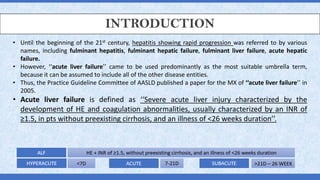
• Acute liver failure is defined as ‘‘Severe acute liver injury characterized by the
development of HE and coagulation abnormalities, usually characterized by an INR of
≥1.5, in pts without preexisting cirrhosis, and an illness of <26 weeks duration’’.
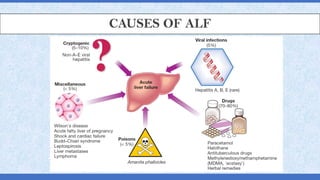
CAUSES OF ALF
CLINICAL ASSESSMENT
Cerebral disturbance
Jaundice
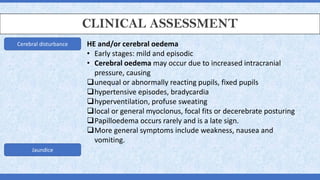
HE and/or cerebral oedema
• Early stages: mild and episodic
• Cerebral oedema may occur due to increased intracranial
pressure, causing
❑unequal or abnormally reacting pupils, fixed pupils
❑hypertensive episodes, bradycardia
❑hyperventilation, profuse sweating
❑local or general myoclonus, focal fits or decerebrate posturing
❑Papilloedema occurs rarely and is a late sign.
❑More general symptoms include weakness, nausea and
vomiting.
HEPATIC ENCEPHALOPATHY
CLINICAL ASSESSMENT
Cerebral disturbance
Jaundice
❑ may not be present at the outset (e.g. in paracetamol overdose).
❑ Fetor hepaticus can be present.
❑ The liver is usually of normal size but later becomes smaller.
❑ Hepatomegaly is unusual and, in the presence of a sudden onset
of ascites, suggests venous outflow obstruction as the cause
(Budd–Chiari syndrome).
❑ Splenomegaly is uncommon and never prominent.
❑ Ascites and oedema are late developments.
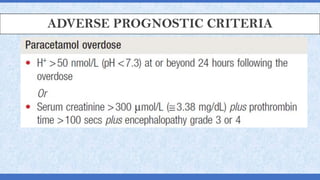
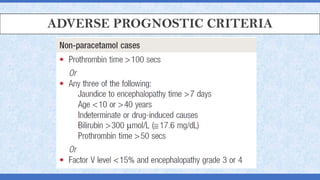
ADVERSE PROGNOSTIC CRITERIA
MANAGEMENT
• Patients should be treated in a ICU .
• Conservative treatment aims to maintain life in the hope that hepatic regeneration
will occur, but early transfer to a specialised transplant unit should always be
considered.
• N-acetylcysteine therapy may improve outcome, particularly in patients with
paracetamol poisoning.
• A number of artificial liver support systems have been developed and evaluated for
use as a bridge to either transplantation or recovery. None, however, has entered
routine clinical use.
TOXIC DOSE
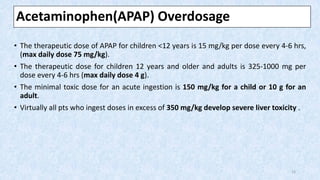
• The therapeutic dose of APAP for children <12 years is 15 mg/kg per dose every 4-6 hrs,
(max daily dose 75 mg/kg).
• The therapeutic dose for children 12 years and older and adults is 325-1000 mg per
dose every 4-6 hrs (max daily dose 4 g).
• The minimal toxic dose for an acute ingestion is 150 mg/kg for a child or 10 g for an
adult.
• Virtually all pts who ingest doses in excess of 350 mg/kg develop severe liver toxicity .
Acetaminophen(APAP) Overdosage
12
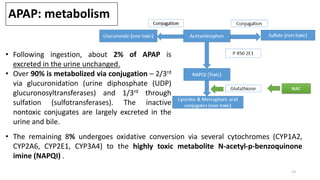
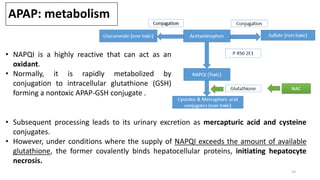
• Following ingestion, about 2% of APAP is
excreted in the urine unchanged.
• Over 90% is metabolized via conjugation – 2/3rd
via glucuronidation (urine diphosphate (UDP)
glucuronosyltransferases) and 1/3rd through
sulfation (sulfotransferases). The inactive
nontoxic conjugates are largely excreted in the
urine and bile.
APAP: metabolism
13
• The remaining 8% undergoes oxidative conversion via several cytochromes (CYP1A2,
CYP2A6, CYP2E1, CYP3A4) to the highly toxic metabolite N-acetyl-p-benzoquinone
imine (NAPQI) .
• NAPQI is a highly reactive that can act as an
oxidant.
• Normally, it is rapidly metabolized by
conjugation to intracellular glutathione (GSH)
forming a nontoxic APAP-GSH conjugate .
• Subsequent processing leads to its urinary excretion as mercapturic acid and cysteine
conjugates.
• However, under conditions where the supply of NAPQI exceeds the amount of available
glutathione, the former covalently binds hepatocellular proteins, initiating hepatocyte
necrosis.
APAP: metabolism
14
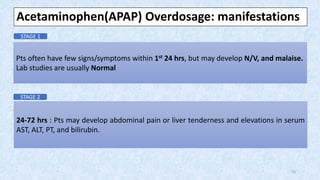
Pts often have few signs/symptoms within 1st 24 hrs, but may develop N/V, and malaise.
Lab studies are usually Normal
24-72 hrs : Pts may develop abdominal pain or liver tenderness and elevations in serum
AST, ALT, PT, and bilirubin.
Acetaminophen(APAP) Overdosage: manifestations
STAGE 1
STAGE 2
15
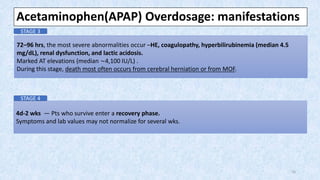
72–96 hrs, the most severe abnormalities occur –HE, coagulopathy, hyperbilirubinemia (median 4.5
mg/dL), renal dysfunction, and lactic acidosis.
Marked AT elevations (median ∼4,100 IU/L) .
During this stage, death most often occurs from cerebral herniation or from MOF.
Acetaminophen(APAP) Overdosage: manifestations
STAGE 3
4d-2 wks — Pts who survive enter a recovery phase.
Symptoms and lab values may not normalize for several wks.
STAGE 4
16
N-Acetylcysteine for Acetaminophen Overdose
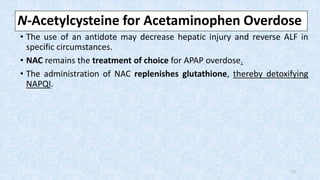
• The use of an antidote may decrease hepatic injury and reverse ALF in
specific circumstances.
• NAC remains the treatment of choice for APAP overdose.
• The administration of NAC replenishes glutathione, thereby detoxifying
NAPQI.
17
Extra note : GI DECONTAMINATION
• Adult patients who present soon after a potentially toxic ingestion of
APAP (single dose ≥7.5 g) are likely to benefit from gastrointestinal
decontamination.
• We suggest treatment with activated charcoal (AC), 1 g/kg (maximum
dose 50 g) by mouth in all patients who present within four hours of a
known or suspected acetaminophen ingestion, unless there are
contraindications to its administration.
• Note: Charcoal should be withheld in patients who are sedated and may
not be able to protect their airway, unless endotracheal intubation is
performed first.
18
Mushroom poisoning
• ALF from ingestion of the mushrooms of the genus Amanita (A. phalloides,
A. verna, and A. virosa) .
• Three medium sized mushrooms (50 g) contain sufficient toxin, α-amanitin
and phalloidin, to cause ALF; the toxins are heat stable and not degraded
by cooking.
• The phallotoxin causes damage to the enterocyte cell membrane.
• The a-amanintin toxin (amatoxin) is dose dependent and responsible for
hepatic injury by disrupting hepatocyte messenger RNA synthesis.
19
Mushroom Poisoning: Course of poisoning
• Following ingestion, a 6–12-hour asymptomatic phase evolves into three
clinical phases.
• The gastrointestinal phase (phase 1; 12–24 hours), consists of diarrhea,
vomiting, and abdominal pain.
• During the hepatotoxic phase (phase 2: 24–48 hours) signs of liver
damage occur and the disease may progress to the third clinical phase
(4– 7 days), during which ALF, hepatorenal syndrome, hemorrhage,
convulsions, coma, and death occur.
• Mortality approaches 10–30% .
20
Mushroom Poisoning
• A combination of penicillin (300,000-1,000,000 U/kg/day, or 250
mg/kg/day iv) and silibinin (20-50 mg/ kg/day iv) has been used as a
specific antidote in those with evidence of liver injury due to Amanita
poisoning.
• These agents are hypothesized to interrupt the enterohepatic circulation of toxins and also to compete
at the hepatocyte membrane for transmembrane transport.
• Because of the rarity of this cause of ALF, the benefits of this regimen remain unproven.
In ALF pts with known or suspected mushroom poisoning, consider administration of
penicillin G and N-acetylcysteine (III). AASLD 2011
Pts with ALF secondary to mushroom poisoning should be listed for transplantation, as
this procedure is often the only lifesaving option (III).AASLD 2011
21
END OF SLDIES

7. ACUTE LIVER FAILURE

  • 1.
    Hepatology lectures for 5thSem;MBBS Pratap Sagar Tiwari MBBS,MD (Medicine),DM (Hepatology)
  • 2.
    INTRODUCTION • Until thebeginning of the 21st century, hepatitis showing rapid progression was referred to by various names, including fulminant hepatitis, fulminant hepatic failure, fulminant liver failure, acute hepatic failure. • However, ‘‘acute liver failure’’ came to be used predominantly as the most suitable umbrella term, because it can be assumed to include all of the other disease entities. • Thus, the Practice Guideline Committee of AASLD published a paper for the MX of ‘‘acute liver failure’’ in 2005. • Acute liver failure is defined as ‘‘Severe acute liver injury characterized by the development of HE and coagulation abnormalities, usually characterized by an INR of ≥1.5, in pts without preexisting cirrhosis, and an illness of <26 weeks duration’’.
  • 3.
  • 4.
    CLINICAL ASSESSMENT Cerebral disturbance Jaundice HEand/or cerebral oedema • Early stages: mild and episodic • Cerebral oedema may occur due to increased intracranial pressure, causing ❑unequal or abnormally reacting pupils, fixed pupils ❑hypertensive episodes, bradycardia ❑hyperventilation, profuse sweating ❑local or general myoclonus, focal fits or decerebrate posturing ❑Papilloedema occurs rarely and is a late sign. ❑More general symptoms include weakness, nausea and vomiting.
  • 5.
  • 6.
    CLINICAL ASSESSMENT Cerebral disturbance Jaundice ❑may not be present at the outset (e.g. in paracetamol overdose). ❑ Fetor hepaticus can be present. ❑ The liver is usually of normal size but later becomes smaller. ❑ Hepatomegaly is unusual and, in the presence of a sudden onset of ascites, suggests venous outflow obstruction as the cause (Budd–Chiari syndrome). ❑ Splenomegaly is uncommon and never prominent. ❑ Ascites and oedema are late developments.
  • 8.
  • 9.
  • 10.
    MANAGEMENT • Patients shouldbe treated in a ICU . • Conservative treatment aims to maintain life in the hope that hepatic regeneration will occur, but early transfer to a specialised transplant unit should always be considered. • N-acetylcysteine therapy may improve outcome, particularly in patients with paracetamol poisoning. • A number of artificial liver support systems have been developed and evaluated for use as a bridge to either transplantation or recovery. None, however, has entered routine clinical use.
  • 12.
    TOXIC DOSE • Thetherapeutic dose of APAP for children <12 years is 15 mg/kg per dose every 4-6 hrs, (max daily dose 75 mg/kg). • The therapeutic dose for children 12 years and older and adults is 325-1000 mg per dose every 4-6 hrs (max daily dose 4 g). • The minimal toxic dose for an acute ingestion is 150 mg/kg for a child or 10 g for an adult. • Virtually all pts who ingest doses in excess of 350 mg/kg develop severe liver toxicity . Acetaminophen(APAP) Overdosage 12
  • 13.
    • Following ingestion,about 2% of APAP is excreted in the urine unchanged. • Over 90% is metabolized via conjugation – 2/3rd via glucuronidation (urine diphosphate (UDP) glucuronosyltransferases) and 1/3rd through sulfation (sulfotransferases). The inactive nontoxic conjugates are largely excreted in the urine and bile. APAP: metabolism 13 • The remaining 8% undergoes oxidative conversion via several cytochromes (CYP1A2, CYP2A6, CYP2E1, CYP3A4) to the highly toxic metabolite N-acetyl-p-benzoquinone imine (NAPQI) .
  • 14.
    • NAPQI isa highly reactive that can act as an oxidant. • Normally, it is rapidly metabolized by conjugation to intracellular glutathione (GSH) forming a nontoxic APAP-GSH conjugate . • Subsequent processing leads to its urinary excretion as mercapturic acid and cysteine conjugates. • However, under conditions where the supply of NAPQI exceeds the amount of available glutathione, the former covalently binds hepatocellular proteins, initiating hepatocyte necrosis. APAP: metabolism 14
  • 15.
    Pts often havefew signs/symptoms within 1st 24 hrs, but may develop N/V, and malaise. Lab studies are usually Normal 24-72 hrs : Pts may develop abdominal pain or liver tenderness and elevations in serum AST, ALT, PT, and bilirubin. Acetaminophen(APAP) Overdosage: manifestations STAGE 1 STAGE 2 15
  • 16.
    72–96 hrs, themost severe abnormalities occur –HE, coagulopathy, hyperbilirubinemia (median 4.5 mg/dL), renal dysfunction, and lactic acidosis. Marked AT elevations (median ∼4,100 IU/L) . During this stage, death most often occurs from cerebral herniation or from MOF. Acetaminophen(APAP) Overdosage: manifestations STAGE 3 4d-2 wks — Pts who survive enter a recovery phase. Symptoms and lab values may not normalize for several wks. STAGE 4 16
  • 17.
    N-Acetylcysteine for AcetaminophenOverdose • The use of an antidote may decrease hepatic injury and reverse ALF in specific circumstances. • NAC remains the treatment of choice for APAP overdose. • The administration of NAC replenishes glutathione, thereby detoxifying NAPQI. 17
  • 18.
    Extra note :GI DECONTAMINATION • Adult patients who present soon after a potentially toxic ingestion of APAP (single dose ≥7.5 g) are likely to benefit from gastrointestinal decontamination. • We suggest treatment with activated charcoal (AC), 1 g/kg (maximum dose 50 g) by mouth in all patients who present within four hours of a known or suspected acetaminophen ingestion, unless there are contraindications to its administration. • Note: Charcoal should be withheld in patients who are sedated and may not be able to protect their airway, unless endotracheal intubation is performed first. 18
  • 19.
    Mushroom poisoning • ALFfrom ingestion of the mushrooms of the genus Amanita (A. phalloides, A. verna, and A. virosa) . • Three medium sized mushrooms (50 g) contain sufficient toxin, α-amanitin and phalloidin, to cause ALF; the toxins are heat stable and not degraded by cooking. • The phallotoxin causes damage to the enterocyte cell membrane. • The a-amanintin toxin (amatoxin) is dose dependent and responsible for hepatic injury by disrupting hepatocyte messenger RNA synthesis. 19
  • 20.
    Mushroom Poisoning: Courseof poisoning • Following ingestion, a 6–12-hour asymptomatic phase evolves into three clinical phases. • The gastrointestinal phase (phase 1; 12–24 hours), consists of diarrhea, vomiting, and abdominal pain. • During the hepatotoxic phase (phase 2: 24–48 hours) signs of liver damage occur and the disease may progress to the third clinical phase (4– 7 days), during which ALF, hepatorenal syndrome, hemorrhage, convulsions, coma, and death occur. • Mortality approaches 10–30% . 20
  • 21.
    Mushroom Poisoning • Acombination of penicillin (300,000-1,000,000 U/kg/day, or 250 mg/kg/day iv) and silibinin (20-50 mg/ kg/day iv) has been used as a specific antidote in those with evidence of liver injury due to Amanita poisoning. • These agents are hypothesized to interrupt the enterohepatic circulation of toxins and also to compete at the hepatocyte membrane for transmembrane transport. • Because of the rarity of this cause of ALF, the benefits of this regimen remain unproven. In ALF pts with known or suspected mushroom poisoning, consider administration of penicillin G and N-acetylcysteine (III). AASLD 2011 Pts with ALF secondary to mushroom poisoning should be listed for transplantation, as this procedure is often the only lifesaving option (III).AASLD 2011 21
  • 22.