Chronic Hepatitis
Dr Manoj K Ghoda M.D., M.R.C.P.
Consultant Gastroenterologist
Visiting faculty at GCS Hospital
All presentations are available on
facebook
at “gujarat gastro group”
12 yrs old boy
•Jaundice
•Abdominal distention
•Edema feet
•Ascites
•Abdominal distention
was there for past few
years (in retrospect)
•History of repeated
epistaxis
What was absent...
•Fever,
•Malaise
•Nausea or
vomiting
•Aversion to food
On examination
•Thin and lean
•Jaundice+
•Moderate edema feet
•Ascites ++
•There was wasting of proximal muscles of arms and
legs
•Liver ++, firm with rounded edges; Spleen ++
•Visible veins on upper part of abdomen
•Other systems were normal
From above findings we know that we are dealing
with liver disease, most probably of longstanding
duration
What features suggestive of long standing
•Long history of liver
disease
•Repeated epistaxis
•Blackening of face
•Edema
•Ascites, Umbilical hernia
•Visible veins
•Proximal muscle wasting
•Spider nevi
•Palmer erythema
•Liver enlarged ++
•Spleen enlarged ++
•Shrunken nodular
liver or coarse
parenchymal echo
•Dilated portal vein
and splenic veins,
collaterals in splenic
hilum
Features suggestive of long standing Liver problem
Chronic hepatitis: Long standing inflammation
of liver; six months is an arbitrary limit.
Coming back to our case....
One elder and one younger sibling were
having similar problems.
What could be causing this?
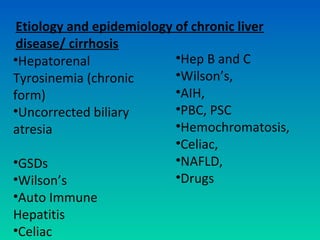
•Hepatorenal
Tyrosinemia (chronic
form)
•Uncorrected biliary
atresia
•GSDs
•Wilson’s
•Auto Immune
Hepatitis
•Celiac
•Hep B and C
•Wilson’s,
•AIH,
•PBC, PSC
•Hemochromatosis,
•Celiac,
•NAFLD,
•Drugs
Etiology and epidemiology of chronic liver
disease/ cirrhosis
Pathogenesis
•Direct toxicity
•Immune mediated
To hepatocytes/its constitute
To biliary epithelium/ its constitute
•Promotion of fibrosis
Or a combination of above
Pathology:
CHRONIC HEPATITIS B. Hepatocytes show pathognomonic
ground glass hepatocytes (arrows), distributed singly in a
haphazard fashion with no zoning preference. Inclusions
have an amorphous or finely granular and paler look
CHRONIC HEPATITIS C. Although portal tracts may
contain lymphoid nodules in chronic hepatitis of any
cause it is more commonly seen in chronic hepatitis C.
AIH
Hepatic macrosteatosis (>5%). Variable hepatocellular
inflammation and injury. Inflammation may be
predominantly neutrophilic or lymphocytic.
Hepatocellular ballooning, apoptoic (acidophil) bodies,
and Mallory’s bodies. Variable pericellular /
perisinusoidal fibrosis.
Wilson's disease --> Cu2+ deposits --> Rhodanine
stain
Cirrhosis of liver
Clinical features:
Sometimes there are no specific symptoms.
When present, symptoms could be very vague.
•Fatigue, lethargy, body ache could be present for
a long time.
•Anorexia.
•Edema, ascites in decompensated stage.
•Easy bruising.
•Blackening of the skin.
•Progressive weight loss.
On examination:
•Jaundice may or may not be present.
•Spider nevi may be present in the upper half of
the body.
•There may be ascites or pedal edema in
decompensated stage.
•Umbilical hernia is frequently seen in patients with
decompensated chronic hepatitis.
•There may be visible veins on abdominal wall.
•Muscle wasting may be present.
Investigations: Diagnostic
•LFT may show elevated bilirubin, SGPT or SGOT.
•Serum albumin may be decreased and globulin raised,
reversing the A/G ratio. In autoimmune hepatitis, there may
be marked rise in globulin.
Sonography may show altered liver size and echo texture,
splenic enlargement and dilated portal and splenic veins and
varices may be seen in splenic hilum, stomach and lower
end of esophagus. Ascites may be present.
•CBC may show anemia, generally normochromic, and
normocytic, but occasionally microcytic hypochromic if there
is frank or occult blood loss or macrocytic if alcohol is the
etiology. ESR may be high in autoimmune variety.
•WCC and Platelets may be decreased due to
hypersplenism.
Investigations:
UGI endoscopy for varices or PHG
Snake skin
Investigations: Etiological
•HBsAg, Total HBcAb
•HCV-Ab
•Ceruloplasmin, 24hr urinary copper, KF
ring, liver copper content
•Transferrin saturation and
ferritin
•ANA, Anti SMA, Anti LKM1-2
•TTGA
•Urinary succinyl acetone
•Liver biopsy
Investigations: Prognostic
The MELD score (UNOS MELD score
calculator)
Above 20= Need for transplant is near
Less than 20= Need for transplant is not
near
(www.mayoclinic.org/meld/mayomodel6.
html)
(optn.transplant.hrsa.gov/resources/Meld
PeldCalculator)
Progression:
If left untreated there is progression of the
disease leading to cirrhosis of liver
Treatment:
•Treatment of liver failure and portal HT if present:
Albumin, non selective B blockers, diuretics, high
protein diet, Lactulose
•Treatment of cause
Hep B infection: If the disease is active, Interferon or
Nucleoside/tide analogues like Tenofovir or Entecavir
Hep C: Inf+ RBV; Direct Acting Agents (DAA)
Wilson’s: d-Penicillamine, Trientin
AIH: Prednisolon + Azathioprine
Celiac: Gluten withdrawl
Hemochromatosis: Venesection
Prognosis:
Excellent if treated in time
Hepatic Encephalopathy
Hepatic encephalopathy consists of a wide spectrum of often-
reversible neuropsychiatric syndromes that complicate acute or
chronic liver disease, occurring with a frequency of 10-50% in
cirrhotics at some time during their illness.
Incidence of coma following acute liver failure is fairly low,
around 0.1 % in general population and up to 20% in pregnant
women with hepatitis E. It has high mortality and morbidity
Pathophysiology:
•Neuropathologically, encephalopathy is characterized by enlarged
astrocytes with prominent nucleoli; margination of chromatin; and
large, pale nuclei without any significant neuronal changes.
•Neurophysiologically, there is no one single mechanism. Current
hypothesis suggest that a combination of chronic low-grade glial
edema and potentiation of the effects of gamma-amino butyric
acid (GABA) on the central nervous system by ammonia may be
responsible for many of the symptoms of hepatic encephalopathy.
Neuropathology (2)
•Of prime importance is ammonia which has direct effect on
neural membrane or on postsynaptic inhibition and
indirect effect on neuronal function via increased level of
glutamine.
•GABA, which is an inhibitory neurotransmitter, enters
circulation without being metabolized in liver and causing
encephalopathy.
•Moreover dopamine and catecholamine mediated
neurotransmission is inhibited by false neurotransmitters
generated by bacterial action in the colon.
•There is an increased levels of manganese in the basal
ganglia and also other areas of the brain which may have a
role to play.
Clinical manifestations:
•Range from mildly altered mental status to coma.
•In subclinical or minimal hepatic encephalopathy there are only
subtle changes, detected only by psychomotor testing and easily
reversible with therapy.
•Acute hepatic encephalopathy associated with acute
fulminant liver failure is characterised by quick progression to
coma.
•Onset is abrupt with confusion, disorientation which quickly
leads to convulsions, coma, and decerebrate rigidity.
•Pupils may be fixed and there could be paroxysmal
hypertension and rapid breathing.
•Fetor hepaticus, a musty smell in breath, may be present.
•There may be high grade fever.
•Jaundice may or may not be visible.
•Mortality is 70-80% and is usually due to hypoxia and cerebral
herniation caused by cerebral edema, increased intracranial
pressure, and reduced cerebral perfusion.
Chronic hepatic encephalopathy is more common and is
associated with end-stage cirrhosis.
1.It is slow in onset with milder symptoms and is usually
triggered by precipitating factors such as infection, electrolyte
disturbances, constipation, and gastrointestinal bleeding, etc.,
and is reversible in a majority of the cases.
2.In sub-acute onset the patient may fluctuate from drowsy
but rousable state to deeply comatose. Flapping tremors or
rigidity may be present.
3.Chronic onset may be missed for some time. There may be
personality changes, forgetfulness, altered sleep pattern
and deteriorating hand writings. They fail on number
connection tests. Flaps and rigidity may be present.
4.Following the first episode of overt hepatic encephalopathy,
1-year survival is approximately 40%. This rate falls to about
15% after 3 years.
Grading of coma:
•Drowsy but rousable.
•Confused, agitated.
•Not rousable, comatose but responds to painful stimuli.
•Deep coma, not responding to painful stimuli.
Investigations:
•CBC and peripheral smear to rule out any infection.
•Electrolytes.
•Blood sugar. Ammonia to confirm hepatic origin of
encephalopathy.
•Urea and creatinine.
•Prothrombin time, bilirubin, SGPT, albumin to gauge the
extent of dysfunction.
•If already not obtained, viral markers and other tests like
24 hour urinary copper , antinuclear antibodies etc. to find
out the etiology of underlying liver disease.
•EEG could be required in an atypical case of chronic
encephalopathy.
Treatment:
•Correction or removal of the underlying precipitant, such as
hypovolemia, electrolyte imbalance, hypoxia, constipation,
gastrointestinal bleeding, metabolic derangement, infection, and
sedatives or tranquilisers.
•Protein restriction is not required. Protein intake could be 1.5
gm/Kg body weight to avoid negative nitrogen balance.
•Treating constipation with lactulose is the mainstay of therapy
for hepatic encephalopathy, but has no significant benefit on
mortality. Lactulose is catabolised by colonic bacterial flora to
short-chain fatty acids which lowers the colonic pH. This
reduction in pH favors the formation of the nonabsorbable NH4+
from NH3, trapping NH3 in the colon and thereby reducing plasma
ammonia concentrations.
Treatement:
•Sodium benzoate, 250mg/Kg body weight/ day in divided
doses IV or orally is the drug of choice to reduce ammonia
levels.
•Sod Phenyl buterate at the same dose is used simultaneously,
if available.
•L-ornithine , L-aspartate is of no proven value.
•Cerebral edema could be life threatening and is treated with
mannitol, if there is adequate urine output and plasma
osmolality is not higher than 340 mmol.
•Antibiotics are also used as second-line therapy.
•Flumazenil is recommended only if the patient has received
benzodiazepines.
•Pentothal sodium may be used in the dose of 1-4 mg , as
infusion if there are no cardiac arrhythmia.
•Hypothermia is a recent concept which tends to lower the
intracranial pressure. Mild hypothermia results in a delay in
onset of encephalopathy and prevention of brain edema. Mild
hypothermia could be beneficial in the prevention of severe
encephalopathy and brain edema in patients with ALF awaiting
liver transplantation.
Prognosis
Any questions?
Dr Manoj K Ghoda M.D., M.R.C.P.
Consultant Gastroenterologist
Visiting faculty at GCS hospital
gujarat gastro group

Chronic hepatitis ppt

  • 1.
    Chronic Hepatitis Dr ManojK Ghoda M.D., M.R.C.P. Consultant Gastroenterologist Visiting faculty at GCS Hospital
  • 2.
    All presentations areavailable on facebook at “gujarat gastro group”
  • 3.
    12 yrs oldboy •Jaundice •Abdominal distention •Edema feet •Ascites •Abdominal distention was there for past few years (in retrospect) •History of repeated epistaxis What was absent... •Fever, •Malaise •Nausea or vomiting •Aversion to food
  • 4.
    On examination •Thin andlean •Jaundice+ •Moderate edema feet •Ascites ++ •There was wasting of proximal muscles of arms and legs •Liver ++, firm with rounded edges; Spleen ++ •Visible veins on upper part of abdomen •Other systems were normal From above findings we know that we are dealing with liver disease, most probably of longstanding duration What features suggestive of long standing
  • 5.
    •Long history ofliver disease •Repeated epistaxis •Blackening of face •Edema •Ascites, Umbilical hernia •Visible veins •Proximal muscle wasting •Spider nevi •Palmer erythema •Liver enlarged ++ •Spleen enlarged ++ •Shrunken nodular liver or coarse parenchymal echo •Dilated portal vein and splenic veins, collaterals in splenic hilum Features suggestive of long standing Liver problem
  • 7.
    Chronic hepatitis: Longstanding inflammation of liver; six months is an arbitrary limit. Coming back to our case.... One elder and one younger sibling were having similar problems. What could be causing this?
  • 8.
    •Hepatorenal Tyrosinemia (chronic form) •Uncorrected biliary atresia •GSDs •Wilson’s •AutoImmune Hepatitis •Celiac •Hep B and C •Wilson’s, •AIH, •PBC, PSC •Hemochromatosis, •Celiac, •NAFLD, •Drugs Etiology and epidemiology of chronic liver disease/ cirrhosis
  • 9.
    Pathogenesis •Direct toxicity •Immune mediated Tohepatocytes/its constitute To biliary epithelium/ its constitute •Promotion of fibrosis Or a combination of above
  • 10.
    Pathology: CHRONIC HEPATITIS B.Hepatocytes show pathognomonic ground glass hepatocytes (arrows), distributed singly in a haphazard fashion with no zoning preference. Inclusions have an amorphous or finely granular and paler look
  • 11.
    CHRONIC HEPATITIS C.Although portal tracts may contain lymphoid nodules in chronic hepatitis of any cause it is more commonly seen in chronic hepatitis C.
  • 12.
  • 13.
    Hepatic macrosteatosis (>5%).Variable hepatocellular inflammation and injury. Inflammation may be predominantly neutrophilic or lymphocytic. Hepatocellular ballooning, apoptoic (acidophil) bodies, and Mallory’s bodies. Variable pericellular / perisinusoidal fibrosis.
  • 14.
    Wilson's disease -->Cu2+ deposits --> Rhodanine stain
  • 16.
  • 17.
    Clinical features: Sometimes thereare no specific symptoms. When present, symptoms could be very vague. •Fatigue, lethargy, body ache could be present for a long time. •Anorexia. •Edema, ascites in decompensated stage. •Easy bruising. •Blackening of the skin. •Progressive weight loss.
  • 18.
    On examination: •Jaundice mayor may not be present. •Spider nevi may be present in the upper half of the body. •There may be ascites or pedal edema in decompensated stage. •Umbilical hernia is frequently seen in patients with decompensated chronic hepatitis. •There may be visible veins on abdominal wall. •Muscle wasting may be present.
  • 19.
    Investigations: Diagnostic •LFT mayshow elevated bilirubin, SGPT or SGOT. •Serum albumin may be decreased and globulin raised, reversing the A/G ratio. In autoimmune hepatitis, there may be marked rise in globulin. Sonography may show altered liver size and echo texture, splenic enlargement and dilated portal and splenic veins and varices may be seen in splenic hilum, stomach and lower end of esophagus. Ascites may be present. •CBC may show anemia, generally normochromic, and normocytic, but occasionally microcytic hypochromic if there is frank or occult blood loss or macrocytic if alcohol is the etiology. ESR may be high in autoimmune variety. •WCC and Platelets may be decreased due to hypersplenism.
  • 20.
    Investigations: UGI endoscopy forvarices or PHG Snake skin
  • 21.
    Investigations: Etiological •HBsAg, TotalHBcAb •HCV-Ab •Ceruloplasmin, 24hr urinary copper, KF ring, liver copper content •Transferrin saturation and ferritin •ANA, Anti SMA, Anti LKM1-2 •TTGA •Urinary succinyl acetone •Liver biopsy
  • 22.
    Investigations: Prognostic The MELDscore (UNOS MELD score calculator) Above 20= Need for transplant is near Less than 20= Need for transplant is not near (www.mayoclinic.org/meld/mayomodel6. html) (optn.transplant.hrsa.gov/resources/Meld PeldCalculator)
  • 23.
    Progression: If left untreatedthere is progression of the disease leading to cirrhosis of liver
  • 24.
    Treatment: •Treatment of liverfailure and portal HT if present: Albumin, non selective B blockers, diuretics, high protein diet, Lactulose •Treatment of cause Hep B infection: If the disease is active, Interferon or Nucleoside/tide analogues like Tenofovir or Entecavir Hep C: Inf+ RBV; Direct Acting Agents (DAA) Wilson’s: d-Penicillamine, Trientin AIH: Prednisolon + Azathioprine Celiac: Gluten withdrawl Hemochromatosis: Venesection
  • 25.
  • 27.
    Hepatic Encephalopathy Hepatic encephalopathyconsists of a wide spectrum of often- reversible neuropsychiatric syndromes that complicate acute or chronic liver disease, occurring with a frequency of 10-50% in cirrhotics at some time during their illness. Incidence of coma following acute liver failure is fairly low, around 0.1 % in general population and up to 20% in pregnant women with hepatitis E. It has high mortality and morbidity
  • 28.
    Pathophysiology: •Neuropathologically, encephalopathy ischaracterized by enlarged astrocytes with prominent nucleoli; margination of chromatin; and large, pale nuclei without any significant neuronal changes. •Neurophysiologically, there is no one single mechanism. Current hypothesis suggest that a combination of chronic low-grade glial edema and potentiation of the effects of gamma-amino butyric acid (GABA) on the central nervous system by ammonia may be responsible for many of the symptoms of hepatic encephalopathy.
  • 29.
    Neuropathology (2) •Of primeimportance is ammonia which has direct effect on neural membrane or on postsynaptic inhibition and indirect effect on neuronal function via increased level of glutamine. •GABA, which is an inhibitory neurotransmitter, enters circulation without being metabolized in liver and causing encephalopathy. •Moreover dopamine and catecholamine mediated neurotransmission is inhibited by false neurotransmitters generated by bacterial action in the colon. •There is an increased levels of manganese in the basal ganglia and also other areas of the brain which may have a role to play.
  • 30.
    Clinical manifestations: •Range frommildly altered mental status to coma. •In subclinical or minimal hepatic encephalopathy there are only subtle changes, detected only by psychomotor testing and easily reversible with therapy.
  • 31.
    •Acute hepatic encephalopathyassociated with acute fulminant liver failure is characterised by quick progression to coma. •Onset is abrupt with confusion, disorientation which quickly leads to convulsions, coma, and decerebrate rigidity. •Pupils may be fixed and there could be paroxysmal hypertension and rapid breathing. •Fetor hepaticus, a musty smell in breath, may be present. •There may be high grade fever. •Jaundice may or may not be visible. •Mortality is 70-80% and is usually due to hypoxia and cerebral herniation caused by cerebral edema, increased intracranial pressure, and reduced cerebral perfusion.
  • 32.
    Chronic hepatic encephalopathyis more common and is associated with end-stage cirrhosis. 1.It is slow in onset with milder symptoms and is usually triggered by precipitating factors such as infection, electrolyte disturbances, constipation, and gastrointestinal bleeding, etc., and is reversible in a majority of the cases. 2.In sub-acute onset the patient may fluctuate from drowsy but rousable state to deeply comatose. Flapping tremors or rigidity may be present. 3.Chronic onset may be missed for some time. There may be personality changes, forgetfulness, altered sleep pattern and deteriorating hand writings. They fail on number connection tests. Flaps and rigidity may be present. 4.Following the first episode of overt hepatic encephalopathy, 1-year survival is approximately 40%. This rate falls to about 15% after 3 years.
  • 33.
    Grading of coma: •Drowsybut rousable. •Confused, agitated. •Not rousable, comatose but responds to painful stimuli. •Deep coma, not responding to painful stimuli.
  • 34.
    Investigations: •CBC and peripheralsmear to rule out any infection. •Electrolytes. •Blood sugar. Ammonia to confirm hepatic origin of encephalopathy. •Urea and creatinine. •Prothrombin time, bilirubin, SGPT, albumin to gauge the extent of dysfunction. •If already not obtained, viral markers and other tests like 24 hour urinary copper , antinuclear antibodies etc. to find out the etiology of underlying liver disease. •EEG could be required in an atypical case of chronic encephalopathy.
  • 35.
    Treatment: •Correction or removalof the underlying precipitant, such as hypovolemia, electrolyte imbalance, hypoxia, constipation, gastrointestinal bleeding, metabolic derangement, infection, and sedatives or tranquilisers. •Protein restriction is not required. Protein intake could be 1.5 gm/Kg body weight to avoid negative nitrogen balance. •Treating constipation with lactulose is the mainstay of therapy for hepatic encephalopathy, but has no significant benefit on mortality. Lactulose is catabolised by colonic bacterial flora to short-chain fatty acids which lowers the colonic pH. This reduction in pH favors the formation of the nonabsorbable NH4+ from NH3, trapping NH3 in the colon and thereby reducing plasma ammonia concentrations.
  • 36.
    Treatement: •Sodium benzoate, 250mg/Kgbody weight/ day in divided doses IV or orally is the drug of choice to reduce ammonia levels. •Sod Phenyl buterate at the same dose is used simultaneously, if available. •L-ornithine , L-aspartate is of no proven value. •Cerebral edema could be life threatening and is treated with mannitol, if there is adequate urine output and plasma osmolality is not higher than 340 mmol. •Antibiotics are also used as second-line therapy. •Flumazenil is recommended only if the patient has received benzodiazepines.
  • 37.
    •Pentothal sodium maybe used in the dose of 1-4 mg , as infusion if there are no cardiac arrhythmia. •Hypothermia is a recent concept which tends to lower the intracranial pressure. Mild hypothermia results in a delay in onset of encephalopathy and prevention of brain edema. Mild hypothermia could be beneficial in the prevention of severe encephalopathy and brain edema in patients with ALF awaiting liver transplantation.
  • 38.
  • 39.
    Any questions? Dr ManojK Ghoda M.D., M.R.C.P. Consultant Gastroenterologist Visiting faculty at GCS hospital gujarat gastro group