
Dr.Sunil Kumar
MEM Resident
Dr.Mehta Hospital Pvt Ltd
Chennai
• Introduction.
• Definition.
• Pathophysiology / Cause.
• Diagnosis.
• Diagnostic study.
• Treatment.
• Clinical Presentation in ER.
• Approach to the patient.
• First priority in ER.
• Principle of Management in ER.
OBJECTIVE
• Gastrointestinal(GI)bleed is a common
presenting problem in the ER.
Upper GI bleed
Lower GI bleed
• Acute Upper GI bleeding in adult has
an over all annual incidence of approximately
47 per 1 lac.
• Male >female.
• Mortality rate 10% (Approx.).
INTRODUCTION
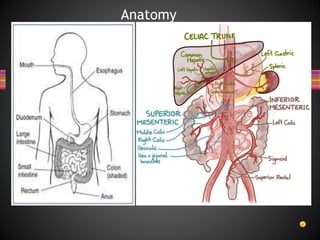
Anatomy
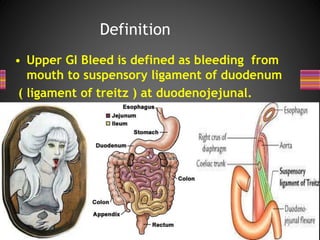
• Upper GI Bleed is defined as bleeding from
mouth to suspensory ligament of duodenum
( ligament of treitz ) at duodenojejunal.
.juction.
Definition
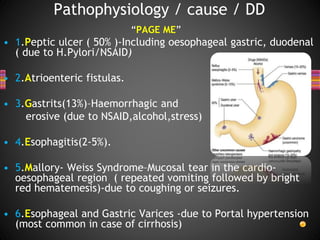
“PAGE ME”
• 1.Peptic ulcer ( 50% )-Including oesophageal gastric, duodenal
( due to H.Pylori/NSAID)
• 2.Atrioenteric fistulas.
• 3.Gastrits(13%)–Haemorrhagic and
erosive (due to NSAID,alcohol,stress)
• 4.Esophagitis(2-5%).
• 5.Mallory- Weiss Syndrome–Mucosal tear in the cardio-
oesophageal region ( repeated vomiting followed by bright
red hematemesis)-due to coughing or seizures.
• 6.Esophageal and Gastric Varices -due to Portal hypertension
(most common in case of cirrhosis)
Pathophysiology / cause / DD
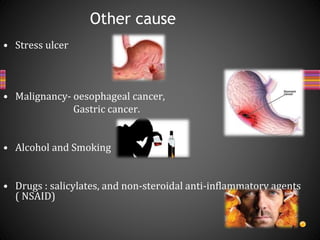
• Stress ulcer
• Malignancy- oesophageal cancer,
Gastric cancer.
• Alcohol and Smoking
• Drugs : salicylates, and non-steroidal anti-inflammatory agents
( NSAID)
Other cause
DIAGNOSIS
1.Clinical presentation/medical history
2.Physical Examination
3.Laboratory Data
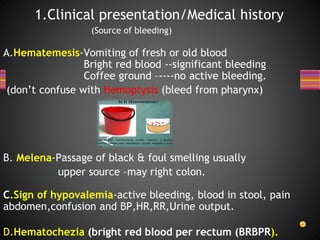
(Source of bleeding)
A.Hematemesis-Vomiting of fresh or old blood
Bright red blood --significant bleeding
Coffee ground –----no active bleeding.
(don’t confuse with Hemoptysis (bleed from pharynx)
B. Melena-Passage of black & foul smelling usually
upper source –may right colon.
C.Sign of hypovalemia-active bleeding, blood in stool, pain
abdomen,confusion and BP,HR,RR,Urine output.
D.Hematochezia (bright red blood per rectum (BRBPR).
1.Clinical presentation/Medical history
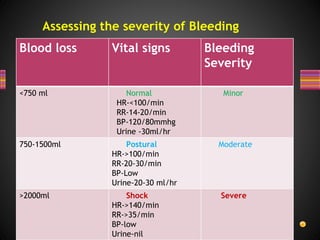
Assessing the severity of Bleeding
Blood loss Vital signs Bleeding
Severity
<750 ml Normal
HR-<100/min
RR-14-20/min
BP-120/80mmhg
Urine -30ml/hr
Minor
750-1500ml Postural
HR->100/min
RR-20-30/min
BP-Low
Urine-20-30 ml/hr
Moderate
>2000ml Shock
HR->140/min
RR->35/min
BP-low
Urine-nil
Severe
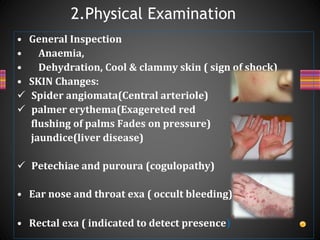
• General Inspection
• Anaemia,
• Dehydration, Cool & clammy skin ( sign of shock)
• SKIN Changes:
 Spider angiomata(Central arteriole)
 palmer erythema(Exagereted red
flushing of palms Fades on pressure)
jaundice(liver disease)
 Petechiae and puroura (cogulopathy)
• Ear nose and throat exa ( occult bleeding)
• Rectal exa ( indicated to detect presence)
2.Physical Examination
• Abdomen examination
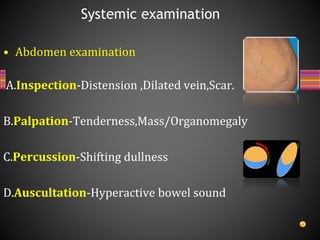
A.Inspection-Distension ,Dilated vein,Scar.
B.Palpation-Tenderness,Mass/Organomegaly
C.Percussion-Shifting dullness
D.Auscultation-Hyperactive bowel sound
Systemic examination
• Complete blood count.
• Blood grouping and typing
( most important lab test).
• Blood urea nitrogen ( BUN) :Creatinine >30-severe bleed
• Glucose.
• Cogulation studies.
• Liver function test ( LFT )
• Stool ocult blood test ,HIV,HCV,HBsAg.
3.Laboratry Data
• Chest x-rays/ABG :
To Rule out aspiration /
/ Pulmonary diseases.
• Serial ECG
• Barium contrast studies
limited diagnostic value
in an emergency setting.
continue..
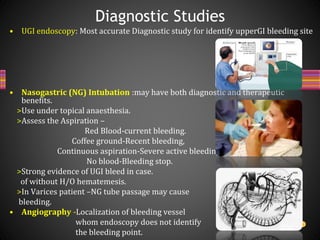
• UGI endoscopy: Most accurate Diagnostic study for identify upperGI bleeding site
• Nasogastric (NG) Intubation :may have both diagnostic and therapeutic
benefits.
>Use under topical anaesthesia.
>Assess the Aspiration –
Red Blood-current bleeding.
Coffee ground-Recent bleeding,
Continuous aspiration-Severe active bleeding,
No blood-Bleeding stop.
>Strong evidence of UGI bleed in case.
of without H/O hematemesis.
>In Varices patient –NG tube passage may cause
bleeding.
• Angiography -Localization of bleeding vessel
whom endoscopy does not identify
the bleeding point.
Diagnostic Studies
PRIMARY
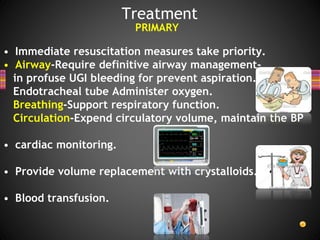
• Immediate resuscitation measures take priority.
• Airway-Require definitive airway management-
in profuse UGI bleeding for prevent aspiration.
Endotracheal tube Administer oxygen.
Breathing-Support respiratory function.
Circulation-Expend circulatory volume, maintain the BP
• cardiac monitoring.
• Provide volume replacement with crystalloids.
• Blood transfusion.
Treatment
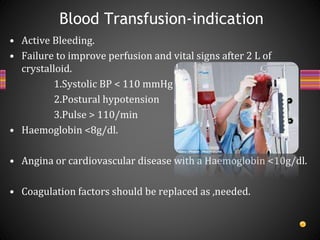
• Active Bleeding.
• Failure to improve perfusion and vital signs after 2 L of
crystalloid.
1.Systolic BP < 110 mmHg
2.Postural hypotension
3.Pulse > 110/min
• Haemoglobin <8g/dl.
• Angina or cardiovascular disease with a Haemoglobin <10g/dl.
• Coagulation factors should be replaced as ,needed.
Blood Transfusion-indication
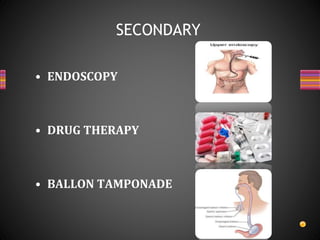
• ENDOSCOPY
• DRUG THERAPY
• BALLON TAMPONADE
SECONDARY
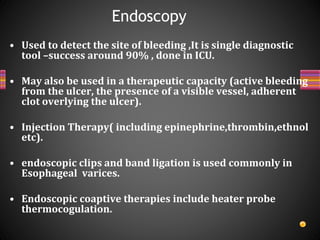
• Used to detect the site of bleeding ,It is single diagnostic
tool –success around 90% , done in ICU.
• May also be used in a therapeutic capacity (active bleeding
from the ulcer, the presence of a visible vessel, adherent
clot overlying the ulcer).
• Injection Therapy( including epinephrine,thrombin,ethnol
etc).
• endoscopic clips and band ligation is used commonly in
Esophageal varices.
• Endoscopic coaptive therapies include heater probe
thermocogulation.
Endoscopy
Antisecretory Agents
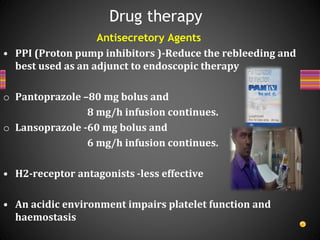
• PPI (Proton pump inhibitors )-Reduce the rebleeding and
best used as an adjunct to endoscopic therapy
o Pantoprazole –80 mg bolus and
8 mg/h infusion continues.
o Lansoprazole -60 mg bolus and
6 mg/h infusion continues.
• H2-receptor antagonists -less effective
• An acidic environment impairs platelet function and
haemostasis
Drug therapy
Splanchnic blood pressure modifiers
• Somatostatin -infusion have been used in UGI bleeding
when uncontrolled bleeding/endoscopy
unsuccessful/contraindicated /unavailable endoscopy.
• Octreotide -25 to 50 microgram IV bolus and 25-
50 microgram/h infusion.
• Vasopressin –Used to control GI bleed (most common
from Varices) - However reaction are more
common(HTN,Myocardial ischemia,Decreased CO /
increase the portal HTN and gangrene).
Continue..
• Antifibrinolytic Agents-Tranexamic acid .Antibiotics(e.g.
quinolone, 3G ceph). Vit K and clotting factors
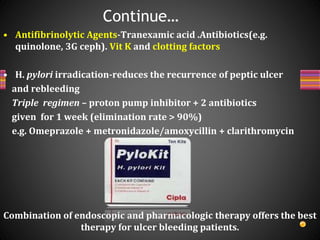
• H. pylori irradication-reduces the recurrence of peptic ulcer
and rebleeding
Triple regimen – proton pump inhibitor + 2 antibiotics
given for 1 week (elimination rate > 90%)
e.g. Omeprazole + metronidazole/amoxycillin + clarithromycin
Combination of endoscopic and pharmacologic therapy offers the best
therapy for ulcer bleeding patients.
Continue…
• BALLOON TAMPONADE :A NOW RARELY USED IN UGI BLEEDING
BECAUSE OF ADVERSE REACTIONS.
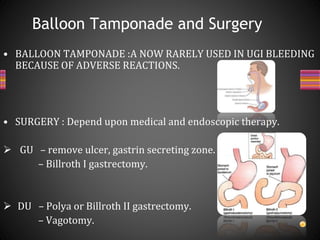
• SURGERY : Depend upon medical and endoscopic therapy.
 GU – remove ulcer, gastrin secreting zone.
– Billroth I gastrectomy.
 DU – Polya or Billroth II gastrectomy.
– Vagotomy.
Balloon Tamponade and Surgery
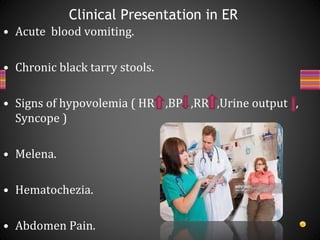
• Acute blood vomiting.
• Chronic black tarry stools.
• Signs of hypovolemia ( HR ,BP ,RR ,Urine output ,
Syncope )
• Melena.
• Hematochezia.
• Abdomen Pain.
Clinical Presentation in ER
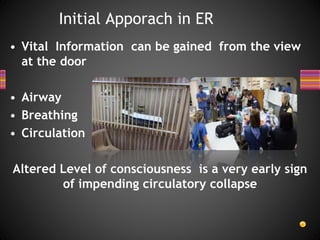
• Vital Information can be gained from the view
at the door
• Airway
• Breathing
• Circulation
Altered Level of consciousness is a very early sign
of impending circulatory collapse
Initial Apporach in ER
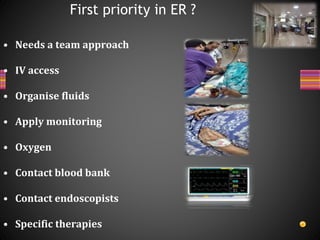
• Needs a team approach
• IV access
• Organise fluids
• Apply monitoring
• Oxygen
• Contact blood bank
• Contact endoscopists
• Specific therapies
First priority in ER ?
• 1.Fluid resuscitation.
• 2.Replacement of Hb/cloting factor if there is
significant blood loss
• 3.Monitoring fluid & blood resuscitation & periodic re-
evaluation
• 4.Determine the etiology & treat the cause .
Principles of management
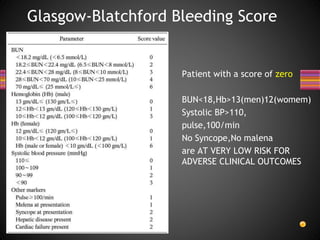
Patient with a score of zero
BUN<18,Hb>13(men)12(womem)
Systolic BP>110,
pulse,100/min
No Syncope,No malena
are AT VERY LOW RISK FOR
A ADVERSE CLINICAL OUTCOMES
Glasgow-Blatchford Bleeding Score
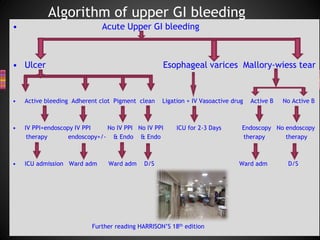
• Acute Upper GI bleeding
• Ulcer Esophageal varices Mallory-wiess tear
• Active bleeding Adherent clot Pigment clean Ligation + IV Vasoactive drug Active B No Active B
• IV PPI+endoscopy IV PPI No IV PPI No IV PPI ICU for 2-3 Days Endoscopy No endoscopy
therapy endoscopy+/- & Endo & Endo therapy therapy
• ICU admission Ward adm Ward adm D/S Ward adm D/S
Further reading HARRISON’S 18th edition
Algorithm of upper GI bleeding
UGI Bleed

UGI Bleed

  • 1.
    Dr.Sunil Kumar MEM Resident Dr.MehtaHospital Pvt Ltd Chennai
  • 2.
    • Introduction. • Definition. •Pathophysiology / Cause. • Diagnosis. • Diagnostic study. • Treatment. • Clinical Presentation in ER. • Approach to the patient. • First priority in ER. • Principle of Management in ER. OBJECTIVE
  • 3.
    • Gastrointestinal(GI)bleed isa common presenting problem in the ER. Upper GI bleed Lower GI bleed • Acute Upper GI bleeding in adult has an over all annual incidence of approximately 47 per 1 lac. • Male >female. • Mortality rate 10% (Approx.). INTRODUCTION
  • 4.
  • 5.
    • Upper GIBleed is defined as bleeding from mouth to suspensory ligament of duodenum ( ligament of treitz ) at duodenojejunal. .juction. Definition
  • 6.
    “PAGE ME” • 1.Pepticulcer ( 50% )-Including oesophageal gastric, duodenal ( due to H.Pylori/NSAID) • 2.Atrioenteric fistulas. • 3.Gastrits(13%)–Haemorrhagic and erosive (due to NSAID,alcohol,stress) • 4.Esophagitis(2-5%). • 5.Mallory- Weiss Syndrome–Mucosal tear in the cardio- oesophageal region ( repeated vomiting followed by bright red hematemesis)-due to coughing or seizures. • 6.Esophageal and Gastric Varices -due to Portal hypertension (most common in case of cirrhosis) Pathophysiology / cause / DD
  • 7.
    • Stress ulcer •Malignancy- oesophageal cancer, Gastric cancer. • Alcohol and Smoking • Drugs : salicylates, and non-steroidal anti-inflammatory agents ( NSAID) Other cause
  • 8.
  • 9.
    (Source of bleeding) A.Hematemesis-Vomitingof fresh or old blood Bright red blood --significant bleeding Coffee ground –----no active bleeding. (don’t confuse with Hemoptysis (bleed from pharynx) B. Melena-Passage of black & foul smelling usually upper source –may right colon. C.Sign of hypovalemia-active bleeding, blood in stool, pain abdomen,confusion and BP,HR,RR,Urine output. D.Hematochezia (bright red blood per rectum (BRBPR). 1.Clinical presentation/Medical history
  • 10.
    Assessing the severityof Bleeding Blood loss Vital signs Bleeding Severity <750 ml Normal HR-<100/min RR-14-20/min BP-120/80mmhg Urine -30ml/hr Minor 750-1500ml Postural HR->100/min RR-20-30/min BP-Low Urine-20-30 ml/hr Moderate >2000ml Shock HR->140/min RR->35/min BP-low Urine-nil Severe
  • 11.
    • General Inspection •Anaemia, • Dehydration, Cool & clammy skin ( sign of shock) • SKIN Changes:  Spider angiomata(Central arteriole)  palmer erythema(Exagereted red flushing of palms Fades on pressure) jaundice(liver disease)  Petechiae and puroura (cogulopathy) • Ear nose and throat exa ( occult bleeding) • Rectal exa ( indicated to detect presence) 2.Physical Examination
  • 12.
    • Abdomen examination A.Inspection-Distension,Dilated vein,Scar. B.Palpation-Tenderness,Mass/Organomegaly C.Percussion-Shifting dullness D.Auscultation-Hyperactive bowel sound Systemic examination
  • 13.
    • Complete bloodcount. • Blood grouping and typing ( most important lab test). • Blood urea nitrogen ( BUN) :Creatinine >30-severe bleed • Glucose. • Cogulation studies. • Liver function test ( LFT ) • Stool ocult blood test ,HIV,HCV,HBsAg. 3.Laboratry Data
  • 14.
    • Chest x-rays/ABG: To Rule out aspiration / / Pulmonary diseases. • Serial ECG • Barium contrast studies limited diagnostic value in an emergency setting. continue..
  • 15.
    • UGI endoscopy:Most accurate Diagnostic study for identify upperGI bleeding site • Nasogastric (NG) Intubation :may have both diagnostic and therapeutic benefits. >Use under topical anaesthesia. >Assess the Aspiration – Red Blood-current bleeding. Coffee ground-Recent bleeding, Continuous aspiration-Severe active bleeding, No blood-Bleeding stop. >Strong evidence of UGI bleed in case. of without H/O hematemesis. >In Varices patient –NG tube passage may cause bleeding. • Angiography -Localization of bleeding vessel whom endoscopy does not identify the bleeding point. Diagnostic Studies
  • 16.
    PRIMARY • Immediate resuscitationmeasures take priority. • Airway-Require definitive airway management- in profuse UGI bleeding for prevent aspiration. Endotracheal tube Administer oxygen. Breathing-Support respiratory function. Circulation-Expend circulatory volume, maintain the BP • cardiac monitoring. • Provide volume replacement with crystalloids. • Blood transfusion. Treatment
  • 17.
    • Active Bleeding. •Failure to improve perfusion and vital signs after 2 L of crystalloid. 1.Systolic BP < 110 mmHg 2.Postural hypotension 3.Pulse > 110/min • Haemoglobin <8g/dl. • Angina or cardiovascular disease with a Haemoglobin <10g/dl. • Coagulation factors should be replaced as ,needed. Blood Transfusion-indication
  • 18.
    • ENDOSCOPY • DRUGTHERAPY • BALLON TAMPONADE SECONDARY
  • 19.
    • Used todetect the site of bleeding ,It is single diagnostic tool –success around 90% , done in ICU. • May also be used in a therapeutic capacity (active bleeding from the ulcer, the presence of a visible vessel, adherent clot overlying the ulcer). • Injection Therapy( including epinephrine,thrombin,ethnol etc). • endoscopic clips and band ligation is used commonly in Esophageal varices. • Endoscopic coaptive therapies include heater probe thermocogulation. Endoscopy
  • 20.
    Antisecretory Agents • PPI(Proton pump inhibitors )-Reduce the rebleeding and best used as an adjunct to endoscopic therapy o Pantoprazole –80 mg bolus and 8 mg/h infusion continues. o Lansoprazole -60 mg bolus and 6 mg/h infusion continues. • H2-receptor antagonists -less effective • An acidic environment impairs platelet function and haemostasis Drug therapy
  • 21.
    Splanchnic blood pressuremodifiers • Somatostatin -infusion have been used in UGI bleeding when uncontrolled bleeding/endoscopy unsuccessful/contraindicated /unavailable endoscopy. • Octreotide -25 to 50 microgram IV bolus and 25- 50 microgram/h infusion. • Vasopressin –Used to control GI bleed (most common from Varices) - However reaction are more common(HTN,Myocardial ischemia,Decreased CO / increase the portal HTN and gangrene). Continue..
  • 22.
    • Antifibrinolytic Agents-Tranexamicacid .Antibiotics(e.g. quinolone, 3G ceph). Vit K and clotting factors • H. pylori irradication-reduces the recurrence of peptic ulcer and rebleeding Triple regimen – proton pump inhibitor + 2 antibiotics given for 1 week (elimination rate > 90%) e.g. Omeprazole + metronidazole/amoxycillin + clarithromycin Combination of endoscopic and pharmacologic therapy offers the best therapy for ulcer bleeding patients. Continue…
  • 23.
    • BALLOON TAMPONADE:A NOW RARELY USED IN UGI BLEEDING BECAUSE OF ADVERSE REACTIONS. • SURGERY : Depend upon medical and endoscopic therapy.  GU – remove ulcer, gastrin secreting zone. – Billroth I gastrectomy.  DU – Polya or Billroth II gastrectomy. – Vagotomy. Balloon Tamponade and Surgery
  • 24.
    • Acute bloodvomiting. • Chronic black tarry stools. • Signs of hypovolemia ( HR ,BP ,RR ,Urine output , Syncope ) • Melena. • Hematochezia. • Abdomen Pain. Clinical Presentation in ER
  • 25.
    • Vital Informationcan be gained from the view at the door • Airway • Breathing • Circulation Altered Level of consciousness is a very early sign of impending circulatory collapse Initial Apporach in ER
  • 26.
    • Needs ateam approach • IV access • Organise fluids • Apply monitoring • Oxygen • Contact blood bank • Contact endoscopists • Specific therapies First priority in ER ?
  • 27.
    • 1.Fluid resuscitation. •2.Replacement of Hb/cloting factor if there is significant blood loss • 3.Monitoring fluid & blood resuscitation & periodic re- evaluation • 4.Determine the etiology & treat the cause . Principles of management
  • 28.
    Patient with ascore of zero BUN<18,Hb>13(men)12(womem) Systolic BP>110, pulse,100/min No Syncope,No malena are AT VERY LOW RISK FOR A ADVERSE CLINICAL OUTCOMES Glasgow-Blatchford Bleeding Score
  • 29.
    • Acute UpperGI bleeding • Ulcer Esophageal varices Mallory-wiess tear • Active bleeding Adherent clot Pigment clean Ligation + IV Vasoactive drug Active B No Active B • IV PPI+endoscopy IV PPI No IV PPI No IV PPI ICU for 2-3 Days Endoscopy No endoscopy therapy endoscopy+/- & Endo & Endo therapy therapy • ICU admission Ward adm Ward adm D/S Ward adm D/S Further reading HARRISON’S 18th edition Algorithm of upper GI bleeding