Communication process
Presented by Nasir Iqbal
 Assigned by Dr.Gohar Zaman
QUOTES about communication
Functions of Communication
The Communication Process
Direction of Communication
Interpersonal Communication
Organizational Communication
Communication models
Barriers to Effective Communication
Seven C’s
Summary
References
MAIN CONTENTS
Quotes about communication:
“Communication is the vehicle which allows humans
to recall the past, think in the present, and plan for
the future.” Roy Berko
“Good communication is as stimulating as black
coffee, and just as hard to sleep after.” Anne Morrow
Lindbergh. (n.d.)
“The most basic and powerful way to connect to
another person is to listen. Just listen. Perhaps the
most important thing we ever give each other is our
attention. A loving silence often has far more power
to heal and to connect than the most well-
intentioned words.” Remen, Rachel Naomi.
(1996).
Introduction
COMMUNICATION DEFINED BY DIFFERENT AUTHORS AS:
2.” Communication is transfer of information from one person to another, whether
or not it elicits confidence. But the information transferred must be
understandable to the receiver” – G.G. Brown.
 No Group can exist without communication: the transference of meaning among
its members.
 Communication must include both the transference and the understanding of
meaning
3.. “Communication is the intercourse by words, letters or messages”- Fred G.
Meyer.
1.Communication is the exchange and flow of information and ideas from
one person to another; it involves a sender transmitting an idea, information,
or feeling to a receiver (U.S. Army, 1983).
Functions of Communication
It serves four major functions within a group or
organization.
Control
1. Communicate job related grievances.
2.To follow job description
3.To comply with company policy.
Motivation
1. It fosters motivation by clarifying what needs to be
done
2.How well employees are doing
3. What can be done to improve performance
Functions of Communication
Emotional Expression
For many employees the work group[ is a primary
source of social interaction .
They share their feelings of frustration and satisfaction
with each other.
Information
Primary role relating to decision making by
transmitting data and evaluating different choices
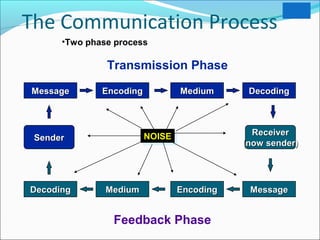
The Communication Process
MessageMessage EncodingEncoding MediumMedium DecodingDecoding
DecodingDecoding MediumMedium EncodingEncoding MessageMessage
ReceiverReceiver
(now sender)(now sender)
SenderSender
Transmission Phase
Feedback Phase
NOISENOISE
•Two phase process
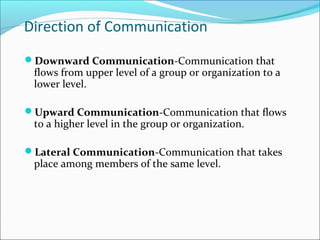
Direction of Communication
Downward Communication-Communication that
flows from upper level of a group or organization to a
lower level.
Upward Communication-Communication that flows
to a higher level in the group or organization.
Lateral Communication-Communication that takes
place among members of the same level.
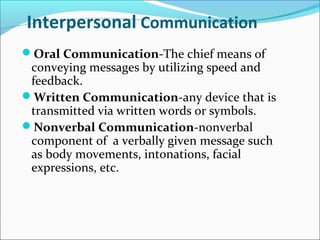
Interpersonal Communication
Oral Communication-The chief means of
conveying messages by utilizing speed and
feedback.
Written Communication-any device that is
transmitted via written words or symbols.
Nonverbal Communication-nonverbal
component of a verbally given message such
as body movements, intonations, facial
expressions, etc.
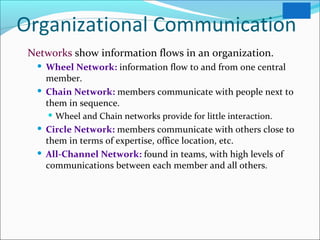
Organizational Communication
Networks show information flows in an organization.
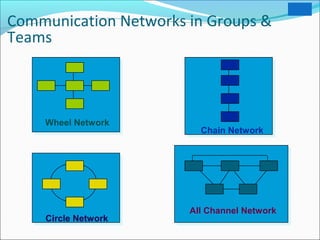
 Wheel Network: information flow to and from one central
member.
 Chain Network: members communicate with people next to
them in sequence.
 Wheel and Chain networks provide for little interaction.
 Circle Network: members communicate with others close to
them in terms of expertise, office location, etc.
 All-Channel Network: found in teams, with high levels of
communications between each member and all others.
Communication Networks in Groups &
Teams
Wheel Network
Circle Network
Chain Network
All Channel Network
3 Models for Communication
Communication as Action
Communication as Transaction
Communication as Interaction
Communication as Action
Sender ReceiverChannelMessage Message
Noise
Noise
Noise
 Questions describing communications:
 Who?
 Says what?
 In which channel?
 To whom?
 With what effect?
Lasswell Model (1948)
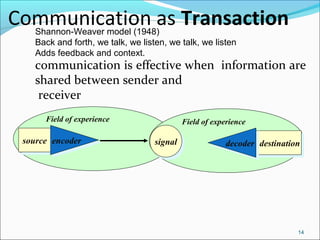
destinationdestinationsourcesource signalsignal
Field of experience Field of experience
encoderencoder
decoderdecoder
communication is effective when information are
shared between sender and
receiver
14
Shannon-Weaver model (1948)
Back and forth, we talk, we listen, we talk, we listen
Adds feedback and context.
Communication as Transaction
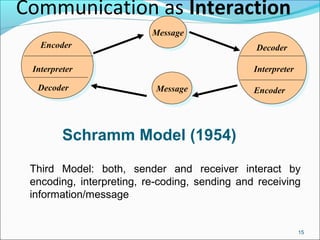
MessageMessage
MessageMessage
Encoder
Interpreter
Decoder
Decoder
Interpreter
Encoder
Third Model: both, sender and receiver interact by
encoding, interpreting, re-coding, sending and receiving
information/message
15
Schramm Model (1954)
Communication as Interaction
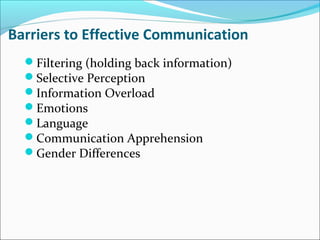
Barriers to Effective Communication
Filtering (holding back information)
Selective Perception
Information Overload
Emotions
Language
Communication Apprehension
Gender Differences
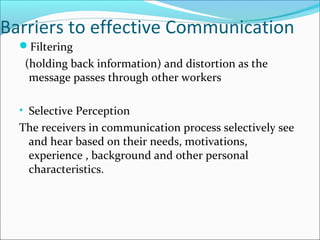
Barriers to effective Communication
Filtering
(holding back information) and distortion as the
message passes through other workers
• Selective Perception
The receivers in communication process selectively see
and hear based on their needs, motivations,
experience , background and other personal
characteristics.
Barriers to effective Communication
Information Overload
Individuals have a finite capacity to process data and
when it exceeds our processing capacity the result is
information load. Then people tend to select out,
ignore, pass over or forget information.
• Emotions
Extreme emotions like jubilation or depression are
more likely to hinder effective communication
Language
Communication apprehensions
 Completeness(all relevant info included)
 Check for five Ws & one H
 Who What When Where Why
 and How.
Conciseness (to the point)
Consideration (focus on audience) avoid I and we
use “U”.
Concreteness (Facts and figure)
Clarity (Using words that familiar to the message of
receiver)
Courtesy(polite and respectful)
Correctness (Grammar, punctuation, and spelling)
The Seven C’s
Pay attention to what is sent as a message.
Be a good listener: don’t interrupt.
Ask questions to clarify your understanding.
Be empathetic: try to understand what the sender feels.
Understand linguistic styles: different people speak
differently.
Speed, tone, pausing all impact communication.
References:
Organizational Behavior, 13th
Edition, Stephen P.
Robbins and Timothy A. Judge
Prentice Hall
Contemporary management, 5thEdition,Gareth
R.Jone and Jennifer M.George
http://www.brainyquote.com/quotes/quotes/a/annemorrow136
.
Remen, Rachel Naomi. (1996). Kitchen Table Wisdom:
Stories That Heal. New York, NY: Riverhead Books.
Thank you for your listening !!
22
Communication process ,,,

Communication process ,,,

  • 1.
    Communication process Presented byNasir Iqbal  Assigned by Dr.Gohar Zaman
  • 2.
    QUOTES about communication Functionsof Communication The Communication Process Direction of Communication Interpersonal Communication Organizational Communication Communication models Barriers to Effective Communication Seven C’s Summary References MAIN CONTENTS
  • 3.
    Quotes about communication: “Communicationis the vehicle which allows humans to recall the past, think in the present, and plan for the future.” Roy Berko “Good communication is as stimulating as black coffee, and just as hard to sleep after.” Anne Morrow Lindbergh. (n.d.) “The most basic and powerful way to connect to another person is to listen. Just listen. Perhaps the most important thing we ever give each other is our attention. A loving silence often has far more power to heal and to connect than the most well- intentioned words.” Remen, Rachel Naomi. (1996).
  • 4.
    Introduction COMMUNICATION DEFINED BYDIFFERENT AUTHORS AS: 2.” Communication is transfer of information from one person to another, whether or not it elicits confidence. But the information transferred must be understandable to the receiver” – G.G. Brown.  No Group can exist without communication: the transference of meaning among its members.  Communication must include both the transference and the understanding of meaning 3.. “Communication is the intercourse by words, letters or messages”- Fred G. Meyer. 1.Communication is the exchange and flow of information and ideas from one person to another; it involves a sender transmitting an idea, information, or feeling to a receiver (U.S. Army, 1983).
  • 5.
    Functions of Communication Itserves four major functions within a group or organization. Control 1. Communicate job related grievances. 2.To follow job description 3.To comply with company policy. Motivation 1. It fosters motivation by clarifying what needs to be done 2.How well employees are doing 3. What can be done to improve performance
  • 6.
    Functions of Communication EmotionalExpression For many employees the work group[ is a primary source of social interaction . They share their feelings of frustration and satisfaction with each other. Information Primary role relating to decision making by transmitting data and evaluating different choices
  • 7.
    The Communication Process MessageMessageEncodingEncoding MediumMedium DecodingDecoding DecodingDecoding MediumMedium EncodingEncoding MessageMessage ReceiverReceiver (now sender)(now sender) SenderSender Transmission Phase Feedback Phase NOISENOISE •Two phase process
  • 8.
    Direction of Communication DownwardCommunication-Communication that flows from upper level of a group or organization to a lower level. Upward Communication-Communication that flows to a higher level in the group or organization. Lateral Communication-Communication that takes place among members of the same level.
  • 9.
    Interpersonal Communication Oral Communication-Thechief means of conveying messages by utilizing speed and feedback. Written Communication-any device that is transmitted via written words or symbols. Nonverbal Communication-nonverbal component of a verbally given message such as body movements, intonations, facial expressions, etc.
  • 10.
    Organizational Communication Networks showinformation flows in an organization.  Wheel Network: information flow to and from one central member.  Chain Network: members communicate with people next to them in sequence.  Wheel and Chain networks provide for little interaction.  Circle Network: members communicate with others close to them in terms of expertise, office location, etc.  All-Channel Network: found in teams, with high levels of communications between each member and all others.
  • 11.
    Communication Networks inGroups & Teams Wheel Network Circle Network Chain Network All Channel Network
  • 12.
    3 Models forCommunication Communication as Action Communication as Transaction Communication as Interaction
  • 13.
    Communication as Action SenderReceiverChannelMessage Message Noise Noise Noise  Questions describing communications:  Who?  Says what?  In which channel?  To whom?  With what effect? Lasswell Model (1948)
  • 14.
    destinationdestinationsourcesource signalsignal Field ofexperience Field of experience encoderencoder decoderdecoder communication is effective when information are shared between sender and receiver 14 Shannon-Weaver model (1948) Back and forth, we talk, we listen, we talk, we listen Adds feedback and context. Communication as Transaction
  • 15.
    MessageMessage MessageMessage Encoder Interpreter Decoder Decoder Interpreter Encoder Third Model: both,sender and receiver interact by encoding, interpreting, re-coding, sending and receiving information/message 15 Schramm Model (1954) Communication as Interaction
  • 16.
    Barriers to EffectiveCommunication Filtering (holding back information) Selective Perception Information Overload Emotions Language Communication Apprehension Gender Differences
  • 17.
    Barriers to effectiveCommunication Filtering (holding back information) and distortion as the message passes through other workers • Selective Perception The receivers in communication process selectively see and hear based on their needs, motivations, experience , background and other personal characteristics.
  • 18.
    Barriers to effectiveCommunication Information Overload Individuals have a finite capacity to process data and when it exceeds our processing capacity the result is information load. Then people tend to select out, ignore, pass over or forget information. • Emotions Extreme emotions like jubilation or depression are more likely to hinder effective communication Language Communication apprehensions
  • 19.
     Completeness(all relevantinfo included)  Check for five Ws & one H  Who What When Where Why  and How. Conciseness (to the point) Consideration (focus on audience) avoid I and we use “U”. Concreteness (Facts and figure) Clarity (Using words that familiar to the message of receiver) Courtesy(polite and respectful) Correctness (Grammar, punctuation, and spelling) The Seven C’s
  • 20.
    Pay attention towhat is sent as a message. Be a good listener: don’t interrupt. Ask questions to clarify your understanding. Be empathetic: try to understand what the sender feels. Understand linguistic styles: different people speak differently. Speed, tone, pausing all impact communication.
  • 21.
    References: Organizational Behavior, 13th Edition,Stephen P. Robbins and Timothy A. Judge Prentice Hall Contemporary management, 5thEdition,Gareth R.Jone and Jennifer M.George http://www.brainyquote.com/quotes/quotes/a/annemorrow136 . Remen, Rachel Naomi. (1996). Kitchen Table Wisdom: Stories That Heal. New York, NY: Riverhead Books.
  • 22.
    Thank you foryour listening !! 22

Editor's Notes

  • #14 Transmission model In 1948, Harold Lasswell described the process as who (sender), says what (message), in what channel, to whom (reciever), with what effect.