COMMUNICATION
PROCESSES, PRINCIPLES,
AND ETHICS
RSBALDONADO
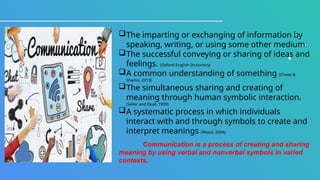
The imparting or exchanging of information by
speaking, writing, or using some other medium.
The successful conveying or sharing of ideas and
feelings. (Oxford English Dictionary)
A common understanding of something (Chase &
Shamo, 2013)
The simultaneous sharing and creating of
meaning through human symbolic interaction.
(Seiler and Beall, 1999)
A systematic process in which individuals
interact with and through symbols to create and
interpret meanings (Wood, 2004)
Communication is a process of creating and sharing
meaning by using verbal and nonverbal symbols in varied
contexts.
COMPONENTS OR
ELEMENTS OF
COMMUNICATION
1. Sender (who the source is)
2. Message (what idea is being
communicated)
3. Channel (through what medium the
message is relayed)
4. Receiver (to whom is the message
directed)
5. Effect (what the desired result of the
communication is)
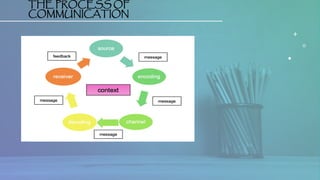
THE PROCESS OF
COMMUNICATION
STAGES OF THE
PROCESS OF
COMMUNICATION
1.Source 5. Decoding
2.Message 6. Receiver
3.Encoding 7. Feedback
4.Channel 8. Context
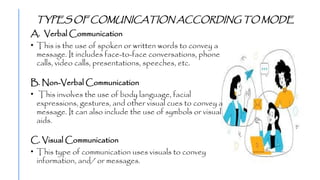
TYPES OF COMUNICATION ACCORDING TO MODE
A. Verbal Communication
• This is the use of spoken or written words to convey a
message. It includes face-to-face conversations, phone
calls, video calls, presentations, speeches, etc.
B. Non-Verbal Communication
• This involves the use of body language, facial
expressions, gestures, and other visual cues to convey a
message. It can also include the use of symbols or visual
aids.
C. Visual Communication
• This type of communication uses visuals to convey
information, and/ or messages.
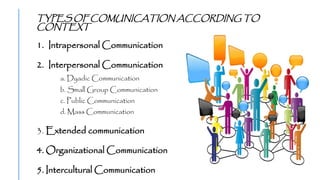
TYPES OF COMUNICATION ACCORDING TO
CONTEXT
1. Intrapersonal Communication
2. Interpersonal Communication
a. Dyadic Communication
b. Small Group Communication
c. Public Communication
d. Mass Communication
3. Extended communication
4. Organizational Communication
5. Intercultural Communication
TYPES OF COMUNICATION ACCORDING TO
PURPOSE AND STYLE
The types of communication in relation to purpose and style are
formal and informal. The focus is on the communication setting
and the mode of delivery.
A. FORMAL Communication employs formal language
delivered orally or in written form. Examples: Lectures, public
talks/ speeches, research and project proposals, reports, and
business letters
B. INFORMAL Communication certainly does not employ
formal language. It involves personal and ordinary conversations
with friends, family members, or acquaintances about anything
under the sun.
The mode may be oral as in face-to-face, ordinary or everyday
talks and phone calls, or written as in the case of e-mail
messages, personal notes,, letters, or text messages. The
purpose is simply to socialize and enhance relationships.
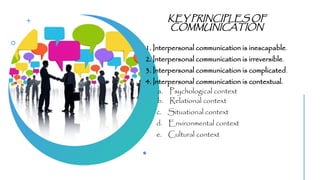
KEY PRINCIPLES OF
COMMUNICATION
1. Interpersonal communication is inescapable.
2. Interpersonal communication is irreversible.
3. Interpersonal communication is complicated.
4. Interpersonal communication is contextual.
a. Psychological context
b. Relational context
c. Situational context
d. Environmental context
e. Cultural context
MORALS AND ETHICS IN
COMMUNICATION
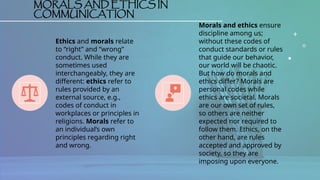
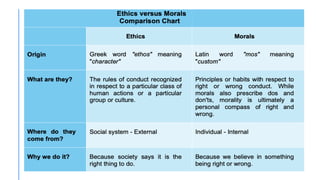
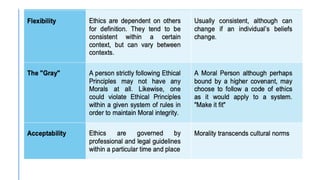
Ethics and morals relate
to “right” and “wrong”
conduct. While they are
sometimes used
interchangeably, they are
different: ethics refer to
rules provided by an
external source, e.g.,
codes of conduct in
workplaces or principles in
religions. Morals refer to
an individual’s own
principles regarding right
and wrong.
Morals and ethics ensure
discipline among us;
without these codes of
conduct standards or rules
that guide our behavior,
our world will be chaotic.
But how do morals and
ethics differ? Morals are
personal codes while
ethics are societal. Morals
are our own set of rules,
so others are neither
expected nor required to
follow them. Ethics, on the
other hand, are rules
accepted and approved by
society, so they are
imposing upon everyone.
ETHICS IN COMMUNICATION
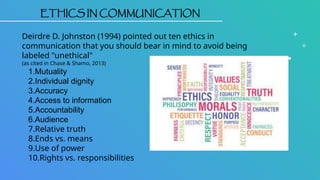
Deirdre D. Johnston (1994) pointed out ten ethics in
communication that you should bear in mind to avoid being
labeled "unethical"
(as cited in Chase & Shamo, 2013)
1.Mutuality
2.Individual dignity
3.Accuracy
4.Access to information
5.Accountability
6.Audience
7.Relative truth
8.Ends vs. means
9.Use of power
10.Rights vs. responsibilities
THANK YOU
FOR
LISTENING!
RSBALDONADO

Lecture-1-Purposive-Comm.pptx slide pptx

  • 1.
  • 2.
    The imparting orexchanging of information by speaking, writing, or using some other medium. The successful conveying or sharing of ideas and feelings. (Oxford English Dictionary) A common understanding of something (Chase & Shamo, 2013) The simultaneous sharing and creating of meaning through human symbolic interaction. (Seiler and Beall, 1999) A systematic process in which individuals interact with and through symbols to create and interpret meanings (Wood, 2004) Communication is a process of creating and sharing meaning by using verbal and nonverbal symbols in varied contexts.
  • 3.
    COMPONENTS OR ELEMENTS OF COMMUNICATION 1.Sender (who the source is) 2. Message (what idea is being communicated) 3. Channel (through what medium the message is relayed) 4. Receiver (to whom is the message directed) 5. Effect (what the desired result of the communication is)
  • 4.
  • 5.
    STAGES OF THE PROCESSOF COMMUNICATION 1.Source 5. Decoding 2.Message 6. Receiver 3.Encoding 7. Feedback 4.Channel 8. Context
  • 6.
    TYPES OF COMUNICATIONACCORDING TO MODE A. Verbal Communication • This is the use of spoken or written words to convey a message. It includes face-to-face conversations, phone calls, video calls, presentations, speeches, etc. B. Non-Verbal Communication • This involves the use of body language, facial expressions, gestures, and other visual cues to convey a message. It can also include the use of symbols or visual aids. C. Visual Communication • This type of communication uses visuals to convey information, and/ or messages.
  • 7.
    TYPES OF COMUNICATIONACCORDING TO CONTEXT 1. Intrapersonal Communication 2. Interpersonal Communication a. Dyadic Communication b. Small Group Communication c. Public Communication d. Mass Communication 3. Extended communication 4. Organizational Communication 5. Intercultural Communication
  • 8.
    TYPES OF COMUNICATIONACCORDING TO PURPOSE AND STYLE The types of communication in relation to purpose and style are formal and informal. The focus is on the communication setting and the mode of delivery. A. FORMAL Communication employs formal language delivered orally or in written form. Examples: Lectures, public talks/ speeches, research and project proposals, reports, and business letters B. INFORMAL Communication certainly does not employ formal language. It involves personal and ordinary conversations with friends, family members, or acquaintances about anything under the sun. The mode may be oral as in face-to-face, ordinary or everyday talks and phone calls, or written as in the case of e-mail messages, personal notes,, letters, or text messages. The purpose is simply to socialize and enhance relationships.
  • 9.
    KEY PRINCIPLES OF COMMUNICATION 1.Interpersonal communication is inescapable. 2. Interpersonal communication is irreversible. 3. Interpersonal communication is complicated. 4. Interpersonal communication is contextual. a. Psychological context b. Relational context c. Situational context d. Environmental context e. Cultural context
  • 10.
    MORALS AND ETHICSIN COMMUNICATION Ethics and morals relate to “right” and “wrong” conduct. While they are sometimes used interchangeably, they are different: ethics refer to rules provided by an external source, e.g., codes of conduct in workplaces or principles in religions. Morals refer to an individual’s own principles regarding right and wrong. Morals and ethics ensure discipline among us; without these codes of conduct standards or rules that guide our behavior, our world will be chaotic. But how do morals and ethics differ? Morals are personal codes while ethics are societal. Morals are our own set of rules, so others are neither expected nor required to follow them. Ethics, on the other hand, are rules accepted and approved by society, so they are imposing upon everyone.
  • 13.
    ETHICS IN COMMUNICATION DeirdreD. Johnston (1994) pointed out ten ethics in communication that you should bear in mind to avoid being labeled "unethical" (as cited in Chase & Shamo, 2013) 1.Mutuality 2.Individual dignity 3.Accuracy 4.Access to information 5.Accountability 6.Audience 7.Relative truth 8.Ends vs. means 9.Use of power 10.Rights vs. responsibilities
  • 14.

Editor's Notes

  • #1 It is often believed that communication is the blood life of the society, it makes the world go round and makes people understand the world they are living in. In communication, English is one essential language for success. And becoming an effective communicator is an edge in order to cope with today’s society. All of you can become better communicators if you just try harder. Among other things, you can start by getting a better picture of what communication is and how it works - - absorbing principles, learning concepts, and applying them in practical situations inside the classroom and in real life as members of the community.
  • #2 THREE PRIMARY FORMS OF COMMUNICATION Verbal Communication depends on words to deliver meaning. It is further subdivided into written communication and oral communication. Written communication can involve anything from words on a page to emails, to text messages. Oral communication involves spoke words. This can be done in person, through the phone, or over video chat. Oral communication is often quicker than written communication although meaning can be shaded using tone, inflection, and volume. Nonverbal Communication occurs when meaning or messages are sent or received without the use of words. Nonverbal communication can be intentional or unintentional. Physical nonverbal communication can be displayed through body language, facial expressions, touch, or eye contact. Nonverbal communication can also be used to modify the meaning of verbal communications. Some researchers believe that nonverbal communications account for 55 percent of all communication. Visual Communication utilizes drawings, illustrations, pictures, colors, graphs, charts, and signs to share meaning. Visual communication can be used in conjunction with verbal communication, or it can stand on its own. Visual communication is frequently used in advertising, art, and entertainment. Often, this form of communication can be left further up to interpretation than other forms of communication. In these cases, it is often the recipient of the communication who imparts at least some meaning on the message.
  • #3 FORMS OF COMMUNICATION 1. Intrapersonal Communication - Is a communication which happens within one’s self. Here both Source (sender) and receiver is only one. so, the feedback works without any interruption. 2. Interpersonal Communication - The process of exchange of information, ideas and feelings between two or more people through verbal or non-verbal methods. It often includes face-to-face exchange of information, in a form of voice, facial expressions, body language and gestures. The level of one’s interpersonal communication skills is measured through the effectiveness of transferring messages to others. 1. Dyadic Communication - Two persons are involved in this communication process. Here the source becomes a receiver and receiver becomes source because of dynamic communication process where the feedbacks are shared between the source and the receiver. 2. Small Group Communication - More than two members involved in communication process will become a group communication. If least number of persons is involved in the group communication is called as small group communication. In this communication process, everyone becomes a Source as well as receiver through sharing information and gives feedback to another. 3. Public Communication - Source or messages from a single person will reach or will be received by huge number of audiences. Feedback is quite distant because of the large number of receivers. 4. Mass Communication – Basically have a large number of audience and they can’t be grouped together in one place so a certain tool or technology for communication process is needed. But in mass communication, there is no direct access with the receiver/s so there is a need for the use of media like newspaper, radio, television and internet. Here the audience feedback is very less or delayed.
  • #4 To achieve effective communication, one needs to understand the communication process, which is quite complex because it is difficult to pinpoint where and with whom a particular communication begins or ends. The best way to illustrate this is through a model. The communication process involves eight stages or steps: 1. SOURCE  Sender of the message decoding channel  Know exactly what information to give or share 2. MESSAGE  The information you want to convey  Details of the information should be very clear 3. ENCODING  The mental process of converting your ideas or thoughts into verbal and/ or nonverbal symbols that can be understood by the receiver of the message 4. CHANNEL  The manner in which the message or information is conveyed  It may be in the form of a face-to-face conversation, text message, phone call, video conference, letter, email, reports, memo) 5. DECODING  The receiver’s mental process of the message into the meaning suggested by the verbal and/or nonverbal symbols used by the sender. 6. RECEIVER  The people or group of people who will get the message. 7. FEEDBACK  The receiver’s response or reply to the message 8. CONTEXT  The situation in which the communication takes place  It includes the a. the environment - location, time, temperature b. the relationship between the communicators c. their respective cultural backgrounds and past experiences d. the topic or subject of their communication
  • #5 To achieve effective communication, one needs to understand the communication process, which is quite complex because it is difficult to pinpoint where and with whom a particular communication begins or ends. The best way to illustrate this is through a model. The communication process involves eight stages or steps: 1. SOURCE  Sender of the message decoding channel  Know exactly what information to give or share 2. MESSAGE  The information you want to convey  Details of the information should be very clear 3. ENCODING  The mental process of converting your ideas or thoughts into verbal and/ or nonverbal symbols that can be understood by the receiver of the message 4. CHANNEL  The manner in which the message or information is conveyed  It may be in the form of a face-to-face conversation, text message, phone call, video conference, letter, email, reports, memo) 5. DECODING  The receiver’s mental process of the message into the meaning suggested by the verbal and/or nonverbal symbols used by the sender. 6. RECEIVER  The people or group of people who will get the message. 7. FEEDBACK  The receiver’s response or reply to the message 8. CONTEXT  The situation in which the communication takes place  It includes the a. the environment - location, time, temperature b. the relationship between the communicators c. their respective cultural backgrounds and past experiences d. the topic or subject of their communication
  • #6 VERBAL COMMUNICATION This is the use of spoken or written words to convey a message. It includes face-to-face conversations, phone calls, video calls, presentations, speeches, etc. Examples: A team meeting where everyone discusses project updates. A professor giving a lecture on a specific topic Instructing a new employee on company procedures. B. NON-VERBAL COMMUNICATION This involves the use of body language, facial expressions, gestures, and other visual cues to convey a message. It can also include the use of symbols or visual aids. Examples: Facial Expression, eye contact, gestures, posture, proximity/ personal space, hand movements, touch, body orientation, head nodding/shaking, Tone of voice, silence, appearance and clothing C. VISUAL COMMUNICATION This type of communication uses visuals to convey information, and/ or messages. Examples: signs, symbols, imagery, maps, graphs, charts, diagrams, pictograms, photos, drawings, or illustrations, and even various forms of electronic communication. Some examples of electronic communication symbols or images are the emojis, emoticons, and animation among others to convey the writer’s emotions or clarify the intent of the message sender. These are achieved through digital mode or text.
  • #7 INTRAPERSONAL- within oneself, self or inner talk, inner dialogue INTERPERSONAL- between, among individuals EXTENDED – involves the use of electronic media. Use of tele, audio, or phone, video or other technological means. The use of electronic media with internet, etc. ORGANIZATIONAL – the role of communication in an organizational context. It can be formal (comm takes place via designated channels of message flow between people of different positions or designations (downward, upward, horizontal, crosswise). Informal from unofficial channels INTERCULTURAL – comm between and among people having different linguistic, religious, ethnic, social, and professional backgrounds
  • #8 INTRAPERSONAL- within oneself, self or inner talk, inner dialogue INTERPERSONAL- between, among individuals EXTENDED – involves the use of electronic media. Use of tele, audio, or phone, video or other technological means. The use of electronic media with internet, etc. ORGANIZATIONAL – the role of communication in an organizational context. It can be formal (comm takes place via designated channels of message flow between people of different positions or designations (downward, upward, horizontal, crosswise). Informal from unofficial channels INTERCULTURAL – comm between and among people having different linguistic, religious, ethnic, social, and professional backgrounds
  • #9 KEY PRINCIPLES OF COMMUNICATIONNTS (Elem The following principles are based on the real-life functioning of interpersonal communication (King, 2000). Interpersonal communication is inescapable. It is not possible for humans not to communicate. Even the attempt of not wanting to communicate communicates something. Your poker face as you communicate to somebody also means a lot. You communicate through both words and behavior, and as long as you are alive, you can still behave; hence, you can communicate from others not only through words but also through voice tone, gesture, posture, bodily movement, facial expression, clothes worn, and so on. Because of this fact, since people are not mind readers, you are often judged through your behavior, not your intention or purpose. 2. Interpersonal communication is irreversible. How often have you said words in anger and wished you could all take them back? Once you have uttered something you can never take it back, and its effect remains. Anyone who says that t apologies can heal the hurt caused by offensive remarks is lying, Words are powerful they can either heal or harm others. This principle of communication best expressed in a Russian proverb which says, "Once a word goes out of your mouth, you can never swallow it again." 3. Interpersonal communication is complicated. Whenever you communicate with anyone, you simultaneously interpret both his verbal and nonverbal language, and that is often both confounding and demanding. For one thing, words (verbal) alone complicate things: A word does not have just one meaning, it is usually not used in the same way, and no two people use the same word exactly alike. Added to this complexity, nonverbal symbols are more vague than words since they are interpreted in many ways. They are primarily relational besides being both culture and gender-bound. To make matters much more difficult, no form of communication is simple because whenever you communicate, there are actually at least six "people" involved: (a) the person whom you think you are; (b) the person whom you think the other person is; (c) the person whom you think the other person thinks you are, (d) the person whom you think the other person thinks he is; (e) the person whom the other person thinks you think you are, and (f) the person whom the other person thinks you think he is. 4. Interpersonal communication is contextual. In other words, communication is affected by several factors; it does not happen in isolation There are many things that need to be considered, such as the ones given below (King, 2000). a. Psychological context, which is who you are, and what you as sender or receiver bring to the interaction--your needs, desires, values, beliefs, personality, and so on. b. Relational context, which concerns your reactions to the other person based on relationship-as boss, colleague, friend, sibling. parent, and the like. c. Situational context, which deals with the psycho-social "where you are communicating. An interaction that takes place in a classroom, which quite formal, will be very different from one that takes place in a bar, which is very informal where communicators do not need to be guarded in their speech d. Environmental context, which has to do with the physical "where you are communicating-objects in the room and their arrangement, location, noise level, temperature, season, time of day. e. Cultural context, which includes all the learned behaviors and rules that affect the interaction. For instance, bodily movement, facial expression, gesture, distance, and eye contact vary in different cultures. If you come from a culture (foreign or within your own country) where it is considered rude to make long, direct eye contact, you will out of politeness avoid eye contact. If the other person comes from a culture where long, direct eye contact signals trustworthiness, then we have in the cultural context a basis for misunderstanding.
  • #10 Ethics and morals relate to “right” and “wrong” conduct. While they are sometimes used interchangeably, they are different: ethics refer to rules provided by an external source, e.g., codes of conduct in workplaces or principles in religions. Morals refer to an individual’s own principles regarding right and wrong. Morals and ethics ensure discipline among us; without these codes of conduct standards or rules that guide our behavior, our world will be chaotic. But how do morals and ethics differ? Morals are personal codes while ethics are societal. Morals are our own set of rules, so others are neither expected nor required to follow them. Ethics, on the other hand, are rules accepted and approved by society, so they are impose upon everyone.
  • #13 ETHICS IN COMMUNICATION Deirdre D. Johnston (1994) pointed out ten ethics in communication that you should bear in mind to avoid being labeled "unethical" (as cited in Chase & Shamo, 2013, pp. 140-141). Mutuality. Pay attention to the needs of others, as well as yours. Individual dignity. Do not cause another person’s embarrassment or a loss dignity. Accuracy. Ensure that others have accurate information. Tell them everything they have a right and need to know, not just what is true. Access to information. Never bolster the impact of your communication by preventing people from communicating with one another or by hindering access to the supporting information. Accountability. Be responsible and accountable for the consequences of your relationships and communication. Audience. As audience or receiver of the information, you also have ethical responsibilities. A good rule of thumb is the 100% rule, where both the sender and the receiver have full or 100% responsibility to ensure that the message is understood, and that ethics are followed. This is a 100/100 rule, not a 50/50 rule. Relative truth. As either sender or receiver of information, remember that your own point of view may not be shared by others and that your conclusions are relative to your perspective, so allow others to respectfully disagree or see it differently. Ends vs. means. Be sure that the end goal of your communication and the means of getting to that end are both ethical although no rule can be applied without reservation to any situation. Use of power. In situations where you have more power than others (e.g., a teacher with a student, a boss with a subordinate, a parent with a child), you also have more responsibility for the outcome. 10. Rights vs. responsibilities. Balance your rights against your responsibilities even if you live in a wonderful society where your rights are protected by law; not everything you have a right to do is ethical.