
PREPARED BY: JEGAN NADAR
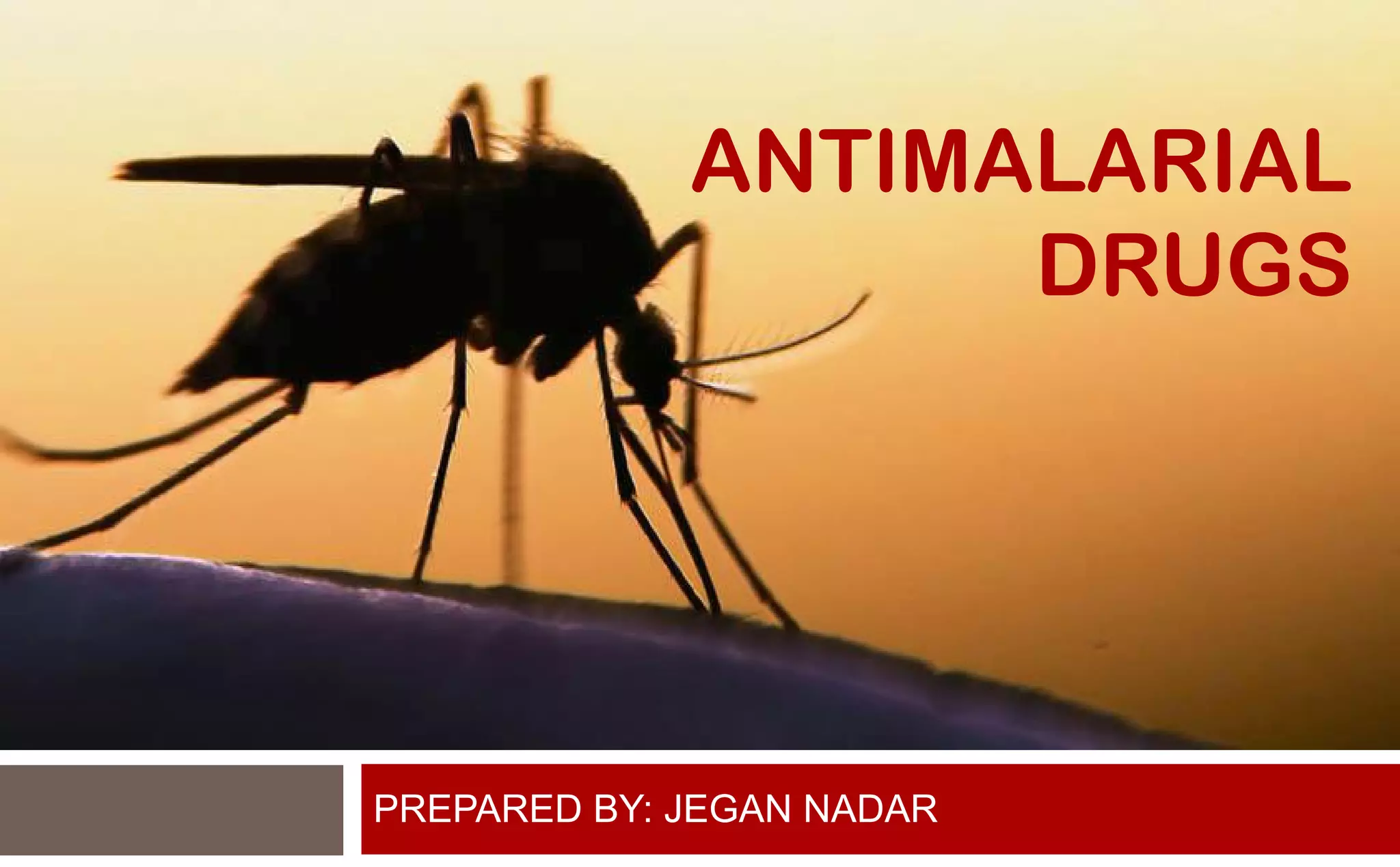
ANTIMALARIAL
DRUGS
Malaria
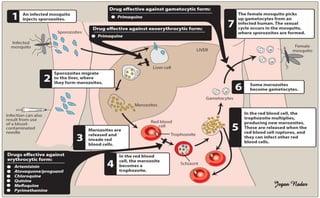
● Malaria is an acute infectious disease caused by four species of the
protozoal genus Plasmodium.
● It is transmitted to humans through the bite of a female Anopheles
mosquito
● Malaria is caused by 4 species of the protozoal parasite
※ Plasmodium falciparum
※ Plasmodium vivax
※ Plasmodium ovale
※ Plasmodium malariae Jegan Nadar
Jegan Nadar
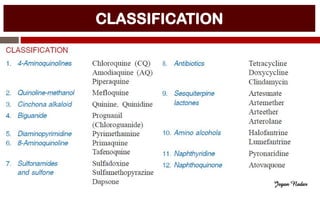
CLASSIFICATION
Jegan Nadar
4-Aminoquinolines
Chloroquine
● Chloroquine is a synthetic 4-aminoquinoline that has been the mainstay of
antimalarial therapy
● It is a rapidly acting erythrocytic schizontocide against all species of
plasmodia
● Controls most clinical attacks in 1–2 days with disappearance of parasites
from peripheral blood in 1–3 days.
Jegan Nadar
Chloroquine-MoA
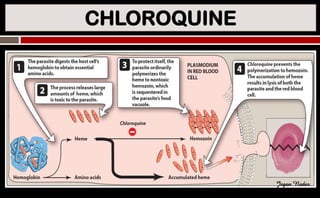
● After traversing to the erythrocytic and plasmodial membranes, chloroquine
is concentrated in the acidic food vacuole of the malarial parasite
● In the food vacuole, the parasite digests the host cell’s hemoglobin to
obtain essential amino acids.
● However, this process also releases large amounts of soluble heme, which
is toxic to the parasite.
Jegan Nadar
● To protect itself, the parasite polymerizes the heme to hemozoin (a
pigment), which is sequestered in the food vacuole.
● Chloroquine specifically binds to heme, preventing its polymerization to
hemozoin.
● The increased pH and the accumulation of heme result in oxidative
damage to the phospholipid membranes, leading to lysis of both the
parasite and the red blood cell.
Jegan Nadar
CHLOROQUINE
Jegan Nadar
Chloroquine
● Chloroquine is rapidly and completely absorbed following oral
administration.
● The drug has a very large volume of distribution and concentrates in
erythrocytes, liver, spleen, kidney, lung, and melanin-containing tissues,
and leukocytes
● Chloroquine is dealkylated by liver, and some metabolic products retain
antimalarial activity.
● Both parent drug and metabolites are excreted predominantly in urine
Jegan Nadar
Chloroquine
● Side effects are minimal at low prophylactic doses.
● At higher doses, gastrointestinal upset, pruritus, headaches, and
blurred vision may occur
● Discoloration of the nail beds and mucous membranes may be seen on
chronic administration.
● Chloroquine should be used cautiously in patients with hepatic
dysfunction, severe gastrointestinal problems, or neurologic disorders
Jegan Nadar
Quinoline-methanol
Mefloquine
● Mefloquine is an effective single agent for prophylaxis and treatment of
infections caused by multidrug-resistant forms of P. falciparum.
● Its exact mechanism of action remains undetermined.
● Resistant strains have been identified, particularly in Southeast Asia.
● Mefloquine is well absorbed after oral administration and is widely
distributed to tissues.
● It has a long half-life (20 days) because of enterohepatic circulation and its
concentration in various tissues. Jegan Nadar
Cinchona alkaloid
Quinine
● Quinine, originally isolated from the bark of the cinchona tree
● Its d-isomer quinidine is used as an antiarrhythmic (and for malaria as
well in some countries).
● It interferes with heme polymerization, resulting in death of the
erythrocytic form of the plasmodial parasite
● Quinine is an erythrocytic schizontocide for all species of plasmodia, but
less effective and more toxic than CQ
Jegan Nadar
● It is reserved for severe infestations and for chloroquine-resistant malarial
strains.
● Quinine is usually administered in combination with doxycycline,
tetracycline, or clindamycin.
● Taken orally, quinine is well distributed throughout the body.
● The major adverse effect of quinine is cinchonism, a syndrome causing
nausea, vomiting, tinnitus, and vertigo.
● Drug interactions include potentiation of neuromuscular-blocking agents
and elevation of digoxin levels if taken concurrently.
● Quinine absorption is reduced by aluminum-containing antacids.
Jegan Nadar
Biguanide
Proguanil (Chloroguanide)
● It is a relatively slow-acting erythrocytic schizontocide for both
P. falciparum and P. vivax
● In addition, it inhibits the preerythrocytic stage of P. falciparum
● Gametocytes exposed to proguanil are not killed but may fail to develop
properly in the mosquito.
● Proguanil is cyclized in the body to a triazine derivative (cycloguanil)
which inhibits plasmodial DHFRase-thymidylate synthase thereby
preventing DNA synthesis. Jegan Nadar
Proguanil (Chloroguanide)
● Absorption of oral proguanil is slow, but almost complete.
● It is partly metabolized and excreted in urine; t½ is 16–20 hr
● It is very well tolerated
● Side effects are less compared to CQ.
● Mild abdominal symptoms, vomiting, occasional stomatitis, haematuria,
rashes and transient loss of hair are reported.
Jegan Nadar
Diaminopyrimidine
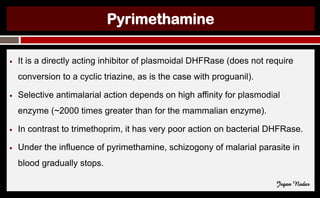
Pyrimethamine
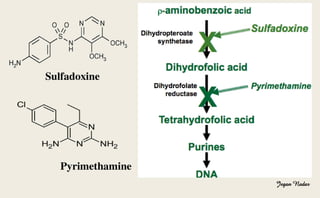
● It is a directly acting inhibitor of plasmoidal DHFRase (does not require
conversion to a cyclic triazine, as is the case with proguanil).
● Selective antimalarial action depends on high affinity for plasmodial
enzyme (~2000 times greater than for the mammalian enzyme).
● In contrast to trimethoprim, it has very poor action on bacterial DHFRase.
● Under the influence of pyrimethamine, schizogony of malarial parasite in
blood gradually stops.
Jegan Nadar
Jegan Nadar
Pyrimethamine
● Absorption of pyrimethamine from g.i.t. is good but slow.
● Pyrimethamine is relatively safe.
● The only side effects are occasional nausea and rashes.
● Folate deficiency is rare; megaloblastic anaemia and granulocytopenia
may occur with higher doses, especially in those with marginal folate
stores.
● This can be treated by folinic acid.
Jegan Nadar
Sulfonamides and sulfone
Sulfonamide
● Sulfonamides/dapsone are not particularly effective antimalarial drugs in
their own right;
● But have some inhibitory influence on the erythrocytic phase, especially of
P. falciparum.
● They are used in combination with pyrimethamine
● They form supra-additive synergistic combination with pyrimethamine due
to sequential block
Jegan Nadar
Sulfonamide
● Sulfadoxine and sulfamethopyrazine are ultralong acting sulfonamides —
attain low blood concentrations, but are able to synergise with
pyrimethamine which also has long t½.
● The combination has the potential to cause seriou adverse effects
(exfoliative dermatitis, Stevens- Johnson syndrome, etc.) due to the
sulfonamide.
● Therefore, use is restricted to single dose treatment of uncomplicated CQ-
resistant falciparum malaria
Jegan Nadar
8-Aminoquinoline
Primaquine
● Primaquine, an 8-aminoquinoline, is an oral antimalarial drug that
eradicates primary exoerythrocytic (tissue) forms of plasmodia and the
secondary exoerythrocytic forms of recurring malarias (P. vivax and P.
ovale).
● The sexual (gametocytic) forms of all four plasmodia are destroyed in the
plasma or are prevented from maturing later in the mosquito, thereby
interrupting transmission of the disease.
Jegan Nadar
Primaquine
● Mechanism of action is completely understood, metabolites of
primaquine are believed to act as oxidants that are responsible for the
schizonticidal action as well as for the hemolysis and methemoglobinemia
encountered as toxicities.
● Primaquine is well absorbed after oral administration and is not
concentrated in tissues.
● It is rapidly oxidized to many compounds, primarily the deaminated drug
Jegan Nadar
Primaquine
● Primaquine is associated with drug-induced hemolytic anemia in patients
with glucose-6-phosphate dehydrogenase deficiency
● Large doses of the drug may cause abdominal discomfort (especially when
administered in combination with chloroquine) and occasional
methemoglobinemia.
● Primaquine should not be used during pregnancy
Jegan Nadar
ARTEMISININ DERIVATIVES
● Artemisinin is the active principle of the plant Artemisia annua used in
Chinese traditional medicine as ‘Quinghaosu’.
● It is a sesquiterpine lactone endoperoxide active against P. falciparum
resistant to all other antimalarial drugs as well as sensitive strains and
other malarial species.
● Potent and rapid blood schizontocide action is exerted eliciting quicker
defervescence and parasitaemia clearance (<48 hr) than CQ or any other
drug
Jegan Nadar
ARTEMISININ DERIVATIVES
● All the drugs in this category are collectively referred to as ‘Artemisinins’.
● Artemisinin is poorly soluble in water as well as in oil.
● Artemether is soluble in oil, while Artesunate (sod.) is water soluble
● Both can be given orally as well as i.m., but artesunate sod. can also be
given i.v.
● Arteether is an injectable compound (i.m. in oil)
● Arterolane is a recently developed totally synthetic oral compound
Jegan Nadar
● Mechanism of action of artemisinin is not definitely known
● The endoperoxide bridge in its molecule interact with haeme in the
parasite.
● Ferrous iron-mediated cleavage of the bridge releases a highly reactive
free radical species
● This free radical species binds to membrane proteins, causes lipid
peroxidation, damages endoplasmic reticulum, and ultimately results in
lysis of the parasite.
● Another line of evidence has shown that the artemisinin free radicals
specifically inhibit a plasmodial sarcoplasmic-endoplasmic calcium ATPase
labelled ‘Pf ATP6 Jegan Nadar
ARTEMISININ DERIVATIVES
● Data on pharmacokinetics of artemisinin derivatives is limited and incomplete.
Both artesunate and artemether are prodrugs.
● Data from >10000 monitored patients shows that artesunate/artemether
produce few adverse effects; most are mild: nausea, vomiting, abdominal
pain, itching and drug fever.
● Headache, tinnitus, dizziness, bleeding, dark urine, S-T segment changes, Q-
T prolongation, first degree A-V block, transient reticulopenia and leucopenia
are rare and subside when the patient improves or drug is stopped.
Jegan Nadar
ARTEMISININ DERIVATIVES
● Concurrent administration of artemisinins with drugs prolonging Q-T, like
astemizole, antiarrhythmics, tricyclic antidepressants and phenothiazines
may increase the risk of cardiac conduction defects
Jegan Nadar
Thank You

Antimalarial drugs

  • 1.
    PREPARED BY: JEGANNADAR ANTIMALARIAL DRUGS
  • 2.
    Malaria ● Malaria isan acute infectious disease caused by four species of the protozoal genus Plasmodium. ● It is transmitted to humans through the bite of a female Anopheles mosquito ● Malaria is caused by 4 species of the protozoal parasite ※ Plasmodium falciparum ※ Plasmodium vivax ※ Plasmodium ovale ※ Plasmodium malariae Jegan Nadar
  • 3.
  • 4.
  • 5.
  • 6.
    Chloroquine ● Chloroquine isa synthetic 4-aminoquinoline that has been the mainstay of antimalarial therapy ● It is a rapidly acting erythrocytic schizontocide against all species of plasmodia ● Controls most clinical attacks in 1–2 days with disappearance of parasites from peripheral blood in 1–3 days. Jegan Nadar
  • 7.
    Chloroquine-MoA ● After traversingto the erythrocytic and plasmodial membranes, chloroquine is concentrated in the acidic food vacuole of the malarial parasite ● In the food vacuole, the parasite digests the host cell’s hemoglobin to obtain essential amino acids. ● However, this process also releases large amounts of soluble heme, which is toxic to the parasite. Jegan Nadar
  • 8.
    ● To protectitself, the parasite polymerizes the heme to hemozoin (a pigment), which is sequestered in the food vacuole. ● Chloroquine specifically binds to heme, preventing its polymerization to hemozoin. ● The increased pH and the accumulation of heme result in oxidative damage to the phospholipid membranes, leading to lysis of both the parasite and the red blood cell. Jegan Nadar
  • 9.
  • 10.
    Chloroquine ● Chloroquine israpidly and completely absorbed following oral administration. ● The drug has a very large volume of distribution and concentrates in erythrocytes, liver, spleen, kidney, lung, and melanin-containing tissues, and leukocytes ● Chloroquine is dealkylated by liver, and some metabolic products retain antimalarial activity. ● Both parent drug and metabolites are excreted predominantly in urine Jegan Nadar
  • 11.
    Chloroquine ● Side effectsare minimal at low prophylactic doses. ● At higher doses, gastrointestinal upset, pruritus, headaches, and blurred vision may occur ● Discoloration of the nail beds and mucous membranes may be seen on chronic administration. ● Chloroquine should be used cautiously in patients with hepatic dysfunction, severe gastrointestinal problems, or neurologic disorders Jegan Nadar
  • 12.
  • 13.
    Mefloquine ● Mefloquine isan effective single agent for prophylaxis and treatment of infections caused by multidrug-resistant forms of P. falciparum. ● Its exact mechanism of action remains undetermined. ● Resistant strains have been identified, particularly in Southeast Asia. ● Mefloquine is well absorbed after oral administration and is widely distributed to tissues. ● It has a long half-life (20 days) because of enterohepatic circulation and its concentration in various tissues. Jegan Nadar
  • 14.
  • 15.
    Quinine ● Quinine, originallyisolated from the bark of the cinchona tree ● Its d-isomer quinidine is used as an antiarrhythmic (and for malaria as well in some countries). ● It interferes with heme polymerization, resulting in death of the erythrocytic form of the plasmodial parasite ● Quinine is an erythrocytic schizontocide for all species of plasmodia, but less effective and more toxic than CQ Jegan Nadar
  • 16.
    ● It isreserved for severe infestations and for chloroquine-resistant malarial strains. ● Quinine is usually administered in combination with doxycycline, tetracycline, or clindamycin. ● Taken orally, quinine is well distributed throughout the body. ● The major adverse effect of quinine is cinchonism, a syndrome causing nausea, vomiting, tinnitus, and vertigo. ● Drug interactions include potentiation of neuromuscular-blocking agents and elevation of digoxin levels if taken concurrently. ● Quinine absorption is reduced by aluminum-containing antacids. Jegan Nadar
  • 17.
  • 18.
    Proguanil (Chloroguanide) ● Itis a relatively slow-acting erythrocytic schizontocide for both P. falciparum and P. vivax ● In addition, it inhibits the preerythrocytic stage of P. falciparum ● Gametocytes exposed to proguanil are not killed but may fail to develop properly in the mosquito. ● Proguanil is cyclized in the body to a triazine derivative (cycloguanil) which inhibits plasmodial DHFRase-thymidylate synthase thereby preventing DNA synthesis. Jegan Nadar
  • 19.
    Proguanil (Chloroguanide) ● Absorptionof oral proguanil is slow, but almost complete. ● It is partly metabolized and excreted in urine; t½ is 16–20 hr ● It is very well tolerated ● Side effects are less compared to CQ. ● Mild abdominal symptoms, vomiting, occasional stomatitis, haematuria, rashes and transient loss of hair are reported. Jegan Nadar
  • 20.
  • 21.
    Pyrimethamine ● It isa directly acting inhibitor of plasmoidal DHFRase (does not require conversion to a cyclic triazine, as is the case with proguanil). ● Selective antimalarial action depends on high affinity for plasmodial enzyme (~2000 times greater than for the mammalian enzyme). ● In contrast to trimethoprim, it has very poor action on bacterial DHFRase. ● Under the influence of pyrimethamine, schizogony of malarial parasite in blood gradually stops. Jegan Nadar
  • 22.
  • 23.
    Pyrimethamine ● Absorption ofpyrimethamine from g.i.t. is good but slow. ● Pyrimethamine is relatively safe. ● The only side effects are occasional nausea and rashes. ● Folate deficiency is rare; megaloblastic anaemia and granulocytopenia may occur with higher doses, especially in those with marginal folate stores. ● This can be treated by folinic acid. Jegan Nadar
  • 24.
  • 25.
    Sulfonamide ● Sulfonamides/dapsone arenot particularly effective antimalarial drugs in their own right; ● But have some inhibitory influence on the erythrocytic phase, especially of P. falciparum. ● They are used in combination with pyrimethamine ● They form supra-additive synergistic combination with pyrimethamine due to sequential block Jegan Nadar
  • 26.
    Sulfonamide ● Sulfadoxine andsulfamethopyrazine are ultralong acting sulfonamides — attain low blood concentrations, but are able to synergise with pyrimethamine which also has long t½. ● The combination has the potential to cause seriou adverse effects (exfoliative dermatitis, Stevens- Johnson syndrome, etc.) due to the sulfonamide. ● Therefore, use is restricted to single dose treatment of uncomplicated CQ- resistant falciparum malaria Jegan Nadar
  • 27.
  • 28.
    Primaquine ● Primaquine, an8-aminoquinoline, is an oral antimalarial drug that eradicates primary exoerythrocytic (tissue) forms of plasmodia and the secondary exoerythrocytic forms of recurring malarias (P. vivax and P. ovale). ● The sexual (gametocytic) forms of all four plasmodia are destroyed in the plasma or are prevented from maturing later in the mosquito, thereby interrupting transmission of the disease. Jegan Nadar
  • 29.
    Primaquine ● Mechanism ofaction is completely understood, metabolites of primaquine are believed to act as oxidants that are responsible for the schizonticidal action as well as for the hemolysis and methemoglobinemia encountered as toxicities. ● Primaquine is well absorbed after oral administration and is not concentrated in tissues. ● It is rapidly oxidized to many compounds, primarily the deaminated drug Jegan Nadar
  • 30.
    Primaquine ● Primaquine isassociated with drug-induced hemolytic anemia in patients with glucose-6-phosphate dehydrogenase deficiency ● Large doses of the drug may cause abdominal discomfort (especially when administered in combination with chloroquine) and occasional methemoglobinemia. ● Primaquine should not be used during pregnancy Jegan Nadar
  • 31.
  • 32.
    ARTEMISININ DERIVATIVES ● Artemisininis the active principle of the plant Artemisia annua used in Chinese traditional medicine as ‘Quinghaosu’. ● It is a sesquiterpine lactone endoperoxide active against P. falciparum resistant to all other antimalarial drugs as well as sensitive strains and other malarial species. ● Potent and rapid blood schizontocide action is exerted eliciting quicker defervescence and parasitaemia clearance (<48 hr) than CQ or any other drug Jegan Nadar
  • 33.
    ARTEMISININ DERIVATIVES ● Allthe drugs in this category are collectively referred to as ‘Artemisinins’. ● Artemisinin is poorly soluble in water as well as in oil. ● Artemether is soluble in oil, while Artesunate (sod.) is water soluble ● Both can be given orally as well as i.m., but artesunate sod. can also be given i.v. ● Arteether is an injectable compound (i.m. in oil) ● Arterolane is a recently developed totally synthetic oral compound Jegan Nadar
  • 34.
    ● Mechanism ofaction of artemisinin is not definitely known ● The endoperoxide bridge in its molecule interact with haeme in the parasite. ● Ferrous iron-mediated cleavage of the bridge releases a highly reactive free radical species ● This free radical species binds to membrane proteins, causes lipid peroxidation, damages endoplasmic reticulum, and ultimately results in lysis of the parasite. ● Another line of evidence has shown that the artemisinin free radicals specifically inhibit a plasmodial sarcoplasmic-endoplasmic calcium ATPase labelled ‘Pf ATP6 Jegan Nadar
  • 35.
    ARTEMISININ DERIVATIVES ● Dataon pharmacokinetics of artemisinin derivatives is limited and incomplete. Both artesunate and artemether are prodrugs. ● Data from >10000 monitored patients shows that artesunate/artemether produce few adverse effects; most are mild: nausea, vomiting, abdominal pain, itching and drug fever. ● Headache, tinnitus, dizziness, bleeding, dark urine, S-T segment changes, Q- T prolongation, first degree A-V block, transient reticulopenia and leucopenia are rare and subside when the patient improves or drug is stopped. Jegan Nadar
  • 36.
    ARTEMISININ DERIVATIVES ● Concurrentadministration of artemisinins with drugs prolonging Q-T, like astemizole, antiarrhythmics, tricyclic antidepressants and phenothiazines may increase the risk of cardiac conduction defects Jegan Nadar
  • 37.