PREPARED BY: JEGAN.S.NADAR
ANTICANCER
DRUGS
ANTICANCER DRUGS
● The anticancer drugs either kill cancer cells or modify their growth.
● The attack is generally directed toward DNA or against metabolic sites essential to
cell replication, for example, the availability of purines and pyrimidines, which are
the building blocks for DNA or RNA synthesis
● Ideally, these anticancer drugs should interfere only with cellular processes that are
unique to malignant cells.
● But, most currently available anticancer drugs do not specifically recognize
neoplastic cells but, rather, affect all kinds of proliferating cells, both normal and
abnormal.
JEGAN
CLASSIFICATION
A. Cytotoxic drugs
B. Targeted drugs
C. Hormonal drugs
JEGAN
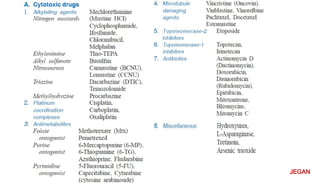
CYTOTOXIC DRUGS
1. Alkylating agents
2. Platinum coordination complex,
3. Antimetabolites
4. Microtubule damaging agents
5. Topoisomerase-2 inhibitors
6. Topoisomerase-1 inhibitors
7. Antibiotics
8. Miscellaneous JEGAN
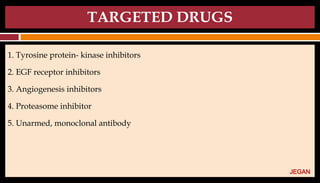
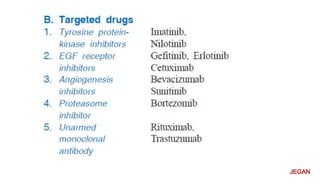
TARGETED DRUGS
1. Tyrosine protein- kinase inhibitors
2. EGF receptor inhibitors
3. Angiogenesis inhibitors
4. Proteasome inhibitor
5. Unarmed, monoclonal antibody
JEGAN
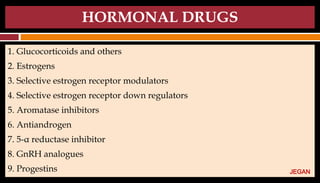
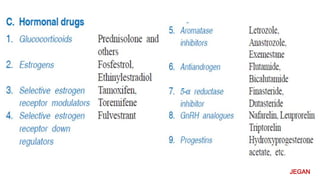
HORMONAL DRUGS
1. Glucocorticoids and others
2. Estrogens
3. Selective estrogen receptor modulators
4. Selective estrogen receptor down regulators
5. Aromatase inhibitors
6. Antiandrogen
7. 5-α reductase inhibitor
8. GnRH analogues
9. Progestins JEGAN
JEGAN
JEGAN
JEGAN
ALKYLATING AGENTS
JEGAN
ALKYLATING AGENTS
● Alkylating agents exert their cytotoxic effects by covalently binding to
nucleophilic groups on various cell constituents.
● Alkylation of DNA is probably the crucial cytotoxic reaction that is lethal to
the tumor cells.
● These compounds produce highly reactive carbonium ion intermediates
which transfer alkyl groups to cellular macromolecules by forming covalent
bonds
JEGAN
CYCLOPHOSPHAMIDE AND IFOSFAMIDE
● Cyclophosphamide is the most commonly used alkylating agent.
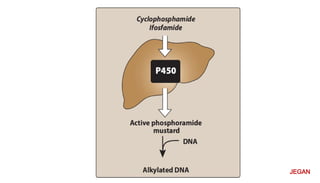
● Both cyclophosphamide and ifosfamide are first biotransformed to hydroxylated
intermediates primarily in the liver by the CYP450 system
● The hydroxylated intermediates then undergo breakdown to form the active
compounds, phosphoramide mustard and acrolein.
● Reaction of the phosphoramide mustard with DNA is considered to be the
cytotoxic step.
● The parent drug and its metabolites are primarily excreted in urine. JEGAN
JEGAN
● Cyclophosphamide is available in oral or IV preparations, whereas
ifosfamide is IV only
● Cyclophosphamide is metabolized in the liver to active and inactive
metabolites, and minimal amounts are excreted in the urine as unchanged
drug
● Common side effects are
● Hemorrhagic cystitis, which can lead to fibrosis of the bladder
● Neurotoxicity
JEGAN
NITROSOUREAS- CARMUSTINE AND LOMUSTINE
● Because of their ability to penetrate the CNS, the nitrosoureas are primarily
employed in the treatment of brain tumors.
● The nitrosoureas exert cytotoxic effects by an alkylation that inhibits replication
and, eventually, RNA and protein synthesis.
● Although they alkylate DNA in resting cells, cytotoxicity is expressed primarily
on cells that are actively dividing.
● Therefore, nondividing cells can escape death if DNA repair occurs.
● Nitrosoureas also inhibit several key enzymatic processes by carbamoylation of
amino acids in proteins in the targeted cells.
JEGAN
● These are highly lipid soluble alkylating agents with a wide range of
antitumour activity.
● They cross blood-brain barrier—are effective in meningeal leukaemias and
brain cancer.
● Nausea, vomiting are common and cns effects also occur.
● Bone marrow depression is peculiarly delayed, taking nearly 6 weeks to
develop.
● Renal damage can occur
JEGAN
TRIAZINE-DACARBAZINE
● Dacarbazine is an alkylating agent that must undergo biotransformation to an
active metabolite, methyltriazenoimidazole carboxamide (MTIC).
● This metabolite is responsible for the drug’s activity as an alkylating agent by
forming methylcarbonium ions that can attack the nucleophilic groups in the
DNA molecule.
● Thus, similar to other alkylating agents, the cytotoxic action of dacarbazine has
been attributed to the ability of its metabolite to methylate DNA
● Dacarbazine has found use in the treatment of melanoma and Hodgkin
lymphoma.
JEGAN
MICROTUBULE INHIBITORS
JEGAN
MICROTUBULE INHIBITORS
● The mitotic spindle is part of a larger, intracellular skeleton (cytoskeleton)
that is essential for the movements of structures occurring in the cytoplasm
of all eukaryotic cells.
● The mitotic spindle consists of chromatin plus a system of microtubules
composed of the protein tubulin.
● The mitotic spindle is essential for the equal partitioning of DNA into the
two daughter cells that are formed when a eukaryotic cell divides
JEGAN
VINCRISTINE AND VINBLASTINE
 Vincristine (VX) and vinblastine (VBL) are structurally related compounds
derived from the periwinkle plant, Vinca rosea
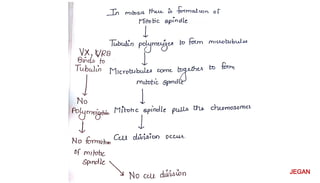
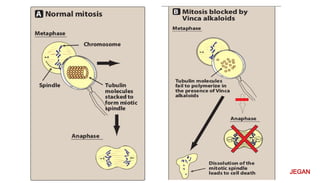
 These are mitotic inhibitors, bind to microtubular protein—‘tubulin’, prevent
its polymerization and assembly of microtubules, cause disruption of mitotic
spindle and interfere with cytoskeletal function.
 The chromosomes fail to move apart during mitosis: metaphase arrest occurs.
 They are cell cycle specific and act in the mitotic phase.
JEGAN
JEGAN
JEGAN
● VX and VBL have certain toxicities in common.
● These include phlebitis or cellulitis, if the drugs extravasate during
● injection, as well as nausea, vomiting, diarrhea, and alopecia.
● However, the adverse effects of VX and VBL are not identical.
● VBL is a more potent myelosuppressant than VX
● Peripheral neuropathy (paresthesias, loss of reflexes, foot drop, and ataxia)
is associated with VX.
● Constipation is more frequently encountered with VX.
JEGAN
PLATINUM COORDINATION COMPLEXES
JEGAN
CISPLATIN
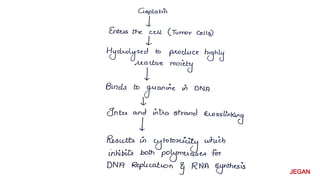
● It is hydrolysed intracellularly to produce a highly reactive moiety which
causes cross linking of DNA.
● The favoured site is N7 of guanine residue.
● It can also react with –SH groups of cytoplasmic and nuclear proteins
● Effects resemble those of alkylating agents and radiation.
● It is bound to plasma proteins, penetrates tissues and is slowly excreted
unchanged in urine with a t½ of about 72 hrs.
● Negligible amounts enter brain
JEGAN
JEGAN
● Cisplatin is very effective in metastatic testicular and ovarian carcinoma.
● It is widely used in many other solid tumours like lung, bladder,
esophageal, gastric, hepatic, head and neck carcinomas.
● Cisplatin is a highly emetic drug.
● Antiemetics are routinely administered before infusing it.
● The most important toxicity is renal impairment
● Tinnitus, deafness, sensory neuropathy and hyperuricaemia are other
problems.
JEGAN
ANTIMETABOLITES
JEGAN
ANTIMETABOLITES
 Antimetabolites are structurally related to normal compounds that exist
within the cell
 They generally interfere with the availability of normal purine or
pyrimidine nucleotide precursors, either by inhibiting their synthesis or by
competing with them in DNA or RNA synthesis.
 Their maximal cytotoxic effects are in S-phase and are, therefore, cell cycle
specific
JEGAN
FOLATE ANTAGONIST-METHOTREXATE (Mtx)
 The vitamin folic acid plays a central role in a variety of metabolic reactions involving the
transfer of one-carbon units and is essential for cell replication
 This folic acid analogue is one of the oldest and highly efficacious antineoplastic drugs
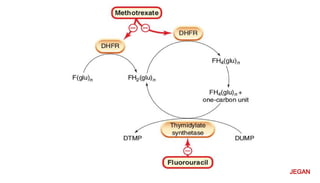
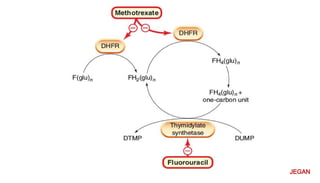
 It acts by inhibiting dihydrofolate reductase (DHFRase)—blocking the conversion of
dihydrofolic acid (DHFA) to tetrahydrofolic acid (THFA).
 Utilizing the folate carrier it enters into cells and is transformed to more active polyglutamate
form
 Tetrahydrofolic acid is an essential coenzyme required for one carbon transfer reactions in de
novo purine synthesis and amino acid interconversions.
JEGAN
JEGAN
 Methotrexate has cell cycle specific action—kills cells in S phase
 In addition to DHFRase it inhibits thymidylate synthase as well so that
DNA synthesis is primarily affected.
 However, synthesis of RNA and protein also suffers.
 It exerts major toxicity on bone marrow—low doses given repeatedly cause
megaloblastic anaemia, but high doses produce pancytopenia.
 It has prominent immunosuppressant property useful in rheumatoid
arthritis, psoriasis and many other antoimmune disorders
JEGAN
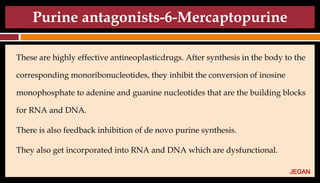
Purine antagonists-6-Mercaptopurine
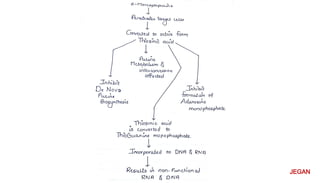
These are highly effective antineoplasticdrugs. After synthesis in the body to the
corresponding monoribonucleotides, they inhibit the conversion of inosine
monophosphate to adenine and guanine nucleotides that are the building blocks
for RNA and DNA.
There is also feedback inhibition of de novo purine synthesis.
They also get incorporated into RNA and DNA which are dysfunctional.
JEGAN
JEGAN
Pyrimidine antagonists-Fluorouracil (5-FU)
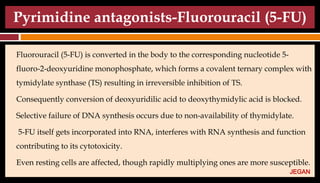
Fluorouracil (5-FU) is converted in the body to the corresponding nucleotide 5-
fluoro-2-deoxyuridine monophosphate, which forms a covalent ternary complex with
tymidylate synthase (TS) resulting in irreversible inhibition of TS.
Consequently conversion of deoxyuridilic acid to deoxythymidylic acid is blocked.
Selective failure of DNA synthesis occurs due to non-availability of thymidylate.
5-FU itself gets incorporated into RNA, interferes with RNA synthesis and function
contributing to its cytotoxicity.
Even resting cells are affected, though rapidly multiplying ones are more susceptible.
JEGAN
JEGAN
ANTIBIOTICS
JEGAN
Actinomycin D (Dactinomycin)
● It is a very potent antineoplastic drug, highly efficacious in Wilms’ tumour and
childhood rhabdomyosarcoma
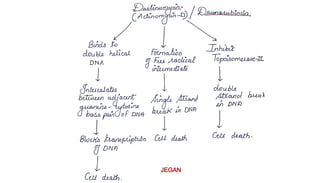
● In addition to blocking RNA transcription (due to interference with template
function of DNA) dactinomycin causes single strand breaks in DNA.
● Prominent adverse effects are vomiting, stomatitis, diarrhoea, erythema and
desquamation of skin, alopecia and bone marrow depression
JEGAN
JEGAN
EGF receptor inhibitors
JEGAN
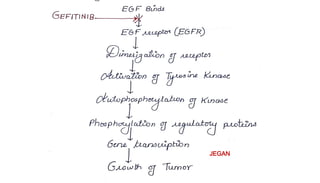
Gefitinib
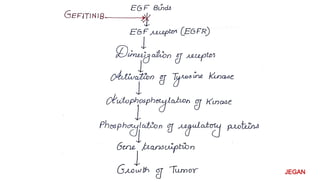
● Gefitinib is a synthetic compound that penetrates cells, binds to the tyrosine
kinase domain of the EGF receptor (also Erbβ 1 , or HER1) and prevents
phosphorylation of regulatory proteins.
● Gefitinib has been found effective in selected patients of non-small cell lung
cancer which has EGFR activating mutation
● Gefitinib monotherapy has been used for locally advanced or metastatic
lung cancers after cisplatin and docetaxal have failed.
JEGAN
JEGAN
Angiogenesis inhibitors
JEGAN
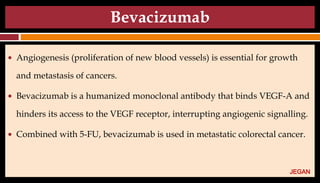
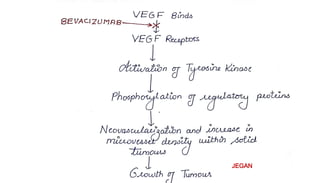
Bevacizumab
● Angiogenesis (proliferation of new blood vessels) is essential for growth
and metastasis of cancers.
● Bevacizumab is a humanized monoclonal antibody that binds VEGF-A and
hinders its access to the VEGF receptor, interrupting angiogenic signalling.
● Combined with 5-FU, bevacizumab is used in metastatic colorectal cancer.
JEGAN
JEGAN
Unarmed monoclonal antibodies
JEGAN
Unarmed monoclonal antibodies
● Monoclonal antibodies (MAbs) are sourced from hybridomas created by fusing a
continuously proliferating cell line from mouse myeloma with antibody producing B
lymphocytes sensitized to produce antibody against a particular antigen.
● This hybridoma is then cloned so that the single species antibody is obtained in large
quantity. Separate hybridomas are created for each antibody.
● Chimerized MAbs are produced by substituting major portion with human IgG
molecule for the mouse antibody. These MAbs are part human-part mouse.
● Totally human MAbs are called humanized MAbs.
JEGAN
JEGAN
Thank You

Anticancer drugs

  • 1.
  • 2.
    ANTICANCER DRUGS ● Theanticancer drugs either kill cancer cells or modify their growth. ● The attack is generally directed toward DNA or against metabolic sites essential to cell replication, for example, the availability of purines and pyrimidines, which are the building blocks for DNA or RNA synthesis ● Ideally, these anticancer drugs should interfere only with cellular processes that are unique to malignant cells. ● But, most currently available anticancer drugs do not specifically recognize neoplastic cells but, rather, affect all kinds of proliferating cells, both normal and abnormal. JEGAN
  • 3.
    CLASSIFICATION A. Cytotoxic drugs B.Targeted drugs C. Hormonal drugs JEGAN
  • 4.
    CYTOTOXIC DRUGS 1. Alkylatingagents 2. Platinum coordination complex, 3. Antimetabolites 4. Microtubule damaging agents 5. Topoisomerase-2 inhibitors 6. Topoisomerase-1 inhibitors 7. Antibiotics 8. Miscellaneous JEGAN
  • 5.
    TARGETED DRUGS 1. Tyrosineprotein- kinase inhibitors 2. EGF receptor inhibitors 3. Angiogenesis inhibitors 4. Proteasome inhibitor 5. Unarmed, monoclonal antibody JEGAN
  • 6.
    HORMONAL DRUGS 1. Glucocorticoidsand others 2. Estrogens 3. Selective estrogen receptor modulators 4. Selective estrogen receptor down regulators 5. Aromatase inhibitors 6. Antiandrogen 7. 5-α reductase inhibitor 8. GnRH analogues 9. Progestins JEGAN
  • 7.
  • 8.
  • 9.
  • 10.
  • 11.
    ALKYLATING AGENTS ● Alkylatingagents exert their cytotoxic effects by covalently binding to nucleophilic groups on various cell constituents. ● Alkylation of DNA is probably the crucial cytotoxic reaction that is lethal to the tumor cells. ● These compounds produce highly reactive carbonium ion intermediates which transfer alkyl groups to cellular macromolecules by forming covalent bonds JEGAN
  • 12.
    CYCLOPHOSPHAMIDE AND IFOSFAMIDE ●Cyclophosphamide is the most commonly used alkylating agent. ● Both cyclophosphamide and ifosfamide are first biotransformed to hydroxylated intermediates primarily in the liver by the CYP450 system ● The hydroxylated intermediates then undergo breakdown to form the active compounds, phosphoramide mustard and acrolein. ● Reaction of the phosphoramide mustard with DNA is considered to be the cytotoxic step. ● The parent drug and its metabolites are primarily excreted in urine. JEGAN
  • 13.
  • 14.
    ● Cyclophosphamide isavailable in oral or IV preparations, whereas ifosfamide is IV only ● Cyclophosphamide is metabolized in the liver to active and inactive metabolites, and minimal amounts are excreted in the urine as unchanged drug ● Common side effects are ● Hemorrhagic cystitis, which can lead to fibrosis of the bladder ● Neurotoxicity JEGAN
  • 15.
    NITROSOUREAS- CARMUSTINE ANDLOMUSTINE ● Because of their ability to penetrate the CNS, the nitrosoureas are primarily employed in the treatment of brain tumors. ● The nitrosoureas exert cytotoxic effects by an alkylation that inhibits replication and, eventually, RNA and protein synthesis. ● Although they alkylate DNA in resting cells, cytotoxicity is expressed primarily on cells that are actively dividing. ● Therefore, nondividing cells can escape death if DNA repair occurs. ● Nitrosoureas also inhibit several key enzymatic processes by carbamoylation of amino acids in proteins in the targeted cells. JEGAN
  • 16.
    ● These arehighly lipid soluble alkylating agents with a wide range of antitumour activity. ● They cross blood-brain barrier—are effective in meningeal leukaemias and brain cancer. ● Nausea, vomiting are common and cns effects also occur. ● Bone marrow depression is peculiarly delayed, taking nearly 6 weeks to develop. ● Renal damage can occur JEGAN
  • 17.
    TRIAZINE-DACARBAZINE ● Dacarbazine isan alkylating agent that must undergo biotransformation to an active metabolite, methyltriazenoimidazole carboxamide (MTIC). ● This metabolite is responsible for the drug’s activity as an alkylating agent by forming methylcarbonium ions that can attack the nucleophilic groups in the DNA molecule. ● Thus, similar to other alkylating agents, the cytotoxic action of dacarbazine has been attributed to the ability of its metabolite to methylate DNA ● Dacarbazine has found use in the treatment of melanoma and Hodgkin lymphoma. JEGAN
  • 18.
  • 19.
    MICROTUBULE INHIBITORS ● Themitotic spindle is part of a larger, intracellular skeleton (cytoskeleton) that is essential for the movements of structures occurring in the cytoplasm of all eukaryotic cells. ● The mitotic spindle consists of chromatin plus a system of microtubules composed of the protein tubulin. ● The mitotic spindle is essential for the equal partitioning of DNA into the two daughter cells that are formed when a eukaryotic cell divides JEGAN
  • 20.
    VINCRISTINE AND VINBLASTINE Vincristine (VX) and vinblastine (VBL) are structurally related compounds derived from the periwinkle plant, Vinca rosea  These are mitotic inhibitors, bind to microtubular protein—‘tubulin’, prevent its polymerization and assembly of microtubules, cause disruption of mitotic spindle and interfere with cytoskeletal function.  The chromosomes fail to move apart during mitosis: metaphase arrest occurs.  They are cell cycle specific and act in the mitotic phase. JEGAN
  • 21.
  • 22.
  • 23.
    ● VX andVBL have certain toxicities in common. ● These include phlebitis or cellulitis, if the drugs extravasate during ● injection, as well as nausea, vomiting, diarrhea, and alopecia. ● However, the adverse effects of VX and VBL are not identical. ● VBL is a more potent myelosuppressant than VX ● Peripheral neuropathy (paresthesias, loss of reflexes, foot drop, and ataxia) is associated with VX. ● Constipation is more frequently encountered with VX. JEGAN
  • 24.
  • 25.
    CISPLATIN ● It ishydrolysed intracellularly to produce a highly reactive moiety which causes cross linking of DNA. ● The favoured site is N7 of guanine residue. ● It can also react with –SH groups of cytoplasmic and nuclear proteins ● Effects resemble those of alkylating agents and radiation. ● It is bound to plasma proteins, penetrates tissues and is slowly excreted unchanged in urine with a t½ of about 72 hrs. ● Negligible amounts enter brain JEGAN
  • 26.
  • 27.
    ● Cisplatin isvery effective in metastatic testicular and ovarian carcinoma. ● It is widely used in many other solid tumours like lung, bladder, esophageal, gastric, hepatic, head and neck carcinomas. ● Cisplatin is a highly emetic drug. ● Antiemetics are routinely administered before infusing it. ● The most important toxicity is renal impairment ● Tinnitus, deafness, sensory neuropathy and hyperuricaemia are other problems. JEGAN
  • 28.
  • 29.
    ANTIMETABOLITES  Antimetabolites arestructurally related to normal compounds that exist within the cell  They generally interfere with the availability of normal purine or pyrimidine nucleotide precursors, either by inhibiting their synthesis or by competing with them in DNA or RNA synthesis.  Their maximal cytotoxic effects are in S-phase and are, therefore, cell cycle specific JEGAN
  • 30.
    FOLATE ANTAGONIST-METHOTREXATE (Mtx) The vitamin folic acid plays a central role in a variety of metabolic reactions involving the transfer of one-carbon units and is essential for cell replication  This folic acid analogue is one of the oldest and highly efficacious antineoplastic drugs  It acts by inhibiting dihydrofolate reductase (DHFRase)—blocking the conversion of dihydrofolic acid (DHFA) to tetrahydrofolic acid (THFA).  Utilizing the folate carrier it enters into cells and is transformed to more active polyglutamate form  Tetrahydrofolic acid is an essential coenzyme required for one carbon transfer reactions in de novo purine synthesis and amino acid interconversions. JEGAN
  • 31.
  • 32.
     Methotrexate hascell cycle specific action—kills cells in S phase  In addition to DHFRase it inhibits thymidylate synthase as well so that DNA synthesis is primarily affected.  However, synthesis of RNA and protein also suffers.  It exerts major toxicity on bone marrow—low doses given repeatedly cause megaloblastic anaemia, but high doses produce pancytopenia.  It has prominent immunosuppressant property useful in rheumatoid arthritis, psoriasis and many other antoimmune disorders JEGAN
  • 33.
    Purine antagonists-6-Mercaptopurine These arehighly effective antineoplasticdrugs. After synthesis in the body to the corresponding monoribonucleotides, they inhibit the conversion of inosine monophosphate to adenine and guanine nucleotides that are the building blocks for RNA and DNA. There is also feedback inhibition of de novo purine synthesis. They also get incorporated into RNA and DNA which are dysfunctional. JEGAN
  • 34.
  • 35.
    Pyrimidine antagonists-Fluorouracil (5-FU) Fluorouracil(5-FU) is converted in the body to the corresponding nucleotide 5- fluoro-2-deoxyuridine monophosphate, which forms a covalent ternary complex with tymidylate synthase (TS) resulting in irreversible inhibition of TS. Consequently conversion of deoxyuridilic acid to deoxythymidylic acid is blocked. Selective failure of DNA synthesis occurs due to non-availability of thymidylate. 5-FU itself gets incorporated into RNA, interferes with RNA synthesis and function contributing to its cytotoxicity. Even resting cells are affected, though rapidly multiplying ones are more susceptible. JEGAN
  • 36.
  • 37.
  • 38.
    Actinomycin D (Dactinomycin) ●It is a very potent antineoplastic drug, highly efficacious in Wilms’ tumour and childhood rhabdomyosarcoma ● In addition to blocking RNA transcription (due to interference with template function of DNA) dactinomycin causes single strand breaks in DNA. ● Prominent adverse effects are vomiting, stomatitis, diarrhoea, erythema and desquamation of skin, alopecia and bone marrow depression JEGAN
  • 39.
  • 40.
  • 41.
    Gefitinib ● Gefitinib isa synthetic compound that penetrates cells, binds to the tyrosine kinase domain of the EGF receptor (also Erbβ 1 , or HER1) and prevents phosphorylation of regulatory proteins. ● Gefitinib has been found effective in selected patients of non-small cell lung cancer which has EGFR activating mutation ● Gefitinib monotherapy has been used for locally advanced or metastatic lung cancers after cisplatin and docetaxal have failed. JEGAN
  • 42.
  • 43.
  • 44.
    Bevacizumab ● Angiogenesis (proliferationof new blood vessels) is essential for growth and metastasis of cancers. ● Bevacizumab is a humanized monoclonal antibody that binds VEGF-A and hinders its access to the VEGF receptor, interrupting angiogenic signalling. ● Combined with 5-FU, bevacizumab is used in metastatic colorectal cancer. JEGAN
  • 45.
  • 46.
  • 47.
    Unarmed monoclonal antibodies ●Monoclonal antibodies (MAbs) are sourced from hybridomas created by fusing a continuously proliferating cell line from mouse myeloma with antibody producing B lymphocytes sensitized to produce antibody against a particular antigen. ● This hybridoma is then cloned so that the single species antibody is obtained in large quantity. Separate hybridomas are created for each antibody. ● Chimerized MAbs are produced by substituting major portion with human IgG molecule for the mouse antibody. These MAbs are part human-part mouse. ● Totally human MAbs are called humanized MAbs. JEGAN
  • 48.
  • 49.