AUTONOMIC NERVOUS SYSTEM AND
AUTONOMIC DRUGS
• I. Parasympathetic nervous
system drugs:
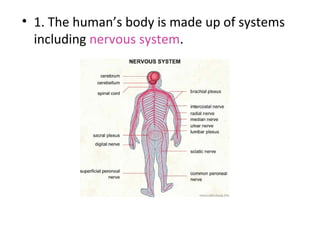
• 1. The human’s body is made up of systems
including nervous system.
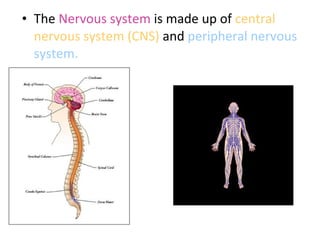
• The Nervous system is made up of central
nervous system (CNS) and peripheral nervous
system.
• The peripheral nervous system is made up of two
divisions:
A. Efferent division ( include neurons that leave the
CNS and transmit impulses from the CNS to the
peripheral parts of the body)
B. Afferent division (Include neurons that bring
impulses from the peripheral parts of the body to
the CNS)
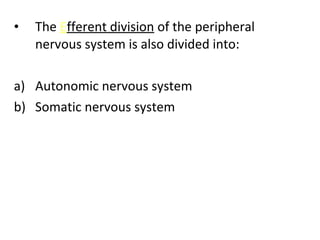
• The Efferent division of the peripheral
nervous system is also divided into:
a) Autonomic nervous system
b) Somatic nervous system
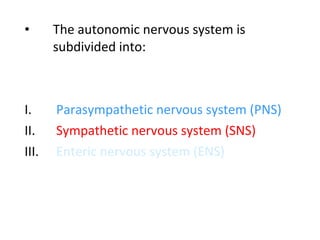
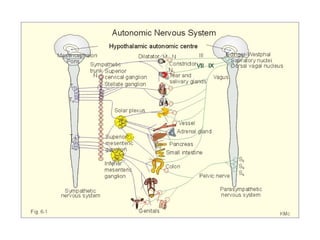
• The autonomic nervous system is
subdivided into:
I. Parasympathetic nervous system (PNS)
II. Sympathetic nervous system (SNS)
III. Enteric nervous system (ENS)
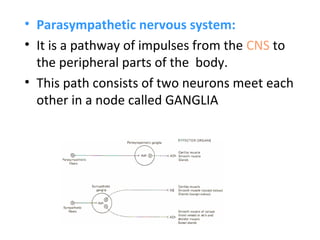
• Parasympathetic nervous system:
• It is a pathway of impulses from the CNS to
the peripheral parts of the body.
• This path consists of two neurons meet each
other in a node called GANGLIA
• The neuron/fibres which is before the ganglia from
the CNS side is called PRE-GANGLIONIC Neuron
• The fiber which is in front of ganglia from the organ
side is called POST-GANGLIONIC Neuron.
• the preganglionic fibers are long while the post-
ganglionic fibers are short
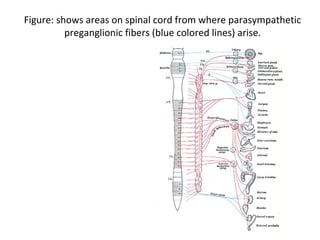
• The parasympathetic preganglionic fibers
arise from the cranial nerves (III, VII, IX and
X) of brain stem and from 2nd
, 3rd
and 4th
sacral
segments of the spinal cord
• The preganglionic fibers run almost to the
organ which is innervated and synapse with
postganglionic fibers in ganglia near or on
the effector organ.
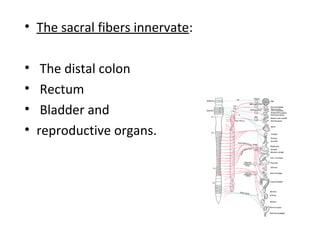
Figure: shows areas on spinal cord from where parasympathetic
preganglionic fibers (blue colored lines) arise.
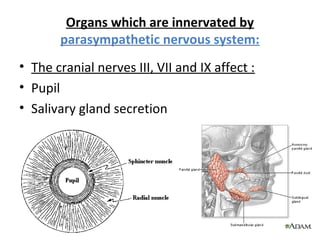
Organs which are innervated by
parasympathetic nervous system:
• The cranial nerves III, VII and IX affect :
• Pupil
• Salivary gland secretion
The vagous nerve X carries fibers to:
• Heart
• Lungs
• Stomach
• Upper intestine
• ureter
• The sacral fibers innervate:
• The distal colon
• Rectum
• Bladder and
• reproductive organs.
Function of parasympathetic nervous
system
• In physiological terms, the parasympathetic nervous
system is concerned with conservation and
restoration of energy.
• It causes:
• Reduction in heart rate
• Reduction in blood pressure
• Facilitates digestion and absorption
• Facilitates the excretion of waste products.
• Usually acts to oppose or balance the actions of
sympathetic system and dominates over it in “rest
and digest” situations
• Neurotransmitter:
• The chemical transmitter at both pre and
post-ganglionic synapses in the
parasympathetic nervous system is
Acetylcholine (Ach).
• The drugs acting on these receptors are:
A. Cholinergic agents
B. Anticholinergic agents
A. Cholinergic agents
• These are the agents that bind to the Ach receptors or
which inhibit the acetylcholineesterase (AChE) and make
Ach available for binding with its receptors.
• Classification of cholinergic agents:
I. Direct acting cholinergic agents:
i. Choline esters:
Acetylcholine
Methacholine
Carbachol
Bethanchol
i. Naturally occuring alkaloids:
Pilocarpine
Muscarine
Nicotine
Lobeline
Arecholine
I. Indirectly acting cholinergics:
i. Reversible:
Physostigmine (tertiary amine)
Neostigmine (quaternary)
Pyridostigmine (-do-)
Edrophonium (-do-)
i. Irreversible:
a. Alkyl-phosphate group:
TEPP (Tetra-ethyl-pyro-phosphate)
HETP (Hexa-ethyl-tetra-phosphate)
DFP (DI-isopropyl-fluro-phosphate)
OMPA (Octa-methyl-pyrophosphate)
b. Aryl group:
Chlorothion
Malathion
Parathion
Diazinon
• Miscellaneous :
Tacrine
Rivastigmine
Galantamine
Donepezil
ACETYLCHOLINE
Ach is a cholinergic agent and considered as a
prototype of this group.
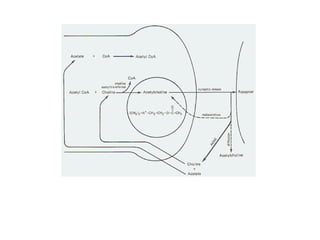
• Synthesis of Ach:
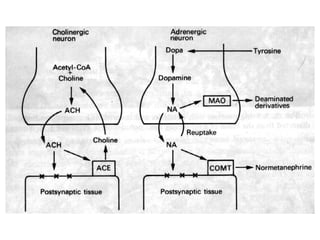
• Its synthesis starts by pumping of choline from extra
cellular space to intra cellular space at nerve ending
where the choline will combine with acetyl-coA in
the presence of choline-acetyltransferase to form
Ach.
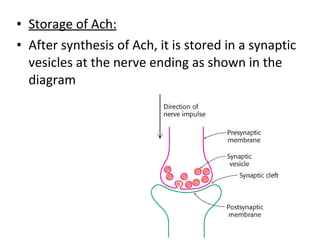
• Storage of Ach:
• After synthesis of Ach, it is stored in a synaptic
vesicles at the nerve ending as shown in the
diagram
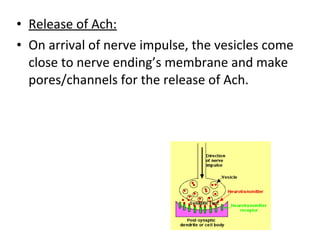
• Release of Ach:
• On arrival of nerve impulse, the vesicles come
close to nerve ending’s membrane and make
pores/channels for the release of Ach.
• Binding of Ach:
• After Ach released from the synaptic vesicles, it
diffuses across the synaptic space where it will bind
with specific receptors on the postsynaptic
neuron/organ as well as presynaptic neuron.
• There are two types of receptors for Ach
a) Muscarinic receptors (M1,M2, M3, M4, M5)
b)Nicotinic receptors (Nn, Nm)
• Fate of Ach:
• Ach is very rapidly hydrolyzed in the synaptic cleft by
acetylcholinesterase (AChE) to choline and acetate.
• The choline is transported back to the presynaptic
nerve ending by a Na+ coupled transportor where it
will be acetylated to form another Ach and stored till
next impulse occur.
• Pharmacological actions:
• Muscarinic actions:
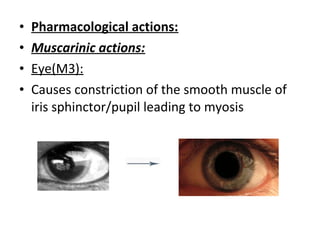
• Eye(M3):
• Causes constriction of the smooth muscle of
iris sphinctor/pupil leading to myosis
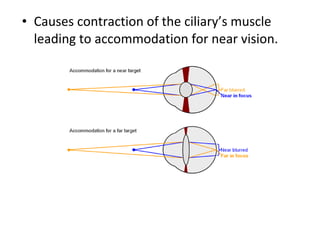
• Causes contraction of the ciliary’s muscle
leading to accommodation for near vision.
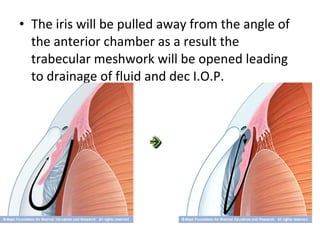
• The iris will be pulled away from the angle of
the anterior chamber as a result the
trabecular meshwork will be opened leading
to drainage of fluid and dec I.O.P.
• CVS
Heart(M2) :SA node rate dec
Atrial contractility dec
AV node rate dec
Ventricular contractility slightly dec
Blood vessels (M3):
only skin of face and neck is innervated
it cause dilation of vessels causing flushing
• Respiratory system (M3):
• Ach stimulates M3 receptors leading to constriction
of bronchial muscles and increase bronchial
secretions leading to asthma
• GIT (M3):
• It will increase the motility of GIT wall and relaxes
the sphincter and causes defecation and diarrhea
• Genitourinary tract (M3):
• It will cause contraction of the urinary bladder and relaxation
of its sphincter leading to maturation
• uterus of pregnant will be contracted
• Secretory glands and temperature (M):
• Lacrimal, nasopharyngeal, salivary, sweat glands secretions as
well as gastric secretions will be increased
skin temperature will increase.
• CNS:
• both M1 and M3 are available in CNS and present variety of
response for cholinergic agents
• Nicotinic actions:
• they will cause stimulation and contraction of
skeletal muscles causing inc in strength of
muscle and in high doses they cause paralysis
of the muscle
• It will stimulate and activate all the ganglias
including adrenal medulla.
• It will stimulate central nervous system
leading in high doses to exitation
• Clinical uses:
Clinically Ach is not used due to its rapid metabolism by
acetylcholinesterase at the synaptic cleft
But its availability at the synaptic cleft can be increased
by indirect acting agents that bind the
acetylcholineesterase and thus prevent the
degradation of the acetylcholine and make it
available for action.
• Alzheimer’s disease:
Tacrine
Rivastigmine
Galantamine
Donepezil
• glaucoma:
Pilocarpine
Carbachol
Physostigmine
Echothiophate
• For GIT disorders like Postoperative ileus:
• For Urinary disorders like urinary retention that may occur
postoperatively or postpartum
Bethanechol
• Myasthenia gravis:
Edromethonium (diagnosis)
Neostigmine
Pyridostigmine
d-tubocurarine (diagnosis)
• Anticholinergic intoxication:
Physostigmine
(only in dangerous situation of elevated temperature and
cardiac arrhythmias)
• Smoking cessation:
Varenicline
• Dryness of mouth associated with sjogren’s syndrome:
Pilocarpine (has been used)
Cevimeline (newly developed drug)
• Adverse effects:
• CNS: excitation
• Eye: myosis and lacrimation
• Mouth: excessive salivation
• Bronchi: excessive secretions and bronchial contraction leading to Asthma
• Heart: bradycardia
• GIT: increase acidic secretions and may cause peptic ulcer, Increase GIT
motility leading to cramps and diarrhea
• Skin: excessive sweating
• Urinary system: involuntary urination
• Skeletal muscle: excitation and in high dose cause muscle paralysis
• Contraindications:
• Asthmatic patient
• Peptic ulcer
• Bradycardia
• Obstructive urinary bladder
B. ANTICHOLINERGIC AGENTS

Autonomic nervous system

  • 1.
    AUTONOMIC NERVOUS SYSTEMAND AUTONOMIC DRUGS • I. Parasympathetic nervous system drugs:
  • 2.
    • 1. Thehuman’s body is made up of systems including nervous system.
  • 3.
    • The Nervoussystem is made up of central nervous system (CNS) and peripheral nervous system.
  • 4.
    • The peripheralnervous system is made up of two divisions: A. Efferent division ( include neurons that leave the CNS and transmit impulses from the CNS to the peripheral parts of the body) B. Afferent division (Include neurons that bring impulses from the peripheral parts of the body to the CNS)
  • 5.
    • The Efferentdivision of the peripheral nervous system is also divided into: a) Autonomic nervous system b) Somatic nervous system
  • 6.
    • The autonomicnervous system is subdivided into: I. Parasympathetic nervous system (PNS) II. Sympathetic nervous system (SNS) III. Enteric nervous system (ENS)
  • 8.
    • Parasympathetic nervoussystem: • It is a pathway of impulses from the CNS to the peripheral parts of the body. • This path consists of two neurons meet each other in a node called GANGLIA
  • 9.
    • The neuron/fibreswhich is before the ganglia from the CNS side is called PRE-GANGLIONIC Neuron • The fiber which is in front of ganglia from the organ side is called POST-GANGLIONIC Neuron. • the preganglionic fibers are long while the post- ganglionic fibers are short
  • 10.
    • The parasympatheticpreganglionic fibers arise from the cranial nerves (III, VII, IX and X) of brain stem and from 2nd , 3rd and 4th sacral segments of the spinal cord • The preganglionic fibers run almost to the organ which is innervated and synapse with postganglionic fibers in ganglia near or on the effector organ.
  • 11.
    Figure: shows areason spinal cord from where parasympathetic preganglionic fibers (blue colored lines) arise.
  • 12.
    Organs which areinnervated by parasympathetic nervous system: • The cranial nerves III, VII and IX affect : • Pupil • Salivary gland secretion
  • 13.
    The vagous nerveX carries fibers to: • Heart • Lungs • Stomach • Upper intestine • ureter
  • 14.
    • The sacralfibers innervate: • The distal colon • Rectum • Bladder and • reproductive organs.
  • 15.
    Function of parasympatheticnervous system • In physiological terms, the parasympathetic nervous system is concerned with conservation and restoration of energy. • It causes: • Reduction in heart rate • Reduction in blood pressure • Facilitates digestion and absorption • Facilitates the excretion of waste products. • Usually acts to oppose or balance the actions of sympathetic system and dominates over it in “rest and digest” situations
  • 16.
    • Neurotransmitter: • Thechemical transmitter at both pre and post-ganglionic synapses in the parasympathetic nervous system is Acetylcholine (Ach).
  • 17.
    • The drugsacting on these receptors are: A. Cholinergic agents B. Anticholinergic agents
  • 18.
    A. Cholinergic agents •These are the agents that bind to the Ach receptors or which inhibit the acetylcholineesterase (AChE) and make Ach available for binding with its receptors. • Classification of cholinergic agents: I. Direct acting cholinergic agents: i. Choline esters: Acetylcholine Methacholine
  • 19.
    Carbachol Bethanchol i. Naturally occuringalkaloids: Pilocarpine Muscarine Nicotine Lobeline Arecholine
  • 20.
    I. Indirectly actingcholinergics: i. Reversible: Physostigmine (tertiary amine) Neostigmine (quaternary) Pyridostigmine (-do-) Edrophonium (-do-)
  • 21.
    i. Irreversible: a. Alkyl-phosphategroup: TEPP (Tetra-ethyl-pyro-phosphate) HETP (Hexa-ethyl-tetra-phosphate) DFP (DI-isopropyl-fluro-phosphate) OMPA (Octa-methyl-pyrophosphate) b. Aryl group: Chlorothion Malathion Parathion Diazinon
  • 22.
  • 23.
    ACETYLCHOLINE Ach is acholinergic agent and considered as a prototype of this group. • Synthesis of Ach: • Its synthesis starts by pumping of choline from extra cellular space to intra cellular space at nerve ending where the choline will combine with acetyl-coA in the presence of choline-acetyltransferase to form Ach.
  • 25.
    • Storage ofAch: • After synthesis of Ach, it is stored in a synaptic vesicles at the nerve ending as shown in the diagram
  • 26.
    • Release ofAch: • On arrival of nerve impulse, the vesicles come close to nerve ending’s membrane and make pores/channels for the release of Ach.
  • 27.
    • Binding ofAch: • After Ach released from the synaptic vesicles, it diffuses across the synaptic space where it will bind with specific receptors on the postsynaptic neuron/organ as well as presynaptic neuron. • There are two types of receptors for Ach a) Muscarinic receptors (M1,M2, M3, M4, M5) b)Nicotinic receptors (Nn, Nm)
  • 28.
    • Fate ofAch: • Ach is very rapidly hydrolyzed in the synaptic cleft by acetylcholinesterase (AChE) to choline and acetate. • The choline is transported back to the presynaptic nerve ending by a Na+ coupled transportor where it will be acetylated to form another Ach and stored till next impulse occur.
  • 30.
    • Pharmacological actions: •Muscarinic actions: • Eye(M3): • Causes constriction of the smooth muscle of iris sphinctor/pupil leading to myosis
  • 31.
    • Causes contractionof the ciliary’s muscle leading to accommodation for near vision.
  • 32.
    • The iriswill be pulled away from the angle of the anterior chamber as a result the trabecular meshwork will be opened leading to drainage of fluid and dec I.O.P.
  • 33.
    • CVS Heart(M2) :SAnode rate dec Atrial contractility dec AV node rate dec Ventricular contractility slightly dec Blood vessels (M3): only skin of face and neck is innervated it cause dilation of vessels causing flushing
  • 34.
    • Respiratory system(M3): • Ach stimulates M3 receptors leading to constriction of bronchial muscles and increase bronchial secretions leading to asthma • GIT (M3): • It will increase the motility of GIT wall and relaxes the sphincter and causes defecation and diarrhea
  • 35.
    • Genitourinary tract(M3): • It will cause contraction of the urinary bladder and relaxation of its sphincter leading to maturation • uterus of pregnant will be contracted • Secretory glands and temperature (M): • Lacrimal, nasopharyngeal, salivary, sweat glands secretions as well as gastric secretions will be increased skin temperature will increase. • CNS: • both M1 and M3 are available in CNS and present variety of response for cholinergic agents
  • 36.
    • Nicotinic actions: •they will cause stimulation and contraction of skeletal muscles causing inc in strength of muscle and in high doses they cause paralysis of the muscle • It will stimulate and activate all the ganglias including adrenal medulla. • It will stimulate central nervous system leading in high doses to exitation
  • 37.
    • Clinical uses: ClinicallyAch is not used due to its rapid metabolism by acetylcholinesterase at the synaptic cleft But its availability at the synaptic cleft can be increased by indirect acting agents that bind the acetylcholineesterase and thus prevent the degradation of the acetylcholine and make it available for action.
  • 38.
    • Alzheimer’s disease: Tacrine Rivastigmine Galantamine Donepezil •glaucoma: Pilocarpine Carbachol Physostigmine Echothiophate
  • 39.
    • For GITdisorders like Postoperative ileus: • For Urinary disorders like urinary retention that may occur postoperatively or postpartum Bethanechol • Myasthenia gravis: Edromethonium (diagnosis) Neostigmine Pyridostigmine d-tubocurarine (diagnosis)
  • 40.
    • Anticholinergic intoxication: Physostigmine (onlyin dangerous situation of elevated temperature and cardiac arrhythmias) • Smoking cessation: Varenicline • Dryness of mouth associated with sjogren’s syndrome: Pilocarpine (has been used) Cevimeline (newly developed drug)
  • 41.
    • Adverse effects: •CNS: excitation • Eye: myosis and lacrimation • Mouth: excessive salivation • Bronchi: excessive secretions and bronchial contraction leading to Asthma • Heart: bradycardia • GIT: increase acidic secretions and may cause peptic ulcer, Increase GIT motility leading to cramps and diarrhea • Skin: excessive sweating • Urinary system: involuntary urination • Skeletal muscle: excitation and in high dose cause muscle paralysis
  • 42.
    • Contraindications: • Asthmaticpatient • Peptic ulcer • Bradycardia • Obstructive urinary bladder
  • 43.