INTRODUCTION
TO
AUTONOMIC NERVOUS SYSTEM(ANS)
NERVOUS SYSTEM
CENTRAL NERVOUS SYSTEM
(Brain, Spinal Cord)
PERIPHERAL NERVOUS SYSTEM
Afferent Pathway Efferent Pathway
AUTONOMIC NERVOUS SYSTEM
(Involuntary)
PARASYMPATHETIC
NERVOUS SYSTEM
SYMPATHETIC NERVOUS
SYSTEM
SOMATIC NERVOUS SYSTEM
(Voluntary)
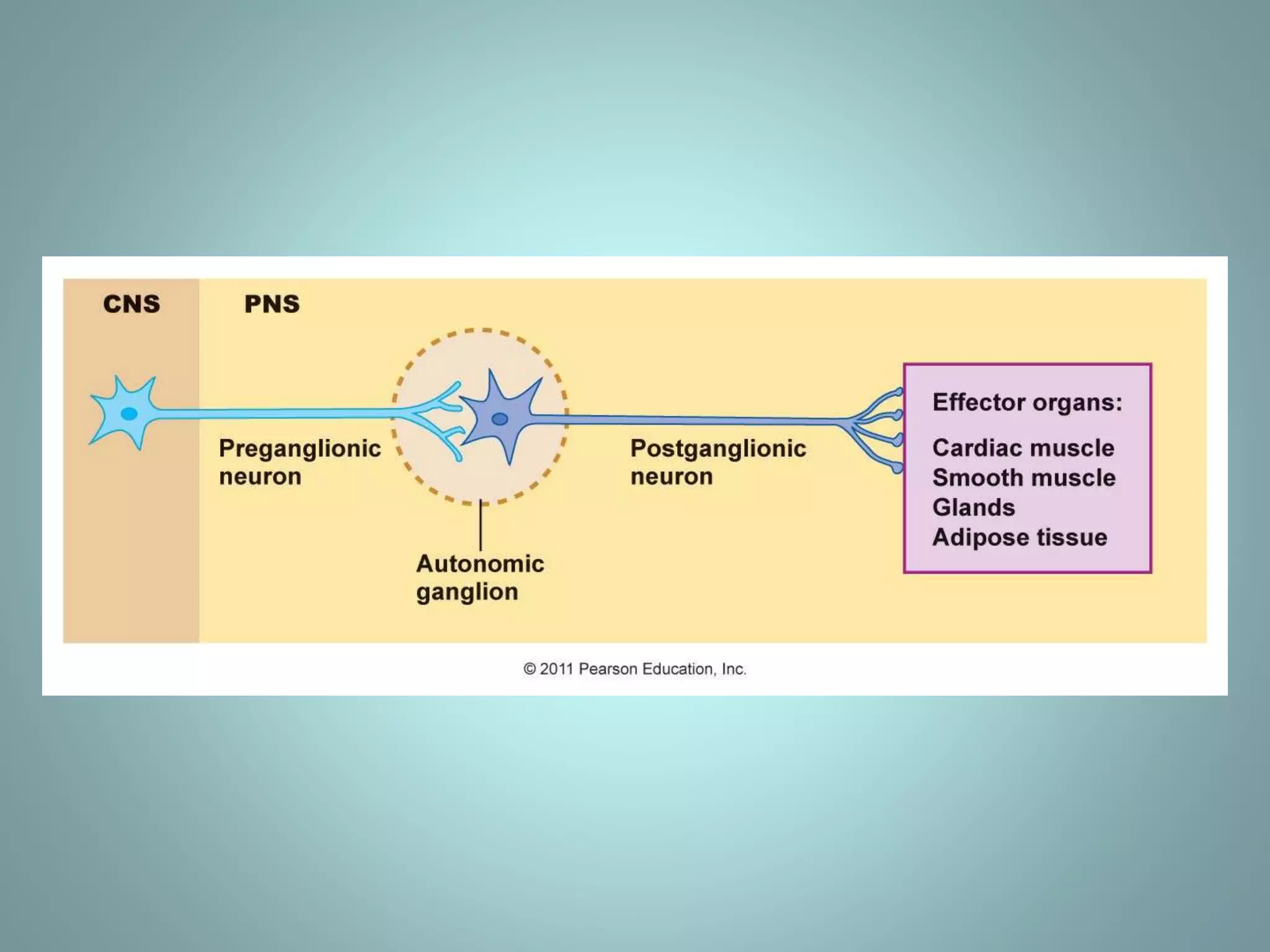
AUTONOMIC NERVOUS SYSTEM
The autonomic nervous system is that division of nervous
system that controls all vital functions & supplies the
viscera. It is largely autonomous & its activities are not
under direct control, hence known as involuntary nervous
system. It maintains the internal environment
(homeostasis).
The two divisions of the autonomic nervous system are
sympathetic & parasympathetic that differs in their
anatomical arrangement, their effects & mechanism of
action.
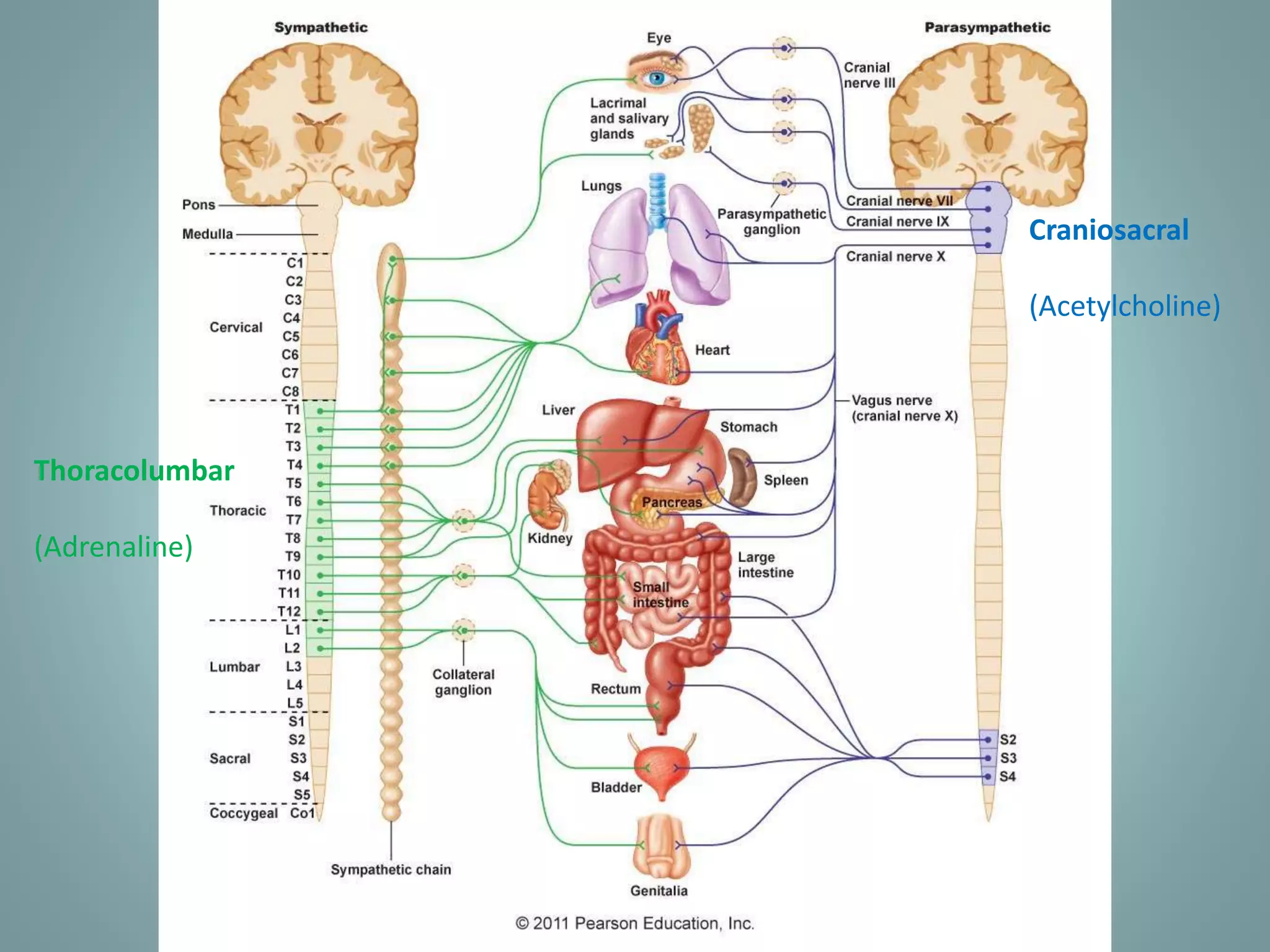
Sympathetic
Adrenaline/Epinephrine
Fight, Flight, Fright
(Emergency)
Parasympathetic
Neurotransmitter: Acetylcholine
Action For Rest, Sleep, Digest :
(Conservation)
• Generally an organ is innervated by both sympathetic &
parasympathetic nervous system. Thus the activity of the
organ is dependent upon the activity of these two. If one
gets depressed another gets raised.
• Some organs are innervated by only one system:
Parasympathetic: Ciliary muscles, Glands of stomach,
Pancreas
Sympathetic: Spleen, blood vessels, hair follicles
Thoracolumbar
(Adrenaline)
Craniosacral
(Acetylcholine)
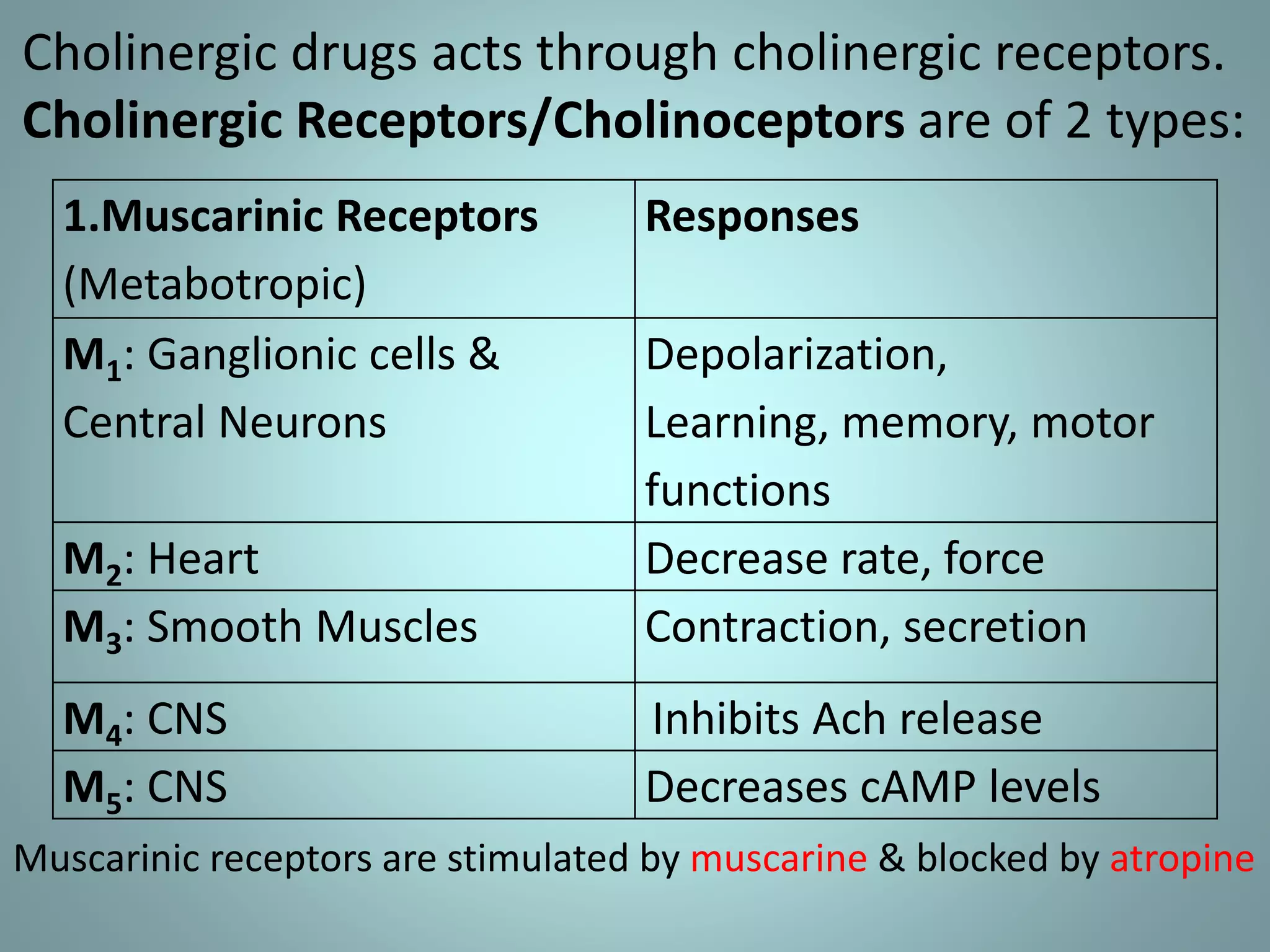
1.Muscarinic Receptors
(Metabotropic)
Responses
M1: Ganglionic cells &
Central Neurons
Depolarization,
Learning, memory, motor
functions
M2: Heart Decrease rate, force
M3: Smooth Muscles Contraction, secretion
M4: CNS Inhibits Ach release
M5: CNS Decreases cAMP levels
Cholinergic drugs acts through cholinergic receptors.
Cholinergic Receptors/Cholinoceptors are of 2 types:
Muscarinic receptors are stimulated by muscarine & blocked by atropine
2.Nicotinic Receptors
(Ionotropic)
Responses
NN: Neurones Depolarization
NM: Skeletal Muscles Contraction
Nicotinic receptors are stimulated by nicotine
& blocked by d-tubocurarine or hexamethonium
Synthesis of Acetylcholine
Synthesis:
Acetyl CoA + Choline
Choline acetyl transferase
Acetylcholine + CoA
Destruction:
Acetylcholine (Ach) Choline + Acetate
Cholinesterase
Cholinergic agonist (Directly acting) Anticholinesterases (Indirectly acting)
1.Choline esters Acetylcholine(Ach)
Methacholine
Carbachol
Bethanechol
1.Carbamates
(Reversible)
Physostigmine
Neostigmine
Pryidostigmine
Rivastigmine
Edrophonium
Donepezil
2.Acridine
(Reversible)
Tacrine
2.Alkaloids Pilocarpine
Muscarine
Arecoline
1.Organophosphates
(Irreversible)
Dyflos,
Echothiophate
Parathion,
Malathion
Diazinon, Tabun
Sarin, Samon
2.Carbamates
(Irreversible)
Carbaryl
Propoxur
(Baygon)
Cholinergic Drugs/Parasympathomimetic
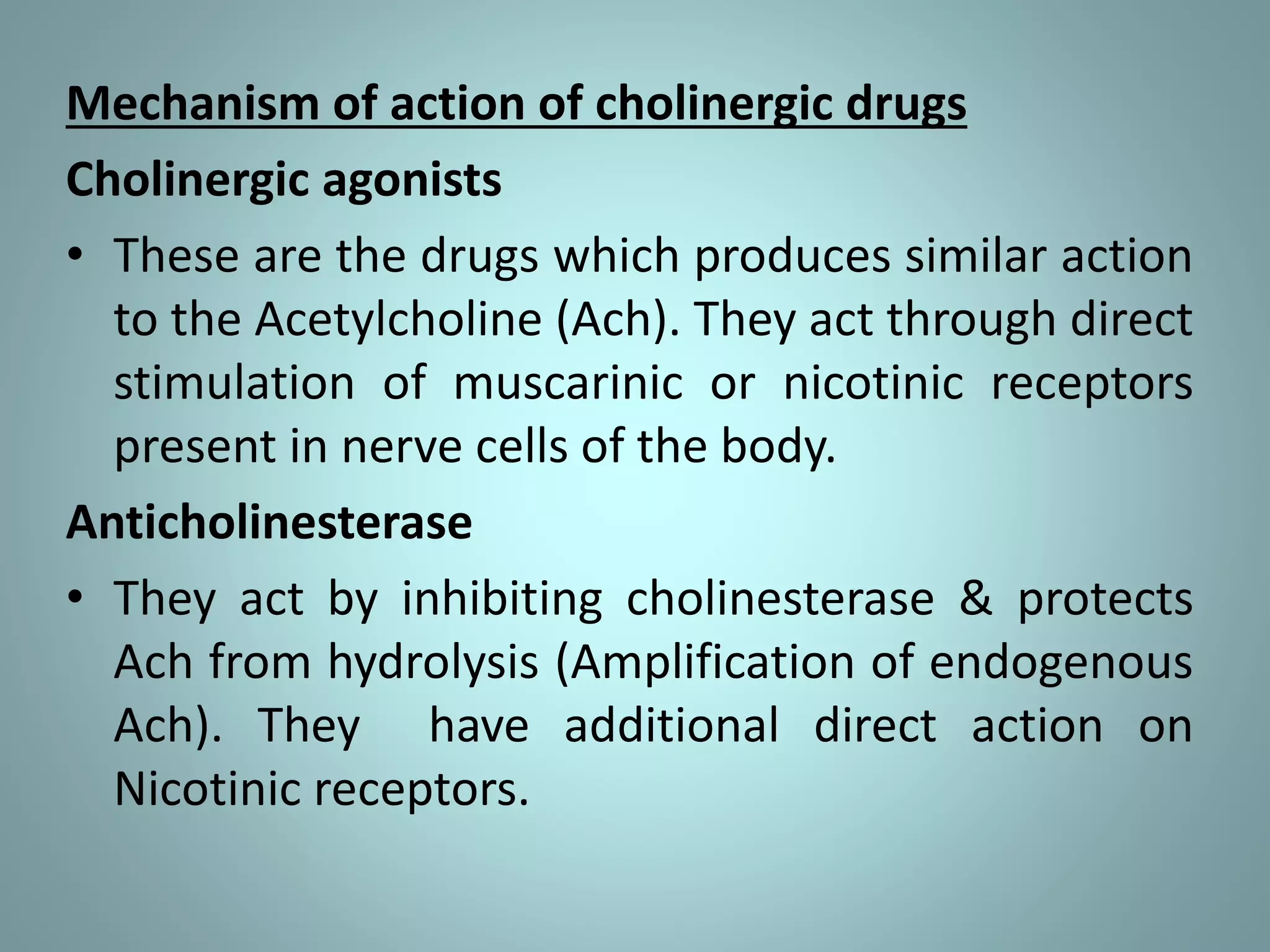
Mechanism of action of cholinergic drugs
Cholinergic agonists
• These are the drugs which produces similar action
to the Acetylcholine (Ach). They act through direct
stimulation of muscarinic or nicotinic receptors
present in nerve cells of the body.
Anticholinesterase
• They act by inhibiting cholinesterase & protects
Ach from hydrolysis (Amplification of endogenous
Ach). They have additional direct action on
Nicotinic receptors.
Acetylcholine (Not used as drug)
Pharmacological actions
Heart Negative ionotropic effect(decrease in force of contraction)
Negative chronotropic effect (decrease in heart rate)
Negative dromotropic effect (decreasein heart conduction)
Glands Secretion
Blood
vessels
Dilation
Blood
pressure
Falls
Smooth
muscles
Tone & contractility of smooth muscles are increased
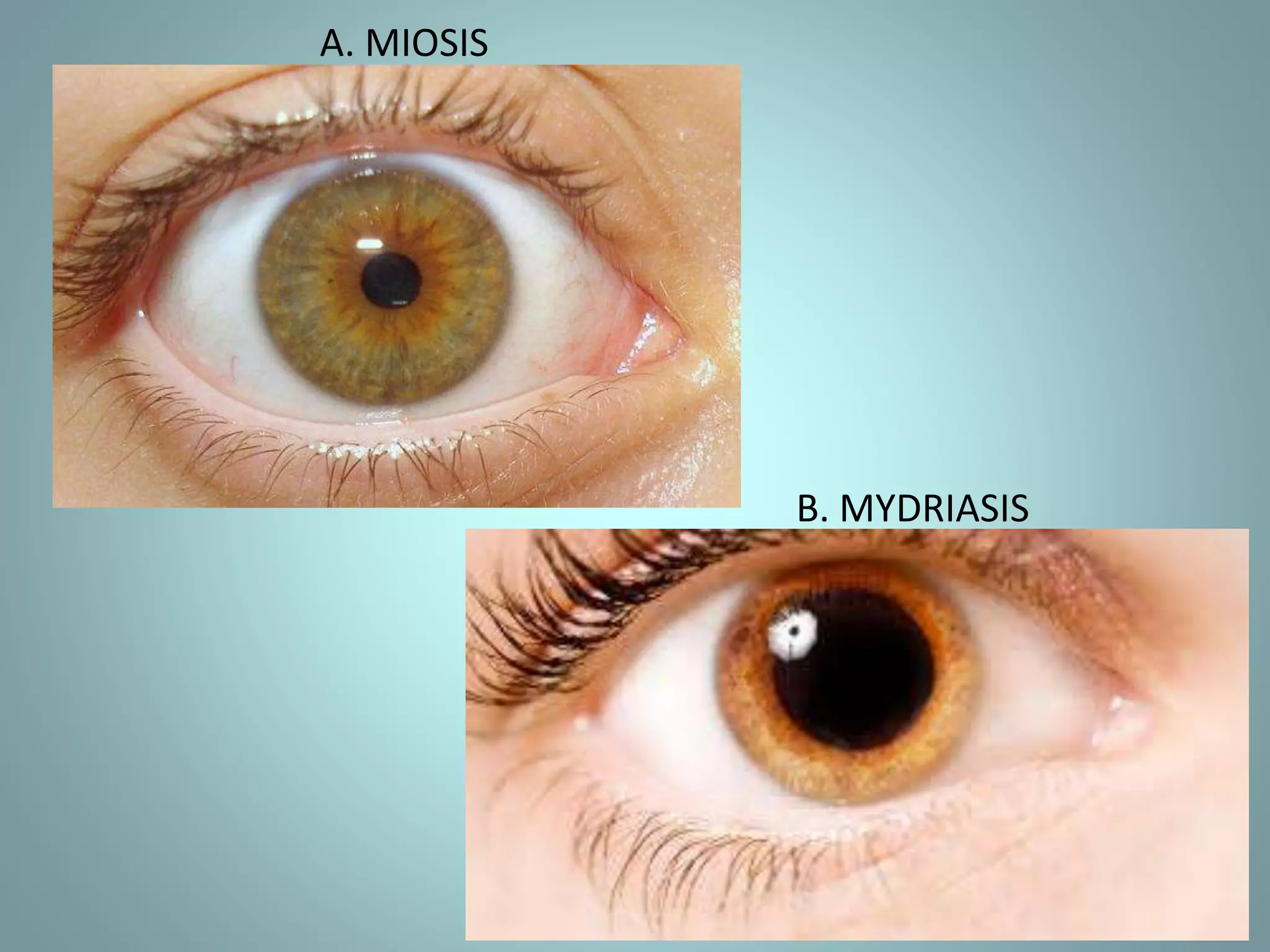
Eye Miosis (Constriction of pupils)
Skeletal
muscle
Contraction, Paralysis (high dose)
A. MIOSIS
B. MYDRIASIS
• Pilocarpine is a cholinergic agonist that has miotic action as
well as stimulates ganglia. It can cause sweating, salivation &
secretion. It is stable to hydrolysis by cholinesterase & can
penetrate cornea.
• Mechanism of action: Pilocarpine produces rapid miosis,
contraction of the ciliary muscle & fall in intraocular pressure. It
acts through direct stimulation of muscarinic receptors and
smooth muscle such as the iris and secretory glands.
• It is used as 0.5-4% eye drop.
• Adverse effects: Pilocarpine can enter the brain and cause CNS
disturbances. Poisoning with this agent is characterized by
exaggeration of various parasympathetic effects, including
profuse sweating (diaphoresis) and salivation. The effects are
similar to those produced by consumption of mushrooms of the
genus Inocybe.
• Nursing Management: Parenteral atropine 2mg (until
atropinization), at doses that can cross the blood-brain barrier,
is administered to counteract the toxicity of pilocarpine.
Glaucoma is an eye disease that is associated with increased
intraocular pressure, in which damage to the eye (optic) nerve can
lead to loss of vision and even blindness. It can be open angle
glaucoma & angle closure glaucoma.
Treatment for Glaucoma
• Pilocarpine is used to treat glaucoma and is the drug of choice in
the emergency lowering of intraocular pressure of both narrow-
angle (or closed-angle) and wide-angle (also called open-angle)
glaucoma. It is extremely effective in opening the trabecular
meshwork around Schlemm’s canal, causing an immediate drop in
intraocular pressure as a result of the increased drainage of
aqueous humor. (action within few minutes, lasts 4-8 hours)
• Carbonic anhydrase inhibitors, such as acetazolamide, as well as
the β-adrenergic blocker timolol, are effective in treating chronic
glaucoma but are not used for emergency lowering of intraocular
pressure.
• Myasthenia gravis is an autoimmune disorder
characterized by easy fatiguability & progressive
weakness of striated muscles. It is differentiated from
cholinergic crisis by edrophonium test.
• Myasthenia gravis occurs due to development of
antibodies developed towards nicotinic receptors.
Diagnostic tests
• Ameliorative test: Edrophonium 2mg i.v.(test dose)
followed by 8 mg i.v.after 30-60 sec. reversal of
weakness and short lasting improvement of strength:
+ve for MG
• Provocative test: d-tubocurarine 0.5mg i.v.
• Electromyography
• Biopsy
Treatment of myasthenia gravis:
• Tab Neostigmine 15mg orally q6h.
• Tab Pyridostigmine 60mg orally q8h.
• Immunosupressants
• Plasmapheresis
• Surgery-Thymectomy
Neostigmine Physostigmine (Eserine)
Source: synthetic Source: Calabar bean
More stable Less stable
Absorption: orally-incomplete,
i.v.-good
Absorption good from GIT,
conjuctiva
Does not crosses BBB Crosses BBB
Inhibits cholinesterase reversibly Inhibits cholinesterase reversibly
Acts on both muscarinic &
nicotinic receptors
It acts directly on skeletal
muscles
Acts on both muscarinic &
nicotinic receptors
It do not act directly on skeletal
muscles
Less toxic More toxic
Uses: myasthenia gravis, curare
poisoning, paralytic ileus,
retention of urine
Uses: miotic, Atropine poisoning
Uses of cholinergic drugs:
• Miotic
• Glaucoma
• Myasthenia gravis
• Alzheimer’s disease (rivastigmine, tacrine)
• Post-operative paralytic ileus/urinary retention
(Inj. Neostigmine 0.5-1 mg s.c)
• Post operative decurarization
(Neostigmine 0.5-2 mg i.v. preceeded by atropine)
• Cobra bite (Neostigmine + Atropine)
• Belladona poisoning (Physostigmine 0.5-2 mg i.v. repeated as
required)
Symptoms:
Killer B's: Bradycardia, Bronchorrhea and Bronchospasm
SLUDGE: Salivation, Lacrimation, Urination, Diarrhoea, &
Gastrointestinal (Emesis)
DUMBBELLSS: Diarrhoea, Urination, Miosis, Bradycardia,
Bronchospasm, Emesis, Lacrimation, Lethargy, Salivation and
Seizures
Common Substances:
Carbamates, Mushrooms, Organophosphates
Complications:
Rapid onset of respiratory failure, Seizures, Dehydration
ADVERSE EFFECTS:
CHOLINERGIC TOXIDROMES
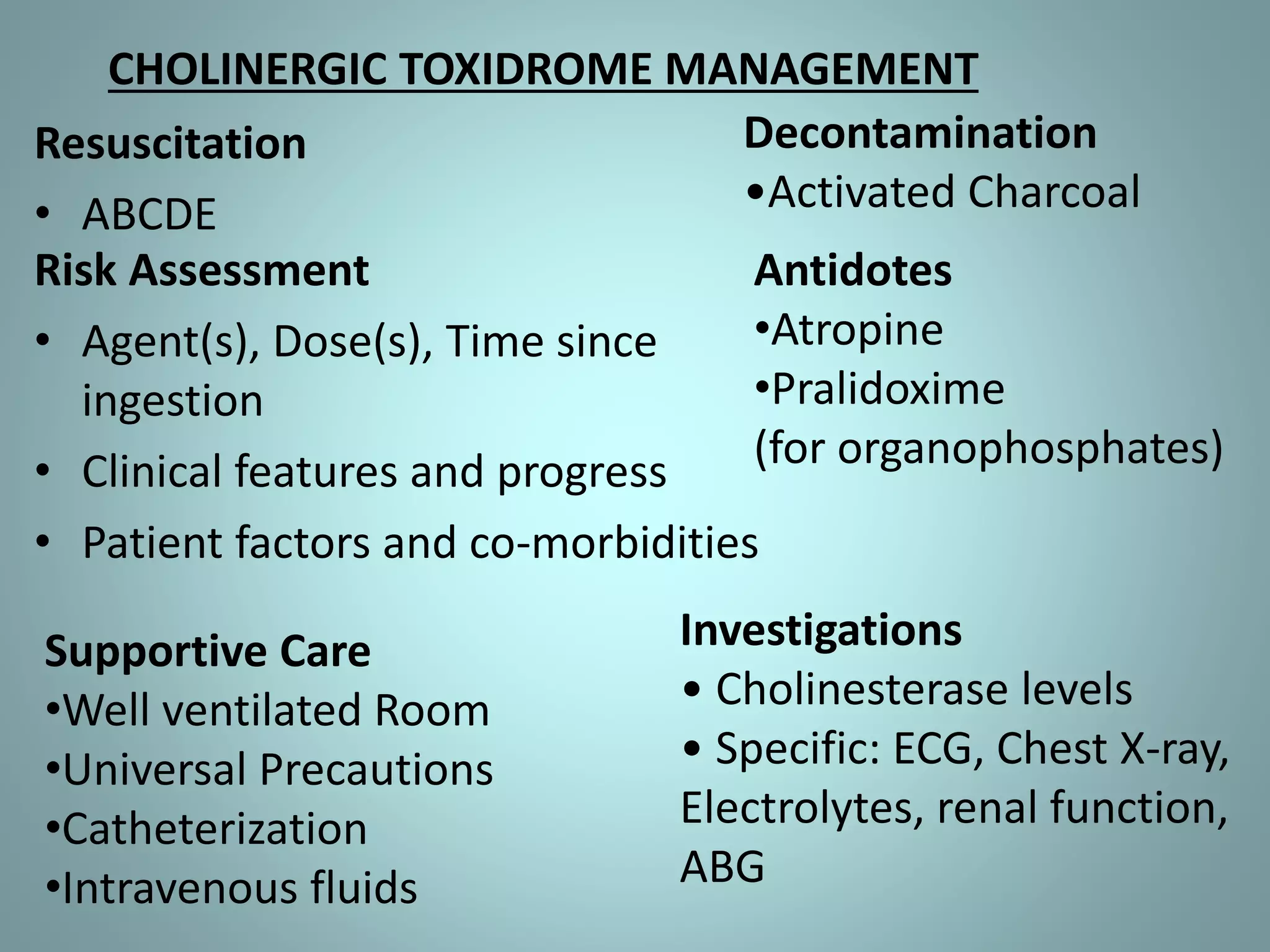
Resuscitation
• ABCDE
Risk Assessment
• Agent(s), Dose(s), Time since
ingestion
• Clinical features and progress
• Patient factors and co-morbidities
Investigations
• Cholinesterase levels
• Specific: ECG, Chest X-ray,
Electrolytes, renal function,
ABG
Supportive Care
•Well ventilated Room
•Universal Precautions
•Catheterization
•Intravenous fluids
Decontamination
•Activated Charcoal
CHOLINERGIC TOXIDROME MANAGEMENT
Antidotes
•Atropine
•Pralidoxime
(for organophosphates)

Cholinergic system and drugs

  • 1.
    INTRODUCTION TO AUTONOMIC NERVOUS SYSTEM(ANS) NERVOUSSYSTEM CENTRAL NERVOUS SYSTEM (Brain, Spinal Cord) PERIPHERAL NERVOUS SYSTEM Afferent Pathway Efferent Pathway AUTONOMIC NERVOUS SYSTEM (Involuntary) PARASYMPATHETIC NERVOUS SYSTEM SYMPATHETIC NERVOUS SYSTEM SOMATIC NERVOUS SYSTEM (Voluntary)
  • 2.
    AUTONOMIC NERVOUS SYSTEM Theautonomic nervous system is that division of nervous system that controls all vital functions & supplies the viscera. It is largely autonomous & its activities are not under direct control, hence known as involuntary nervous system. It maintains the internal environment (homeostasis). The two divisions of the autonomic nervous system are sympathetic & parasympathetic that differs in their anatomical arrangement, their effects & mechanism of action. Sympathetic Adrenaline/Epinephrine Fight, Flight, Fright (Emergency) Parasympathetic Neurotransmitter: Acetylcholine Action For Rest, Sleep, Digest : (Conservation)
  • 3.
    • Generally anorgan is innervated by both sympathetic & parasympathetic nervous system. Thus the activity of the organ is dependent upon the activity of these two. If one gets depressed another gets raised. • Some organs are innervated by only one system: Parasympathetic: Ciliary muscles, Glands of stomach, Pancreas Sympathetic: Spleen, blood vessels, hair follicles
  • 5.
  • 8.
    1.Muscarinic Receptors (Metabotropic) Responses M1: Ganglioniccells & Central Neurons Depolarization, Learning, memory, motor functions M2: Heart Decrease rate, force M3: Smooth Muscles Contraction, secretion M4: CNS Inhibits Ach release M5: CNS Decreases cAMP levels Cholinergic drugs acts through cholinergic receptors. Cholinergic Receptors/Cholinoceptors are of 2 types: Muscarinic receptors are stimulated by muscarine & blocked by atropine
  • 9.
    2.Nicotinic Receptors (Ionotropic) Responses NN: NeuronesDepolarization NM: Skeletal Muscles Contraction Nicotinic receptors are stimulated by nicotine & blocked by d-tubocurarine or hexamethonium
  • 10.
  • 11.
    Synthesis: Acetyl CoA +Choline Choline acetyl transferase Acetylcholine + CoA Destruction: Acetylcholine (Ach) Choline + Acetate Cholinesterase
  • 12.
    Cholinergic agonist (Directlyacting) Anticholinesterases (Indirectly acting) 1.Choline esters Acetylcholine(Ach) Methacholine Carbachol Bethanechol 1.Carbamates (Reversible) Physostigmine Neostigmine Pryidostigmine Rivastigmine Edrophonium Donepezil 2.Acridine (Reversible) Tacrine 2.Alkaloids Pilocarpine Muscarine Arecoline 1.Organophosphates (Irreversible) Dyflos, Echothiophate Parathion, Malathion Diazinon, Tabun Sarin, Samon 2.Carbamates (Irreversible) Carbaryl Propoxur (Baygon) Cholinergic Drugs/Parasympathomimetic
  • 13.
    Mechanism of actionof cholinergic drugs Cholinergic agonists • These are the drugs which produces similar action to the Acetylcholine (Ach). They act through direct stimulation of muscarinic or nicotinic receptors present in nerve cells of the body. Anticholinesterase • They act by inhibiting cholinesterase & protects Ach from hydrolysis (Amplification of endogenous Ach). They have additional direct action on Nicotinic receptors.
  • 14.
    Acetylcholine (Not usedas drug) Pharmacological actions Heart Negative ionotropic effect(decrease in force of contraction) Negative chronotropic effect (decrease in heart rate) Negative dromotropic effect (decreasein heart conduction) Glands Secretion Blood vessels Dilation Blood pressure Falls Smooth muscles Tone & contractility of smooth muscles are increased Eye Miosis (Constriction of pupils) Skeletal muscle Contraction, Paralysis (high dose)
  • 15.
  • 16.
    • Pilocarpine isa cholinergic agonist that has miotic action as well as stimulates ganglia. It can cause sweating, salivation & secretion. It is stable to hydrolysis by cholinesterase & can penetrate cornea. • Mechanism of action: Pilocarpine produces rapid miosis, contraction of the ciliary muscle & fall in intraocular pressure. It acts through direct stimulation of muscarinic receptors and smooth muscle such as the iris and secretory glands. • It is used as 0.5-4% eye drop. • Adverse effects: Pilocarpine can enter the brain and cause CNS disturbances. Poisoning with this agent is characterized by exaggeration of various parasympathetic effects, including profuse sweating (diaphoresis) and salivation. The effects are similar to those produced by consumption of mushrooms of the genus Inocybe. • Nursing Management: Parenteral atropine 2mg (until atropinization), at doses that can cross the blood-brain barrier, is administered to counteract the toxicity of pilocarpine.
  • 17.
    Glaucoma is aneye disease that is associated with increased intraocular pressure, in which damage to the eye (optic) nerve can lead to loss of vision and even blindness. It can be open angle glaucoma & angle closure glaucoma. Treatment for Glaucoma • Pilocarpine is used to treat glaucoma and is the drug of choice in the emergency lowering of intraocular pressure of both narrow- angle (or closed-angle) and wide-angle (also called open-angle) glaucoma. It is extremely effective in opening the trabecular meshwork around Schlemm’s canal, causing an immediate drop in intraocular pressure as a result of the increased drainage of aqueous humor. (action within few minutes, lasts 4-8 hours) • Carbonic anhydrase inhibitors, such as acetazolamide, as well as the β-adrenergic blocker timolol, are effective in treating chronic glaucoma but are not used for emergency lowering of intraocular pressure.
  • 18.
    • Myasthenia gravisis an autoimmune disorder characterized by easy fatiguability & progressive weakness of striated muscles. It is differentiated from cholinergic crisis by edrophonium test. • Myasthenia gravis occurs due to development of antibodies developed towards nicotinic receptors. Diagnostic tests • Ameliorative test: Edrophonium 2mg i.v.(test dose) followed by 8 mg i.v.after 30-60 sec. reversal of weakness and short lasting improvement of strength: +ve for MG • Provocative test: d-tubocurarine 0.5mg i.v. • Electromyography • Biopsy
  • 20.
    Treatment of myastheniagravis: • Tab Neostigmine 15mg orally q6h. • Tab Pyridostigmine 60mg orally q8h. • Immunosupressants • Plasmapheresis • Surgery-Thymectomy
  • 21.
    Neostigmine Physostigmine (Eserine) Source:synthetic Source: Calabar bean More stable Less stable Absorption: orally-incomplete, i.v.-good Absorption good from GIT, conjuctiva Does not crosses BBB Crosses BBB Inhibits cholinesterase reversibly Inhibits cholinesterase reversibly Acts on both muscarinic & nicotinic receptors It acts directly on skeletal muscles Acts on both muscarinic & nicotinic receptors It do not act directly on skeletal muscles Less toxic More toxic Uses: myasthenia gravis, curare poisoning, paralytic ileus, retention of urine Uses: miotic, Atropine poisoning
  • 22.
    Uses of cholinergicdrugs: • Miotic • Glaucoma • Myasthenia gravis • Alzheimer’s disease (rivastigmine, tacrine) • Post-operative paralytic ileus/urinary retention (Inj. Neostigmine 0.5-1 mg s.c) • Post operative decurarization (Neostigmine 0.5-2 mg i.v. preceeded by atropine) • Cobra bite (Neostigmine + Atropine) • Belladona poisoning (Physostigmine 0.5-2 mg i.v. repeated as required)
  • 23.
    Symptoms: Killer B's: Bradycardia,Bronchorrhea and Bronchospasm SLUDGE: Salivation, Lacrimation, Urination, Diarrhoea, & Gastrointestinal (Emesis) DUMBBELLSS: Diarrhoea, Urination, Miosis, Bradycardia, Bronchospasm, Emesis, Lacrimation, Lethargy, Salivation and Seizures Common Substances: Carbamates, Mushrooms, Organophosphates Complications: Rapid onset of respiratory failure, Seizures, Dehydration ADVERSE EFFECTS: CHOLINERGIC TOXIDROMES
  • 24.
    Resuscitation • ABCDE Risk Assessment •Agent(s), Dose(s), Time since ingestion • Clinical features and progress • Patient factors and co-morbidities Investigations • Cholinesterase levels • Specific: ECG, Chest X-ray, Electrolytes, renal function, ABG Supportive Care •Well ventilated Room •Universal Precautions •Catheterization •Intravenous fluids Decontamination •Activated Charcoal CHOLINERGIC TOXIDROME MANAGEMENT Antidotes •Atropine •Pralidoxime (for organophosphates)