The document provides an overview of antifungal drugs, detailing their mechanisms of action, classifications, and specific examples such as amphotericin B, echinocandins, azoles, and allylamines. It highlights the structural differences between fungi and bacteria that make targeting fungal infections unique, as well as the therapeutic applications and potential adverse effects of various antifungal agents. Key points include the effectiveness of different drug classes against specific fungal infections and their respective pharmacokinetics.
ANTI-FUNGAL DRUGS
● Infectiousdiseases caused by fungi are called mycoses, and they are often
chronic in nature.
● Mycotic infections may be superficial and involve only the skin (cutaneous
mycoses extending into the epidermis), while others may penetrate the skin,
causing subcutaneous or systemic infections
● Unlike bacteria, fungi are eukaryotic, with rigid cell walls composed largely of
chitin rather than peptidoglycan (a characteristic component of most bacterial cell
walls). Jegan
3.
ANTI-FUNGAL DRUGS
● Inaddition,the fungal cell membrane contains ergosterol rather than the
cholesterol found in mammalian membranes.
● These structural characteristics are useful in targeting chemotherapeutic agents
against fungal infections.
● Fungal infections are generally resistant to antibiotics, and conversely, bacteria
are resistant to antifungal agents.
Jegan
Amphotericin B (AMB)
●It is obtained from Streptomyces nodosus.
● The polyenes have high affinity for ergosterol present in fungal cell
membrane.
● They combine with it, get inserted into the membrane and several polyene
molecules together orient themselves in such a way as to form a
‘micropore’.
Jegan
9.
ANTI-FUNGAL DRUGS● Thehydrophilic side forms the interior of the pore through which ions,
amino acids and other water-soluble substances move out.
● The micropore is stabilized by membrane sterols which fill up the spaces
between the AMB molecules on the lipophilic side—constituting the outer
surface of the pore.
● Thus, cell permeability is markedly increased.
● The pores disrupt membrane function, allowing electrolytes (particularly
potassium) and small molecules to leak from the cell, resulting in cell death.
Jegan
10.
Amphotericin B (AMB)
●Amphotericin B is either fungicidal or fungistatic, depending on the
organism and the concentration of the drug.
● It is fungicidal at high and static at low concentrations
11.
Amphotericin B (AMB)
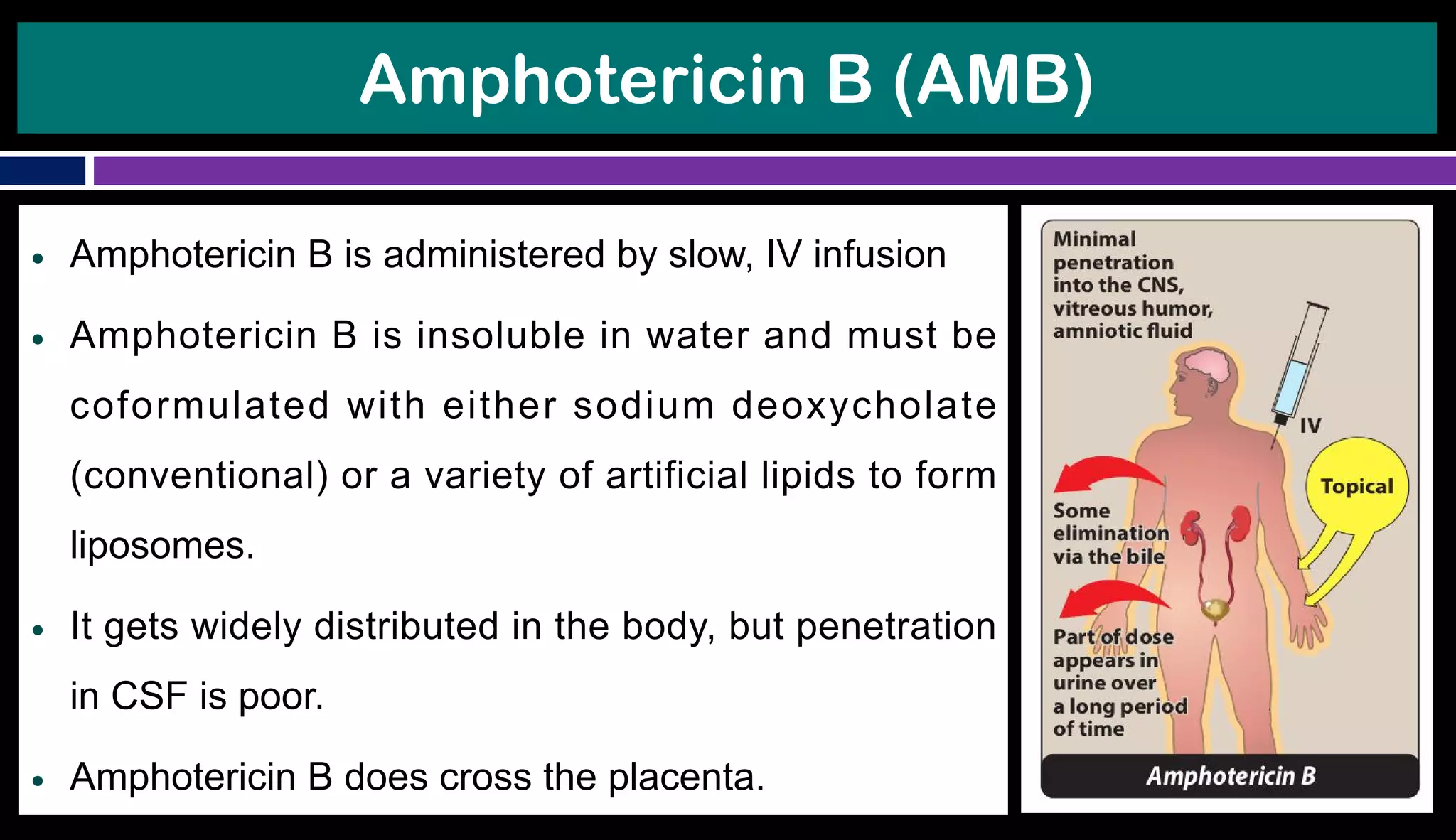
●Amphotericin B is administered by slow, IV infusion
● Amphotericin B is insoluble in water and must be
coformulated with either sodium deoxycholate
(conventional) or a variety of artificial lipids to form
liposomes.
● It gets widely distributed in the body, but penetration
in CSF is poor.
● Amphotericin B does cross the placenta.
12.
Adverse effects
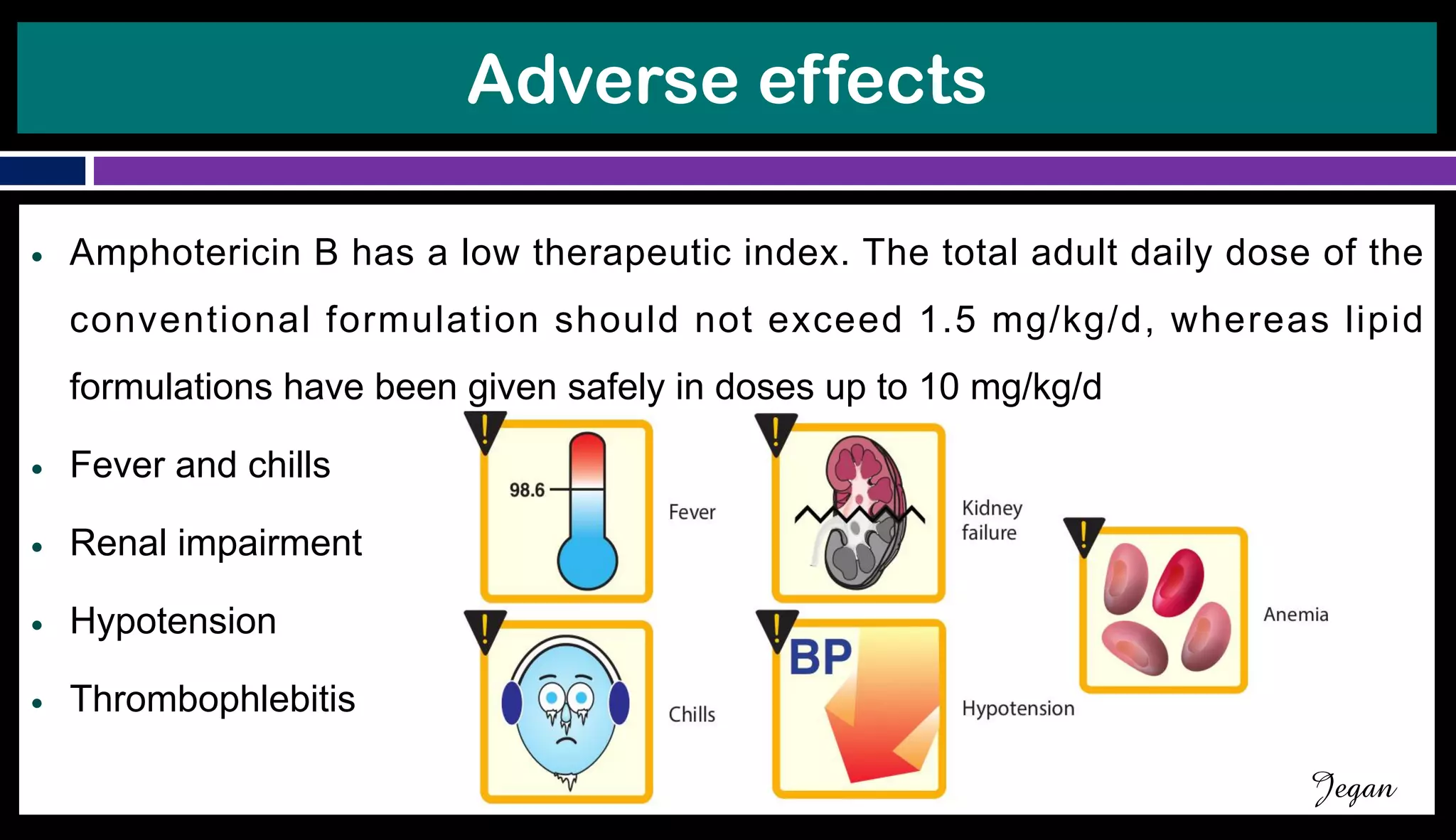
● AmphotericinB has a low therapeutic index. The total adult daily dose of the
conventional formulation should not exceed 1.5 mg/kg/d, whereas lipid
formulations have been given safely in doses up to 10 mg/kg/d
● Fever and chills
● Renal impairment
● Hypotension
● Thrombophlebitis
Jegan
Caspofungin
● It isthe first and the prototype member of the class, active mainly against
Candida and Aspergillus.
● The mechanism of action is different from other antifungals, viz. it inhibits the
synthesis of β-1,3-glucan, which is a unique component of the fungal cell wall.
● Cross linking between chitin (a fibrillar polysaccharide) and β-1,3-glucan gives
toughness to the fungal cell wall.
● Weakening of the cell wall by caspofungin leads to osmotic susceptibility of fungal
cell, which then succumbs
Jegan
Griseofulvin
● It wasone of the early antibiotics extracted from Penicillium griseofulvum
● Its only use is in the systemic treatment of dermatophytosis
● The absorption of griseofulvin from g.i.t. is somewhat irregular because of its
very low water solubility.
● Ultrafine crystalline preparations are absorbed adequately from the
gastrointestinal tract,
● Absorption is enhanced by high-fat meals
● Drug interaction with Warfarin and Phenobbarbitol
Jegan
FLUCYTOSINE
● It isa pyrimidine antimetabolite which is inactive as such.
● After uptake into fungal cells, it is converted into 5-fluorouracil and then to
5-fluorodeoxyuridylic acid which is an inhibitor of thymidylate synthesis.
● Thymidylic acid is a component of DNA
● This disrupt nucleic acid and protein synthesis
● Amphotericin B increases cell permeability, allowing more 5-FC to
penetrate the cell and leading to synergistic effects.
Jegan
20.
● 5-FC isa narrow spectrum fungistatic
● It is active against
◎Cryptococcus neoformans,
◎Torula,
◎Chromoblastomyces
◎few strains of Candida.
● Other fungi and bacteria are insensitive
● 5-FC is well absorbed by the oral route. It distributes
throughout the body water and penetrates well into
the CSF.
FLUCYTOSINE
● Toxicity of5-FC is lower than that of AMB
● Consists of dose-dependent bone marrow depression and gastrointestinal
disturbances, particularly enteritis and diarrhoea.
● Liver dysfunction is mild and reversible.
Jegan
IMIDAZOLES AND TRIAZOLES
●Azole antifungals are made up of two different classes of drug imidazoles
and triazoles.
● Although these drugs have similar mechanisms of action and spectra of
activity, their pharmacokinetics and therapeutic uses vary significantly.
● In general, imidazoles are given topically for cutaneous infections
● Whereas triazoles are given systemically for the treatment or prophylaxis
of cutaneous and systemic fungal infections.
Jegan
25.
IMIDAZOLES AND TRIAZOLES
●Azoles are predominantly fungistatic.
● They inhibit C-14 α-demethylase (a cytochrome P450 [CYP450]
enzyme),
● This blocks the demethylation of lanosterol to ergosterol, the principal
sterol of fungal membranes
● The inhibition of ergosterol biosynthesis disrupts membrane structure and
function, which, in turn, inhibits fungal cell growth.
Jegan
26.
Clotrimazole
● It iseffective in the topical treatment of tinea infections like ringworm
● It is also effective against oropharyngeal candidiasis
● It is particularly favoured for vaginitis because of a long lasting residual
effect after once daily application. A 7 day course is generally used
● Clotrimazole is well tolerated by most patients. Local irritation with stinging
and burning sensation occurs in some.
● No systemic toxicity is seen after topical use.
Jegan
27.
Ketoconazole
● Ketoconazole wasthe first oral azole introduced into clinical use.
● It is distinguished from triazoles by its greater propensity to inhibit
mammalian cytochrome P450 enzymes; that is, it is less selective for fungal
P450 than are the newer azoles.
● As a result, systemic ketoconazole has fallen out of clinical use.
● Ketoconazole is replaced by newer Triazoles
Jegan
28.
Fluconazole
● Fluconazole wasthe first member of the triazole class of antifungal agents.
● It is the least active of all triazoles, with most of its spectrum limited to
yeasts and some dimorphic fungi.
● Fungicidal concentrations are achieved in nails, vagina and saliva;
penetration into brain and CSF is good.
● Dose reduction is needed in renal impairment.
Fluconazole
● It isa water-soluble triazole having a wider range of activity than KTZ
● Indications include
● Cryptococcal meningitis,
● Systemic candidiasis in both normal and immunocompromised patients,
● Mucosal candidiasis in both normal and immunocompromised patients,
● Coccidioidal meningitis
● Some tinea infections.
Jegan
Terbinafine
● This orallyand topically active drug against dermatophytes and Candida
belongs to a new allylamine class of antifungals
● It is fungicidal in nature
● It acts as a non-competitive inhibitor of ‘squalene epoxidase’,
● The mammalian enzyme is inhibited only by 1000-fold higher concentration
of terbinafine
Jegan
Terbinafine
● These agentsact by inhibiting squalene
epoxidase, thereby blocking the
biosynthesis of ergosterol, an essential
component of the fungal cell membrane
● Accumulation of toxic amounts of
squalene results in increased membrane
permeability and death of the fungal cell.
Jegan