



Carbohydrates StorageCarbohydrates Storage
DiseasesDiseases
By
Dr Khaled Saleh Al gariri
2014
What is glucose used for?
• Immediate carbohydrate energy &/or
glycogen storage (Liver & Muscle)
• Brain, central nervous system (CNS), & red
blood cell (RBC) function
• Requires a minimum of 100-150g carbohydrate day
(continuous)
• Muscle functioning (muscle glycogen)
• Fat synthesis (excess energy intake)
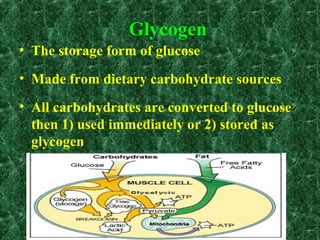
Glycogen
• The storage form of glucose
• Made from dietary carbohydrate sources
• All carbohydrates are converted to glucose
then 1) used immediately or 2) stored as
glycogen
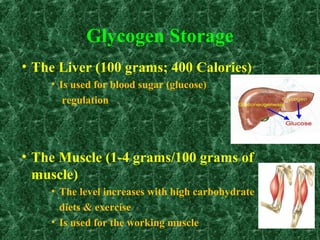
Glycogen Storage
• The Liver (100 grams; 400 Calories)
• Is used for blood sugar (glucose)
regulation
• The Muscle (1-4 grams/100 grams of
muscle)
• The level increases with high carbohydrate
diets & exercise
• Is used for the working muscle
Blood Sugar (glucose) Regulation
• Regulation of the blood glucose level depends on liver:Regulation of the blood glucose level depends on liver:
• 1. extracting glucose1. extracting glucose from bloodfrom blood
• 2. synthesizing glycogen2. synthesizing glycogen
• 3. performing glycogenolysis3. performing glycogenolysis
• 4. performing gluconeogenesis4. performing gluconeogenesis
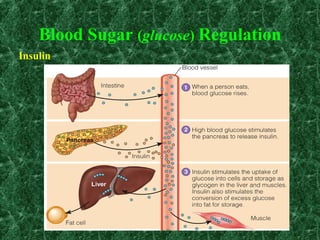
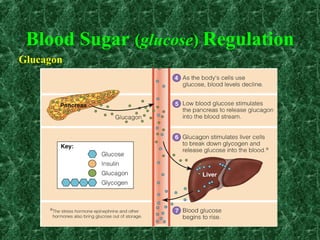
By hormones that are produced in the pancreas
• The hormones effect the liver & muscle cells
– Insulin: decreases blood sugar levels
– Glucagon: increases blood sugar level
Blood Sugar (glucose) Regulation
Insulin
Blood Sugar (glucose) Regulation
Glucagon
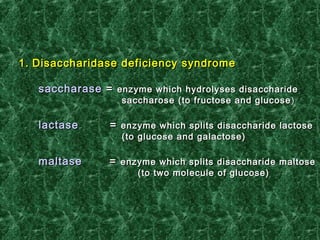
1.1. Disaccharidase deficiency syndromeDisaccharidase deficiency syndrome
saccharasesaccharase == enzyme which hydrolyenzyme which hydroly sesses disaccharidedisaccharide
saccharosesaccharose (to fructose and glucose(to fructose and glucose ))
lactaselactase == enzyme which splits disaccharide lactoseenzyme which splits disaccharide lactose
((toto glucoseglucose andand galactose)galactose)
maltasemaltase == enzyme which splits disaccharide maltoseenzyme which splits disaccharide maltose
(to two molecule of glucose)(to two molecule of glucose)
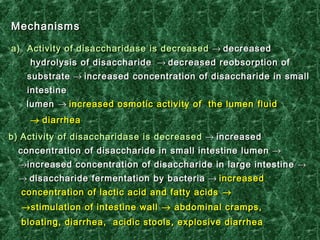
MechanismMechanismss
a)a) Activity of disaccharidase is decreasedActivity of disaccharidase is decreased →→ decreaseddecreased
hydrolysishydrolysis oof disaccharidef disaccharide →→ decreased reobsorption ofdecreased reobsorption of
substratesubstrate →→ increased concentration of disaccharide in smallincreased concentration of disaccharide in small
intestineintestine
lumenlumen →→ increased osmotic activity of the lumenincreased osmotic activity of the lumen fluidfluid
→→ diarrheadiarrhea
b)b) Activity of disaccharidase is decreasedActivity of disaccharidase is decreased →→ increasedincreased
concentration of disaccharide in small intestine lumenconcentration of disaccharide in small intestine lumen →→
→→increased concentration of disaccharide in large intestineincreased concentration of disaccharide in large intestine →→
→→ disaccharidedisaccharide fermentationfermentation by bacteriaby bacteria →→ increasedincreased
concentration of lactic acid and fatty acidsconcentration of lactic acid and fatty acids →→
→→stimulation of intestine wallstimulation of intestine wall →→ abdominal cramps,abdominal cramps,
bloating, diarrhea, acidic stools, explosive diarrheabloating, diarrhea, acidic stools, explosive diarrhea
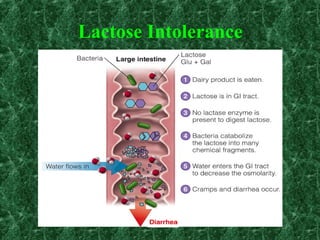
LACTOSE INTOLERANCE:
•Many healthy people, adults and children have the
inability to digest lactose.
•It maybe inherited or acquired and results from a
deficiency of the enzyme LACTASE.
•Lactase is necessary to breakdown lactose to
galactose and glucose.
•Under some circumstances, the unhydrolysed sugar
passes into the large intestine and gets fermented by
the bacteria, inducing a laxative action.
•Lactase is added in dairy products for fermentation
to form yogurt, cottage cheese by changing lactose to
lactic acid
Lactose Intolerance
BIFIDUS FACTOR
•Lactose accounts for 25% of the total dietary CHO.
•Due to large amount of lactose in mother milk, not
all is digested .
•A small portion is left and fermented in the small
intestine to lactic acid.
•Lactic acid increases the acidity in the lower
intestine which promotes the growth of a
microorganism, Lactobaccilus bifidus.
•This L. bifidus helps prevent the growth of other
undesirable microorganism.
•L. Bifidus is found mostly in breast fed infants.
Lactase deficiency syndromeLactase deficiency syndrome
Causes of lactase deficiencyCauses of lactase deficiency ::
-- genetic defectgenetic defect (primary)(primary)
- secondary to a wide variety of gastrointesti- secondary to a wide variety of gastrointesti nalnal diseasesdiseases
that damage the mucosa of thethat damage the mucosa of the smallsmall intestineintestine
(secondary)(secondary)
Disaccharide lactoseDisaccharide lactose is the principal carbohydrateis the principal carbohydrate in milkin milk ..
-- Many persons showing milk intolerance prove to be lactaseMany persons showing milk intolerance prove to be lactase ––
deficientdeficient
-- Primary lactase deficiency incidencePrimary lactase deficiency incidence is as high as 80 % to 90is as high as 80 % to 90
%%
amongamong African – AmericanAfrican – American ss and Asiansand Asians
-- Milk intolerance may not become clinically apparent untilMilk intolerance may not become clinically apparent until
Causes of secondary lactase deficiencyCauses of secondary lactase deficiency ::
-- nontropicalnontropical (celiac disease)(celiac disease) and tropicaland tropical sprue,sprue,
-- regional enteritis,regional enteritis,
-- viral and bacterial infections of the intestinaviral and bacterial infections of the intestina ll tract,tract,
-- giardiasis, cystic fibrosis, ulcerative colitis,giardiasis, cystic fibrosis, ulcerative colitis,
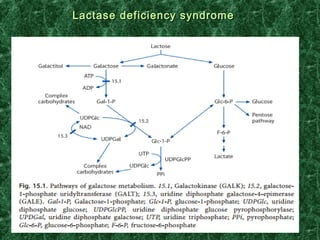
Galactose:
Not found in nature as monosaccharide, but as a
part of a disaccharide, lactose.
Milk is the prime source of galactose.( milk sugar)
Mammary glands convert glucose to galactose by
galactose-1-phosphate uridyl transferase then
synthesize lactose.
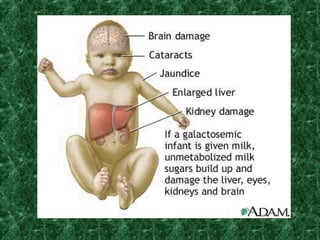
Galactosemia is an inherited disorder that affects the way the
body breaks down certain sugars. Specifically, it affects the way th
e sugar called galactose is broken down.. The body uses glucose fo
r energy. Because of the lack of the enzyme (galactose-1-phosphat
e uridyl transferase) which helps the body break down the galacto
se, it then builds up and becomes toxic. In reaction to this build up
of galactose the body makes some abnormal chemicals. The build u
p of galactose and the other chemicals can cause serious health pro
blems like a swollen and inflamed liver, kidney failure, stunted phy
sical and mental growth, and cataracts in the eyes. If the condition i
s not treated there is a 80% chance that the child could die.
Treatment: All forms of milk and lactose be removed from the
body.
Glycogen Storage Diseases
Glycogen storage diseases are inherited disorders
that affect glycogen metabolism. Virtually all
proteins involved in the synthesis or degradation of
glycogen and its regulation have been discovered to
cause some type of glycogen storage disease. The
glycogen found in these disorders is abnormal in
quantity, quality, or both. The different forms of
glycogen storage disease have been categorized by
number in accordance with the chronological order
in which these enzymatic defects were identified
Liver and muscle have abundant quantities of
glycogen and are the most commonly and seriously
affected tissues. Because carbohydrate metabolism
in the liver is responsible for plasma glucose
homeostasis, glycogen storage diseases that mainly
affect the liver usually have hepatomegaly and
hypoglycemia as the presenting features.
Glycogen Storage Diseases
In contrast, the role of glycogen in muscle is to
provide substrates for the generation of ATP for
muscle contraction. The predominant clinical
features of glycogen storage diseases that mainly
affect the muscle are muscle cramps, exercise
intolerance, fatigue, and progressive weakness
Glycogen Sorage Diseases
Type Ia glycogen storage disease, or Von Gierke
Disease, is caused by a deficiency of glucose 6-
phosphatase activity in the liver and kidney with
excessive accumulation of glycogen in these organs.
The stored materials in the liver include both
glycogen and fat. The clinical manifestations are
growth retardation, hepatomegaly, hypoglycemia,
lactic acidemia, hyperuricemia, and hyperlipidemia.
Glycogen Storage Diseases
Type Ib glycogen storage disease is caused by a
deficiency of glucose 6-phosphate translocase .
The clinical features of this types are the same in
type Ia with additional findings of neutropenia
and impaired neutrophil function, resulting in
recurrent bacterial infections and intestinal
mucosa ulceration. Both type Ia and Ib genes
have been cloned and mutations responsible for
the diseases identified.
Glycogen Storage Diseases
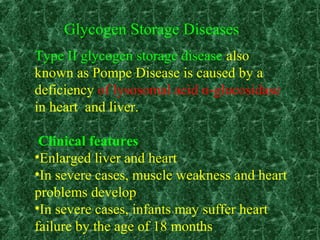
Type II glycogen storage disease also
known as Pompe Disease is caused by a
deficiency of lysosomal acid α-glucosidase
in heart and liver.
Clinical features
•Enlarged liver and heart
•In severe cases, muscle weakness and heart
problems develop
•In severe cases, infants may suffer heart
failure by the age of 18 months
Glycogen Storage Diseases
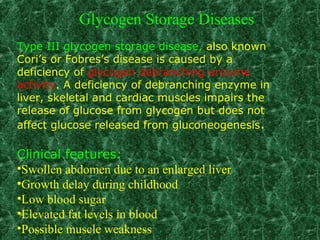
Type III glycogen storage disease, also known
Cori’s or Fobres’s disease is caused by a
deficiency of glycogen debranching enzyme
activity. A deficiency of debranching enzyme in
liver, skeletal and cardiac muscles impairs the
release of glucose from glycogen but does not
affect glucose released from gluconeogenesis.
Clinical features:
•Swollen abdomen due to an enlarged liver
•Growth delay during childhood
•Low blood sugar
•Elevated fat levels in blood
•Possible muscle weakness
Glycogen Storage Diseases
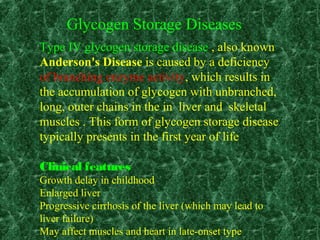
Type IV glycogen storage disease , also known
Anderson's Disease is caused by a deficiency
of branching enzyme activity, which results in
the accumulation of glycogen with unbranched,
long, outer chains in the in liver and skeletal
muscles . This form of glycogen storage disease
typically presents in the first year of life
Clinical features
Growth delay in childhood
Enlarged liver
Progressive cirrhosis of the liver (which may lead to
liver failure)
May affect muscles and heart in late-onset type
Glycogen Storage Diseases
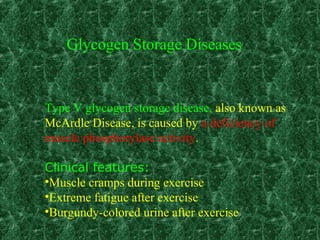
Type V glycogen storage disease, also known as
McArdle Disease, is caused by a deficiency of
muscle phosphorylase activity.
Clinical features:
•Muscle cramps during exercise
•Extreme fatigue after exercise
•Burgundy-colored urine after exercise
Glycogen Storage Diseases
Type VI and type IX glycogen storage diseases also
Hers' Disease represent a heterogeneous group of
diseases caused by a deficiency of the liver
phosphorylase system
Clinical features:
•Liver enlargement occurs, but diminishes with age
•Low blood sugar
Glycogen Storage Diseases
0), is caused by a deficiency of muscle phosphorylase activity. Symptoms usually appear in adulthood and are characterized by exercise intolera
Type VII glycogen storage disease also known
Tarui's Disease is caused by a deficiency of
muscle phosphofructokinase activity. The
clinical features are very similar to those in
type V glycogen storage disease with the
notable exceptions of a compensated
hemolytic anemia and early onset myogenic
hyperuricemia.
Glycogen Storage Diseases
Cho storage diseases powerpoint

Cho storage diseases powerpoint

  • 1.
  • 2.
    What is glucoseused for? • Immediate carbohydrate energy &/or glycogen storage (Liver & Muscle) • Brain, central nervous system (CNS), & red blood cell (RBC) function • Requires a minimum of 100-150g carbohydrate day (continuous) • Muscle functioning (muscle glycogen) • Fat synthesis (excess energy intake)
  • 3.
    Glycogen • The storageform of glucose • Made from dietary carbohydrate sources • All carbohydrates are converted to glucose then 1) used immediately or 2) stored as glycogen
  • 4.
    Glycogen Storage • TheLiver (100 grams; 400 Calories) • Is used for blood sugar (glucose) regulation • The Muscle (1-4 grams/100 grams of muscle) • The level increases with high carbohydrate diets & exercise • Is used for the working muscle
  • 5.
    Blood Sugar (glucose)Regulation • Regulation of the blood glucose level depends on liver:Regulation of the blood glucose level depends on liver: • 1. extracting glucose1. extracting glucose from bloodfrom blood • 2. synthesizing glycogen2. synthesizing glycogen • 3. performing glycogenolysis3. performing glycogenolysis • 4. performing gluconeogenesis4. performing gluconeogenesis By hormones that are produced in the pancreas • The hormones effect the liver & muscle cells – Insulin: decreases blood sugar levels – Glucagon: increases blood sugar level
  • 6.
    Blood Sugar (glucose)Regulation Insulin
  • 7.
    Blood Sugar (glucose)Regulation Glucagon
  • 8.
    1.1. Disaccharidase deficiencysyndromeDisaccharidase deficiency syndrome saccharasesaccharase == enzyme which hydrolyenzyme which hydroly sesses disaccharidedisaccharide saccharosesaccharose (to fructose and glucose(to fructose and glucose )) lactaselactase == enzyme which splits disaccharide lactoseenzyme which splits disaccharide lactose ((toto glucoseglucose andand galactose)galactose) maltasemaltase == enzyme which splits disaccharide maltoseenzyme which splits disaccharide maltose (to two molecule of glucose)(to two molecule of glucose)
  • 9.
    MechanismMechanismss a)a) Activity ofdisaccharidase is decreasedActivity of disaccharidase is decreased →→ decreaseddecreased hydrolysishydrolysis oof disaccharidef disaccharide →→ decreased reobsorption ofdecreased reobsorption of substratesubstrate →→ increased concentration of disaccharide in smallincreased concentration of disaccharide in small intestineintestine lumenlumen →→ increased osmotic activity of the lumenincreased osmotic activity of the lumen fluidfluid →→ diarrheadiarrhea b)b) Activity of disaccharidase is decreasedActivity of disaccharidase is decreased →→ increasedincreased concentration of disaccharide in small intestine lumenconcentration of disaccharide in small intestine lumen →→ →→increased concentration of disaccharide in large intestineincreased concentration of disaccharide in large intestine →→ →→ disaccharidedisaccharide fermentationfermentation by bacteriaby bacteria →→ increasedincreased concentration of lactic acid and fatty acidsconcentration of lactic acid and fatty acids →→ →→stimulation of intestine wallstimulation of intestine wall →→ abdominal cramps,abdominal cramps, bloating, diarrhea, acidic stools, explosive diarrheabloating, diarrhea, acidic stools, explosive diarrhea
  • 10.
    LACTOSE INTOLERANCE: •Many healthypeople, adults and children have the inability to digest lactose. •It maybe inherited or acquired and results from a deficiency of the enzyme LACTASE. •Lactase is necessary to breakdown lactose to galactose and glucose. •Under some circumstances, the unhydrolysed sugar passes into the large intestine and gets fermented by the bacteria, inducing a laxative action. •Lactase is added in dairy products for fermentation to form yogurt, cottage cheese by changing lactose to lactic acid
  • 11.
  • 12.
    BIFIDUS FACTOR •Lactose accountsfor 25% of the total dietary CHO. •Due to large amount of lactose in mother milk, not all is digested . •A small portion is left and fermented in the small intestine to lactic acid. •Lactic acid increases the acidity in the lower intestine which promotes the growth of a microorganism, Lactobaccilus bifidus. •This L. bifidus helps prevent the growth of other undesirable microorganism. •L. Bifidus is found mostly in breast fed infants.
  • 13.
  • 14.
    Lactase deficiency syndromeLactasedeficiency syndrome Causes of lactase deficiencyCauses of lactase deficiency :: -- genetic defectgenetic defect (primary)(primary) - secondary to a wide variety of gastrointesti- secondary to a wide variety of gastrointesti nalnal diseasesdiseases that damage the mucosa of thethat damage the mucosa of the smallsmall intestineintestine (secondary)(secondary) Disaccharide lactoseDisaccharide lactose is the principal carbohydrateis the principal carbohydrate in milkin milk .. -- Many persons showing milk intolerance prove to be lactaseMany persons showing milk intolerance prove to be lactase –– deficientdeficient -- Primary lactase deficiency incidencePrimary lactase deficiency incidence is as high as 80 % to 90is as high as 80 % to 90 %% amongamong African – AmericanAfrican – American ss and Asiansand Asians -- Milk intolerance may not become clinically apparent untilMilk intolerance may not become clinically apparent until
  • 15.
    Causes of secondarylactase deficiencyCauses of secondary lactase deficiency :: -- nontropicalnontropical (celiac disease)(celiac disease) and tropicaland tropical sprue,sprue, -- regional enteritis,regional enteritis, -- viral and bacterial infections of the intestinaviral and bacterial infections of the intestina ll tract,tract, -- giardiasis, cystic fibrosis, ulcerative colitis,giardiasis, cystic fibrosis, ulcerative colitis,
  • 16.
    Galactose: Not found innature as monosaccharide, but as a part of a disaccharide, lactose. Milk is the prime source of galactose.( milk sugar) Mammary glands convert glucose to galactose by galactose-1-phosphate uridyl transferase then synthesize lactose.
  • 17.
    Galactosemia is aninherited disorder that affects the way the body breaks down certain sugars. Specifically, it affects the way th e sugar called galactose is broken down.. The body uses glucose fo r energy. Because of the lack of the enzyme (galactose-1-phosphat e uridyl transferase) which helps the body break down the galacto se, it then builds up and becomes toxic. In reaction to this build up of galactose the body makes some abnormal chemicals. The build u p of galactose and the other chemicals can cause serious health pro blems like a swollen and inflamed liver, kidney failure, stunted phy sical and mental growth, and cataracts in the eyes. If the condition i s not treated there is a 80% chance that the child could die. Treatment: All forms of milk and lactose be removed from the body.
  • 19.
    Glycogen Storage Diseases Glycogenstorage diseases are inherited disorders that affect glycogen metabolism. Virtually all proteins involved in the synthesis or degradation of glycogen and its regulation have been discovered to cause some type of glycogen storage disease. The glycogen found in these disorders is abnormal in quantity, quality, or both. The different forms of glycogen storage disease have been categorized by number in accordance with the chronological order in which these enzymatic defects were identified
  • 20.
    Liver and musclehave abundant quantities of glycogen and are the most commonly and seriously affected tissues. Because carbohydrate metabolism in the liver is responsible for plasma glucose homeostasis, glycogen storage diseases that mainly affect the liver usually have hepatomegaly and hypoglycemia as the presenting features. Glycogen Storage Diseases
  • 21.
    In contrast, therole of glycogen in muscle is to provide substrates for the generation of ATP for muscle contraction. The predominant clinical features of glycogen storage diseases that mainly affect the muscle are muscle cramps, exercise intolerance, fatigue, and progressive weakness Glycogen Sorage Diseases
  • 22.
    Type Ia glycogenstorage disease, or Von Gierke Disease, is caused by a deficiency of glucose 6- phosphatase activity in the liver and kidney with excessive accumulation of glycogen in these organs. The stored materials in the liver include both glycogen and fat. The clinical manifestations are growth retardation, hepatomegaly, hypoglycemia, lactic acidemia, hyperuricemia, and hyperlipidemia. Glycogen Storage Diseases
  • 23.
    Type Ib glycogenstorage disease is caused by a deficiency of glucose 6-phosphate translocase . The clinical features of this types are the same in type Ia with additional findings of neutropenia and impaired neutrophil function, resulting in recurrent bacterial infections and intestinal mucosa ulceration. Both type Ia and Ib genes have been cloned and mutations responsible for the diseases identified. Glycogen Storage Diseases
  • 24.
    Type II glycogenstorage disease also known as Pompe Disease is caused by a deficiency of lysosomal acid α-glucosidase in heart and liver. Clinical features •Enlarged liver and heart •In severe cases, muscle weakness and heart problems develop •In severe cases, infants may suffer heart failure by the age of 18 months Glycogen Storage Diseases
  • 25.
    Type III glycogenstorage disease, also known Cori’s or Fobres’s disease is caused by a deficiency of glycogen debranching enzyme activity. A deficiency of debranching enzyme in liver, skeletal and cardiac muscles impairs the release of glucose from glycogen but does not affect glucose released from gluconeogenesis. Clinical features: •Swollen abdomen due to an enlarged liver •Growth delay during childhood •Low blood sugar •Elevated fat levels in blood •Possible muscle weakness Glycogen Storage Diseases
  • 26.
    Type IV glycogenstorage disease , also known Anderson's Disease is caused by a deficiency of branching enzyme activity, which results in the accumulation of glycogen with unbranched, long, outer chains in the in liver and skeletal muscles . This form of glycogen storage disease typically presents in the first year of life Clinical features Growth delay in childhood Enlarged liver Progressive cirrhosis of the liver (which may lead to liver failure) May affect muscles and heart in late-onset type Glycogen Storage Diseases
  • 27.
    Type V glycogenstorage disease, also known as McArdle Disease, is caused by a deficiency of muscle phosphorylase activity. Clinical features: •Muscle cramps during exercise •Extreme fatigue after exercise •Burgundy-colored urine after exercise Glycogen Storage Diseases
  • 28.
    Type VI andtype IX glycogen storage diseases also Hers' Disease represent a heterogeneous group of diseases caused by a deficiency of the liver phosphorylase system Clinical features: •Liver enlargement occurs, but diminishes with age •Low blood sugar Glycogen Storage Diseases
  • 29.
    0), is causedby a deficiency of muscle phosphorylase activity. Symptoms usually appear in adulthood and are characterized by exercise intolera Type VII glycogen storage disease also known Tarui's Disease is caused by a deficiency of muscle phosphofructokinase activity. The clinical features are very similar to those in type V glycogen storage disease with the notable exceptions of a compensated hemolytic anemia and early onset myogenic hyperuricemia. Glycogen Storage Diseases