GLYCOGEN
STORAGE
DISEASE (GSD)
Amer Gul
Sending to BashirAhmadKarimi
Introduction
• Glycogen is a branched-chain polymer of glucose and
serves as a dynamic but limited reservoir of glucose,
mainly in skeletal muscle and liver.
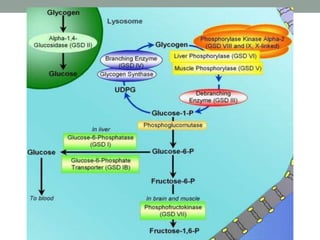
• There are a number of different enzymes involved in
glycogen synthesis, utilization and breakdown within the
body.
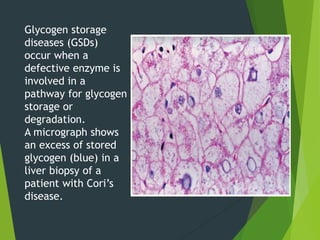
Glycogen storage
diseases (GSDs)
occur when a
defective enzyme is
involved in a
pathway for glycogen
storage or
degradation.
A micrograph shows
an excess of stored
glycogen (blue) in a
liver biopsy of a
patient with Cori’s
disease.
• Glycogen storage disorders (GSD) are a group of
inherited inborn errors of metabolism due to deficiency or
dysfunction of these enzymes.
• confined to just liver and muscle.
• But some cause more generalised pathology and affect
tissues such as the kidney, heart and bowel.
• The classification of glycogen storage disorders is based
on the enzyme deficiency and the affected tissue.
Epidiomology
• The overall GSD incidence is estimated at 1 case per
20,000-43,000 live births.
• Type I is the most common (25% of all GSD).
Inheritancepatterns
• Autosomal recessive (I, II, III, IV, V, VII, some IX).
• Both parents are carriers.
• Chance of sibling being affected is 1 in 4.
• X-linked (some IX, VI)
Types
• There are eleven (11) distinct diseases that are commonly
considered to be glycogen storage diseases.
• Although glycogen synthase deficiency does not result in
storage of extra glycogen in the liver, it is often classified
with the GSDs as type 0.
Type I, Von Gierke'sdisease
Affected enzyme: glucose-6-phosphatase
Affected tissue: Liver and kidney
Clinical features:
• Large quantities of glycogen are formed and stored in
hepatocytes, renal and intestinal mucosa cells. The liver
and kidneys become enlarged.
• Abnormalities of lipids may lead to xanthoma formation.
• Uric acid is often elevated and may cause clinical gout.
Galactose, fructose, and glycerol are metabolised to
lactate. The elevated blood lactate levels cause metabolic
acidosis.
Treatment
• Blood loss may require oral iron.
• Raised uric acid levels may require allopurinol.
• Treatment of hyperuricaemia and pyelonephritis protect renal
function.
• Diazoxide to maintain blood glucose has been disappointing.
• Liver transplantation for primary disease or for hepatocellular
carcinoma seems effective.
TYPE II, POMPE'SDISEASE
Cause:
• The deficiency of the lysosomal enzyme alpha-1,4-
glucosidase (acid maltase) leads to the accumulation of
glycogen in many tissues.
Clinical feature:
• The clinical spectrum is continuous and broad, with
presentation in infants, children and adults.
• In the infantile form, accumulation of glycogen in cardiac
muscle leads to cardiac failure.
• Accumulation may also occur in the liver, which results in
hepatomegaly and elevation of hepatic enzymes.
• Glycogen accumulation in muscle and peripheral nerves
causes hypotonia and weakness.
• Glycogen deposition in blood vessels may result in
intracranial aneurysms.
Treatment:
• Enzyme replacement therapy (Alglucosidase alfa)
• Diet therapy may provide temporary improvement but
does not alter the disease course: a high-protein, low-
carbohydrate diet may be beneficial.
• Physiotherapy and occupational therapy may be required.
• Genetic counselling and prenatal diagnosis: chorionic
villus sampling and amniocentesis can be used to
determine enzyme activity in a fetus.
• Gene therapy remains a potentially effective treatment for
the future.
Type III, Cori disease
• Affected enzyme: Glycogen debranching enzyme.
Deposition of abnormal glycogen structure.
• Affected tissues: Liver and muscle.
• Clinical features:
• About 15% affect liver only. Hypoglycaemia, poor
growth, hepatomegaly, moderate progressive myopathy.
• Symptoms can regress with age.
• A few cases of liver cirrhosis and hepatocellular
carcinoma have been reported.
• Treatment: As with type I, also protein supplements for
muscle disorder.
Type IV, Andersen'sdisease,
Amylopectinosis
• Affected enzyme: Glycogen branching enzyme.
Abnormally structured glycogen forms.
• Affected tissues: Many, including liver. Rare variant
affects peripheral nerves.
• Clinical features:
• Hepatomegaly, failure to thrive, cirrhosis, splenomegaly,
jaundice, hypotonia, waddling gait, lumbar lordosis.
• Treatment: Liver transplant.
• Prognosis: Mostly death by age 4 due to
cirrhosis and portal hypertension.
Type V, McArdle's disease
Cause: Myophosphorylase deficiency
Affected tissue: Muscle
Clinical features
• Clinical findings may be absent on physical examination.
Muscle strength and reflexes may be normal
• In later adult life, persistent proximal weakness and
muscle wasting may be present.
• The fatal infantile form presents with hypotonia and
reduced reflexes.
• Ischaemic forearm test: traditional test but is painful and
non-ischaemic exercise tests are now preferred.
Treatmen
• No specific treatment exists.
• Avoid strenuous (anaerobic or sustained) exercise,
including lifting or pushing.
• A carbohydrate rich diet did benefit patients.
Type VI, Hers disease
• Affected enzyme: Liver phosphorylase.
• Affected tissues: Liver, rare cardiac form.
• Clinical features:
• Most common variant is X-linked therefore usually
affects only males.
• Hepatomegaly, hypoglycaemia, growth retardation,
hyperlipidaemia.
• Treatment: Cardiac transplantation for rare cardiac form.
May need frequent feeding to avoid hypoglycaemia.
• Prognosis: Usually normal life span.
Type VII, Taruidisease
Cause: Phosphofructokinase (PFK) deficiency
Affected tissue: Muscle
Clinical features:
• Exercise intolerance, muscle cramping, exertional
myopathy, compensated haemolysis and myoglobinuria.
Note : Symptoms can be similar to McArdle's Glycogen
Storage Disease but more severe.
Treatment:
No specific treatment exists.
There is evidence that a high protein diet may
improve muscle function and slow progression of
the disease.
Vigorous exercise should be avoided as it causes
myoglobinuria.
TypeXI, Fanconi-Bickelsyndrome
• Affected enzyme: Glucose transporter GLUT2 [solute
carrier family 2 ,facilitated glucose transporter]
• Clinical features: Similar features to Von Gierke's
disease, e.g. hypoglycaemia.
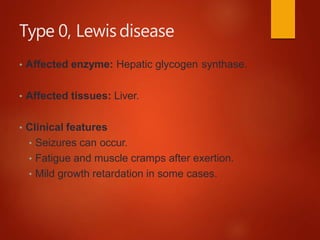
Type 0, Lewisdisease
• Affected enzyme: Hepatic glycogen synthase.
• Affected tissues: Liver.
• Clinical features
• Seizures can occur.
• Fatigue and muscle cramps after exertion.
• Mild growth retardation in some cases.
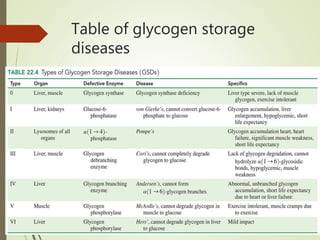
Table of glycogen storage
diseases
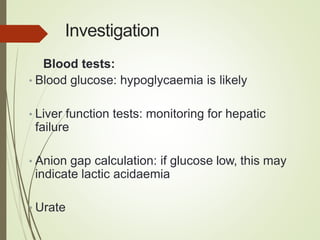
Investigation
Blood tests:
• Blood glucose: hypoglycaemia is likely
• Liver function tests: monitoring for hepatic
failure
• Anion gap calculation: if glucose low, this may
indicate lactic acidaemia
• Urate
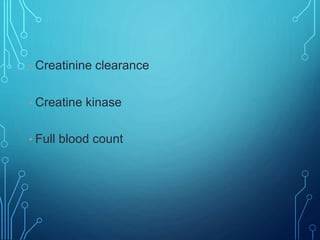
• Creatinine clearance
• Creatine kinase
• Full blood count
Urine tests:
• Myoglobinuria after exercise found in 50% of people with
McArdle's disease.
Pre-natal diagnosis
• Genetic counseling.
• Referral to geneticist for possible prenatal investigation
(amniotic fluid analysis) and diagnosis.
Differential Diagnosis
• In GSD affecting muscle, exclude the muscular
dystrophies (including Duchenne's) and secondary
disorders of muscle including polymyositis.
Amer glycogen storage disease

Amer glycogen storage disease

  • 1.
  • 2.
    Introduction • Glycogen isa branched-chain polymer of glucose and serves as a dynamic but limited reservoir of glucose, mainly in skeletal muscle and liver. • There are a number of different enzymes involved in glycogen synthesis, utilization and breakdown within the body.
  • 3.
    Glycogen storage diseases (GSDs) occurwhen a defective enzyme is involved in a pathway for glycogen storage or degradation. A micrograph shows an excess of stored glycogen (blue) in a liver biopsy of a patient with Cori’s disease.
  • 4.
    • Glycogen storagedisorders (GSD) are a group of inherited inborn errors of metabolism due to deficiency or dysfunction of these enzymes. • confined to just liver and muscle. • But some cause more generalised pathology and affect tissues such as the kidney, heart and bowel. • The classification of glycogen storage disorders is based on the enzyme deficiency and the affected tissue.
  • 6.
    Epidiomology • The overallGSD incidence is estimated at 1 case per 20,000-43,000 live births. • Type I is the most common (25% of all GSD).
  • 7.
    Inheritancepatterns • Autosomal recessive(I, II, III, IV, V, VII, some IX). • Both parents are carriers. • Chance of sibling being affected is 1 in 4. • X-linked (some IX, VI)
  • 8.
    Types • There areeleven (11) distinct diseases that are commonly considered to be glycogen storage diseases. • Although glycogen synthase deficiency does not result in storage of extra glycogen in the liver, it is often classified with the GSDs as type 0.
  • 9.
    Type I, VonGierke'sdisease Affected enzyme: glucose-6-phosphatase Affected tissue: Liver and kidney Clinical features: • Large quantities of glycogen are formed and stored in hepatocytes, renal and intestinal mucosa cells. The liver and kidneys become enlarged.
  • 10.
    • Abnormalities oflipids may lead to xanthoma formation. • Uric acid is often elevated and may cause clinical gout. Galactose, fructose, and glycerol are metabolised to lactate. The elevated blood lactate levels cause metabolic acidosis.
  • 11.
    Treatment • Blood lossmay require oral iron. • Raised uric acid levels may require allopurinol. • Treatment of hyperuricaemia and pyelonephritis protect renal function. • Diazoxide to maintain blood glucose has been disappointing. • Liver transplantation for primary disease or for hepatocellular carcinoma seems effective.
  • 12.
    TYPE II, POMPE'SDISEASE Cause: •The deficiency of the lysosomal enzyme alpha-1,4- glucosidase (acid maltase) leads to the accumulation of glycogen in many tissues. Clinical feature: • The clinical spectrum is continuous and broad, with presentation in infants, children and adults. • In the infantile form, accumulation of glycogen in cardiac muscle leads to cardiac failure.
  • 13.
    • Accumulation mayalso occur in the liver, which results in hepatomegaly and elevation of hepatic enzymes. • Glycogen accumulation in muscle and peripheral nerves causes hypotonia and weakness. • Glycogen deposition in blood vessels may result in intracranial aneurysms.
  • 14.
    Treatment: • Enzyme replacementtherapy (Alglucosidase alfa) • Diet therapy may provide temporary improvement but does not alter the disease course: a high-protein, low- carbohydrate diet may be beneficial. • Physiotherapy and occupational therapy may be required.
  • 15.
    • Genetic counsellingand prenatal diagnosis: chorionic villus sampling and amniocentesis can be used to determine enzyme activity in a fetus. • Gene therapy remains a potentially effective treatment for the future.
  • 16.
    Type III, Coridisease • Affected enzyme: Glycogen debranching enzyme. Deposition of abnormal glycogen structure. • Affected tissues: Liver and muscle. • Clinical features: • About 15% affect liver only. Hypoglycaemia, poor growth, hepatomegaly, moderate progressive myopathy. • Symptoms can regress with age. • A few cases of liver cirrhosis and hepatocellular carcinoma have been reported.
  • 17.
    • Treatment: Aswith type I, also protein supplements for muscle disorder.
  • 18.
    Type IV, Andersen'sdisease, Amylopectinosis •Affected enzyme: Glycogen branching enzyme. Abnormally structured glycogen forms. • Affected tissues: Many, including liver. Rare variant affects peripheral nerves. • Clinical features: • Hepatomegaly, failure to thrive, cirrhosis, splenomegaly, jaundice, hypotonia, waddling gait, lumbar lordosis.
  • 19.
    • Treatment: Livertransplant. • Prognosis: Mostly death by age 4 due to cirrhosis and portal hypertension.
  • 20.
    Type V, McArdle'sdisease Cause: Myophosphorylase deficiency Affected tissue: Muscle Clinical features • Clinical findings may be absent on physical examination. Muscle strength and reflexes may be normal • In later adult life, persistent proximal weakness and muscle wasting may be present.
  • 21.
    • The fatalinfantile form presents with hypotonia and reduced reflexes. • Ischaemic forearm test: traditional test but is painful and non-ischaemic exercise tests are now preferred.
  • 22.
    Treatmen • No specifictreatment exists. • Avoid strenuous (anaerobic or sustained) exercise, including lifting or pushing. • A carbohydrate rich diet did benefit patients.
  • 23.
    Type VI, Hersdisease • Affected enzyme: Liver phosphorylase. • Affected tissues: Liver, rare cardiac form. • Clinical features: • Most common variant is X-linked therefore usually affects only males. • Hepatomegaly, hypoglycaemia, growth retardation, hyperlipidaemia.
  • 24.
    • Treatment: Cardiactransplantation for rare cardiac form. May need frequent feeding to avoid hypoglycaemia. • Prognosis: Usually normal life span.
  • 25.
    Type VII, Taruidisease Cause:Phosphofructokinase (PFK) deficiency Affected tissue: Muscle Clinical features: • Exercise intolerance, muscle cramping, exertional myopathy, compensated haemolysis and myoglobinuria. Note : Symptoms can be similar to McArdle's Glycogen Storage Disease but more severe.
  • 26.
    Treatment: No specific treatmentexists. There is evidence that a high protein diet may improve muscle function and slow progression of the disease. Vigorous exercise should be avoided as it causes myoglobinuria.
  • 27.
    TypeXI, Fanconi-Bickelsyndrome • Affectedenzyme: Glucose transporter GLUT2 [solute carrier family 2 ,facilitated glucose transporter] • Clinical features: Similar features to Von Gierke's disease, e.g. hypoglycaemia.
  • 28.
    Type 0, Lewisdisease •Affected enzyme: Hepatic glycogen synthase. • Affected tissues: Liver. • Clinical features • Seizures can occur. • Fatigue and muscle cramps after exertion. • Mild growth retardation in some cases.
  • 29.
    Table of glycogenstorage diseases
  • 30.
    Investigation Blood tests: • Bloodglucose: hypoglycaemia is likely • Liver function tests: monitoring for hepatic failure • Anion gap calculation: if glucose low, this may indicate lactic acidaemia • Urate
  • 31.
    • Creatinine clearance •Creatine kinase • Full blood count
  • 32.
    Urine tests: • Myoglobinuriaafter exercise found in 50% of people with McArdle's disease.
  • 33.
    Pre-natal diagnosis • Geneticcounseling. • Referral to geneticist for possible prenatal investigation (amniotic fluid analysis) and diagnosis.
  • 34.
    Differential Diagnosis • InGSD affecting muscle, exclude the muscular dystrophies (including Duchenne's) and secondary disorders of muscle including polymyositis.