Glycogen Storage Diseases
 INTRODUCTION The
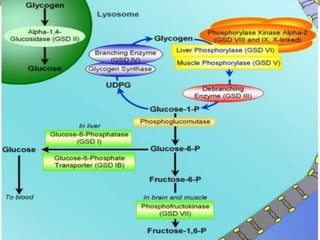
metabolic defects concerned with the glycogen
synthesis and degradation are collectively
referred to as glycogen storage diseases.
 These disorders are due to defects in the
enzymes.
 The inherited disorders are characterized by
deposition of normal or abnormal type of
glycogen in one or more tissues.
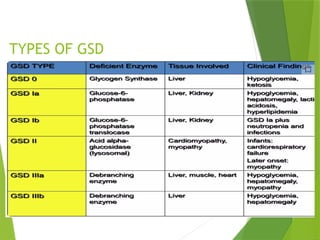
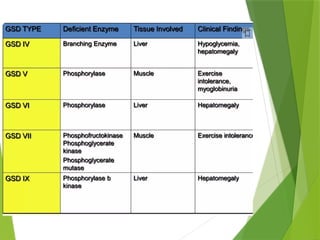
TYPES OF GSD
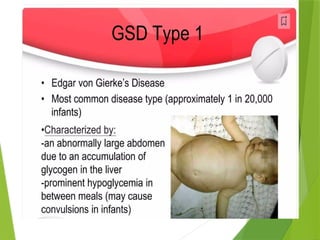
von Gierke's disease (Type l)
 It is transmitted by autosomal recessive trait.
 Enzyme deficiency: Glucose 6-phosphatase.
 The enzyme is absent in liver cells & intestinal
mucosa.
 Liver cells, intestinal mucosa & renal tubular
epithelial cells are loaded with glycogen,
which is normal in structure but metabolically
not available.

Clinical & Biochemical features
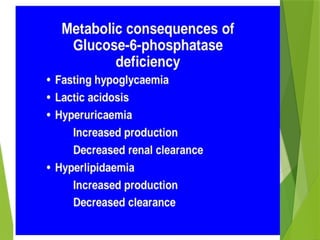
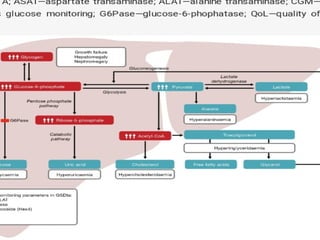
Fasting hypoglycemia:
 Hypoglycemia, decreases insulin secretion,
which in turn inhibits protein synthesis
causes stunted growth (dwarfism).
Lactic acidemia:
 Glucose is not synthesized from lactate
produced in muscle & liver.
 Lactate level in blood increases & the pH is
lowered (acidosis).
Hyperlipidemia:
 Fat is utilized as energy source, which leads to
lipaemia, acidaemia & ketosis.
 Excess of acetyl CoA resulting in increased
cholesterol levels, produce xanthomas.
 There is a blockade in gluconeogenesis.
Hyperuricemia:
 Glucose 6-phosphate that accumulates is
diverted to HMP Shunt, leading to increased
synthesis of ribose phosphates which increase
the cellular levels of phosphoribosyl
pyrophosphate & enhance the metabolism of
purine nucleotides to uric acid (gouty arthritis).
CLINICAL PRESENTATION(gsd)
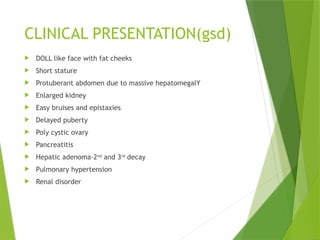
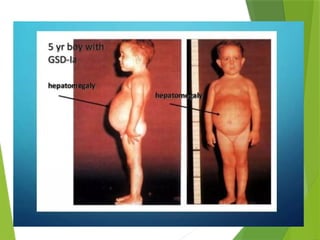
 DOLL like face with fat cheeks
 Short stature
 Protuberant abdomen due to massive hepatomegalY
 Enlarged kidney
 Easy bruises and epistaxies
 Delayed puberty
 Poly cystic ovary
 Pancreatitis
 Hepatic adenoma-2nd
and 3rd
decay
 Pulmonary hypertension
 Renal disorder
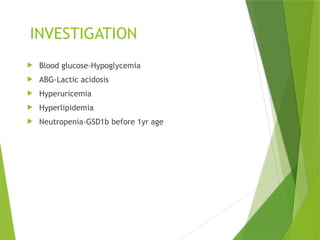
INVESTIGATION
 Blood glucose-Hypoglycemia
 ABG-Lactic acidosis
 Hyperuricemia
 Hyperlipidemia
 Neutropenia-GSD1b before 1yr age
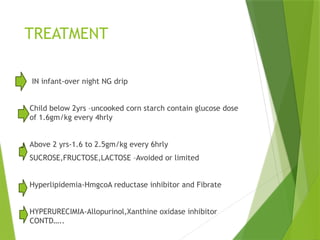
TREATMENT
IN infant-over night NG drip
Child below 2yrs –uncooked corn starch contain glucose dose
of 1.6gm/kg every 4hrly
Above 2 yrs-1.6 to 2.5gm/kg every 6hrly
SUCROSE,FRUCTOSE,LACTOSE –Avoided or limited
Hyperlipidemia-HmgcoA reductase inhibitor and Fibrate
HYPERURECIMIA-Allopurinol,Xanthine oxidase inhibitor
CONTD…..
TREATMENT( CONTD) GSD TYP1
 MICROALBUMINURIA-ACE INHIBITORS
 NEPHROCALCINOSIS/HYPERCALCIURIA-CITRATE
SUPLEMENTS,THIAZIDE DIURETICS
 NEUTROPENIA-GRANULOCYTE MACROPHAGE COLONY
STIMULATING FACTOR
 SURGICAL MANAGEMENT
 HEPATIC ADENOMA, < 2CM –PERCUTANEOUS ETHANOL
INJ/TRANSCATHETER ATERIAL EMBOLIZATION
 HEPATIC ADENOMA >2CM SURGICAL RESECTION
 RL –AVOIDED
 ENZYME REPLACEMENT THERAPY-SPECIFIC
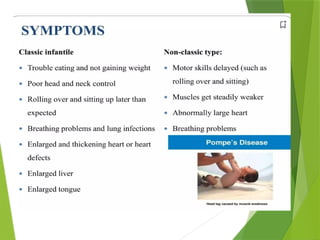
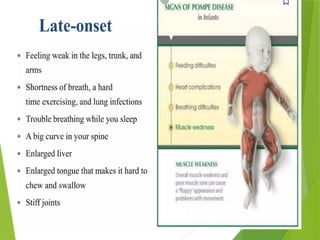
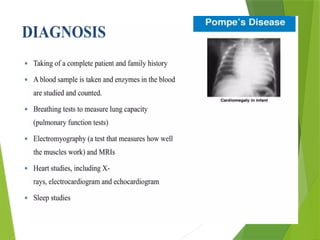
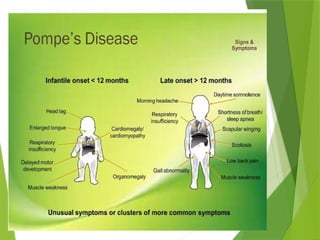
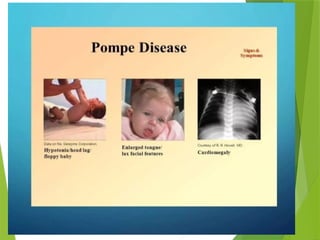
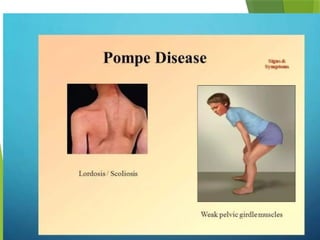
Pompe's disease (Type II)
 Enzyme deficiency: (acid maltase).
 Glycogen accumulates in lysosomes in all
most all the tissues.
 Enlargement of heart (cardiomegaly).
 Nervous system is also affected.
 No hypoglycemia
 Death occurs due to heart failure.
TREATMENT
 ENZYME REPLACEMENT-AL GLUCOSIDASE alpha
 IMMUNOMODULATOR-MTX,RITUXIMAB,IVIG-AB AGAINST
ERT
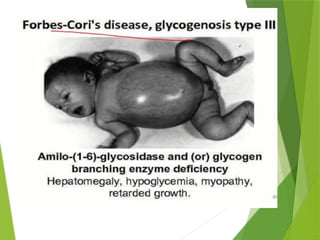
Coris’disease (Type III)
Limit Dextrinosis (Forbe’s Disease)
 Enzyme deficiency: Amylo a-1,6-glucosidase
(debranching enzyme)
 Organs affected - Liver (Hepatomegaly), muscle, Heart, leucocytes
 Branched chain glycogen accumulates.
 Clinical manifestations are similar to von
Gierke's disease but glycogen is abnormal.
 Moderate hypoglycemia.,splenomegaly
prsnt,no renal hepatic adenoma,uric
acid,lactic acid
Anderson’s disease (amylopectinosis) (Type IV)
 Enzyme deficiency:
 (branching enzyme)
 Glycogen deposited is abnormal.
 Glycogen with only few branches accumulate.
 Organs mainly affected - liver (Hepatomegaly),
heart, muscle & kidney.
 Moderate hypoglycemia, ascites, cirrhosis of
liver & hepatic failure & usually fetal.
CLINICAL PRESENTATION
 PERINATAL FORM-FETAL AKINESIA DEFORMATION
SEQUENCE AND DEATH
 CONGENITAL FORM-SEVERE HTPOTONIA,MUSCLE
ATROPHY,NEURONAL INVOLVMENT,DEATH IN NEONATAL
PERIOD
 CHILDHOOD FORM-CARDIOMYOPATHY
 ADULT FORM-ADULT POLYGLUCOSAN BODY
DISEASE(CARDIOMYOPATHY +DIFFUSE CNS AND
PERIPHERAL NS DYSFUNCTION
DIAGNOSIS
 LIVER,HEART,SKIN,BRAIN,INTESTINE,SPINALCORD
 DEPOSITION OF AMYLOPECTIN LIKE MATERIAL
 WORST PROGNOSIS
 EALY ONSET LIVER CIRRHOSIS
TREATMENT-
 LIVER TRANSPLANT
 HYPOGLYCEMIA-RARE
McArdle’s disease (Type v)
 Enzyme deficiency:
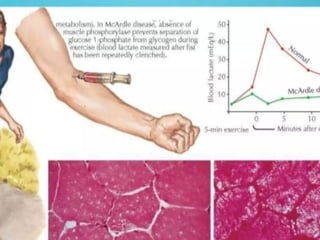
 Muscle glycogen phosphorylase
 Glycogen deposited is normal in structure.
 Organs involved - skeletal muscle.
 Muscle cramps on exercise, pain, weakness &
stiffness of muscles.
 No lactate is formed.
 Muscle may get damaged.

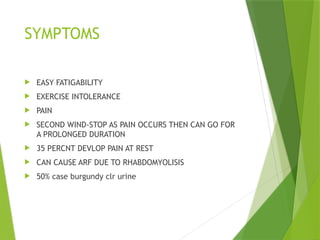
SYMPTOMS
 EASY FATIGABILITY
 EXERCISE INTOLERANCE
 PAIN
 SECOND WIND-STOP AS PAIN OCCURS THEN CAN GO FOR
A PROLONGED DURATION
 35 PERCNT DEVLOP PAIN AT REST
 CAN CAUSE ARF DUE TO RHABDOMYOLISIS
 50% case burgundy clr urine
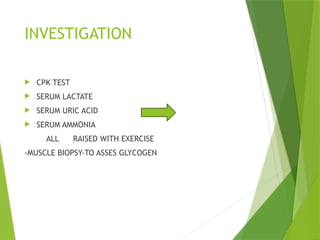
INVESTIGATION
 CPK TEST
 SERUM LACTATE
 SERUM URIC ACID
 SERUM AMMONIA
ALL RAISED WITH EXERCISE
-MUSCLE BIOPSY-TO ASSES GLYCOGEN
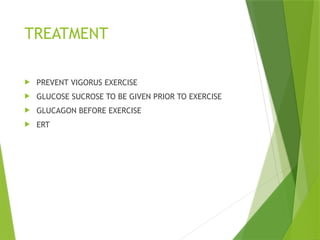
TREATMENT
 PREVENT VIGORUS EXERCISE
 GLUCOSE SUCROSE TO BE GIVEN PRIOR TO EXERCISE
 GLUCAGON BEFORE EXERCISE
 ERT
Her’s disease (Type VI)
 Enzyme deficiency:
 Liver glycogen phosphorylase.
 Glycogen deposited is normal in structure.
 Organs mainly affected liver.
 Hepatomegaly, moderate hypoglycemia, mild
acidosis, liver glycogen cannot form glucose
(pyruvate & lactate can be precursors for
glucose).
Tarui’s disease (Type VII)
 Enzyme deficiency: Phosphofructokinase
 Organs affected - skeletal muscles.
 Accumulation of glycogen in skeletal
muscles.
 Glucose 6-phosphate & fructose 6-phosphate
is also accumulated.
 Muscle cramps.
CLINICAL MENIFESTATION
 EXERCISE INTOLERANCE after taking carbohydrate meal
 HEMOLYSIS WITH INCREASE SR BILIRUBIN
 INCRESE RETICULOCYTE COUNT
 HYPERURECIMIA AFTER EXERCISE
 SECOND WIND PHENOMENON
 DEATH WITH IN 4YRS
 SOME CASES-HYPOTONIA,DEV.DELAY AND SEIZURE
 DIAGNOSIS
ABSENCE OF M ISO ENZYME OF PFK IN MUSCLE,BLOOD CELLS AND
FIBROBLAST
 TREATMENT
 -PREVENT STRENOUS EXERCISE
 TAKING KRTOGENIC DIET
 SIMPLE CARBOHYDRATE BEFORE EXERCISE
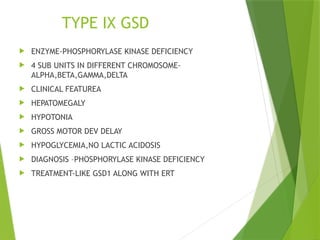
TYPE IX GSD
 ENZYME-PHOSPHORYLASE KINASE DEFICIENCY
 4 SUB UNITS IN DIFFERENT CHROMOSOME-
ALPHA,BETA,GAMMA,DELTA
 CLINICAL FEATUREA
 HEPATOMEGALY
 HYPOTONIA
 GROSS MOTOR DEV DELAY
 HYPOGLYCEMIA,NO LACTIC ACIDOSIS
 DIAGNOSIS –PHOSPHORYLASE KINASE DEFICIENCY
 TREATMENT-LIKE GSD1 ALONG WITH ERT
TYPE XI ,FANCONI-BICKEL
SYNDROME
 ENZYME-GLUCOSE TRANSPORTER GLUT 2(TRANSPORT
GLUCOSE IN AND OUT OF HEPATOCYTE,PANCREATIC BETA
CELL ,INTESTINE AND PCT)
 75% H/O CONSANGUINITY
 C/F-SIMILAR TO GSD TYP1
 INTESTINAL MALABSORPTION
 DIARRHOEA
 REPEATEDBONE FRACTURE
DANON DISEASE
 DUE TO DEFICIENCY OF LYSOZOMAL ASSOCIATED
MEMBRANE PROTEIN 2
 WHICH LEADS TO ACCUMULATION OF GLYCOGEN IN
HEART AND MUSCLE CAUSING HCM,SKELETAL MUSCLE
WEAKNESS
 C/F
 CHEAST PAIN
 PALPITATION
 SYNCOPE
 CARDIAC ARREST
 AGE B/W 8-15 YRS
 EYE CHANGES-PERIPHERAL PIGMENTORY
RETINOPATHY,LENS CHANGE,ABN ELECTRO RETINOGRAM
CONTD…
 X LINKED DOMINANT INHERITENCE
INVESTIGATION
 GENETIC TESTING FOR LAMP2 GENE
TREATMENT
 SYMPTOMATIC
 CARDIAC TRANSPLANT
TYPE 0 GSD
 ENZYME DEF-GLYCOGEN SYNTHATASE
 DECREASE GLYCOGEN STORE IN LIVER
 CLINICAL FEATURE-PRE BREAKFAST
DROWSINESS,PALLOR,FATIGUE,CONVULSION
 TREATMENT-LIKE GSD1
 PROGNOSIS -GOOD
Thank you

GSD NEW one classification , diagnosis & manaement.pptx

  • 1.
  • 2.
     INTRODUCTION The metabolicdefects concerned with the glycogen synthesis and degradation are collectively referred to as glycogen storage diseases.  These disorders are due to defects in the enzymes.  The inherited disorders are characterized by deposition of normal or abnormal type of glycogen in one or more tissues.
  • 3.
  • 6.
    von Gierke's disease(Type l)  It is transmitted by autosomal recessive trait.  Enzyme deficiency: Glucose 6-phosphatase.  The enzyme is absent in liver cells & intestinal mucosa.  Liver cells, intestinal mucosa & renal tubular epithelial cells are loaded with glycogen, which is normal in structure but metabolically not available.
  • 8.
  • 9.
    Clinical & Biochemicalfeatures Fasting hypoglycemia:  Hypoglycemia, decreases insulin secretion, which in turn inhibits protein synthesis causes stunted growth (dwarfism). Lactic acidemia:  Glucose is not synthesized from lactate produced in muscle & liver.
  • 10.
     Lactate levelin blood increases & the pH is lowered (acidosis). Hyperlipidemia:  Fat is utilized as energy source, which leads to lipaemia, acidaemia & ketosis.  Excess of acetyl CoA resulting in increased cholesterol levels, produce xanthomas.  There is a blockade in gluconeogenesis.
  • 11.
    Hyperuricemia:  Glucose 6-phosphatethat accumulates is diverted to HMP Shunt, leading to increased synthesis of ribose phosphates which increase the cellular levels of phosphoribosyl pyrophosphate & enhance the metabolism of purine nucleotides to uric acid (gouty arthritis).
  • 13.
    CLINICAL PRESENTATION(gsd)  DOLLlike face with fat cheeks  Short stature  Protuberant abdomen due to massive hepatomegalY  Enlarged kidney  Easy bruises and epistaxies  Delayed puberty  Poly cystic ovary  Pancreatitis  Hepatic adenoma-2nd and 3rd decay  Pulmonary hypertension  Renal disorder
  • 15.
    INVESTIGATION  Blood glucose-Hypoglycemia ABG-Lactic acidosis  Hyperuricemia  Hyperlipidemia  Neutropenia-GSD1b before 1yr age
  • 16.
    TREATMENT IN infant-over nightNG drip Child below 2yrs –uncooked corn starch contain glucose dose of 1.6gm/kg every 4hrly Above 2 yrs-1.6 to 2.5gm/kg every 6hrly SUCROSE,FRUCTOSE,LACTOSE –Avoided or limited Hyperlipidemia-HmgcoA reductase inhibitor and Fibrate HYPERURECIMIA-Allopurinol,Xanthine oxidase inhibitor CONTD…..
  • 17.
    TREATMENT( CONTD) GSDTYP1  MICROALBUMINURIA-ACE INHIBITORS  NEPHROCALCINOSIS/HYPERCALCIURIA-CITRATE SUPLEMENTS,THIAZIDE DIURETICS  NEUTROPENIA-GRANULOCYTE MACROPHAGE COLONY STIMULATING FACTOR  SURGICAL MANAGEMENT  HEPATIC ADENOMA, < 2CM –PERCUTANEOUS ETHANOL INJ/TRANSCATHETER ATERIAL EMBOLIZATION  HEPATIC ADENOMA >2CM SURGICAL RESECTION  RL –AVOIDED  ENZYME REPLACEMENT THERAPY-SPECIFIC
  • 18.
    Pompe's disease (TypeII)  Enzyme deficiency: (acid maltase).  Glycogen accumulates in lysosomes in all most all the tissues.  Enlargement of heart (cardiomegaly).  Nervous system is also affected.  No hypoglycemia  Death occurs due to heart failure.
  • 25.
    TREATMENT  ENZYME REPLACEMENT-ALGLUCOSIDASE alpha  IMMUNOMODULATOR-MTX,RITUXIMAB,IVIG-AB AGAINST ERT
  • 26.
    Coris’disease (Type III) LimitDextrinosis (Forbe’s Disease)  Enzyme deficiency: Amylo a-1,6-glucosidase (debranching enzyme)  Organs affected - Liver (Hepatomegaly), muscle, Heart, leucocytes  Branched chain glycogen accumulates.  Clinical manifestations are similar to von Gierke's disease but glycogen is abnormal.  Moderate hypoglycemia.,splenomegaly prsnt,no renal hepatic adenoma,uric acid,lactic acid
  • 28.
    Anderson’s disease (amylopectinosis)(Type IV)  Enzyme deficiency:  (branching enzyme)  Glycogen deposited is abnormal.  Glycogen with only few branches accumulate.  Organs mainly affected - liver (Hepatomegaly), heart, muscle & kidney.  Moderate hypoglycemia, ascites, cirrhosis of liver & hepatic failure & usually fetal.
  • 29.
    CLINICAL PRESENTATION  PERINATALFORM-FETAL AKINESIA DEFORMATION SEQUENCE AND DEATH  CONGENITAL FORM-SEVERE HTPOTONIA,MUSCLE ATROPHY,NEURONAL INVOLVMENT,DEATH IN NEONATAL PERIOD  CHILDHOOD FORM-CARDIOMYOPATHY  ADULT FORM-ADULT POLYGLUCOSAN BODY DISEASE(CARDIOMYOPATHY +DIFFUSE CNS AND PERIPHERAL NS DYSFUNCTION
  • 30.
    DIAGNOSIS  LIVER,HEART,SKIN,BRAIN,INTESTINE,SPINALCORD  DEPOSITIONOF AMYLOPECTIN LIKE MATERIAL  WORST PROGNOSIS  EALY ONSET LIVER CIRRHOSIS TREATMENT-  LIVER TRANSPLANT  HYPOGLYCEMIA-RARE
  • 31.
    McArdle’s disease (Typev)  Enzyme deficiency:  Muscle glycogen phosphorylase  Glycogen deposited is normal in structure.  Organs involved - skeletal muscle.  Muscle cramps on exercise, pain, weakness & stiffness of muscles.  No lactate is formed.  Muscle may get damaged. 
  • 33.
    SYMPTOMS  EASY FATIGABILITY EXERCISE INTOLERANCE  PAIN  SECOND WIND-STOP AS PAIN OCCURS THEN CAN GO FOR A PROLONGED DURATION  35 PERCNT DEVLOP PAIN AT REST  CAN CAUSE ARF DUE TO RHABDOMYOLISIS  50% case burgundy clr urine
  • 34.
    INVESTIGATION  CPK TEST SERUM LACTATE  SERUM URIC ACID  SERUM AMMONIA ALL RAISED WITH EXERCISE -MUSCLE BIOPSY-TO ASSES GLYCOGEN
  • 35.
    TREATMENT  PREVENT VIGORUSEXERCISE  GLUCOSE SUCROSE TO BE GIVEN PRIOR TO EXERCISE  GLUCAGON BEFORE EXERCISE  ERT
  • 36.
    Her’s disease (TypeVI)  Enzyme deficiency:  Liver glycogen phosphorylase.  Glycogen deposited is normal in structure.  Organs mainly affected liver.  Hepatomegaly, moderate hypoglycemia, mild acidosis, liver glycogen cannot form glucose (pyruvate & lactate can be precursors for glucose).
  • 37.
    Tarui’s disease (TypeVII)  Enzyme deficiency: Phosphofructokinase  Organs affected - skeletal muscles.  Accumulation of glycogen in skeletal muscles.  Glucose 6-phosphate & fructose 6-phosphate is also accumulated.  Muscle cramps.
  • 38.
    CLINICAL MENIFESTATION  EXERCISEINTOLERANCE after taking carbohydrate meal  HEMOLYSIS WITH INCREASE SR BILIRUBIN  INCRESE RETICULOCYTE COUNT  HYPERURECIMIA AFTER EXERCISE  SECOND WIND PHENOMENON  DEATH WITH IN 4YRS  SOME CASES-HYPOTONIA,DEV.DELAY AND SEIZURE  DIAGNOSIS ABSENCE OF M ISO ENZYME OF PFK IN MUSCLE,BLOOD CELLS AND FIBROBLAST  TREATMENT  -PREVENT STRENOUS EXERCISE  TAKING KRTOGENIC DIET  SIMPLE CARBOHYDRATE BEFORE EXERCISE
  • 39.
    TYPE IX GSD ENZYME-PHOSPHORYLASE KINASE DEFICIENCY  4 SUB UNITS IN DIFFERENT CHROMOSOME- ALPHA,BETA,GAMMA,DELTA  CLINICAL FEATUREA  HEPATOMEGALY  HYPOTONIA  GROSS MOTOR DEV DELAY  HYPOGLYCEMIA,NO LACTIC ACIDOSIS  DIAGNOSIS –PHOSPHORYLASE KINASE DEFICIENCY  TREATMENT-LIKE GSD1 ALONG WITH ERT
  • 40.
    TYPE XI ,FANCONI-BICKEL SYNDROME ENZYME-GLUCOSE TRANSPORTER GLUT 2(TRANSPORT GLUCOSE IN AND OUT OF HEPATOCYTE,PANCREATIC BETA CELL ,INTESTINE AND PCT)  75% H/O CONSANGUINITY  C/F-SIMILAR TO GSD TYP1  INTESTINAL MALABSORPTION  DIARRHOEA  REPEATEDBONE FRACTURE
  • 41.
    DANON DISEASE  DUETO DEFICIENCY OF LYSOZOMAL ASSOCIATED MEMBRANE PROTEIN 2  WHICH LEADS TO ACCUMULATION OF GLYCOGEN IN HEART AND MUSCLE CAUSING HCM,SKELETAL MUSCLE WEAKNESS  C/F  CHEAST PAIN  PALPITATION  SYNCOPE  CARDIAC ARREST  AGE B/W 8-15 YRS  EYE CHANGES-PERIPHERAL PIGMENTORY RETINOPATHY,LENS CHANGE,ABN ELECTRO RETINOGRAM
  • 42.
    CONTD…  X LINKEDDOMINANT INHERITENCE INVESTIGATION  GENETIC TESTING FOR LAMP2 GENE TREATMENT  SYMPTOMATIC  CARDIAC TRANSPLANT
  • 43.
    TYPE 0 GSD ENZYME DEF-GLYCOGEN SYNTHATASE  DECREASE GLYCOGEN STORE IN LIVER  CLINICAL FEATURE-PRE BREAKFAST DROWSINESS,PALLOR,FATIGUE,CONVULSION  TREATMENT-LIKE GSD1  PROGNOSIS -GOOD
  • 44.

Editor's Notes

  • #21 ECG-HIGH VOLTAGE QRS COMPLEX WITH WPW SYND AND SHORTEND PR INTERVAL,ECHO-THICKENNING OF BOTH VENTRICLE AND IVS,MUSCLE BIOPSY-GLYCOGEN ACCUMULATION IN MEMBRANOUS SAC AND CYTOPLASM,LFT-DEARRANGE,LDH-HIGH
  • #28 ENZYME-ALPHA