SUB : Biochemistry
Topic :Glycogen Storage Disease
( GSD )
Introduction
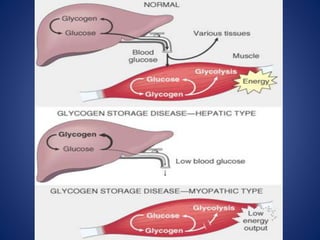
o Glucose is a large energy source for the body, it is
stored in the body in the form of glycogen.
o It is released into the blood as needed with the help
of special proteins called enzymes.
o After meal the blood glucose level rises, and the
body stores the extra glucose that is not needed
right away as Glycogen in the liver and muscles
and stimulation of glycogenesis occur.
CON…
o As the blood glucose level in the body begin drop,
the body uses the stored energy by stimulating
glycogenolysis.
o Making the glycogen and breaking it down are
controlled by special enzymes and this process is
called glycogen metabolism.
Glycogen Storage Disease
o GSD also known as glycogenosis is a rare inherited
metabolic disorder of glycogen metabolism.
o All characterized by deficient or defective activity
of the enzymes responsible for metabolizing
glycogen in the body.
o This leads to an abnormal accumulation of
glycogen resulting enlargement and dysfunction of
liver, heart and kidneys.
Causes of GSD
o A glycogen storage disease is the result of an
enzyme defect.
o These enzymes normally catalyze reactions that
ultimately convert glycogen compounds to glucose.
o Enzyme deficiency results in glycogen
accumulation in tissues.
o In some cases the defect can be systemic or tissue
specific.
Types of GSD
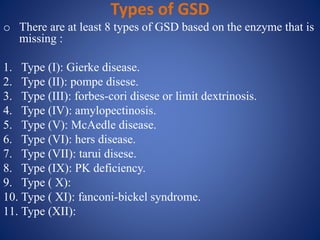
o There are at least 8 types of GSD based on the enzyme that is
missing :
1. Type (I): Gierke disease.
2. Type (II): pompe disese.
3. Type (III): forbes-cori disese or limit dextrinosis.
4. Type (IV): amylopectinosis.
5. Type (V): McAedle disease.
6. Type (VI): hers disease.
7. Type (VII): tarui disese.
8. Type (IX): PK deficiency.
9. Type ( X):
10. Type ( XI): fanconi-bickel syndrome.
11. Type (XII):
GSD type I
o This is due to metabolic disorder or deficiency of
glucose-6-phosphatase enzyme which helps
maintanence of glucose homeostasis.
o G6Pase is mainly found in the liver, kidney and
intestine to maintain glycogenolysis.
o Because of insufficient G6Pase activity, the G6P
cannot be converted into free glucose.
CON…
o The excess glycogen that is formed are stored in the
cytoplasm of hepatocytes, renal and intestinal
mucosa cells.
o This excess of storage causes enlargement of liver
and kidneys which dominate the clinical
presentation of the disease.
CON…
This type of GSD is characterized by :
 Fasting Hypoglycemia :
o the deficiency of G6Pase blocks the process of
glycogen degradation and gluconeogenesis in the
liver preventing the production of free glucose
molecules.
o Despite the metabolic block, the endogenous
glucose formation is not fully inhibited.
CON…
 Hyperlipidemia
o Elevated endogenous triglyceride synthesis from
NAD phosphate, acetyl CoA, glycerol and
diminished lipolysis can cause hyperlipidemia.
o Theses lipids can also increase the risk of fatty liver
infiltration which contributes the hepatomegaly.
CON…
 Hyperuricemia
Blood uric acid levels are raised because of increased
production of nucleic acids from HMP.
 Decreased of G-6-Pase leads to increase G-6-P
which also causes increase HMP which further
causes increase of NA production resulting elevated
uric acid level.
GSD type II
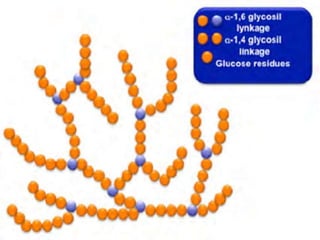
o This type is also known as alpha glucosidase
deficiency or pomp disease.
o The lysosomal enzyme ( Alpha glucosidase ) acts as
hydrolyzing the alpha-1,4 and 1,6 glucosidic
linkages of the glycogen within the lysosome.
o The deficient of this enzyme leads progressive
accumulation of glycogen in the lysosomes and
cytoplasm of different tissues causing destruction.
GSD type III
o GSD type III is also known as forbes-cori disease or
limit dextrinosis.
o Due to deficiency in glycogen debranching enzyme
and limited storage of dextrin.
o Abnormal glycogen with short external branches is
stored in the liver and muscle cells.
o The accumulated glycogen resembles the limit
dextrin which is product of glycogen degradation.
GSD type IV
o Also known as amylopectinosis which there is
deficiency or reduced the activity of glycogen
branching enzyme.
o GBE catalyze the formation of alpha-1,6-
glycosidic bonds to linear alpha-1,4-glycosidic
bonds that forms the skeleton of glycogen
molecule.
o In case of deficiency, abnormal glycogen is
formed with less branches in the liver, heart and
GSD type V
o GSD type V or McArdle disease is the most
common disorder of skeletal muscle glycogen
metabolism.
o Its caused by the lack of the muscle glycogen
phosphorylase ( myophosphorylase enzyme ).
o The characteristcs of GSD type V are exercise
intolerance, myalgia, and muscle stiffness.
o Also myoglobinuria due to the presence of
GSD type VI
o GSD type VI is also known as hers disease, is an
inherited disorder caused by inability to break down
the glycogen in the liver.
o This type of disease is resulted from a primary
deficiency of liver phosphorylase enzyme.
o Phosphorylase is the rate limiting enzyme of
glycogenolysis.
CON…
o Enzyme deficiency results in impaired cleavage of
glucose units from the straight chains of the
glycogen molecule.
o Most patients the enzyme deficiency is incomplete
and gluconeogenesis remains intact.
o The ability of the liver to maintain normoglycemia
during fasting may be partially impaired resulting :
 Hypoglycemia.
 Hyperketosis.
GSD type VII
o The phosphofructokinase enzyme is needed to
facilitate the breakdown of glycogen into energy
in muscles.
o The deficient of this enzyme effects glycogen
breakdown in the muscle resulting pain and
weakness during exercise.
CON….
o PFK is the key regulatory enzymes for glycolysis
thus, tissue deficient in PFK cannot use free or
glycogen derived glucose as a fuel source.
o So the glycogen is accumulate due to impaired
degradation or excess synthesis.
o The enzymatic block also causes a decrease in
2,3-diphosphoglycerate, which therefor oxygen
affinity of hemoglobin is increased, resulting
hemolytic anemia.
GSD type IX
o GSD type IX hepatic glycogen storage disease
resulting from lack of expression of phosphorylase
kinase activity.
o This enzyme is necessary to break down the
glycogen into glucose .
o People with this type of GSD cannot properly
breakdown the glycogen due to PK enzyme
deficiency, thus excess amount of glycogen are
accumulated in the liver , muscle or both.
GSD type IX
Type IX is characterized by :
 Abnormal liver enlargement ( Hepatomegaly ).
 Fasting hypoglycemia.
 Growth delay.
o Since the GSD-IX disorder involves the same
enzyme complex with VIII, the classification of
VIII is no longer used.
GSD type X
o This type of GSD is causes by deficiency of
Phosphoglycerate mutase.
o It effects primarily in the muscles ( skeletal muscle
) beginning in childhood.
o It characterized by :
 Muscle aches.
 Myoglobinuria.
 Kidney failure.
GSD type XI
o GSD type-XI is resulted from the deficiency of
lactate dehydrogenase enzyme.
o It affects the way the body breaks downs glucose
for energy.
o There are two types of Lactate dehydrogenase
deficiency :
 A-LDH deficiency.

 B-LDH deficiency.
CON…
o In deficiency of LDH is characterized by :
 Muscle fatigue during exercise.
 Rhabdomyolysis.
 Myogolobine due to muscle tissue destruction.
o Skeletal muscle require large amount of energy
during exercise.
o During anaerobic exercise LDH enzyme is involved
in the breakdown of glucose stored in muscle as
glycogen.
CON…
o In case of LDH deficiency the glycogen is not
decomposed efficiently, leading to decrease energy
in muscle cells during strenuouse physical activity.
o Muscle weaken and muscle tissue decompose
occur.
Bio chemo ( gsd )
Bio chemo ( gsd )

Bio chemo ( gsd )

  • 1.
    SUB : Biochemistry Topic:Glycogen Storage Disease ( GSD )
  • 3.
    Introduction o Glucose isa large energy source for the body, it is stored in the body in the form of glycogen. o It is released into the blood as needed with the help of special proteins called enzymes. o After meal the blood glucose level rises, and the body stores the extra glucose that is not needed right away as Glycogen in the liver and muscles and stimulation of glycogenesis occur.
  • 4.
    CON… o As theblood glucose level in the body begin drop, the body uses the stored energy by stimulating glycogenolysis. o Making the glycogen and breaking it down are controlled by special enzymes and this process is called glycogen metabolism.
  • 5.
    Glycogen Storage Disease oGSD also known as glycogenosis is a rare inherited metabolic disorder of glycogen metabolism. o All characterized by deficient or defective activity of the enzymes responsible for metabolizing glycogen in the body. o This leads to an abnormal accumulation of glycogen resulting enlargement and dysfunction of liver, heart and kidneys.
  • 6.
    Causes of GSD oA glycogen storage disease is the result of an enzyme defect. o These enzymes normally catalyze reactions that ultimately convert glycogen compounds to glucose. o Enzyme deficiency results in glycogen accumulation in tissues. o In some cases the defect can be systemic or tissue specific.
  • 7.
    Types of GSD oThere are at least 8 types of GSD based on the enzyme that is missing : 1. Type (I): Gierke disease. 2. Type (II): pompe disese. 3. Type (III): forbes-cori disese or limit dextrinosis. 4. Type (IV): amylopectinosis. 5. Type (V): McAedle disease. 6. Type (VI): hers disease. 7. Type (VII): tarui disese. 8. Type (IX): PK deficiency. 9. Type ( X): 10. Type ( XI): fanconi-bickel syndrome. 11. Type (XII):
  • 8.
    GSD type I oThis is due to metabolic disorder or deficiency of glucose-6-phosphatase enzyme which helps maintanence of glucose homeostasis. o G6Pase is mainly found in the liver, kidney and intestine to maintain glycogenolysis. o Because of insufficient G6Pase activity, the G6P cannot be converted into free glucose.
  • 9.
    CON… o The excessglycogen that is formed are stored in the cytoplasm of hepatocytes, renal and intestinal mucosa cells. o This excess of storage causes enlargement of liver and kidneys which dominate the clinical presentation of the disease.
  • 10.
    CON… This type ofGSD is characterized by :  Fasting Hypoglycemia : o the deficiency of G6Pase blocks the process of glycogen degradation and gluconeogenesis in the liver preventing the production of free glucose molecules. o Despite the metabolic block, the endogenous glucose formation is not fully inhibited.
  • 11.
    CON…  Hyperlipidemia o Elevatedendogenous triglyceride synthesis from NAD phosphate, acetyl CoA, glycerol and diminished lipolysis can cause hyperlipidemia. o Theses lipids can also increase the risk of fatty liver infiltration which contributes the hepatomegaly.
  • 12.
    CON…  Hyperuricemia Blood uricacid levels are raised because of increased production of nucleic acids from HMP.  Decreased of G-6-Pase leads to increase G-6-P which also causes increase HMP which further causes increase of NA production resulting elevated uric acid level.
  • 13.
    GSD type II oThis type is also known as alpha glucosidase deficiency or pomp disease. o The lysosomal enzyme ( Alpha glucosidase ) acts as hydrolyzing the alpha-1,4 and 1,6 glucosidic linkages of the glycogen within the lysosome. o The deficient of this enzyme leads progressive accumulation of glycogen in the lysosomes and cytoplasm of different tissues causing destruction.
  • 14.
    GSD type III oGSD type III is also known as forbes-cori disease or limit dextrinosis. o Due to deficiency in glycogen debranching enzyme and limited storage of dextrin. o Abnormal glycogen with short external branches is stored in the liver and muscle cells. o The accumulated glycogen resembles the limit dextrin which is product of glycogen degradation.
  • 15.
    GSD type IV oAlso known as amylopectinosis which there is deficiency or reduced the activity of glycogen branching enzyme. o GBE catalyze the formation of alpha-1,6- glycosidic bonds to linear alpha-1,4-glycosidic bonds that forms the skeleton of glycogen molecule. o In case of deficiency, abnormal glycogen is formed with less branches in the liver, heart and
  • 16.
    GSD type V oGSD type V or McArdle disease is the most common disorder of skeletal muscle glycogen metabolism. o Its caused by the lack of the muscle glycogen phosphorylase ( myophosphorylase enzyme ). o The characteristcs of GSD type V are exercise intolerance, myalgia, and muscle stiffness. o Also myoglobinuria due to the presence of
  • 17.
    GSD type VI oGSD type VI is also known as hers disease, is an inherited disorder caused by inability to break down the glycogen in the liver. o This type of disease is resulted from a primary deficiency of liver phosphorylase enzyme. o Phosphorylase is the rate limiting enzyme of glycogenolysis.
  • 18.
    CON… o Enzyme deficiencyresults in impaired cleavage of glucose units from the straight chains of the glycogen molecule. o Most patients the enzyme deficiency is incomplete and gluconeogenesis remains intact. o The ability of the liver to maintain normoglycemia during fasting may be partially impaired resulting :  Hypoglycemia.  Hyperketosis.
  • 19.
    GSD type VII oThe phosphofructokinase enzyme is needed to facilitate the breakdown of glycogen into energy in muscles. o The deficient of this enzyme effects glycogen breakdown in the muscle resulting pain and weakness during exercise.
  • 20.
    CON…. o PFK isthe key regulatory enzymes for glycolysis thus, tissue deficient in PFK cannot use free or glycogen derived glucose as a fuel source. o So the glycogen is accumulate due to impaired degradation or excess synthesis. o The enzymatic block also causes a decrease in 2,3-diphosphoglycerate, which therefor oxygen affinity of hemoglobin is increased, resulting hemolytic anemia.
  • 21.
    GSD type IX oGSD type IX hepatic glycogen storage disease resulting from lack of expression of phosphorylase kinase activity. o This enzyme is necessary to break down the glycogen into glucose . o People with this type of GSD cannot properly breakdown the glycogen due to PK enzyme deficiency, thus excess amount of glycogen are accumulated in the liver , muscle or both.
  • 22.
    GSD type IX TypeIX is characterized by :  Abnormal liver enlargement ( Hepatomegaly ).  Fasting hypoglycemia.  Growth delay. o Since the GSD-IX disorder involves the same enzyme complex with VIII, the classification of VIII is no longer used.
  • 23.
    GSD type X oThis type of GSD is causes by deficiency of Phosphoglycerate mutase. o It effects primarily in the muscles ( skeletal muscle ) beginning in childhood. o It characterized by :  Muscle aches.  Myoglobinuria.  Kidney failure.
  • 24.
    GSD type XI oGSD type-XI is resulted from the deficiency of lactate dehydrogenase enzyme. o It affects the way the body breaks downs glucose for energy. o There are two types of Lactate dehydrogenase deficiency :  A-LDH deficiency.  B-LDH deficiency.
  • 25.
    CON… o In deficiencyof LDH is characterized by :  Muscle fatigue during exercise.  Rhabdomyolysis.  Myogolobine due to muscle tissue destruction. o Skeletal muscle require large amount of energy during exercise. o During anaerobic exercise LDH enzyme is involved in the breakdown of glucose stored in muscle as glycogen.
  • 26.
    CON… o In caseof LDH deficiency the glycogen is not decomposed efficiently, leading to decrease energy in muscle cells during strenuouse physical activity. o Muscle weaken and muscle tissue decompose occur.