Galactosemia
DR.SUNIL BHOYE
MPH(NUTRITION)
1
Content
• Introduction
• Synonyms and Subdivisions
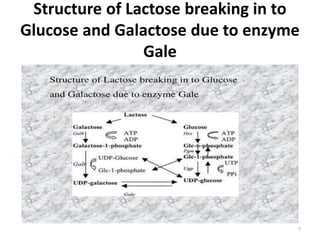
• Structure of Lactose breaking in to Glucose
and Galactose due to enzyme Gale
• How does Galactosemia occur?
• Can it be passed to future generation or is it
heredity?
• Brief History of Galactosemia
• Type of mutation
2
Content
• Where does it occur in a
karyotype/chromosome/gene.
• Signs/Symptoms in Adults & Infants
• How is it diagnosed
• Is it curable/How is it treated
• References
3
Introduction
• Galactosemia is a rare, hereditary disorder of
carbohydrate metabolism that affects the body’s
ability to convert galactose (a sugar contained in
milk, including human mother’s milk) to glucose
(a different type of sugar).
• The disorder is caused by a deficiency of an
enzyme galactose-1-phosphate uridylyl
transferase (GALT) which is vital to this process.
• Early diagnosis and treatment with a lactose-
restricted (dairy-free) diet is absolutely essential
to avoid profound intellectual disability, liver
failure and death in the newborn period. 4
Introduction
• Galactosemia is inherited as an autosomal
recessive genetic condition.
• Classic galactosemia and clinical variant
galactosemia can both result in life-
threatening health problems unless treatment
is started shortly after birth.
• A biochemical variant form of galactosemia
termed Duarte is not thought to cause clinical
disease due to lactose consumption
5
Synonyms and Subdivisions
• Synonyms of Galactosemia
• Galactose-1-phosphate uridylyl transferase
deficiency
• Transferase deficiency galactosemia
• GALT deficiency
• Subdivisions of Galactosemia
• Classic galactosemia
• Clinical variant galactosemia
• Biochemical variant galactosemia (Duarte variant
galactosemia)
6
Structure of Lactose breaking in to
Glucose and Galactose due to enzyme
Gale
7
How does Galactosemia occur?
• Galactosemia occurs when a child inherits a
defective gene from each parent.
• Lacking a normal copy of this gene, the child
cannot make one of the enzymes necessary to
breakdown galactose.
• There is a simple sugar called galactose where
the body produces. Also there is a large sugar
called lactose.
8
Can it be passed to future generation
or is it heredity?
• The genetically significant mutations occur in
reproductive cells and can therefore be
transmitted to future generations.
• Natural selection acts upon the genetic
diversity generated by mutation to preserve
beneficial mutations and eliminate deleterious
ones.
• It is a heredity recessive disease.
9
Brief History of Galactosemia
• Galactosemia was first discovered in 1908 by the
physician Von Ruess.
• It was first recognized and described in detail in
1935 by Mason and Turner.
• Leloir worked out the metabolic pathway and the
process of sugar-nucleotides and won the Nobel
prize in Chemistry in 1970 for his work.
• The defective gene that caused it was found in
1956.It was first found to be detectable through a
newborn screening method in This method was
developed by Guthrie and Paigen.
• Galactosemia affects 1 in every 55,000 newborns.
10
Type of mutation
• The gene mutation (usually "Q188R") that
causes galactosemia is inherited in what is
called an autosomal recessive pattern.
• Galactosemia is a recessive gene.
11
Where does it occur in a
karyotype/chromosome/gene.
• Most people with galactosemia are missing an
enzyme (called GALT) in chromosome to get the
disorder, a child must inherit one defective gene
from each parent.
• Galactosemia is inherited in an autosomal
recessive manner, meaning a child must inherit
one defective gene from each parent to show the
disease.
• Heterozygotes are carriers, because they inherit
one normal gene and one defective gene.
• Carriers show no symptoms of galactosemia
12
Signs/Symptoms in Adults & Infants
• Adults
• Speech difficulties
• Learning disabilities
• Ovarian failure for female
• Infants
• Lethargy
• Vomiting
• Diarrhea
• Failure to thrive
• Jaundice
• Hypoglycemia, Hypotonia
13
How is it diagnosed
• In most states, babies are tested for
galactosemia at birth.
• Using a tiny blood sample taken from the
baby's heel, the test checks for low levels of
the GALT enzyme.
• This allows for prompt treatment, which can
substantially prevent the serious symptoms of
this disorder
14
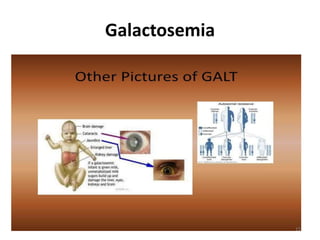
Galactosemia
15
Is it curable/How is it treated
• The only way to treat galactosemia is through
dietary restrictions.
• People with the disorder must stay away from
foods and drinks containing galactose,
including milk, cheese, and legumes (dried
beans).
• People who have GALT should stay away from
food which have GALT.
• It is not cure but there are several treatments
16
Dietary Management
Initial management that continues throughout life
• Eliminate galactose from the diet
– Lactose*
– Galactose*
• Life-long diet
• Calcium supplements
• Avoid some pharmaceuticals
• Endogenous galactose
• Vitamin K
17
18
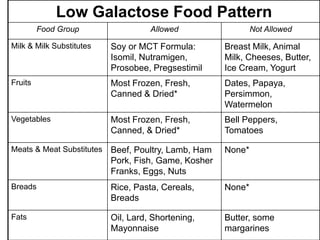
Low Galactose Food Pattern
Food Group Allowed Not Allowed
Milk & Milk Substitutes Soy or MCT Formula:
Isomil, Nutramigen,
Prosobee, Pregsestimil
Breast Milk, Animal
Milk, Cheeses, Butter,
Ice Cream, Yogurt
Fruits Most Frozen, Fresh,
Canned & Dried*
Dates, Papaya,
Persimmon,
Watermelon
Vegetables Most Frozen, Fresh,
Canned, & Dried*
Bell Peppers,
Tomatoes
Meats & Meat Substitutes Beef, Poultry, Lamb, Ham
Pork, Fish, Game, Kosher
Franks, Eggs, Nuts
None*
Breads Rice, Pasta, Cereals,
Breads
None*
Fats Oil, Lard, Shortening,
Mayonnaise
Butter, some
margarines
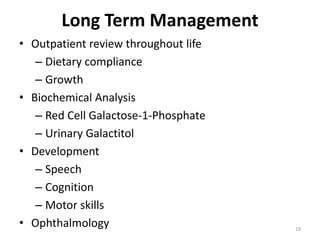
Long Term Management
• Outpatient review throughout life
– Dietary compliance
– Growth
• Biochemical Analysis
– Red Cell Galactose-1-Phosphate
– Urinary Galactitol
• Development
– Speech
– Cognition
– Motor skills
• Ophthalmology 19
References
• Galactosemia(GALT) By Raveeja V Deshpande.
• NORD (National Organization For Rare
Disorders)
• https://www.indianpediatrics.net/jan2016/21.
pdf
• JH Walter, JE Collins & JV Leonard, 1999.
• LK Mahan & S Escott-Stump, 1996.
20

Galactosemia

  • 1.
  • 2.
    Content • Introduction • Synonymsand Subdivisions • Structure of Lactose breaking in to Glucose and Galactose due to enzyme Gale • How does Galactosemia occur? • Can it be passed to future generation or is it heredity? • Brief History of Galactosemia • Type of mutation 2
  • 3.
    Content • Where doesit occur in a karyotype/chromosome/gene. • Signs/Symptoms in Adults & Infants • How is it diagnosed • Is it curable/How is it treated • References 3
  • 4.
    Introduction • Galactosemia isa rare, hereditary disorder of carbohydrate metabolism that affects the body’s ability to convert galactose (a sugar contained in milk, including human mother’s milk) to glucose (a different type of sugar). • The disorder is caused by a deficiency of an enzyme galactose-1-phosphate uridylyl transferase (GALT) which is vital to this process. • Early diagnosis and treatment with a lactose- restricted (dairy-free) diet is absolutely essential to avoid profound intellectual disability, liver failure and death in the newborn period. 4
  • 5.
    Introduction • Galactosemia isinherited as an autosomal recessive genetic condition. • Classic galactosemia and clinical variant galactosemia can both result in life- threatening health problems unless treatment is started shortly after birth. • A biochemical variant form of galactosemia termed Duarte is not thought to cause clinical disease due to lactose consumption 5
  • 6.
    Synonyms and Subdivisions •Synonyms of Galactosemia • Galactose-1-phosphate uridylyl transferase deficiency • Transferase deficiency galactosemia • GALT deficiency • Subdivisions of Galactosemia • Classic galactosemia • Clinical variant galactosemia • Biochemical variant galactosemia (Duarte variant galactosemia) 6
  • 7.
    Structure of Lactosebreaking in to Glucose and Galactose due to enzyme Gale 7
  • 8.
    How does Galactosemiaoccur? • Galactosemia occurs when a child inherits a defective gene from each parent. • Lacking a normal copy of this gene, the child cannot make one of the enzymes necessary to breakdown galactose. • There is a simple sugar called galactose where the body produces. Also there is a large sugar called lactose. 8
  • 9.
    Can it bepassed to future generation or is it heredity? • The genetically significant mutations occur in reproductive cells and can therefore be transmitted to future generations. • Natural selection acts upon the genetic diversity generated by mutation to preserve beneficial mutations and eliminate deleterious ones. • It is a heredity recessive disease. 9
  • 10.
    Brief History ofGalactosemia • Galactosemia was first discovered in 1908 by the physician Von Ruess. • It was first recognized and described in detail in 1935 by Mason and Turner. • Leloir worked out the metabolic pathway and the process of sugar-nucleotides and won the Nobel prize in Chemistry in 1970 for his work. • The defective gene that caused it was found in 1956.It was first found to be detectable through a newborn screening method in This method was developed by Guthrie and Paigen. • Galactosemia affects 1 in every 55,000 newborns. 10
  • 11.
    Type of mutation •The gene mutation (usually "Q188R") that causes galactosemia is inherited in what is called an autosomal recessive pattern. • Galactosemia is a recessive gene. 11
  • 12.
    Where does itoccur in a karyotype/chromosome/gene. • Most people with galactosemia are missing an enzyme (called GALT) in chromosome to get the disorder, a child must inherit one defective gene from each parent. • Galactosemia is inherited in an autosomal recessive manner, meaning a child must inherit one defective gene from each parent to show the disease. • Heterozygotes are carriers, because they inherit one normal gene and one defective gene. • Carriers show no symptoms of galactosemia 12
  • 13.
    Signs/Symptoms in Adults& Infants • Adults • Speech difficulties • Learning disabilities • Ovarian failure for female • Infants • Lethargy • Vomiting • Diarrhea • Failure to thrive • Jaundice • Hypoglycemia, Hypotonia 13
  • 14.
    How is itdiagnosed • In most states, babies are tested for galactosemia at birth. • Using a tiny blood sample taken from the baby's heel, the test checks for low levels of the GALT enzyme. • This allows for prompt treatment, which can substantially prevent the serious symptoms of this disorder 14
  • 15.
  • 16.
    Is it curable/Howis it treated • The only way to treat galactosemia is through dietary restrictions. • People with the disorder must stay away from foods and drinks containing galactose, including milk, cheese, and legumes (dried beans). • People who have GALT should stay away from food which have GALT. • It is not cure but there are several treatments 16
  • 17.
    Dietary Management Initial managementthat continues throughout life • Eliminate galactose from the diet – Lactose* – Galactose* • Life-long diet • Calcium supplements • Avoid some pharmaceuticals • Endogenous galactose • Vitamin K 17
  • 18.
    18 Low Galactose FoodPattern Food Group Allowed Not Allowed Milk & Milk Substitutes Soy or MCT Formula: Isomil, Nutramigen, Prosobee, Pregsestimil Breast Milk, Animal Milk, Cheeses, Butter, Ice Cream, Yogurt Fruits Most Frozen, Fresh, Canned & Dried* Dates, Papaya, Persimmon, Watermelon Vegetables Most Frozen, Fresh, Canned, & Dried* Bell Peppers, Tomatoes Meats & Meat Substitutes Beef, Poultry, Lamb, Ham Pork, Fish, Game, Kosher Franks, Eggs, Nuts None* Breads Rice, Pasta, Cereals, Breads None* Fats Oil, Lard, Shortening, Mayonnaise Butter, some margarines
  • 19.
    Long Term Management •Outpatient review throughout life – Dietary compliance – Growth • Biochemical Analysis – Red Cell Galactose-1-Phosphate – Urinary Galactitol • Development – Speech – Cognition – Motor skills • Ophthalmology 19
  • 20.
    References • Galactosemia(GALT) ByRaveeja V Deshpande. • NORD (National Organization For Rare Disorders) • https://www.indianpediatrics.net/jan2016/21. pdf • JH Walter, JE Collins & JV Leonard, 1999. • LK Mahan & S Escott-Stump, 1996. 20