GLYCOGEN
STORAGE
DISEASES
(GLYCOGENOSES)
GLUCOSE
Glucose is a large energy source for the body. It is stored
by the body in the form of glycogen and released into
the blood as needed with the help of special proteins
called enzymes.
Many sugars (including glucose) are found in foods and
are used by the body as a source of energy. After a meal,
blood glucose levels rise.
The body stores the extra glucose that is not needed
right away as glycogen in the liver and muscles. Later, as
the blood glucose levels in the body begin to drop, the
body uses this stored energy.
…CONT’D
These sugars, stored in the form of glycogen, need to be
processed by enzymes in the body before they can carry
out their functions.
If the enzymes needed to process them are missing, the
glycogen or one of its related starches can build up in
the liver, causing problems.
INTRO TO GSD
An inherited deficiency of any one of the enzymes
involved in glycogen synthesis or degradation can result
in excessive accumulation of glycogen or some abnormal
form of glycogen in various tissues.
IC location, Type of glycogen and tissue distribution
Depend on
Which Enzyme is missing?
MAJORITY OF GSD CAN
BE OF…….
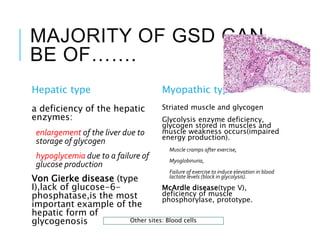
Hepatic type
a deficiency of the hepatic
enzymes:
enlargement of the liver due to
storage of glycogen
hypoglycemia due to a failure of
glucose production
Von Gierke disease (type
I),lack of glucose-6-
phosphatase,is the most
important example of the
hepatic form of
glycogenosis
Myopathic type
Striated muscle and glycogen
Glycolysis enzyme deficiency,
glycogen stored in muscles and
muscle weakness occurs(impaired
energy production).
Muscle cramps after exercise,
Myoglobinuria,
Failure of exercise to induce elevation in blood
lactate levels (block in glycolysis).
McArdle disease(type V),
deficiency of muscle
phosphorylase, prototype.
Other sites: Blood cells
GLYCOGEN
METABOLISM
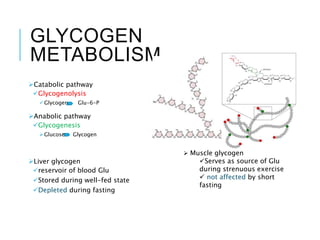
Catabolic pathway
Glycogenolysis
Glycogen Glu-6-P
Anabolic pathway
Glycogenesis
Glucose Glycogen
Liver glycogen
reservoir of blood Glu
Stored during well-fed state
Depleted during fasting
 Muscle glycogen
Serves as source of Glu
during strenuous exercise
 not affected by short
fasting
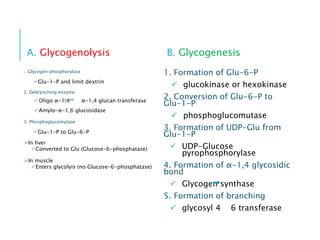
A. Glycogenolysis
1. Glycogen phosphorylase
Glu-1-P and limit dextrin
2. Debranching enzyme
Oligo α-1,4 α-1,4 glucan transferase
Amylo-α-1,6 glucosidase
3. Phosphoglucomutase
Glu-1-P to Glu-6-P
In liver
Converted to Glu (Glucose-6-phosphatase)
In muscle
Enters glycolyis (no Glucose-6-phosphatase)
B. Glycogenesis
1. Formation of Glu-6-P
 glucokinase or hexokinase
2. Conversion of Glu-6-P to
Glu-1-P
 phosphoglucomutase
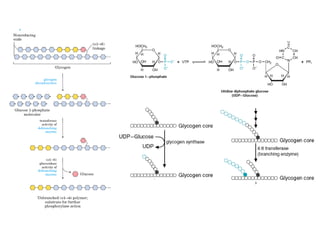
3. Formation of UDP-Glu from
Glu-1-P
 UDP-Glucose
pyrophosphorylase
4. Formation of α-1,4 glycosidic
bond
 Glycogen synthase
5. Formation of branching
 glycosyl 4 6 transferase
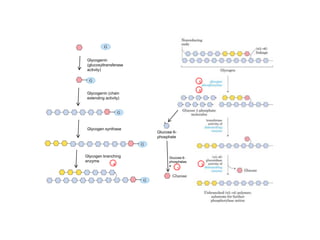
Glycogenin
(glucosyltransferase
activity)
Glycogenin (chain
extending activity)
Glycogen synthase
Glycogen branching
enzyme
Glucose 6-
phosphate
Glucose 6-
phosphatas
e
1
3
5
6
4
GLYCOGEN STORAGE
DISEASE (GSD)
There are different types of GSD but all people who have
GSD are born with the disease. When a person has GSD:
 The liver cannot control the use of glycogen and glucose because
certain enzymes are missing that control the change of sugar
(glucose) into its storage form (glycogen) or release of glucose from
glycogen.
 An abnormal amount of glycogen is stored in the liver.
 Not enough glucose is in the blood (also called hypoglycemia).
TYPES OF GSD
There are at least 10 different types of GSDs. The types
are put into groups based on the enzyme that is missing.
The most common forms of GSD are
 types I (one),
 III (three) and
 IV (four).
Number
Enzyme
deficiency
Eponym Incidence
Hypo-
glycemia?
Hepato-
megaly?
Hyperlip-
idemia?
Muscle
symptoms
Development/
prognosis
Other
symptoms
GSD type 0
glycogen
synthase
- Yes No No
Occasional
muscle
cramping
Growth failure
in some cases
GSD type I
glucose-6-
phosphatase
von Gierke's
disease
1 in 50,000
100,000[
births
Yes Yes Yes None Growth failure
Lactic
acidosis,
hyperuricem
ia
GSD type II
acid alpha-
glucosidase
Pompe's
disease
1 in 40,000
births-50,000
No Yes No
Muscle
weakness
*Death by age
~2 years
(infantile
variant)
heart failure
GSD type III
glycogen
debranching
enzyme
Cori's disease
or Forbes'
disease
1 in 100,000
births
Yes Yes Yes Myopathy
GSD type IV
glycogen
branching
enzyme
Andersen
disease
1 to 500,000 No
Yes,
also
cirrhosis
No None
Failure to
thrive, death
at age ~5
years
GSD type V
muscle
glycogen
phosphorylas
e
McArdle
disease
1 in 100,000-
500,000
No No No
Exercise-
induced
cramps,
Rhabdomyoly
sis
Renal failure
by
myoglobinur
ia, second
wind
phenomeno
n
GSD type VI
liver glycogen
phosphorylas
e
Hers' disease
1 in 65,000-
85,000 births] Yes Yes Yes [15] None
initially
benign,
growth
retardation
follows.
GSD type VII
muscle
phosphofruct
okinase
Tarui's
disease
1 in
1,000,000
No No No
Exercise-
induced
muscle
cramps and
weakness
growth
retardation
Haemolytic
anaemia
GSD type IX
Phosphorylase
kinase
Yes Yes Yes None
Delayed
motor
development,
Growth
retardation
…CONT’D
GSD I, also known as von Gierke disease: Results from a
lack of the enzyme Glucose-6-Phosphatase.
GSD III, also known as Cori disease: Results from a lack
of the debrancher enzyme.
 This causes the body to form glycogen molecules that have an
abnormal structure which prevents the glycogen from being broken
down into free glucose.
GSD IV, also known as amylopectinosis: There is not an
increased amount of glycogen in the tissues. Instead, the
glycogen that does build up in the tissues has very long
outer branches.
 With this type of GSD, there is lack of the branching enzyme. This
abnormal glycogen is thought to stimulate the immune system. The
result is a great deal of scarring (cirrhosis) of the liver as well as other
organs, such as muscle and heart.
CAUSES OF GSD
When glucose is changed into glycogen, a different
enzyme is required at each step. If one of these enzymes
is defective (not normal) and fails to complete its step,
the process stops.
These enzyme defects cause glycogen storage diseases.
SIGNS AND SYMPTOMS
Symptoms vary based on the enzyme that is missing.
 They usually result from the buildup of glycogen or from not being
able to produce glucose when needed. Because GSD occurs mainly in
muscles and the liver, those areas show the most symptoms.
…CONT’D
Symptoms may include:
 Poor growth
 Muscle cramps
 Low blood sugar
 A greatly enlarged liver
 A swollen belly
 Abnormal blood test
…CONT’D
The age when symptoms begin and how severe they are
depends on the type of GSD. Children with GSD I rarely
develop cirrhosis (liver disease), but they are at an
increased risk for developing liver tumors.
In some ways, GSD III is a milder version of GSD I. It also
is a very rare cause of liver failure, but it may cause
fibrosis (early scarring of the liver, which may be caused
by a healing response to injury, infection or
inflammation). GSD II is a muscle disease and does not
affect the liver.
Glycogen storage disease IV causes cirrhosis; it may also
cause heart or muscle dysfunction. Often, infants born
with GSD IV are diagnosed with enlarged livers and
failure to thrive within their first year of life. They
develop cirrhosis of the liver by age 3-5.
TREATMENT OF GSD
Treatment depends on the type of GSD. Some GSD types
cannot be treated; others are fairly easy to control by
treating the symptoms.
…CONT’D
For the types of GSD that can be treated, patients must carefully follow a
special diet.
Frequent high carbohydrate meals during the day. For some children,
eating several small meals rich in sugars and starches every day helps
prevent blood sugar levels from dropping.
Cornstarch. For some young children, giving uncooked cornstarch
every four to six hours – including during overnight hours – also can
help keep blood sugar levels from getting low. A doctor would know
how much cornstarch a child would need.
Continuous nighttime feeding. Some children will need a special
feeding tube placed into their stomach in order to maintain the blood
glucose level. The feeding tube is then used to give formula with a
high concentration of glucose. This helps control the blood sugar
level.
Medicine: GSD tends to cause uric acid (a waste product) to build up in
the body. This buildup of uric acid can cause gout (painful
inflammation of the joints) and kidney stones. Medication is often
necessary.
In some types of this disease, children must limit their amount of
exercise to reduce muscle cramps.
LONG-TERM OUTLOOK
Some GSD types cannot be treated, while others are fairly
easy to control by treating the symptoms. Patients with
treatable GSD do very well if the blood glucose level is
maintained within the normal range. Maintaining a
healthy blood glucose level can reverse all of the signs of
this disease, allowing the child to lead a long life.
In the more severe cases of GSD, infection and other
complications are likely to occur. These include liver,
heart and respiratory failure. If liver failure occurs,
receiving a liver transplant is the only option.
Transplants have been effective in reversing the
symptoms of GSD.
Glycogen storage disease LB

Glycogen storage disease LB

  • 1.
  • 2.
    GLUCOSE Glucose is alarge energy source for the body. It is stored by the body in the form of glycogen and released into the blood as needed with the help of special proteins called enzymes. Many sugars (including glucose) are found in foods and are used by the body as a source of energy. After a meal, blood glucose levels rise. The body stores the extra glucose that is not needed right away as glycogen in the liver and muscles. Later, as the blood glucose levels in the body begin to drop, the body uses this stored energy.
  • 3.
    …CONT’D These sugars, storedin the form of glycogen, need to be processed by enzymes in the body before they can carry out their functions. If the enzymes needed to process them are missing, the glycogen or one of its related starches can build up in the liver, causing problems.
  • 4.
    INTRO TO GSD Aninherited deficiency of any one of the enzymes involved in glycogen synthesis or degradation can result in excessive accumulation of glycogen or some abnormal form of glycogen in various tissues. IC location, Type of glycogen and tissue distribution Depend on Which Enzyme is missing?
  • 5.
    MAJORITY OF GSDCAN BE OF……. Hepatic type a deficiency of the hepatic enzymes: enlargement of the liver due to storage of glycogen hypoglycemia due to a failure of glucose production Von Gierke disease (type I),lack of glucose-6- phosphatase,is the most important example of the hepatic form of glycogenosis Myopathic type Striated muscle and glycogen Glycolysis enzyme deficiency, glycogen stored in muscles and muscle weakness occurs(impaired energy production). Muscle cramps after exercise, Myoglobinuria, Failure of exercise to induce elevation in blood lactate levels (block in glycolysis). McArdle disease(type V), deficiency of muscle phosphorylase, prototype. Other sites: Blood cells
  • 6.
    GLYCOGEN METABOLISM Catabolic pathway Glycogenolysis Glycogen Glu-6-P Anabolicpathway Glycogenesis Glucose Glycogen Liver glycogen reservoir of blood Glu Stored during well-fed state Depleted during fasting  Muscle glycogen Serves as source of Glu during strenuous exercise  not affected by short fasting
  • 7.
    A. Glycogenolysis 1. Glycogenphosphorylase Glu-1-P and limit dextrin 2. Debranching enzyme Oligo α-1,4 α-1,4 glucan transferase Amylo-α-1,6 glucosidase 3. Phosphoglucomutase Glu-1-P to Glu-6-P In liver Converted to Glu (Glucose-6-phosphatase) In muscle Enters glycolyis (no Glucose-6-phosphatase) B. Glycogenesis 1. Formation of Glu-6-P  glucokinase or hexokinase 2. Conversion of Glu-6-P to Glu-1-P  phosphoglucomutase 3. Formation of UDP-Glu from Glu-1-P  UDP-Glucose pyrophosphorylase 4. Formation of α-1,4 glycosidic bond  Glycogen synthase 5. Formation of branching  glycosyl 4 6 transferase
  • 8.
    Glycogenin (glucosyltransferase activity) Glycogenin (chain extending activity) Glycogensynthase Glycogen branching enzyme Glucose 6- phosphate Glucose 6- phosphatas e 1 3 5 6 4
  • 10.
    GLYCOGEN STORAGE DISEASE (GSD) Thereare different types of GSD but all people who have GSD are born with the disease. When a person has GSD:  The liver cannot control the use of glycogen and glucose because certain enzymes are missing that control the change of sugar (glucose) into its storage form (glycogen) or release of glucose from glycogen.  An abnormal amount of glycogen is stored in the liver.  Not enough glucose is in the blood (also called hypoglycemia).
  • 11.
    TYPES OF GSD Thereare at least 10 different types of GSDs. The types are put into groups based on the enzyme that is missing. The most common forms of GSD are  types I (one),  III (three) and  IV (four).
  • 12.
    Number Enzyme deficiency Eponym Incidence Hypo- glycemia? Hepato- megaly? Hyperlip- idemia? Muscle symptoms Development/ prognosis Other symptoms GSD type0 glycogen synthase - Yes No No Occasional muscle cramping Growth failure in some cases GSD type I glucose-6- phosphatase von Gierke's disease 1 in 50,000 100,000[ births Yes Yes Yes None Growth failure Lactic acidosis, hyperuricem ia GSD type II acid alpha- glucosidase Pompe's disease 1 in 40,000 births-50,000 No Yes No Muscle weakness *Death by age ~2 years (infantile variant) heart failure GSD type III glycogen debranching enzyme Cori's disease or Forbes' disease 1 in 100,000 births Yes Yes Yes Myopathy GSD type IV glycogen branching enzyme Andersen disease 1 to 500,000 No Yes, also cirrhosis No None Failure to thrive, death at age ~5 years GSD type V muscle glycogen phosphorylas e McArdle disease 1 in 100,000- 500,000 No No No Exercise- induced cramps, Rhabdomyoly sis Renal failure by myoglobinur ia, second wind phenomeno n GSD type VI liver glycogen phosphorylas e Hers' disease 1 in 65,000- 85,000 births] Yes Yes Yes [15] None initially benign, growth retardation follows. GSD type VII muscle phosphofruct okinase Tarui's disease 1 in 1,000,000 No No No Exercise- induced muscle cramps and weakness growth retardation Haemolytic anaemia GSD type IX Phosphorylase kinase Yes Yes Yes None Delayed motor development, Growth retardation
  • 13.
    …CONT’D GSD I, alsoknown as von Gierke disease: Results from a lack of the enzyme Glucose-6-Phosphatase. GSD III, also known as Cori disease: Results from a lack of the debrancher enzyme.  This causes the body to form glycogen molecules that have an abnormal structure which prevents the glycogen from being broken down into free glucose. GSD IV, also known as amylopectinosis: There is not an increased amount of glycogen in the tissues. Instead, the glycogen that does build up in the tissues has very long outer branches.  With this type of GSD, there is lack of the branching enzyme. This abnormal glycogen is thought to stimulate the immune system. The result is a great deal of scarring (cirrhosis) of the liver as well as other organs, such as muscle and heart.
  • 14.
    CAUSES OF GSD Whenglucose is changed into glycogen, a different enzyme is required at each step. If one of these enzymes is defective (not normal) and fails to complete its step, the process stops. These enzyme defects cause glycogen storage diseases.
  • 15.
    SIGNS AND SYMPTOMS Symptomsvary based on the enzyme that is missing.  They usually result from the buildup of glycogen or from not being able to produce glucose when needed. Because GSD occurs mainly in muscles and the liver, those areas show the most symptoms.
  • 16.
    …CONT’D Symptoms may include: Poor growth  Muscle cramps  Low blood sugar  A greatly enlarged liver  A swollen belly  Abnormal blood test
  • 17.
    …CONT’D The age whensymptoms begin and how severe they are depends on the type of GSD. Children with GSD I rarely develop cirrhosis (liver disease), but they are at an increased risk for developing liver tumors. In some ways, GSD III is a milder version of GSD I. It also is a very rare cause of liver failure, but it may cause fibrosis (early scarring of the liver, which may be caused by a healing response to injury, infection or inflammation). GSD II is a muscle disease and does not affect the liver. Glycogen storage disease IV causes cirrhosis; it may also cause heart or muscle dysfunction. Often, infants born with GSD IV are diagnosed with enlarged livers and failure to thrive within their first year of life. They develop cirrhosis of the liver by age 3-5.
  • 18.
    TREATMENT OF GSD Treatmentdepends on the type of GSD. Some GSD types cannot be treated; others are fairly easy to control by treating the symptoms.
  • 19.
    …CONT’D For the typesof GSD that can be treated, patients must carefully follow a special diet. Frequent high carbohydrate meals during the day. For some children, eating several small meals rich in sugars and starches every day helps prevent blood sugar levels from dropping. Cornstarch. For some young children, giving uncooked cornstarch every four to six hours – including during overnight hours – also can help keep blood sugar levels from getting low. A doctor would know how much cornstarch a child would need. Continuous nighttime feeding. Some children will need a special feeding tube placed into their stomach in order to maintain the blood glucose level. The feeding tube is then used to give formula with a high concentration of glucose. This helps control the blood sugar level. Medicine: GSD tends to cause uric acid (a waste product) to build up in the body. This buildup of uric acid can cause gout (painful inflammation of the joints) and kidney stones. Medication is often necessary. In some types of this disease, children must limit their amount of exercise to reduce muscle cramps.
  • 20.
    LONG-TERM OUTLOOK Some GSDtypes cannot be treated, while others are fairly easy to control by treating the symptoms. Patients with treatable GSD do very well if the blood glucose level is maintained within the normal range. Maintaining a healthy blood glucose level can reverse all of the signs of this disease, allowing the child to lead a long life. In the more severe cases of GSD, infection and other complications are likely to occur. These include liver, heart and respiratory failure. If liver failure occurs, receiving a liver transplant is the only option. Transplants have been effective in reversing the symptoms of GSD.