

GLYCOGEN STORAGE
DISORDERS
These are a group of inherited disorders
associated with glycogen metabolism,
familial in incidence and characterized by
deposition of normal or abnormal type and
quantity of glycogen in the tissues
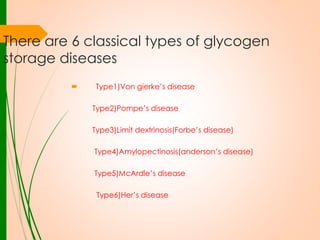
There are 6 classical types of glycogen
storage diseases


Type1)Von gierke’s disease
Type2)Pompe’s disease

Type3)Limit dextrinosis(Forbe’s disease)
Type4)Amylopectinosis(anderson’s disease)
Type5)McArdle’s disease
Type6)Her’s disease
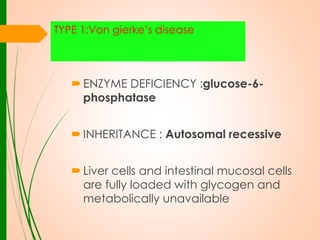
TYPE 1:Von gierke’s disease

 ENZYME DEFICIENCY :glucose-6phosphatase
 INHERITANCE : Autosomal recessive
 Liver cells and intestinal mucosal cells
are fully loaded with glycogen and
metabolically unavailable
CLINICAL AND BIOCHEMICAL FEATURES OF VON
GIERKE’S DISEASE

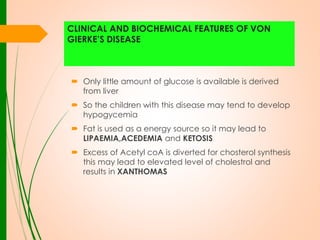
 Only little amount of glucose is available is derived
from liver
 So the children with this disease may tend to develop
hypogycemia

 Fat is used as a energy source so it may lead to
LIPAEMIA,ACEDEMIA and KETOSIS
 Excess of Acetyl coA is diverted for chosterol synthesis
this may lead to elevated level of cholestrol and
results in XANTHOMAS
Cont….
 Increased fatty acid synthesis can produce fatty
infiltration of liver
 PERSISTENT HYPOGLYCAEMIA has 2 effects
Hypoglycemia inhibits insulin which in turn inhibits
protein synthesis which results in DWARFISM
Hypoglycemia stimulates the secretion of
CATECHOLAMINES which cause muscle glycogen to
break down producing lactic acid and LACTIC ACIDOSIS
 Increased blood lactic acid competes with urate
excretion by kidneys leading to increased blood uric acid
levels
 Children with increased uric acid synthesis may develop
the symptoms of GOUT
PROGNOSIS
Children with this disease
may die young and some
of them survive till
adolescence
TYPE 2: POMPE’S DISEASE

 ENZYME DEFICIENCY : ACID MALTASE enzyme
which is present in lysosome and catalyses the
breakdown of oligosaccharides
 INHERITANCE : AUTOSOMAL RECESSIVE
 Here the glycogen structure is normal and the
organs which are involved is
HEART,LIVER,SMOOTH MUSCLE,AND STRAITED
MUSCLE

 All the tissue contain excess of glycogen
CLINICAL FEATURES
 Enlargement of heart (cardiomegaly)
 Muscle weakness
PROGNOSIS

 Infants usually die due to cardiac failure and broncho
pnuemonia
 Death usually occurs before 9 months
TYPE 3 : LIMIT DEXTRINOSIS(FORBE’S
DISEASE)

 ENZYME DEFICIENCY : DEBRANCHING ENZYME
 INHERITANCE : AUTOSOMAL RECESSIVE
 GLYCOGEN STRUCTURE : LIMIT DEXTRIN TYPE

 Organs involved are heart liver and muscle
CLINICAL AND BIOCHEMICAL FEATURES

•
•
•
•
•

HEPATOMEGALY
MODERATE HYPOGLYCEMIA
ACIDOSIS
PROGRESSIVE MYOPATHY
Enzyme deficiency can be
demonstrated in leucocytes
PROGNOSIS

 Survives well to adultlife
TYPE 4 : AMYLOPECTINOSIS(ANDERSON’S
DISEASE)

 ENZYME DEFICIENCY : BRANCHING ENZYME
 INHERITANCE : NOT DEFINETELY KNOWN
 Glycogen deposited is abnormal type, few
branch points and very long inner and outer
unbranched chains
 LIVER is the mainly affected organ and other
organs are HEART, KIDNEY, and MUSCLES
 Deposition is seen in RE SYSTEM
CLINICAL AND BIOCHEMICAL FEATURES

 HEPATOMEGALY
 SPLENOMEGALY
 MODERATE HYPOGLYCEMIA

 NODULAR CIRRHOSIS OF LIVER
 HEPATIC FAILURE
 Enzyme deficiency can be demonsrated in
leucocytes and liver
PROGNOSIS

 Usually fatal
 Longest survival is reported as 4 years
TYPE 5 : McArdle’s disease
 ENZYME DEFICIENCY : MUSCLE PHOSPHORYLASE
 INHERITANCE : AUTOSOMAL RECESSIVE
 Glycogen deposited in normalstructure and the organs
involved are skeletal muscles
CLINICAL FEATURES

Muscle cramps on exercise

Pain
Stiffness and weakness of muscles
EPINEPHRINE TEST
 After administration of epinephrine rise in
blood glucose occurs which shows that
hepatic phosphorylase activity is normal
TYPE 6 : Her’s disease

ENZYME DEFICIENCY : LIVER
PHOSPHORYLASE
Glycogen deposited is normal in
structure

Organs affected are mainly LIVER
and LEUCOCYTES
CLINICAL AND BIOCHEMICAL FEATURES

 HEPATOMEGALY
 MODERATE HYPOGLYCEMIA
 MILD ACIDOSIS

GLYCOGEN STORAGE DISORDERS

  • 3.
    GLYCOGEN STORAGE DISORDERS These area group of inherited disorders associated with glycogen metabolism, familial in incidence and characterized by deposition of normal or abnormal type and quantity of glycogen in the tissues
  • 4.
    There are 6classical types of glycogen storage diseases  Type1)Von gierke’s disease Type2)Pompe’s disease Type3)Limit dextrinosis(Forbe’s disease) Type4)Amylopectinosis(anderson’s disease) Type5)McArdle’s disease Type6)Her’s disease
  • 5.
    TYPE 1:Von gierke’sdisease  ENZYME DEFICIENCY :glucose-6phosphatase  INHERITANCE : Autosomal recessive  Liver cells and intestinal mucosal cells are fully loaded with glycogen and metabolically unavailable
  • 6.
    CLINICAL AND BIOCHEMICALFEATURES OF VON GIERKE’S DISEASE  Only little amount of glucose is available is derived from liver  So the children with this disease may tend to develop hypogycemia  Fat is used as a energy source so it may lead to LIPAEMIA,ACEDEMIA and KETOSIS  Excess of Acetyl coA is diverted for chosterol synthesis this may lead to elevated level of cholestrol and results in XANTHOMAS
  • 7.
    Cont….  Increased fattyacid synthesis can produce fatty infiltration of liver  PERSISTENT HYPOGLYCAEMIA has 2 effects Hypoglycemia inhibits insulin which in turn inhibits protein synthesis which results in DWARFISM Hypoglycemia stimulates the secretion of CATECHOLAMINES which cause muscle glycogen to break down producing lactic acid and LACTIC ACIDOSIS  Increased blood lactic acid competes with urate excretion by kidneys leading to increased blood uric acid levels  Children with increased uric acid synthesis may develop the symptoms of GOUT
  • 8.
    PROGNOSIS Children with thisdisease may die young and some of them survive till adolescence
  • 9.
    TYPE 2: POMPE’SDISEASE  ENZYME DEFICIENCY : ACID MALTASE enzyme which is present in lysosome and catalyses the breakdown of oligosaccharides  INHERITANCE : AUTOSOMAL RECESSIVE  Here the glycogen structure is normal and the organs which are involved is HEART,LIVER,SMOOTH MUSCLE,AND STRAITED MUSCLE  All the tissue contain excess of glycogen
  • 10.
    CLINICAL FEATURES  Enlargementof heart (cardiomegaly)  Muscle weakness
  • 11.
    PROGNOSIS  Infants usuallydie due to cardiac failure and broncho pnuemonia  Death usually occurs before 9 months
  • 12.
    TYPE 3 :LIMIT DEXTRINOSIS(FORBE’S DISEASE)  ENZYME DEFICIENCY : DEBRANCHING ENZYME  INHERITANCE : AUTOSOMAL RECESSIVE  GLYCOGEN STRUCTURE : LIMIT DEXTRIN TYPE  Organs involved are heart liver and muscle
  • 13.
    CLINICAL AND BIOCHEMICALFEATURES • • • • • HEPATOMEGALY MODERATE HYPOGLYCEMIA ACIDOSIS PROGRESSIVE MYOPATHY Enzyme deficiency can be demonstrated in leucocytes
  • 14.
  • 15.
    TYPE 4 :AMYLOPECTINOSIS(ANDERSON’S DISEASE)  ENZYME DEFICIENCY : BRANCHING ENZYME  INHERITANCE : NOT DEFINETELY KNOWN  Glycogen deposited is abnormal type, few branch points and very long inner and outer unbranched chains  LIVER is the mainly affected organ and other organs are HEART, KIDNEY, and MUSCLES  Deposition is seen in RE SYSTEM
  • 16.
    CLINICAL AND BIOCHEMICALFEATURES  HEPATOMEGALY  SPLENOMEGALY  MODERATE HYPOGLYCEMIA  NODULAR CIRRHOSIS OF LIVER  HEPATIC FAILURE  Enzyme deficiency can be demonsrated in leucocytes and liver
  • 17.
    PROGNOSIS  Usually fatal Longest survival is reported as 4 years
  • 18.
    TYPE 5 :McArdle’s disease  ENZYME DEFICIENCY : MUSCLE PHOSPHORYLASE  INHERITANCE : AUTOSOMAL RECESSIVE  Glycogen deposited in normalstructure and the organs involved are skeletal muscles
  • 19.
    CLINICAL FEATURES Muscle crampson exercise Pain Stiffness and weakness of muscles
  • 20.
    EPINEPHRINE TEST  Afteradministration of epinephrine rise in blood glucose occurs which shows that hepatic phosphorylase activity is normal
  • 21.
    TYPE 6 :Her’s disease ENZYME DEFICIENCY : LIVER PHOSPHORYLASE Glycogen deposited is normal in structure Organs affected are mainly LIVER and LEUCOCYTES
  • 22.
    CLINICAL AND BIOCHEMICALFEATURES  HEPATOMEGALY  MODERATE HYPOGLYCEMIA  MILD ACIDOSIS