GLYCOGEN
STORAGE
DISEASES.
Glycogen Metabolism
A glycogen storage disease (GSD, also glycogenosis and
dextrinosis) is a metabolic disorder caused by enzyme
deficiencies affecting either glycogen synthesis,
, glycogen breakdown or glycolysis (glucose breakdown),
typically in muscles and/or liver cells.

GSD has two classes of cause:
1. Genetic
2. Acquired
GLYCOGEN STORAGE DISEASES.
Glycogen
Glycogen is a polymer of glucose
residues linked by α-1,4-glycosidic
bonds.
Glucose is stored as glycogen
predominantly in liver and muscle
cells.
Glycogen Phosphorylase
catalyzes phosphorolytic cleavage of
the glycosidic linkages of glycogen,
releasing glucose-1-phosphate as
reaction product.
Glycogen catabolism (breakdown):
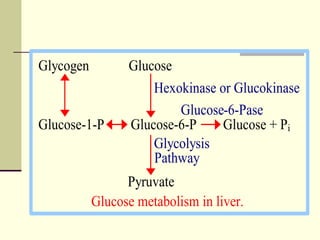
Glycogen Glucose
Hexokinase or Glucokinase
Glucose-6-Pase
Glucose-1-P Glucose-6-P Glucose + Pi
Glycolysis
Pathway
Pyruvate
Glucose metabolism in liver.
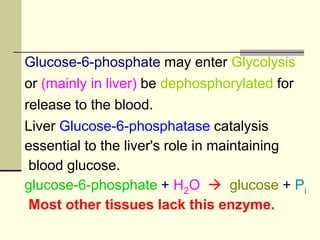
Glucose-6-phosphate may enter Glycolysis
or (mainly in liver) be dephosphorylated for
release to the blood.
Liver Glucose-6-phosphatase catalysis
essential to the liver's role in maintaining
blood glucose.
glucose-6-phosphate + H2O  glucose + Pi
Most other tissues lack this enzyme.
Uridine diphosphate glucose
(UDP-glucose) is the immediate precursor
for glycogen synthesis.
As glucose residues are added to
glycogen, UDP-glucose is the substrate
and UDP is released as a reaction product.
Glycogen synthesis
Glycogenin
Glycogenin initiates glycogen
synthesis.
Glycogenin is an enzyme that
catalyzes attachment of a glucose
molecule to one of its own tyrosine
residues.
Glycogen Synthase
Glycogen Synthase catalyzes the
transfer of glucose moiety of
UDP-glucose to the residue of a
glycogen chain to form a glycosidic
linkage.
Glycogen breakdown is
inhibited when ATP and
glucose-6-phosphate are
plentiful.
Glycogen Synthase
 Glycogen Synthase is activated by
glucose-6-P.
 Thus Glycogen Synthase is active when
high blood glucose leads to elevated
intracellular glucose-6-P.
 It is useful to a cell to store glucose as
glycogen when the input to Glycolysis
(glucose-6-P), and the main product of
Glycolysis (ATP), are adequate.
Glycolysis is the metabolic pathway that
converts glucose C₆H₁₂O₆, into pyruvate,. The
free energy released in this process is used to
form the high-energy molecules ATP and NADH.
Glycolysis is a sequence of ten enzyme-
catalyzed reactions.
The net end products of glycolysis are two Pyruvate,
two NADH, and two ATP (A special note on the
"two" ATP later).
The hormones glucagon and epinephrine
activate cAMP (Cyclic adenosine monophosphate)
cascades leading to
glycogenolysis. Both hormones are produced
in response to low blood sugar.
 Glucagon, which is synthesized by a-cells
of the pancreas, activates cAMP formation in
liver.
 Epinephrine activates cAMP formation in
muscle.
The insulin antagonizes
effects of the cAMP cascade
induced by glucagon &
epinephrine.
Phosphorylation of the enzyme
via a cAMP cascade induced by epinephrine,
results in further activation.
These regulatory processes ensure release of
phosphorylated glucose from glycogen, for
entry into Glycolysis to provide ATP needed for
muscle contraction.
Phosphorylation of the enzyme
During extended exercise, as glycogen stores
become depleted, muscle cells rely more on
glucose uptake from the blood, and
on fatty acid catabolism as a source of ATP.
GLYCOGEN
STORAGE
DISEASES.
GLYCOGEN STORAGE DISEASES.
 Glycogen serves as the primary fuel
reserves for the body, s energy needs.
 Glycogen storage disease (GSD) are
genetically linked metabolic disorders
that involve the enzyme regulating
glycogen metabolism.
GLYCOGEN STORAGE DISEASES.
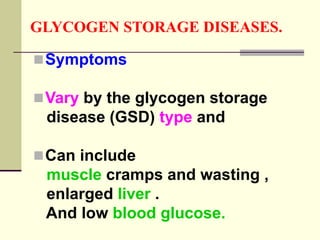
Symptoms
Vary by the glycogen storage
disease (GSD) type and
Can include
muscle cramps and wasting ,
enlarged liver .
And low blood glucose.
Glycogen Storage Diseases
Glycogen Storage Diseases are genetic
enzyme deficiencies associated with
excessive glycogen accumulation within
cells.
Some enzymes whose deficiency leads
to glycogen accumulation are part of the
inter-connected pathways.
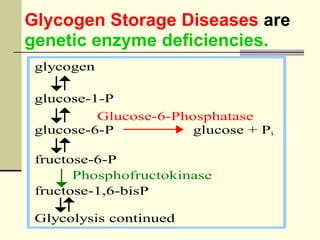
Glycogen Storage Diseases are
genetic enzyme deficiencies.
glycogen
glucose-1-P
Glucose-6-Phosphatase
glucose-6-P glucose + Pi
fructose-6-P
Phosphofructokinase
fructose-1,6-bisP
Glycolysis continued
Symptoms in addition to
excess glycogen storage:
 When a genetic defect affects mainly an
isoform of an enzyme expressed in
liver, a common symptom is
hypoglycemia, relating to impaired
mobilization of glucose for release to
the blood during fasting.
Symptoms in addition to
excess glycogen storage:
 When the defect is in muscle tissue,
weakness & difficulty with exercise
result from inability to increase glucose
entry into Glycolysis during exercise.
Symptoms in addition to
excess glycogen storage:
 Additional symptoms
depend on the particular
enzyme that is deficient.
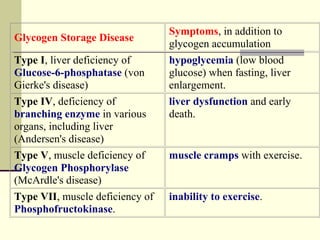
Glycogen Storage Disease
Symptoms, in addition to
glycogen accumulation
Type I, liver deficiency of
Glucose-6-phosphatase (von
Gierke's disease)
hypoglycemia (low blood
glucose) when fasting, liver
enlargement.
Type IV, deficiency of
branching enzyme in various
organs, including liver
(Andersen's disease)
liver dysfunction and early
death.
Type V, muscle deficiency of
Glycogen Phosphorylase
(McArdle's disease)
muscle cramps with exercise.
Type VII, muscle deficiency of
Phosphofructokinase.
inability to exercise.
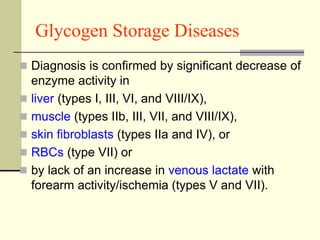
Glycogen Storage Diseases
 Diagnosis is confirmed by significant decrease of
enzyme activity in
 liver (types I, III, VI, and VIII/IX),
 muscle (types IIb, III, VII, and VIII/IX),
 skin fibroblasts (types IIa and IV), or
 RBCs (type VII) or
 by lack of an increase in venous lactate with
forearm activity/ischemia (types V and VII).
GLYCOGEN STORAGE DISEASES.
 The glycogen metabolism require a complex
system of enzymes.
 Various enzyme defects produces various
diseases.
 The most common form is type 1 or von-
gierkes disease. There is deficiency of
glucose-6-phosphatase which is required for
breakdown of glycogen and release of glucose
in liver , kidney and intestine.
GLYCOGEN STORAGE DISEASES.
 The diagnosis is made
 Directly by demonstrating the
absence of enzyme in liver biopsy
specimen , or
 Indirectly by demonstrating the
failure of plasma glucose levels to
rise after giving glucagon to
stimulate glycogenolysis.
GLYCOGEN STORAGE DISEASES.
Treatment.
Frequent meals should be given to
Maintain
normal plasma glucose levels
and to
Prevent cerebral damage.
A genetic defect in the isoform of an
enzyme expressed in liver causes the
following symptoms:
 After eating a CHO meal,
elevated blood levels of glucose,
lactate, & lipids.
 During fasting, low blood glucose &
high ketone bodies.
Which liver enzyme
is defective?
Glycogen Synthase
Explain Symptoms:
 After eating, blood glucose is high
because liver cannot store it as glycogen.
Some excess glucose is processed via
Glycolysis to produce lactate & fatty acid
precursors.
 During fasting, glucose is low because the
liver lacks glycogen stores for generation
of glucose.
Ketone bodies are produced as an
alternative fuel.
Nutritional treatment for deficiency of
liver Glycogen Synthase?
 Frequent meals of complex
carbohydrates
 Avoid simple sugars that would lead to a
rapid rise in blood glucose.
 Meals high in protein to provide
substrates for gluconeogenesis.
THANK YOU

Final lect; 8 glycogen storage diseases

  • 1.
  • 2.
  • 3.
    A glycogen storagedisease (GSD, also glycogenosis and dextrinosis) is a metabolic disorder caused by enzyme deficiencies affecting either glycogen synthesis, , glycogen breakdown or glycolysis (glucose breakdown), typically in muscles and/or liver cells. GSD has two classes of cause: 1. Genetic 2. Acquired GLYCOGEN STORAGE DISEASES.
  • 4.
    Glycogen Glycogen is apolymer of glucose residues linked by α-1,4-glycosidic bonds. Glucose is stored as glycogen predominantly in liver and muscle cells.
  • 5.
    Glycogen Phosphorylase catalyzes phosphorolyticcleavage of the glycosidic linkages of glycogen, releasing glucose-1-phosphate as reaction product. Glycogen catabolism (breakdown):
  • 6.
    Glycogen Glucose Hexokinase orGlucokinase Glucose-6-Pase Glucose-1-P Glucose-6-P Glucose + Pi Glycolysis Pathway Pyruvate Glucose metabolism in liver.
  • 8.
    Glucose-6-phosphate may enterGlycolysis or (mainly in liver) be dephosphorylated for release to the blood. Liver Glucose-6-phosphatase catalysis essential to the liver's role in maintaining blood glucose. glucose-6-phosphate + H2O  glucose + Pi Most other tissues lack this enzyme.
  • 9.
    Uridine diphosphate glucose (UDP-glucose)is the immediate precursor for glycogen synthesis. As glucose residues are added to glycogen, UDP-glucose is the substrate and UDP is released as a reaction product. Glycogen synthesis
  • 10.
    Glycogenin Glycogenin initiates glycogen synthesis. Glycogeninis an enzyme that catalyzes attachment of a glucose molecule to one of its own tyrosine residues.
  • 11.
    Glycogen Synthase Glycogen Synthasecatalyzes the transfer of glucose moiety of UDP-glucose to the residue of a glycogen chain to form a glycosidic linkage.
  • 12.
    Glycogen breakdown is inhibitedwhen ATP and glucose-6-phosphate are plentiful.
  • 13.
    Glycogen Synthase  GlycogenSynthase is activated by glucose-6-P.  Thus Glycogen Synthase is active when high blood glucose leads to elevated intracellular glucose-6-P.  It is useful to a cell to store glucose as glycogen when the input to Glycolysis (glucose-6-P), and the main product of Glycolysis (ATP), are adequate.
  • 14.
    Glycolysis is themetabolic pathway that converts glucose C₆H₁₂O₆, into pyruvate,. The free energy released in this process is used to form the high-energy molecules ATP and NADH. Glycolysis is a sequence of ten enzyme- catalyzed reactions. The net end products of glycolysis are two Pyruvate, two NADH, and two ATP (A special note on the "two" ATP later).
  • 15.
    The hormones glucagonand epinephrine activate cAMP (Cyclic adenosine monophosphate) cascades leading to glycogenolysis. Both hormones are produced in response to low blood sugar.  Glucagon, which is synthesized by a-cells of the pancreas, activates cAMP formation in liver.  Epinephrine activates cAMP formation in muscle.
  • 16.
    The insulin antagonizes effectsof the cAMP cascade induced by glucagon & epinephrine.
  • 17.
    Phosphorylation of theenzyme via a cAMP cascade induced by epinephrine, results in further activation. These regulatory processes ensure release of phosphorylated glucose from glycogen, for entry into Glycolysis to provide ATP needed for muscle contraction.
  • 18.
    Phosphorylation of theenzyme During extended exercise, as glycogen stores become depleted, muscle cells rely more on glucose uptake from the blood, and on fatty acid catabolism as a source of ATP.
  • 19.
  • 20.
    GLYCOGEN STORAGE DISEASES. Glycogen serves as the primary fuel reserves for the body, s energy needs.  Glycogen storage disease (GSD) are genetically linked metabolic disorders that involve the enzyme regulating glycogen metabolism.
  • 21.
    GLYCOGEN STORAGE DISEASES. Symptoms Varyby the glycogen storage disease (GSD) type and Can include muscle cramps and wasting , enlarged liver . And low blood glucose.
  • 22.
    Glycogen Storage Diseases GlycogenStorage Diseases are genetic enzyme deficiencies associated with excessive glycogen accumulation within cells. Some enzymes whose deficiency leads to glycogen accumulation are part of the inter-connected pathways.
  • 23.
    Glycogen Storage Diseasesare genetic enzyme deficiencies. glycogen glucose-1-P Glucose-6-Phosphatase glucose-6-P glucose + Pi fructose-6-P Phosphofructokinase fructose-1,6-bisP Glycolysis continued
  • 24.
    Symptoms in additionto excess glycogen storage:  When a genetic defect affects mainly an isoform of an enzyme expressed in liver, a common symptom is hypoglycemia, relating to impaired mobilization of glucose for release to the blood during fasting.
  • 25.
    Symptoms in additionto excess glycogen storage:  When the defect is in muscle tissue, weakness & difficulty with exercise result from inability to increase glucose entry into Glycolysis during exercise.
  • 26.
    Symptoms in additionto excess glycogen storage:  Additional symptoms depend on the particular enzyme that is deficient.
  • 27.
    Glycogen Storage Disease Symptoms,in addition to glycogen accumulation Type I, liver deficiency of Glucose-6-phosphatase (von Gierke's disease) hypoglycemia (low blood glucose) when fasting, liver enlargement. Type IV, deficiency of branching enzyme in various organs, including liver (Andersen's disease) liver dysfunction and early death. Type V, muscle deficiency of Glycogen Phosphorylase (McArdle's disease) muscle cramps with exercise. Type VII, muscle deficiency of Phosphofructokinase. inability to exercise.
  • 28.
    Glycogen Storage Diseases Diagnosis is confirmed by significant decrease of enzyme activity in  liver (types I, III, VI, and VIII/IX),  muscle (types IIb, III, VII, and VIII/IX),  skin fibroblasts (types IIa and IV), or  RBCs (type VII) or  by lack of an increase in venous lactate with forearm activity/ischemia (types V and VII).
  • 29.
    GLYCOGEN STORAGE DISEASES. The glycogen metabolism require a complex system of enzymes.  Various enzyme defects produces various diseases.  The most common form is type 1 or von- gierkes disease. There is deficiency of glucose-6-phosphatase which is required for breakdown of glycogen and release of glucose in liver , kidney and intestine.
  • 30.
    GLYCOGEN STORAGE DISEASES. The diagnosis is made  Directly by demonstrating the absence of enzyme in liver biopsy specimen , or  Indirectly by demonstrating the failure of plasma glucose levels to rise after giving glucagon to stimulate glycogenolysis.
  • 31.
    GLYCOGEN STORAGE DISEASES. Treatment. Frequentmeals should be given to Maintain normal plasma glucose levels and to Prevent cerebral damage.
  • 32.
    A genetic defectin the isoform of an enzyme expressed in liver causes the following symptoms:  After eating a CHO meal, elevated blood levels of glucose, lactate, & lipids.  During fasting, low blood glucose & high ketone bodies.
  • 33.
    Which liver enzyme isdefective? Glycogen Synthase
  • 34.
    Explain Symptoms:  Aftereating, blood glucose is high because liver cannot store it as glycogen. Some excess glucose is processed via Glycolysis to produce lactate & fatty acid precursors.  During fasting, glucose is low because the liver lacks glycogen stores for generation of glucose. Ketone bodies are produced as an alternative fuel.
  • 35.
    Nutritional treatment fordeficiency of liver Glycogen Synthase?  Frequent meals of complex carbohydrates  Avoid simple sugars that would lead to a rapid rise in blood glucose.  Meals high in protein to provide substrates for gluconeogenesis.
  • 36.