COMSATS Institute of Information Technology
Defence Road, Off Raiwind Road, Lahore,
Pakistan
Chemistry of Petrochemical Processes
Chemicals based on Ethylene
Presented by Group #7
• Hafiz Annus Mahmood CIIT/SP10-BEC-015/LHR
• Mohammad Abubakar CIIT/SP10-BEC-022/LHR
• Noaman Ahmed CIIT/SP10-BEC-037/LHR
• Saim Khan CIIT/SP10-BEC-044/LHR
Outline
• Brief introduction of ethylene
• Properties of ethylene
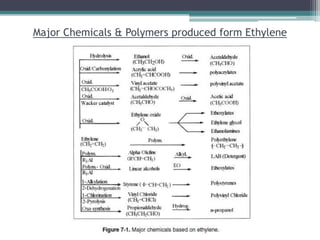
• List of major products of ethylene
• Discussion of products obtained from ethylene
▫ Ethylene Glycol
▫ Acetaldehyde
• Conclusion
• References
Ethylene – An Introduction
• Ethylene is a hydrocarbon with a chemical formula
C2H4
Ethylene – Properties
• Colorless, flammable gas with a sweet and musky odor in
its pure form
• Simple structure
• High reactivity
• Relatively inexpensive
• Produces less by-products, during reactions with other
compounds, as compared to other olefins
Ethylene – Properties (contd.)
• Raw material for various chemicals and polymers e.g., ethanol and
polyethylene
• Easily produced from any hydrocarbon source through steam-cracking
• Molecular weight – 28.05 g/mol
• Density - 1.178 kg/m3 at 15 °C, gas
• At standard conditions,
▫ Melting point is −169.2 °C or 104.0 K
▫ Boiling point is −103.7 °C or 169.5 K
Major Chemicals & Polymers produced form Ethylene
Products of Ethylene
ETHYLENE OXIDE
Ethylene Oxide
• A precursor for many important commercial
chemicals such as,
▫ Ethylene glycol
▫ Ethanolamines
▫ Polyesters
Ethylene Oxide - Production
• Main reaction is controlled oxidation (either using
oxygen or air) of ethylene over a silver catalyst
• Reaction is exothermic and heat content should be
controlled
• Excessive temperature increase and over-oxidation
causes complete combustion of ethylene liberating water
and carbon dioxide
• Catalyst deteriorates at high temperature
Ethylene Oxide - Production (contd.)
Ethylene Oxide
Ethylene Oxide - Production (contd.)
• Why use oxygen instead of air ?
• Oxygen (> 95% purity) is preferred for several reasons
such as,
▫ Higher molar yield of ethylene oxide (75–82% for oxygen
vs. 63–75% for air)
▫ Higher reaction rate (no gas dilution)
▫ No need of separating nitrogen in the reaction products
Ethylene Oxide - Production (contd.)
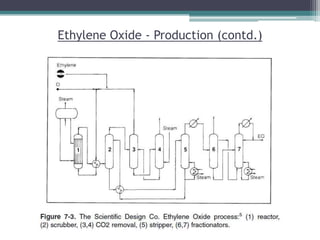
• Compressed oxygen, ethylene, and recycled gas are fed to a
multi-tubular reactor
• The temperature of oxidation is controlled by boiling water in
the shell side of the reactor
• Effluent gases are cooled and passed to the scrubber where
ethylene oxide is absorbed as a dilute aqueous solution
• Un-reacted gases are recycled
• Epoxidation reaction occurs at approximately 200–300°C with
a short residence time of one second
Ethylene Oxide - Production (contd.)
• A selectivity of 70–75% can be reached for the
oxygen based process
• Ethylene oxide selectivity can be improved when the
reaction temperature is lowered and the conversion
of ethylene is decreased (higher recycle of un-
reacted gases)
Products of Ethylene
ACETALDEHYDE
Acetaldehyde
• A colorless liquid with a pungent odor
• A reactive compound with no direct use except for
the synthesis of other compounds e.g., raw material
for production of acetic acid
Acetaldehyde - Production
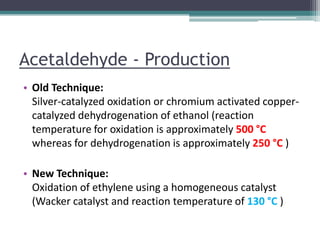
• Old Technique:
Silver-catalyzed oxidation or chromium activated copper-
catalyzed dehydrogenation of ethanol (reaction
temperature for oxidation is approximately 500 °C
whereas for dehydrogenation is approximately 250 °C )
• New Technique:
Oxidation of ethylene using a homogeneous catalyst
(Wacker catalyst and reaction temperature of 130 °C )
Acetaldehyde – Production (contd.)
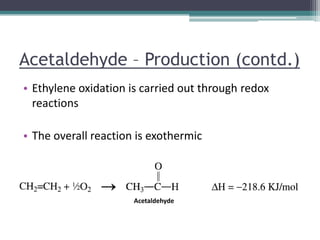
• Ethylene oxidation is carried out through redox
reactions
• The overall reaction is exothermic
Acetaldehyde
Acetaldehyde – Production (contd.)
The Wacker Process
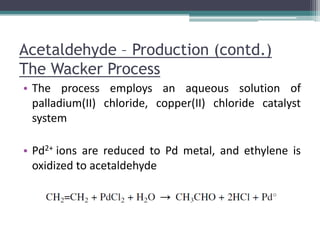
• The process employs an aqueous solution of
palladium(II) chloride, copper(II) chloride catalyst
system
• Pd2+ ions are reduced to Pd metal, and ethylene is
oxidized to acetaldehyde
Acetaldehyde – Production (contd.)
The Wacker Process (contd.)
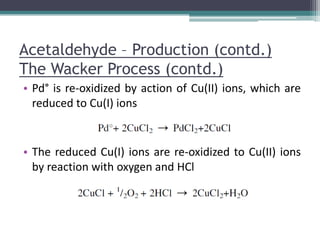
• Pd° is re-oxidized by action of Cu(II) ions, which are
reduced to Cu(I) ions
• The reduced Cu(I) ions are re-oxidized to Cu(II) ions
by reaction with oxygen and HCl
Acetaldehyde – Production (contd.)
• The oxidation reaction may be carried out in a single-
stage or a two stage process
▫ In the single-stage, ethylene, oxygen, and recycled gas are
fed into a vertical reactor containing the catalyst solution.
Heat is controlled by boiling off some of the water. The
reaction conditions are approximately 130°C and 3
atmospheres
▫ In the two-stage process, the reaction occurs under
relatively higher pressure (approximately 8 atmospheres) to
ensure higher ethylene conversion. The reaction
temperature is approximately 130°C
Acetaldehyde – Production (contd.)
• The yield of acetaldehyde from either process is
about 95%
• By-products from this reaction include acetic acid,
ethyl chloride, chloroacetaldehyde, and carbon
dioxide
Conclusion
Conclusion
• Ethylene is indeed one of the most important raw
materials for manufacturing of various chemicals and
polymers
• It is sometimes referred to as the “king of
petrochemicals”
• It has great commercial importance and thus
improvements should be continuously made in its
manufacturing, in order to increase production of
various other petrochemicals
References
1. S. Matar, Ph.D., Chemistry of Petrochemical
Processes, 2nd Ed., Gulf Publishing Company,
Houston, Texas
2. http://en.wikipedia.org/wiki/Ethylene_oxide
3. http://en.wikipedia.org/wiki/Acetaldehyde
HAVE A NICE DAY ! 

Chemicals based on ethylene

  • 1.
    COMSATS Institute ofInformation Technology Defence Road, Off Raiwind Road, Lahore, Pakistan
  • 2.
    Chemistry of PetrochemicalProcesses Chemicals based on Ethylene
  • 3.
    Presented by Group#7 • Hafiz Annus Mahmood CIIT/SP10-BEC-015/LHR • Mohammad Abubakar CIIT/SP10-BEC-022/LHR • Noaman Ahmed CIIT/SP10-BEC-037/LHR • Saim Khan CIIT/SP10-BEC-044/LHR
  • 4.
    Outline • Brief introductionof ethylene • Properties of ethylene • List of major products of ethylene • Discussion of products obtained from ethylene ▫ Ethylene Glycol ▫ Acetaldehyde • Conclusion • References
  • 5.
    Ethylene – AnIntroduction • Ethylene is a hydrocarbon with a chemical formula C2H4
  • 6.
    Ethylene – Properties •Colorless, flammable gas with a sweet and musky odor in its pure form • Simple structure • High reactivity • Relatively inexpensive • Produces less by-products, during reactions with other compounds, as compared to other olefins
  • 7.
    Ethylene – Properties(contd.) • Raw material for various chemicals and polymers e.g., ethanol and polyethylene • Easily produced from any hydrocarbon source through steam-cracking • Molecular weight – 28.05 g/mol • Density - 1.178 kg/m3 at 15 °C, gas • At standard conditions, ▫ Melting point is −169.2 °C or 104.0 K ▫ Boiling point is −103.7 °C or 169.5 K
  • 8.
    Major Chemicals &Polymers produced form Ethylene
  • 9.
  • 10.
    Ethylene Oxide • Aprecursor for many important commercial chemicals such as, ▫ Ethylene glycol ▫ Ethanolamines ▫ Polyesters
  • 11.
    Ethylene Oxide -Production • Main reaction is controlled oxidation (either using oxygen or air) of ethylene over a silver catalyst • Reaction is exothermic and heat content should be controlled • Excessive temperature increase and over-oxidation causes complete combustion of ethylene liberating water and carbon dioxide • Catalyst deteriorates at high temperature
  • 12.
    Ethylene Oxide -Production (contd.) Ethylene Oxide
  • 13.
    Ethylene Oxide -Production (contd.) • Why use oxygen instead of air ? • Oxygen (> 95% purity) is preferred for several reasons such as, ▫ Higher molar yield of ethylene oxide (75–82% for oxygen vs. 63–75% for air) ▫ Higher reaction rate (no gas dilution) ▫ No need of separating nitrogen in the reaction products
  • 14.
    Ethylene Oxide -Production (contd.)
  • 15.
    Ethylene Oxide -Production (contd.) • Compressed oxygen, ethylene, and recycled gas are fed to a multi-tubular reactor • The temperature of oxidation is controlled by boiling water in the shell side of the reactor • Effluent gases are cooled and passed to the scrubber where ethylene oxide is absorbed as a dilute aqueous solution • Un-reacted gases are recycled • Epoxidation reaction occurs at approximately 200–300°C with a short residence time of one second
  • 16.
    Ethylene Oxide -Production (contd.) • A selectivity of 70–75% can be reached for the oxygen based process • Ethylene oxide selectivity can be improved when the reaction temperature is lowered and the conversion of ethylene is decreased (higher recycle of un- reacted gases)
  • 17.
  • 18.
    Acetaldehyde • A colorlessliquid with a pungent odor • A reactive compound with no direct use except for the synthesis of other compounds e.g., raw material for production of acetic acid
  • 19.
    Acetaldehyde - Production •Old Technique: Silver-catalyzed oxidation or chromium activated copper- catalyzed dehydrogenation of ethanol (reaction temperature for oxidation is approximately 500 °C whereas for dehydrogenation is approximately 250 °C ) • New Technique: Oxidation of ethylene using a homogeneous catalyst (Wacker catalyst and reaction temperature of 130 °C )
  • 20.
    Acetaldehyde – Production(contd.) • Ethylene oxidation is carried out through redox reactions • The overall reaction is exothermic Acetaldehyde
  • 21.
    Acetaldehyde – Production(contd.) The Wacker Process • The process employs an aqueous solution of palladium(II) chloride, copper(II) chloride catalyst system • Pd2+ ions are reduced to Pd metal, and ethylene is oxidized to acetaldehyde
  • 22.
    Acetaldehyde – Production(contd.) The Wacker Process (contd.) • Pd° is re-oxidized by action of Cu(II) ions, which are reduced to Cu(I) ions • The reduced Cu(I) ions are re-oxidized to Cu(II) ions by reaction with oxygen and HCl
  • 23.
    Acetaldehyde – Production(contd.) • The oxidation reaction may be carried out in a single- stage or a two stage process ▫ In the single-stage, ethylene, oxygen, and recycled gas are fed into a vertical reactor containing the catalyst solution. Heat is controlled by boiling off some of the water. The reaction conditions are approximately 130°C and 3 atmospheres ▫ In the two-stage process, the reaction occurs under relatively higher pressure (approximately 8 atmospheres) to ensure higher ethylene conversion. The reaction temperature is approximately 130°C
  • 24.
    Acetaldehyde – Production(contd.) • The yield of acetaldehyde from either process is about 95% • By-products from this reaction include acetic acid, ethyl chloride, chloroacetaldehyde, and carbon dioxide
  • 25.
  • 26.
    Conclusion • Ethylene isindeed one of the most important raw materials for manufacturing of various chemicals and polymers • It is sometimes referred to as the “king of petrochemicals” • It has great commercial importance and thus improvements should be continuously made in its manufacturing, in order to increase production of various other petrochemicals
  • 27.
    References 1. S. Matar,Ph.D., Chemistry of Petrochemical Processes, 2nd Ed., Gulf Publishing Company, Houston, Texas 2. http://en.wikipedia.org/wiki/Ethylene_oxide 3. http://en.wikipedia.org/wiki/Acetaldehyde
  • 28.
    HAVE A NICEDAY ! 