POLY-NUCLEAR
HYDROCARBONS
Pt L R College of
pharmacy, faridabad
POLYNUCLEAR AROMATIC
HYDROCARBONS
Def. These are the organic compounds have more than one aromatic
rings & made up of carbon & hydrogens only
Or we can say hydrocarbon made up of isolated or fused aromatic or
non aromatic ring molecules
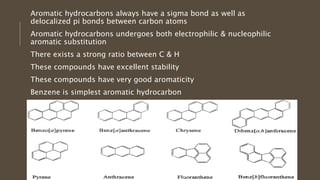
Aromatic hydrocarbons always have a sigma bond as well as
delocalized pi bonds between carbon atoms
Aromatic hydrocarbons undergoes both electrophilic & nucleophilic
aromatic substitution
There exists a strong ratio between C & H
These compounds have excellent stability
These compounds have very good aromaticity
Benzene is simplest aromatic hydrocarbon
POLYAROMATIC HYDROCARBONS
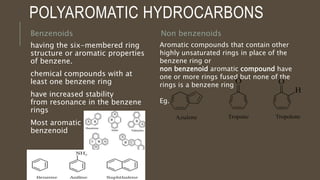
Benzenoids
having the six-membered ring
structure or aromatic properties
of benzene.
chemical compounds with at
least one benzene ring
have increased stability
from resonance in the benzene
rings
Most aromatic hydrocarbons are
benzenoid
Non benzenoids
Aromatic compounds that contain other
highly unsaturated rings in place of the
benzene ring or
non benzenoid aromatic compound have
one or more rings fused but none of the
rings is a benzene ring
Eg.
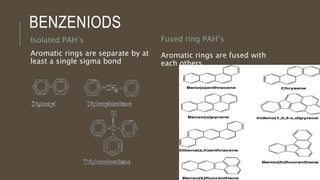
BENZENIODS
Isolated PAH’s
Aromatic rings are separate by at
least a single sigma bond
Fused ring PAH’s
Aromatic rings are fused with
each others
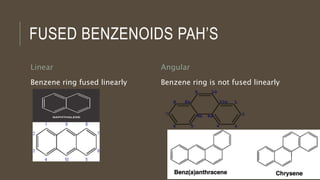
FUSED BENZENOIDS PAH’S
Linear
Benzene ring fused linearly
Angular
Benzene ring is not fused linearly
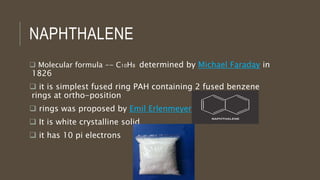
NAPHTHALENE
 Molecular formula -- C10H8 determined by Michael Faraday in
1826
 it is simplest fused ring PAH containing 2 fused benzene
rings at ortho-position
 rings was proposed by Emil Erlenmeyer in 1866
 It is white crystalline solid
 it has 10 pi electrons
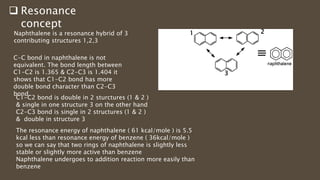
 Resonance
concept
Naphthalene is a resonance hybrid of 3
contributing structures 1,2,3
1 2
3
C-C bond in naphthalene is not
equivalent. The bond length between
C1-C2 is 1.365 & C2-C3 is 1.404 it
shows that C1-C2 bond has more
double bond character than C2-C3
bond.
C1-C2 bond is double in 2 sturctures (1 & 2 )
& single in one structure 3 on the other hand
C2-C3 bond is single in 2 structures (1 & 2 )
& double in structure 3
The resonance energy of naphthalene ( 61 kcal/mole ) is 5.5
kcal less than resonance energy of benzene ( 36kcal/mole )
so we can say that two rings of naphthalene is slightly less
stable or slightly more active than benzene
Naphthalene undergoes to addition reaction more easily than
benzene
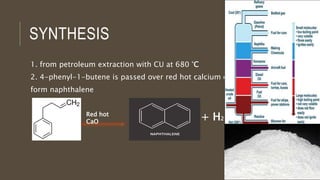
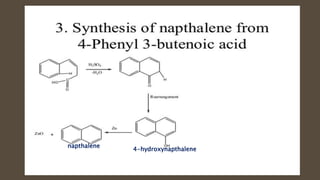
SYNTHESIS
1. from petroleum extraction with CU at 680 °C
2. 4-phenyl-1-butene is passed over red hot calcium oxide to
form naphthalene
Red hot
CaO
+ H2
napthalene
4-hydroxynapthalene
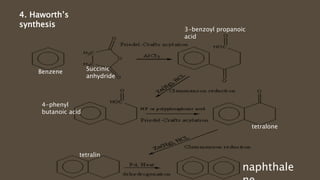
4. Haworth’s
synthesis
Benzene Succinic
anhydride
3-benzoyl propanoic
acid
4-phenyl
butanoic acid
tetralone
tetralin
naphthale
CHEMICAL REACTIONS
Naphthalene is like benzene in chemical properties but it is more
reactive towards substitution reaction & addition reaction
Orientation of disubstitution in naphthalene
Electron releasing or activating groups ( alkyl, OH, CH3O, amino )
when present in the monosubstituted naphthalene ring favour further
substitution in same ring
When ERG is present at position 1 the second substituent goes to
position 4 & some extent to position 2
If ERG is present at position 2 the second substituent goes to position
1
Electron withdrawing groups ( deactivating groups-nitro, sulphonic
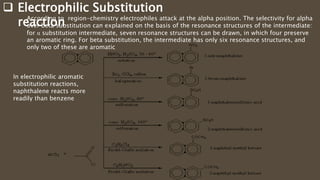
 Electrophilic Substitution
reaction
In electrophilic aromatic
substitution reactions,
naphthalene reacts more
readily than benzene
According to region-chemistry electrophiles attack at the alpha position. The selectivity for alpha
over beta substitution can explained on the basis of the resonance structures of the intermediate:
for α substitution intermediate, seven resonance structures can be drawn, in which four preserve
an aromatic ring. For beta substitution, the intermediate has only six resonance structures, and
only two of these are aromatic
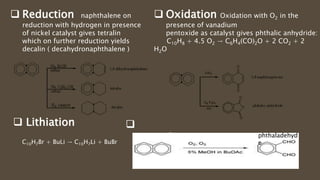
 Reduction naphthalene on
reduction with hydrogen in presence
of nickel catalyst gives tetralin
which on further reduction yields
decalin ( decahydronaphthalene )
 Oxidation Oxidation with O2 in the
presence of vanadium
pentoxide as catalyst gives phthalic anhydride:
C10H8 + 4.5 O2 → C6H4(CO)2O + 2 CO2 + 2
H2O
 Lithiation
C10H7Br + BuLi → C10H7Li + BuBr

Ozonolysis phthaladehyd
e
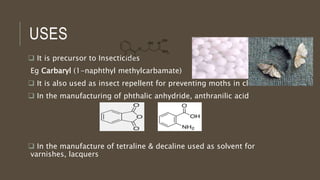
USES
 It is precursor to Insecticides
Eg Carbaryl (1-naphthyl methylcarbamate)
 It is also used as insect repellent for preventing moths in cloths
 In the manufacturing of phthalic anhydride, anthranilic acid
 In the manufacture of tetraline & decaline used as solvent for
varnishes, lacquers
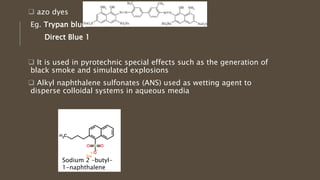
 azo dyes
Eg. Trypan blue
Direct Blue 1
 It is used in pyrotechnic special effects such as the generation of
black smoke and simulated explosions
 Alkyl naphthalene sulfonates (ANS) used as wetting agent to
disperse colloidal systems in aqueous media
Sodium 2 –butyl-
1-naphthalene
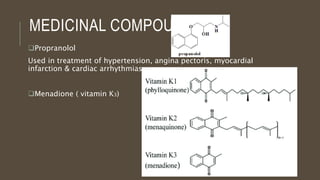
MEDICINAL COMPOUNDS
Propranolol
Used in treatment of hypertension, angina pectoris, myocardial
infarction & cardiac arrhythmias
Menadione ( vitamin K3)
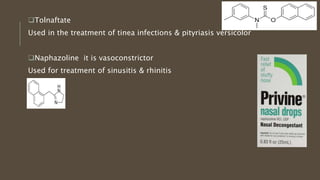
Tolnaftate
Used in the treatment of tinea infections & pityriasis versicolor
Naphazoline it is vasoconstrictor
Used for treatment of sinusitis & rhinitis
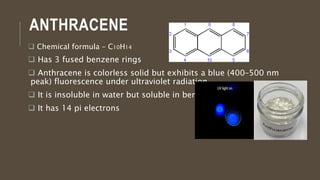
ANTHRACENE
 Chemical formula – C10H14
 Has 3 fused benzene rings
 Anthracene is colorless solid but exhibits a blue (400–500 nm
peak) fluorescence under ultraviolet radiation
 It is insoluble in water but soluble in benzene
 It has 14 pi electrons
 Reonance
concept
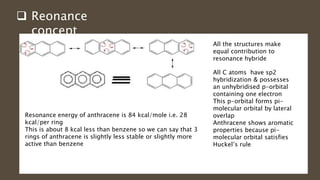
All the structures make
equal contribution to
resonance hybride
Resonance energy of anthracene is 84 kcal/mole i.e. 28
kcal/per ring
This is about 8 kcal less than benzene so we can say that 3
rings of anthracene is slightly less stable or slightly more
active than benzene
All C atoms have sp2
hybridization & possesses
an unhybridised p-orbital
containing one electron
This p-orbital forms pi-
molecular orbital by lateral
overlap
Anthracene shows aromatic
properties because pi-
molecular orbital satisfies
Huckel’s rule
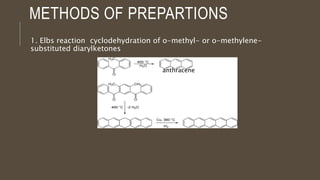
METHODS OF PREPARTIONS
1. Elbs reaction cyclodehydration of o-methyl- or o-methylene-
substituted diarylketones
anthracene
REACTIONS
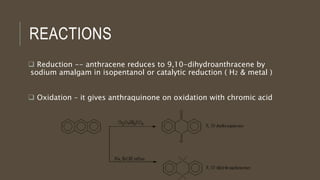
 Reduction -- anthracene reduces to 9,10-dihydroanthracene by
sodium amalgam in isopentanol or catalytic reduction ( H2 & metal )
 Oxidation – it gives anthraquinone on oxidation with chromic acid
CYCLOADDITIONS
2 molecules of
anthracene are
connected by a pair of
new carbon-carbon
bond resulting
dianthracene
Anthracene also reacts
with dienophile singlet
oxygen in a [4+2]-
cycloaddition (Diels–
Alder reaction)
ELECTROPHILIC AROMATIC
SUBSTITUTION
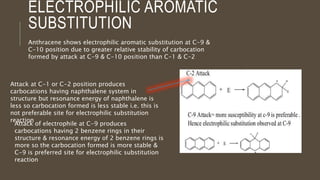
Anthracene shows electrophilic aromatic substitution at C-9 &
C-10 position due to greater relative stability of carbocation
formed by attack at C-9 & C-10 position than C-1 & C-2
Attack of electrophile at C-9 produces
carbocations having 2 benzene rings in their
structure & resonance energy of 2 benzene rings is
more so the carbocation formed is more stable &
C-9 is preferred site for electrophilic substitution
reaction
Attack at C-1 or C-2 position produces
carbocations having naphthalene system in
structure but resonance energy of naphthalene is
less so carbocation formed is less stable i.e. this is
not preferable site for electrophilic substitution
reaction
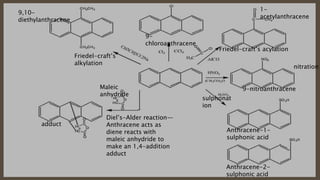
9-nitroanthracene
nitration
Anthracene-1-
sulphonic acid
Anthracene-2-
sulphonic acid
sulphonat
ion
9-
chloroanthracene
1-
acetylanthracene
Friedel-craft’s acylation
9,10-
diethylanthracene
Friedel-craft’s
alkylation
Diel’s-Alder reaction—
Anthracene acts as
diene reacts with
maleic anhydride to
make an 1,4-addition
adduct
Maleic
anhydride
adduct
USES
 It is used as wood preservatives, insecticides, and coating materials.
 It is used in manufacture of
Anthraquinone dyes & dye
stuffs
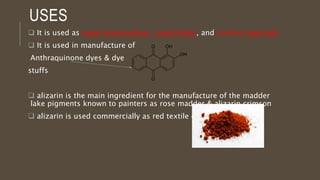
 alizarin is the main ingredient for the manufacture of the madder
lake pigments known to painters as rose madder & alizarin crimson
 alizarin is used commercially as red textile dyes
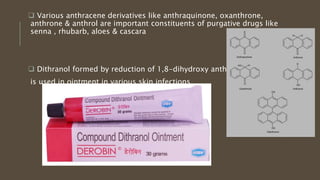
 Various anthracene derivatives like anthraquinone, oxanthrone,
anthrone & anthrol are important constituents of purgative drugs like
senna , rhubarb, aloes & cascara
 Dithranol formed by reduction of 1,8-dihydroxy anthraquinone
is used in ointment in various skin infections
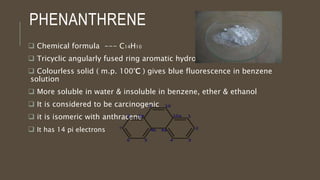
PHENANTHRENE
 Chemical formula --- C14H10
 Tricyclic angularly fused ring aromatic hydrocarbons
 Colourless solid ( m.p. 100°C ) gives blue fluorescence in benzene
solution
 More soluble in water & insoluble in benzene, ether & ethanol
 It is considered to be carcinogenic
 it is isomeric with anthracene
 It has 14 pi electrons
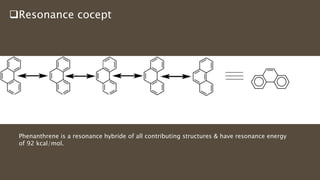
Resonance cocept
Phenanthrene is a resonance hybride of all contributing structures & have resonance energy
of 92 kcal/mol.
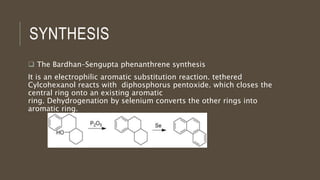
SYNTHESIS
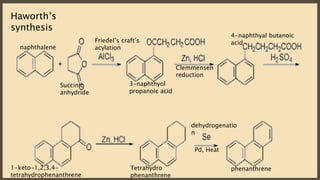
 The Bardhan–Sengupta phenanthrene synthesis
It is an electrophilic aromatic substitution reaction. tethered
Cylcohexanol reacts with diphosphorus pentoxide. which closes the
central ring onto an existing aromatic
ring. Dehydrogenation by selenium converts the other rings into
aromatic ring.
Haworth’s
synthesis
naphthalene
Succinic
anhydride
Friedel’s craft’s
acylation
3-naphthyol
propanoic acid
Clemmensen
reduction
4-naphthyal butanoic
acid
phenanthreneTetrahydro
phenanthrene
1-keto-1,2,3,4-
tetrahydrophenanthrene
Pd, Heat
dehydrogenatio
n
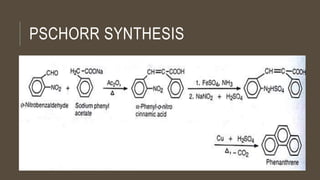
PSCHORR SYNTHESIS
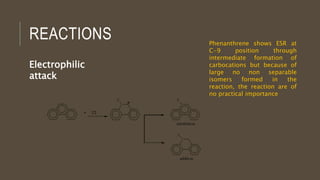
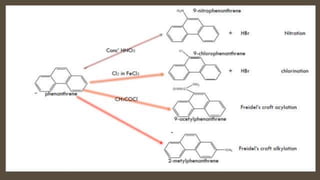
REACTIONS
Electrophilic
attack
Phenanthrene shows ESR at
C-9 position through
intermediate formation of
carbocations but because of
large no non separable
isomers formed in the
reaction, the reaction are of
no practical importance
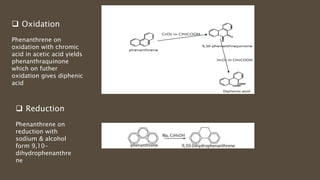
 Oxidation
Phenanthrene on
oxidation with chromic
acid in acetic acid yields
phenanthraquinone
which on futher
oxidation gives diphenic
acid
 Reduction
Phenanthrene on
reduction with
sodium & alcohol
form 9,10-
dihydrophenanthre
ne
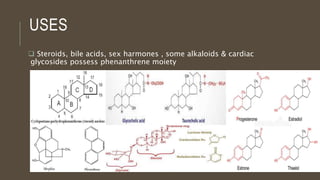
USES
 Steroids, bile acids, sex harmones , some alkaloids & cardiac
glycosides possess phenanthrene moiety
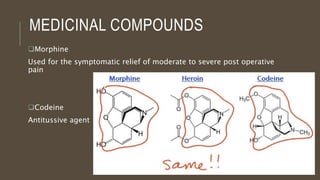
MEDICINAL COMPOUNDS
Morphine
Used for the symptomatic relief of moderate to severe post operative
pain
Codeine
Antitussive agent
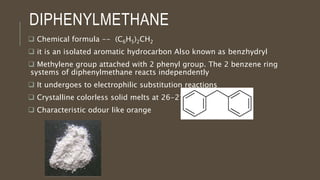
DIPHENYLMETHANE
 Chemical formula -- (C6H5)2CH2
 it is an isolated aromatic hydrocarbon Also known as benzhydryl
 Methylene group attached with 2 phenyl group. The 2 benzene ring
systems of diphenylmethane reacts independently
 It undergoes to electrophilic substitution reactions
 Crystalline colorless solid melts at 26-27 °C
 Characteristic odour like orange
SYNTHESIS
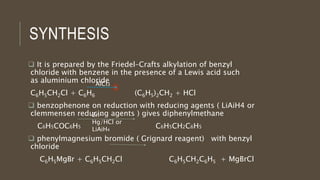
 It is prepared by the Friedel–Crafts alkylation of benzyl
chloride with benzene in the presence of a Lewis acid such
as aluminium chloride
C6H5CH2Cl + C6H6 (C6H5)2CH2 + HCl
 benzophenone on reduction with reducing agents ( LiAiH4 or
clemmensen reducing agents ) gives diphenylmethane
C6H5COC6H5 C6H5CH2C6H5
 phenylmagnesium bromide ( Grignard reagent) with benzyl
chloride
C6H5MgBr + C6H5CH2Cl C6H5CH2C6H5 + MgBrCl
AlCl3
Zn-
Hg/HCl or
LiAiH4
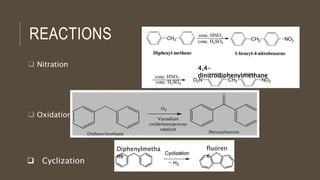
REACTIONS
 Nitration
 Oxidation
4,4-
dinitrodiphenylmethane
 Cyclization
Diphenylmetha
ne
fluoren
e
USES
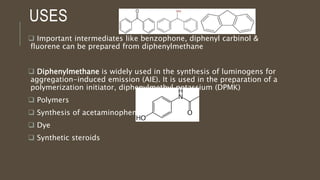
 Important intermediates like benzophone, diphenyl carbinol &
fluorene can be prepared from diphenylmethane
 Diphenylmethane is widely used in the synthesis of luminogens for
aggregation-induced emission (AIE). It is used in the preparation of a
polymerization initiator, diphenylmethyl potassium (DPMK)
 Polymers
 Synthesis of acetaminophen
 Dye
 Synthetic steroids
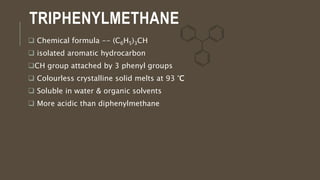
TRIPHENYLMETHANE
 Chemical formula -- (C6H5)3CH
 isolated aromatic hydrocarbon
CH group attached by 3 phenyl groups
 Colourless crystalline solid melts at 93 °C
 Soluble in water & organic solvents
 More acidic than diphenylmethane
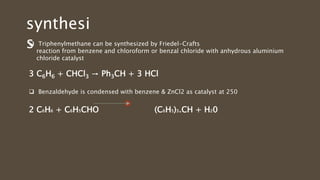
 Triphenylmethane can be synthesized by Friedel-Crafts
reaction from benzene and chloroform or benzal chloride with anhydrous aluminium
chloride catalyst
3 C6H6 + CHCl3 → Ph3CH + 3 HCl
 Benzaldehyde is condensed with benzene & ZnCl2 as catalyst at 250
2 C6H6 + C6H5CHO (C6H5)3.CH + H20
synthesi
s
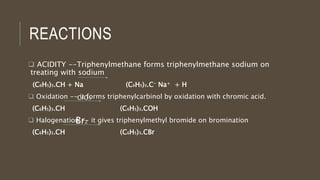
REACTIONS
 ACIDITY --Triphenylmethane forms triphenylmethane sodium on
treating with sodium
(C6H5)3.CH + Na (C6H5)3.C- Na+ + H
 Oxidation -- it forms triphenylcarbinol by oxidation with chromic acid.
(C6H5)3.CH (C6H5)3.COH
 Halogenation -- it gives triphenylmethyl bromide on bromination
(C6H5)3.CH (C6H5)3.CBr
CrO3
Br2
USES
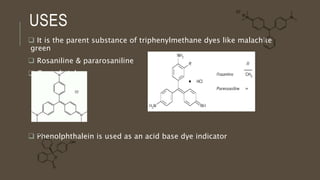
 It is the parent substance of triphenylmethane dyes like malachite
green
 Rosaniline & pararosaniline
 Crystal violet
 Phenolphthalein is used as an acid base dye indicator
THANKS YOU FOR
WATCHING
Like & subscribe

Polycyclic aromatic hydrocarbons

  • 1.
    POLY-NUCLEAR HYDROCARBONS Pt L RCollege of pharmacy, faridabad
  • 2.
    POLYNUCLEAR AROMATIC HYDROCARBONS Def. Theseare the organic compounds have more than one aromatic rings & made up of carbon & hydrogens only Or we can say hydrocarbon made up of isolated or fused aromatic or non aromatic ring molecules
  • 3.
    Aromatic hydrocarbons alwayshave a sigma bond as well as delocalized pi bonds between carbon atoms Aromatic hydrocarbons undergoes both electrophilic & nucleophilic aromatic substitution There exists a strong ratio between C & H These compounds have excellent stability These compounds have very good aromaticity Benzene is simplest aromatic hydrocarbon
  • 4.
    POLYAROMATIC HYDROCARBONS Benzenoids having thesix-membered ring structure or aromatic properties of benzene. chemical compounds with at least one benzene ring have increased stability from resonance in the benzene rings Most aromatic hydrocarbons are benzenoid Non benzenoids Aromatic compounds that contain other highly unsaturated rings in place of the benzene ring or non benzenoid aromatic compound have one or more rings fused but none of the rings is a benzene ring Eg.
  • 5.
    BENZENIODS Isolated PAH’s Aromatic ringsare separate by at least a single sigma bond Fused ring PAH’s Aromatic rings are fused with each others
  • 6.
    FUSED BENZENOIDS PAH’S Linear Benzenering fused linearly Angular Benzene ring is not fused linearly
  • 7.
    NAPHTHALENE  Molecular formula-- C10H8 determined by Michael Faraday in 1826  it is simplest fused ring PAH containing 2 fused benzene rings at ortho-position  rings was proposed by Emil Erlenmeyer in 1866  It is white crystalline solid  it has 10 pi electrons
  • 8.
     Resonance concept Naphthalene isa resonance hybrid of 3 contributing structures 1,2,3 1 2 3 C-C bond in naphthalene is not equivalent. The bond length between C1-C2 is 1.365 & C2-C3 is 1.404 it shows that C1-C2 bond has more double bond character than C2-C3 bond. C1-C2 bond is double in 2 sturctures (1 & 2 ) & single in one structure 3 on the other hand C2-C3 bond is single in 2 structures (1 & 2 ) & double in structure 3 The resonance energy of naphthalene ( 61 kcal/mole ) is 5.5 kcal less than resonance energy of benzene ( 36kcal/mole ) so we can say that two rings of naphthalene is slightly less stable or slightly more active than benzene Naphthalene undergoes to addition reaction more easily than benzene
  • 9.
    SYNTHESIS 1. from petroleumextraction with CU at 680 °C 2. 4-phenyl-1-butene is passed over red hot calcium oxide to form naphthalene Red hot CaO + H2
  • 10.
  • 11.
    4. Haworth’s synthesis Benzene Succinic anhydride 3-benzoylpropanoic acid 4-phenyl butanoic acid tetralone tetralin naphthale
  • 12.
    CHEMICAL REACTIONS Naphthalene islike benzene in chemical properties but it is more reactive towards substitution reaction & addition reaction Orientation of disubstitution in naphthalene Electron releasing or activating groups ( alkyl, OH, CH3O, amino ) when present in the monosubstituted naphthalene ring favour further substitution in same ring When ERG is present at position 1 the second substituent goes to position 4 & some extent to position 2 If ERG is present at position 2 the second substituent goes to position 1 Electron withdrawing groups ( deactivating groups-nitro, sulphonic
  • 13.
     Electrophilic Substitution reaction Inelectrophilic aromatic substitution reactions, naphthalene reacts more readily than benzene According to region-chemistry electrophiles attack at the alpha position. The selectivity for alpha over beta substitution can explained on the basis of the resonance structures of the intermediate: for α substitution intermediate, seven resonance structures can be drawn, in which four preserve an aromatic ring. For beta substitution, the intermediate has only six resonance structures, and only two of these are aromatic
  • 14.
     Reduction naphthaleneon reduction with hydrogen in presence of nickel catalyst gives tetralin which on further reduction yields decalin ( decahydronaphthalene )  Oxidation Oxidation with O2 in the presence of vanadium pentoxide as catalyst gives phthalic anhydride: C10H8 + 4.5 O2 → C6H4(CO)2O + 2 CO2 + 2 H2O  Lithiation C10H7Br + BuLi → C10H7Li + BuBr  Ozonolysis phthaladehyd e
  • 15.
    USES  It isprecursor to Insecticides Eg Carbaryl (1-naphthyl methylcarbamate)  It is also used as insect repellent for preventing moths in cloths  In the manufacturing of phthalic anhydride, anthranilic acid  In the manufacture of tetraline & decaline used as solvent for varnishes, lacquers
  • 16.
     azo dyes Eg.Trypan blue Direct Blue 1  It is used in pyrotechnic special effects such as the generation of black smoke and simulated explosions  Alkyl naphthalene sulfonates (ANS) used as wetting agent to disperse colloidal systems in aqueous media Sodium 2 –butyl- 1-naphthalene
  • 17.
    MEDICINAL COMPOUNDS Propranolol Used intreatment of hypertension, angina pectoris, myocardial infarction & cardiac arrhythmias Menadione ( vitamin K3)
  • 18.
    Tolnaftate Used in thetreatment of tinea infections & pityriasis versicolor Naphazoline it is vasoconstrictor Used for treatment of sinusitis & rhinitis
  • 19.
    ANTHRACENE  Chemical formula– C10H14  Has 3 fused benzene rings  Anthracene is colorless solid but exhibits a blue (400–500 nm peak) fluorescence under ultraviolet radiation  It is insoluble in water but soluble in benzene  It has 14 pi electrons
  • 20.
     Reonance concept All thestructures make equal contribution to resonance hybride Resonance energy of anthracene is 84 kcal/mole i.e. 28 kcal/per ring This is about 8 kcal less than benzene so we can say that 3 rings of anthracene is slightly less stable or slightly more active than benzene All C atoms have sp2 hybridization & possesses an unhybridised p-orbital containing one electron This p-orbital forms pi- molecular orbital by lateral overlap Anthracene shows aromatic properties because pi- molecular orbital satisfies Huckel’s rule
  • 21.
    METHODS OF PREPARTIONS 1.Elbs reaction cyclodehydration of o-methyl- or o-methylene- substituted diarylketones anthracene
  • 22.
    REACTIONS  Reduction --anthracene reduces to 9,10-dihydroanthracene by sodium amalgam in isopentanol or catalytic reduction ( H2 & metal )  Oxidation – it gives anthraquinone on oxidation with chromic acid
  • 23.
    CYCLOADDITIONS 2 molecules of anthraceneare connected by a pair of new carbon-carbon bond resulting dianthracene Anthracene also reacts with dienophile singlet oxygen in a [4+2]- cycloaddition (Diels– Alder reaction)
  • 24.
    ELECTROPHILIC AROMATIC SUBSTITUTION Anthracene showselectrophilic aromatic substitution at C-9 & C-10 position due to greater relative stability of carbocation formed by attack at C-9 & C-10 position than C-1 & C-2 Attack of electrophile at C-9 produces carbocations having 2 benzene rings in their structure & resonance energy of 2 benzene rings is more so the carbocation formed is more stable & C-9 is preferred site for electrophilic substitution reaction Attack at C-1 or C-2 position produces carbocations having naphthalene system in structure but resonance energy of naphthalene is less so carbocation formed is less stable i.e. this is not preferable site for electrophilic substitution reaction
  • 25.
    9-nitroanthracene nitration Anthracene-1- sulphonic acid Anthracene-2- sulphonic acid sulphonat ion 9- chloroanthracene 1- acetylanthracene Friedel-craft’sacylation 9,10- diethylanthracene Friedel-craft’s alkylation Diel’s-Alder reaction— Anthracene acts as diene reacts with maleic anhydride to make an 1,4-addition adduct Maleic anhydride adduct
  • 26.
    USES  It isused as wood preservatives, insecticides, and coating materials.  It is used in manufacture of Anthraquinone dyes & dye stuffs  alizarin is the main ingredient for the manufacture of the madder lake pigments known to painters as rose madder & alizarin crimson  alizarin is used commercially as red textile dyes
  • 27.
     Various anthracenederivatives like anthraquinone, oxanthrone, anthrone & anthrol are important constituents of purgative drugs like senna , rhubarb, aloes & cascara  Dithranol formed by reduction of 1,8-dihydroxy anthraquinone is used in ointment in various skin infections
  • 28.
    PHENANTHRENE  Chemical formula--- C14H10  Tricyclic angularly fused ring aromatic hydrocarbons  Colourless solid ( m.p. 100°C ) gives blue fluorescence in benzene solution  More soluble in water & insoluble in benzene, ether & ethanol  It is considered to be carcinogenic  it is isomeric with anthracene  It has 14 pi electrons
  • 29.
    Resonance cocept Phenanthrene isa resonance hybride of all contributing structures & have resonance energy of 92 kcal/mol.
  • 30.
    SYNTHESIS  The Bardhan–Senguptaphenanthrene synthesis It is an electrophilic aromatic substitution reaction. tethered Cylcohexanol reacts with diphosphorus pentoxide. which closes the central ring onto an existing aromatic ring. Dehydrogenation by selenium converts the other rings into aromatic ring.
  • 31.
    Haworth’s synthesis naphthalene Succinic anhydride Friedel’s craft’s acylation 3-naphthyol propanoic acid Clemmensen reduction 4-naphthyalbutanoic acid phenanthreneTetrahydro phenanthrene 1-keto-1,2,3,4- tetrahydrophenanthrene Pd, Heat dehydrogenatio n
  • 32.
  • 33.
    REACTIONS Electrophilic attack Phenanthrene shows ESRat C-9 position through intermediate formation of carbocations but because of large no non separable isomers formed in the reaction, the reaction are of no practical importance
  • 35.
     Oxidation Phenanthrene on oxidationwith chromic acid in acetic acid yields phenanthraquinone which on futher oxidation gives diphenic acid  Reduction Phenanthrene on reduction with sodium & alcohol form 9,10- dihydrophenanthre ne
  • 36.
    USES  Steroids, bileacids, sex harmones , some alkaloids & cardiac glycosides possess phenanthrene moiety
  • 37.
    MEDICINAL COMPOUNDS Morphine Used forthe symptomatic relief of moderate to severe post operative pain Codeine Antitussive agent
  • 38.
    DIPHENYLMETHANE  Chemical formula-- (C6H5)2CH2  it is an isolated aromatic hydrocarbon Also known as benzhydryl  Methylene group attached with 2 phenyl group. The 2 benzene ring systems of diphenylmethane reacts independently  It undergoes to electrophilic substitution reactions  Crystalline colorless solid melts at 26-27 °C  Characteristic odour like orange
  • 39.
    SYNTHESIS  It isprepared by the Friedel–Crafts alkylation of benzyl chloride with benzene in the presence of a Lewis acid such as aluminium chloride C6H5CH2Cl + C6H6 (C6H5)2CH2 + HCl  benzophenone on reduction with reducing agents ( LiAiH4 or clemmensen reducing agents ) gives diphenylmethane C6H5COC6H5 C6H5CH2C6H5  phenylmagnesium bromide ( Grignard reagent) with benzyl chloride C6H5MgBr + C6H5CH2Cl C6H5CH2C6H5 + MgBrCl AlCl3 Zn- Hg/HCl or LiAiH4
  • 40.
  • 41.
    USES  Important intermediateslike benzophone, diphenyl carbinol & fluorene can be prepared from diphenylmethane  Diphenylmethane is widely used in the synthesis of luminogens for aggregation-induced emission (AIE). It is used in the preparation of a polymerization initiator, diphenylmethyl potassium (DPMK)  Polymers  Synthesis of acetaminophen  Dye  Synthetic steroids
  • 42.
    TRIPHENYLMETHANE  Chemical formula-- (C6H5)3CH  isolated aromatic hydrocarbon CH group attached by 3 phenyl groups  Colourless crystalline solid melts at 93 °C  Soluble in water & organic solvents  More acidic than diphenylmethane
  • 43.
     Triphenylmethane canbe synthesized by Friedel-Crafts reaction from benzene and chloroform or benzal chloride with anhydrous aluminium chloride catalyst 3 C6H6 + CHCl3 → Ph3CH + 3 HCl  Benzaldehyde is condensed with benzene & ZnCl2 as catalyst at 250 2 C6H6 + C6H5CHO (C6H5)3.CH + H20 synthesi s
  • 44.
    REACTIONS  ACIDITY --Triphenylmethaneforms triphenylmethane sodium on treating with sodium (C6H5)3.CH + Na (C6H5)3.C- Na+ + H  Oxidation -- it forms triphenylcarbinol by oxidation with chromic acid. (C6H5)3.CH (C6H5)3.COH  Halogenation -- it gives triphenylmethyl bromide on bromination (C6H5)3.CH (C6H5)3.CBr CrO3 Br2
  • 45.
    USES  It isthe parent substance of triphenylmethane dyes like malachite green  Rosaniline & pararosaniline  Crystal violet  Phenolphthalein is used as an acid base dye indicator
  • 46.