Ethyl Acetate
Submitted by,
Rajasekaran E
Final year- Bachelor of Technology,
Department of Pharmaceutical Technology,
University college of Engineering- BIT Campus,
Anna University,
Tiruchirappalli-24
Ethyl Acetate
• Ethyl acetate is a organic compound with the formula
CH3–COO–CH2–CH3, simplified to C4H8O2.
• Ethyl acetate is the ester of ethanol and acetic acid.
• This is a colourless liquid has a characteristic sweet
smell (similar to peer drops).
• They are manufactured in large quantities for use as a
solvent.
• They are also used in glues, nail polish removers, and in
decaffeinating tea /coffee.
For your knowledge
 Caffeine is a CNS stimulant of Methyl xanthine class present in tea
and coffee.
 Removal of caffeine from the tea leaves,coco,coffee bean,etc. Is
known as decaffeinating process.
 In this process the unroasted beans are soaked in the ethyl acetate and
washed.
 Decaffeinated drinks should contain 1- 2•/• of original caffeine.
Properties
• It is also called as ethyl ethanoate, Acetic ester, acetic ether.
• commonly abbreviated EtOAc, ETAC or EA.
• Lethal dose & concentration:.
 LD 50- 11.3 g/kg (in rat).
 LC 50- 16000 pm (in rat for 6 hed).
• General properties:
 Chemical formula - C4H8O2
 Malar mass- 88.106 g/mol
 Appearance- colourless
 Odour- fruity smell
 The LD50 for rats is 5620 mg/kg, indicating low toxicity,
though there is little risk of toxicity.
 Overexposure to ethyl acetate may cause irritation of the eyes,
nose, and throat.
 Severe overexposure may cause weakness, drowsiness, and
unconsciousness.
 Ethyl acetate is an irritant of the conjunctiva and mucous
membrane of the respiratory tract. Which causes temporary
opacity and eruption of skin.
 At higher concentrations (20,000 to 43,000 ppm (2.0–4.3%))
there may be pulmonary edema with hemorrhages, symptoms
of central nervous system depression, secondary anemia and
liver damage.
 Flammable (F),I.
 Irritant (Xi).
 Flash point - −4 °C (25 °F; 269 K).
 Explosive limits- 2.0–11.5%
Hazards properties
Manufacturing methods
of Ethyl acetate
Production techniques
Fisher esterification process.
Tishchenko reaction.
Dehydrogenation of ethanol.
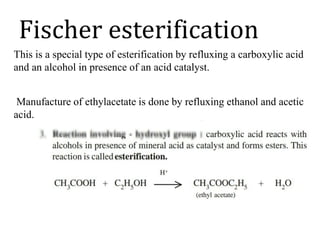
Fischer esterification
This is a special type of esterification by refluxing a carboxylic acid
and an alcohol in presence of an acid catalyst.
Manufacture of ethylacetate is done by refluxing ethanol and acetic
acid.
 Maximum yield obtained from this reaction is 65
percent.
 Equilibrium can be shifted to right by removal of
water.
 One of the easiest technique for dedicated
production.
 Initially in all the chemical industry this technique
is used.
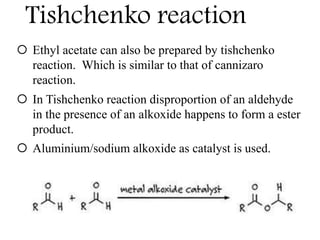
Tishchenko reaction
 Ethyl acetate can also be prepared by tishchenko
reaction. Which is similar to that of cannizaro
reaction.
 In Tishchenko reaction disproportion of an aldehyde
in the presence of an alkoxide happens to form a ester
product.
 Aluminium/sodium alkoxide as catalyst is used.
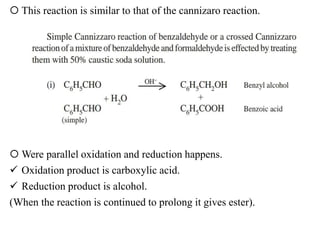
 This reaction is similar to that of the cannizaro reaction.
 Were parallel oxidation and reduction happens.
 Oxidation product is carboxylic acid.
 Reduction product is alcohol.
(When the reaction is continued to prolong it gives ester).
Dehydrogenation of
ethanol
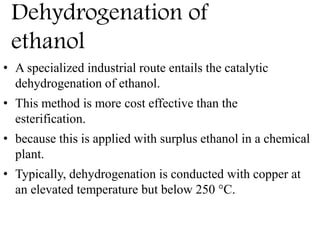
• A specialized industrial route entails the catalytic
dehydrogenation of ethanol.
• This method is more cost effective than the
esterification.
• because this is applied with surplus ethanol in a chemical
plant.
• Typically, dehydrogenation is conducted with copper at
an elevated temperature but below 250 °C.
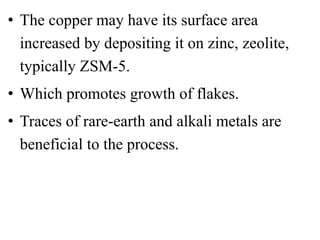
• The copper may have its surface area
increased by depositing it on zinc, zeolite,
typically ZSM-5.
• Which promotes growth of flakes.
• Traces of rare-earth and alkali metals are
beneficial to the process.
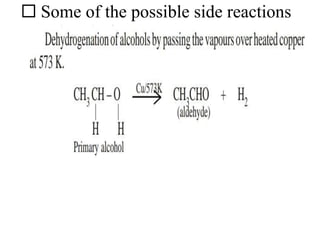
 Some of the possible side reactions
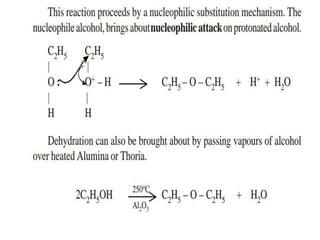
Byproducts of the dehydrogenation include
 diethyl ether, which is thought to arise primarily due to
aluminum sites in the catalyst,
 acetaldehyde and its aldol products, higher esters, and
ketones.
Hence separation of such kinds of mixtures are very tedious
process. Because,
 ethanol forms an azeotrope with water, as does ethyl
acetate with ethanol and water.
 azeotropes are broken by pressure swing distillation or
membrane distillation.
For your knowledge
 An azeotrope is a mixture of two or more liquids whose proportions
cannot be altered or changed by simple distillation.
 This happens because when an azeotrope is boiled, the vapour has
the same proportions of constituents as the unboiled mixture.
 Because their composition is unchanged by distillation, azeotropes
are also called constant boiling point mixtures.
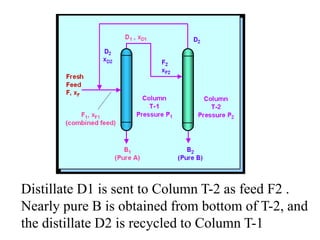
Pressure swing distillation:
Pressure-swing distillation is a method for
separating a pressure-sensitive azeotrope that
utiltizes 2 columns operated in sequence at 2
different pressures.
Distillate D1 is sent to Column T-2 as feed F2 .
Nearly pure B is obtained from bottom of T-2, and
the distillate D2 is recycled to Column T-1
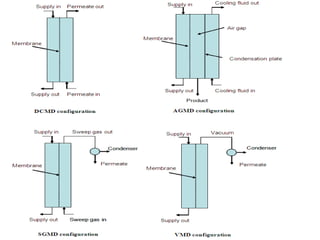
Membrane distillation
 Membrane distillation (MD) is a thermally driven separation process
in which separation is driven by phase change.
 A hydrophobic membrane presents a barrier for the liquid phase,
allowing the vapour phase (e.g. water vapour) to pass through the
membrane's pores.
 The driving force of the process is a partial vapour pressure
difference commonly triggered by a temperature difference.
Uses of ethyl acetate
 Ethyl acetate is used primarily as a solvent and diluent,
being favored because of its low cost, low toxicity, and
agreeable odor.
 it is commonly used to clean circuit boards and in some
nail varnish removers.
 Coffee beans and tea leaves are decaffeinated with this
solvent.
 Ethyl acetate is present in confectionery, perfumes, and
fruits.
 In perfumes, it evaporates quickly, leaving only the scent
of the perfume on the skin.
 Ethyl acetate is the most common ester in wine, being generated
during the fermentation.
 The aroma of ethyl acetate is most vivid in younger wines.
 Excessive amounts of ethyl acetate are considered a wine fault.
 In the field of entomology, ethyl acetate is an effective asphyxiant
for use in insect collecting and study
Laboratory uses
 In the laboratory, mixtures containing ethyl acetate are
commonly used in column chromatography and extractions.
 Ethyl acetate is rarely selected as a reaction solvent because
it is prone to hydrolysis and transesterification.
 Ethyl acetate is fairly volatile at room temperature and has a
boiling point of 77 °C (171 °F).Hence, it can be removed
from a sample by heating in a hot water bath and providing
ventilation with compressed air.
Thank you
for
your patience.
~நன்றி
இ.ராஜசேகரன்

Ethyl acetate

  • 1.
    Ethyl Acetate Submitted by, RajasekaranE Final year- Bachelor of Technology, Department of Pharmaceutical Technology, University college of Engineering- BIT Campus, Anna University, Tiruchirappalli-24
  • 2.
    Ethyl Acetate • Ethylacetate is a organic compound with the formula CH3–COO–CH2–CH3, simplified to C4H8O2. • Ethyl acetate is the ester of ethanol and acetic acid. • This is a colourless liquid has a characteristic sweet smell (similar to peer drops). • They are manufactured in large quantities for use as a solvent. • They are also used in glues, nail polish removers, and in decaffeinating tea /coffee.
  • 3.
    For your knowledge Caffeine is a CNS stimulant of Methyl xanthine class present in tea and coffee.  Removal of caffeine from the tea leaves,coco,coffee bean,etc. Is known as decaffeinating process.  In this process the unroasted beans are soaked in the ethyl acetate and washed.  Decaffeinated drinks should contain 1- 2•/• of original caffeine.
  • 4.
    Properties • It isalso called as ethyl ethanoate, Acetic ester, acetic ether. • commonly abbreviated EtOAc, ETAC or EA. • Lethal dose & concentration:.  LD 50- 11.3 g/kg (in rat).  LC 50- 16000 pm (in rat for 6 hed). • General properties:  Chemical formula - C4H8O2  Malar mass- 88.106 g/mol  Appearance- colourless  Odour- fruity smell
  • 5.
     The LD50for rats is 5620 mg/kg, indicating low toxicity, though there is little risk of toxicity.  Overexposure to ethyl acetate may cause irritation of the eyes, nose, and throat.  Severe overexposure may cause weakness, drowsiness, and unconsciousness.  Ethyl acetate is an irritant of the conjunctiva and mucous membrane of the respiratory tract. Which causes temporary opacity and eruption of skin.  At higher concentrations (20,000 to 43,000 ppm (2.0–4.3%)) there may be pulmonary edema with hemorrhages, symptoms of central nervous system depression, secondary anemia and liver damage.
  • 6.
     Flammable (F),I. Irritant (Xi).  Flash point - −4 °C (25 °F; 269 K).  Explosive limits- 2.0–11.5% Hazards properties
  • 7.
  • 8.
    Production techniques Fisher esterificationprocess. Tishchenko reaction. Dehydrogenation of ethanol.
  • 9.
    Fischer esterification This isa special type of esterification by refluxing a carboxylic acid and an alcohol in presence of an acid catalyst. Manufacture of ethylacetate is done by refluxing ethanol and acetic acid.
  • 11.
     Maximum yieldobtained from this reaction is 65 percent.  Equilibrium can be shifted to right by removal of water.  One of the easiest technique for dedicated production.  Initially in all the chemical industry this technique is used.
  • 12.
    Tishchenko reaction  Ethylacetate can also be prepared by tishchenko reaction. Which is similar to that of cannizaro reaction.  In Tishchenko reaction disproportion of an aldehyde in the presence of an alkoxide happens to form a ester product.  Aluminium/sodium alkoxide as catalyst is used.
  • 13.
     This reactionis similar to that of the cannizaro reaction.  Were parallel oxidation and reduction happens.  Oxidation product is carboxylic acid.  Reduction product is alcohol. (When the reaction is continued to prolong it gives ester).
  • 14.
    Dehydrogenation of ethanol • Aspecialized industrial route entails the catalytic dehydrogenation of ethanol. • This method is more cost effective than the esterification. • because this is applied with surplus ethanol in a chemical plant. • Typically, dehydrogenation is conducted with copper at an elevated temperature but below 250 °C.
  • 15.
    • The coppermay have its surface area increased by depositing it on zinc, zeolite, typically ZSM-5. • Which promotes growth of flakes. • Traces of rare-earth and alkali metals are beneficial to the process.
  • 16.
     Some ofthe possible side reactions
  • 18.
    Byproducts of thedehydrogenation include  diethyl ether, which is thought to arise primarily due to aluminum sites in the catalyst,  acetaldehyde and its aldol products, higher esters, and ketones. Hence separation of such kinds of mixtures are very tedious process. Because,  ethanol forms an azeotrope with water, as does ethyl acetate with ethanol and water.  azeotropes are broken by pressure swing distillation or membrane distillation.
  • 19.
    For your knowledge An azeotrope is a mixture of two or more liquids whose proportions cannot be altered or changed by simple distillation.  This happens because when an azeotrope is boiled, the vapour has the same proportions of constituents as the unboiled mixture.  Because their composition is unchanged by distillation, azeotropes are also called constant boiling point mixtures.
  • 20.
    Pressure swing distillation: Pressure-swingdistillation is a method for separating a pressure-sensitive azeotrope that utiltizes 2 columns operated in sequence at 2 different pressures.
  • 21.
    Distillate D1 issent to Column T-2 as feed F2 . Nearly pure B is obtained from bottom of T-2, and the distillate D2 is recycled to Column T-1
  • 22.
    Membrane distillation  Membranedistillation (MD) is a thermally driven separation process in which separation is driven by phase change.  A hydrophobic membrane presents a barrier for the liquid phase, allowing the vapour phase (e.g. water vapour) to pass through the membrane's pores.  The driving force of the process is a partial vapour pressure difference commonly triggered by a temperature difference.
  • 24.
    Uses of ethylacetate  Ethyl acetate is used primarily as a solvent and diluent, being favored because of its low cost, low toxicity, and agreeable odor.  it is commonly used to clean circuit boards and in some nail varnish removers.  Coffee beans and tea leaves are decaffeinated with this solvent.  Ethyl acetate is present in confectionery, perfumes, and fruits.  In perfumes, it evaporates quickly, leaving only the scent of the perfume on the skin.
  • 25.
     Ethyl acetateis the most common ester in wine, being generated during the fermentation.  The aroma of ethyl acetate is most vivid in younger wines.  Excessive amounts of ethyl acetate are considered a wine fault.  In the field of entomology, ethyl acetate is an effective asphyxiant for use in insect collecting and study
  • 26.
    Laboratory uses  Inthe laboratory, mixtures containing ethyl acetate are commonly used in column chromatography and extractions.  Ethyl acetate is rarely selected as a reaction solvent because it is prone to hydrolysis and transesterification.  Ethyl acetate is fairly volatile at room temperature and has a boiling point of 77 °C (171 °F).Hence, it can be removed from a sample by heating in a hot water bath and providing ventilation with compressed air.
  • 27.