ETHYLENE
OXIDE BY
DIRECT
OXIDATION OF
ETHYLENE
By
Sameer Raza (102112038)
G.Venkatesh (102112025)
CONSUMPTION PATTERNS
Used as a permanent antifreeze for
automobile radiators.
Production of:
Ethylene glycol polyesters
Non-Ionic detergents
Ethanol amines
Methods of Production
Direct oxidation of
ethylene
Chlorohydrination of
ethylene
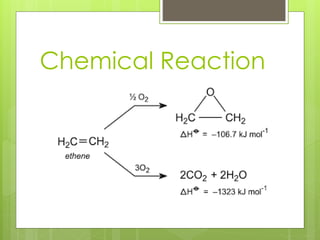
Chemical Reaction
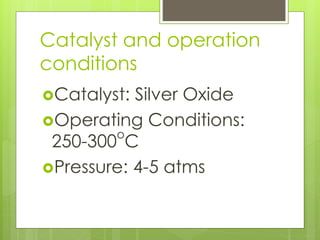
Catalyst and operation
conditions
Catalyst: Silver Oxide
Operating Conditions:
250-300
o
C
Pressure: 4-5 atms
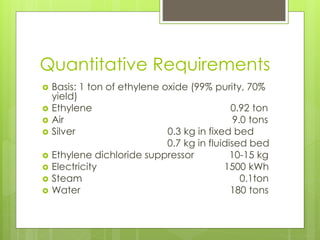
Quantitative Requirements
 Basis: 1 ton of ethylene oxide (99% purity, 70%
yield)
 Ethylene 0.92 ton
 Air 9.0 tons
 Silver 0.3 kg in fixed bed
0.7 kg in fluidised bed
 Ethylene dichloride suppressor 10-15 kg
 Electricity 1500 kWh
 Steam 0.1ton
 Water 180 tons
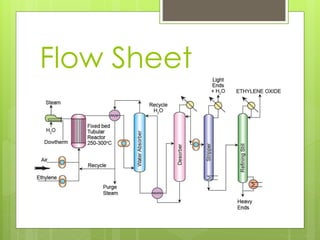
Flow Sheet
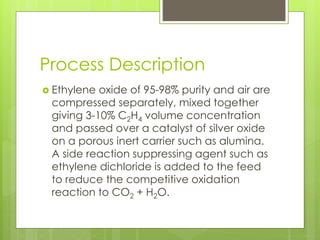
Process Description
 Ethylene oxide of 95-98% purity and air are
compressed separately, mixed together
giving 3-10% C2H4 volume concentration
and passed over a catalyst of silver oxide
on a porous inert carrier such as alumina.
A side reaction suppressing agent such as
ethylene dichloride is added to the feed
to reduce the competitive oxidation
reaction to CO2 + H2O.
 The reaction is highly exothermic and is
best carried out in a fixed bed tubular
reactor in which heat transfer salt or
Dowtherm is pumped around the tube
within the shell to maintain a 250-300oC
temperature. Heat is recovered in a
waste-heat steam boiler. A short
residence time of 1 sec in plug flow is the
design with an ultimate yield of 60-70%.
° The effluent gasses from the reactor are
water washed under pressure. The absorbed
ethylene oxide is sent to a packed bed
desorber-fractionator tower and taken
overhead. It still contains a large amount of
water vapour plus some impurities. This
stream is compressed to 4-5 atm and
fractionated twice to remove the light ends,
water and high boiling polymers.
Major Engineering Problems
 Volume ratio of air
–ethylene.
 Air versus oxygen.
 Hydration of
ethylene oxide to
glycol.
 Fluidized bed
versus fixed bed.
 Use of reactors in
series.
References
 Dryden’s outlines of
chemical
technology.
 http://nptel.ac.in/c
ourses/103103029/1
7
 http://www.essenti
alchemicalindustry.
org/chemicals/epo
xyethane.html

Ethylene oxide by oxidation of E

  • 1.
    ETHYLENE OXIDE BY DIRECT OXIDATION OF ETHYLENE By SameerRaza (102112038) G.Venkatesh (102112025)
  • 2.
    CONSUMPTION PATTERNS Used asa permanent antifreeze for automobile radiators. Production of: Ethylene glycol polyesters Non-Ionic detergents Ethanol amines
  • 3.
    Methods of Production Directoxidation of ethylene Chlorohydrination of ethylene
  • 4.
  • 5.
    Catalyst and operation conditions Catalyst:Silver Oxide Operating Conditions: 250-300 o C Pressure: 4-5 atms
  • 6.
    Quantitative Requirements  Basis:1 ton of ethylene oxide (99% purity, 70% yield)  Ethylene 0.92 ton  Air 9.0 tons  Silver 0.3 kg in fixed bed 0.7 kg in fluidised bed  Ethylene dichloride suppressor 10-15 kg  Electricity 1500 kWh  Steam 0.1ton  Water 180 tons
  • 7.
  • 8.
    Process Description  Ethyleneoxide of 95-98% purity and air are compressed separately, mixed together giving 3-10% C2H4 volume concentration and passed over a catalyst of silver oxide on a porous inert carrier such as alumina. A side reaction suppressing agent such as ethylene dichloride is added to the feed to reduce the competitive oxidation reaction to CO2 + H2O.
  • 9.
     The reactionis highly exothermic and is best carried out in a fixed bed tubular reactor in which heat transfer salt or Dowtherm is pumped around the tube within the shell to maintain a 250-300oC temperature. Heat is recovered in a waste-heat steam boiler. A short residence time of 1 sec in plug flow is the design with an ultimate yield of 60-70%.
  • 10.
    ° The effluentgasses from the reactor are water washed under pressure. The absorbed ethylene oxide is sent to a packed bed desorber-fractionator tower and taken overhead. It still contains a large amount of water vapour plus some impurities. This stream is compressed to 4-5 atm and fractionated twice to remove the light ends, water and high boiling polymers.
  • 11.
    Major Engineering Problems Volume ratio of air –ethylene.  Air versus oxygen.  Hydration of ethylene oxide to glycol.  Fluidized bed versus fixed bed.  Use of reactors in series.
  • 12.
    References  Dryden’s outlinesof chemical technology.  http://nptel.ac.in/c ourses/103103029/1 7  http://www.essenti alchemicalindustry. org/chemicals/epo xyethane.html