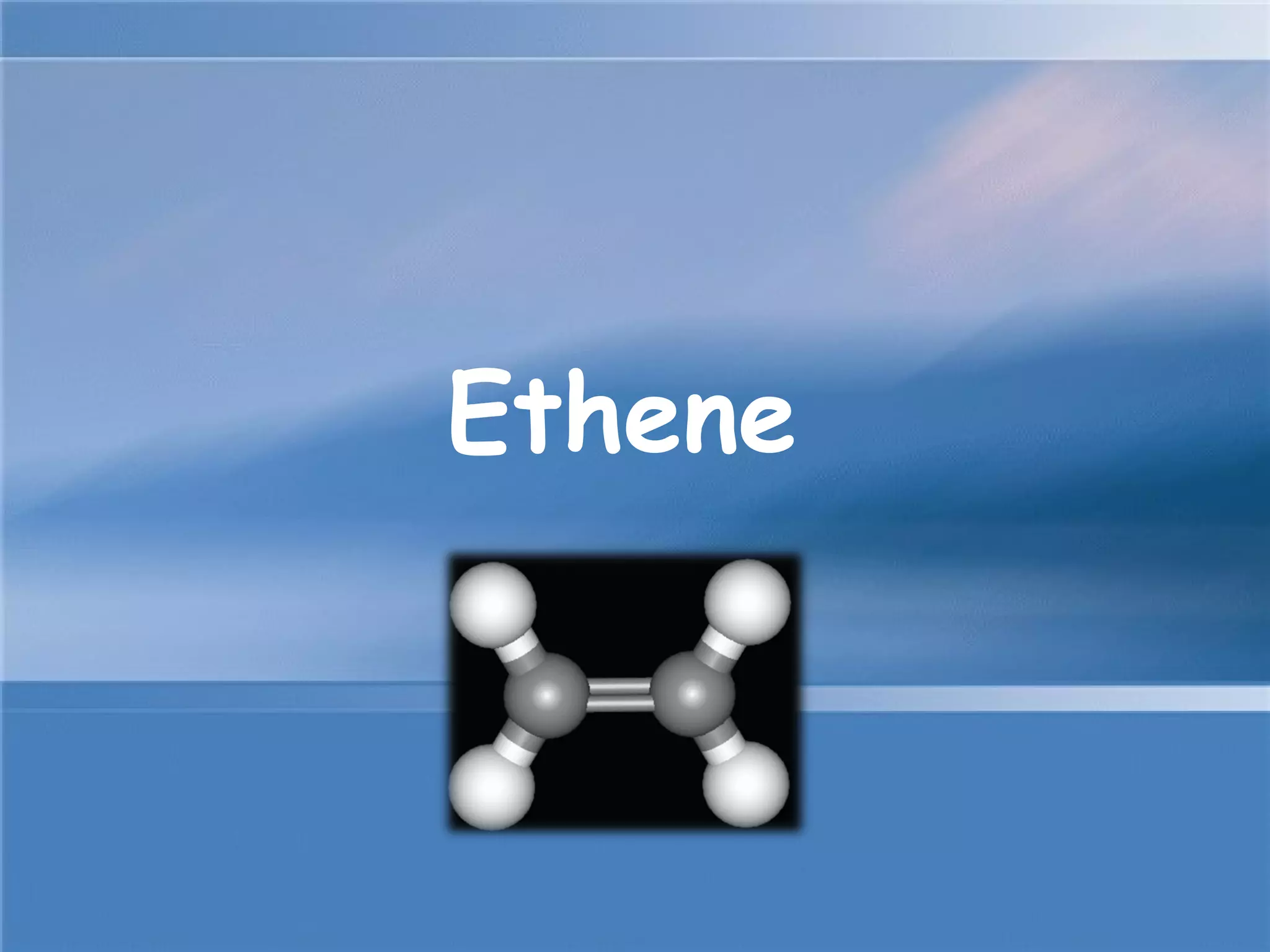
Ethene
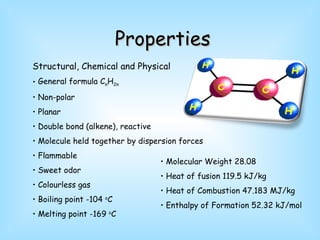
Properties Structural, Chemical and Physical General formula C n H 2n   Non-polar Planar Double bond (alkene), reactive Molecule held together by dispersion forces Flammable Sweet odor Colourless gas Boiling point -104  o C  Melting point -169  o C   Molecular Weight 28.08 Heat of fusion 119.5 kJ/kg Heat of Combustion 47.183 MJ/kg Enthalpy of Formation 52.32 kJ/mol
Reactions Since ethene is an alkene, it follows some characteristic reactions of alkenes. Such reactions include: Addition reactions   –  With water, halogens, hydrogen halides, hydrogen - Halogenation and polymerization are both addition reactions Oxidation reactions - When using potassium permanganate as the oxidant, products of reaction are dependent on the pH condition of the KMnO 4 - Acidic = purple to colourless - Basic/neutral = purple to dark green with brown precipitate Combustion reaction   - The usual. Reacts with oxygen, carbon dioxide and water vapour formed.
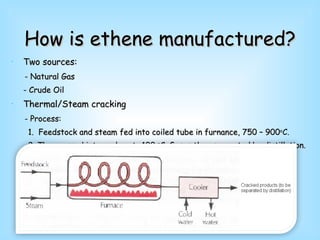
How is ethene manufactured? Two sources: - Natural Gas  - Crude Oil Thermal/Steam cracking - Process: 1.  Feedstock and steam fed into coiled tube in furnance, 750 – 900 o C. 2. Then passed into cooler at -100  o C.  Gases then separated by distillation.
…  and continuing An example of a typical cracking reaction: Ethane forms ethene through the cracking procedure. C2H6 (g)    C2H4 (g) + H2 (g)  ∆H = + 138 KJ/mol Maximum yield at: - High temperature - Pressure just below the atmosphere pressure Other methods of manufacture: Dehydration of ethanol - Presence of a catalyst (sulfuric acid, aluminium oxide, zeolite catalyst) Using cellulose as a raw material - Too costly. In every singly way imaginable.
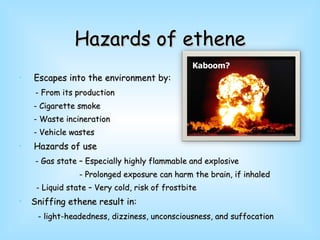
Hazards of ethene Escapes into the environment by: - From its production - Cigarette smoke - Waste incineration - Vehicle wastes Hazards of use - Gas state – Especially highly flammable and explosive - Prolonged exposure can harm the brain, if inhaled - Liquid state – Very cold, risk of frostbite Sniffing ethene result in: - light-headedness, dizziness, unconsciousness, and suffocation  Kaboom?
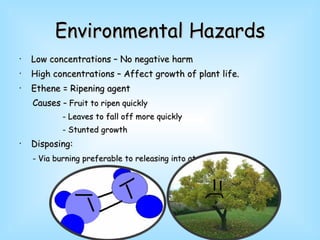
Environmental Hazards Low concentrations – No negative harm High concentrations – Affect growth of plant life.   Ethene = Ripening agent Causes  – Fruit to ripen quickly - Leaves to fall off more quickly - Stunted growth Disposing: - Via burning preferable to releasing into atmosphere
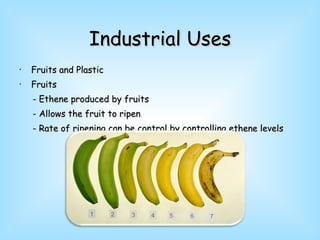
Industrial Uses Fruits and Plastic Fruits - Ethene produced by fruits - Allows the fruit to ripen - Rate of ripening can be control by controlling ethene levels
Polymerization Polymerization  = reaction where monomers join together to form a large chain molecule = formation of plastic Monomers such as ethene, vinyl chloride and styrene polymerize to form polymers which can be used for many applications. Polyethene  – Used in plastics Polyvinyl chloride (PVC)  – thermoplastic - additives sometimes added - used in wire coatings, packaging and  many more Polystyrene  – hard - transparent - found in food cups and plastic containers etc
More more more and more uses As antifreeze - Main component - ethylene glycol - Aqueous ethylene glycol used in car radiators Formation of ethanol - Ethene reacts with water in the presence of a catalyst to form ethanol - Ethanol then used as solvent in : - Inks - Cosmetics - Pharmaceuticals
Thank you (:

Ethene presentation

  • 1.
  • 2.
    Properties Structural, Chemicaland Physical General formula C n H 2n Non-polar Planar Double bond (alkene), reactive Molecule held together by dispersion forces Flammable Sweet odor Colourless gas Boiling point -104 o C Melting point -169 o C Molecular Weight 28.08 Heat of fusion 119.5 kJ/kg Heat of Combustion 47.183 MJ/kg Enthalpy of Formation 52.32 kJ/mol
  • 3.
    Reactions Since etheneis an alkene, it follows some characteristic reactions of alkenes. Such reactions include: Addition reactions – With water, halogens, hydrogen halides, hydrogen - Halogenation and polymerization are both addition reactions Oxidation reactions - When using potassium permanganate as the oxidant, products of reaction are dependent on the pH condition of the KMnO 4 - Acidic = purple to colourless - Basic/neutral = purple to dark green with brown precipitate Combustion reaction - The usual. Reacts with oxygen, carbon dioxide and water vapour formed.
  • 4.
    How is ethenemanufactured? Two sources: - Natural Gas - Crude Oil Thermal/Steam cracking - Process: 1. Feedstock and steam fed into coiled tube in furnance, 750 – 900 o C. 2. Then passed into cooler at -100 o C. Gases then separated by distillation.
  • 5.
    … andcontinuing An example of a typical cracking reaction: Ethane forms ethene through the cracking procedure. C2H6 (g)  C2H4 (g) + H2 (g) ∆H = + 138 KJ/mol Maximum yield at: - High temperature - Pressure just below the atmosphere pressure Other methods of manufacture: Dehydration of ethanol - Presence of a catalyst (sulfuric acid, aluminium oxide, zeolite catalyst) Using cellulose as a raw material - Too costly. In every singly way imaginable.
  • 6.
    Hazards of etheneEscapes into the environment by: - From its production - Cigarette smoke - Waste incineration - Vehicle wastes Hazards of use - Gas state – Especially highly flammable and explosive - Prolonged exposure can harm the brain, if inhaled - Liquid state – Very cold, risk of frostbite Sniffing ethene result in: - light-headedness, dizziness, unconsciousness, and suffocation Kaboom?
  • 7.
    Environmental Hazards Lowconcentrations – No negative harm High concentrations – Affect growth of plant life. Ethene = Ripening agent Causes – Fruit to ripen quickly - Leaves to fall off more quickly - Stunted growth Disposing: - Via burning preferable to releasing into atmosphere
  • 8.
    Industrial Uses Fruitsand Plastic Fruits - Ethene produced by fruits - Allows the fruit to ripen - Rate of ripening can be control by controlling ethene levels
  • 9.
    Polymerization Polymerization = reaction where monomers join together to form a large chain molecule = formation of plastic Monomers such as ethene, vinyl chloride and styrene polymerize to form polymers which can be used for many applications. Polyethene – Used in plastics Polyvinyl chloride (PVC) – thermoplastic - additives sometimes added - used in wire coatings, packaging and many more Polystyrene – hard - transparent - found in food cups and plastic containers etc
  • 10.
    More more moreand more uses As antifreeze - Main component - ethylene glycol - Aqueous ethylene glycol used in car radiators Formation of ethanol - Ethene reacts with water in the presence of a catalyst to form ethanol - Ethanol then used as solvent in : - Inks - Cosmetics - Pharmaceuticals
  • 11.