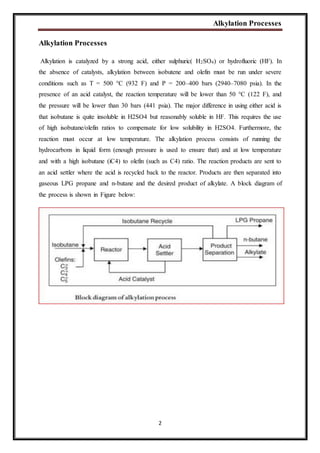
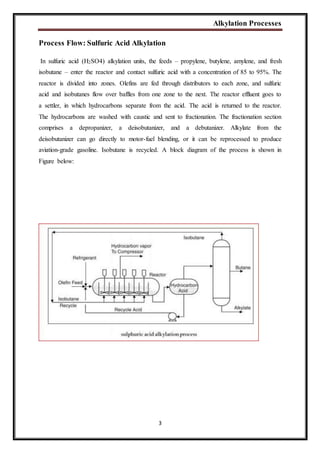
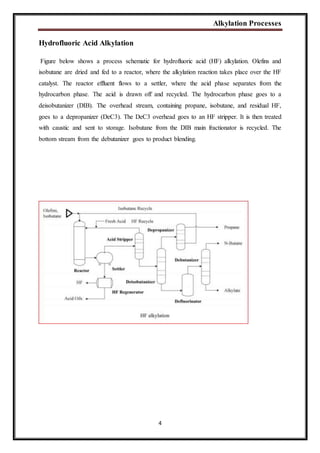
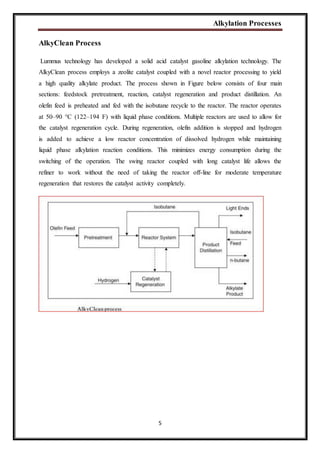
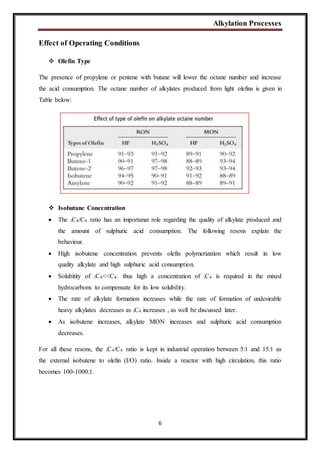
The alkylation process combines light iso-paraffins like isobutane with C3-C4 olefins in the presence of a strong acid catalyst like sulfuric or hydrofluoric acid. This produces a high-octane gasoline blending component called alkylate. Alkylation takes place at low temperatures and pressures and produces no aromatics or olefins. Key factors that affect the process include olefin type, isobutane concentration, acid strength, temperature, and space velocity. The goal is to maximize high-octane alkylate production while minimizing undesirable side products and acid consumption.
![Alkylation Processes
7
Acid Strength
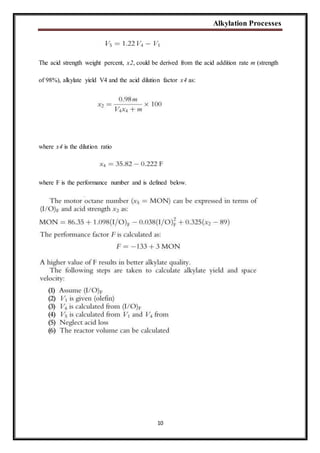
An optimum value of acid strength of 90 wt% H2SO4 is maintained by adding fresh
concentrated acid (98–99 wt%). As the strength of the acid decreases, the acid consumption
increases with the octane number decreases. The minimum acid strength required to operate
the system should not be lower than 85 wt%. To provide a sufficient margin of safety, acid
strength is kept around 90 wt%. The acid strength decreases because of the formation of
gums and other products resulting from the reaction with other impurities. Thus, acid makeup
has to be added.
Degree of Agitation
When the hydrocarbons are dispersed in sulphuric acid, the speed of the impeller determines
the dispersed phase size (droplet diameter) and hence, the interfacial contact area. The
reaction rate of iC4 and C4 is quite fast, and the reaction is controlled by mass transfer.
where [iC4] h is the concentration of iC4 in hydrocarbon phase, N is the impeller speed
(rpm), Ha is the fractional acid hold-up, (SV)o is the space olefin velocity (1/h), RHeavy
alkylate is the rate of formation of the undesirable heavy alkylate, and RiC8 is the rate of
formation of the target alkylateiC8 .
Space Velocity
The olefin space velocity is defined as:
The residence time in the reactor is (1/(SV)o ) and is defined as the residence time of the
fresh feed and externally recycled isobutane in the reaction mixture. Since the alkylation
reaction is very fast, the residence time is not a limiting parameter. However, as the space
velocity increases, the octane number tends to decrease while acid consumption tends to
increase. Residence time for sulphuric acid is usually from 5 to 40 min, and for hydrofluoric
acid, it is 5–25 min.](https://image.slidesharecdn.com/alkylation-200405072851/85/Alkylation-7-320.jpg)


![Phosphoric acid [CHEMICAL PROCESSS INDUSTRIES]](https://cdn.slidesharecdn.com/ss_thumbnails/phosphoricacid-210509141123-thumbnail.jpg?width=640&height=640&fit=bounds)


