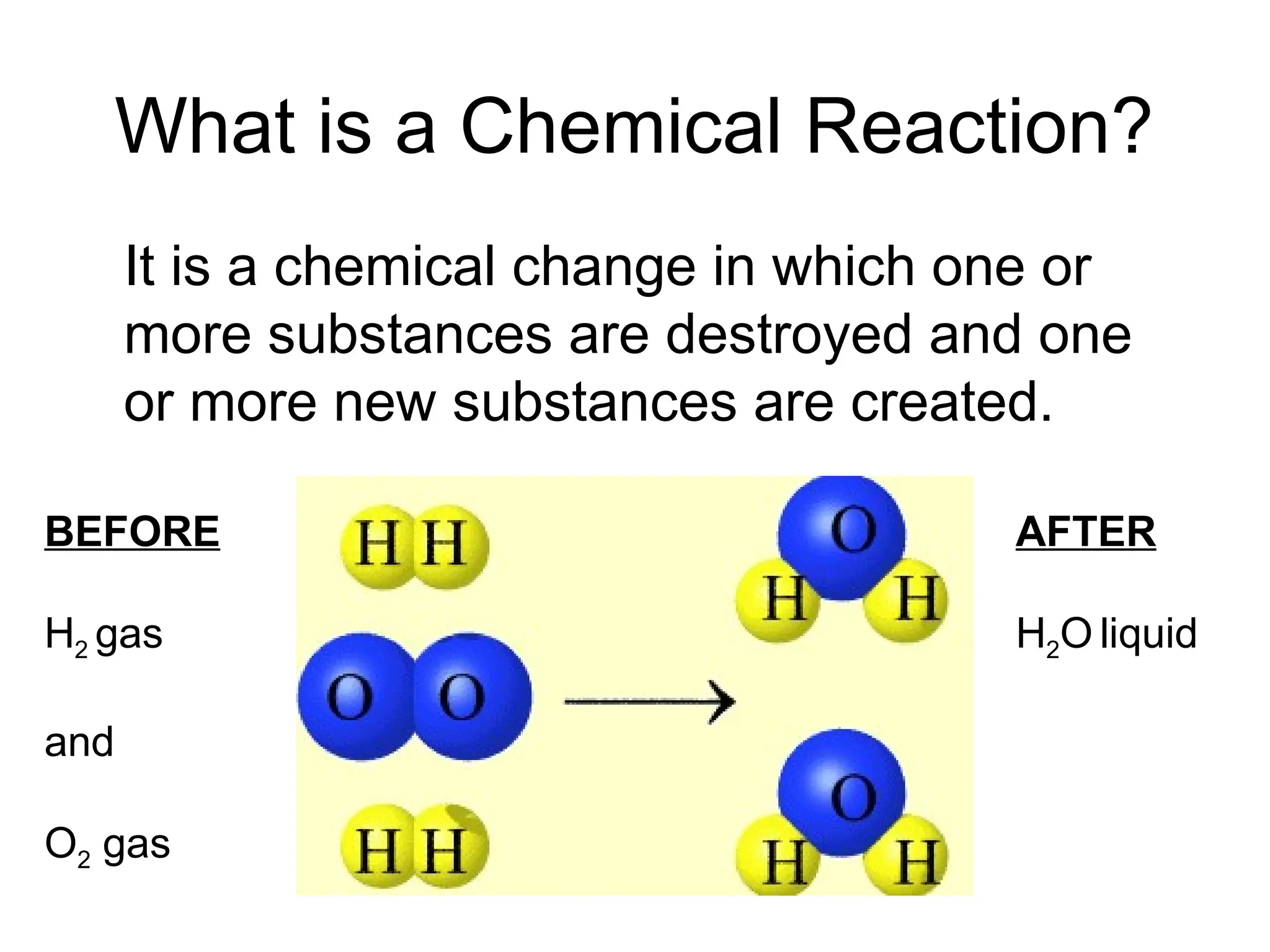
What is aChemical Reaction?
It is a chemical change in which one or
more substances are destroyed and one
or more new substances are created.
BEFORE
H2 gas
and
O2 gas
AFTER
H2O liquid
3.
Parts of aChemical Reaction
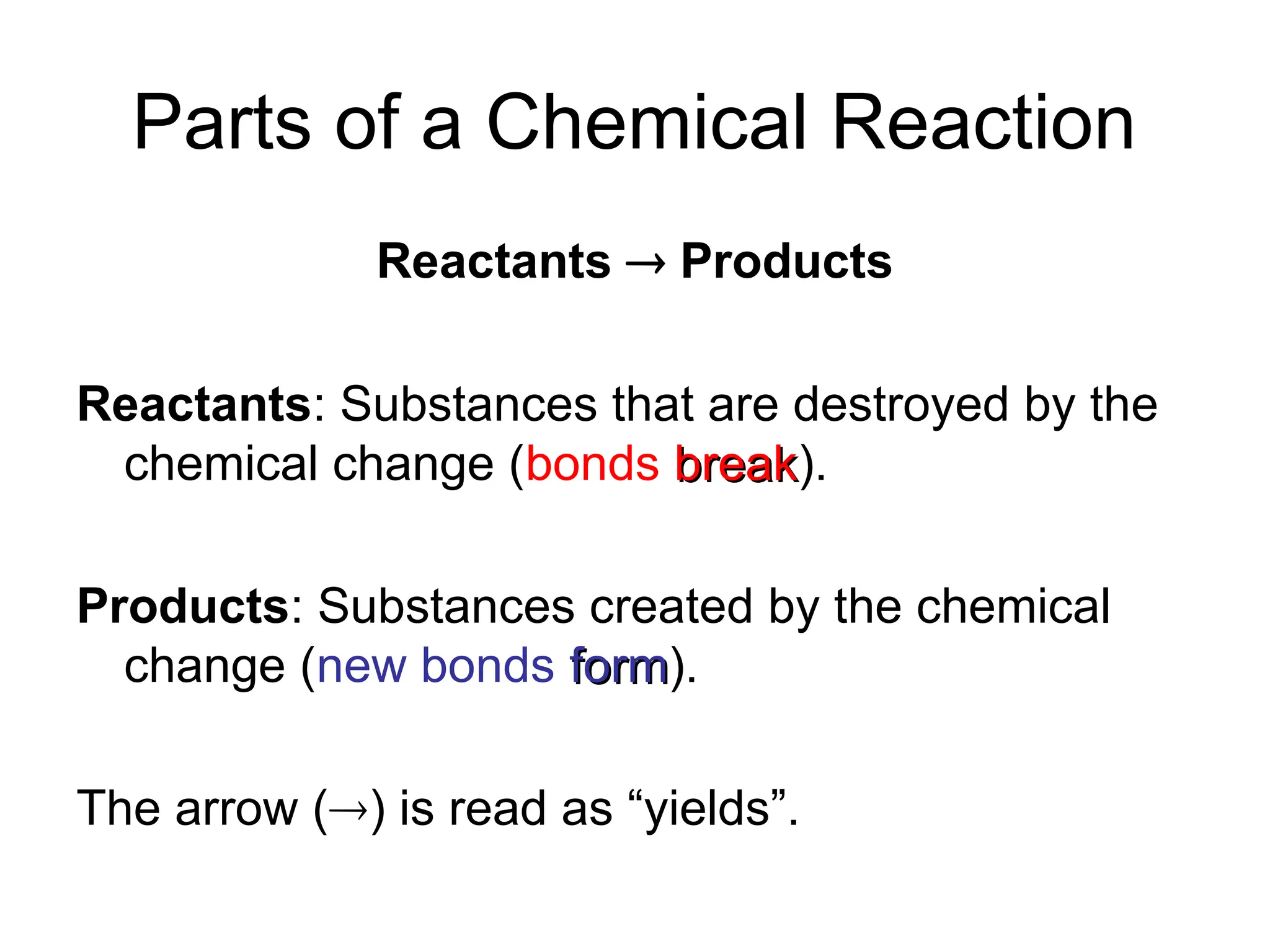
Reactants Products
Reactants: Substances that are destroyed by the
chemical change (bonds break
break).
Products: Substances created by the chemical
change (new bonds form
form).
The arrow () is read as “yields”.
4.
Other symbols inchemical
reactions
• (s) = solid
• (l) = liquid
• (g) = gas
• (aq) = aqueous solution (the substance is
dissolved in H2O)
• “+” separates two or more reactants or
products
• “” yield sign separates reactants from
products
5.
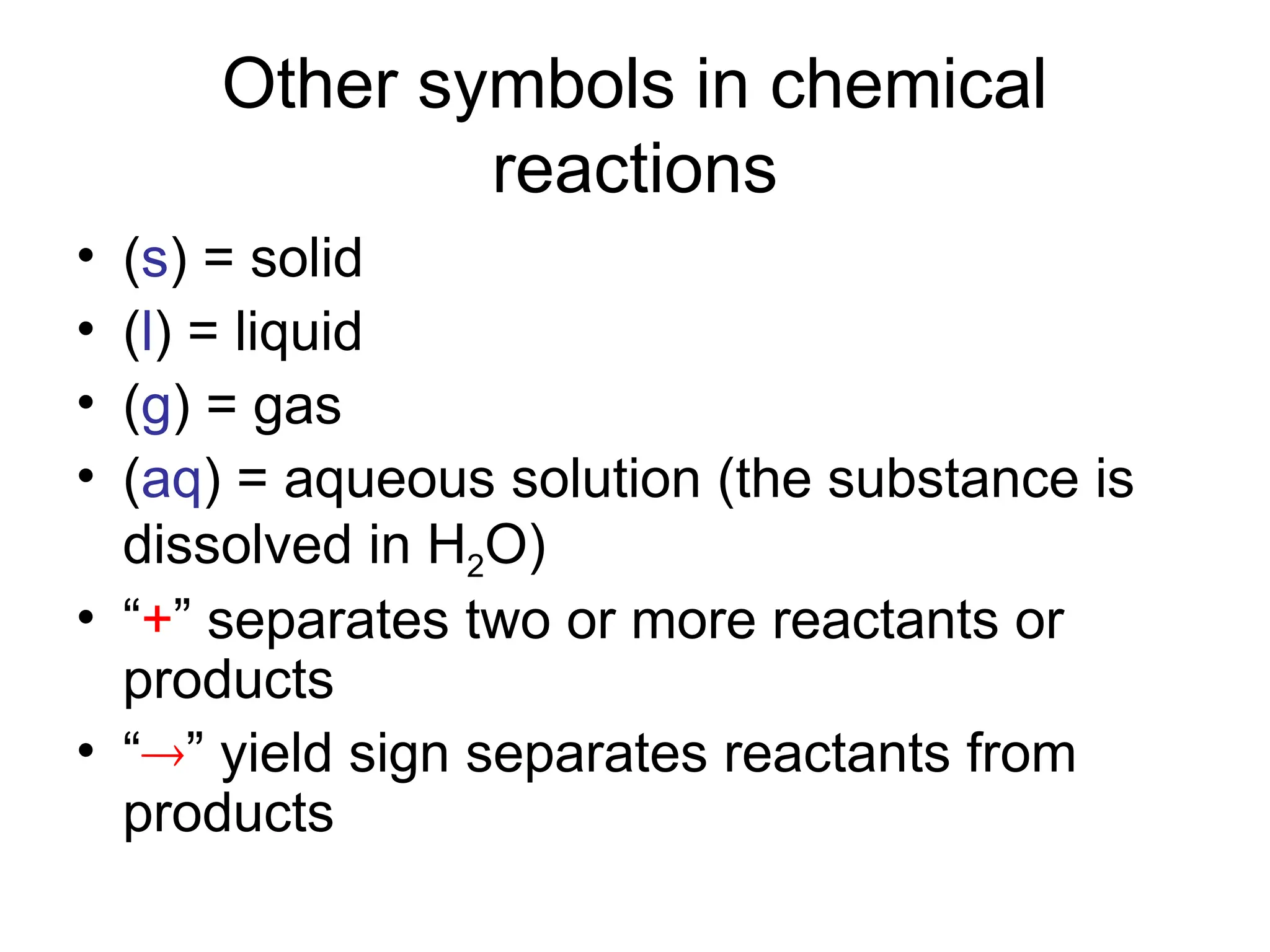
Evidence for aChemical Reaction
1) Evolution of light or heat.
6.
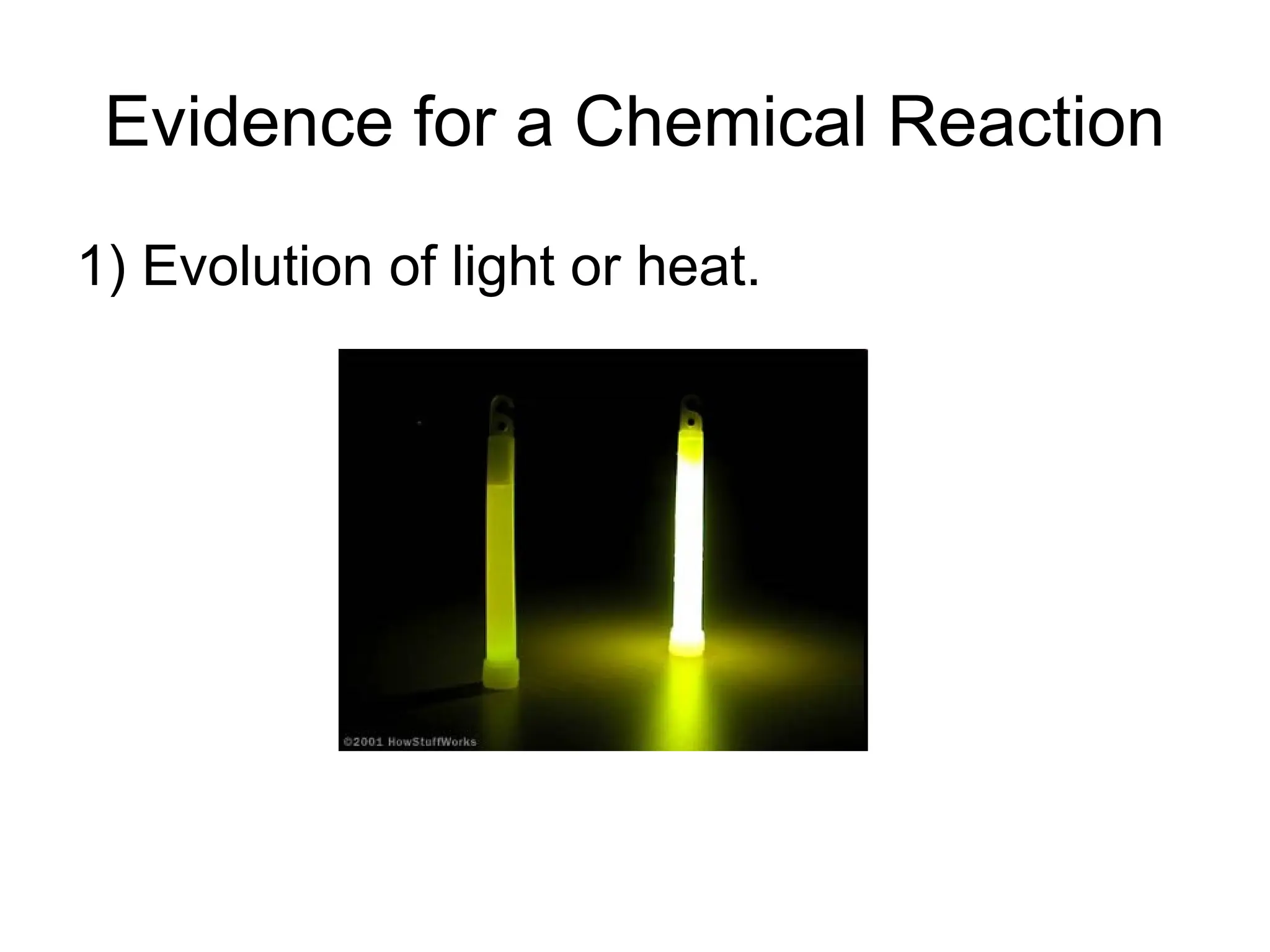
Evidence for aChemical Reaction
2) Temperature change (increase or
decrease) to the surroundings.
7.
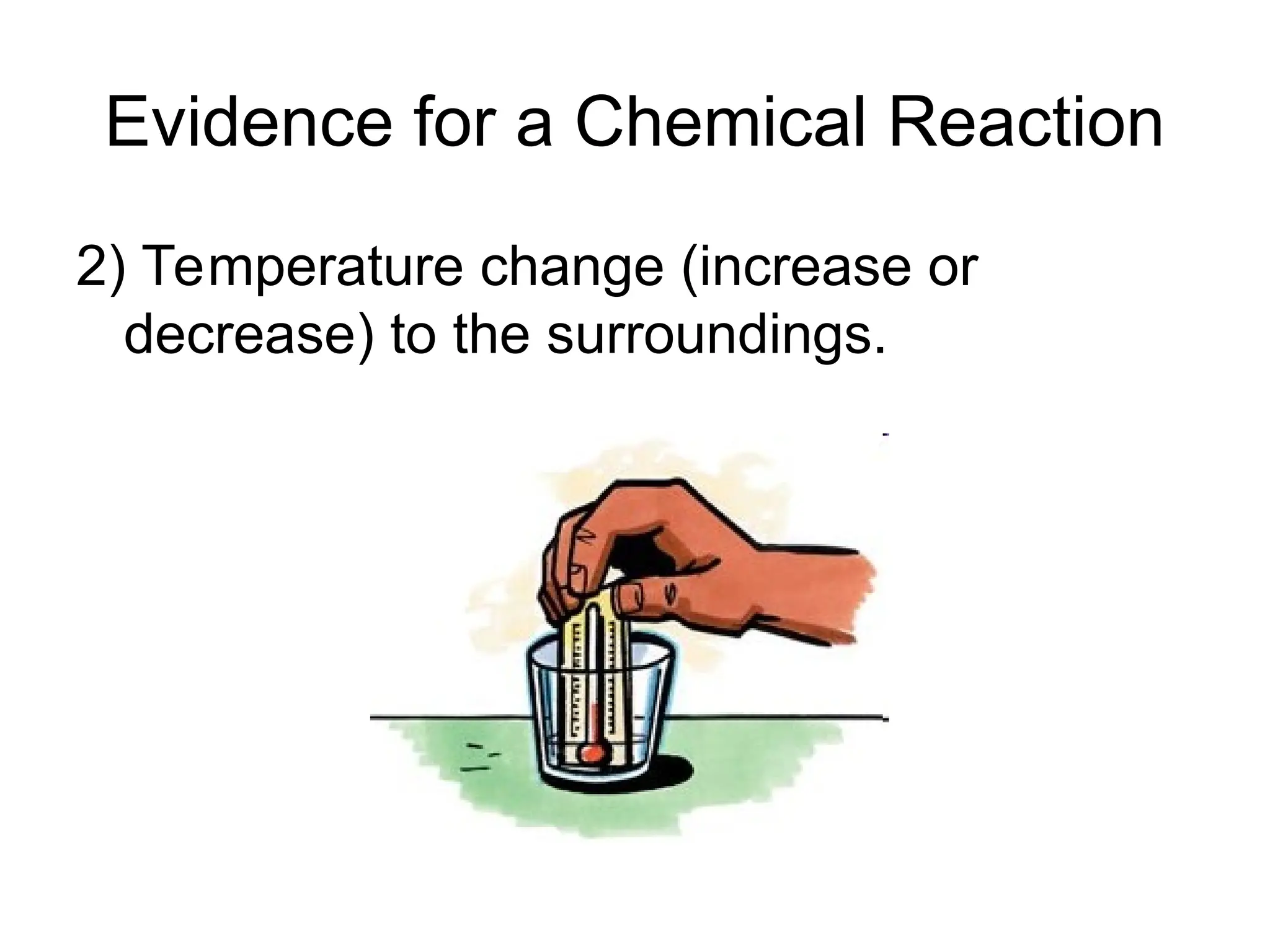
Evidence for aChemical Reaction
3) Formation of a gas (bubbling or an odor)
other than boiling.
8.
Evidence for aChemical Reaction
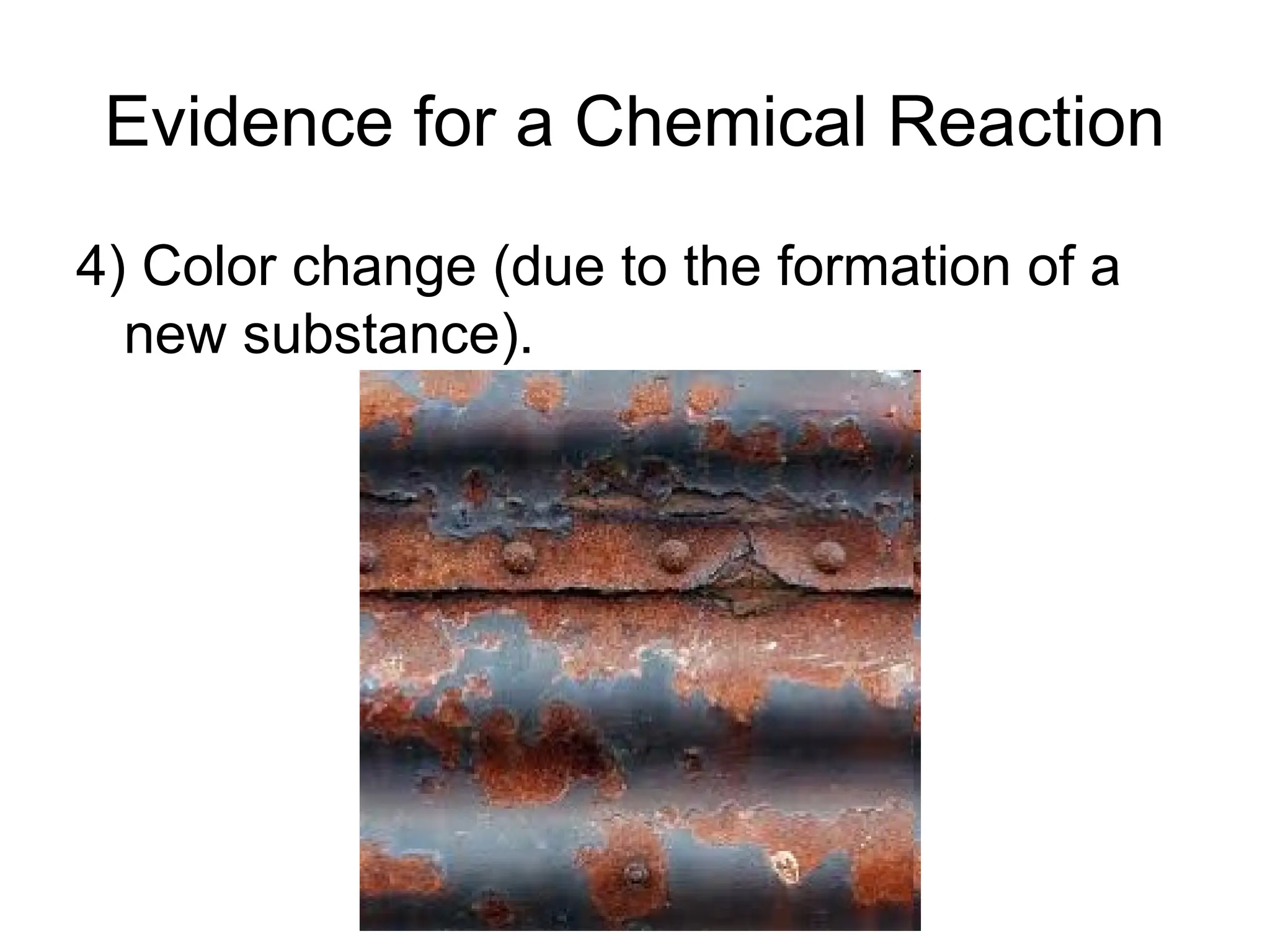
4) Color change (due to the formation of a
new substance).
9.
Evidence for aChemical Reaction
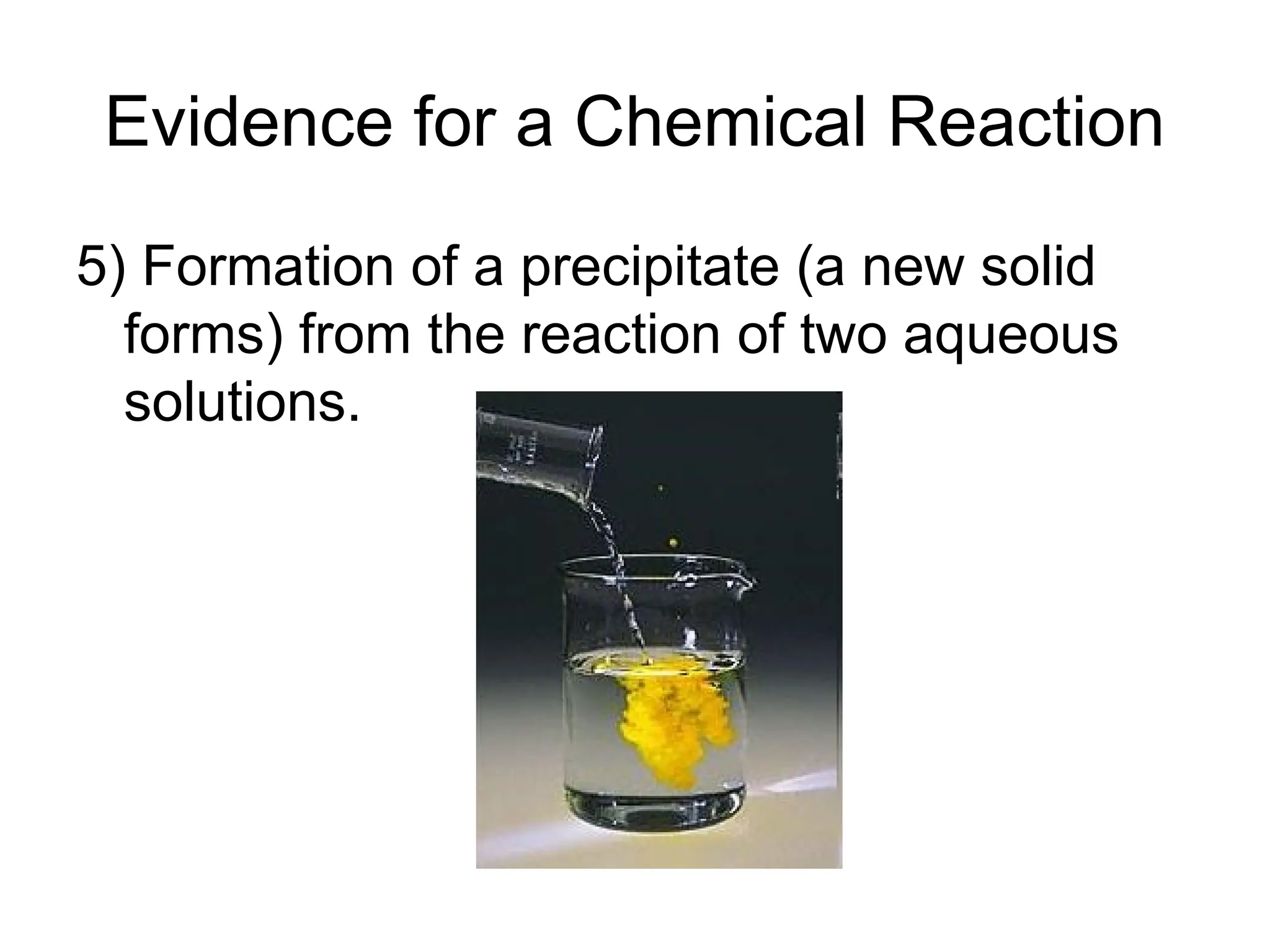
5) Formation of a precipitate (a new solid
forms) from the reaction of two aqueous
solutions.
10.
Word Equations
• Statementsthat indicate the reactants and
products in a chemical reaction.
• Ex. Iron (s) + chlorine (g) iron (III) chloride (s)
• This is read as:
“Solid iron and chlorine gas react (combine) to produce
solid iron (III) chloride”
11.
Translating Word Equationsto
Skeleton Equations
• A skeleton equation uses chemical formulas
rather than words to identify the reactants and
products of a chemical reaction.
• The word equation
Iron (s) + chlorine (g) iron (III) chloride (s)
• The skeleton equation
Fe(s) + Cl2(g) FeCl3 (s)
A skeleton equation is not yet “balanced” by coefficients!
12.
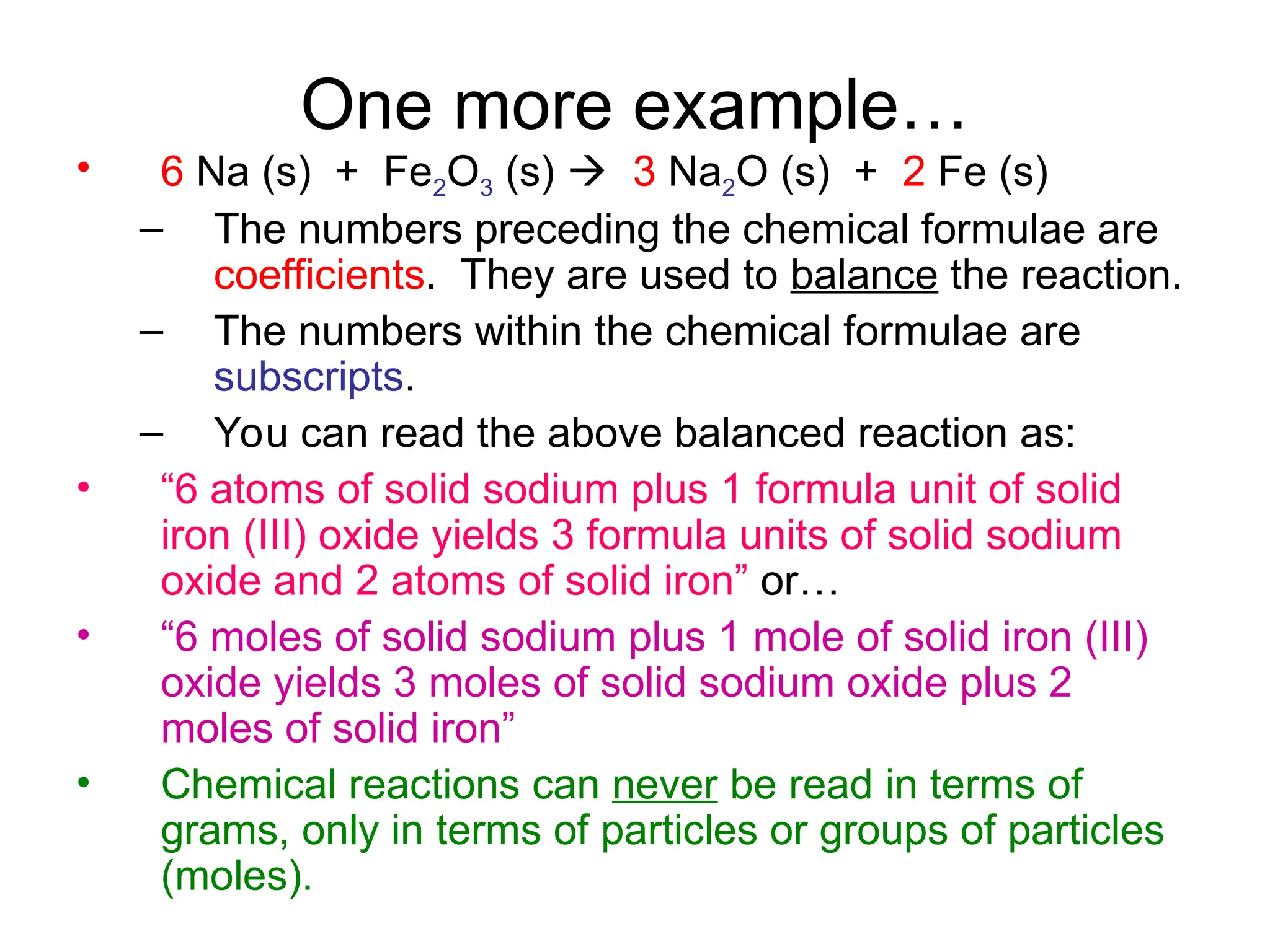
One more example…
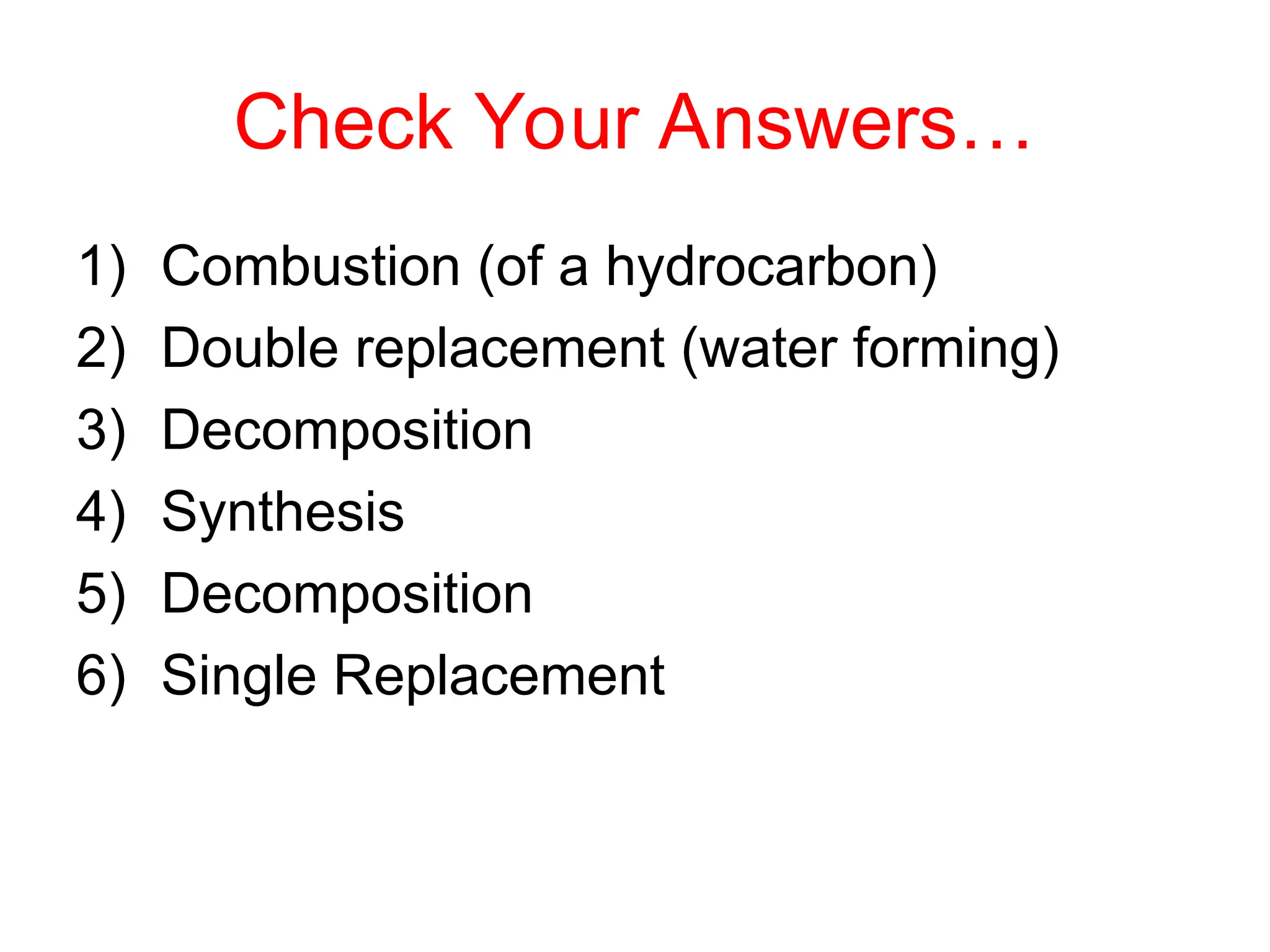
•6 Na (s) + Fe2O3 (s) 3 Na2O (s) + 2 Fe (s)
– The numbers preceding the chemical formulae are
coefficients. They are used to balance the reaction.
– The numbers within the chemical formulae are
subscripts.
– You can read the above balanced reaction as:
• “6 atoms of solid sodium plus 1 formula unit of solid
iron (III) oxide yields 3 formula units of solid sodium
oxide and 2 atoms of solid iron” or…
• “6 moles of solid sodium plus 1 mole of solid iron (III)
oxide yields 3 moles of solid sodium oxide plus 2
moles of solid iron”
• Chemical reactions can never be read in terms of
grams, only in terms of particles or groups of particles
(moles).
13.
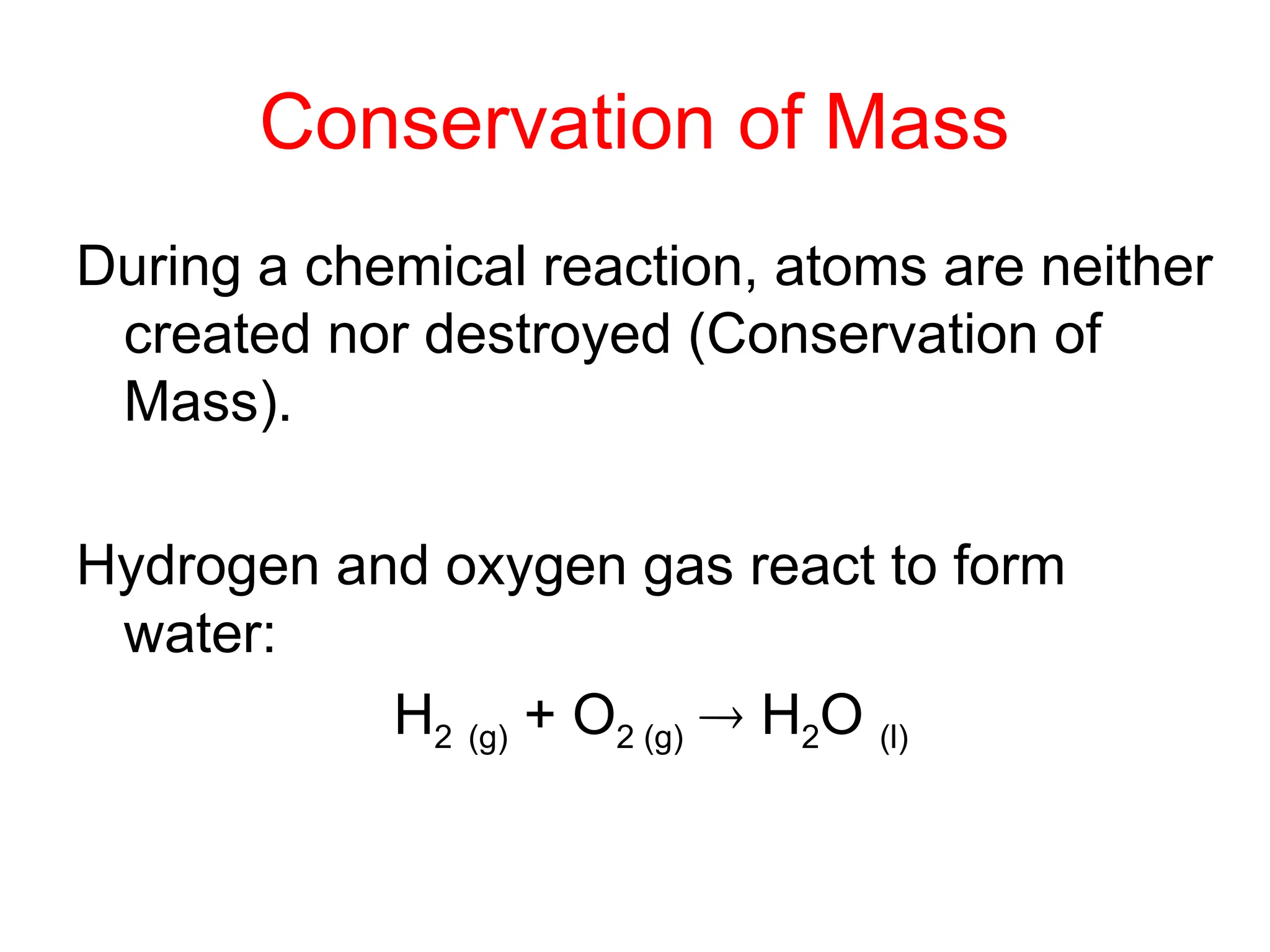
Conservation of Mass
Duringa chemical reaction, atoms are neither
created nor destroyed (Conservation of
Mass).
Hydrogen and oxygen gas react to form
water:
H2 (g) + O2 (g) H2O (l)
14.
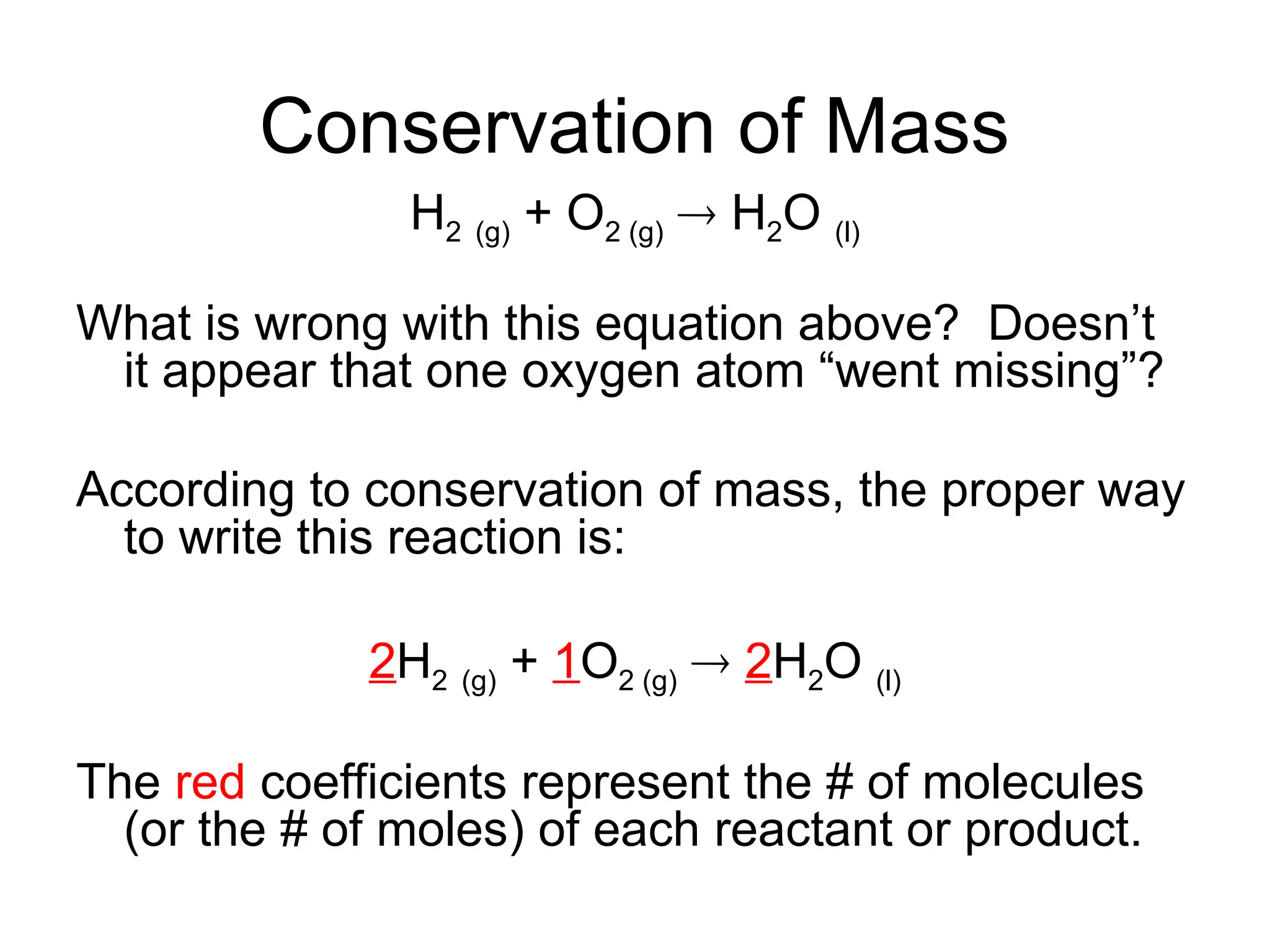
Conservation of Mass
H2(g) + O2 (g) H2O (l)
What is wrong with this equation above? Doesn’t
it appear that one oxygen atom “went missing”?
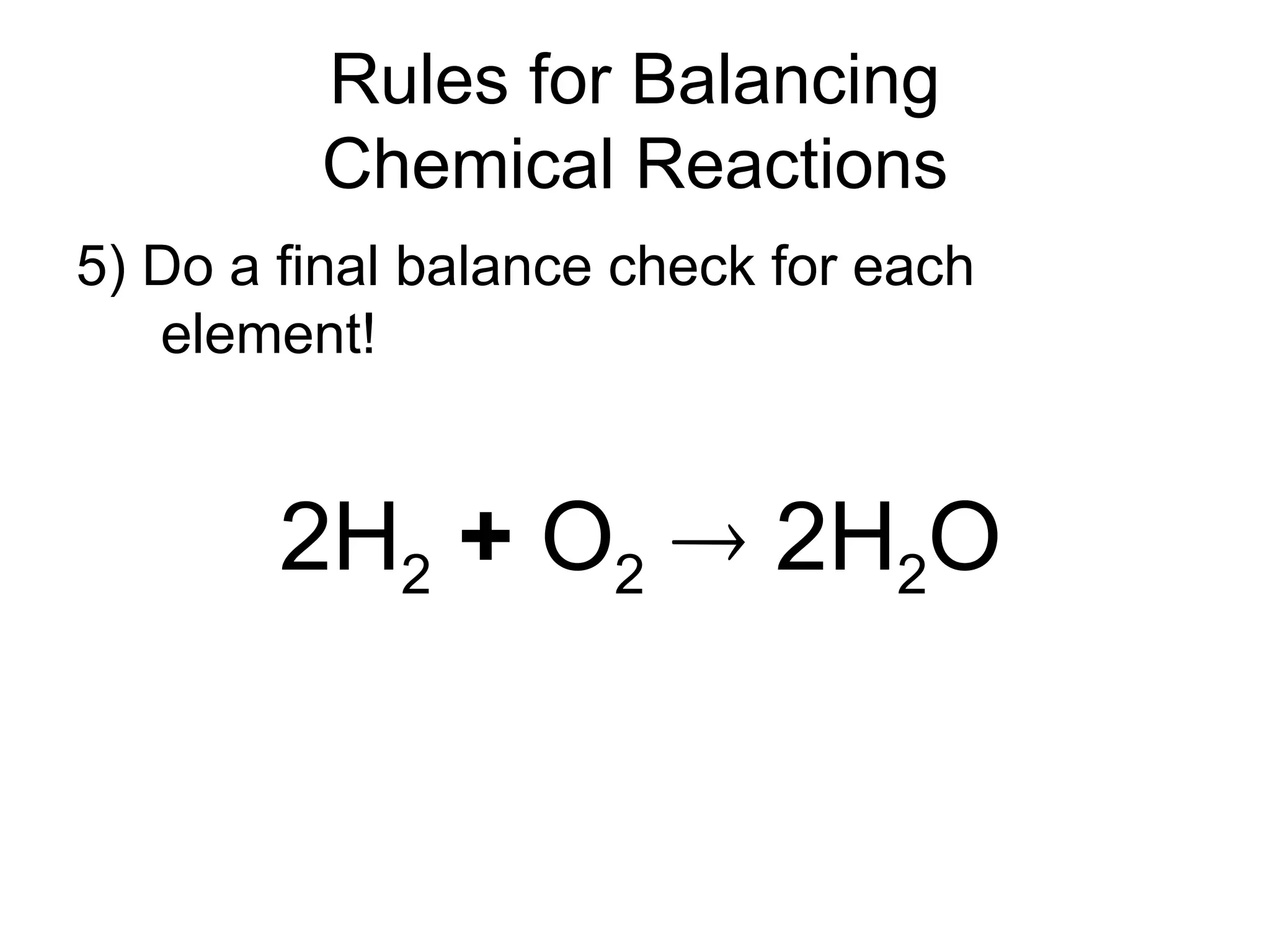
According to conservation of mass, the proper way
to write this reaction is:
2H2 (g) + 1O2 (g) 2H2O (l)
The red coefficients represent the # of molecules
(or the # of moles) of each reactant or product.
15.
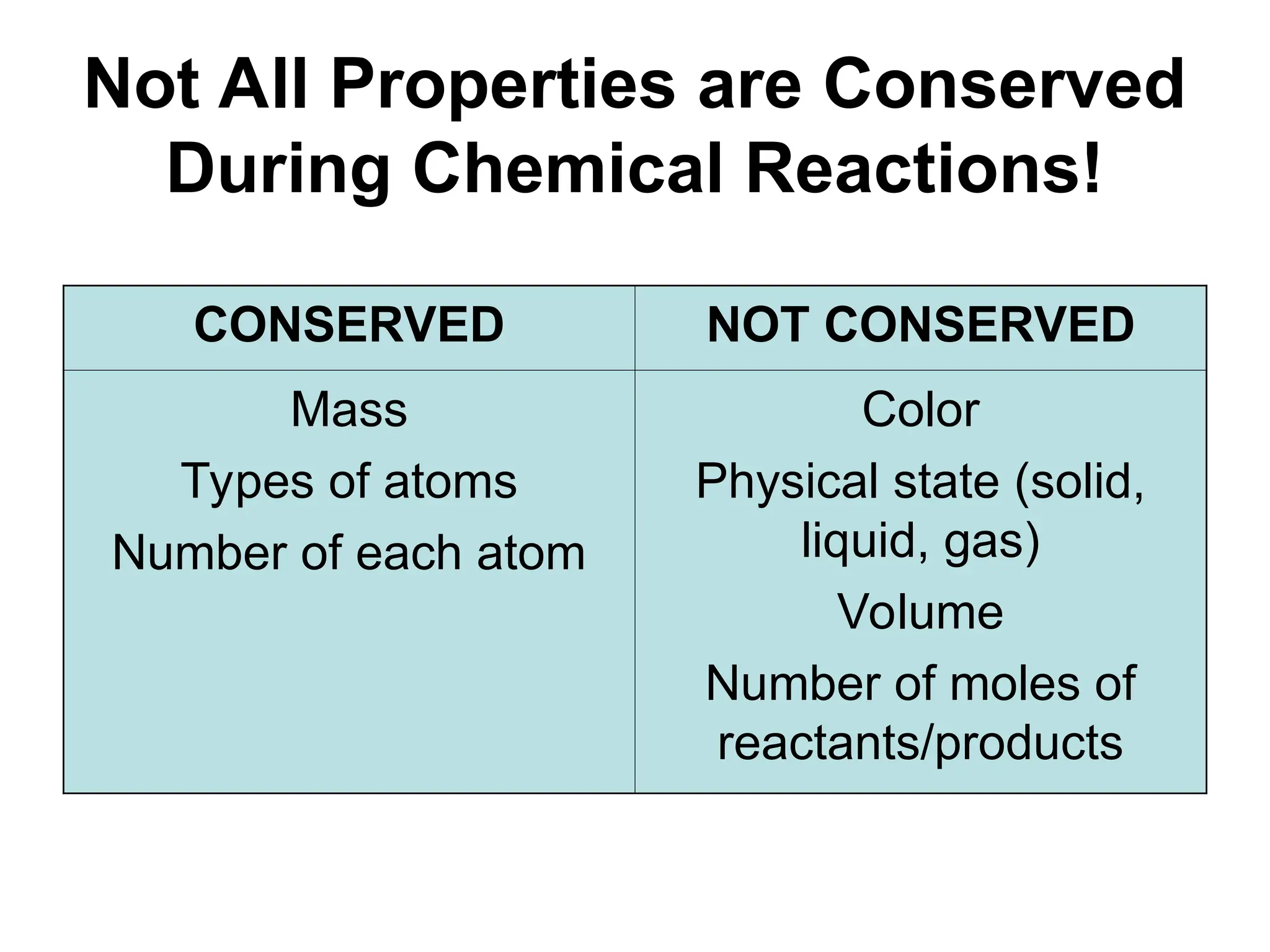
Not All Propertiesare Conserved
During Chemical Reactions!
CONSERVED NOT CONSERVED
Mass
Types of atoms
Number of each atom
Color
Physical state (solid,
liquid, gas)
Volume
Number of moles of
reactants/products
There are 5basic types….
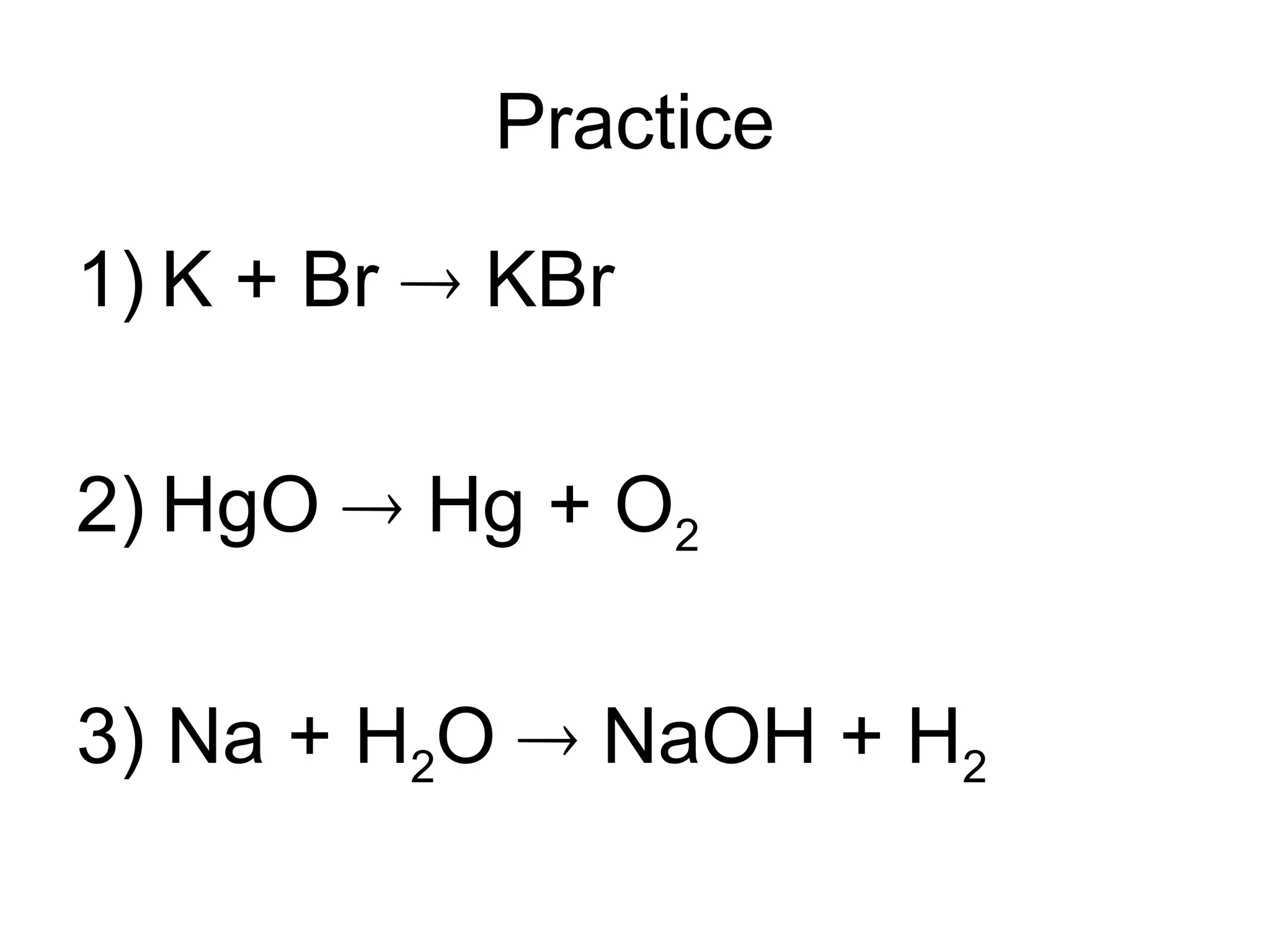
• Single Replacement (Displacement)
(Redox)
• Double Replacement (Displacement)
(Metathesis)
• Synthesis (Combination)
• Decomposition
• Combustion
18.
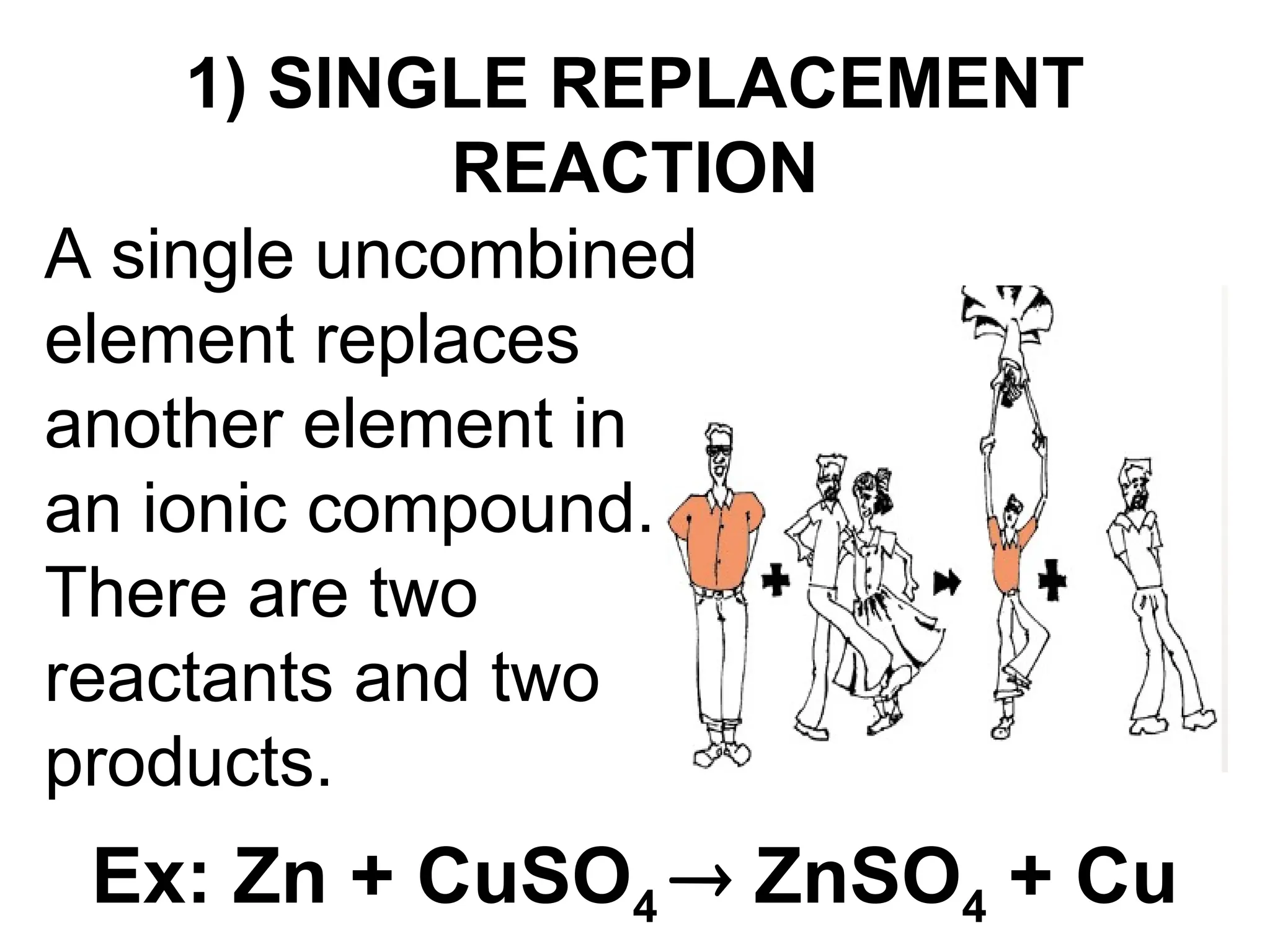
A single uncombined
elementreplaces
another element in
an ionic compound.
There are two
reactants and two
products.
1) SINGLE REPLACEMENT
REACTION
Ex: Zn + CuSO4 ZnSO4 + Cu
19.
Single Replacement Reactions
Singlereplacement reactions have the
general form, A + BC AC + B.
Question: Do all single replacement
reactions actually occur?
Answer: Not necessarily…
20.
Single Replacement Reactions
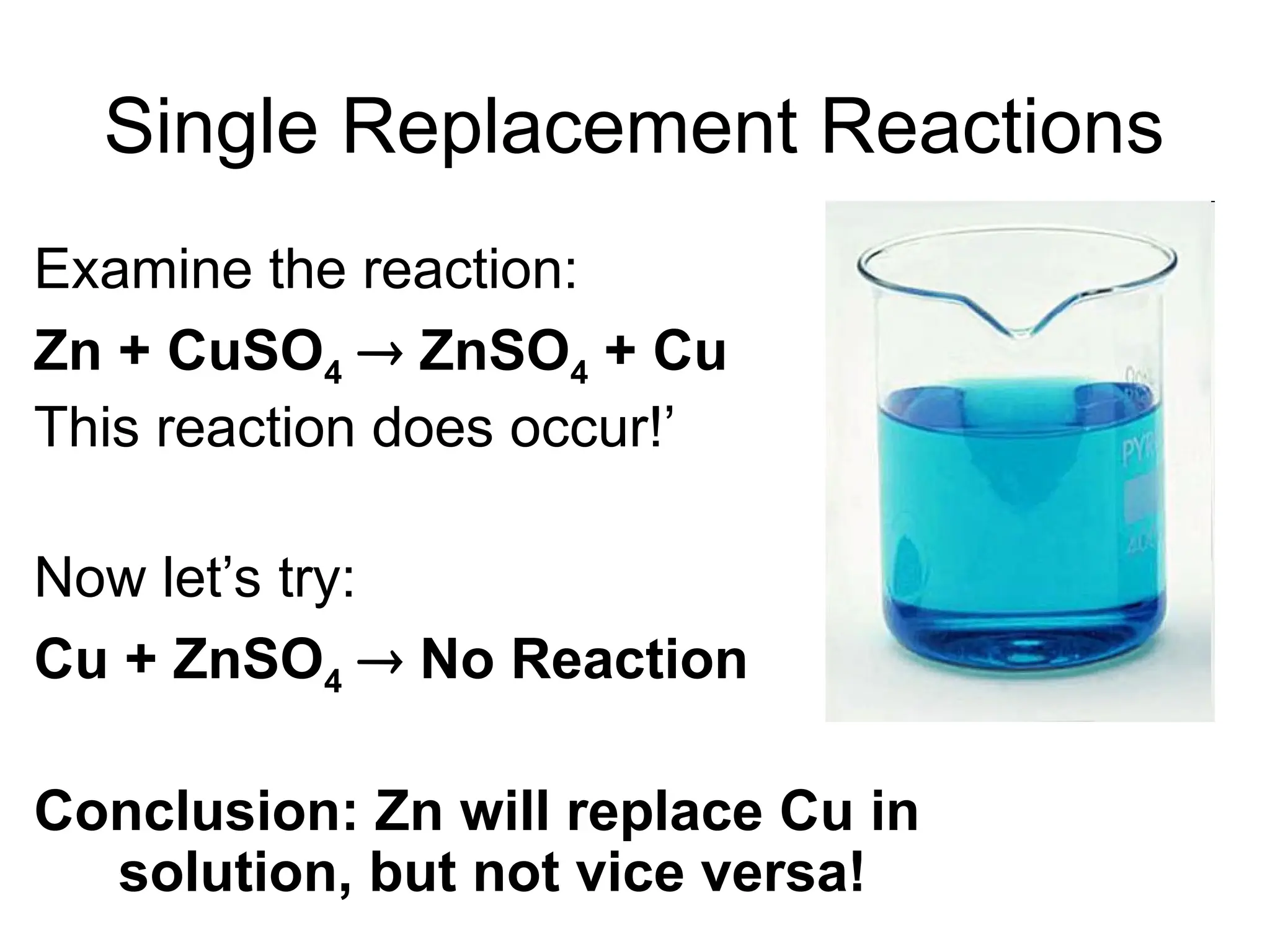
Examinethe reaction:
Zn + CuSO4 ZnSO4 + Cu
This reaction does occur!’
Now let’s try:
Cu + ZnSO4 No Reaction
Conclusion: Zn will replace Cu in
solution, but not vice versa!
21.
Single Replacement Reactions
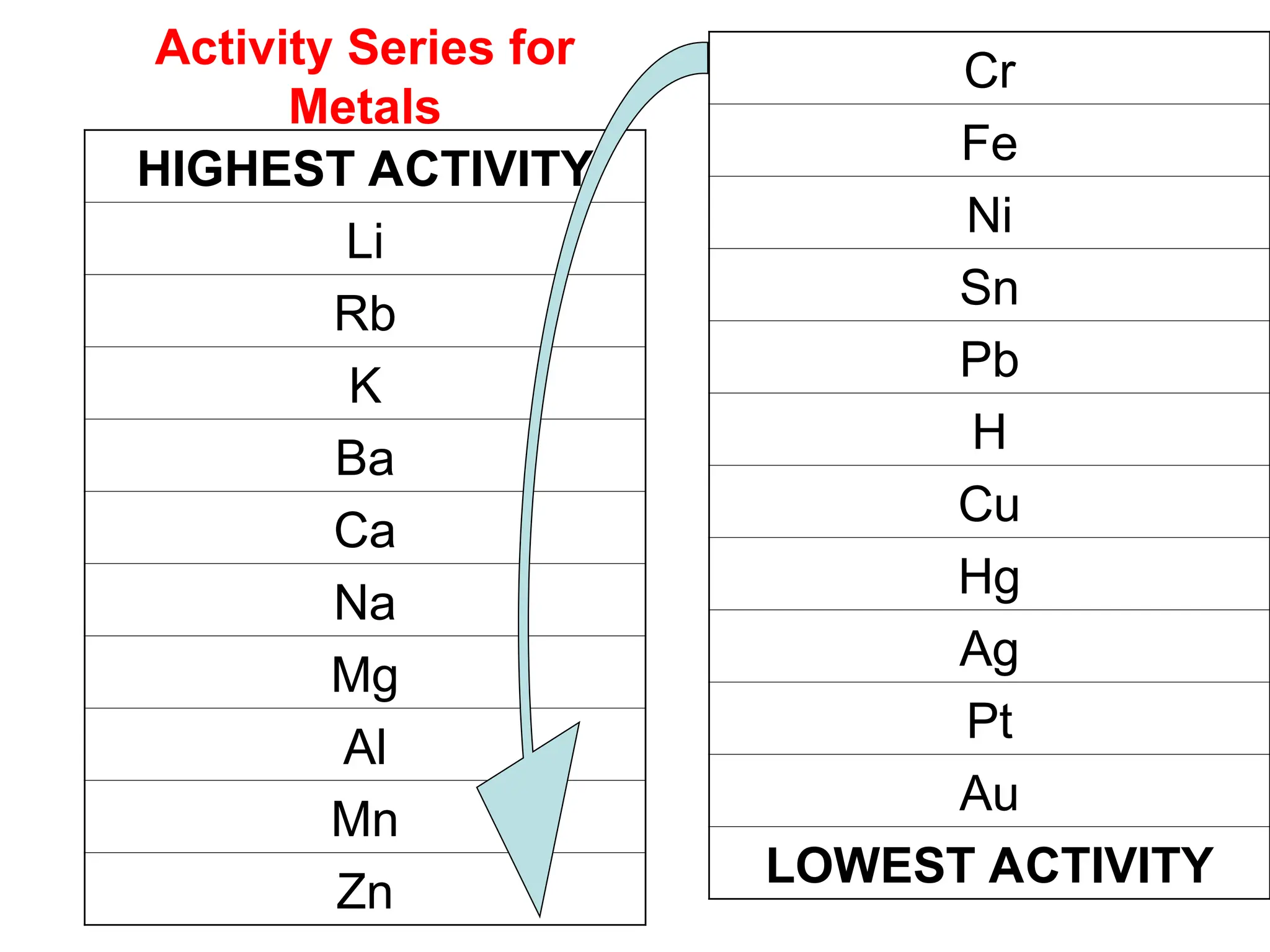
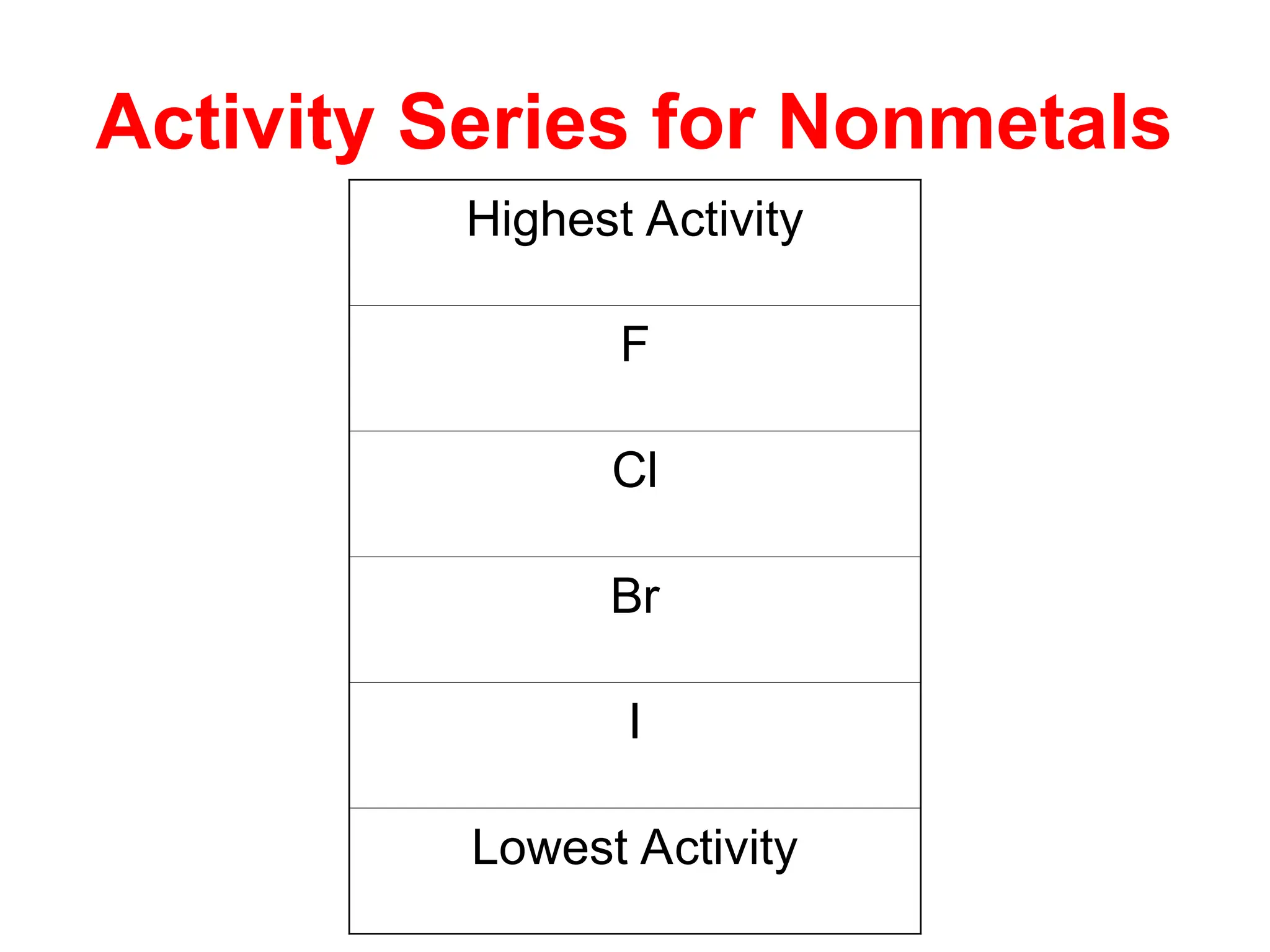
Howdo we know which reactions will occur
and which ones will not?
We look at the “activity series”.
Elements with higher activities replace
elements with lower activities during a
single-replacement reaction, but not vice-
versa.
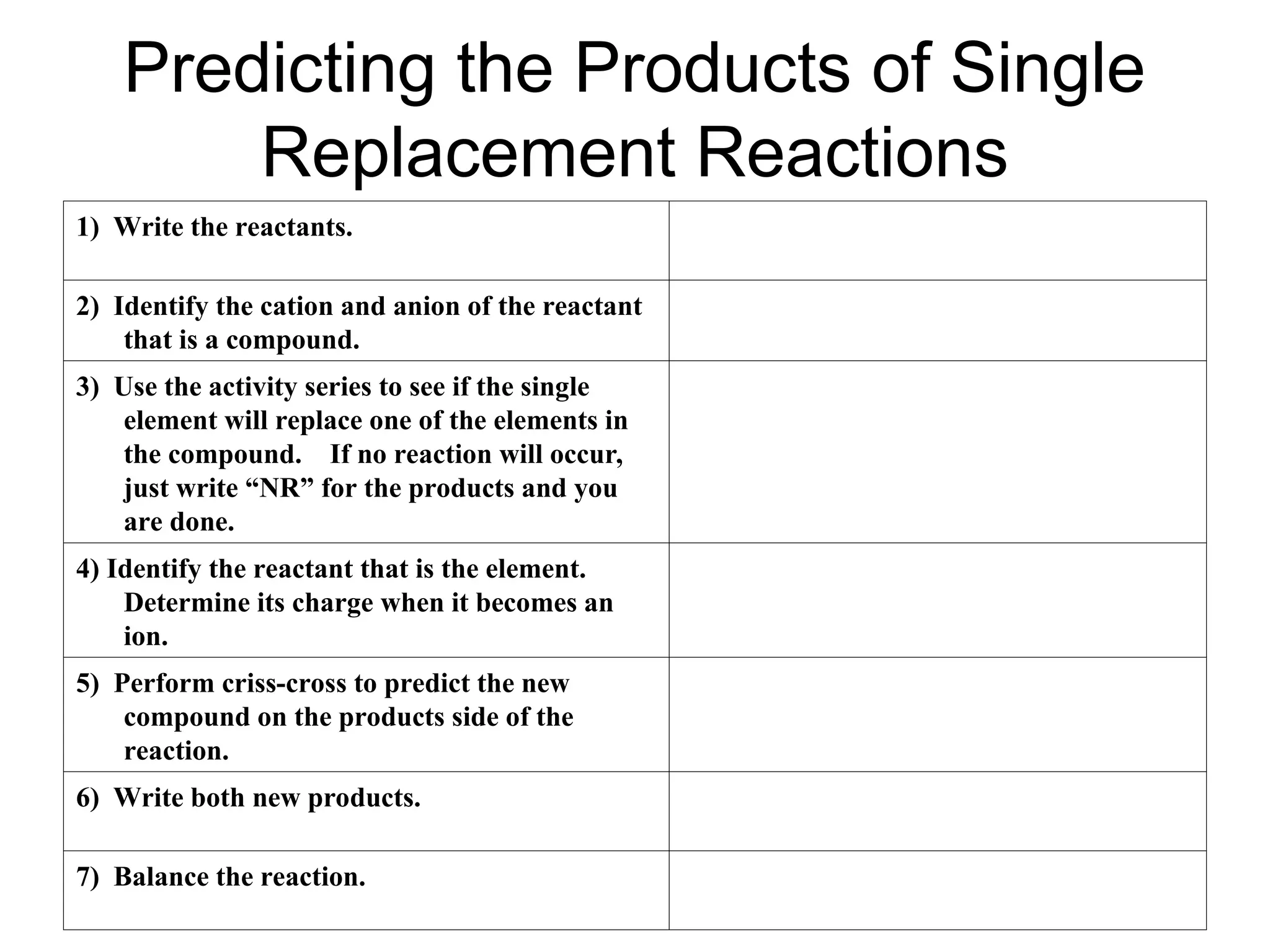
Predicting the Productsof Single
Replacement Reactions
1) Write the reactants.
2) Identify the cation and anion of the reactant
that is a compound.
3) Use the activity series to see if the single
element will replace one of the elements in
the compound. If no reaction will occur,
just write “NR” for the products and you
are done.
4) Identify the reactant that is the element.
Determine its charge when it becomes an
ion.
5) Perform criss-cross to predict the new
compound on the products side of the
reaction.
6) Write both new products.
7) Balance the reaction.
25.
Single Replacement Between
Metalsand Water
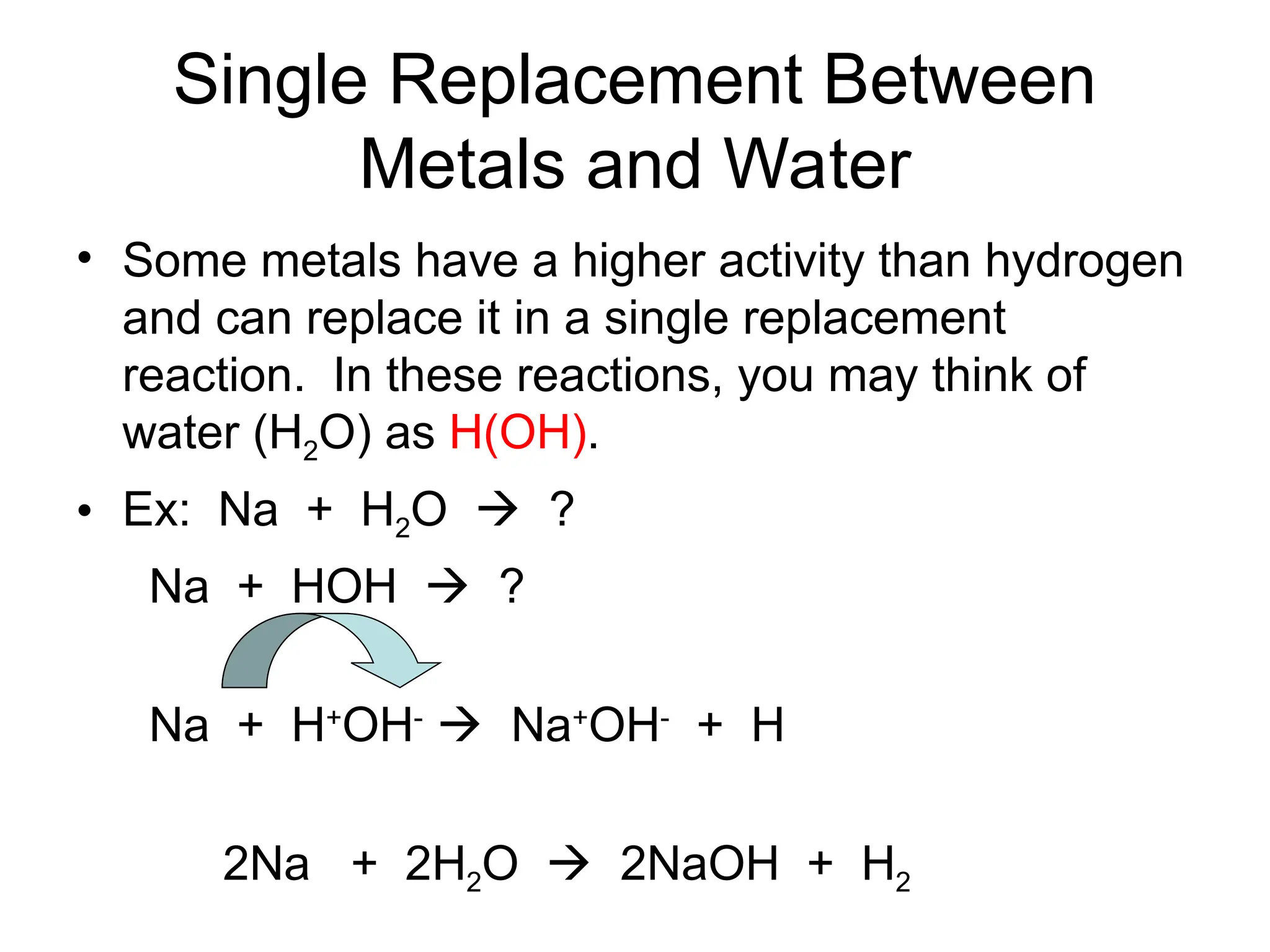
• Some metals have a higher activity than hydrogen
and can replace it in a single replacement
reaction. In these reactions, you may think of
water (H2O) as H(OH).
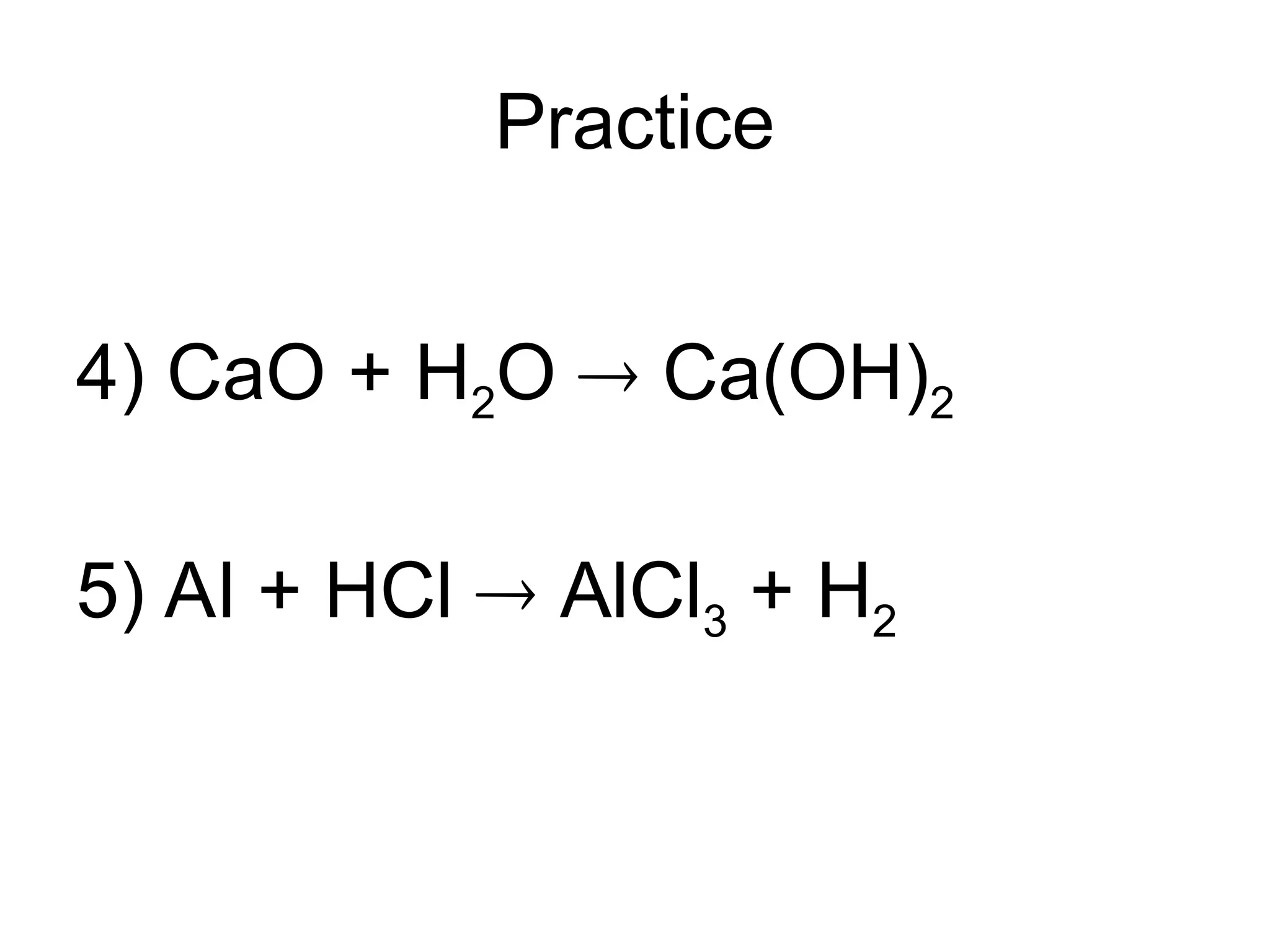
• Ex: Na + H2O ?
Na + HOH ?
Na + H+
OH-
Na+
OH-
+ H
2Na + 2H2O 2NaOH + H2
26.
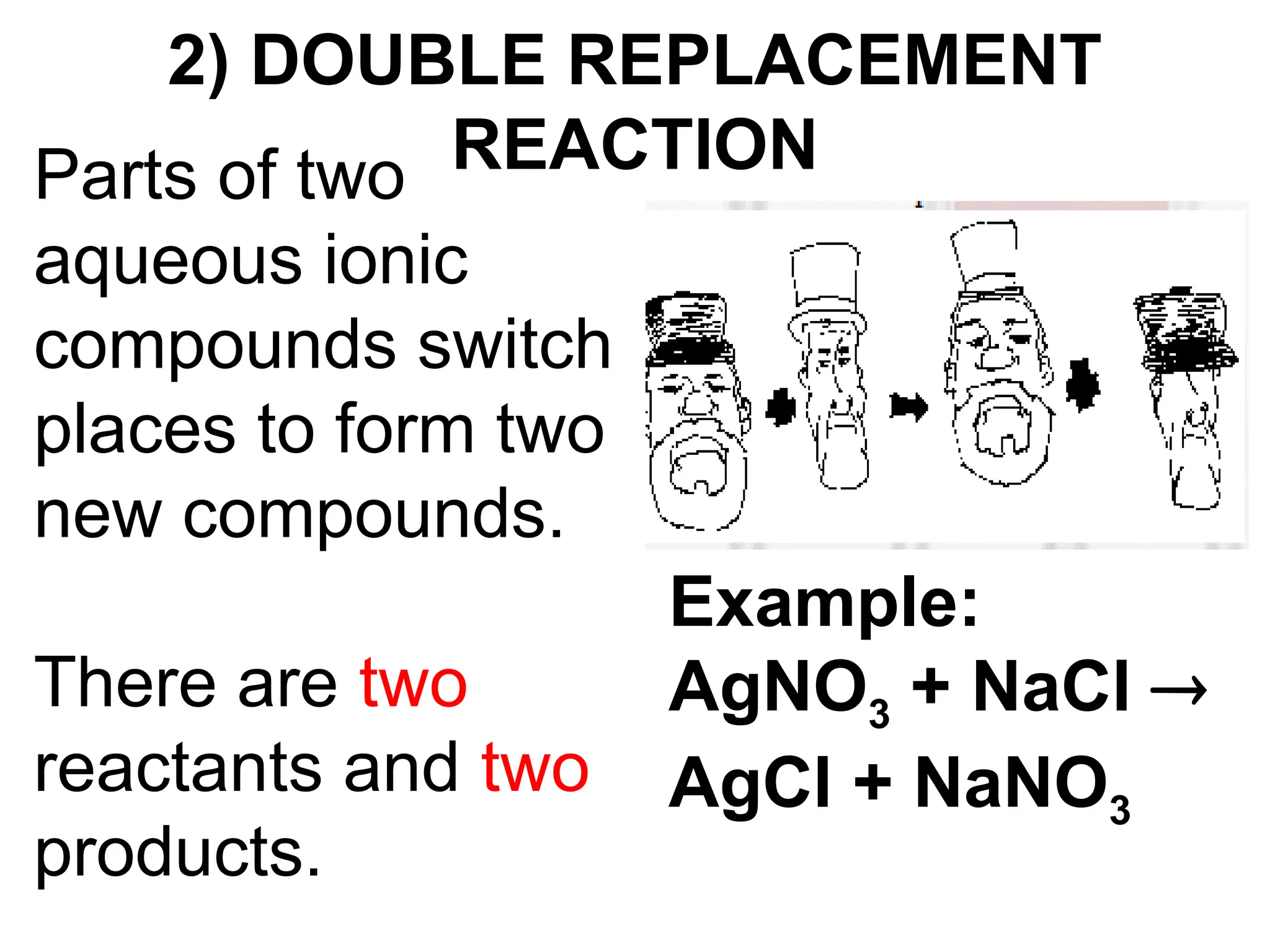
Parts of two
aqueousionic
compounds switch
places to form two
new compounds.
There are two
reactants and two
products.
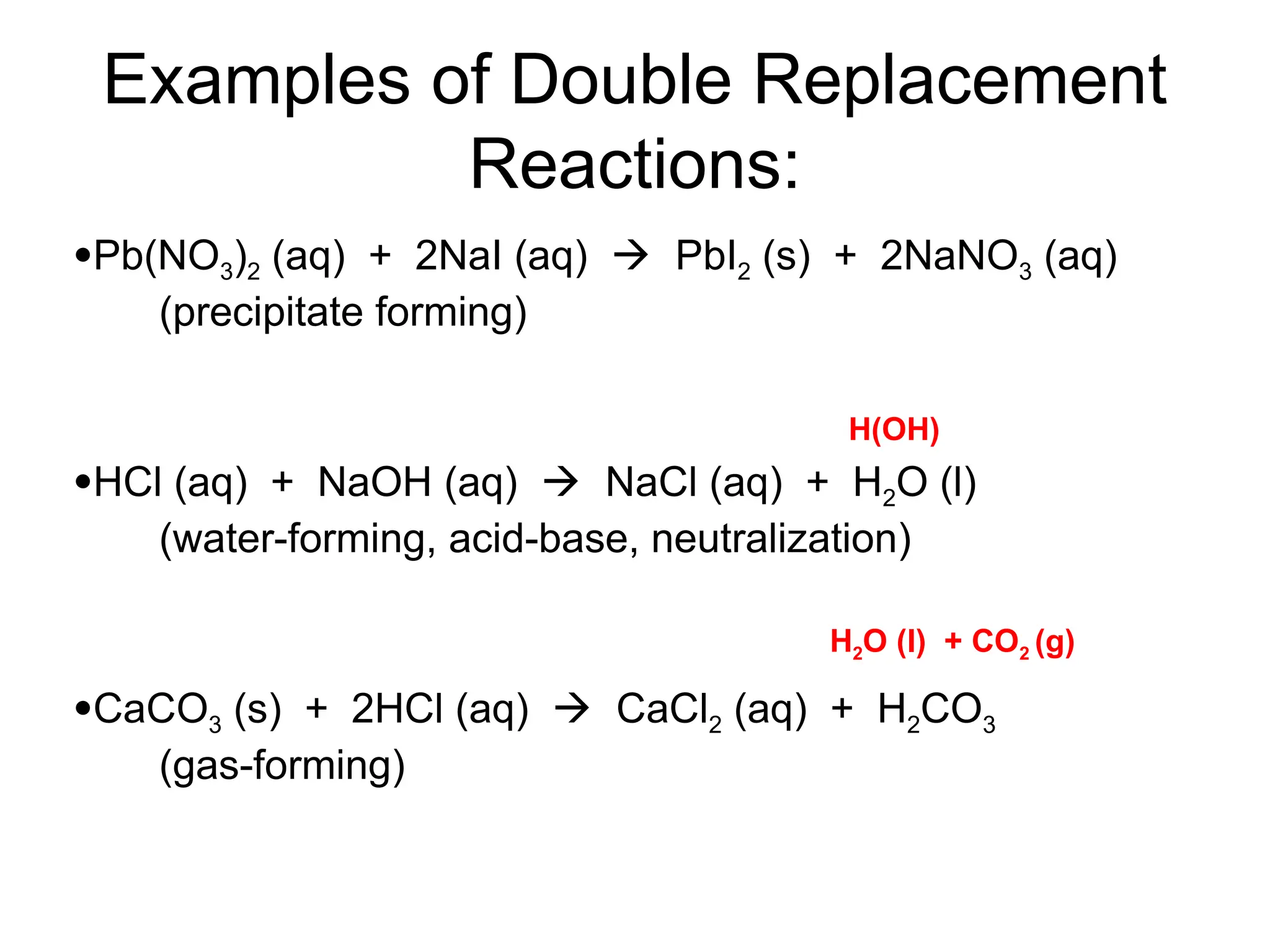
2) DOUBLE REPLACEMENT
REACTION
Example:
AgNO3 + NaCl
AgCl + NaNO3
27.
Double Replacement Reactions
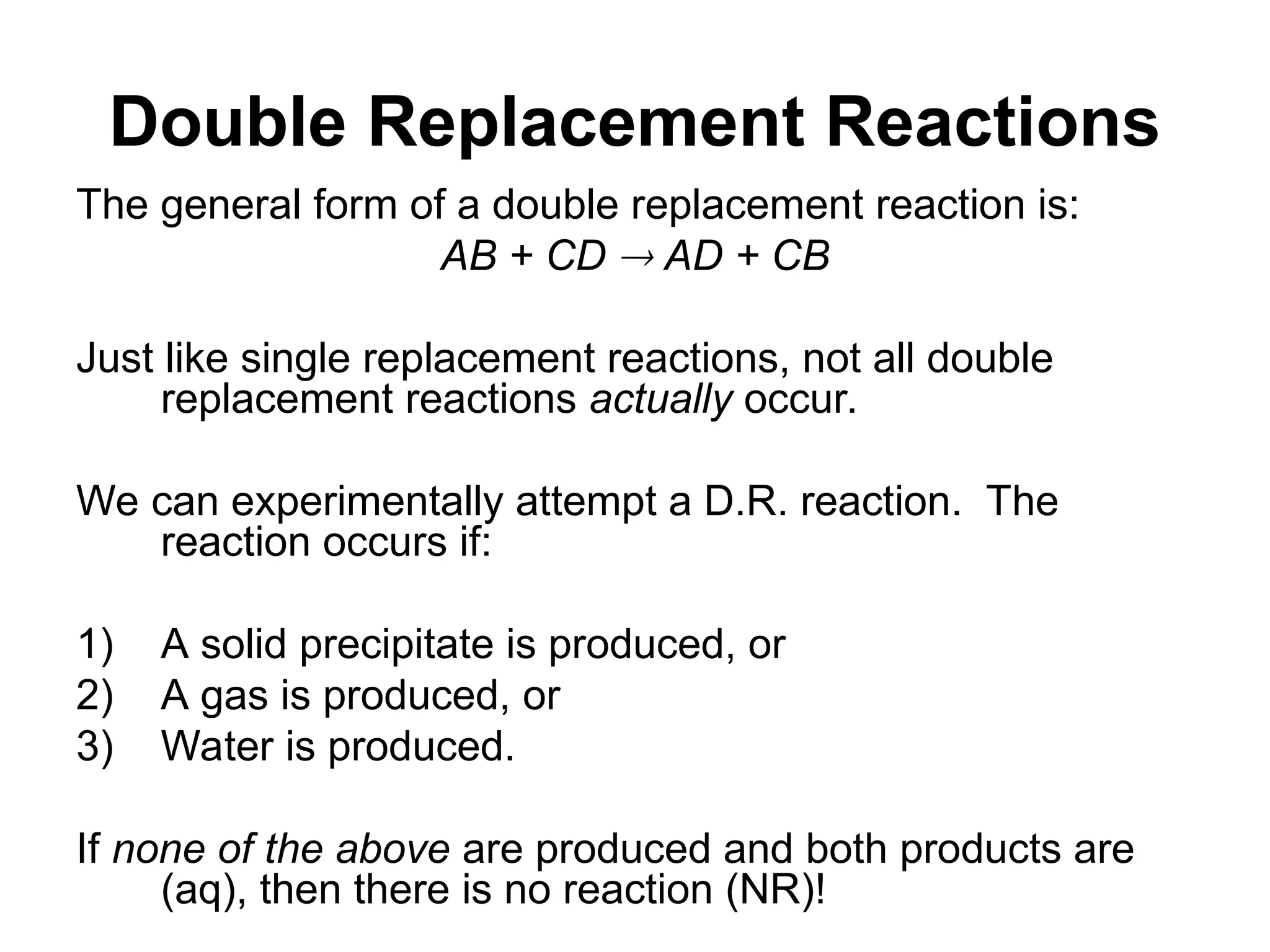
Thegeneral form of a double replacement reaction is:
AB + CD AD + CB
Just like single replacement reactions, not all double
replacement reactions actually occur.
We can experimentally attempt a D.R. reaction. The
reaction occurs if:
1) A solid precipitate is produced, or
2) A gas is produced, or
3) Water is produced.
If none of the above are produced and both products are
(aq), then there is no reaction (NR)!
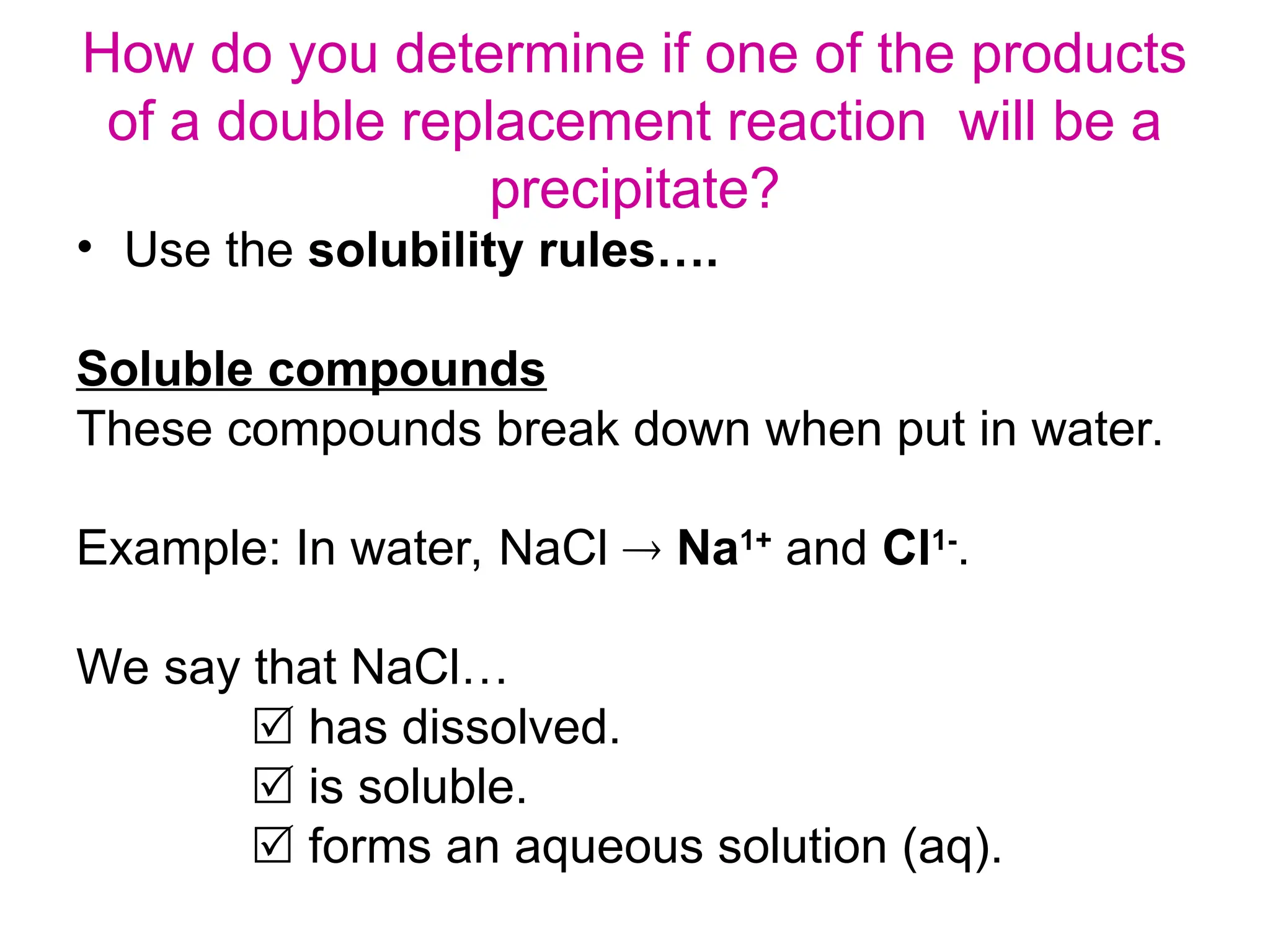
How do youdetermine if one of the products
of a double replacement reaction will be a
precipitate?
• Use the solubility rules….
Soluble compounds
These compounds break down when put in water.
Example: In water, NaCl Na1+
and Cl1-
.
We say that NaCl…
has dissolved.
is soluble.
forms an aqueous solution (aq).
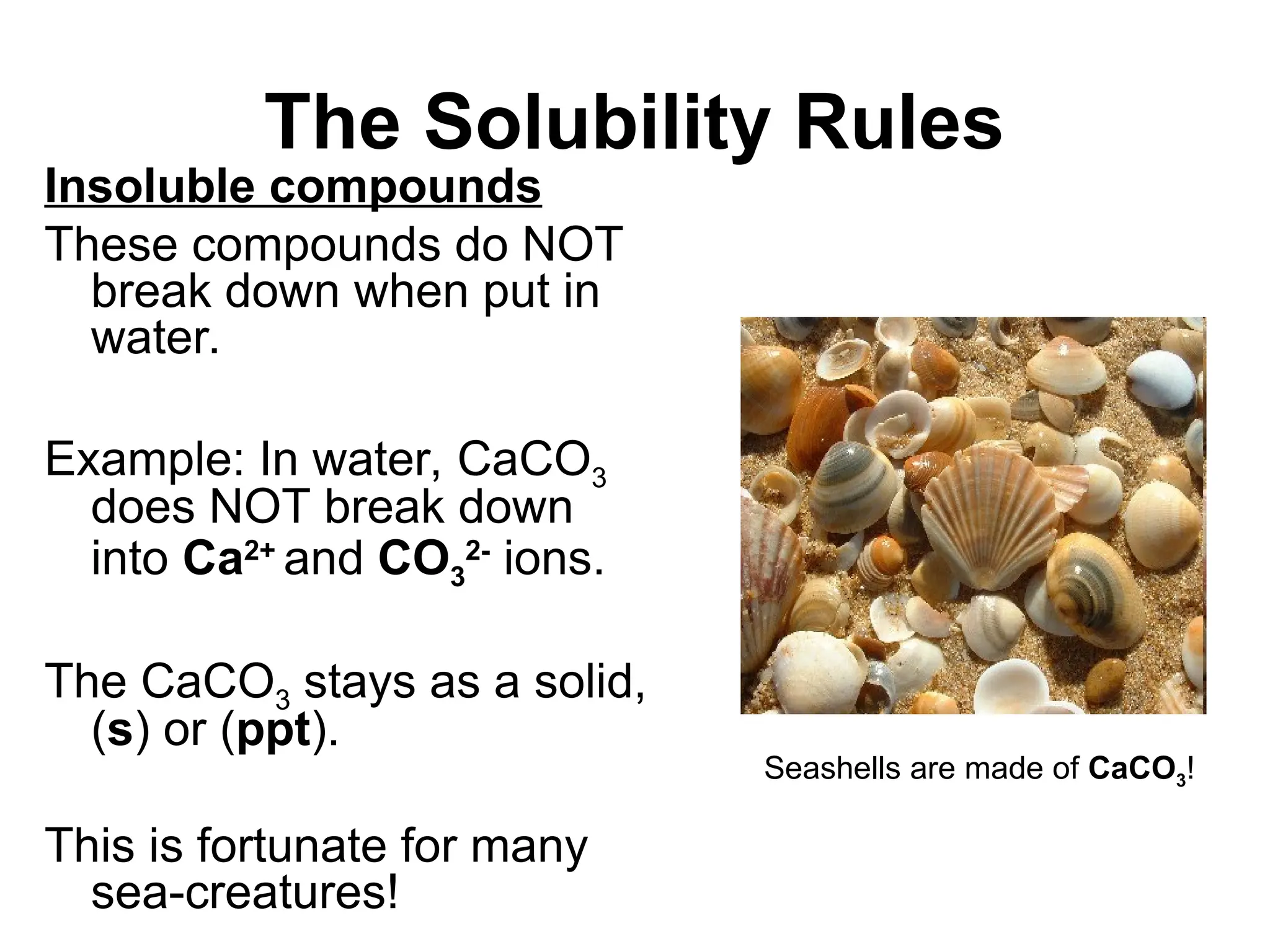
30.
The Solubility Rules
Insolublecompounds
These compounds do NOT
break down when put in
water.
Example: In water, CaCO3
does NOT break down
into Ca2+
and CO3
2-
ions.
The CaCO3 stays as a solid,
(s) or (ppt).
This is fortunate for many
sea-creatures!
Seashells are made of CaCO3!
31.
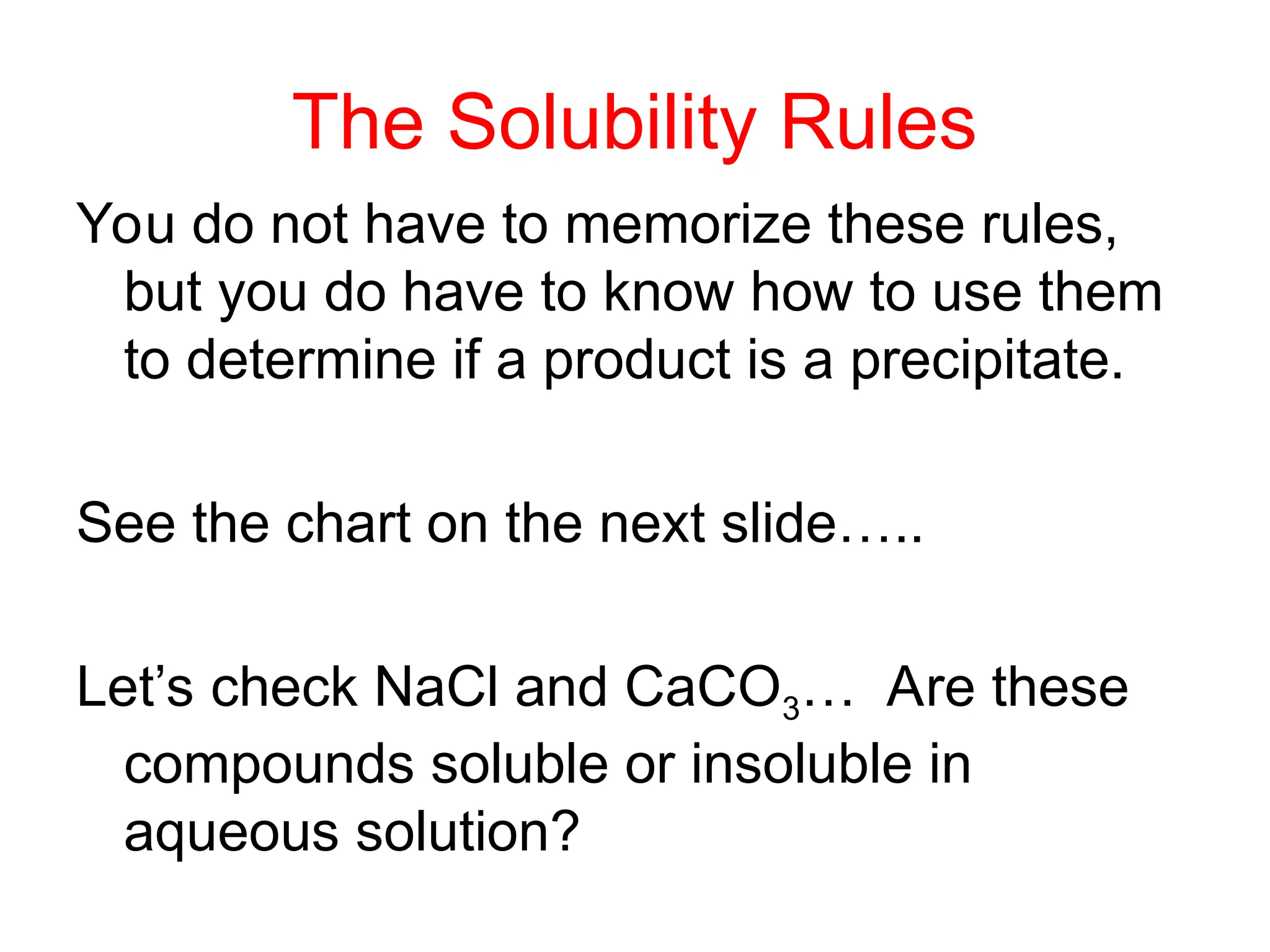
The Solubility Rules
Youdo not have to memorize these rules,
but you do have to know how to use them
to determine if a product is a precipitate.
See the chart on the next slide…..
Let’s check NaCl and CaCO3… Are these
compounds soluble or insoluble in
aqueous solution?
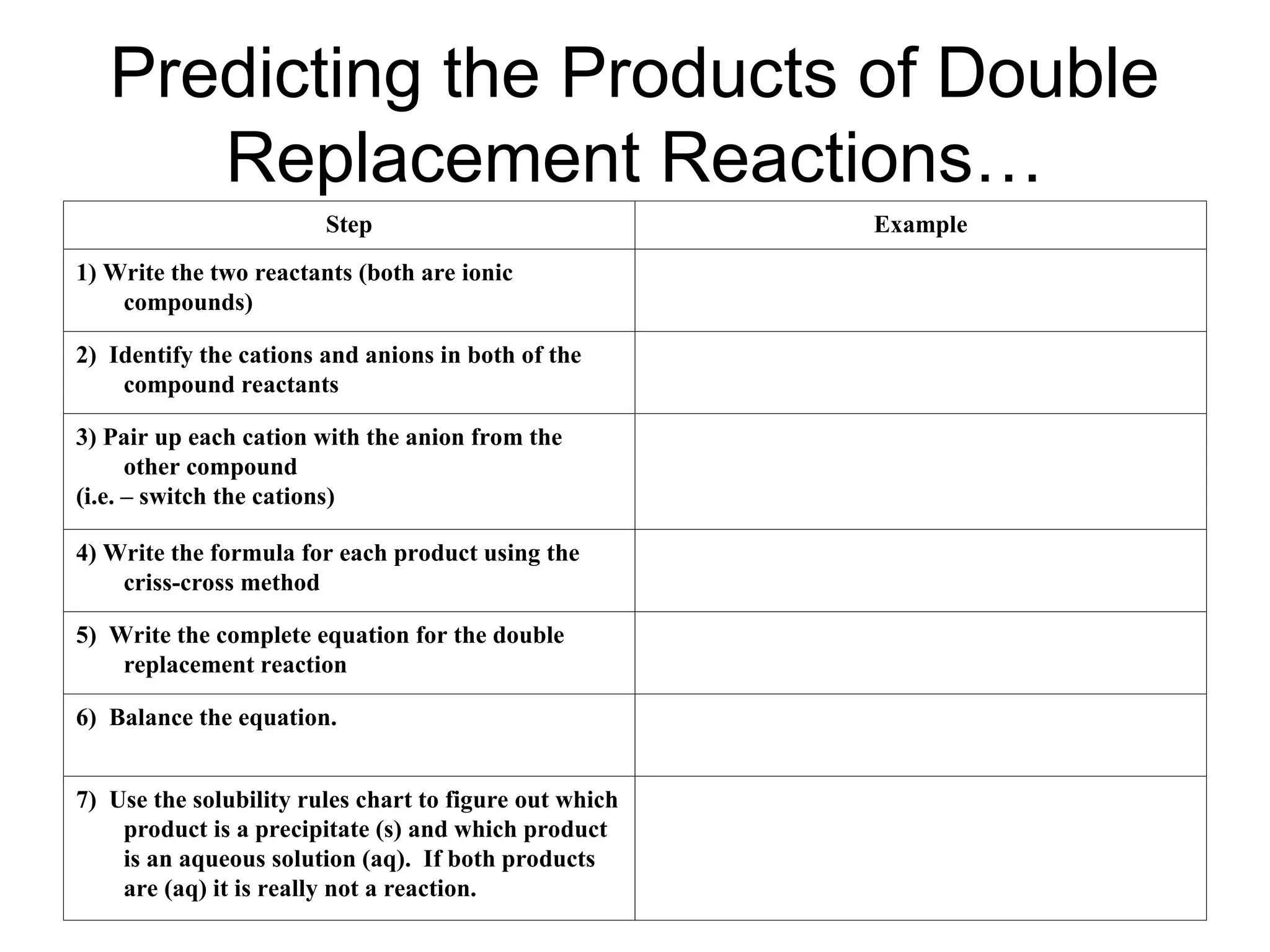
Predicting the Productsof Double
Replacement Reactions…
Step Example
1) Write the two reactants (both are ionic
compounds)
2) Identify the cations and anions in both of the
compound reactants
3) Pair up each cation with the anion from the
other compound
(i.e. – switch the cations)
4) Write the formula for each product using the
criss-cross method
5) Write the complete equation for the double
replacement reaction
6) Balance the equation.
7) Use the solubility rules chart to figure out which
product is a precipitate (s) and which product
is an aqueous solution (aq). If both products
are (aq) it is really not a reaction.
34.
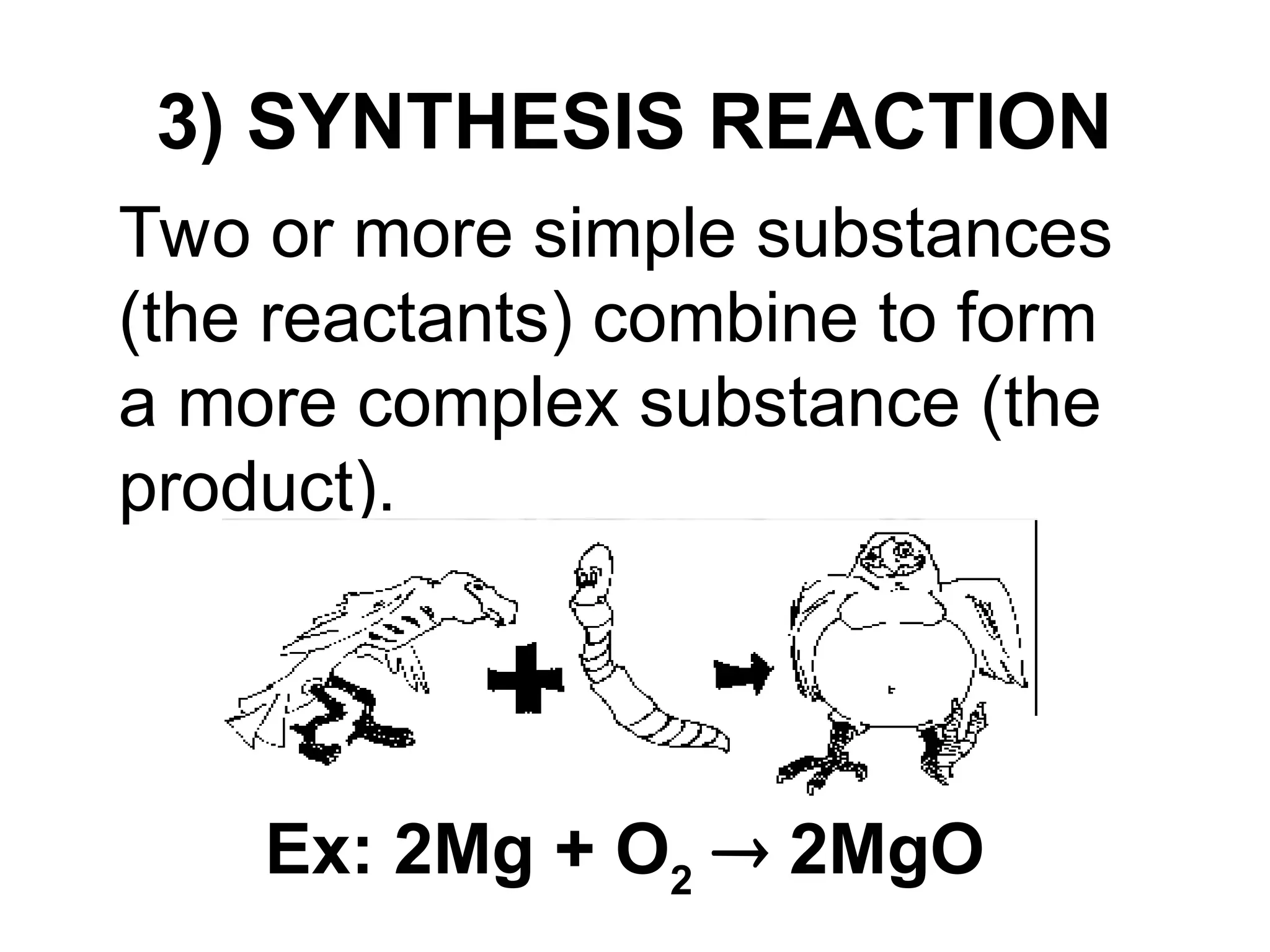
Two or moresimple substances
(the reactants) combine to form
a more complex substance (the
product).
3) SYNTHESIS REACTION
Ex: 2Mg + O2
2MgO
35.
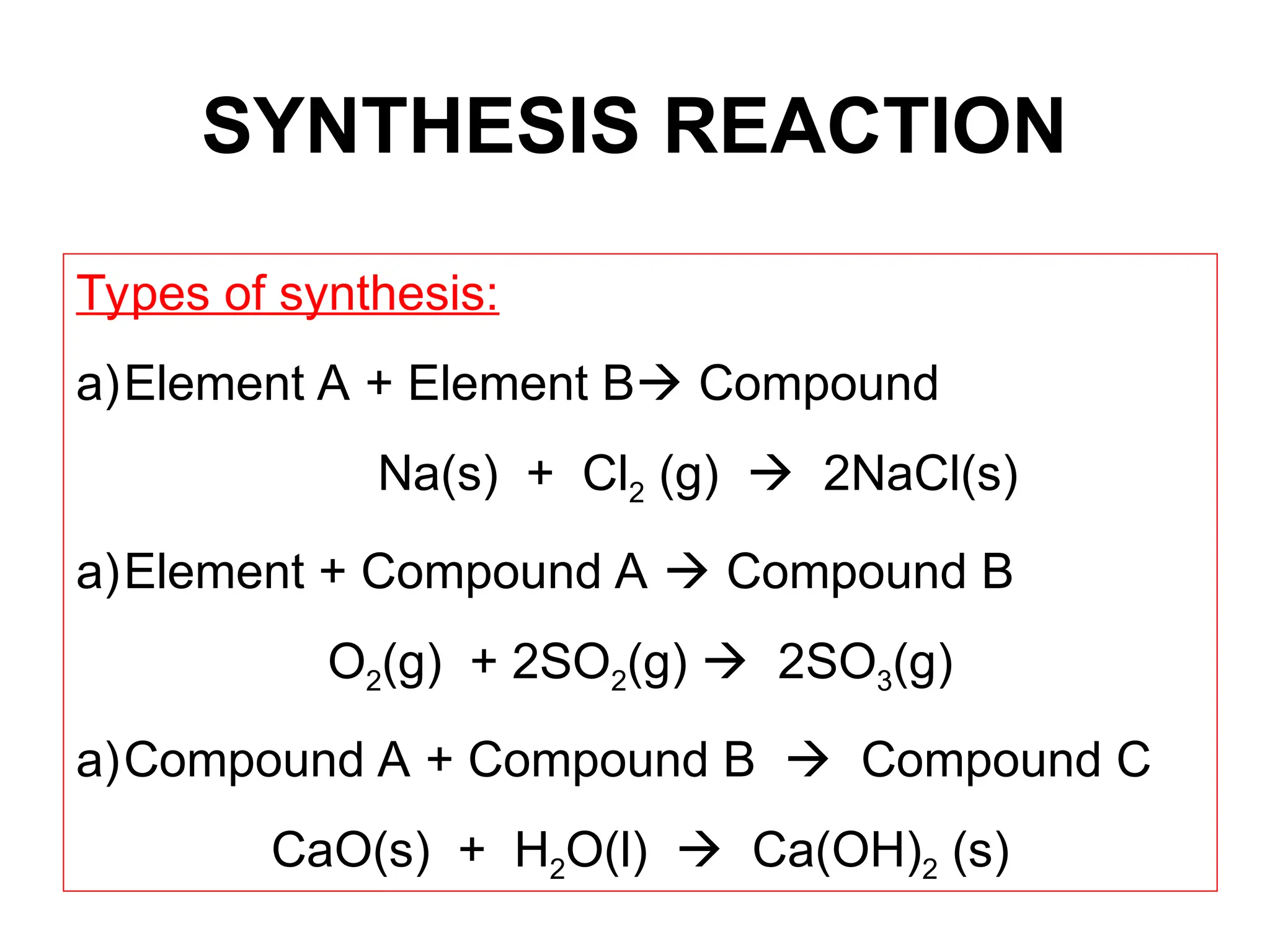
SYNTHESIS REACTION
Types ofsynthesis:
a)Element A + Element B Compound
Na(s) + Cl2 (g) 2NaCl(s)
a)Element + Compound A Compound B
O2(g) + 2SO2(g) 2SO3(g)
a)Compound A + Compound B Compound C
CaO(s) + H2O(l) Ca(OH)2 (s)
36.
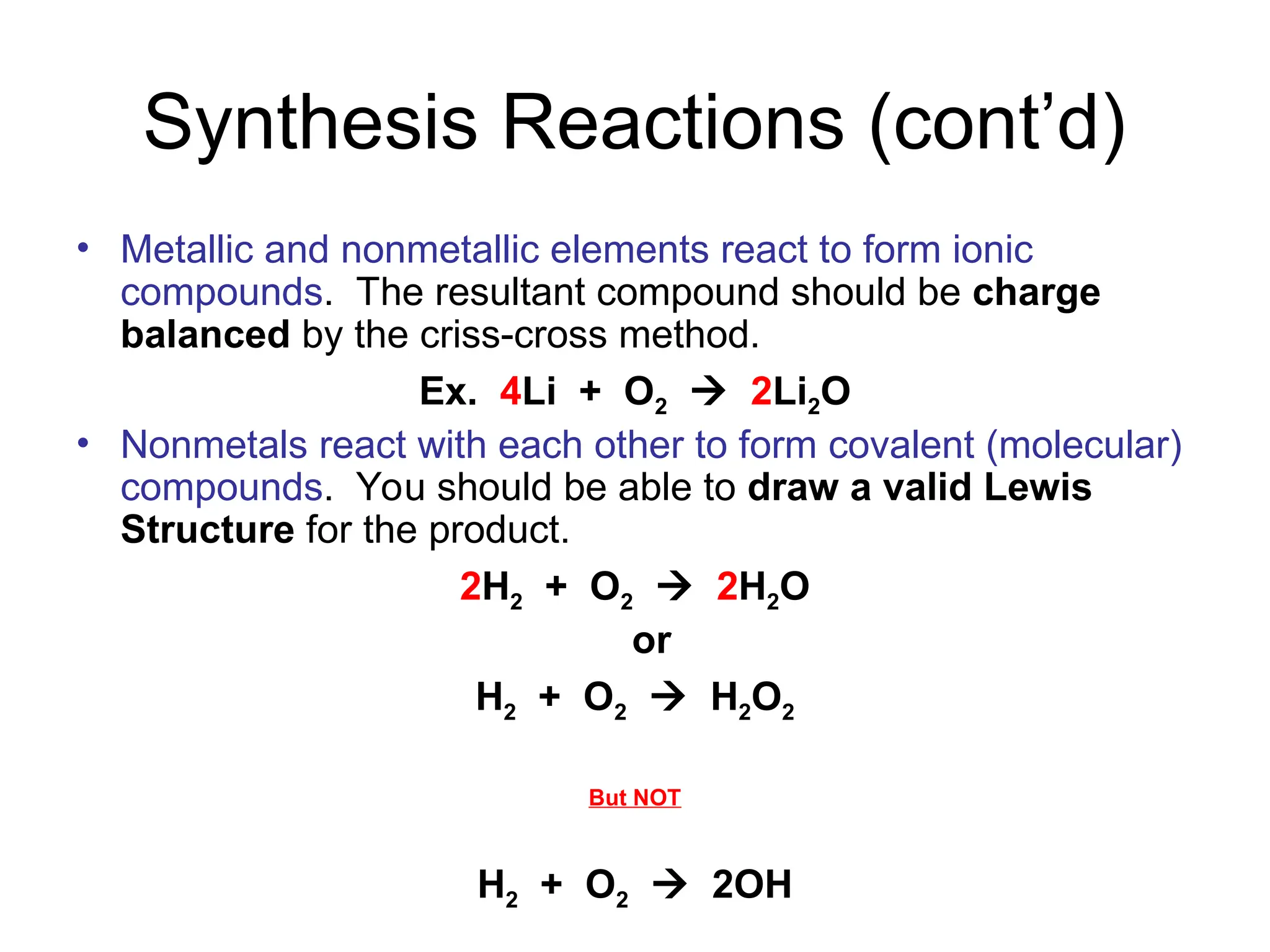
Synthesis Reactions (cont’d)
•Metallic and nonmetallic elements react to form ionic
compounds. The resultant compound should be charge
balanced by the criss-cross method.
Ex. 4Li + O2 2Li2O
• Nonmetals react with each other to form covalent (molecular)
compounds. You should be able to draw a valid Lewis
Structure for the product.
2H2 + O2 2H2O
or
H2 + O2 H2O2
But NOT
H2 + O2 2OH
37.
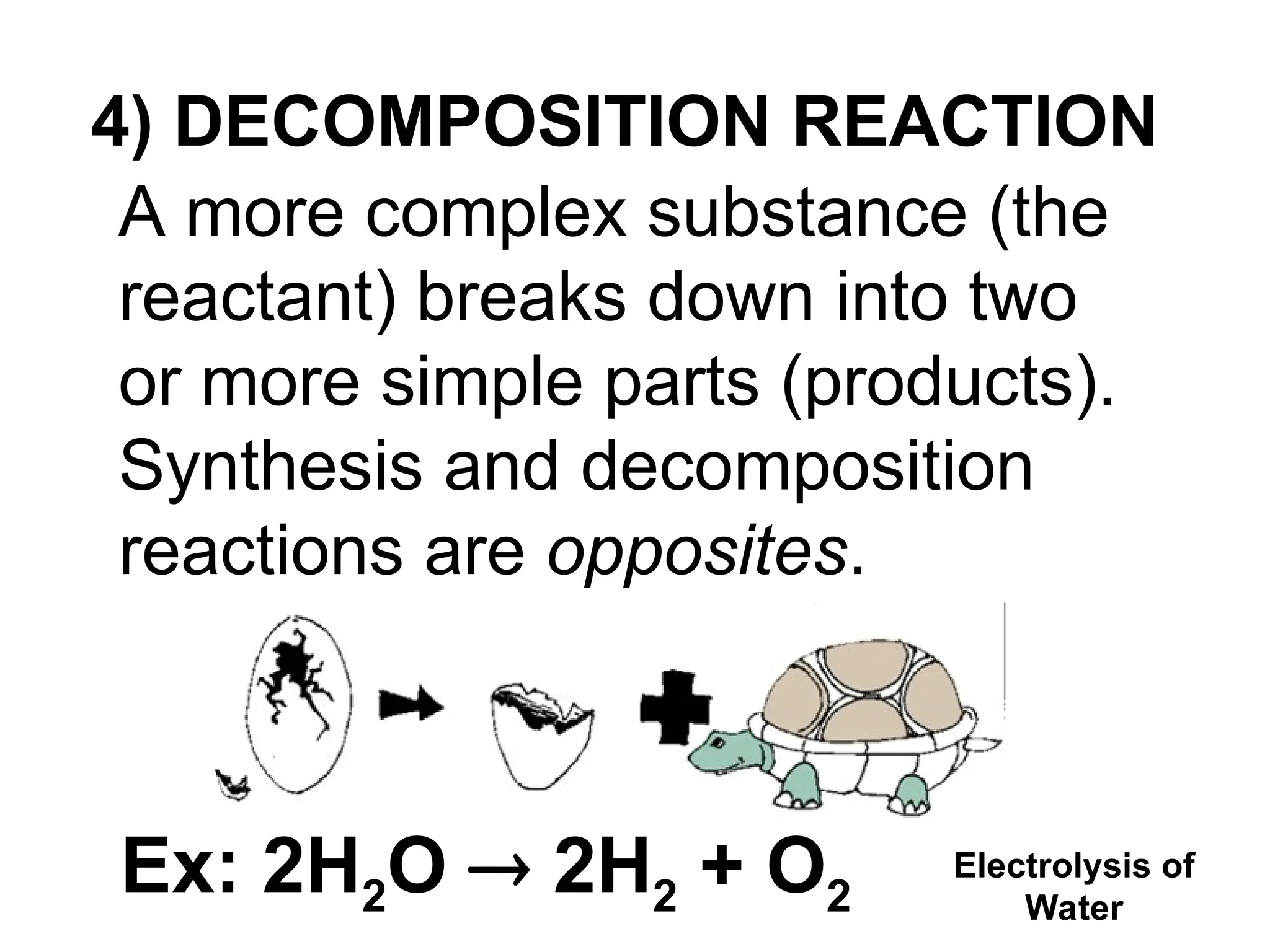
A more complexsubstance (the
reactant) breaks down into two
or more simple parts (products).
Synthesis and decomposition
reactions are opposites.
4) DECOMPOSITION REACTION
Ex: 2H2O 2H2 + O2
Electrolysis of
Water
38.
DECOMPOSITION REACTIONS
(Cont’d)
Decomposition ofa compound produces two or
more elements and/or compounds
The products are always simpler than the
reactant.
Gases are often produced (H2, N2, O2, CO2, etc.)
in the decomposition of covalent compounds.
Ionic compounds may be decomposed into pure
elements by using electricity (electrolysis). This is
how pure metals are obtained from salts.
39.
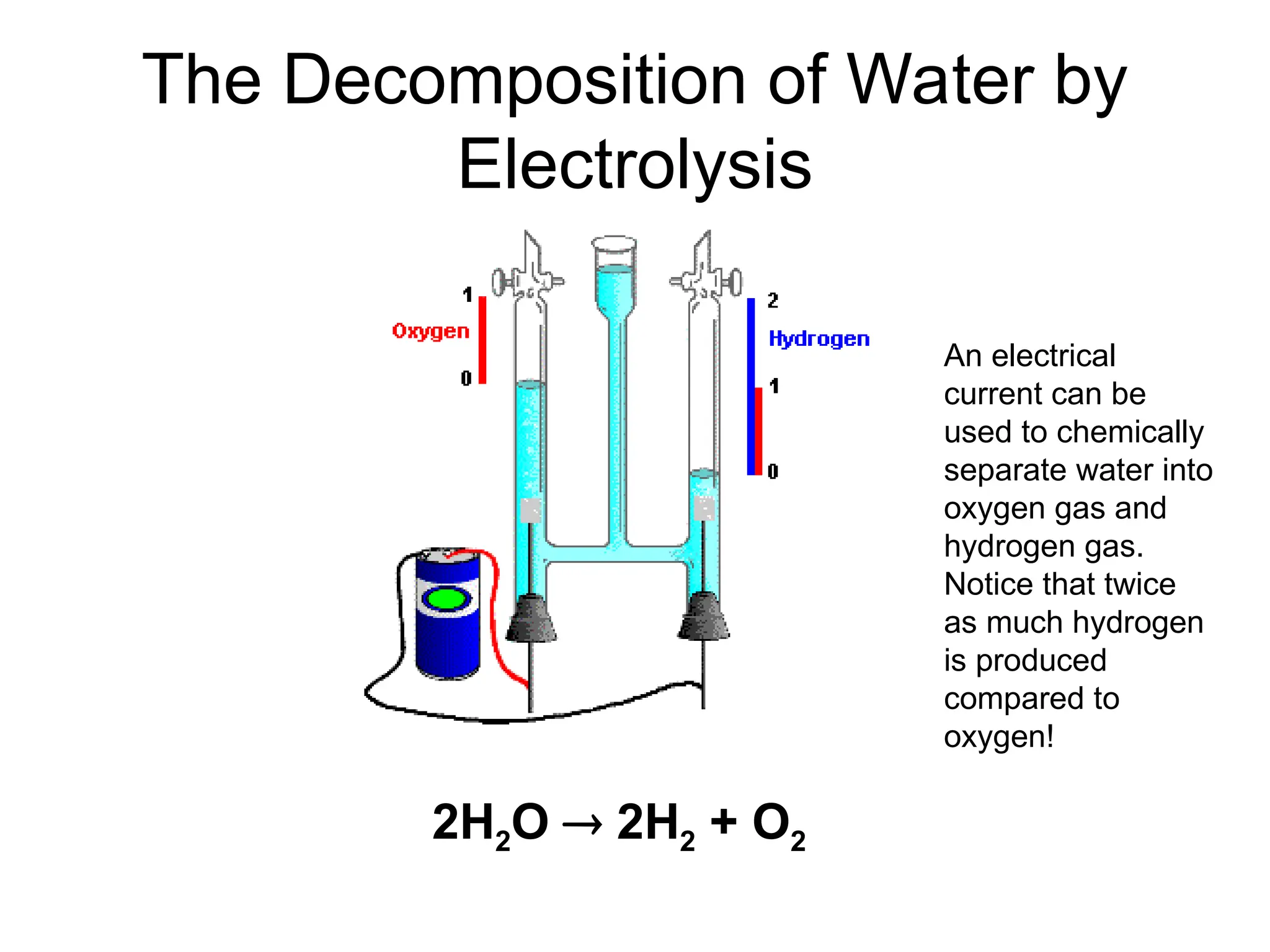
The Decomposition ofWater by
Electrolysis
2H2O 2H2 + O2
An electrical
current can be
used to chemically
separate water into
oxygen gas and
hydrogen gas.
Notice that twice
as much hydrogen
is produced
compared to
oxygen!
40.
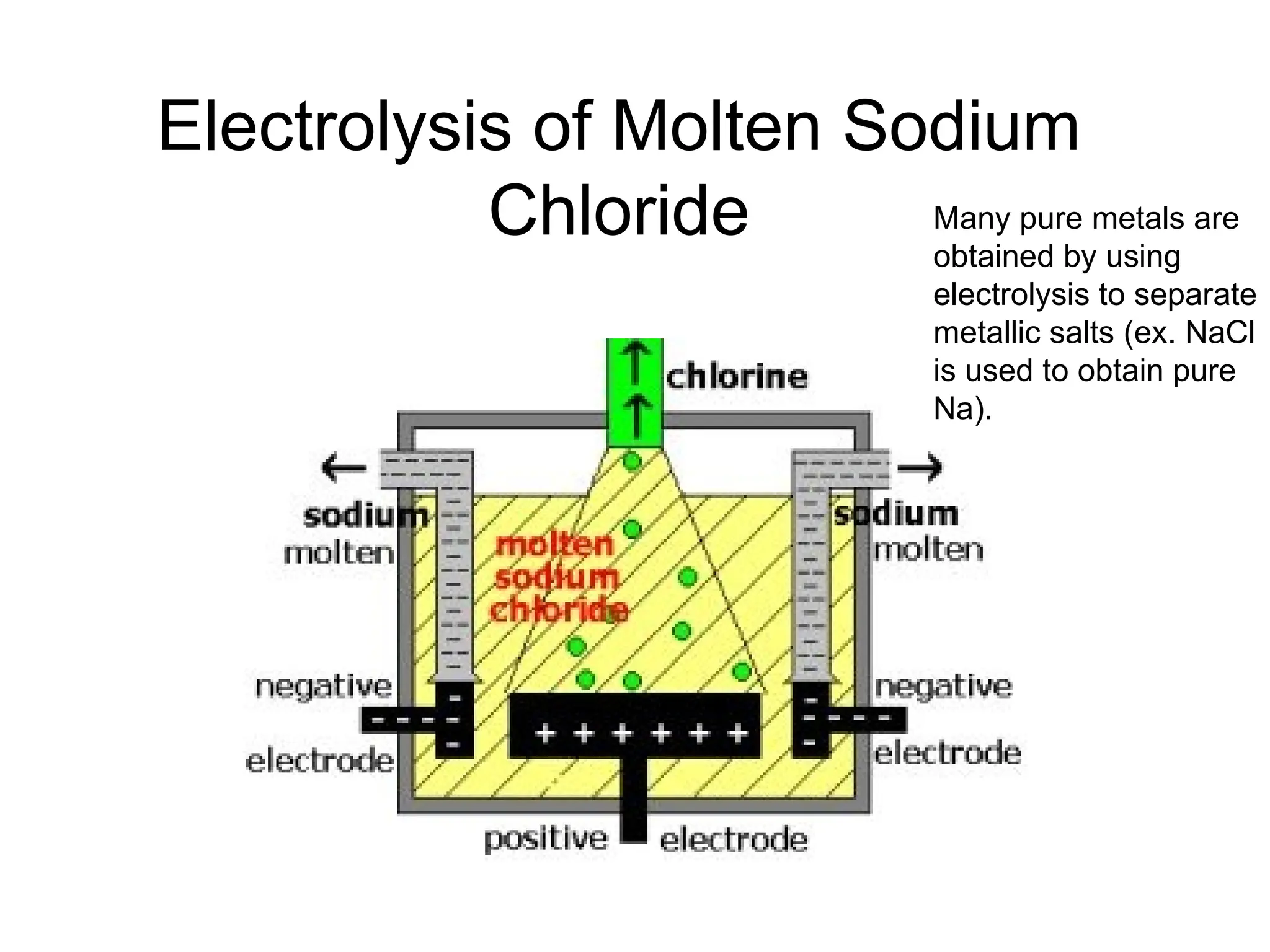
Electrolysis of MoltenSodium
Chloride Many pure metals are
obtained by using
electrolysis to separate
metallic salts (ex. NaCl
is used to obtain pure
Na).
41.
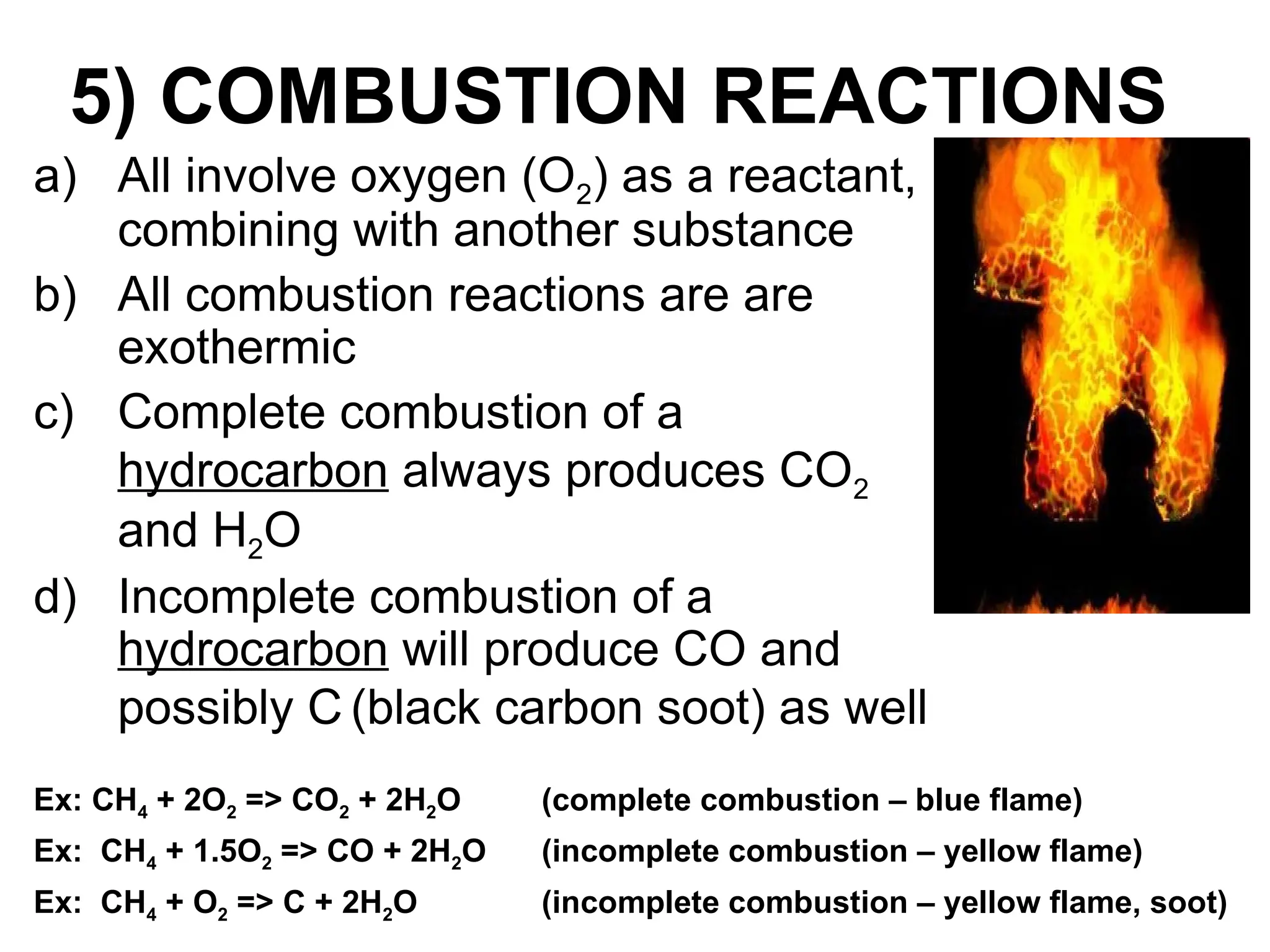
5) COMBUSTION REACTIONS
a)All involve oxygen (O2) as a reactant,
combining with another substance
b) All combustion reactions are are
exothermic
c) Complete combustion of a
hydrocarbon always produces CO2
and H2O
d) Incomplete combustion of a
hydrocarbon will produce CO and
possibly C (black carbon soot) as well
Ex: CH4 + 2O2 => CO2 + 2H2O (complete combustion – blue flame)
Ex: CH4 + 1.5O2 => CO + 2H2O (incomplete combustion – yellow flame)
Ex: CH4 + O2 => C + 2H2O (incomplete combustion – yellow flame, soot)
42.
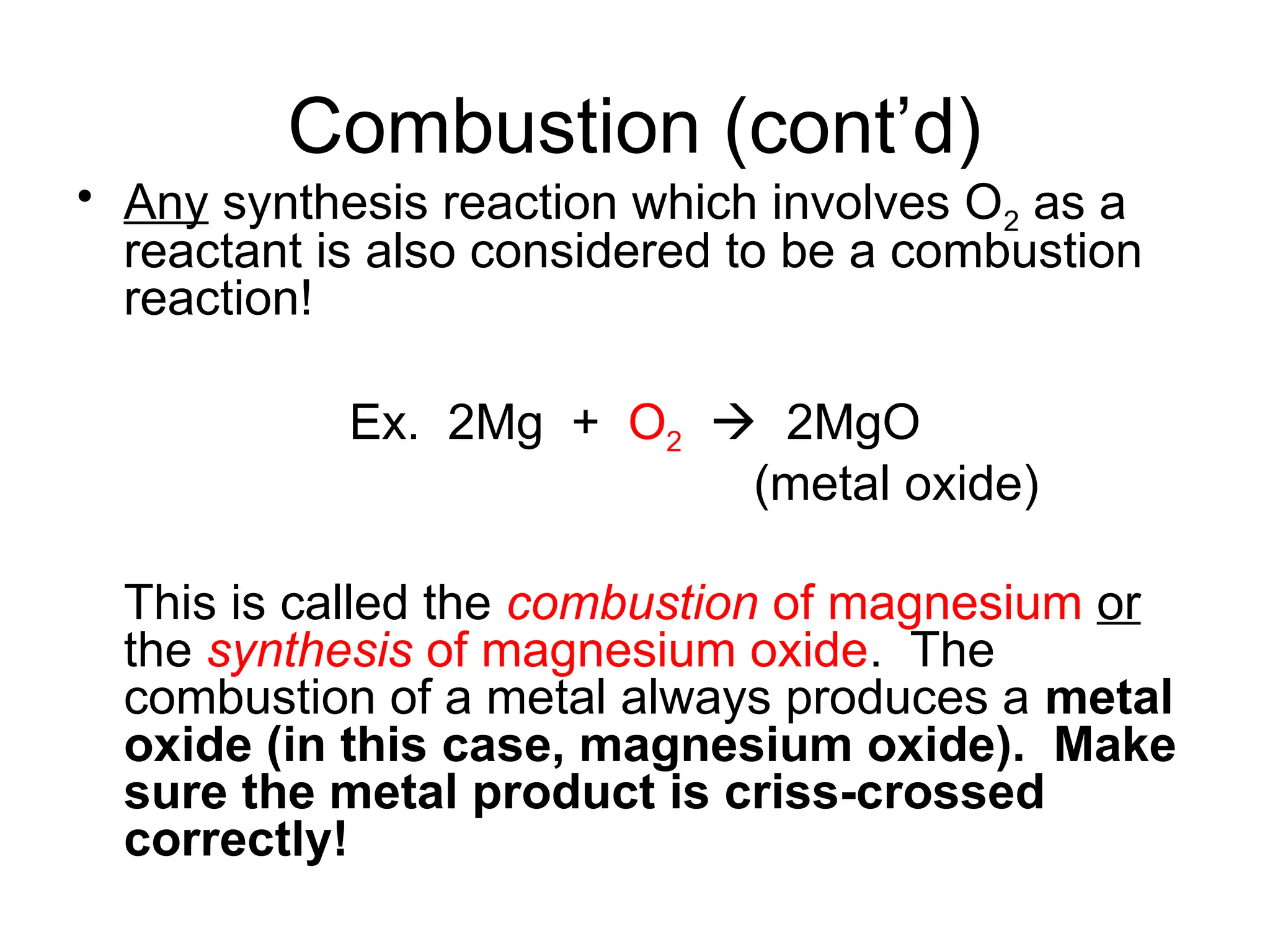
Combustion (cont’d)
• Anysynthesis reaction which involves O2 as a
reactant is also considered to be a combustion
reaction!
Ex. 2Mg + O2 2MgO
(metal oxide)
This is called the combustion of magnesium or
the synthesis of magnesium oxide. The
combustion of a metal always produces a metal
oxide (in this case, magnesium oxide). Make
sure the metal product is criss-crossed
correctly!
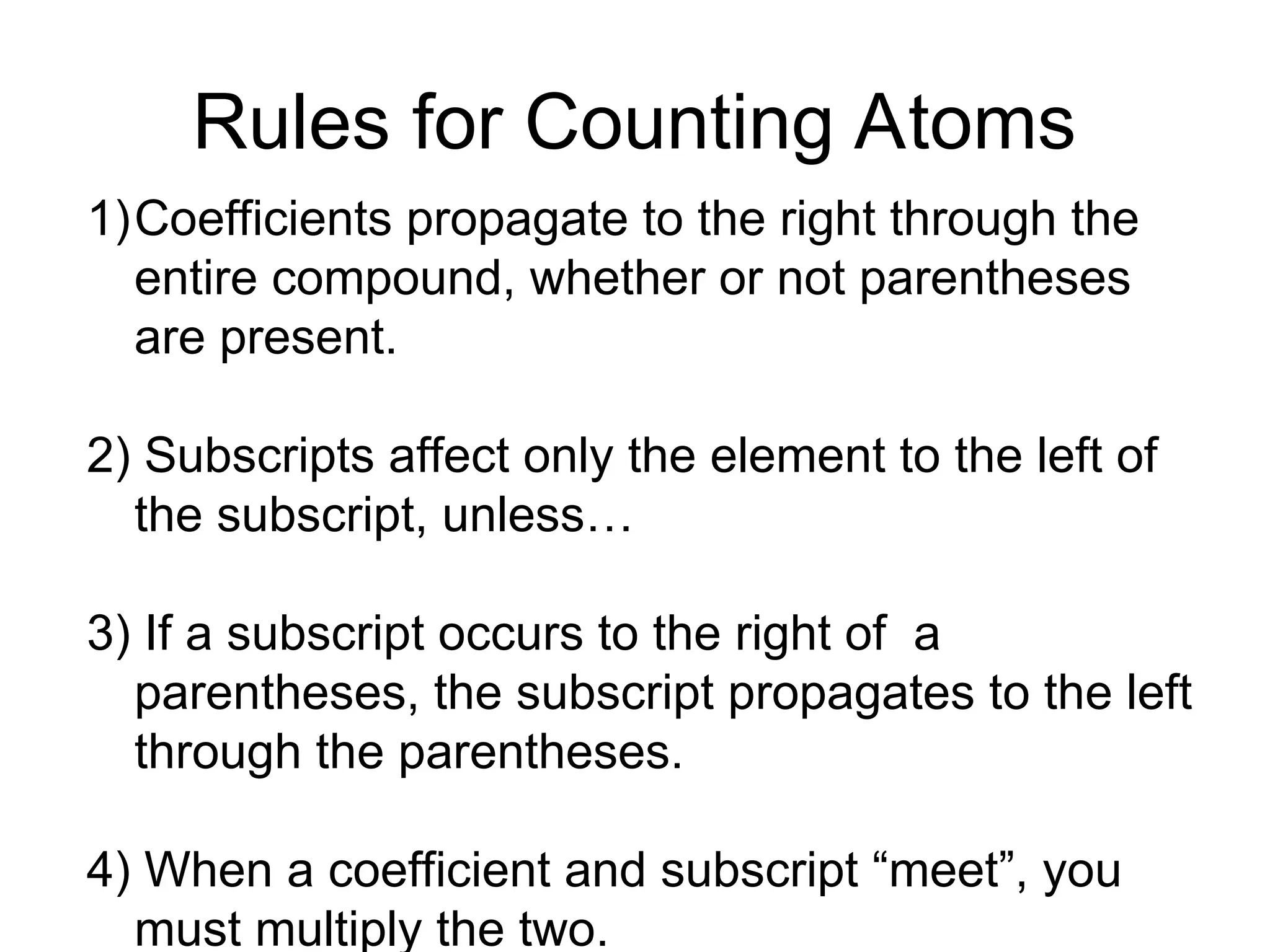
Rules for CountingAtoms
1)Coefficients propagate to the right through the
entire compound, whether or not parentheses
are present.
2) Subscripts affect only the element to the left of
the subscript, unless…
3) If a subscript occurs to the right of a
parentheses, the subscript propagates to the left
through the parentheses.
4) When a coefficient and subscript “meet”, you
must multiply the two.
48.
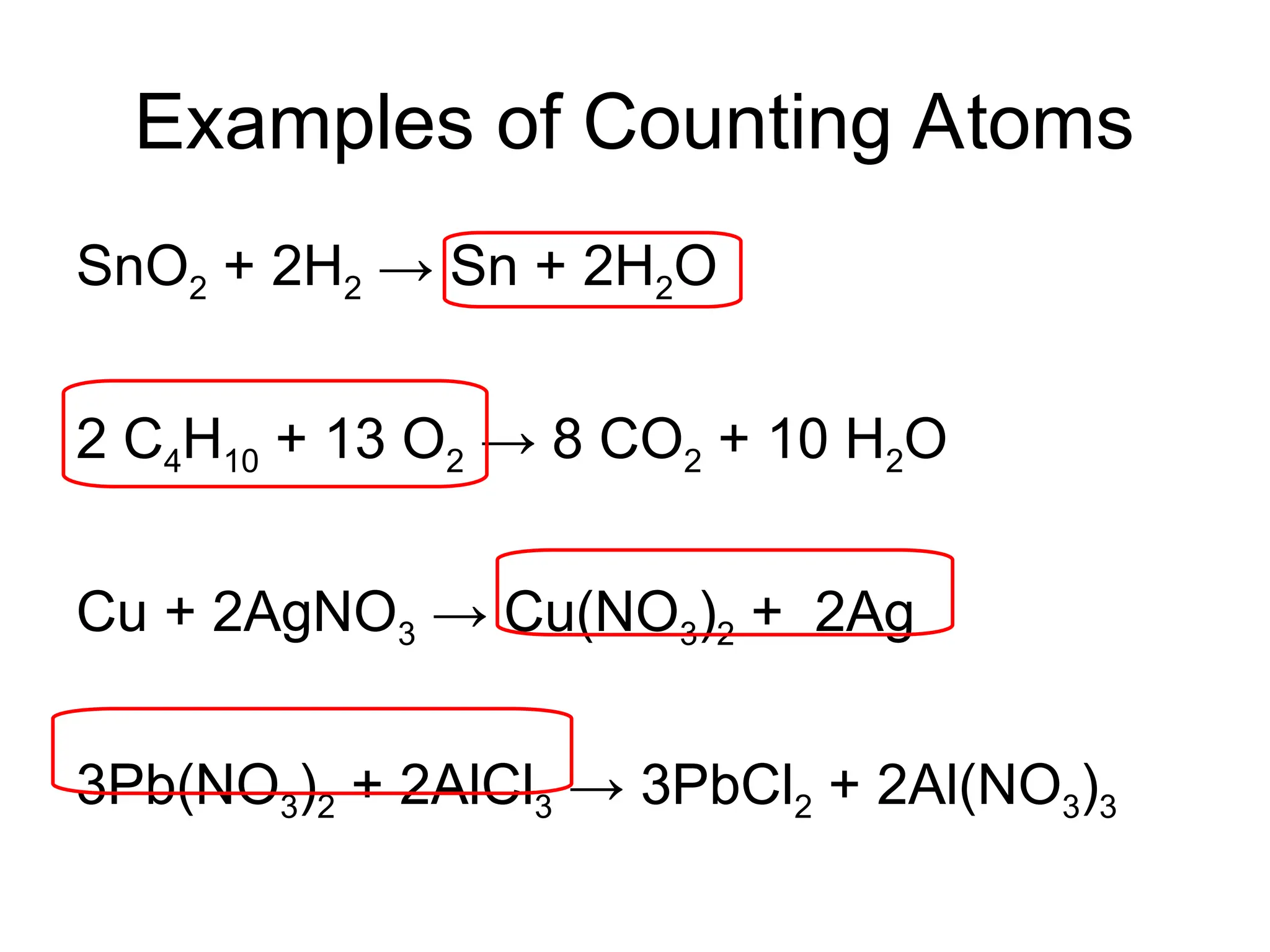
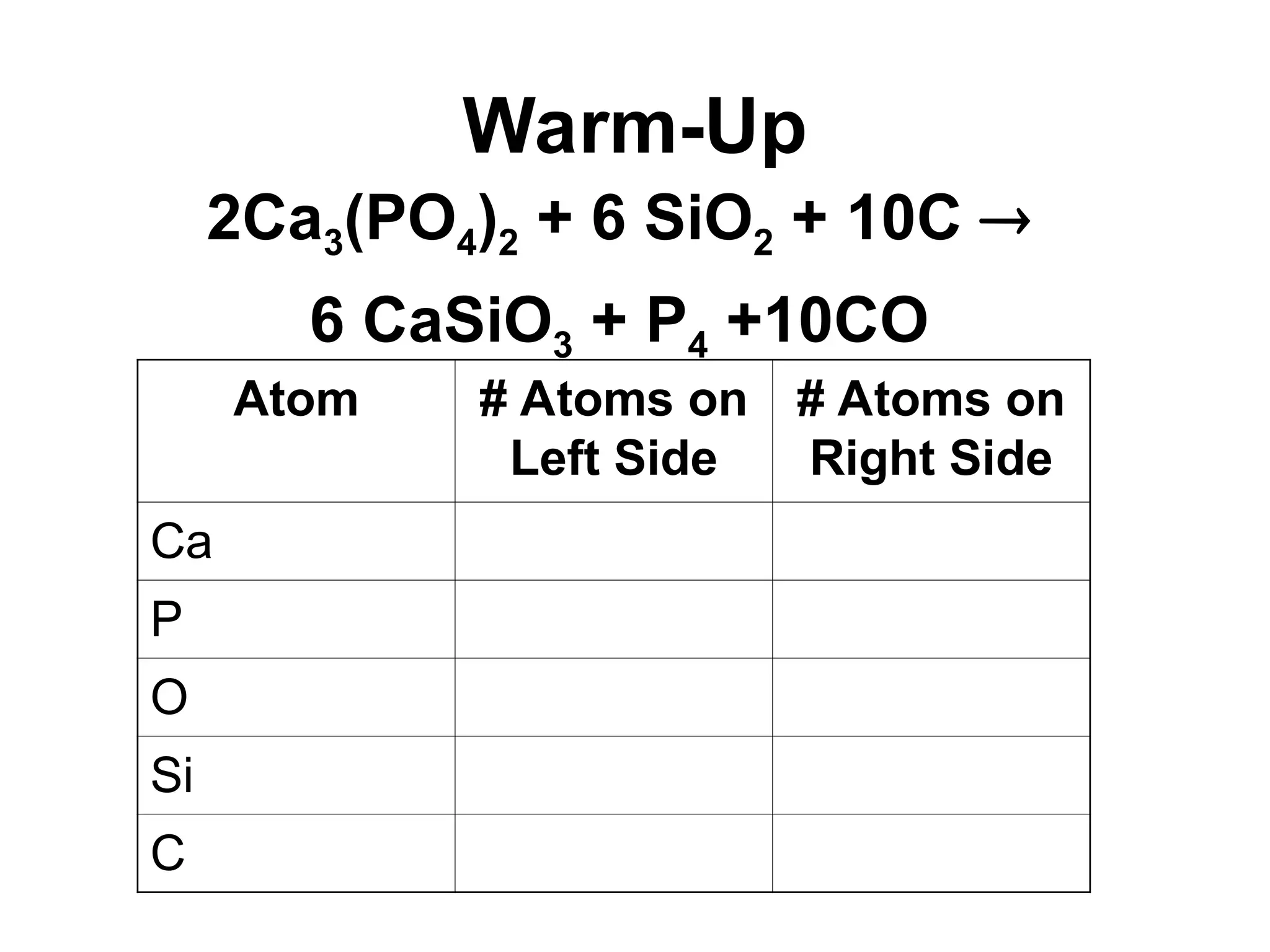
Examples of CountingAtoms
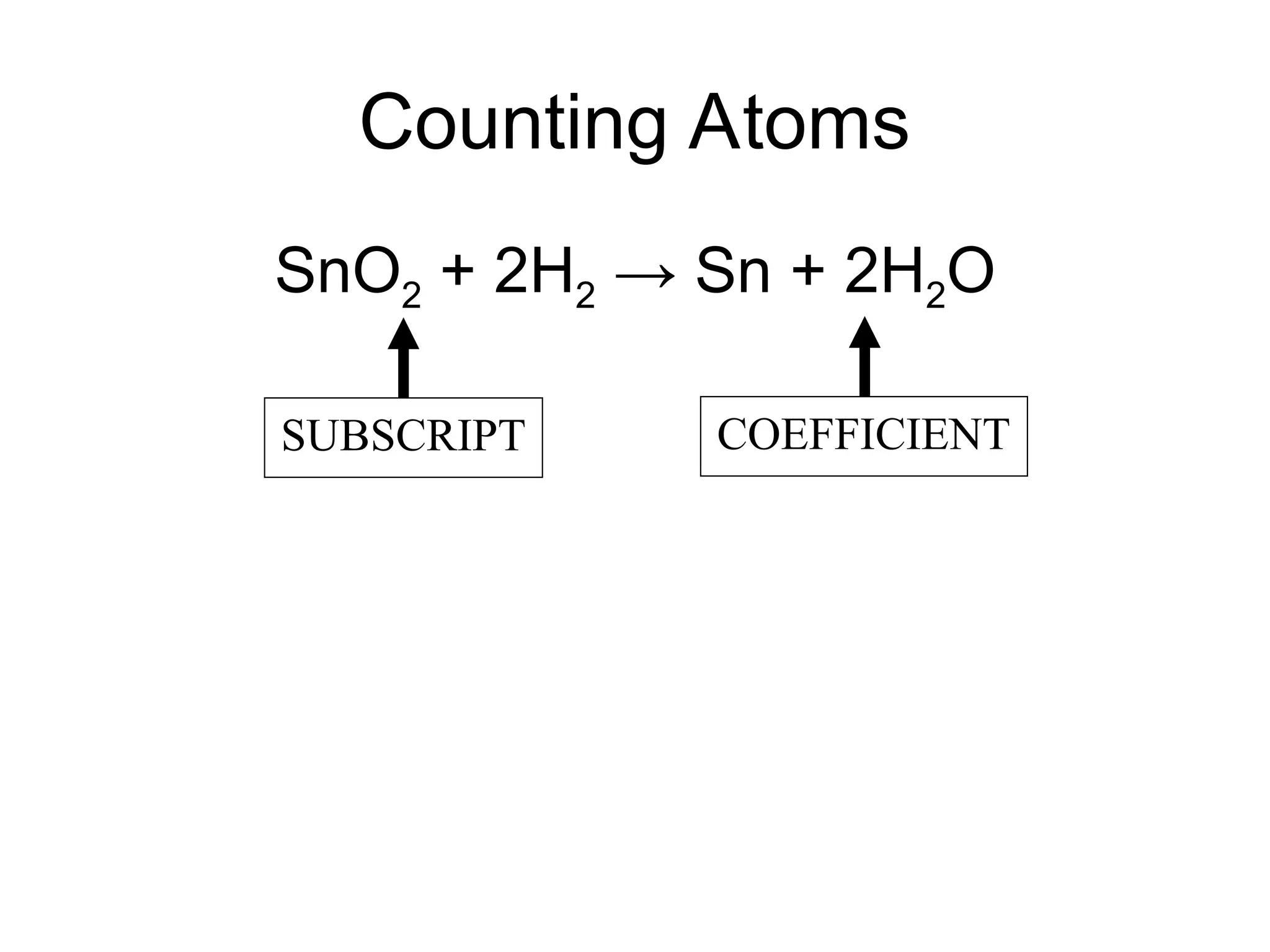
SnO2 + 2H2 → Sn + 2H2O
2 C4H10 + 13 O2 → 8 CO2 + 10 H2O
Cu + 2AgNO3 → Cu(NO3)2 + 2Ag
3Pb(NO3)2 + 2AlCl3 → 3PbCl2 + 2Al(NO3)3
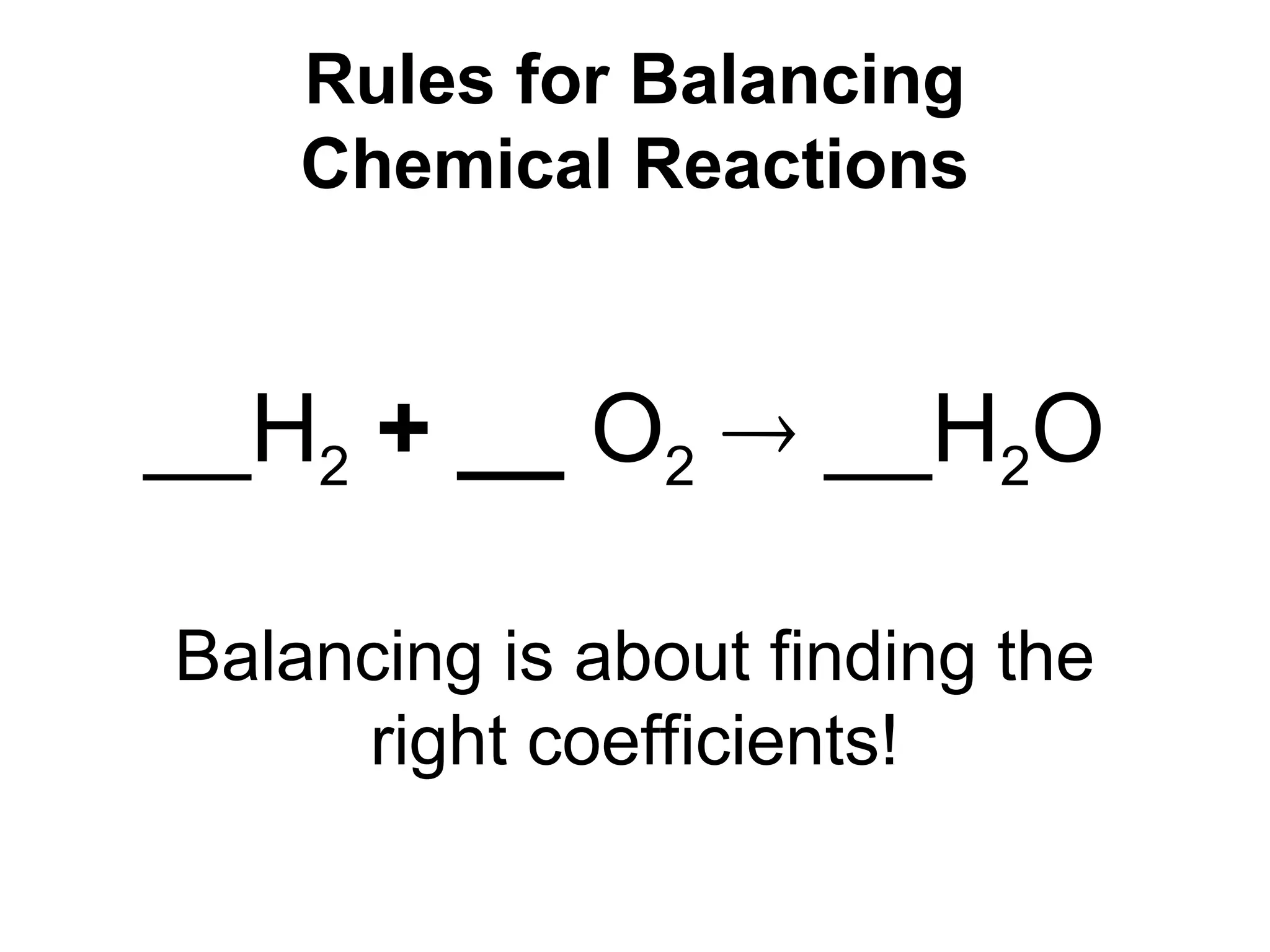
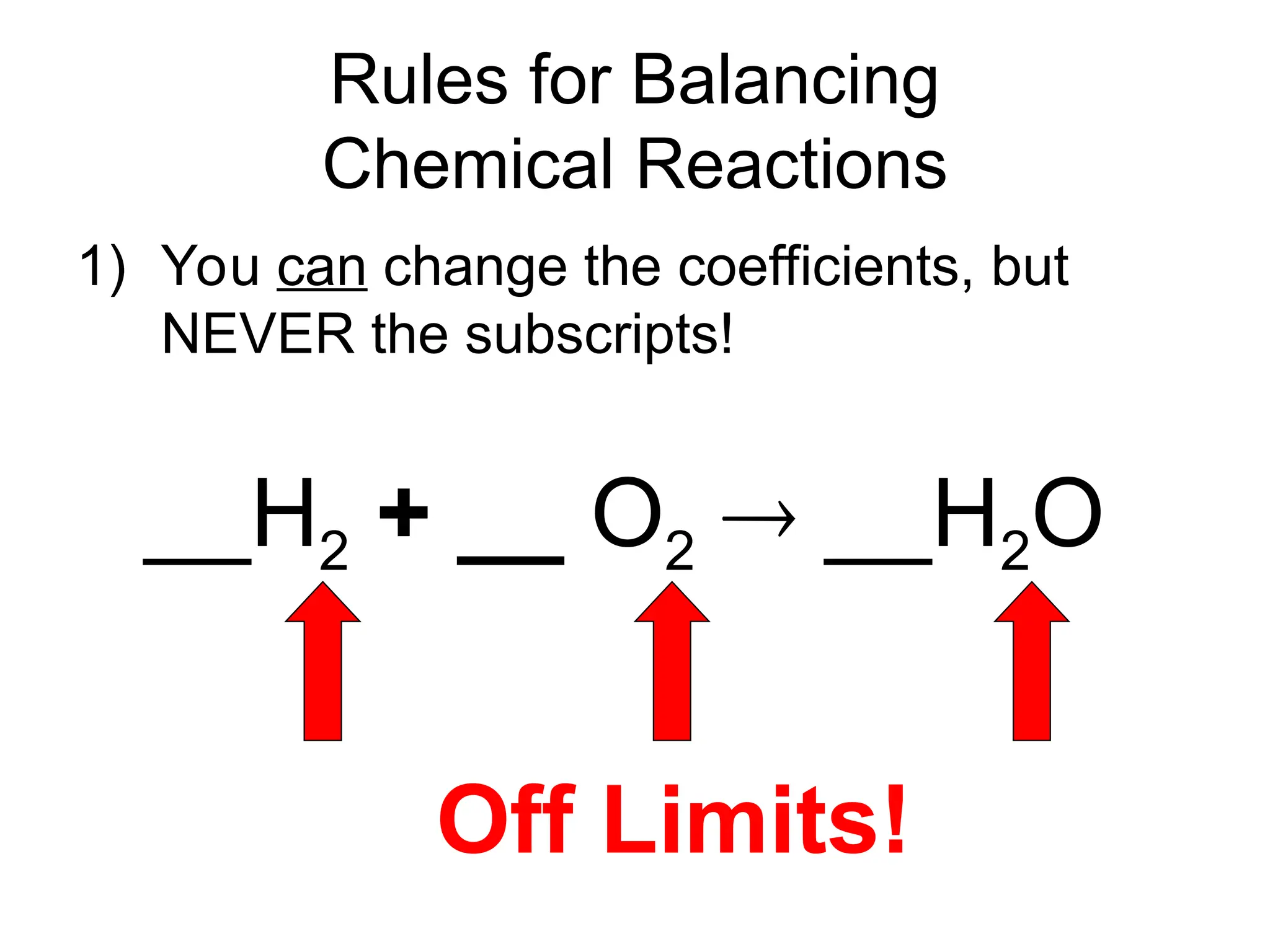
Rules for Balancing
ChemicalReactions
1) You can change the coefficients, but
NEVER the subscripts!
__H2 + __ O2 __H2O
Off Limits!
53.
Rules for Balancing
ChemicalReactions
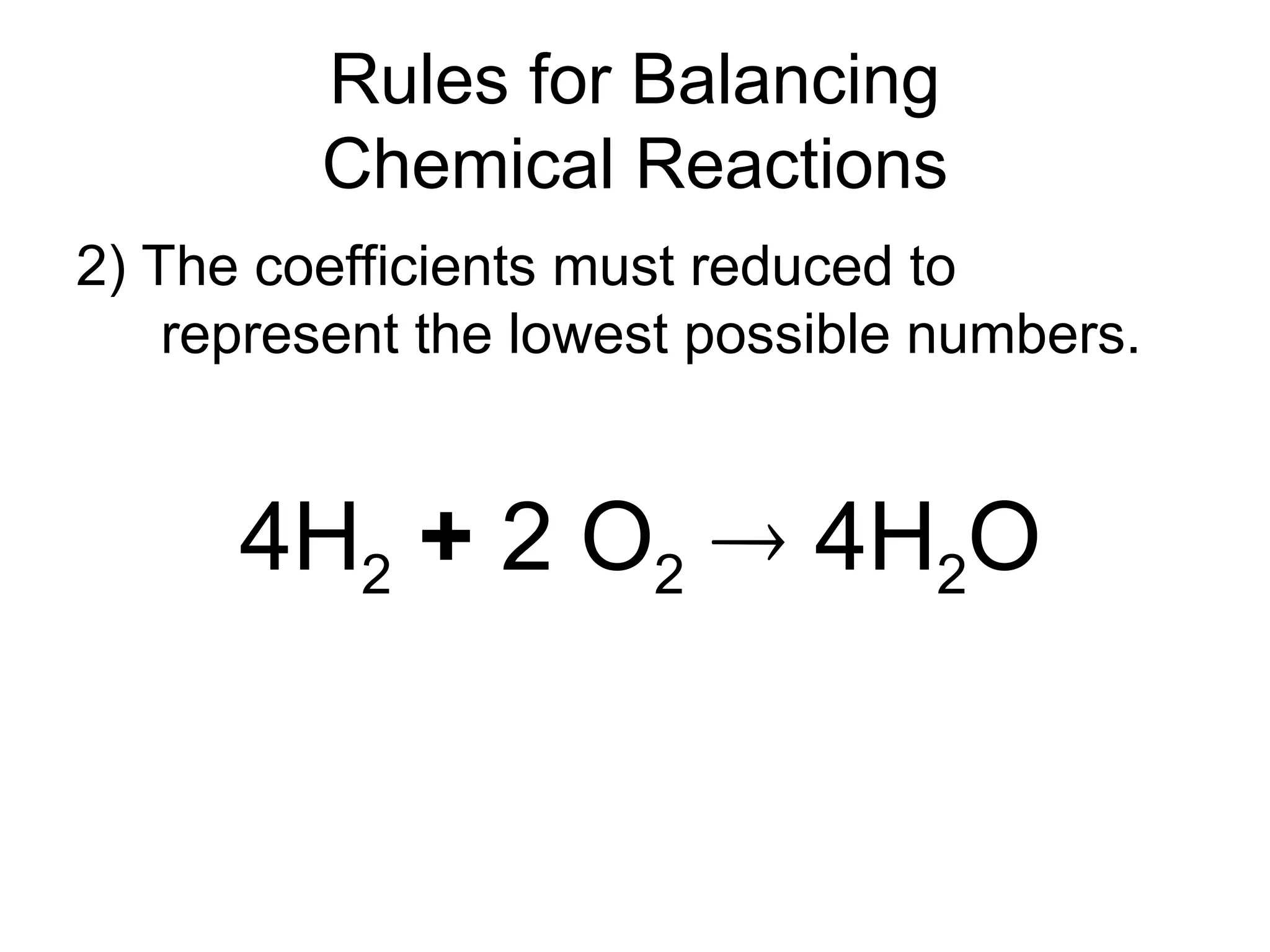
2) The coefficients must reduced to
represent the lowest possible numbers.
4H2 + 2 O2 4H2O
54.
Rules for Balancing
ChemicalReactions
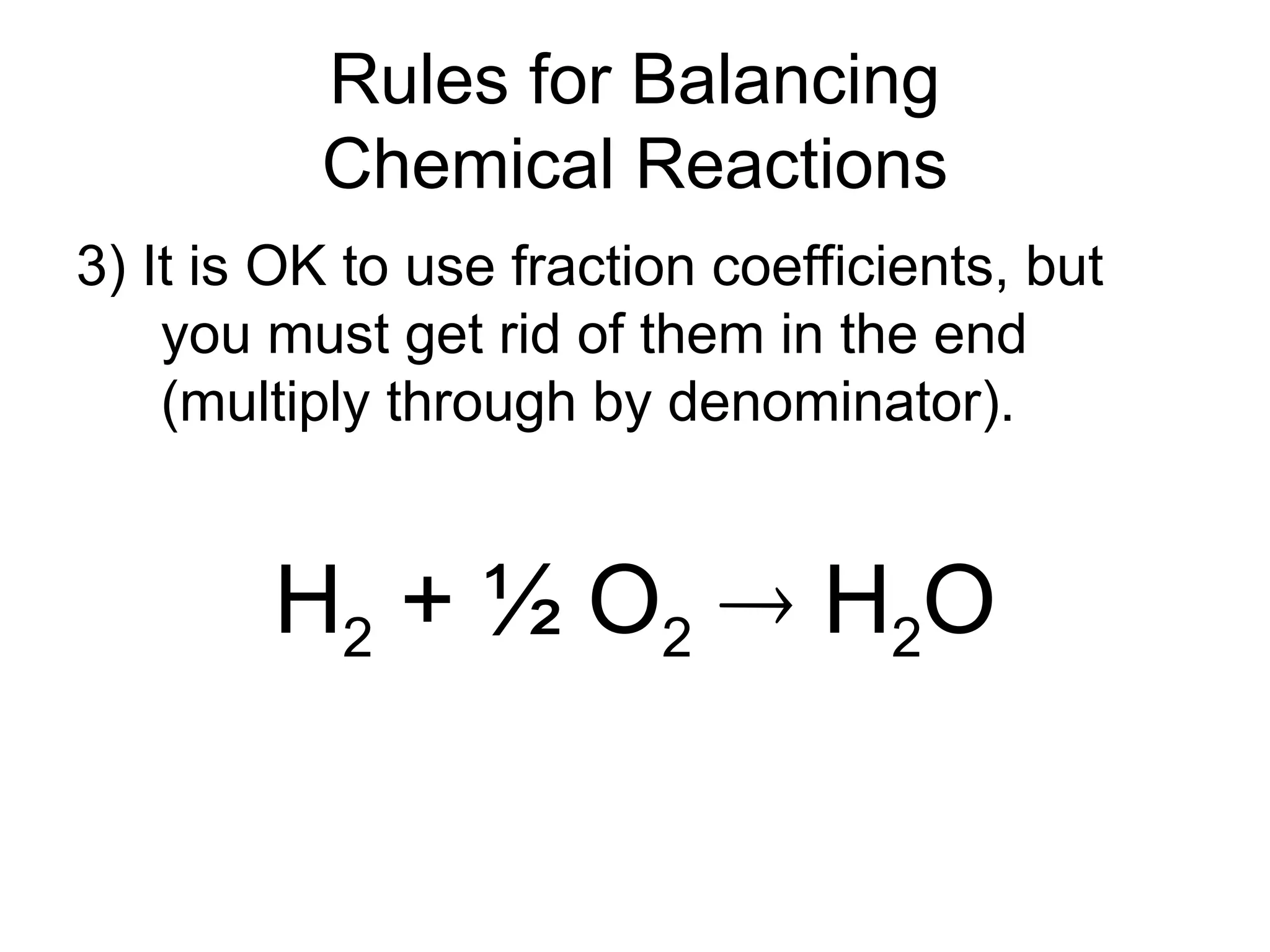
3) It is OK to use fraction coefficients, but
you must get rid of them in the end
(multiply through by denominator).
H2 + ½ O2 H2O
55.
Rules for Balancing
ChemicalReactions
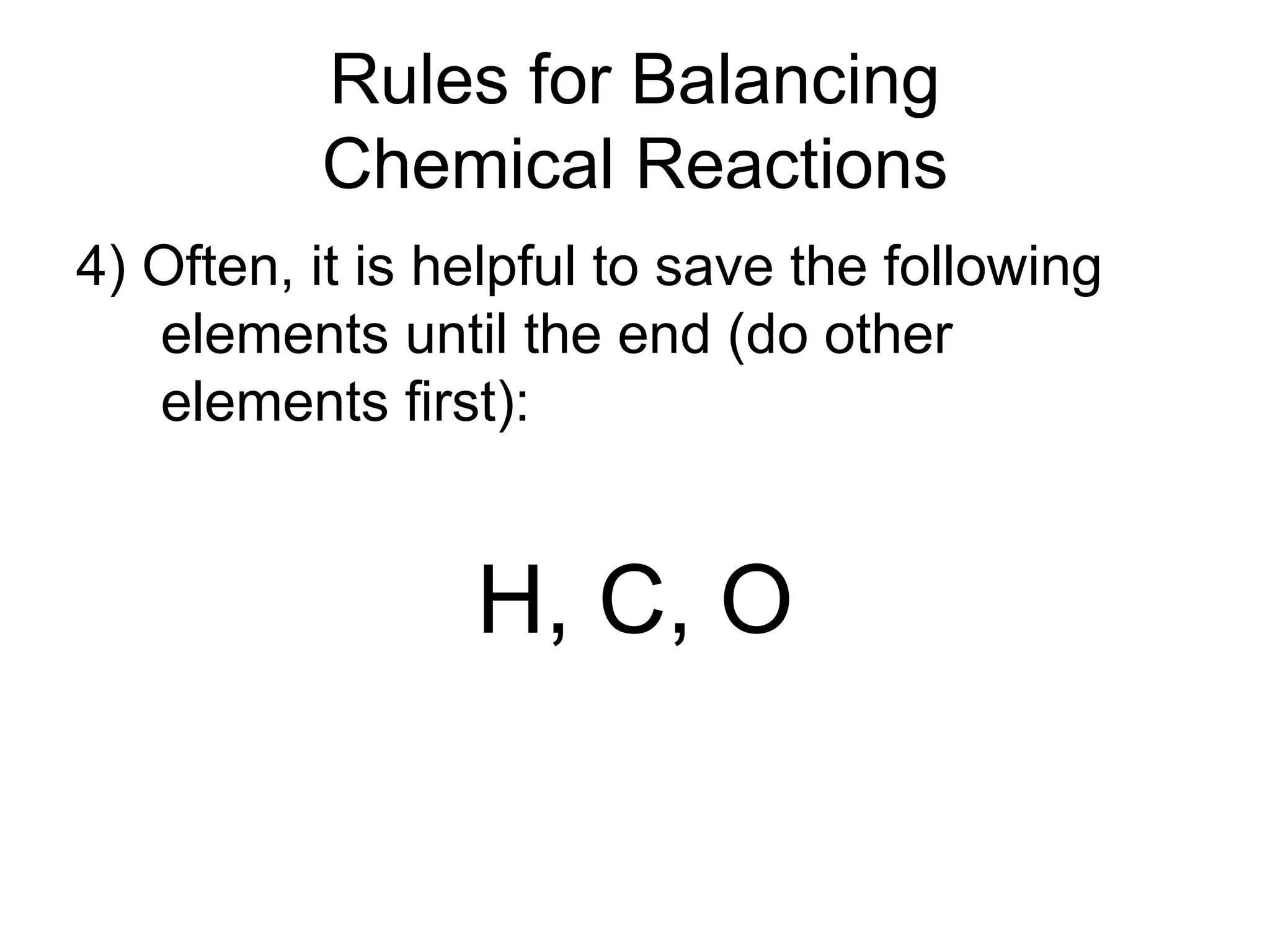
4) Often, it is helpful to save the following
elements until the end (do other
elements first):
H, C, O
Energy Changes Accompanying
ChemicalReactions
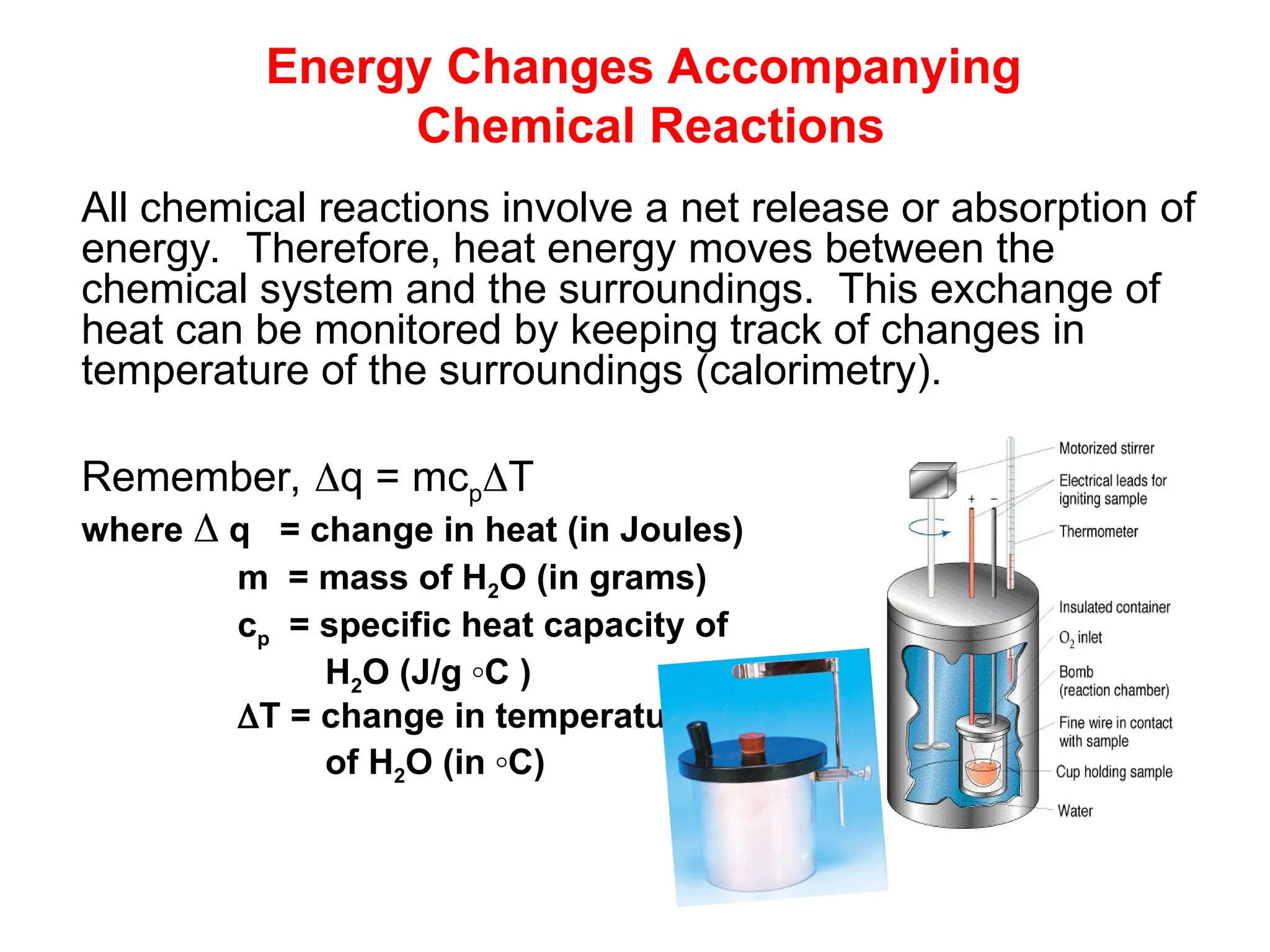
All chemical reactions involve a net release or absorption of
energy. Therefore, heat energy moves between the
chemical system and the surroundings. This exchange of
heat can be monitored by keeping track of changes in
temperature of the surroundings (calorimetry).
Remember, q = mcpT
where q = change in heat (in Joules)
m = mass of H2O (in grams)
cp = specific heat capacity of
H2O (J/g ◦C )
T = change in temperature
of H2O (in ◦C)
60.
Where does theenergy come from
during a chemical reaction?
• During chemical reactions, bonds are broken and new bonds are
formed.
• The heat energy that moves between the system and
surroundings during chemical reactions is basically the energy that
is used to break bonds and the energy that is released when
bonds form. (i.e. bond energy)
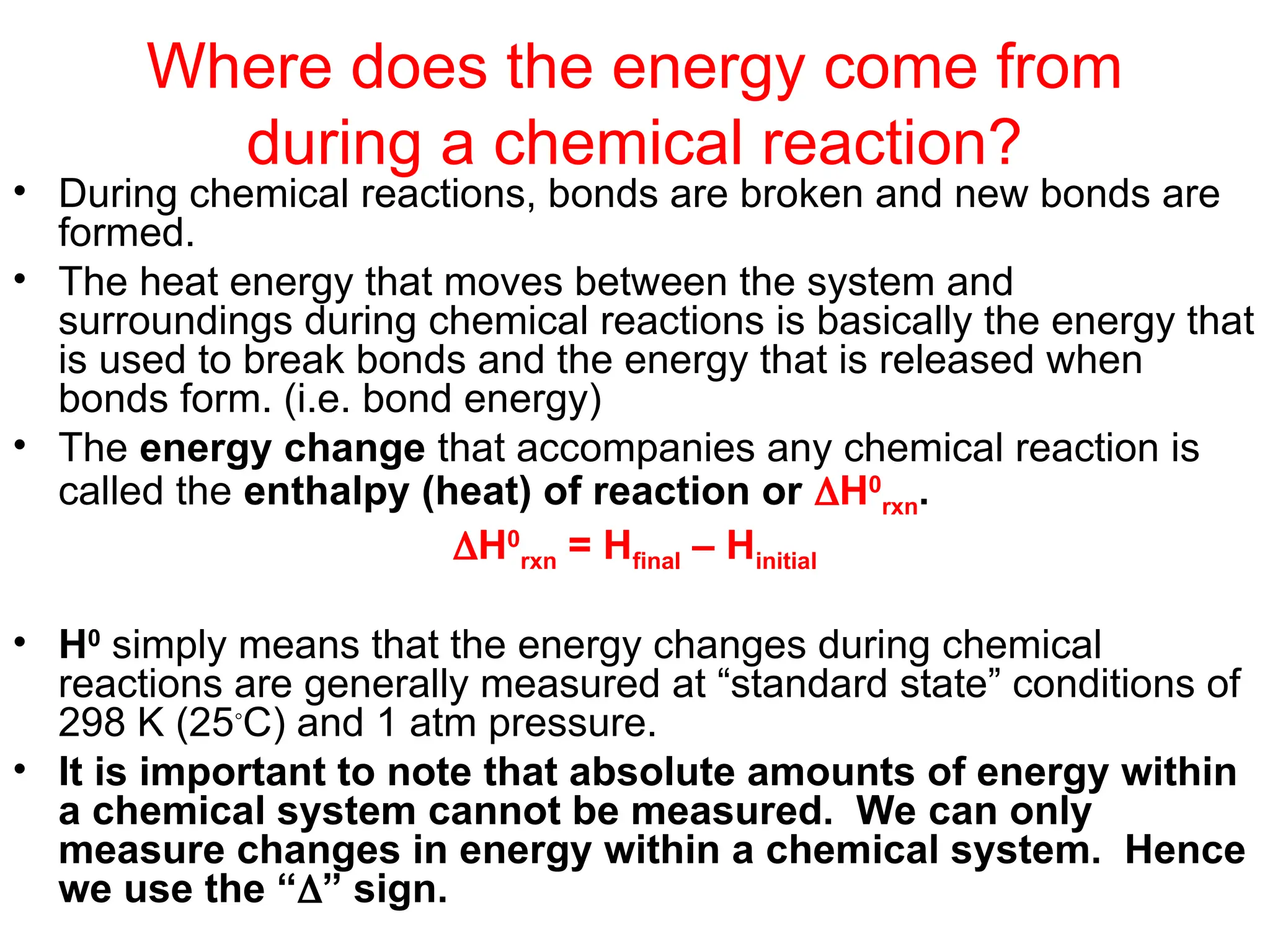
• The energy change that accompanies any chemical reaction is
called the enthalpy (heat) of reaction or H0
rxn.
H0
rxn = Hfinal – Hinitial
• H0
simply means that the energy changes during chemical
reactions are generally measured at “standard state” conditions of
298 K (25◦
C) and 1 atm pressure.
• It is important to note that absolute amounts of energy within
a chemical system cannot be measured. We can only
measure changes in energy within a chemical system. Hence
we use the “” sign.
61.
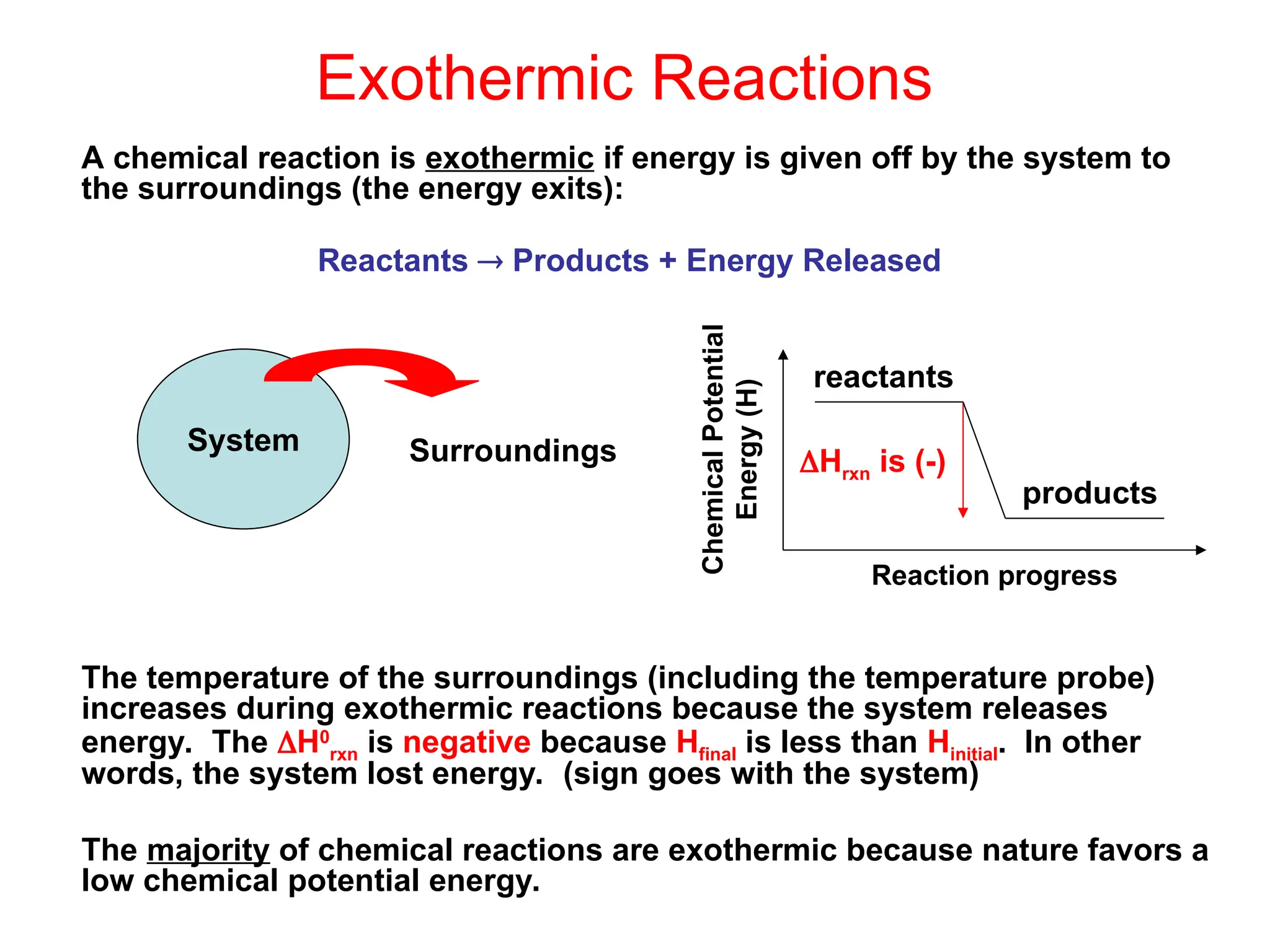
Exothermic Reactions
A chemicalreaction is exothermic if energy is given off by the system to
the surroundings (the energy exits):
Reactants Products + Energy Released
The temperature of the surroundings (including the temperature probe)
increases during exothermic reactions because the system releases
energy. The H0
rxn is negative because Hfinal is less than Hinitial. In other
words, the system lost energy. (sign goes with the system)
The majority of chemical reactions are exothermic because nature favors a
low chemical potential energy.
System Surroundings
reactants
products
Chemical
Potential
Energy
(H)
Reaction progress
Hrxn is (-)
62.
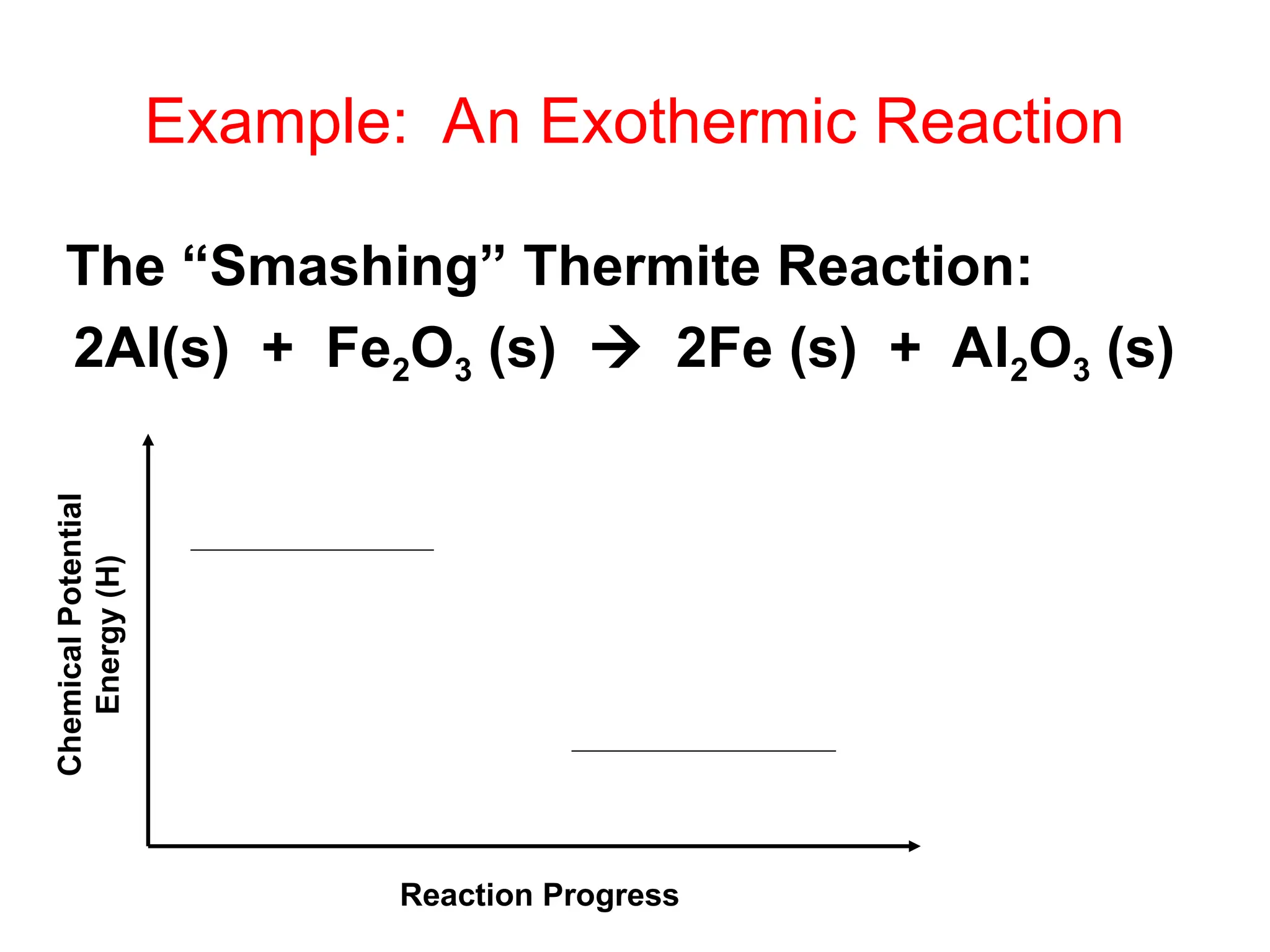
Example: An ExothermicReaction
The “Smashing” Thermite Reaction:
2Al(s) + Fe2O3 (s) 2Fe (s) + Al2O3 (s)
Reaction Progress
Chemical
Potential
Energy
(H)
63.
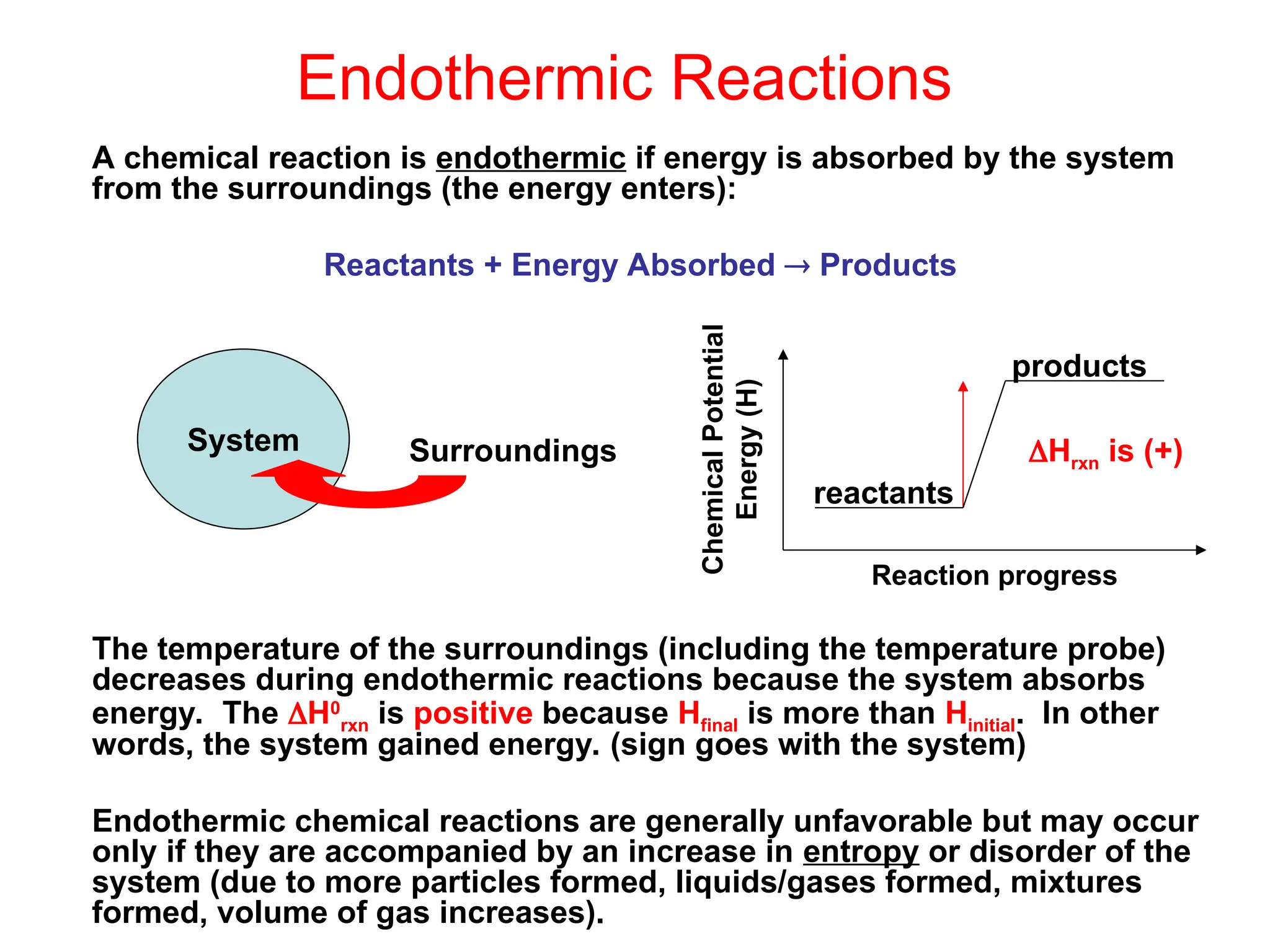
Endothermic Reactions
A chemicalreaction is endothermic if energy is absorbed by the system
from the surroundings (the energy enters):
Reactants + Energy Absorbed Products
The temperature of the surroundings (including the temperature probe)
decreases during endothermic reactions because the system absorbs
energy. The H0
rxn is positive because Hfinal is more than Hinitial. In other
words, the system gained energy. (sign goes with the system)
Endothermic chemical reactions are generally unfavorable but may occur
only if they are accompanied by an increase in entropy or disorder of the
system (due to more particles formed, liquids/gases formed, mixtures
formed, volume of gas increases).
System Surroundings
reactants
products
Chemical
Potential
Energy
(H)
Reaction progress
Hrxn is (+)
64.
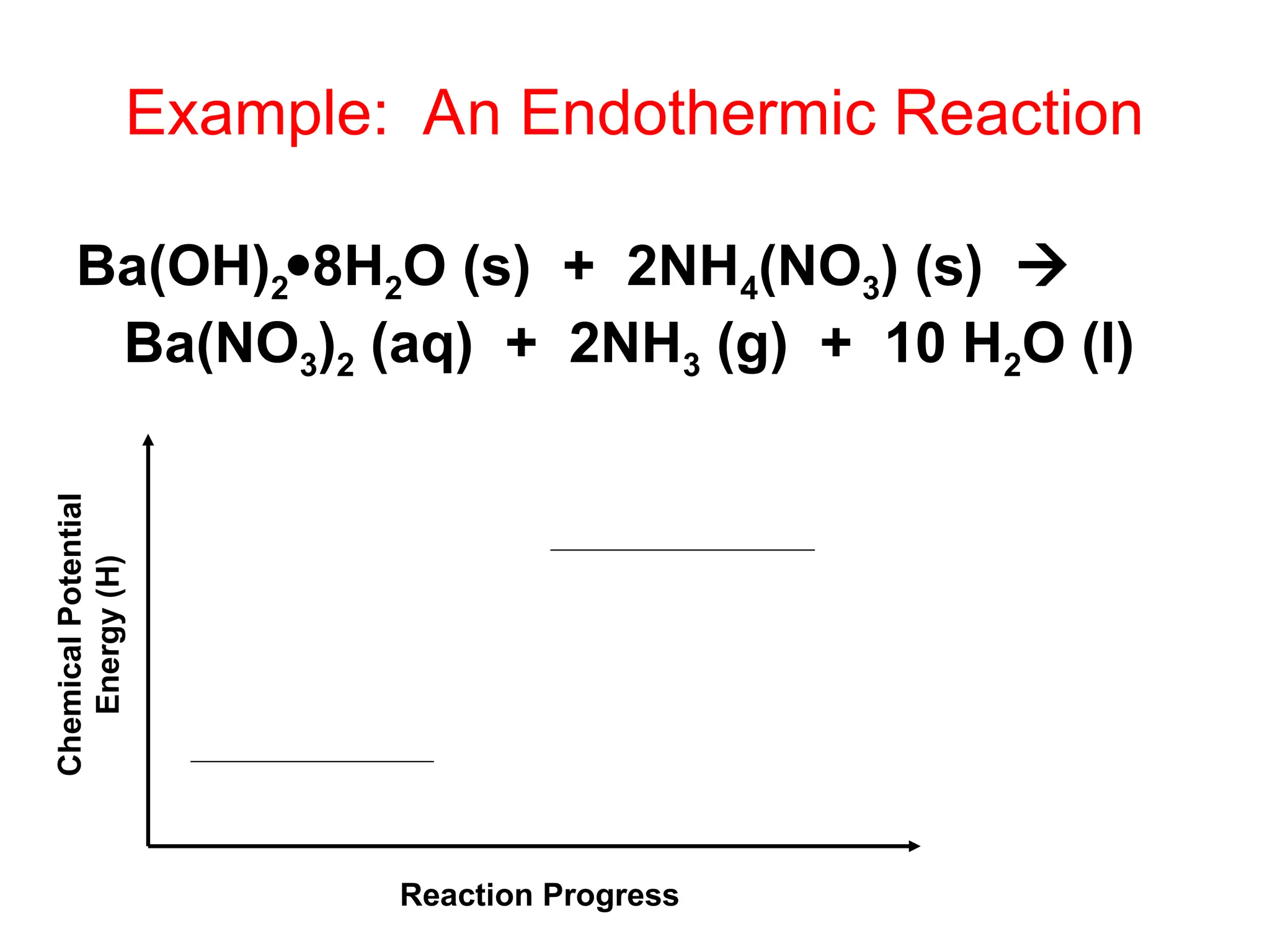
Example: An EndothermicReaction
Ba(OH)28H2O (s) + 2NH4(NO3) (s)
Ba(NO3)2 (aq) + 2NH3 (g) + 10 H2O (l)
Reaction Progress
Chemical
Potential
Energy
(H)
65.
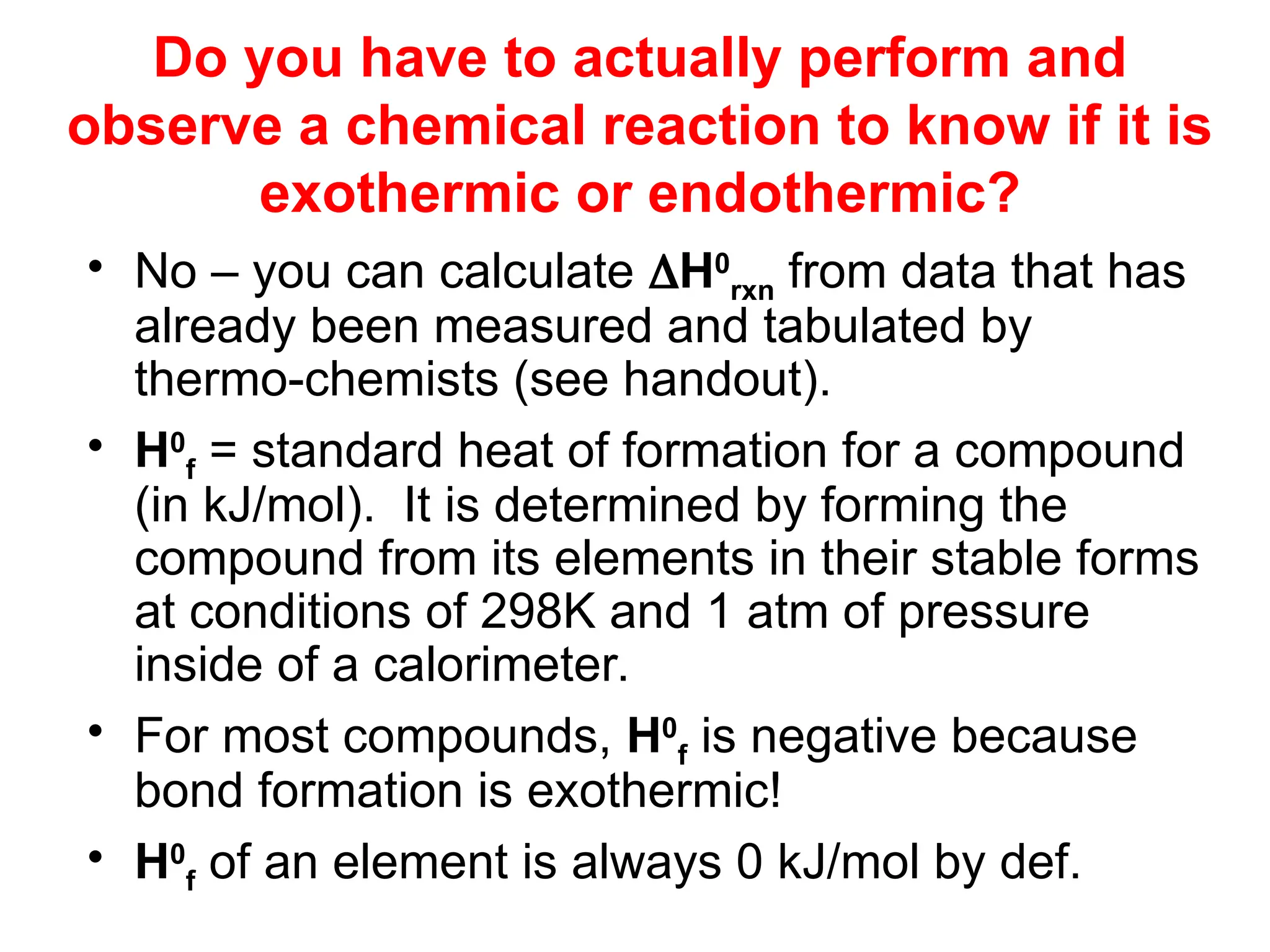
Do you haveto actually perform and
observe a chemical reaction to know if it is
exothermic or endothermic?
• No – you can calculate H0
rxn from data that has
already been measured and tabulated by
thermo-chemists (see handout).
• H0
f = standard heat of formation for a compound
(in kJ/mol). It is determined by forming the
compound from its elements in their stable forms
at conditions of 298K and 1 atm of pressure
inside of a calorimeter.
• For most compounds, H0
f is negative because
bond formation is exothermic!
• H0
f of an element is always 0 kJ/mol by def.
66.
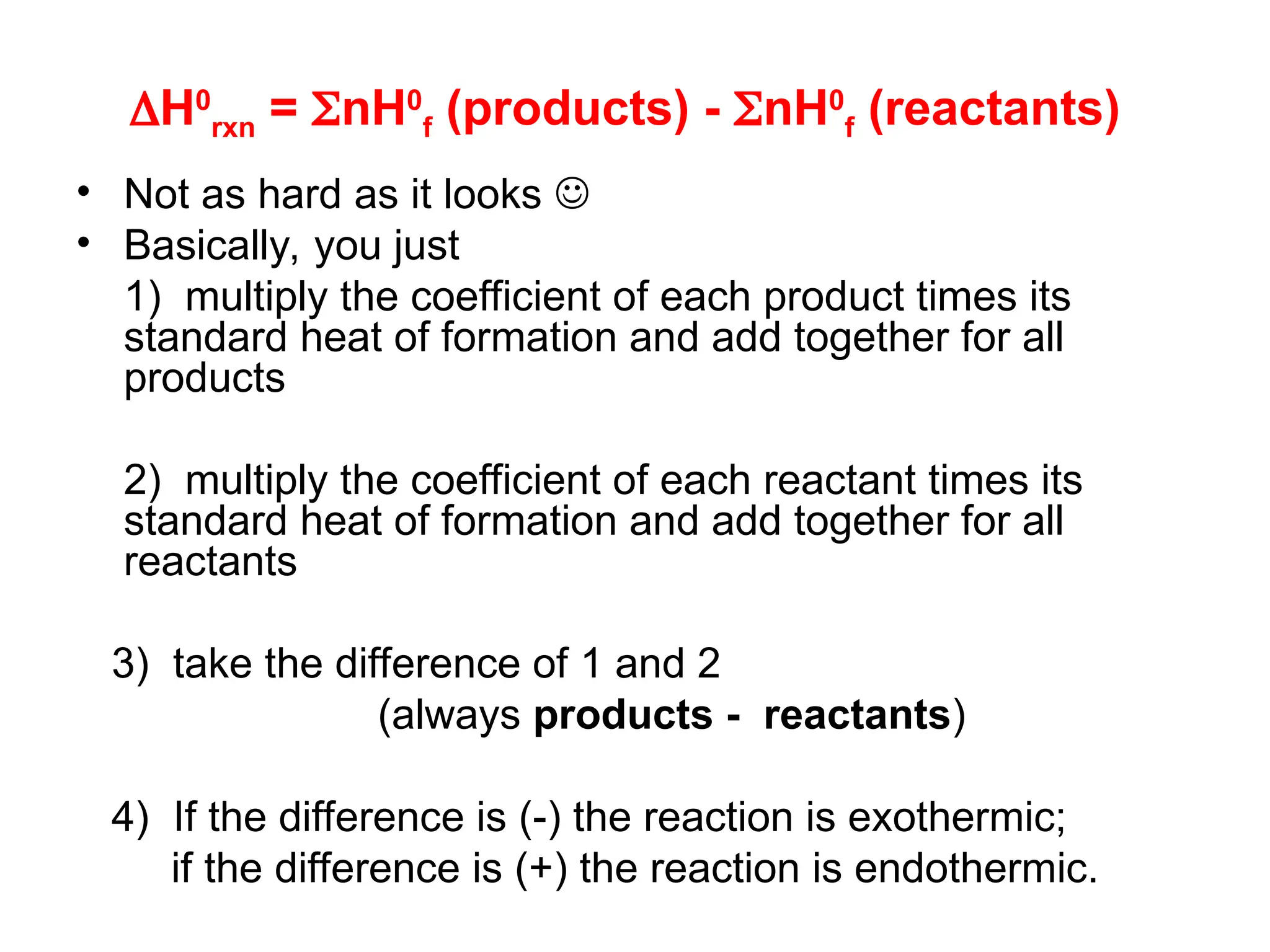
H0
rxn = nH0
f(products) - nH0
f (reactants)
• Not as hard as it looks
• Basically, you just
1) multiply the coefficient of each product times its
standard heat of formation and add together for all
products
2) multiply the coefficient of each reactant times its
standard heat of formation and add together for all
reactants
3) take the difference of 1 and 2
(always products - reactants)
4) If the difference is (-) the reaction is exothermic;
if the difference is (+) the reaction is endothermic.
67.
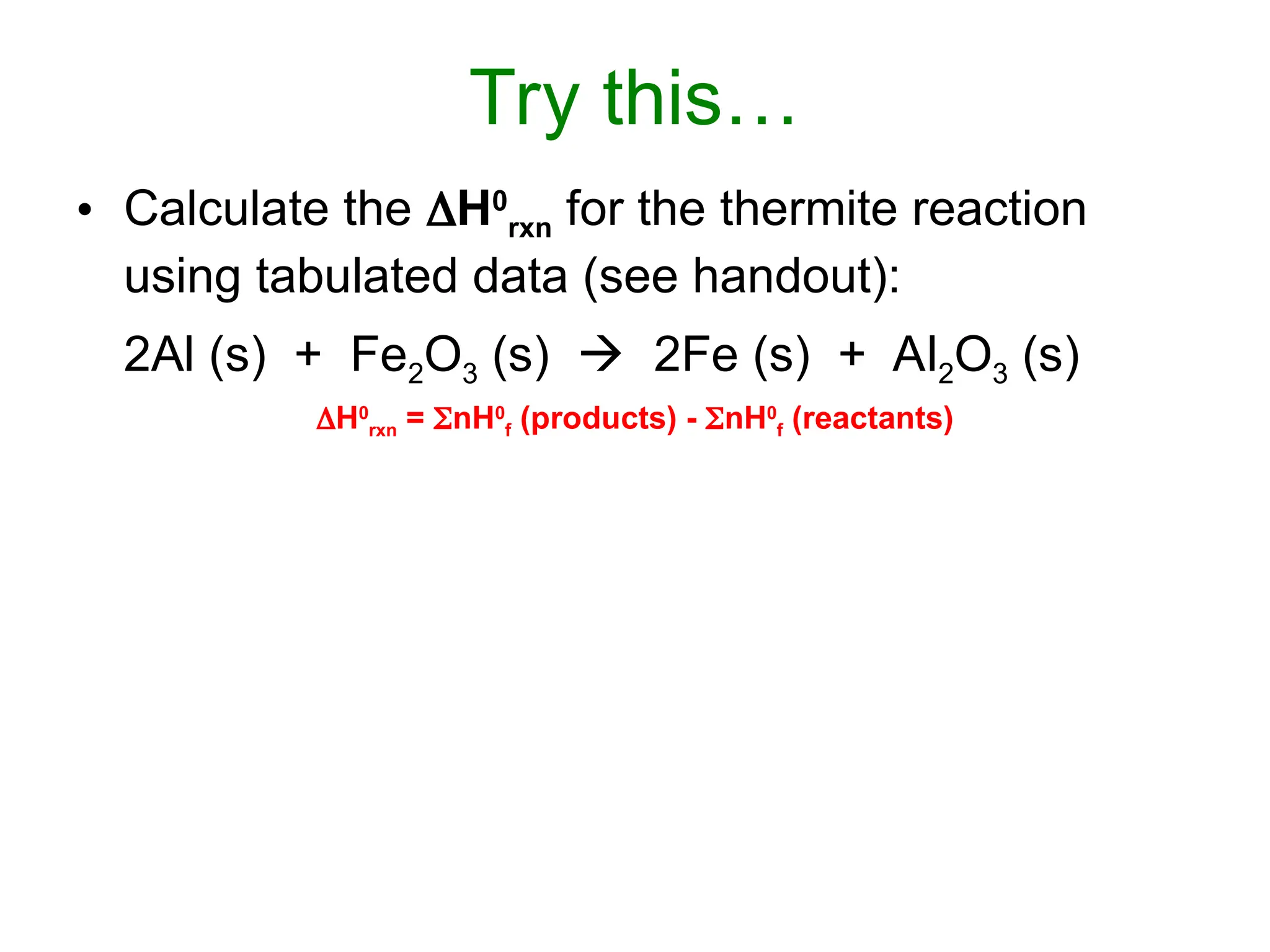
Try this…
• Calculatethe H0
rxn for the thermite reaction
using tabulated data (see handout):
2Al (s) + Fe2O3 (s) 2Fe (s) + Al2O3 (s)
H0
rxn = nH0
f (products) - nH0
f (reactants)
68.
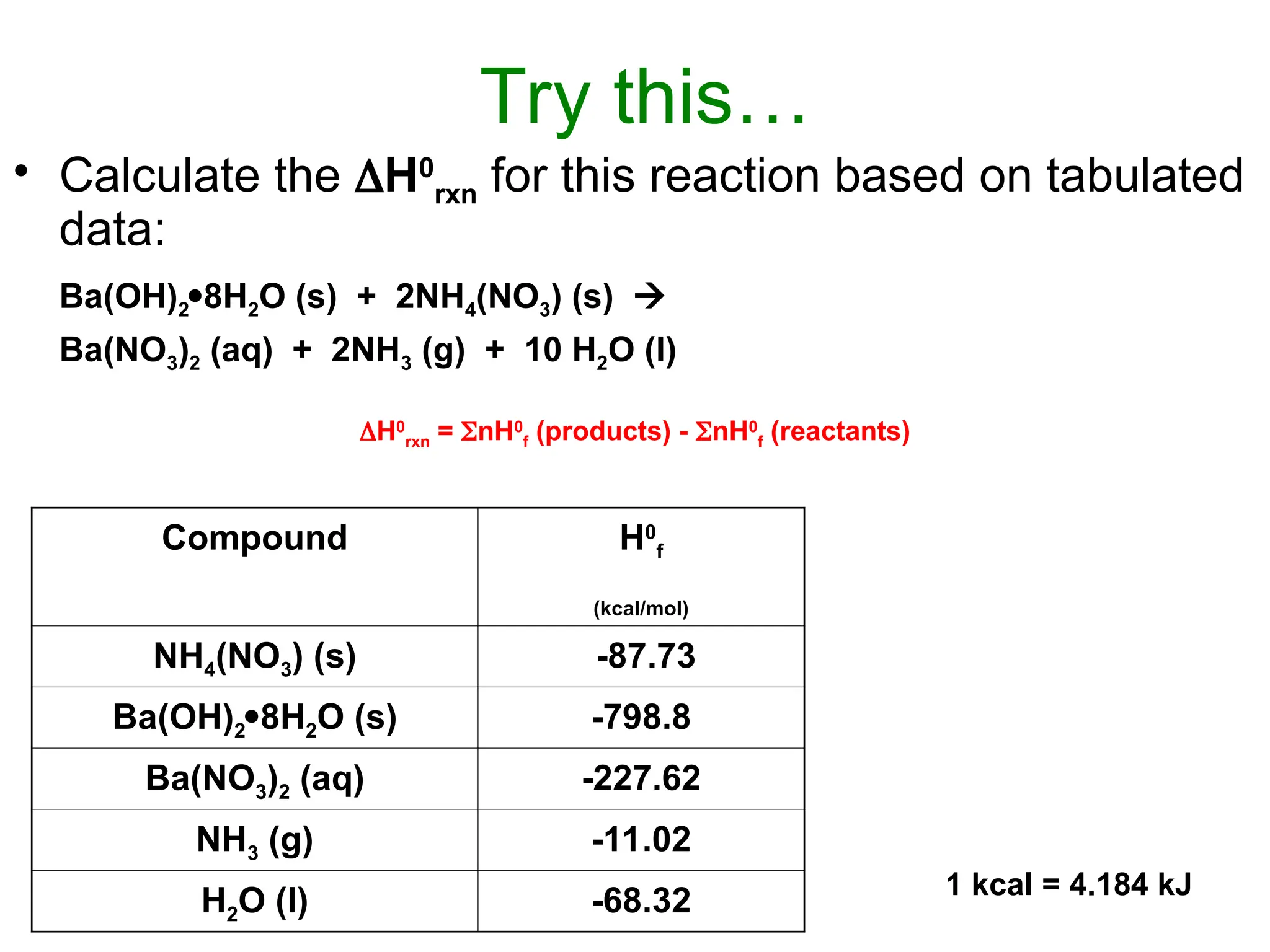
Try this…
• Calculatethe H0
rxn for this reaction based on tabulated
data:
Ba(OH)28H2O (s) + 2NH4(NO3) (s)
Ba(NO3)2 (aq) + 2NH3 (g) + 10 H2O (l)
H0
rxn = nH0
f (products) - nH0
f (reactants)
Compound H0
f
(kcal/mol)
NH4(NO3) (s) -87.73
Ba(OH)28H2O (s) -798.8
Ba(NO3)2 (aq) -227.62
NH3 (g) -11.02
H2O (l) -68.32 1 kcal = 4.184 kJ
69.
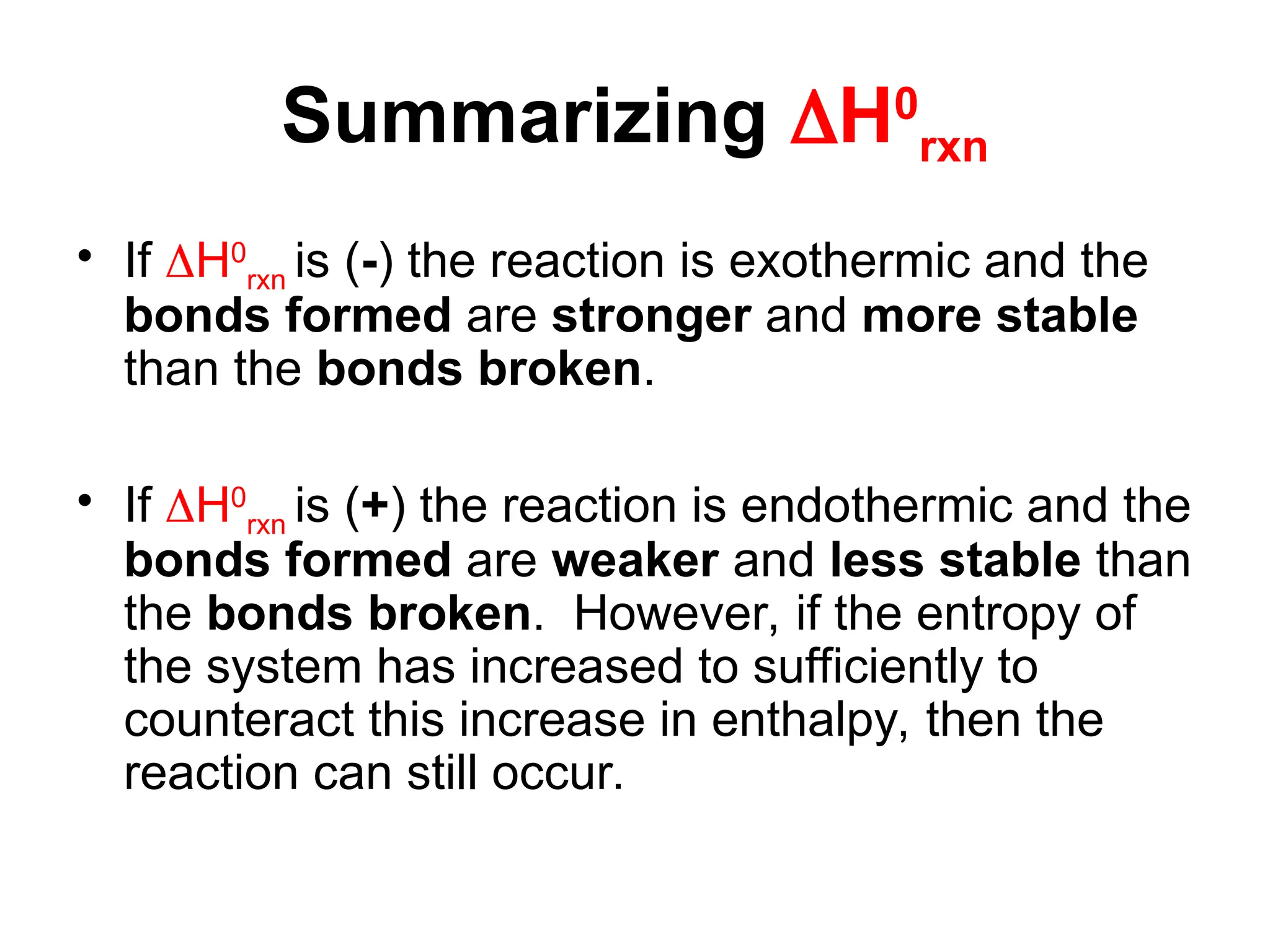
Summarizing H0
rxn
• IfH0
rxn is (-) the reaction is exothermic and the
bonds formed are stronger and more stable
than the bonds broken.
• If H0
rxn is (+) the reaction is endothermic and the
bonds formed are weaker and less stable than
the bonds broken. However, if the entropy of
the system has increased to sufficiently to
counteract this increase in enthalpy, then the
reaction can still occur.
70.
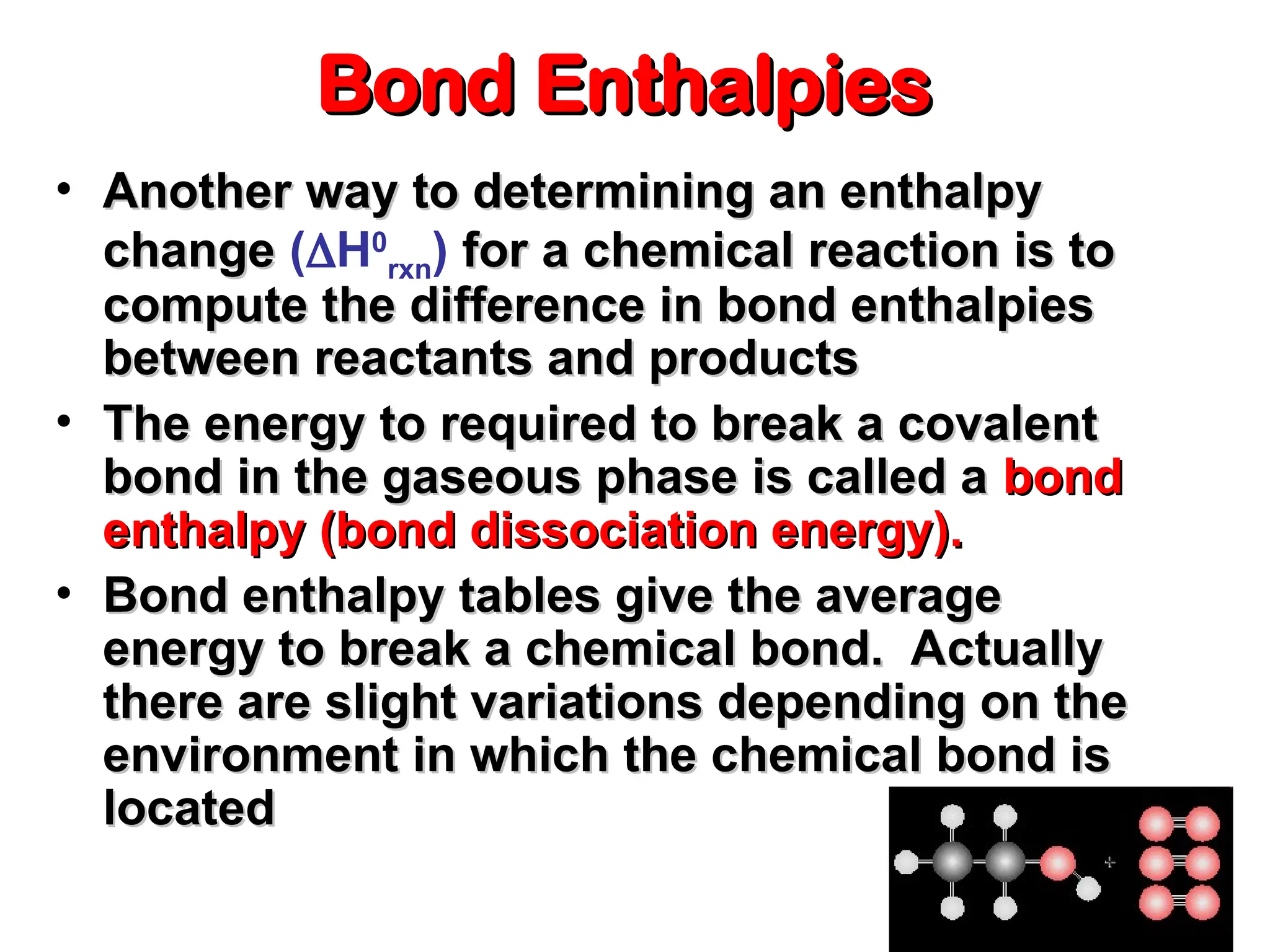
Bond Enthalpies
Bond Enthalpies
•Another way to determining an enthalpy
Another way to determining an enthalpy
change
change (H0
rxn) for a chemical reaction is to
for a chemical reaction is to
compute the difference in bond enthalpies
compute the difference in bond enthalpies
between reactants and products
between reactants and products
• The energy to required to break a covalent
The energy to required to break a covalent
bond in the gaseous phase is called a
bond in the gaseous phase is called a bond
bond
enthalpy (bond dissociation energy).
enthalpy (bond dissociation energy).
• Bond enthalpy tables give the average
Bond enthalpy tables give the average
energy to break a chemical bond. Actually
energy to break a chemical bond. Actually
there are slight variations depending on the
there are slight variations depending on the
environment in which the chemical bond is
environment in which the chemical bond is
located
located
71.
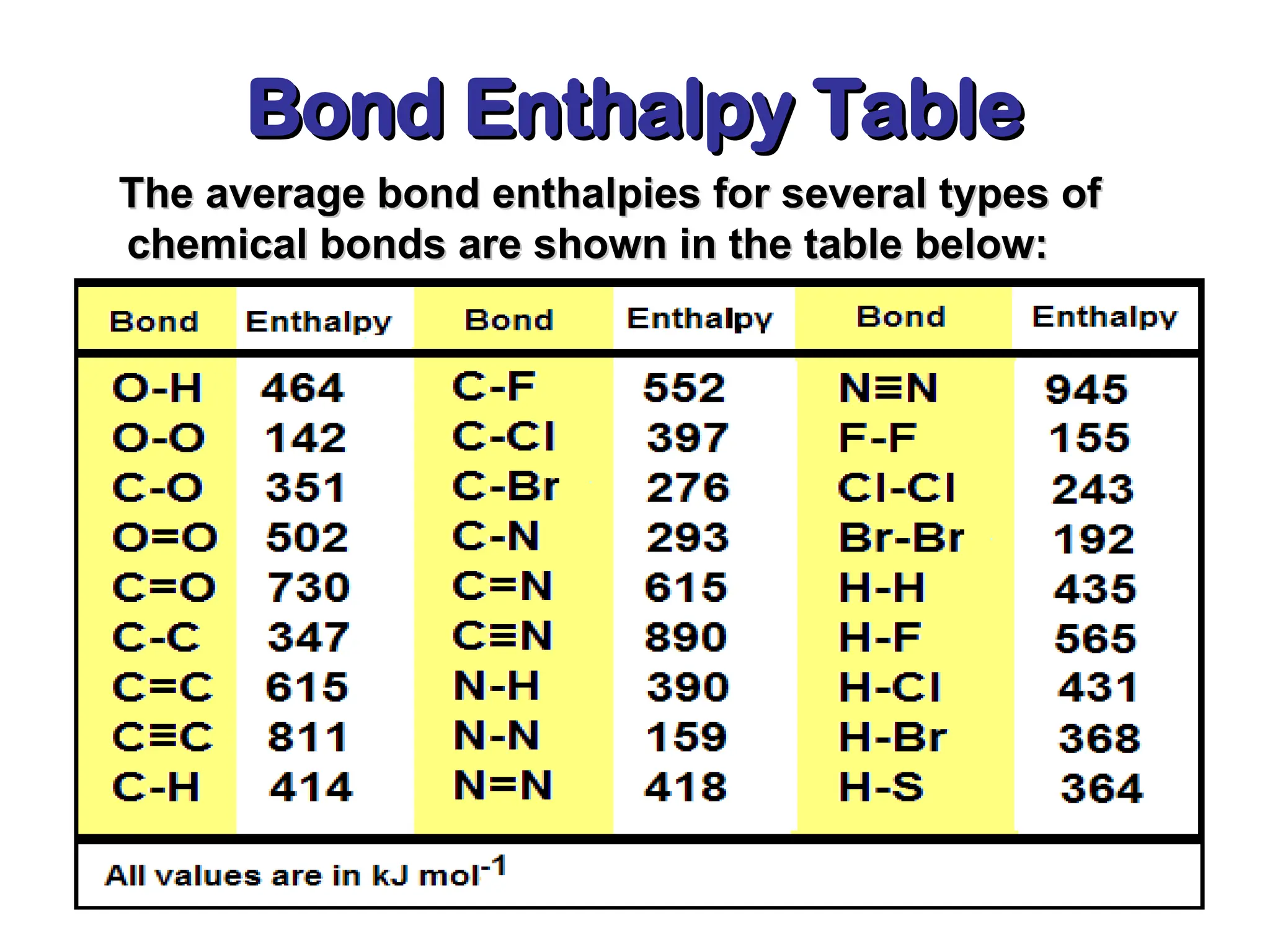
Bond Enthalpy Table
BondEnthalpy Table
The average bond enthalpies for several types of
The average bond enthalpies for several types of
chemical bonds are shown in the table below:
chemical bonds are shown in the table below:
72.
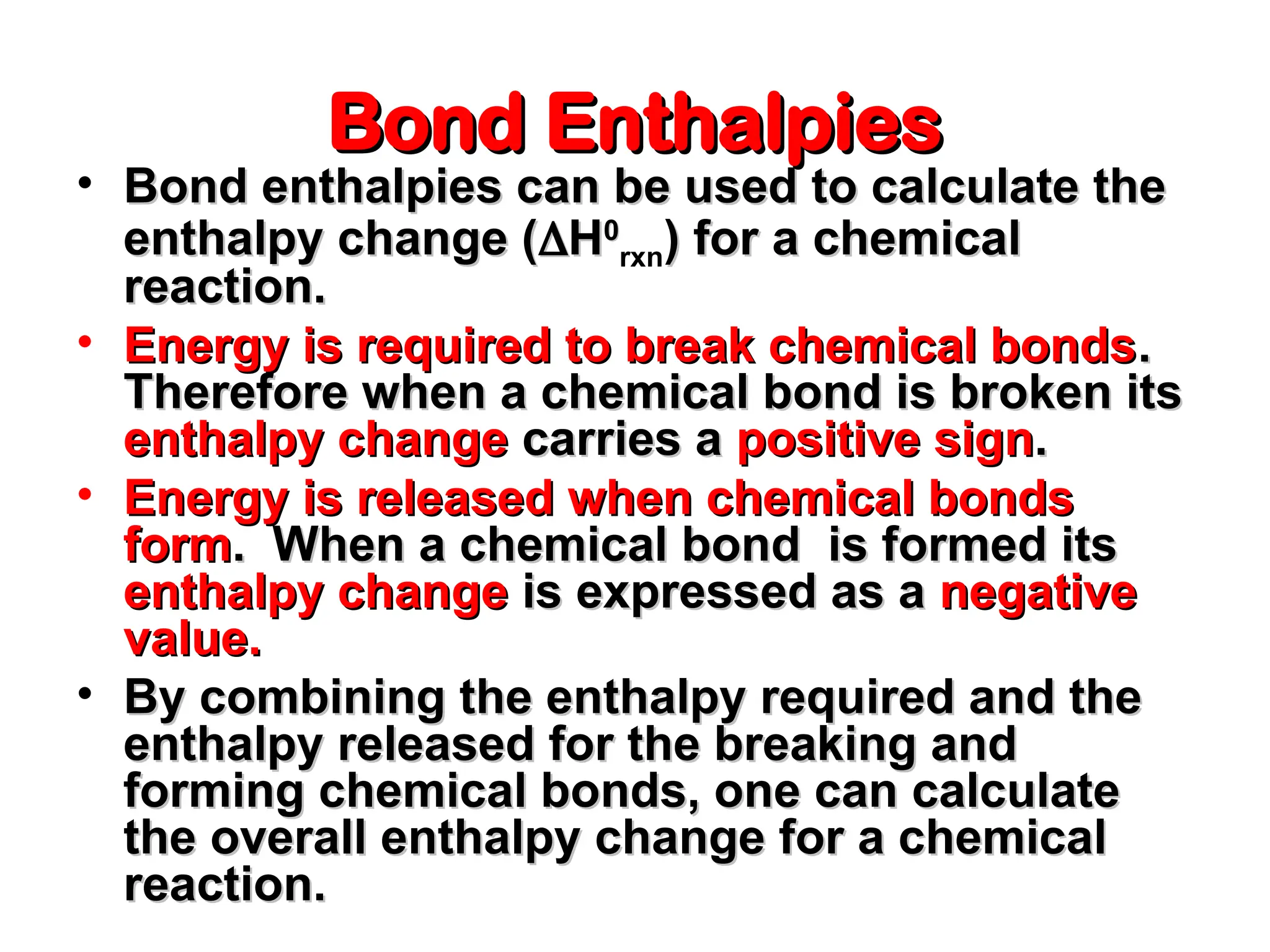
Bond Enthalpies
Bond Enthalpies
•Bond enthalpies can be used to calculate the
Bond enthalpies can be used to calculate the
enthalpy change (
enthalpy change (
H
H0
0
rxn) for a chemical
) for a chemical
reaction.
reaction.
• Energy is required to break chemical bonds
Energy is required to break chemical bonds.
.
Therefore when a chemical bond is broken its
Therefore when a chemical bond is broken its
enthalpy change
enthalpy change carries a
carries a positive sign
positive sign.
.
• Energy is released when chemical bonds
Energy is released when chemical bonds
form
form. When a chemical bond is formed its
. When a chemical bond is formed its
enthalpy change
enthalpy change is expressed as a
is expressed as a negative
negative
value.
value.
• By combining the enthalpy required and the
By combining the enthalpy required and the
enthalpy released for the breaking and
enthalpy released for the breaking and
forming chemical bonds, one can calculate
forming chemical bonds, one can calculate
the overall enthalpy change for a chemical
the overall enthalpy change for a chemical
reaction.
reaction.
73.
Bond Enthalpy Calculations
BondEnthalpy Calculations
Example : Calculate the enthalpy change
Example : Calculate the enthalpy change (H0
rxn)
for the reaction N
for the reaction N2 + 3 H
+ 3 H2
2 NH
2 NH3
Bonds broken (energy in)
1 N≡N: = 945
3 H-H: 3(435) = 1305
Total = 2250 kJ/mol
Bonds formed (energy out)
2x3 = 6 N-H: 6 (390) = - 2340 kJ/mol
H0
rxn = [energy used for breaking bonds] + [energy released in forming bonds]
Net enthalpy change (H0
rxn)
= + 2250 + (-2340) = - 90 kJ/mol (exothermic reaction)
H - H
H - H
H - H
You may have
to draw a
Lewis
Structure to
know what
type of bonds
are present!
74.
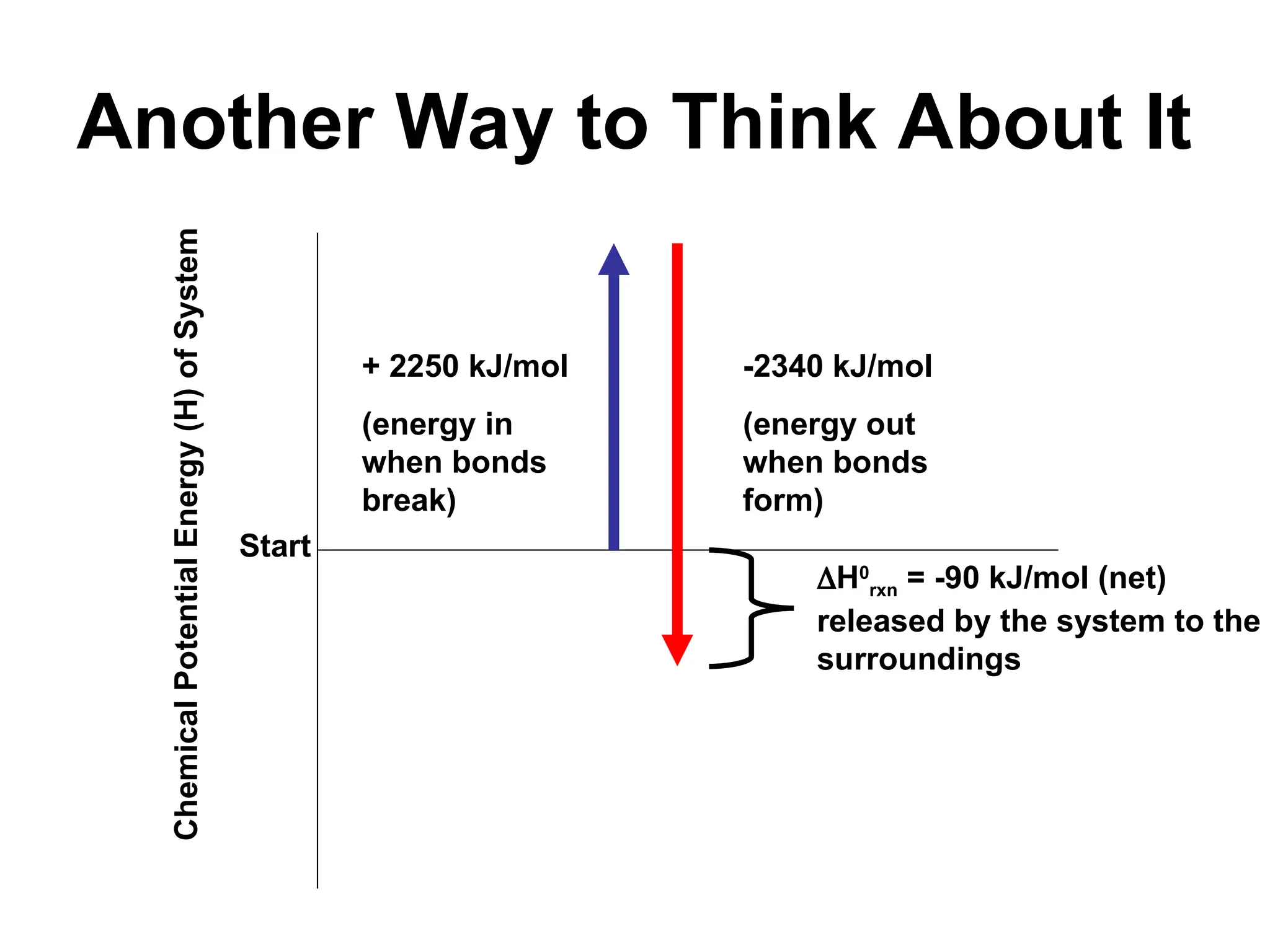
Another Way toThink About It
Chemical
Potential
Energy
(H)
of
System
Start
+ 2250 kJ/mol
(energy in
when bonds
break)
-2340 kJ/mol
(energy out
when bonds
form)
H0
rxn = -90 kJ/mol (net)
released by the system to the
surroundings

![Bond Enthalpy Calculations
Bond Enthalpy Calculations
Example : Calculate the enthalpy change
Example : Calculate the enthalpy change (H0
rxn)
for the reaction N
for the reaction N2 + 3 H
+ 3 H2
2 NH
2 NH3
Bonds broken (energy in)
1 N≡N: = 945
3 H-H: 3(435) = 1305
Total = 2250 kJ/mol
Bonds formed (energy out)
2x3 = 6 N-H: 6 (390) = - 2340 kJ/mol
H0
rxn = [energy used for breaking bonds] + [energy released in forming bonds]
Net enthalpy change (H0
rxn)
= + 2250 + (-2340) = - 90 kJ/mol (exothermic reaction)
H - H
H - H
H - H
You may have
to draw a
Lewis
Structure to
know what
type of bonds
are present!](https://image.slidesharecdn.com/introductiontochemicalreactions2011-2012-250521032331-989d51de/75/Introduction_to_Chemical_Reactions_2011-2012-ppt-73-2048.jpg)