CHEMICAL
PROCESS
PRINCIPLE-I
CHE-120
3 CREDIT HOURS Department of Chemical
Engineering,
Engr. Khurram Shahzad
LECTURE 2
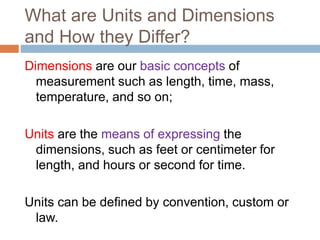
What are Units and Dimensions
and How they Differ?
Dimensions are our basic concepts of
measurement such as length, time, mass,
temperature, and so on;
Units are the means of expressing the
dimensions, such as feet or centimeter for
length, and hours or second for time.
Units can be defined by convention, custom or
law.
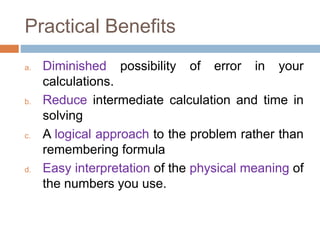
Practical Benefits
a. Diminished possibility of error in your
calculations.
b. Reduce intermediate calculation and time in
solving
c. A logical approach to the problem rather than
remembering formula
d. Easy interpretation of the physical meaning of
the numbers you use.
 Fundamental (or basic) dimensions/units are
those that can be measured independently
and are sufficiently to describe essential
physical quantities.
 Derived dimensions/units are those that can
be developed in term of the fundamental
dimensions/units.
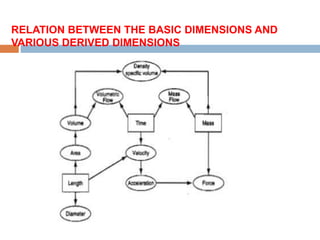
 Figure 1.1 illustrates the relation between the
basic dimensions and some of the derived
dimensions.
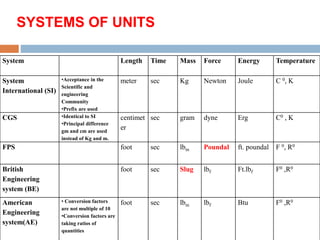
System Length Time Mass Force Energy Temperature
System
International (SI)
•Acceptance in the
Scientific and
engineering
Community
•Prefix are used
meter sec Kg Newton Joule C 0, K
CGS •Identical to SI
•Principal difference
gm and cm are used
instead of Kg and m.
centimet
er
sec gram dyne Erg C0 , K
FPS foot sec lbm Poundal ft. poundal F 0, R0
British
Engineering
system (BE)
foot sec Slug lbf Ft.lbf F0 ,R0
American
Engineering
system(AE)
• Conversion factors
are not multiple of 10
•Conversion factors are
taking ratios of
quantities
foot sec lbm lbf Btu F0 ,R0
SYSTEMS OF UNITS
 Dyne: One dyne is the force necessary to impart to a mass of an
acceleration of 1cm/s2.
F =ma
Dyne = 1gm.cm/s2 = gm.cm s-2
= [MLT-2]
 Newton: Newton is the force necessary to impart to a mass of 1 Kg
an acceleration of 1m/s2.
F = ma
N = m/s2 = Kgms-2 = [MLT-2]
 Joule: One joule is amount of work done when a force of 1N acting
on a body displaces it through a distance of 1m along the direction
of force i.e.
Joule = N .m = Kg m/s2 .m = Kgm2. S-2
1 joule = 107 erg J > erg
 Erg: It is the amount of work done when a force of I dyne acting on
body displaces it through a distance of 1cm along the direction of
force.
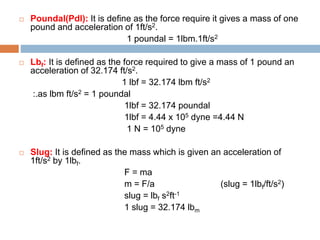
 Poundal(Pdl): It is define as the force require it gives a mass of one
pound and acceleration of 1ft/s2.
1 poundal = 1lbm.1ft/s2
 Lbf: It is defined as the force required to give a mass of 1 pound an
acceleration of 32.174 ft/s2.
1 lbf = 32.174 lbm ft/s2
:.as lbm ft/s2 = 1 poundal
1lbf = 32.174 poundal
1lbf = 4.44 x 10⁵ dyne =4.44 N
1 N = 105 dyne
 Slug: It is defined as the mass which is given an acceleration of
1ft/s2 by 1lbf.
F = ma
m = F/a (slug = 1lbf/ft/s2)
slug = lbf s2ft-1
1 slug = 32.174 lbm
Operations with Unit
 Units can be treated like algebraic variables
 Numerical values of two quantities may be
added or subtracted only if the units are same.
3cm-1 cm=2cm (3x-x=2x)
But
3cm-1 mm (or s)=? (3x-y=?)
 Numerical values and their corresponding
units may always be combined by
multiplication and division
3N X 4 m= 12N.m
5 km =2.5km/h
2.0h
7 km/h X 4 h = 28 km
3 m X 4 m = 12m2
Example 1.1
Add the following
(a) 1 foot + 3 seconds
(b) 1 horsepower + 300watts
RELATION BETWEEN THE BASIC DIMENSIONS AND
VARIOUS DERIVED DIMENSIONS
Conversion of Units and
Conversion Factors
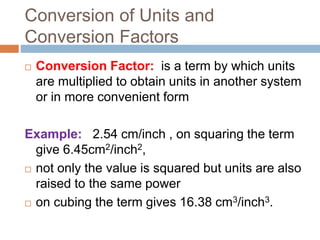
 Conversion Factor: is a term by which units
are multiplied to obtain units in another system
or in more convenient form
Example: 2.54 cm/inch , on squaring the term
give 6.45cm2/inch2,
 not only the value is squared but units are also
raised to the same power
 on cubing the term gives 16.38 cm3/inch3.
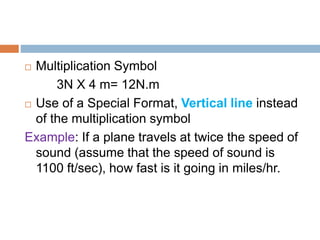
 Multiplication Symbol
3N X 4 m= 12N.m
 Use of a Special Format, Vertical line instead
of the multiplication symbol
Example: If a plane travels at twice the speed of
sound (assume that the speed of sound is
1100 ft/sec), how fast is it going in miles/hr.
1. If a plane travels twice the speed of sound (assume
that the speed of sound is 1100 ft/sec.) how fast is it
going in miles/hr.
2. Change 400 inch3/day to cm3/min.
3. Convert 760 mm of Hg to inches of Hg.
4. Convert an acceleration of 1 cm/sec2 to its equivalent
in Km/yr2.
5. Convert 23 lb mass. ft/min2 tp its equivalent in Kg
cm/sec.
6. Express 1.80 gms/cm3 to its equivalent lbm /gallons
7. The viscosity of a certain is 0.000672 lb/ft.sec convert
its to metric units gm/cm.hr .
Practic
e
Chemical principle process

Chemical principle process

  • 2.
    CHEMICAL PROCESS PRINCIPLE-I CHE-120 3 CREDIT HOURSDepartment of Chemical Engineering, Engr. Khurram Shahzad
  • 3.
  • 4.
    What are Unitsand Dimensions and How they Differ? Dimensions are our basic concepts of measurement such as length, time, mass, temperature, and so on; Units are the means of expressing the dimensions, such as feet or centimeter for length, and hours or second for time. Units can be defined by convention, custom or law.
  • 5.
    Practical Benefits a. Diminishedpossibility of error in your calculations. b. Reduce intermediate calculation and time in solving c. A logical approach to the problem rather than remembering formula d. Easy interpretation of the physical meaning of the numbers you use.
  • 6.
     Fundamental (orbasic) dimensions/units are those that can be measured independently and are sufficiently to describe essential physical quantities.  Derived dimensions/units are those that can be developed in term of the fundamental dimensions/units.  Figure 1.1 illustrates the relation between the basic dimensions and some of the derived dimensions.
  • 7.
    System Length TimeMass Force Energy Temperature System International (SI) •Acceptance in the Scientific and engineering Community •Prefix are used meter sec Kg Newton Joule C 0, K CGS •Identical to SI •Principal difference gm and cm are used instead of Kg and m. centimet er sec gram dyne Erg C0 , K FPS foot sec lbm Poundal ft. poundal F 0, R0 British Engineering system (BE) foot sec Slug lbf Ft.lbf F0 ,R0 American Engineering system(AE) • Conversion factors are not multiple of 10 •Conversion factors are taking ratios of quantities foot sec lbm lbf Btu F0 ,R0 SYSTEMS OF UNITS
  • 10.
     Dyne: Onedyne is the force necessary to impart to a mass of an acceleration of 1cm/s2. F =ma Dyne = 1gm.cm/s2 = gm.cm s-2 = [MLT-2]  Newton: Newton is the force necessary to impart to a mass of 1 Kg an acceleration of 1m/s2. F = ma N = m/s2 = Kgms-2 = [MLT-2]  Joule: One joule is amount of work done when a force of 1N acting on a body displaces it through a distance of 1m along the direction of force i.e. Joule = N .m = Kg m/s2 .m = Kgm2. S-2 1 joule = 107 erg J > erg  Erg: It is the amount of work done when a force of I dyne acting on body displaces it through a distance of 1cm along the direction of force.
  • 11.
     Poundal(Pdl): Itis define as the force require it gives a mass of one pound and acceleration of 1ft/s2. 1 poundal = 1lbm.1ft/s2  Lbf: It is defined as the force required to give a mass of 1 pound an acceleration of 32.174 ft/s2. 1 lbf = 32.174 lbm ft/s2 :.as lbm ft/s2 = 1 poundal 1lbf = 32.174 poundal 1lbf = 4.44 x 10⁵ dyne =4.44 N 1 N = 105 dyne  Slug: It is defined as the mass which is given an acceleration of 1ft/s2 by 1lbf. F = ma m = F/a (slug = 1lbf/ft/s2) slug = lbf s2ft-1 1 slug = 32.174 lbm
  • 12.
    Operations with Unit Units can be treated like algebraic variables  Numerical values of two quantities may be added or subtracted only if the units are same. 3cm-1 cm=2cm (3x-x=2x) But 3cm-1 mm (or s)=? (3x-y=?)
  • 13.
     Numerical valuesand their corresponding units may always be combined by multiplication and division 3N X 4 m= 12N.m 5 km =2.5km/h 2.0h 7 km/h X 4 h = 28 km 3 m X 4 m = 12m2
  • 14.
    Example 1.1 Add thefollowing (a) 1 foot + 3 seconds (b) 1 horsepower + 300watts
  • 15.
    RELATION BETWEEN THEBASIC DIMENSIONS AND VARIOUS DERIVED DIMENSIONS
  • 16.
    Conversion of Unitsand Conversion Factors  Conversion Factor: is a term by which units are multiplied to obtain units in another system or in more convenient form Example: 2.54 cm/inch , on squaring the term give 6.45cm2/inch2,  not only the value is squared but units are also raised to the same power  on cubing the term gives 16.38 cm3/inch3.
  • 17.
     Multiplication Symbol 3NX 4 m= 12N.m  Use of a Special Format, Vertical line instead of the multiplication symbol Example: If a plane travels at twice the speed of sound (assume that the speed of sound is 1100 ft/sec), how fast is it going in miles/hr.
  • 18.
    1. If aplane travels twice the speed of sound (assume that the speed of sound is 1100 ft/sec.) how fast is it going in miles/hr. 2. Change 400 inch3/day to cm3/min. 3. Convert 760 mm of Hg to inches of Hg. 4. Convert an acceleration of 1 cm/sec2 to its equivalent in Km/yr2. 5. Convert 23 lb mass. ft/min2 tp its equivalent in Kg cm/sec. 6. Express 1.80 gms/cm3 to its equivalent lbm /gallons 7. The viscosity of a certain is 0.000672 lb/ft.sec convert its to metric units gm/cm.hr . Practic e

Editor's Notes