Chapter 1
                  General Principles


Engineering Mechanics: Statics
Chapter Objectives
To provide an introduction to the basic quantities and
idealizations of mechanics.
To give a statement of Newton’s Laws of Motion and
Gravitation.
To review the principles for applying the SI system of
units.
To examine the standard procedures for performing
numerical calculations.
To present a general guide for solving problems.
Chapter Outline

Mechanics
Fundamental Concepts
Units of Measurement
The International System of Units
Numerical Calculations
General Procedure for Analysis
1.1 Mechanics

Mechanics can be divided into 3
branches:
- Rigid-body Mechanics
- Deformable-body Mechanics
- Fluid Mechanics
Rigid-body Mechanics deals with
- Statics
- Dynamics
1.1 Mechanics

 Statics – Equilibrium of bodies
 At rest
 Move with constant velocity
Dynamics – Accelerated motion of
 bodies
1.2 Fundamentals Concepts

Basic Quantities
 Length
 – Locate position and describe size of physical
 system
 – Define distance and geometric properties of a
 body
 Mass
 – Comparison of action of one body against
 another
 – Measure of resistance of matter to a change in
 velocity
1.2 Fundamentals Concepts

Basic Quantities
 Time
 – Conceive as succession of events
 Force
 – “push” or “pull” exerted by one body on
 another
 – Occur due to direct contact between bodies
 Eg: Person pushing against the wall
 – Occur through a distance without direct
 contact Eg: Gravitational, electrical and magnetic
 forces
1.2 Fundamentals Concepts

Idealizations
 Particles
 – Consider mass but neglect size
 Eg: Size of Earth insignificant compared to its
 size of orbit
 Rigid Body
 – Combination of large number of particles
 – Neglect material properties
 Eg: Deformations in structures, machines and
 mechanism
1.2 Fundamentals Concepts

Idealizations
 Concentrated Force
  – Effect of loading, assumed to act at a
 point on a body

  – Represented by a concentrated force,
 provided loading area is small compared to
 overall size
 Eg: Contact force between wheel and ground
1.2 Fundamentals Concepts

Newton’s Three Laws of Motion
 First Law
 “A particle originally at rest, or moving in a
 straight line with constant velocity, will
 remain in this state provided that the particle
 is not subjected to an unbalanced
 force”
1.2 Fundamentals Concepts

Newton’s Three Laws of Motion
 Second Law
 “A particle acted upon by an unbalanced
 force F experiences an acceleration a that
 has the same direction as the force and a
 magnitude that is directly proportional to the
 force”
              F = ma
1.2 Fundamentals Concepts

Newton’s Three Laws of Motion
 Third Law
 “The mutual forces of action and reaction
 between two particles are equal and,
 opposite and collinear”
1.2 Fundamentals Concepts

Newton’s Law of Gravitational Attraction

                        m1 m 2
                 F =G         2
                          r

F = force of gravitation between two particles
G = universal constant of gravitation
m1,m2 = mass of each of the two particles
r = distance between the two particles
1.2 Fundamentals Concepts


                      mM e
     Weight,      W =G 2
                       r

Letting g = GM e / r 2 yields

                   W = mg
1.2 Fundamentals Concepts

Comparing F = mg with F = ma
 g is the acceleration due to gravity
 Since g is dependent on r, weight of a body is
 not an absolute quantity
 Magnitude is determined from where the
 measurement is taken
 For most engineering calculations, g is
 determined at sea level and at a latitude of 45°
1.3 Units of Measurement

SI Units
 Système International d’Unités
 F = ma is maintained only if
 – Three of the units, called base units, are
 arbitrarily defined
 – Fourth unit is derived from the equation
 SI system specifies length in meters (m), time in
 seconds (s) and mass in kilograms (kg)
 Unit of force, called Newton (N) is derived from F
 = ma
1.3 Units of Measurement

Name        Length Time     Mass    Force

Internationa Meter   Second Kilogram Newton
l Systems of (m)     (s)    (kg)     (N)
Units (SI)
                                     kg .m 
                                     2 
                                     s 
1.3 Units of Measurement

At the standard location,
g = 9.806 65 m/s2
For calculations, we use
g = 9.81 m/s2
Thus,
W = mg        (g = 9.81m/s2)
Hence, a body of mass 1 kg has a weight
of 9.81 N, a 2 kg body weighs 19.62 N
1.4 The International System of
              Units
Prefixes
 For a very large or very small numerical
 quantity, the units can be modified by
 using a prefix
 Each represent a multiple or sub-multiple
 of a unit
 Eg: 4,000,000 N = 4000 kN (kilo-newton)
                   = 4 MN (mega- newton)
      0.005m = 5 mm (milli-meter)
1.4 The International System of
               Units
                Exponential Prefix   SI Symbol
                Form
Multiple
1 000 000 000   109         Giga     G
1 000 000       106         Mega     M
1 000           103         Kilo     k

Sub-Multiple
0.001           10-3        Milli    m
0.000 001       10-6        Micro    µ
0.000 000 001   10-9        nano     n
1.4 The International System of
             Units
Rules for Use
 Never write a symbol with a plural “s”.
 Easily confused with second (s)
 Symbols are always written in
 lowercase letters, except the 2 largest
 prefixes, mega (M) and giga (G)
 Symbols named after an individual are
 capitalized Eg: newton (N)
1.4 The International System of
             Units
Rules for Use
 Quantities defined by several units
 which are multiples, are separated by a
 dot
 Eg: N = kg.m/s2 = kg.m.s-2
 The exponential power represented for
 a unit having a prefix refer to both the
 unit and its prefix
 Eg: µN2 = (µN)2 = µN. µN
1.4 The International System of
              Units
Rules for Use
 Physical constants with several digits on
 either side should be written with a space
 between 3 digits rather than a comma
 Eg: 73 569.213 427
 In calculations, represent numbers in
 terms of their base or derived units by
 converting all prefixes to powers of 10
1.4 The International System of
              Units
Rules for Use
Eg: (50kN)(60nm) = [50(103)N][60(10-9)m]
                 = 3000(10-6)N.m
                 = 3(10-3)N.m
                 = 3 mN.m

 The final result should be expressed using
 a single prefix
1.4 The International System of
              Units
Rules for Use
 Compound prefix should not be used
 Eg: kµs (kilo-micro-second) should be expressed as
 ms (milli-second) since
 1 kµs = 1 (103)(10-6) s = 1 (10-3) s = 1ms
 With exception of base unit kilogram, avoid use
 of prefix in the denominator of composite units
 Eg: Do not write N/mm but rather kN/m
 Also, m/mg should be expressed as Mm/kg
1.4 The International System of
              Units
Rules for Use
 Although not expressed in terms of
 multiples of 10, the minute, hour etc are
 retained for practical purposes as multiples
 of second.
 Plane angular measurements are made
 using radians. In this class, degrees would
 be often used where 180° = π rad
1.5 Numerical Calculations

Dimensional Homogeneity
- Each term must be expressed in the
same units
Eg: s = vt + ½ at2 where s is position
in meters (m), t is time in seconds (s),
v is velocity in m/s and a is acceleration
in m/s2
- Regardless of how the equation is
evaluated, it maintains its dimensional
homogeneity
1.5 Numerical Calculations

Dimensional Homogeneity
- All the terms of an equation can be
replaced by a consistent set of units,
that can be used as a partial check for
algebraic manipulations of an equation
1.5 Numerical Calculations

Significant Figures
- The accuracy of a number is specified by
the number of significant figures it contains

- A significant figure is any digit including
zero, provided it is not used to specify the
location of the decimal point for the number
Eg: 5604 and 34.52 have four significant
numbers
1.5 Numerical Calculations

 Significant Figures
 - When numbers begin or end with zero, we make
 use of prefixes to clarify the number of significant
 figures
Eg: 400 as one significant figure would be 0.4(103)
    2500 as three significant figures would be
    2.50(103)
1.5 Numerical Calculations


Computers are often used in engineering for
advanced design and analysis
1.5 Numerical Calculations
Rounding Off Numbers
- For numerical calculations, the accuracy
obtained from the solution of a problem
would never be better than the accuracy of
the problem data

- Often handheld calculators or computers
involve more figures in the answer than the
number of significant figures in the data
1.5 Numerical Calculations
Rounding Off Numbers
- Calculated results should always be
“rounded off” to an appropriate number of
significant figures
1.5 Numerical Calculations
Rules for Rounding to n significant
figures
- If the n+1 digit is less than 5, the n+1 digit and
others following it are dropped
Eg: 2.326 and 0.451 rounded off to n = 2
significance figures would be 2.3 and 0.45

- If the n+1 digit is equal to 5 with zero following it,
then round nth digit to an even number
Eg: 1.245(103) and 0.8655 rounded off to n = 3
significant figures become 1.24(103) and 0.866
1.5 Numerical Calculations
Rules for Rounding to n significant
figures
- If the n+1 digit is greater than 5 or equal
to 5 with non-zero digits following it,
increase the nth digit by 1 and drop the
n+1digit and the others following it
Eg: 0.723 87 and 565.5003 rounded off to
n = 3 significance figures become 0.724
and 566
1.5 Numerical Calculations

Calculations
- To ensure the accuracy of the final
results, always retain a greater number of
digits than the problem data
- If possible, try work out computations so
that numbers that are approximately equal
are not subtracted
-In engineering, we generally round off
final answers to three significant figures
1.5 Numerical Calculations
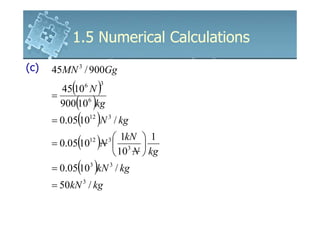
Example 1.1
Evaluate each of the following and express with
SI units having an approximate prefix: (a) (50
mN)(6 GN), (b) (400 mm)(0.6 MN)2, (c) 45
MN3/900 Gg

Solution
First convert to base units, perform indicated
operations and choose an appropriate prefix
1.5 Numerical Calculations
(a)   (50mN )(6GN )
        [ ( ) ][ ( ) ]
      = 50 10 −3 N 6 109 N
      = 300(10 )N
              6   2


      = 300(10 )N 
              6    1kN  1kN 
                  2
                        3       3
                      
                    10 N 10 N        
      = 300kN 2
1.5 Numerical Calculations
(b)   (400mm )(0.6MN )2
        [ ( )m][0.6(10 )N ]
      = 400 10   −3       6        2


      = [400(10 )m][0.36(10 )N ]
                 −3           12       2


      = 144(10 )m.N
             9        2


      = 144Gm.kN 2
1.5 Numerical Calculations
(c)            3
      45MN / 900Gg

      =
           (
        45 10 N    6
                            )
                            3


            ( )
        900 106 kg
      = 0.05(10 )N / kg12       3


      = 0.05(10 )N 
                     1kN  1
                       12       3
                                   3
                     10 N  kg
      = 0.05(10 )kN / kg
                       3        3


      = 50kN 3 / kg
1.6 General Procedure for
           Analysis
Most efficient way of learning is to solve
problems

To be successful at this, it is important to
present work in a logical and orderly way as
suggested:
1) Read problem carefully and try correlate
actual physical situation with theory
2) Draw any necessary diagrams and
tabulate the problem data
1.6 General Procedure for
           Analysis
3) Apply relevant principles, generally in
mathematics forms
4) Solve the necessary equations
algebraically as far as practical, making sure
that they are dimensionally homogenous,
using a consistent set of units and complete
the solution numerically
5) Report the answer with no more
significance figures than accuracy of the
given data
1.6 General Procedure for
            Analysis
6) Study the answer with technical judgment and
common sense to determine whether or not it
seems reasonable
1.6 General Procedure for
            Analysis


When solving the problems, do the work as
neatly as possible. Being neat generally
stimulates clear and orderly thinking and vice
versa.

6161103 1 general principles

  • 1.
    Chapter 1 General Principles Engineering Mechanics: Statics
  • 2.
    Chapter Objectives To providean introduction to the basic quantities and idealizations of mechanics. To give a statement of Newton’s Laws of Motion and Gravitation. To review the principles for applying the SI system of units. To examine the standard procedures for performing numerical calculations. To present a general guide for solving problems.
  • 3.
    Chapter Outline Mechanics Fundamental Concepts Unitsof Measurement The International System of Units Numerical Calculations General Procedure for Analysis
  • 4.
    1.1 Mechanics Mechanics canbe divided into 3 branches: - Rigid-body Mechanics - Deformable-body Mechanics - Fluid Mechanics Rigid-body Mechanics deals with - Statics - Dynamics
  • 5.
    1.1 Mechanics Statics– Equilibrium of bodies At rest Move with constant velocity Dynamics – Accelerated motion of bodies
  • 6.
    1.2 Fundamentals Concepts BasicQuantities Length – Locate position and describe size of physical system – Define distance and geometric properties of a body Mass – Comparison of action of one body against another – Measure of resistance of matter to a change in velocity
  • 7.
    1.2 Fundamentals Concepts BasicQuantities Time – Conceive as succession of events Force – “push” or “pull” exerted by one body on another – Occur due to direct contact between bodies Eg: Person pushing against the wall – Occur through a distance without direct contact Eg: Gravitational, electrical and magnetic forces
  • 8.
    1.2 Fundamentals Concepts Idealizations Particles – Consider mass but neglect size Eg: Size of Earth insignificant compared to its size of orbit Rigid Body – Combination of large number of particles – Neglect material properties Eg: Deformations in structures, machines and mechanism
  • 9.
    1.2 Fundamentals Concepts Idealizations Concentrated Force – Effect of loading, assumed to act at a point on a body – Represented by a concentrated force, provided loading area is small compared to overall size Eg: Contact force between wheel and ground
  • 10.
    1.2 Fundamentals Concepts Newton’sThree Laws of Motion First Law “A particle originally at rest, or moving in a straight line with constant velocity, will remain in this state provided that the particle is not subjected to an unbalanced force”
  • 11.
    1.2 Fundamentals Concepts Newton’sThree Laws of Motion Second Law “A particle acted upon by an unbalanced force F experiences an acceleration a that has the same direction as the force and a magnitude that is directly proportional to the force” F = ma
  • 12.
    1.2 Fundamentals Concepts Newton’sThree Laws of Motion Third Law “The mutual forces of action and reaction between two particles are equal and, opposite and collinear”
  • 13.
    1.2 Fundamentals Concepts Newton’sLaw of Gravitational Attraction m1 m 2 F =G 2 r F = force of gravitation between two particles G = universal constant of gravitation m1,m2 = mass of each of the two particles r = distance between the two particles
  • 14.
    1.2 Fundamentals Concepts mM e Weight, W =G 2 r Letting g = GM e / r 2 yields W = mg
  • 15.
    1.2 Fundamentals Concepts ComparingF = mg with F = ma g is the acceleration due to gravity Since g is dependent on r, weight of a body is not an absolute quantity Magnitude is determined from where the measurement is taken For most engineering calculations, g is determined at sea level and at a latitude of 45°
  • 16.
    1.3 Units ofMeasurement SI Units Système International d’Unités F = ma is maintained only if – Three of the units, called base units, are arbitrarily defined – Fourth unit is derived from the equation SI system specifies length in meters (m), time in seconds (s) and mass in kilograms (kg) Unit of force, called Newton (N) is derived from F = ma
  • 17.
    1.3 Units ofMeasurement Name Length Time Mass Force Internationa Meter Second Kilogram Newton l Systems of (m) (s) (kg) (N) Units (SI)  kg .m   2   s 
  • 18.
    1.3 Units ofMeasurement At the standard location, g = 9.806 65 m/s2 For calculations, we use g = 9.81 m/s2 Thus, W = mg (g = 9.81m/s2) Hence, a body of mass 1 kg has a weight of 9.81 N, a 2 kg body weighs 19.62 N
  • 19.
    1.4 The InternationalSystem of Units Prefixes For a very large or very small numerical quantity, the units can be modified by using a prefix Each represent a multiple or sub-multiple of a unit Eg: 4,000,000 N = 4000 kN (kilo-newton) = 4 MN (mega- newton) 0.005m = 5 mm (milli-meter)
  • 20.
    1.4 The InternationalSystem of Units Exponential Prefix SI Symbol Form Multiple 1 000 000 000 109 Giga G 1 000 000 106 Mega M 1 000 103 Kilo k Sub-Multiple 0.001 10-3 Milli m 0.000 001 10-6 Micro µ 0.000 000 001 10-9 nano n
  • 21.
    1.4 The InternationalSystem of Units Rules for Use Never write a symbol with a plural “s”. Easily confused with second (s) Symbols are always written in lowercase letters, except the 2 largest prefixes, mega (M) and giga (G) Symbols named after an individual are capitalized Eg: newton (N)
  • 22.
    1.4 The InternationalSystem of Units Rules for Use Quantities defined by several units which are multiples, are separated by a dot Eg: N = kg.m/s2 = kg.m.s-2 The exponential power represented for a unit having a prefix refer to both the unit and its prefix Eg: µN2 = (µN)2 = µN. µN
  • 23.
    1.4 The InternationalSystem of Units Rules for Use Physical constants with several digits on either side should be written with a space between 3 digits rather than a comma Eg: 73 569.213 427 In calculations, represent numbers in terms of their base or derived units by converting all prefixes to powers of 10
  • 24.
    1.4 The InternationalSystem of Units Rules for Use Eg: (50kN)(60nm) = [50(103)N][60(10-9)m] = 3000(10-6)N.m = 3(10-3)N.m = 3 mN.m The final result should be expressed using a single prefix
  • 25.
    1.4 The InternationalSystem of Units Rules for Use Compound prefix should not be used Eg: kµs (kilo-micro-second) should be expressed as ms (milli-second) since 1 kµs = 1 (103)(10-6) s = 1 (10-3) s = 1ms With exception of base unit kilogram, avoid use of prefix in the denominator of composite units Eg: Do not write N/mm but rather kN/m Also, m/mg should be expressed as Mm/kg
  • 26.
    1.4 The InternationalSystem of Units Rules for Use Although not expressed in terms of multiples of 10, the minute, hour etc are retained for practical purposes as multiples of second. Plane angular measurements are made using radians. In this class, degrees would be often used where 180° = π rad
  • 27.
    1.5 Numerical Calculations DimensionalHomogeneity - Each term must be expressed in the same units Eg: s = vt + ½ at2 where s is position in meters (m), t is time in seconds (s), v is velocity in m/s and a is acceleration in m/s2 - Regardless of how the equation is evaluated, it maintains its dimensional homogeneity
  • 28.
    1.5 Numerical Calculations DimensionalHomogeneity - All the terms of an equation can be replaced by a consistent set of units, that can be used as a partial check for algebraic manipulations of an equation
  • 29.
    1.5 Numerical Calculations SignificantFigures - The accuracy of a number is specified by the number of significant figures it contains - A significant figure is any digit including zero, provided it is not used to specify the location of the decimal point for the number Eg: 5604 and 34.52 have four significant numbers
  • 30.
    1.5 Numerical Calculations Significant Figures - When numbers begin or end with zero, we make use of prefixes to clarify the number of significant figures Eg: 400 as one significant figure would be 0.4(103) 2500 as three significant figures would be 2.50(103)
  • 31.
    1.5 Numerical Calculations Computersare often used in engineering for advanced design and analysis
  • 32.
    1.5 Numerical Calculations RoundingOff Numbers - For numerical calculations, the accuracy obtained from the solution of a problem would never be better than the accuracy of the problem data - Often handheld calculators or computers involve more figures in the answer than the number of significant figures in the data
  • 33.
    1.5 Numerical Calculations RoundingOff Numbers - Calculated results should always be “rounded off” to an appropriate number of significant figures
  • 34.
    1.5 Numerical Calculations Rulesfor Rounding to n significant figures - If the n+1 digit is less than 5, the n+1 digit and others following it are dropped Eg: 2.326 and 0.451 rounded off to n = 2 significance figures would be 2.3 and 0.45 - If the n+1 digit is equal to 5 with zero following it, then round nth digit to an even number Eg: 1.245(103) and 0.8655 rounded off to n = 3 significant figures become 1.24(103) and 0.866
  • 35.
    1.5 Numerical Calculations Rulesfor Rounding to n significant figures - If the n+1 digit is greater than 5 or equal to 5 with non-zero digits following it, increase the nth digit by 1 and drop the n+1digit and the others following it Eg: 0.723 87 and 565.5003 rounded off to n = 3 significance figures become 0.724 and 566
  • 36.
    1.5 Numerical Calculations Calculations -To ensure the accuracy of the final results, always retain a greater number of digits than the problem data - If possible, try work out computations so that numbers that are approximately equal are not subtracted -In engineering, we generally round off final answers to three significant figures
  • 37.
    1.5 Numerical Calculations Example1.1 Evaluate each of the following and express with SI units having an approximate prefix: (a) (50 mN)(6 GN), (b) (400 mm)(0.6 MN)2, (c) 45 MN3/900 Gg Solution First convert to base units, perform indicated operations and choose an appropriate prefix
  • 38.
    1.5 Numerical Calculations (a) (50mN )(6GN ) [ ( ) ][ ( ) ] = 50 10 −3 N 6 109 N = 300(10 )N 6 2 = 300(10 )N  6  1kN  1kN  2 3  3  10 N 10 N   = 300kN 2
  • 39.
    1.5 Numerical Calculations (b) (400mm )(0.6MN )2 [ ( )m][0.6(10 )N ] = 400 10 −3 6 2 = [400(10 )m][0.36(10 )N ] −3 12 2 = 144(10 )m.N 9 2 = 144Gm.kN 2
  • 40.
    1.5 Numerical Calculations (c) 3 45MN / 900Gg = ( 45 10 N 6 ) 3 ( ) 900 106 kg = 0.05(10 )N / kg12 3 = 0.05(10 )N   1kN  1 12 3  3  10 N  kg = 0.05(10 )kN / kg 3 3 = 50kN 3 / kg
  • 41.
    1.6 General Procedurefor Analysis Most efficient way of learning is to solve problems To be successful at this, it is important to present work in a logical and orderly way as suggested: 1) Read problem carefully and try correlate actual physical situation with theory 2) Draw any necessary diagrams and tabulate the problem data
  • 42.
    1.6 General Procedurefor Analysis 3) Apply relevant principles, generally in mathematics forms 4) Solve the necessary equations algebraically as far as practical, making sure that they are dimensionally homogenous, using a consistent set of units and complete the solution numerically 5) Report the answer with no more significance figures than accuracy of the given data
  • 43.
    1.6 General Procedurefor Analysis 6) Study the answer with technical judgment and common sense to determine whether or not it seems reasonable
  • 44.
    1.6 General Procedurefor Analysis When solving the problems, do the work as neatly as possible. Being neat generally stimulates clear and orderly thinking and vice versa.