SYNTHESIS AND CHARACTERIZATION OF
NANOFLUID WITH BASE FLUID WATER
INSTITUTE OF ENGINEERING AND TECHNOLOGY
DEPARTMENT OF MECHANICAL ENGINEERING
SESSION 2017-18
Submitted to; submitted by;
Er. Rahul shukla abhay nath tiwari
Asst. professor abhinay rai
IET BU Jhansi abhishek singh
awadesh kumar
shiv pratap singh
pravej alam
TABLE OF CONTENTS
 Nanofluid and nonotechnology
 Types of nanoparticle
 Types of nanofluid
 Cerium oxide nanoparticle
 Synthesis of nanofluid
 Experimentation
 Environmental aspects and human safety
 Result and discussion
 Conclusion
 Future aspects of nanofluid
 References
NANOFLUID AND NANOTECHNOLOGY
• Nano word is originated from Latin word, which means dwarf.
• 'Nano' is a prefix used to describe 'one billionth’.
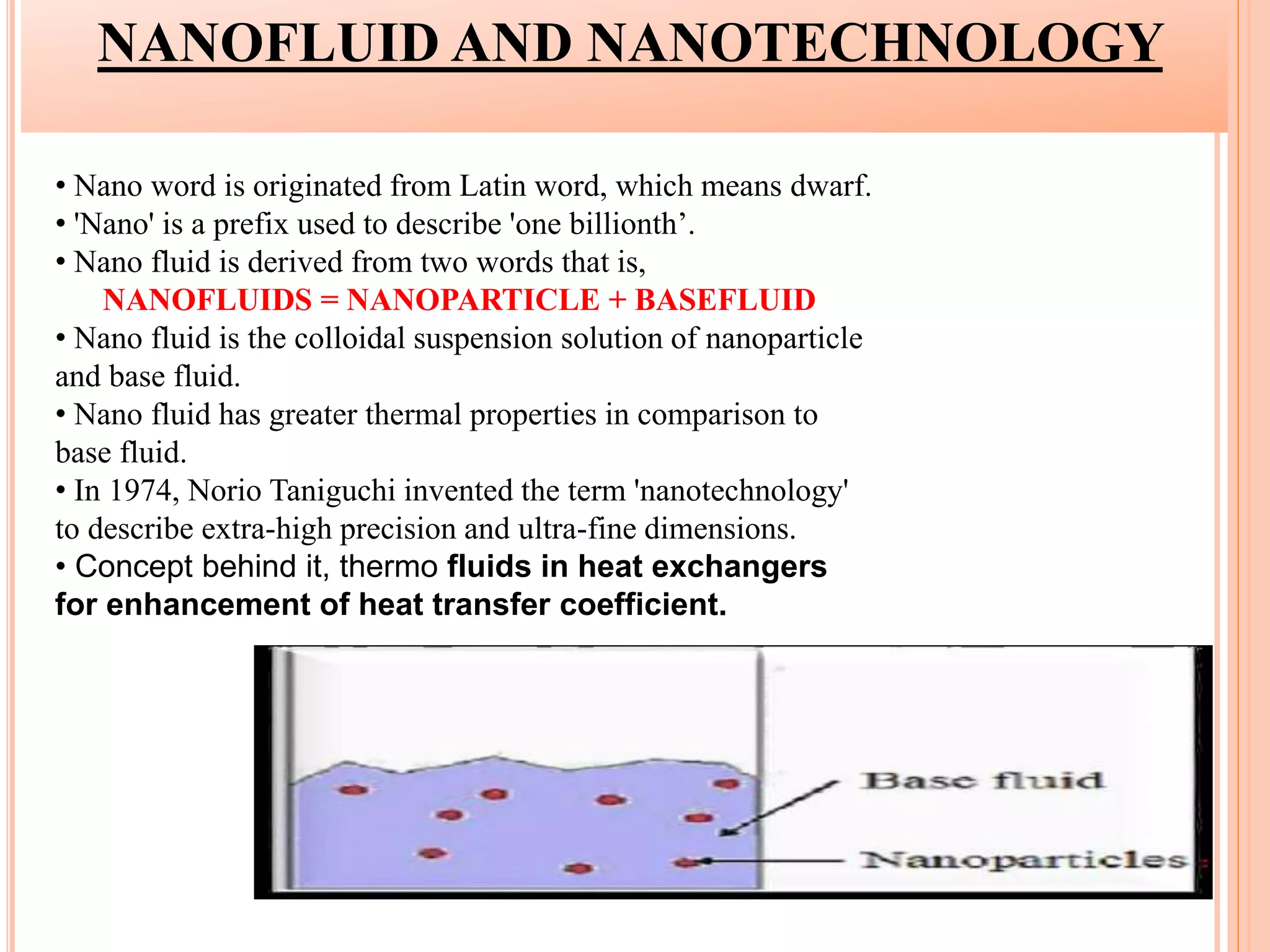
• Nano fluid is derived from two words that is,
NANOFLUIDS = NANOPARTICLE + BASEFLUID
• Nano fluid is the colloidal suspension solution of nanoparticle
and base fluid.
• Nano fluid has greater thermal properties in comparison to
base fluid.
• In 1974, Norio Taniguchi invented the term 'nanotechnology'
to describe extra-high precision and ultra-fine dimensions.
• Concept behind it, thermo fluids in heat exchangers
for enhancement of heat transfer coefficient.
TPYES OF NANOPARTICLES
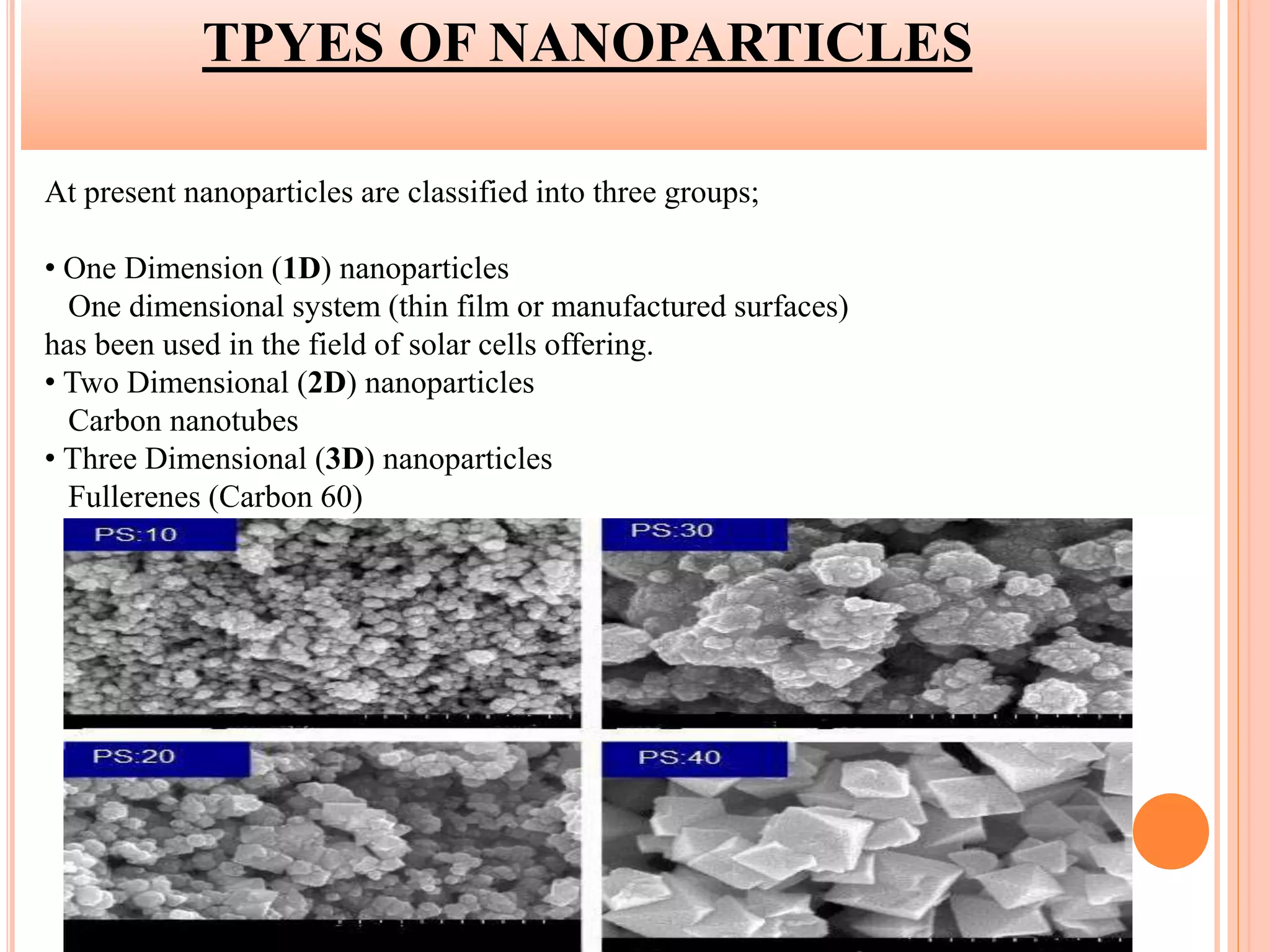
At present nanoparticles are classified into three groups;
• One Dimension (1D) nanoparticles
One dimensional system (thin film or manufactured surfaces)
has been used in the field of solar cells offering.
• Two Dimensional (2D) nanoparticles
Carbon nanotubes
• Three Dimensional (3D) nanoparticles
Fullerenes (Carbon 60)
TYPES OF NANOFLUID
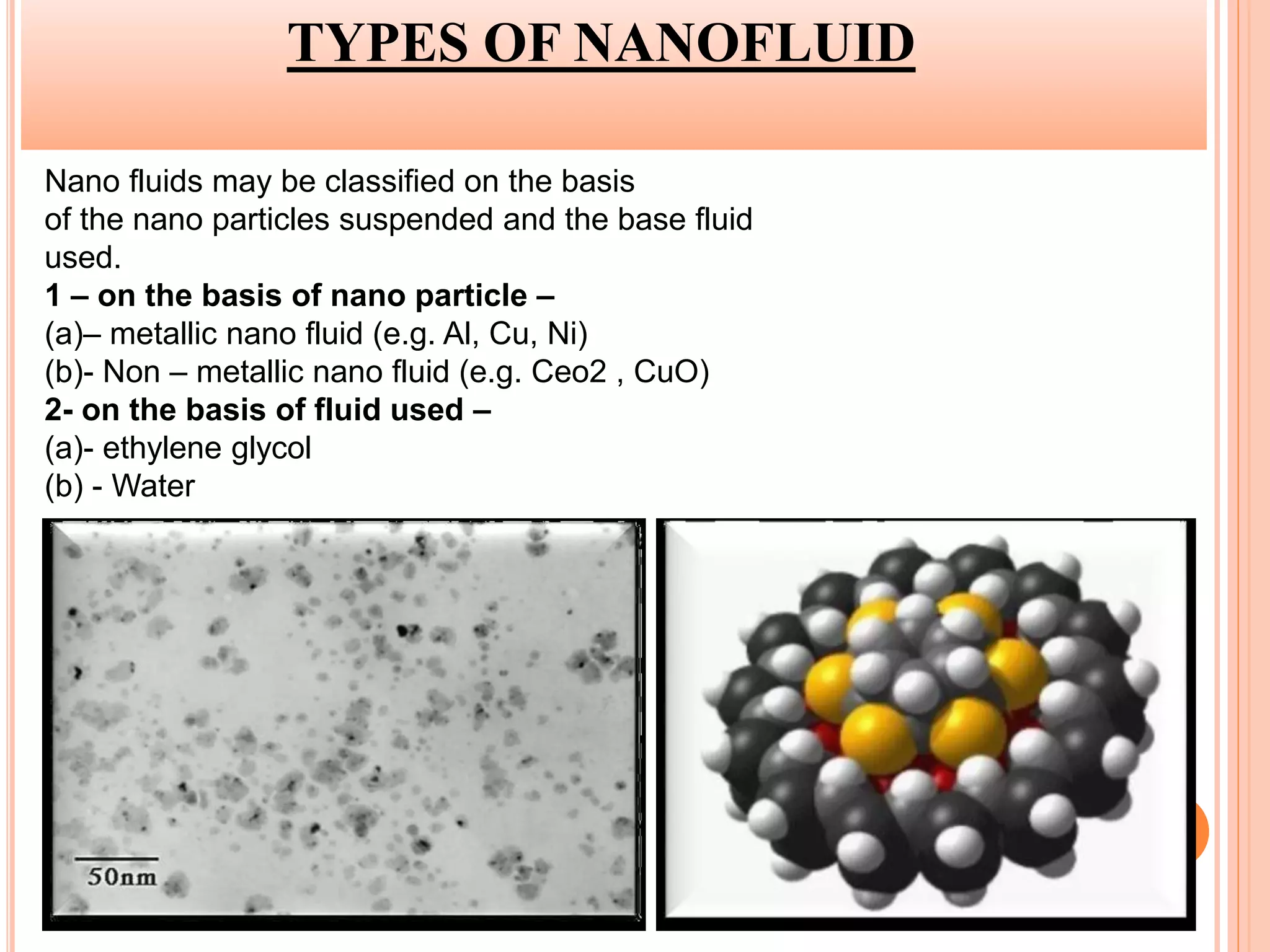
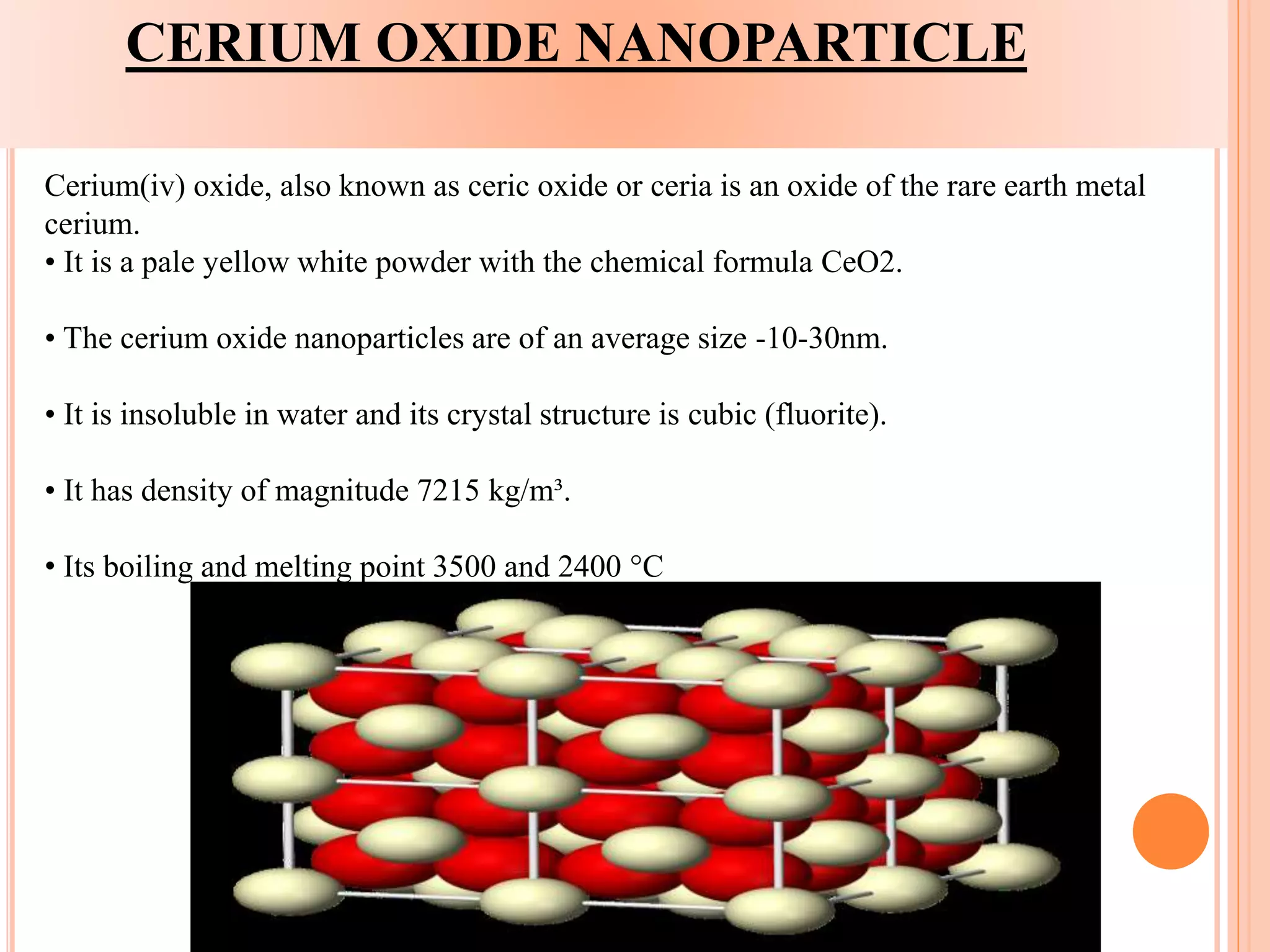
Nano fluids may be classified on the basis
of the nano particles suspended and the base fluid
used.
1 – on the basis of nano particle –
(a)– metallic nano fluid (e.g. Al, Cu, Ni)
(b)- Non – metallic nano fluid (e.g. Ceo2 , CuO)
2- on the basis of fluid used –
(a)- ethylene glycol
(b) - Water
CERIUM OXIDE NANOPARTICLE
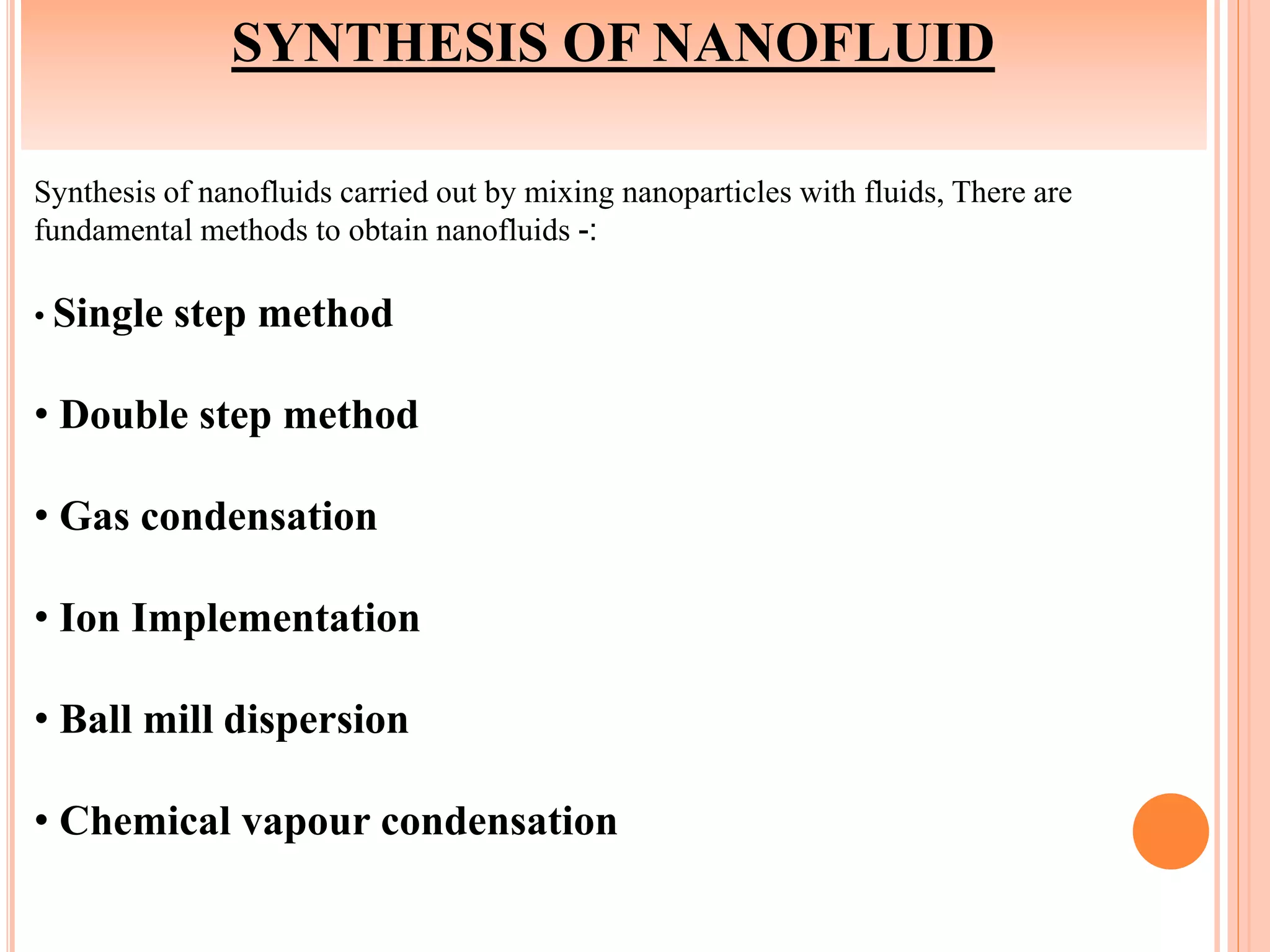
Cerium(iv) oxide, also known as ceric oxide or ceria is an oxide of the rare earth metal
cerium.
• It is a pale yellow white powder with the chemical formula CeO2.
• The cerium oxide nanoparticles are of an average size -10-30nm.
• It is insoluble in water and its crystal structure is cubic (fluorite).
• It has density of magnitude 7215 kg/m³.
• Its boiling and melting point 3500 and 2400 °C
SYNTHESIS OF NANOFLUID
Synthesis of nanofluids carried out by mixing nanoparticles with fluids, There are
fundamental methods to obtain nanofluids -:
• Single step method
• Double step method
• Gas condensation
• Ion Implementation
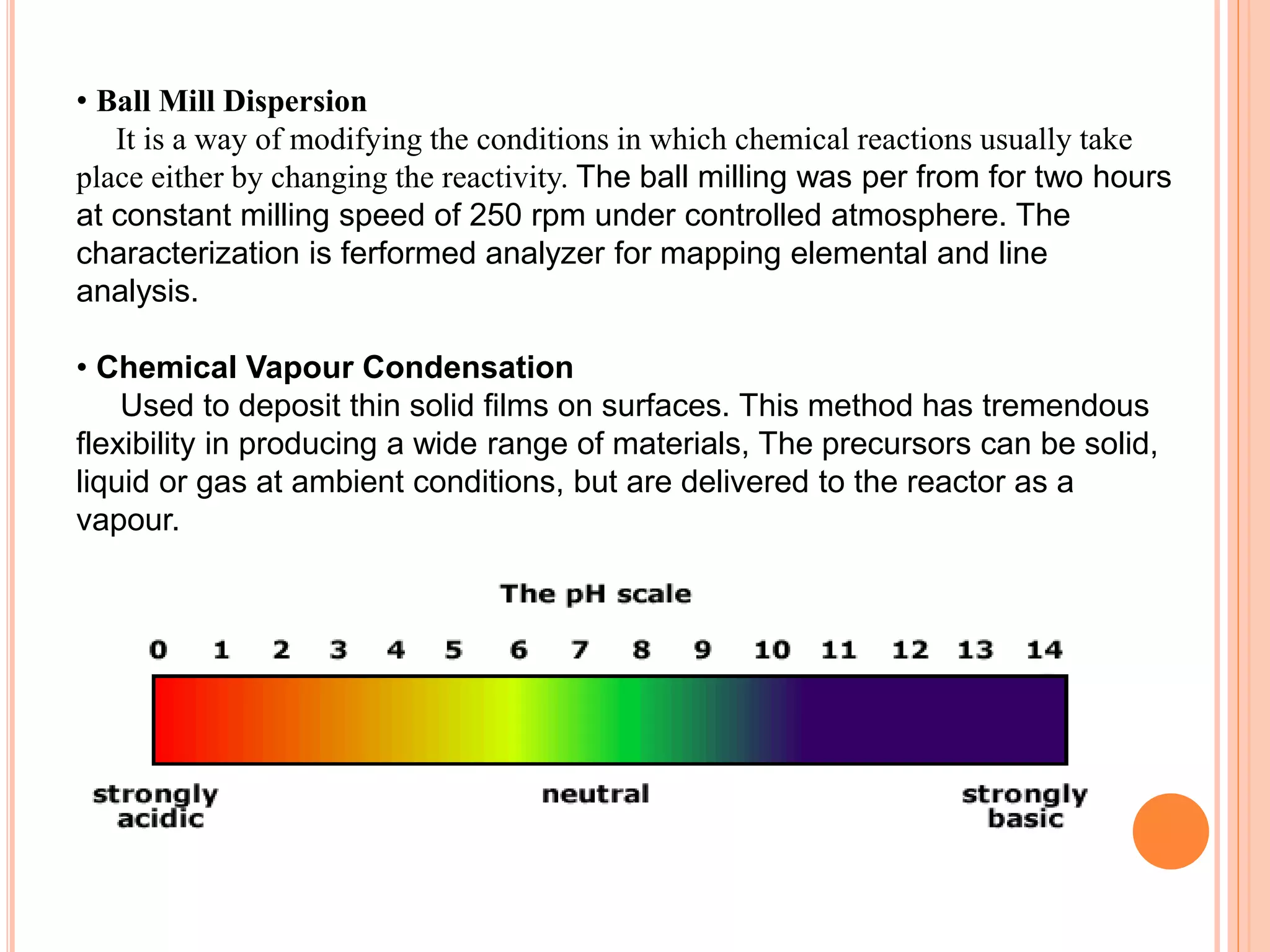
• Ball mill dispersion
• Chemical vapour condensation
• Single step method
Used makes and disperses the nanoparticles straight into a conventional base fluid
best for metallic nanofluids. The preliminary materials tried for nanofluids were
oxide particles, primarily because they were easy to produce and chemically
stable in solution.
• Double step method
Two-step technique is the most cost-effective method to generate nanofluids in big
scale. Nanoparticles, nanotubes, nanofibers and other non material’s used in
this technique are first formed as dry powders by physical and chemical
methods.
• Gas Condensation
Used to make nanoparticles from metals with low melting points. In this method
the solid along with the liquid is fed into a colloidal mill.
• Ion Implementation
Used in semiconductor device fabrication and in metal finishing, as well as in
materials science research. Ion implantation cause also chemical and physical
changes when the ions impinge on the target at high energy.
• Ball Mill Dispersion
It is a way of modifying the conditions in which chemical reactions usually take
place either by changing the reactivity. The ball milling was per from for two hours
at constant milling speed of 250 rpm under controlled atmosphere. The
characterization is ferformed analyzer for mapping elemental and line
analysis.
• Chemical Vapour Condensation
Used to deposit thin solid films on surfaces. This method has tremendous
flexibility in producing a wide range of materials, The precursors can be solid,
liquid or gas at ambient conditions, but are delivered to the reactor as a
vapour.
EXPERIMENTATION
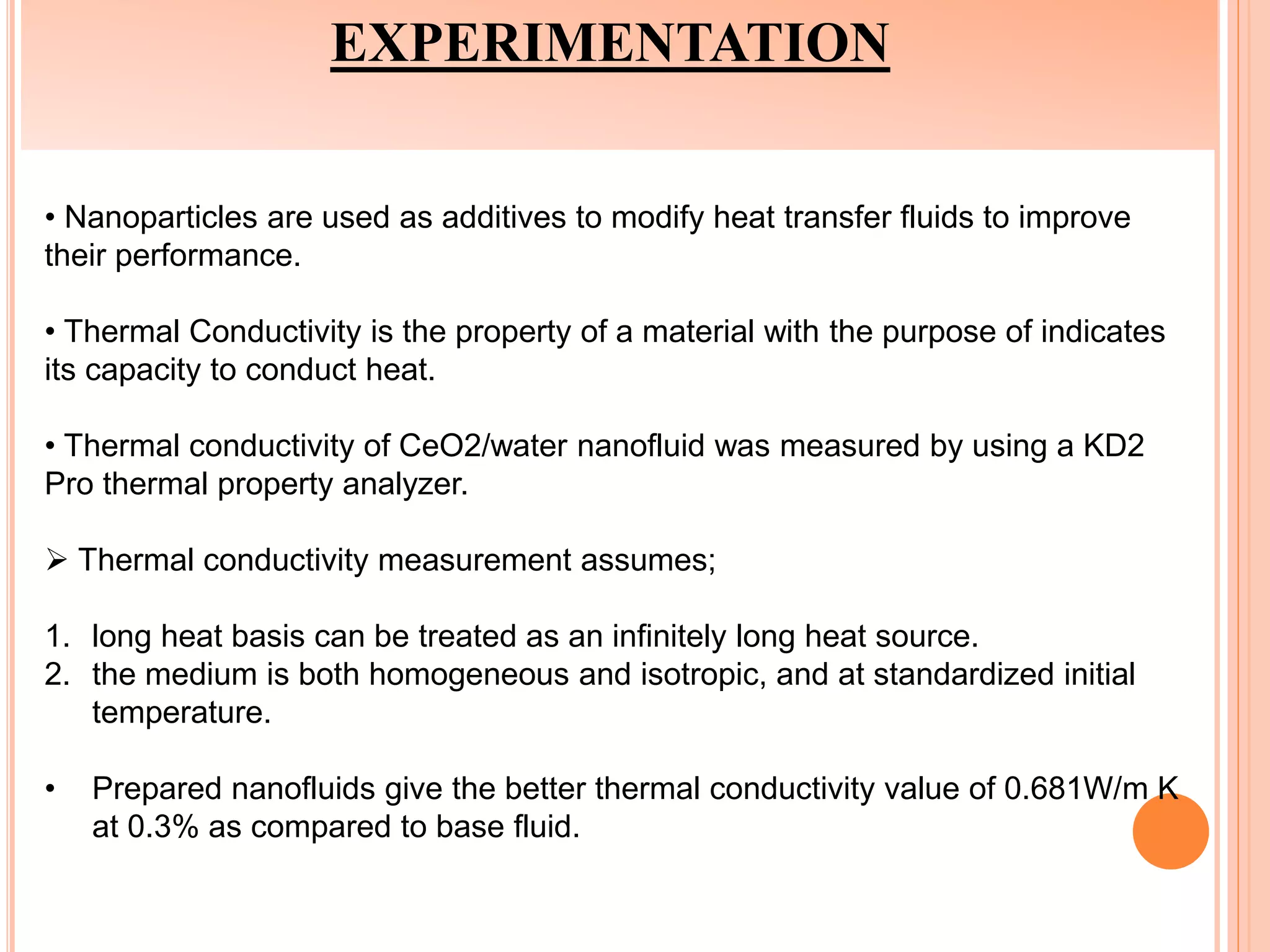
• Nanoparticles are used as additives to modify heat transfer fluids to improve
their performance.
• Thermal Conductivity is the property of a material with the purpose of indicates
its capacity to conduct heat.
• Thermal conductivity of CeO2/water nanofluid was measured by using a KD2
Pro thermal property analyzer.
 Thermal conductivity measurement assumes;
1. long heat basis can be treated as an infinitely long heat source.
2. the medium is both homogeneous and isotropic, and at standardized initial
temperature.
• Prepared nanofluids give the better thermal conductivity value of 0.681W/m K
at 0.3% as compared to base fluid.
Steps:
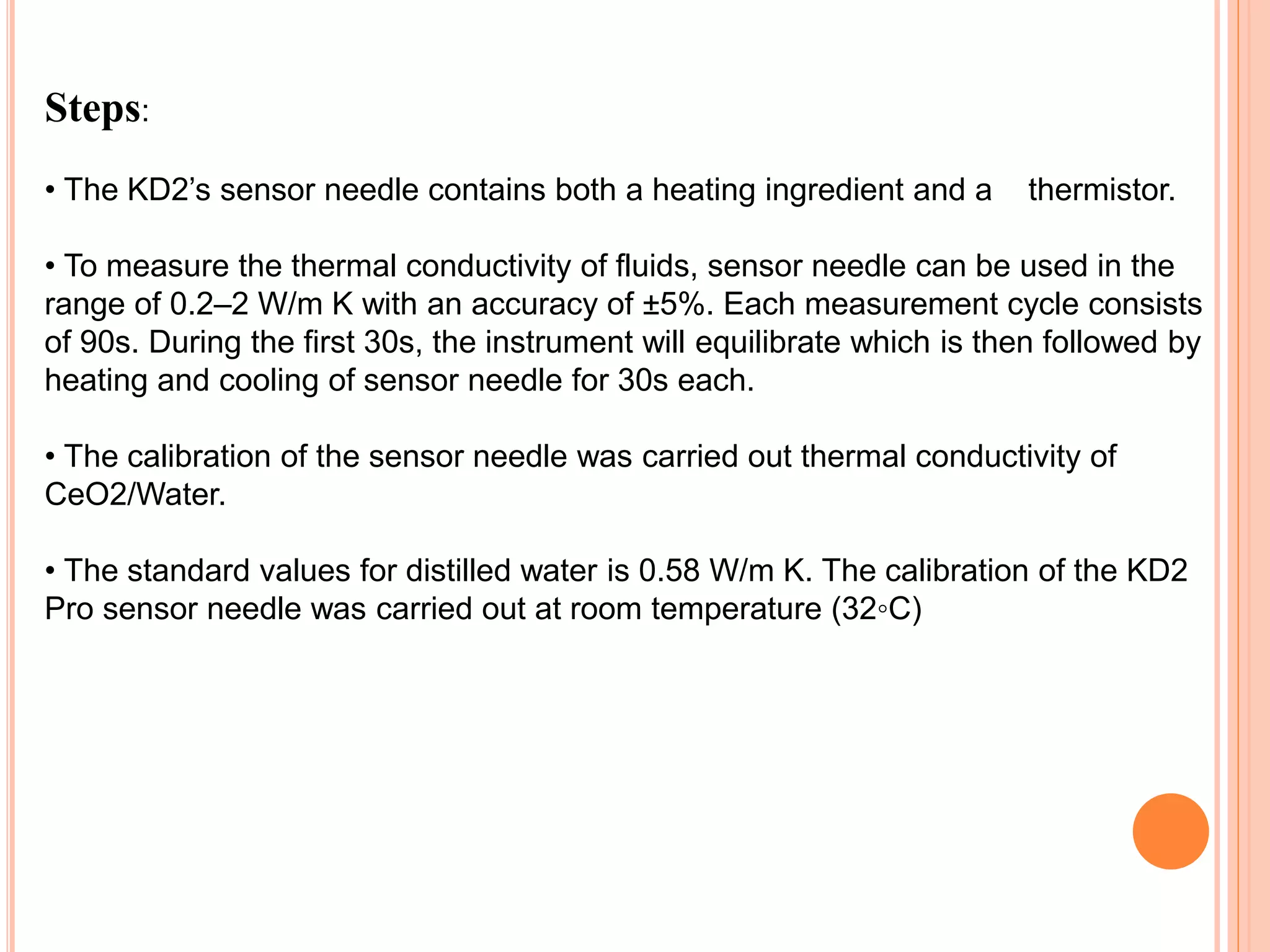
• The KD2’s sensor needle contains both a heating ingredient and a thermistor.
• To measure the thermal conductivity of fluids, sensor needle can be used in the
range of 0.2–2 W/m K with an accuracy of ±5%. Each measurement cycle consists
of 90s. During the first 30s, the instrument will equilibrate which is then followed by
heating and cooling of sensor needle for 30s each.
• The calibration of the sensor needle was carried out thermal conductivity of
CeO2/Water.
• The standard values for distilled water is 0.58 W/m K. The calibration of the KD2
Pro sensor needle was carried out at room temperature (32◦C)
ENVIRONMENTAL AND HUMAN SAFETY ASPECTS
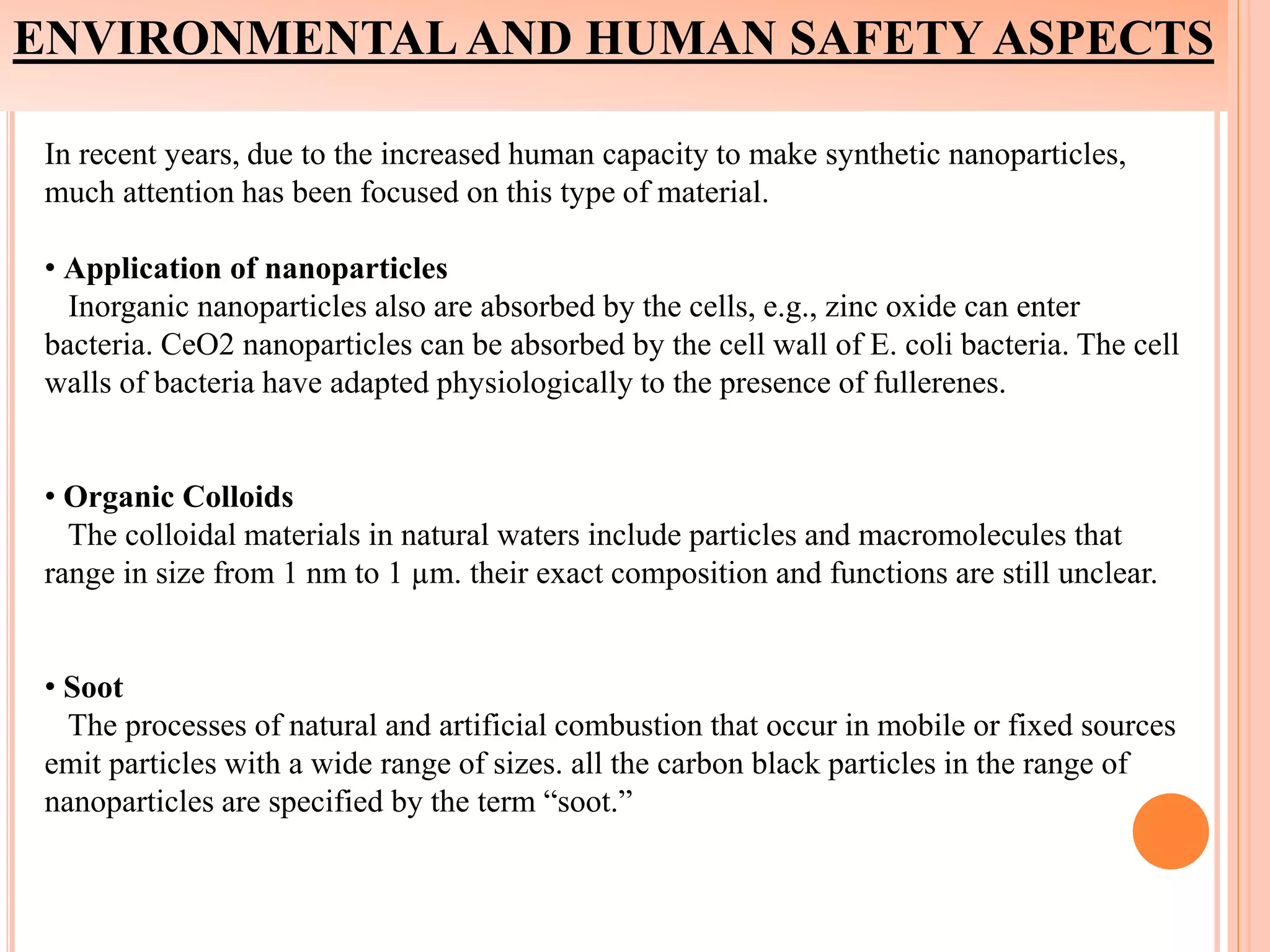
In recent years, due to the increased human capacity to make synthetic nanoparticles,
much attention has been focused on this type of material.
• Application of nanoparticles
Inorganic nanoparticles also are absorbed by the cells, e.g., zinc oxide can enter
bacteria. CeO2 nanoparticles can be absorbed by the cell wall of E. coli bacteria. The cell
walls of bacteria have adapted physiologically to the presence of fullerenes.
• Organic Colloids
The colloidal materials in natural waters include particles and macromolecules that
range in size from 1 nm to 1 µm. their exact composition and functions are still unclear.
• Soot
The processes of natural and artificial combustion that occur in mobile or fixed sources
emit particles with a wide range of sizes. all the carbon black particles in the range of
nanoparticles are specified by the term “soot.”
• fullerenes and carbon nanotubes
fullerenes and carbon nanotubes are considered to be engineered nanoparticles, natural
fullerenes and carbon nanotubes also exist in the environment.
• Natural and unintentionally-produced inorganic Nanoparticles (NP)
Mineral nanoparticles exist everywhere in the soil and in geological systems. Aerosols
that are present in the atmosphere also are considered to be nanoparticle.
• Engineered fullerenes and CNTs
Most fullerenes are used in polymeric composites, such as thin membranes, and in
electro-optical devices and biological applications.
• Engineered polymeric NP
Synthetic nanoparticles resulting from organic polymers have been used in
many applications in medicine as drug-delivery devices. Different types of these
nanoparticles have been studied regarding their ability to pass through brain-
blood barriers.
RESULT AND DISSCUSION
• DENSITY
The density or more precisely, the volumetric mass density, of a substance is
its mass per unit volume. The symbol most often used for density is ρ.
density= mass/volume
The SI unit of density is Kg/m3.
• VISCOSITY
Viscosity is a measure of a fluid’s resistance to flow. It describes the internal
friction of a moving fluid. A fluid with large viscosity resists motion because its
molecular makeup gives it a lot of internal friction.
Viscosity =Shear force/velocity gradient
μ=τdu /dy
The SI unit of viscosity, if equivalent to N-s/m2.
• THERMAL CONDUCTIVITY
Thermal conductivity is the property of material to conduct heat. It is evaluated
primarily in terms of fourier’s law for heat conduction.
In SI units, thermal conductivity is measured in W/m-K.
• SPECIFIC HEAT
The specific heat is the amount of heat per unit mass required to rise the
temperature by 10 C. The relationship between heat and temperature change
is usually expressed in the form of specific heat (c).
RESULT AND DISSCUSION
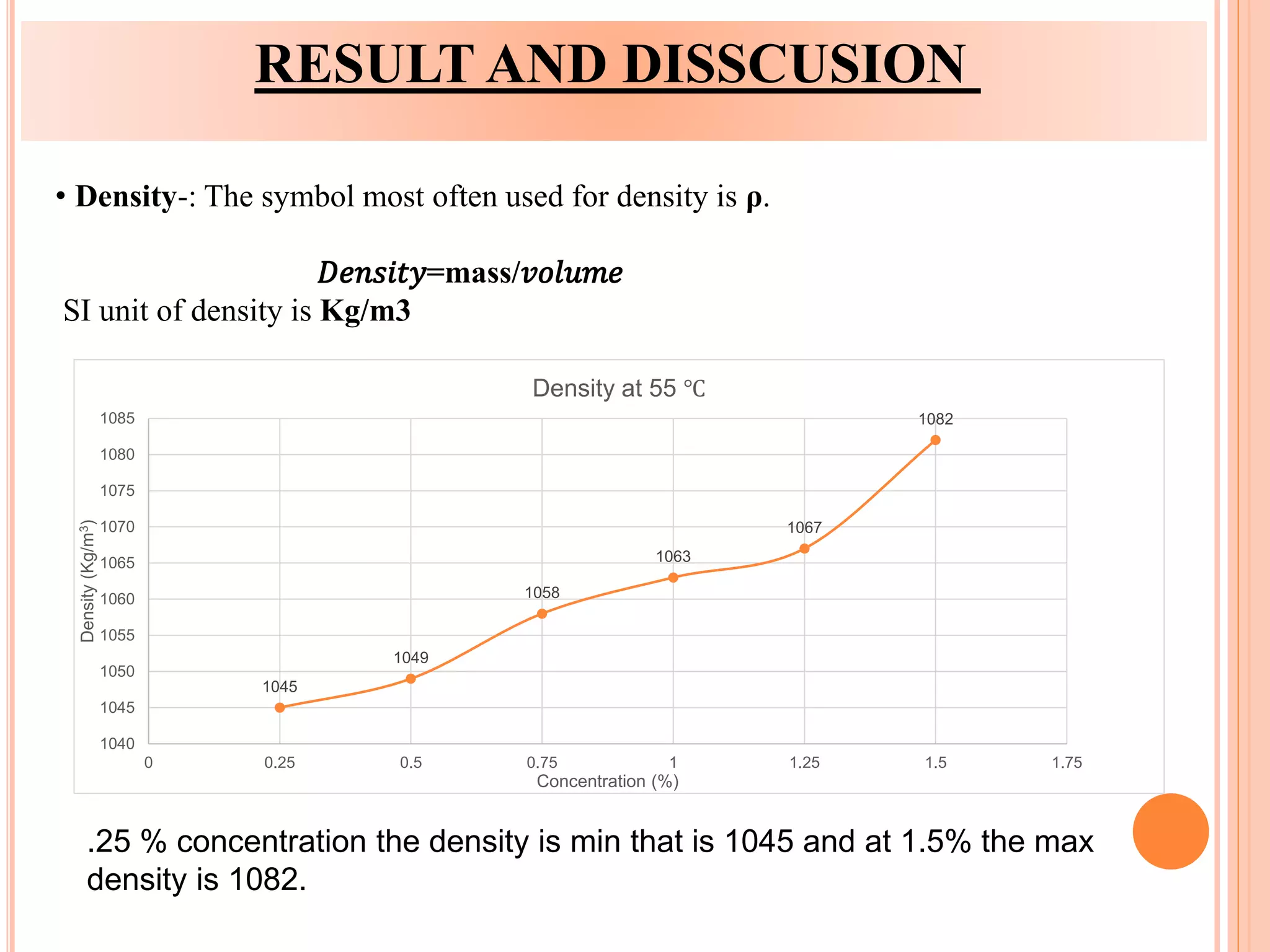
• Density-: The symbol most often used for density is ρ.
𝐷𝑒𝑛𝑠𝑖𝑡𝑦=mass/𝑣𝑜𝑙𝑢𝑚𝑒
SI unit of density is Kg/m3
1045
1049
1058
1063
1067
1082
1040
1045
1050
1055
1060
1065
1070
1075
1080
1085
0 0.25 0.5 0.75 1 1.25 1.5 1.75
Density(Kg/m3)
Concentration (%)
Density at 55 ℃
.25 % concentration the density is min that is 1045 and at 1.5% the max
density is 1082.
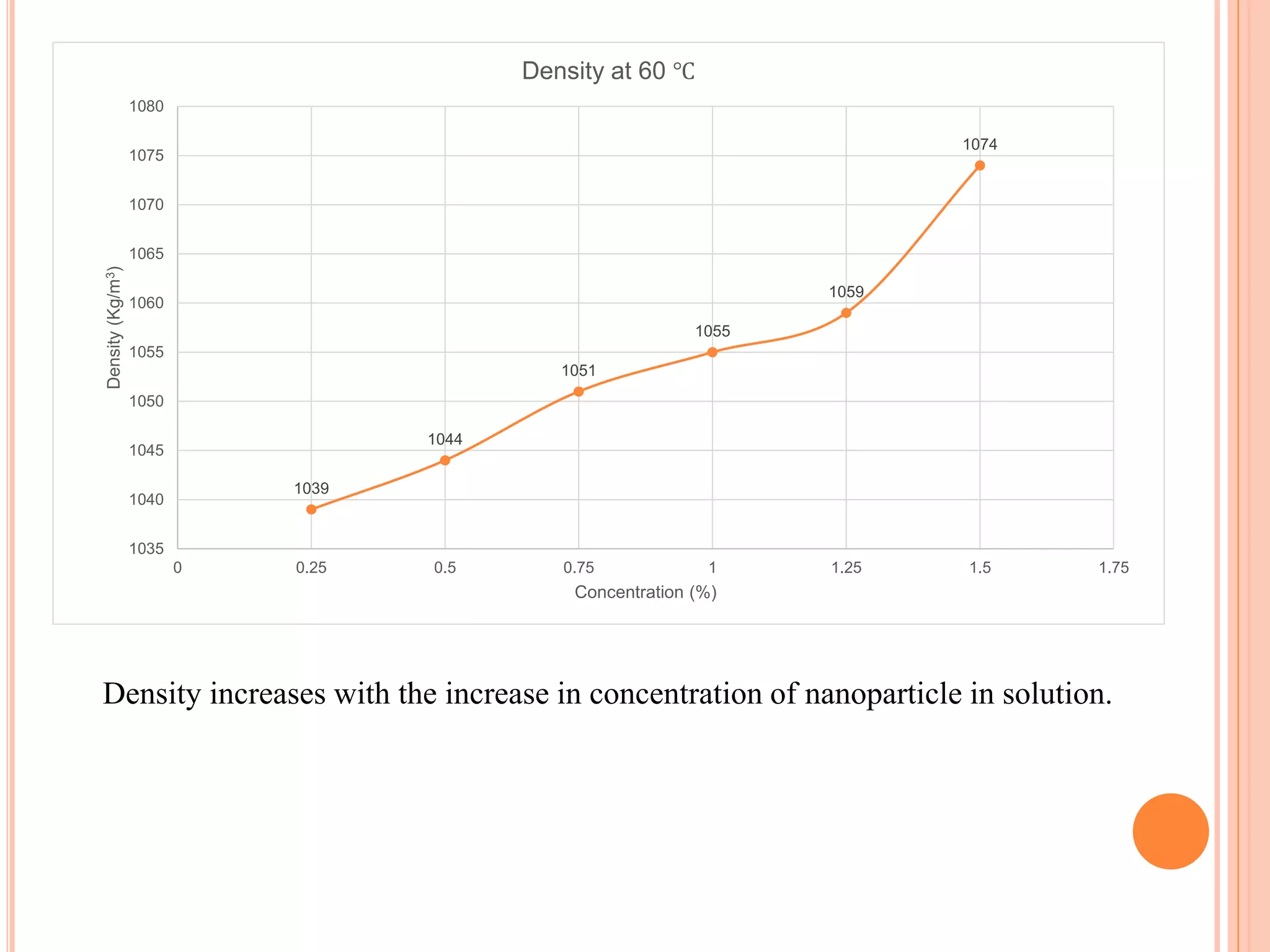
1039
1044
1051
1055
1059
1074
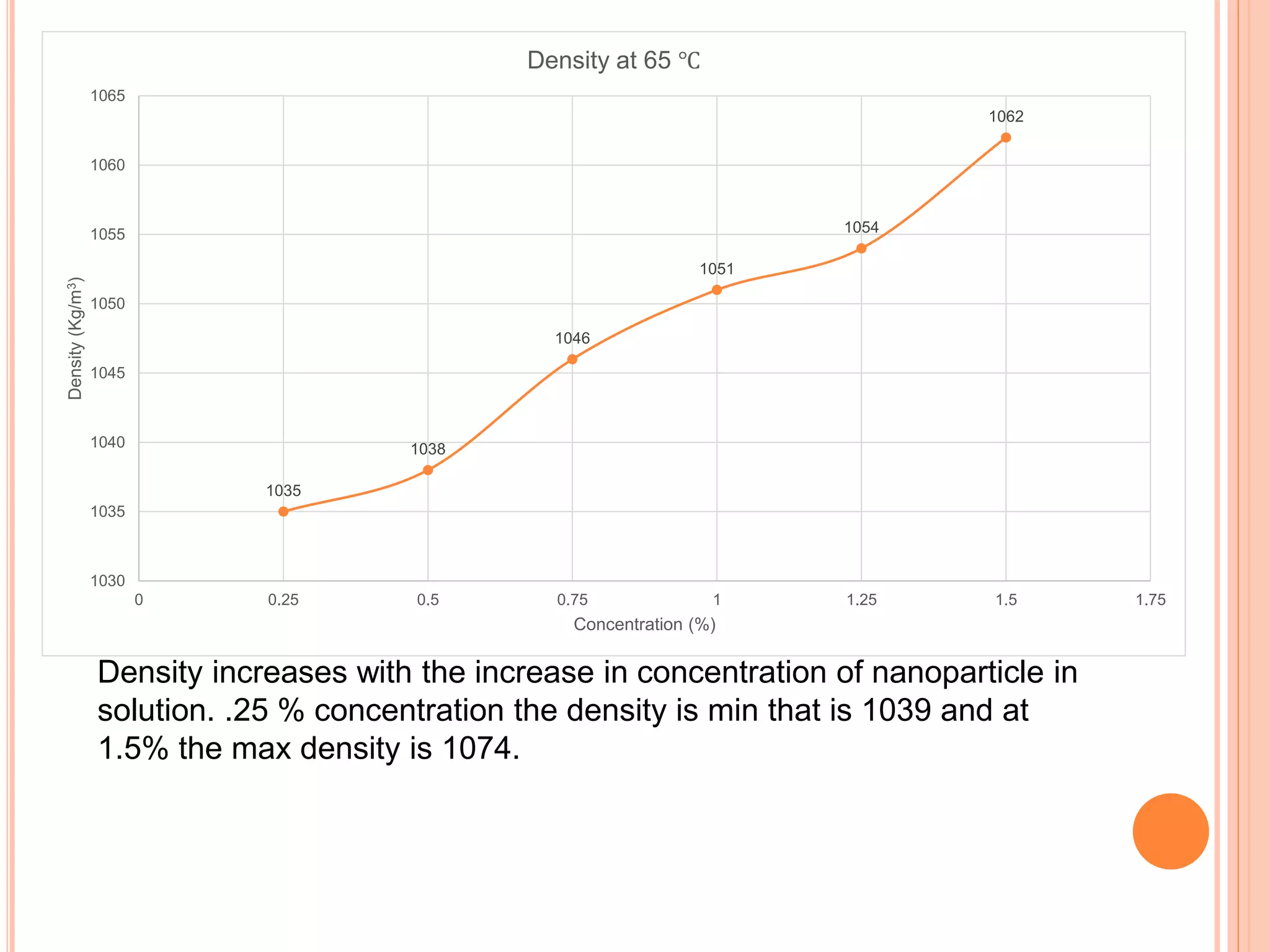
1035
1040
1045
1050
1055
1060
1065
1070
1075
1080
0 0.25 0.5 0.75 1 1.25 1.5 1.75
Density(Kg/m3)
Concentration (%)
Density at 60 ℃
Density increases with the increase in concentration of nanoparticle in solution.
1035
1038
1046
1051
1054
1062
1030
1035
1040
1045
1050
1055
1060
1065
0 0.25 0.5 0.75 1 1.25 1.5 1.75
Density(Kg/m3)
Concentration (%)
Density at 65 ℃
Density increases with the increase in concentration of nanoparticle in
solution. .25 % concentration the density is min that is 1039 and at
1.5% the max density is 1074.
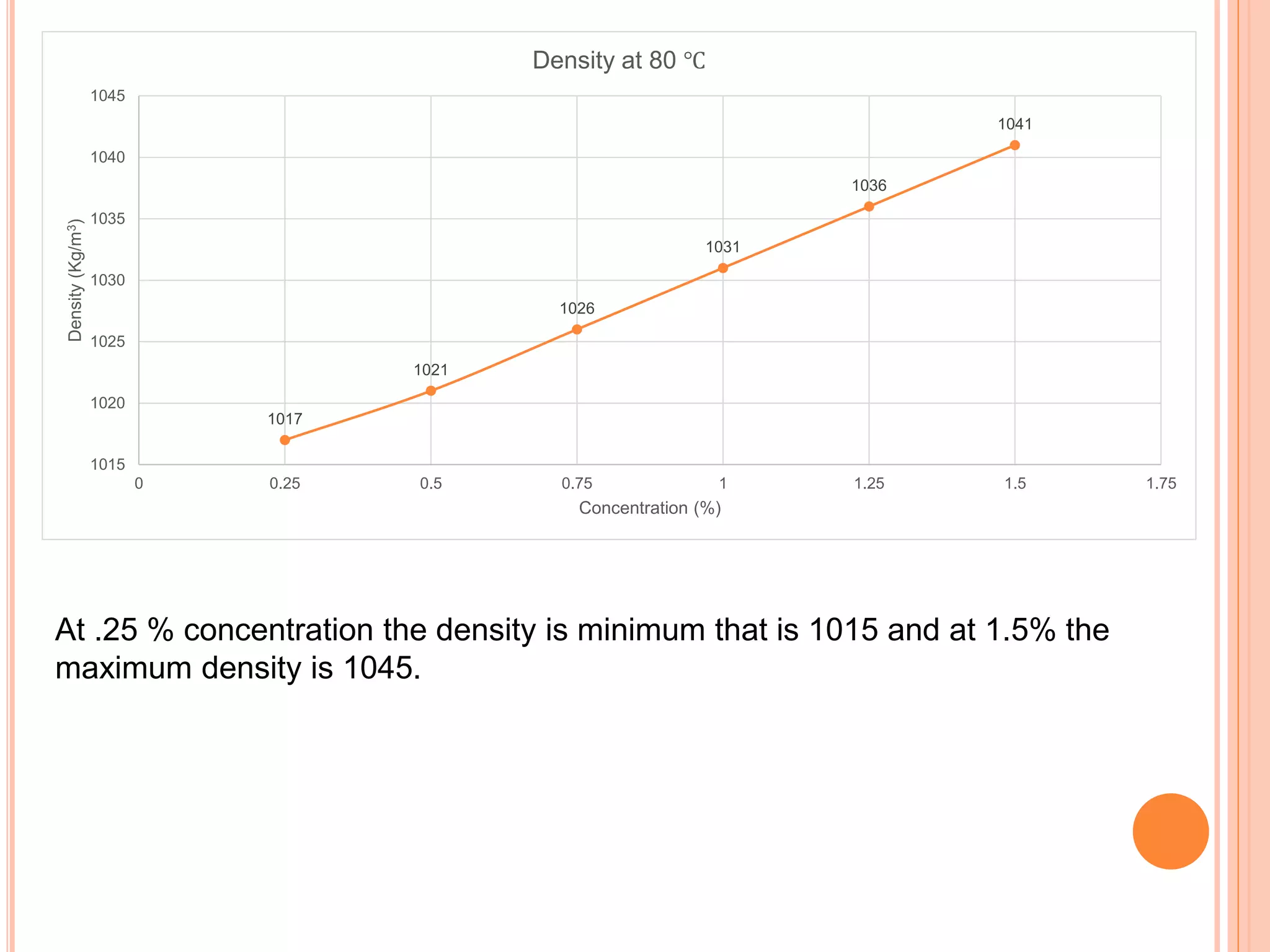
1017
1021
1026
1031
1036
1041
1015
1020
1025
1030
1035
1040
1045
0 0.25 0.5 0.75 1 1.25 1.5 1.75
Density(Kg/m3)
Concentration (%)
Density at 80 ℃
At .25 % concentration the density is minimum that is 1015 and at 1.5% the
maximum density is 1045.
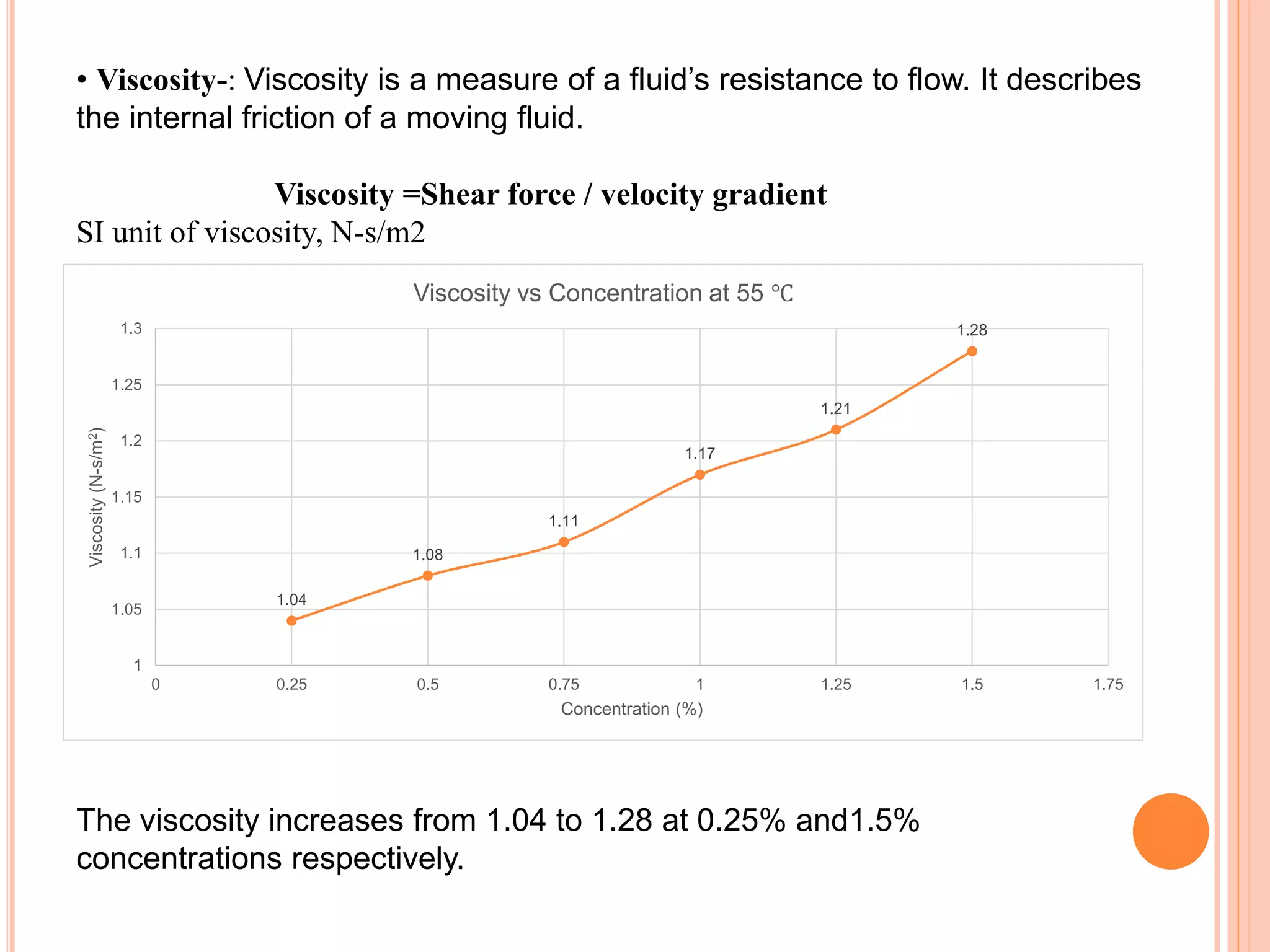
1.04
1.08
1.11
1.17
1.21
1.28
1
1.05
1.1
1.15
1.2
1.25
1.3
0 0.25 0.5 0.75 1 1.25 1.5 1.75
Viscosity(N-s/m2)
Concentration (%)
Viscosity vs Concentration at 55 ℃
• Viscosity-: Viscosity is a measure of a fluid’s resistance to flow. It describes
the internal friction of a moving fluid.
Viscosity =Shear force / velocity gradient
SI unit of viscosity, N-s/m2
The viscosity increases from 1.04 to 1.28 at 0.25% and1.5%
concentrations respectively.
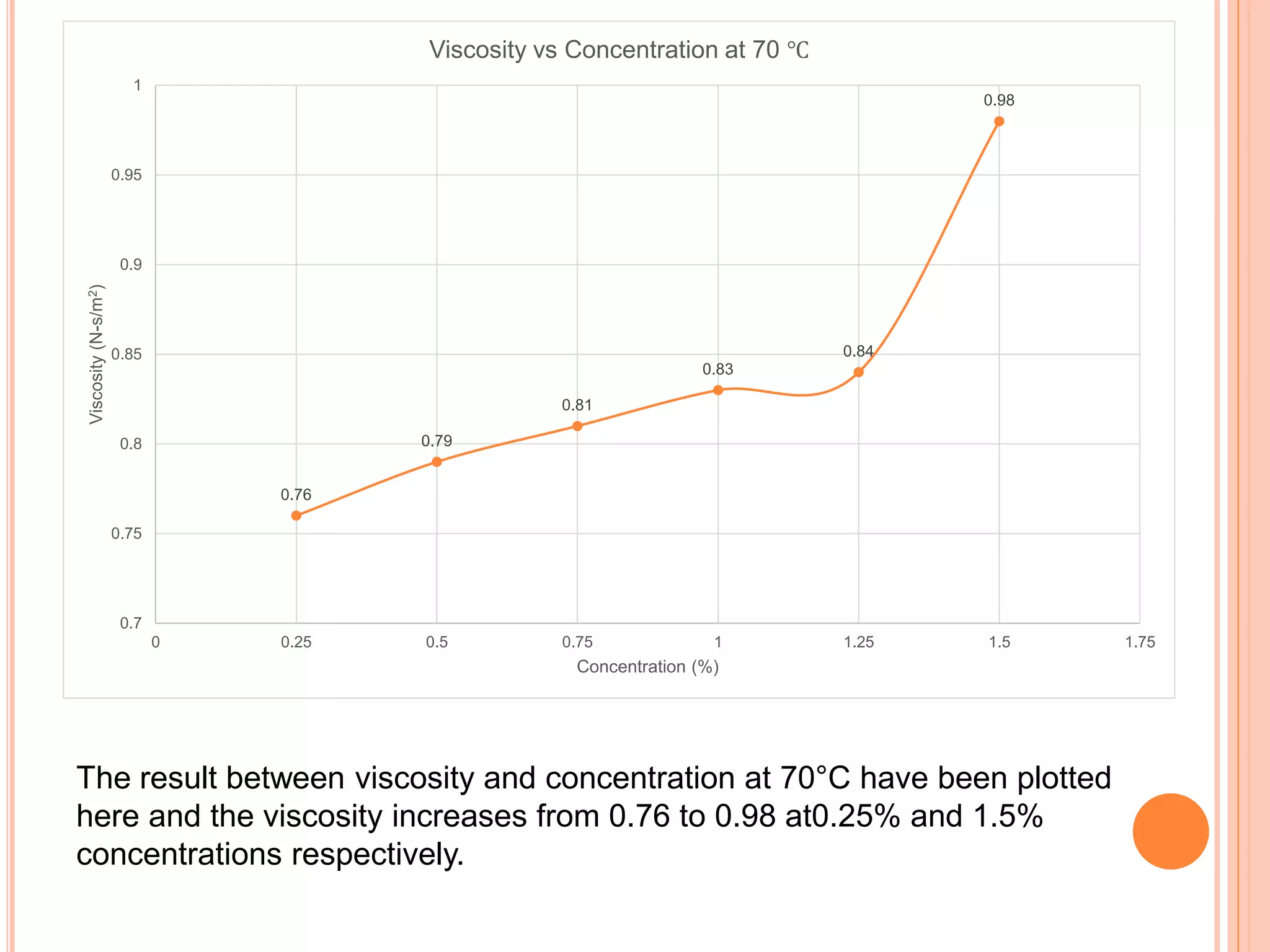
0.76
0.79
0.81
0.83
0.84
0.98
0.7
0.75
0.8
0.85
0.9
0.95
1
0 0.25 0.5 0.75 1 1.25 1.5 1.75
Viscosity(N-s/m2)
Concentration (%)
Viscosity vs Concentration at 70 ℃
The result between viscosity and concentration at 70°C have been plotted
here and the viscosity increases from 0.76 to 0.98 at0.25% and 1.5%
concentrations respectively.
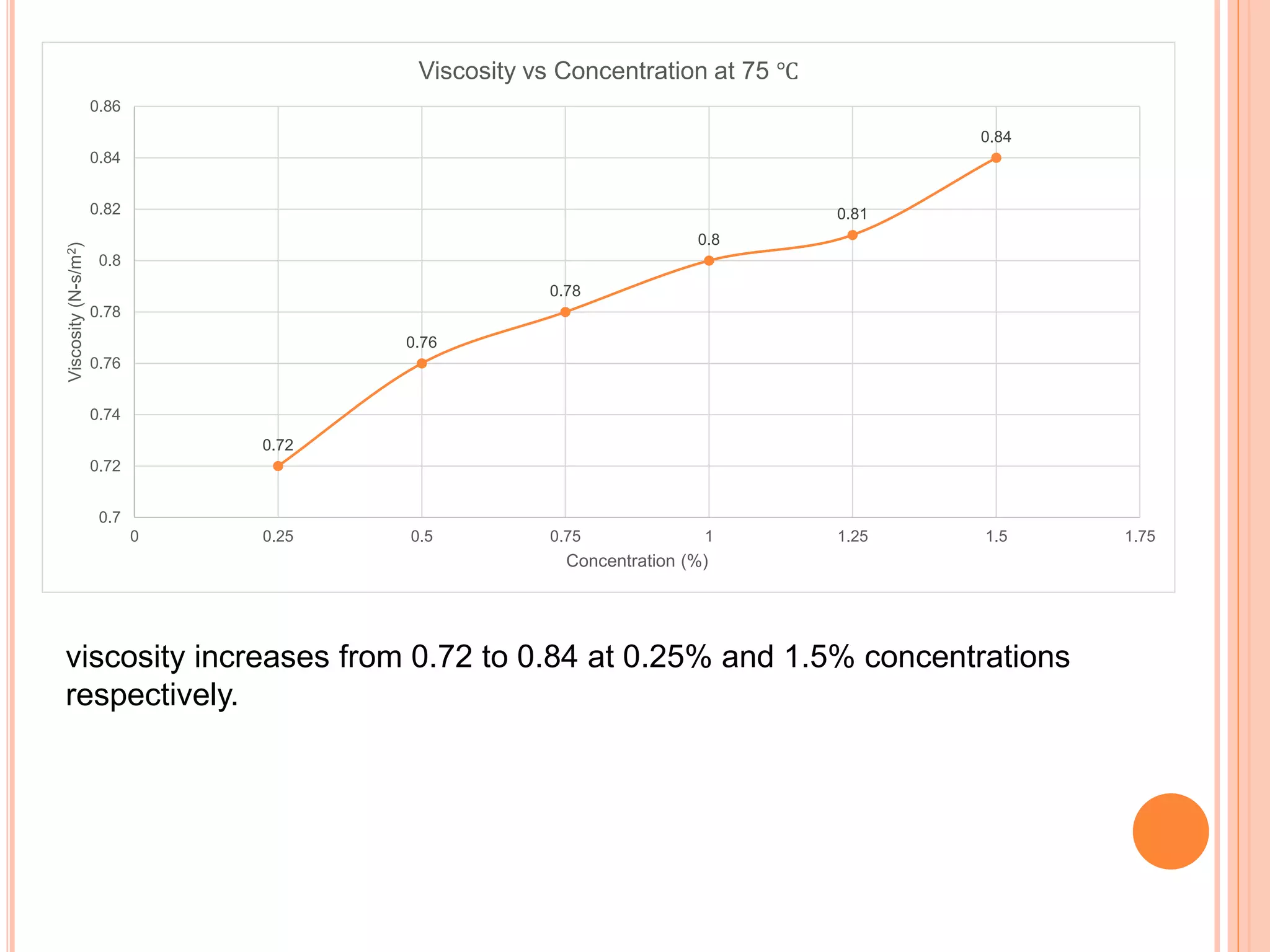
0.72
0.76
0.78
0.8
0.81
0.84
0.7
0.72
0.74
0.76
0.78
0.8
0.82
0.84
0.86
0 0.25 0.5 0.75 1 1.25 1.5 1.75
Viscosity(N-s/m2)
Concentration (%)
Viscosity vs Concentration at 75 ℃
viscosity increases from 0.72 to 0.84 at 0.25% and 1.5% concentrations
respectively.
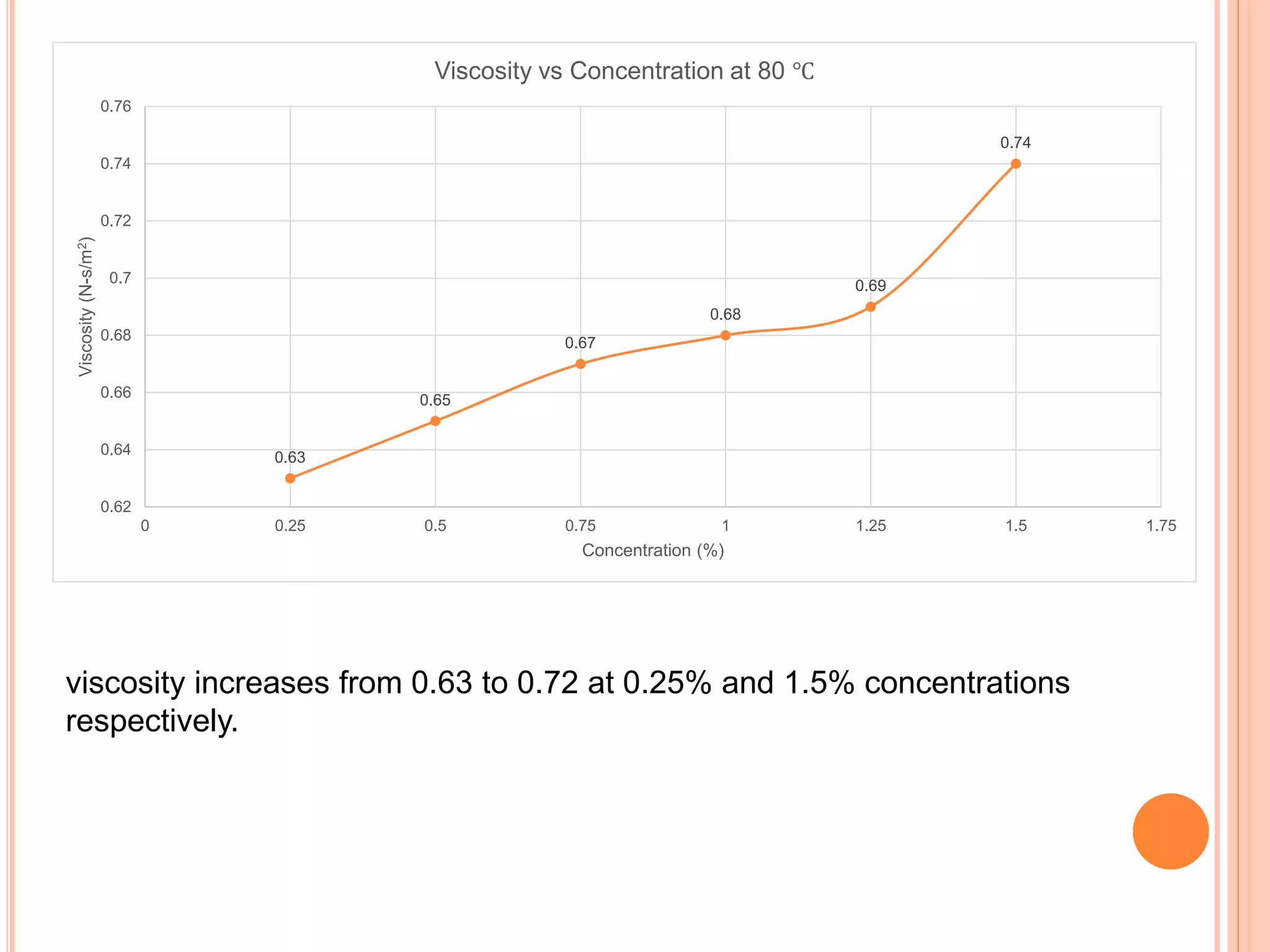
0.63
0.65
0.67
0.68
0.69
0.74
0.62
0.64
0.66
0.68
0.7
0.72
0.74
0.76
0 0.25 0.5 0.75 1 1.25 1.5 1.75
Viscosity(N-s/m2)
Concentration (%)
Viscosity vs Concentration at 80 ℃
viscosity increases from 0.63 to 0.72 at 0.25% and 1.5% concentrations
respectively.
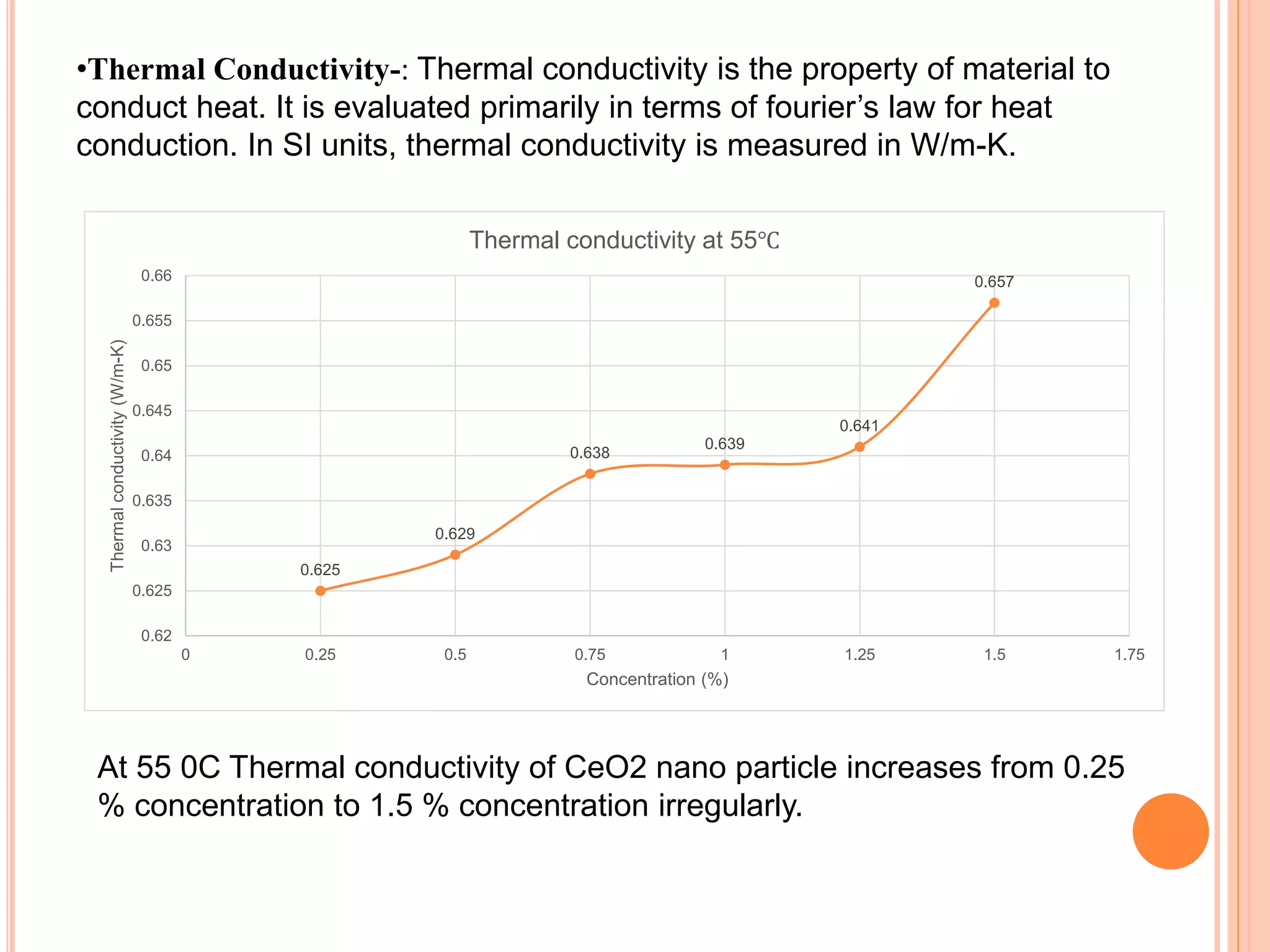
0.625
0.629
0.638
0.639
0.641
0.657
0.62
0.625
0.63
0.635
0.64
0.645
0.65
0.655
0.66
0 0.25 0.5 0.75 1 1.25 1.5 1.75
Thermalconductivity(W/m-K)
Concentration (%)
Thermal conductivity at 55℃
•Thermal Conductivity-: Thermal conductivity is the property of material to
conduct heat. It is evaluated primarily in terms of fourier’s law for heat
conduction. In SI units, thermal conductivity is measured in W/m-K.
At 55 0C Thermal conductivity of CeO2 nano particle increases from 0.25
% concentration to 1.5 % concentration irregularly.
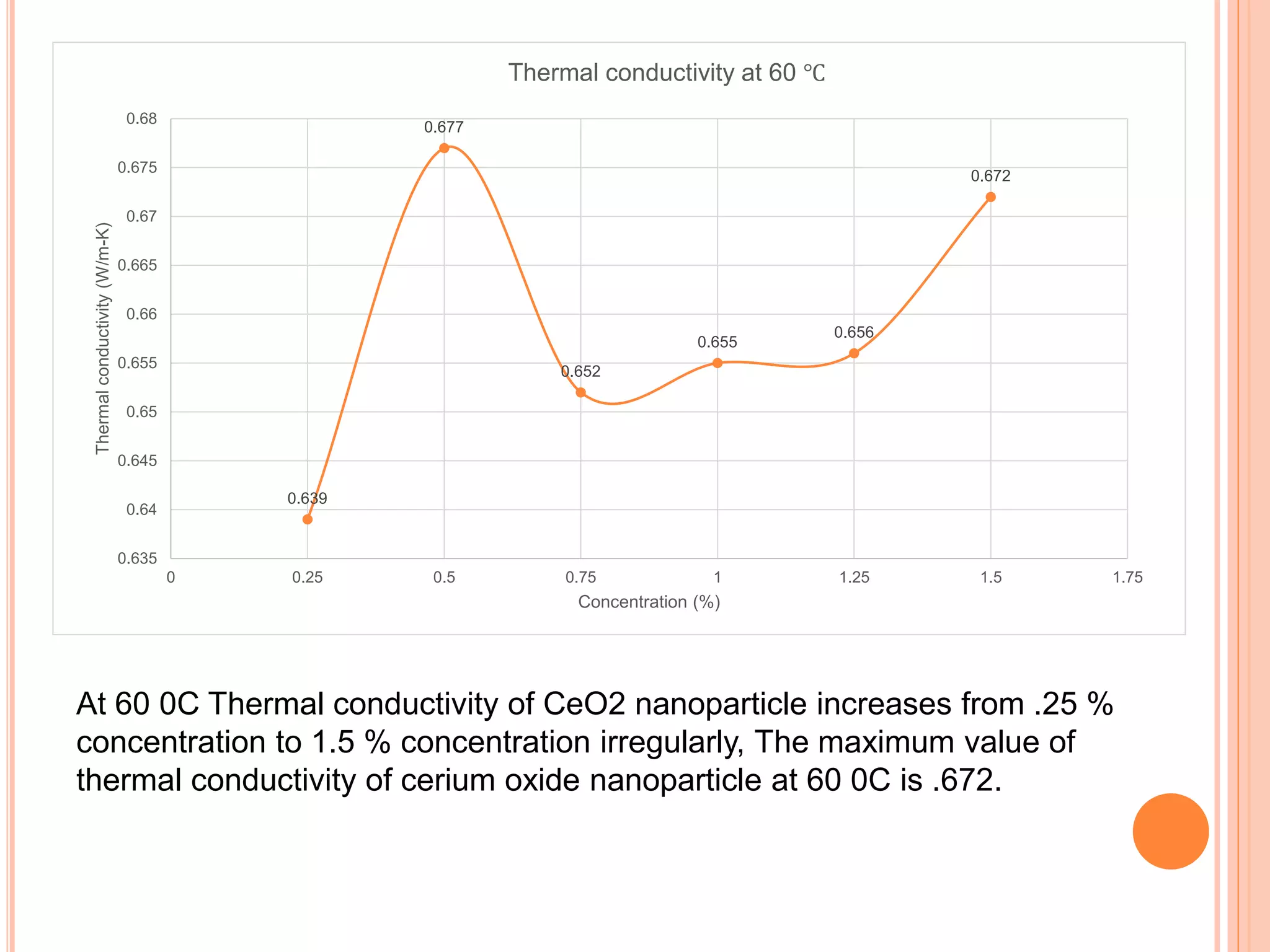
0.639
0.677
0.652
0.655
0.656
0.672
0.635
0.64
0.645
0.65
0.655
0.66
0.665
0.67
0.675
0.68
0 0.25 0.5 0.75 1 1.25 1.5 1.75
Thermalconductivity(W/m-K)
Concentration (%)
Thermal conductivity at 60 ℃
At 60 0C Thermal conductivity of CeO2 nanoparticle increases from .25 %
concentration to 1.5 % concentration irregularly, The maximum value of
thermal conductivity of cerium oxide nanoparticle at 60 0C is .672.
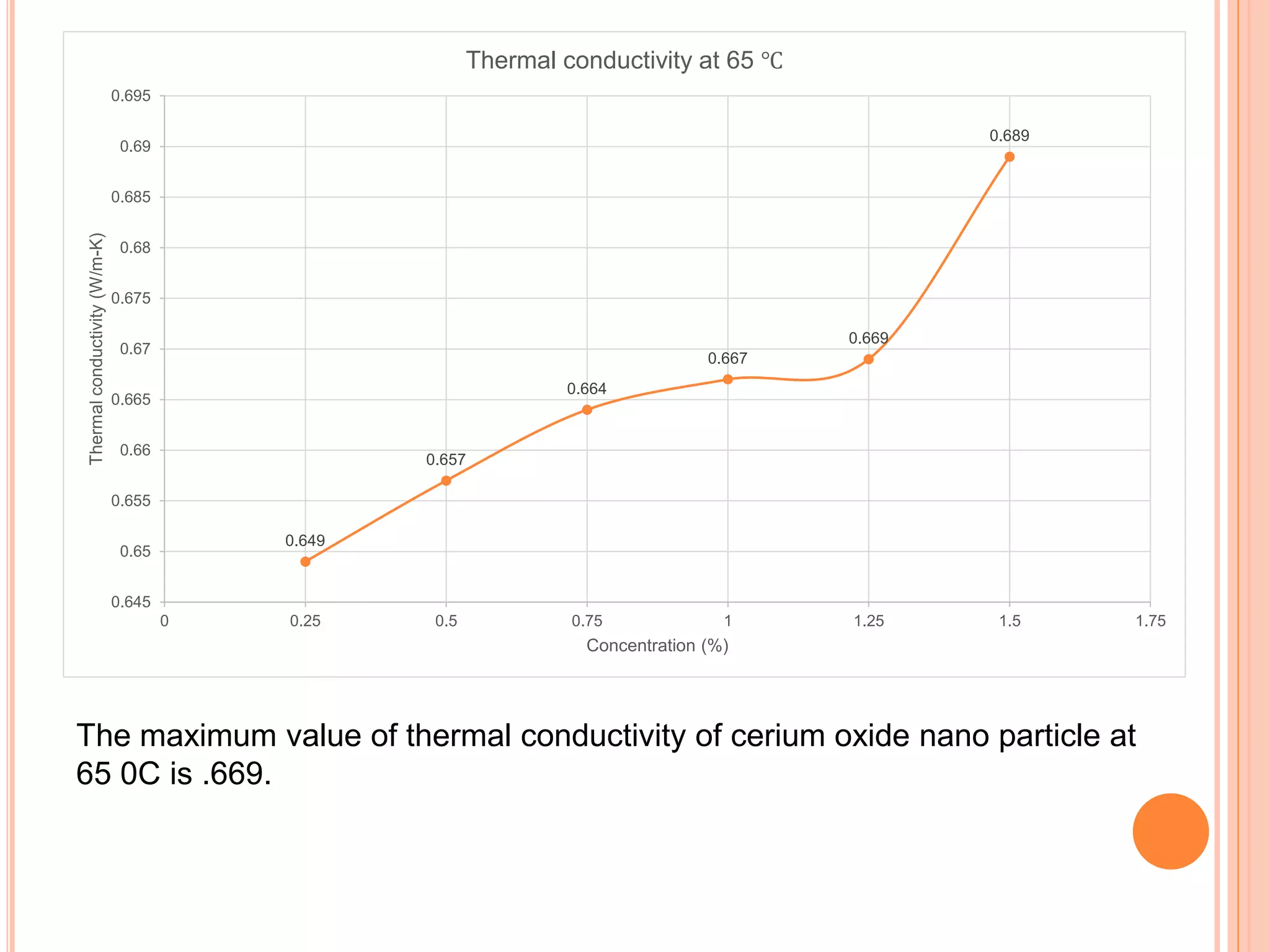
0.649
0.657
0.664
0.667
0.669
0.689
0.645
0.65
0.655
0.66
0.665
0.67
0.675
0.68
0.685
0.69
0.695
0 0.25 0.5 0.75 1 1.25 1.5 1.75
Thermalconductivity(W/m-K)
Concentration (%)
Thermal conductivity at 65 ℃
The maximum value of thermal conductivity of cerium oxide nano particle at
65 0C is .669.
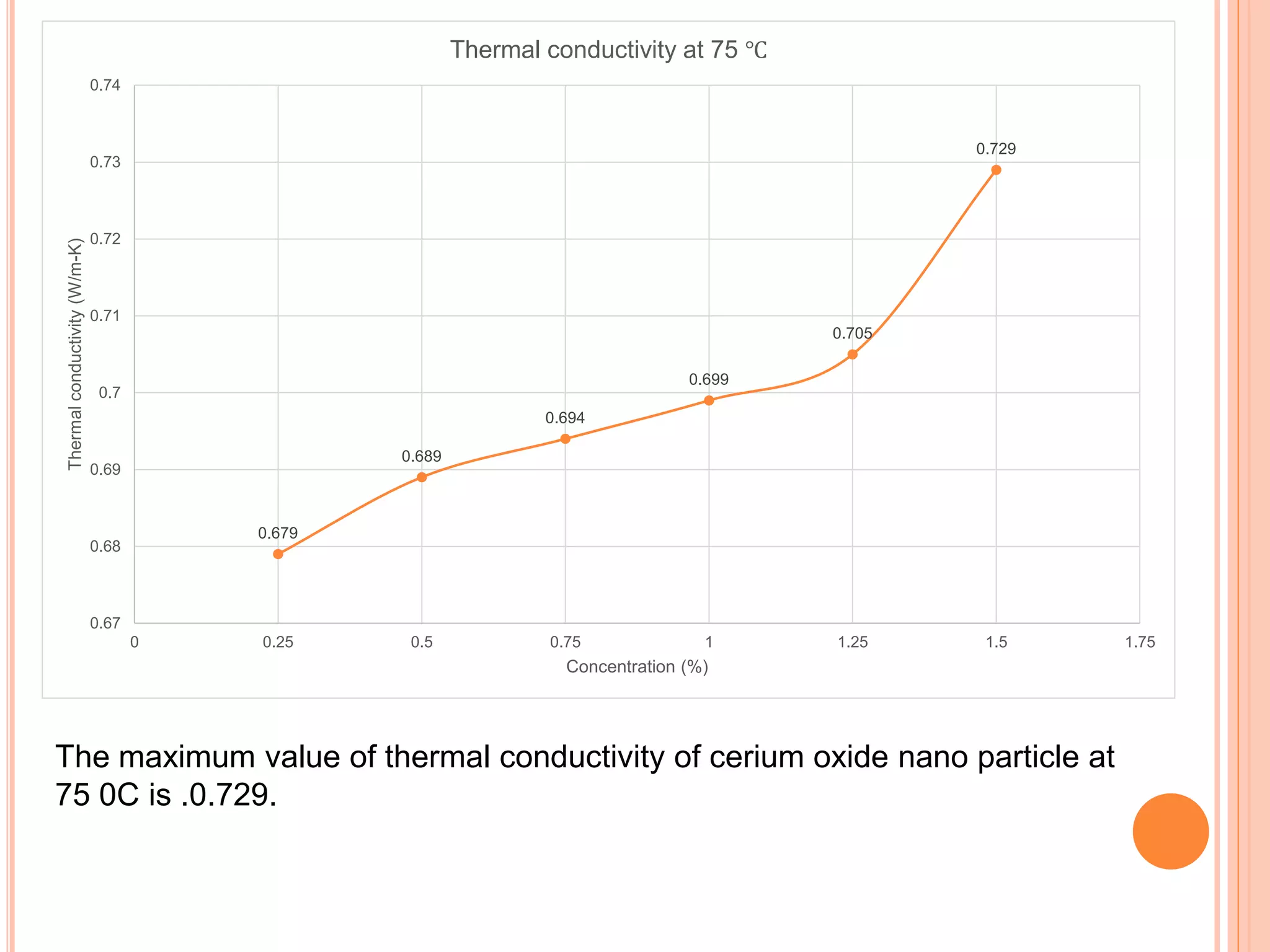
0.679
0.689
0.694
0.699
0.705
0.729
0.67
0.68
0.69
0.7
0.71
0.72
0.73
0.74
0 0.25 0.5 0.75 1 1.25 1.5 1.75
Thermalconductivity(W/m-K)
Concentration (%)
Thermal conductivity at 75 ℃
The maximum value of thermal conductivity of cerium oxide nano particle at
75 0C is .0.729.
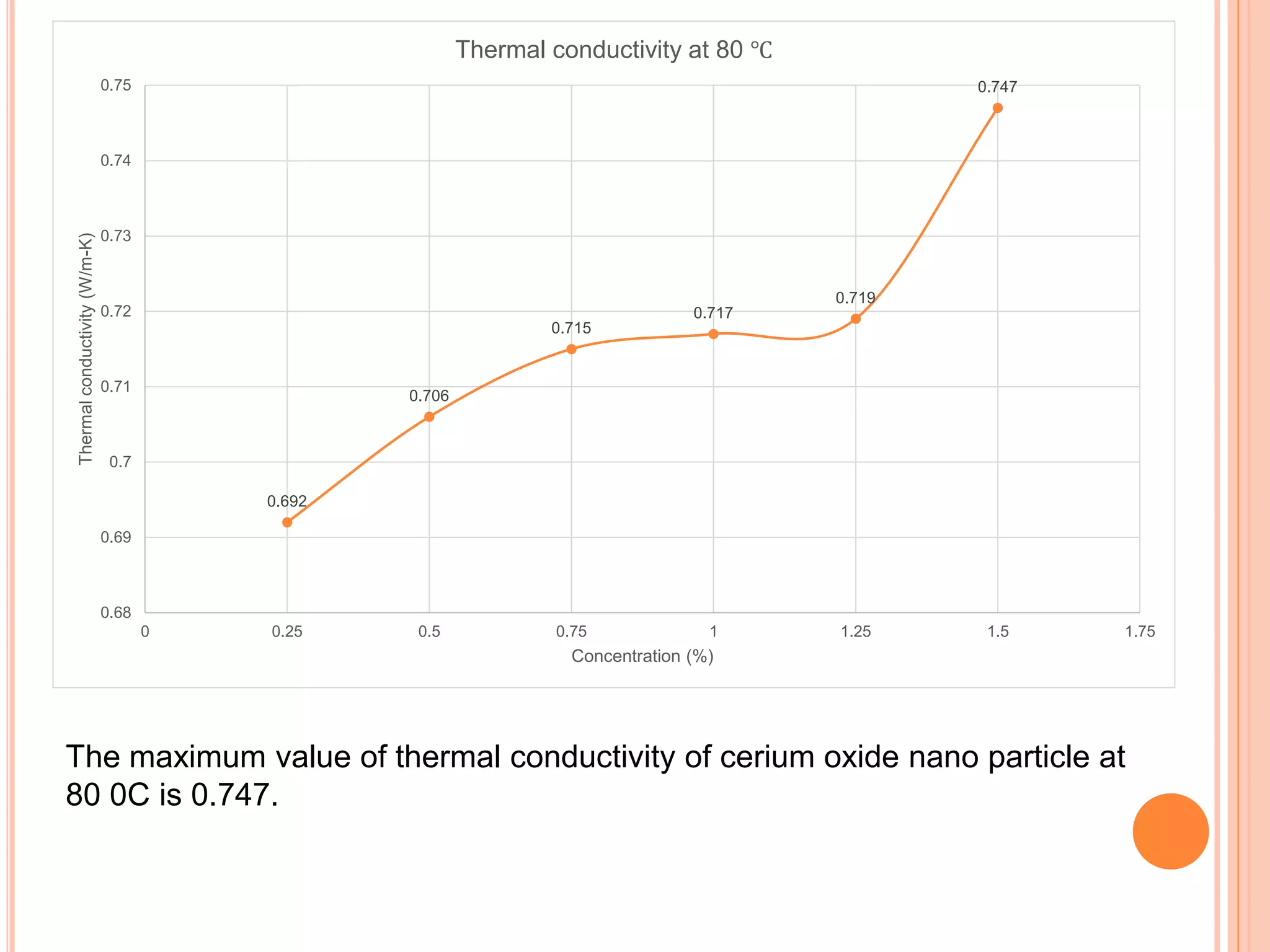
0.692
0.706
0.715
0.717
0.719
0.747
0.68
0.69
0.7
0.71
0.72
0.73
0.74
0.75
0 0.25 0.5 0.75 1 1.25 1.5 1.75
Thermalconductivity(W/m-K)
Concentration (%)
Thermal conductivity at 80 ℃
The maximum value of thermal conductivity of cerium oxide nano particle at
80 0C is 0.747.
3810
3774
3722
3653
3610
3526
3500
3550
3600
3650
3700
3750
3800
3850
0 0.25 0.5 0.75 1 1.25 1.5 1.75
SpecificHeat(J/Kg-K)
Concentration (%)
Specific Heat at 60 ℃
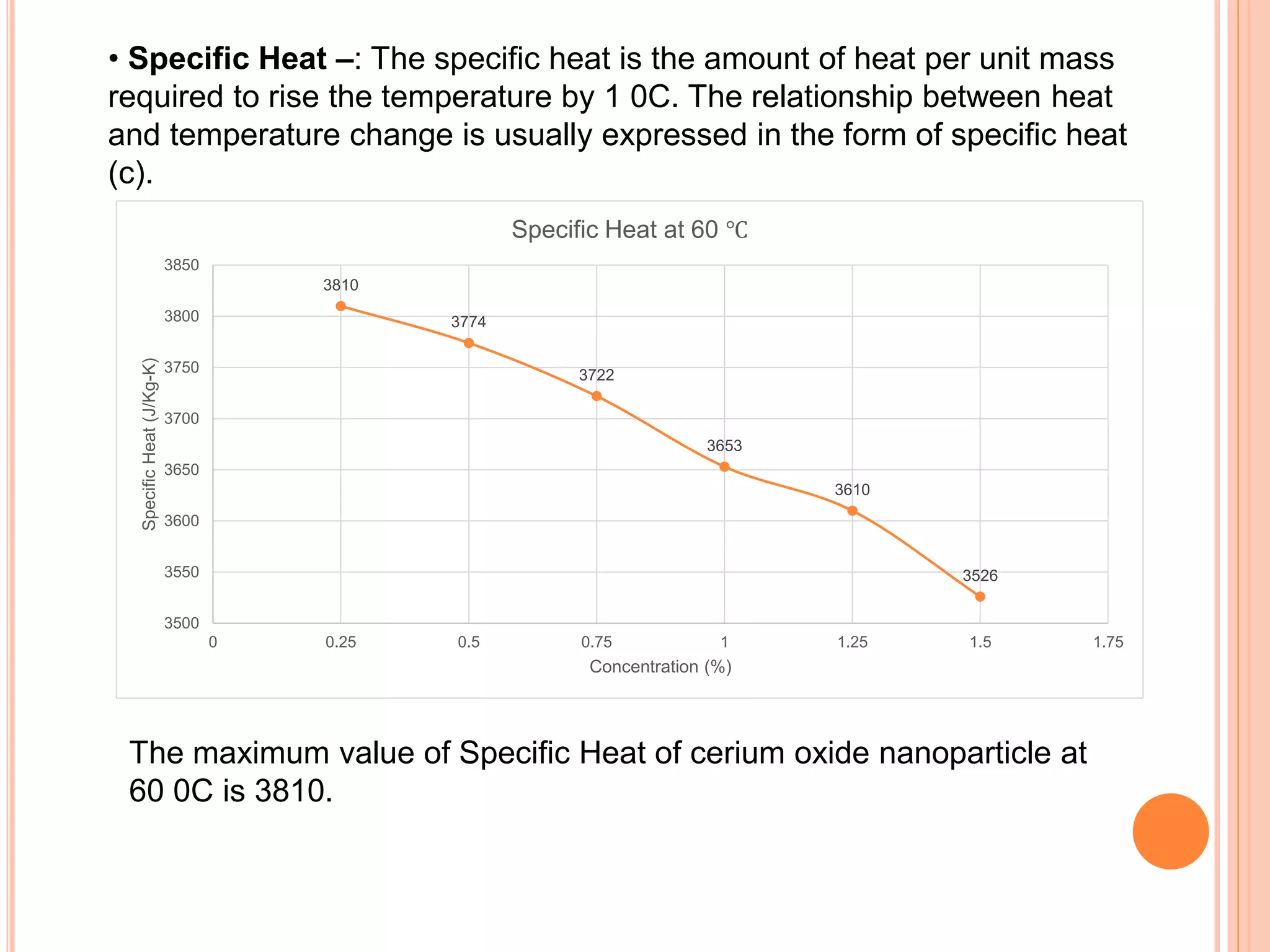
• Specific Heat –: The specific heat is the amount of heat per unit mass
required to rise the temperature by 1 0C. The relationship between heat
and temperature change is usually expressed in the form of specific heat
(c).
The maximum value of Specific Heat of cerium oxide nanoparticle at
60 0C is 3810.
3844
3792
3754
3998
3654
3545
3500
3550
3600
3650
3700
3750
3800
3850
3900
3950
4000
4050
0 0.25 0.5 0.75 1 1.25 1.5 1.75
SpecificHeat(J/Kg-K)
Concentration (%)
Specific Heat at 65 ℃
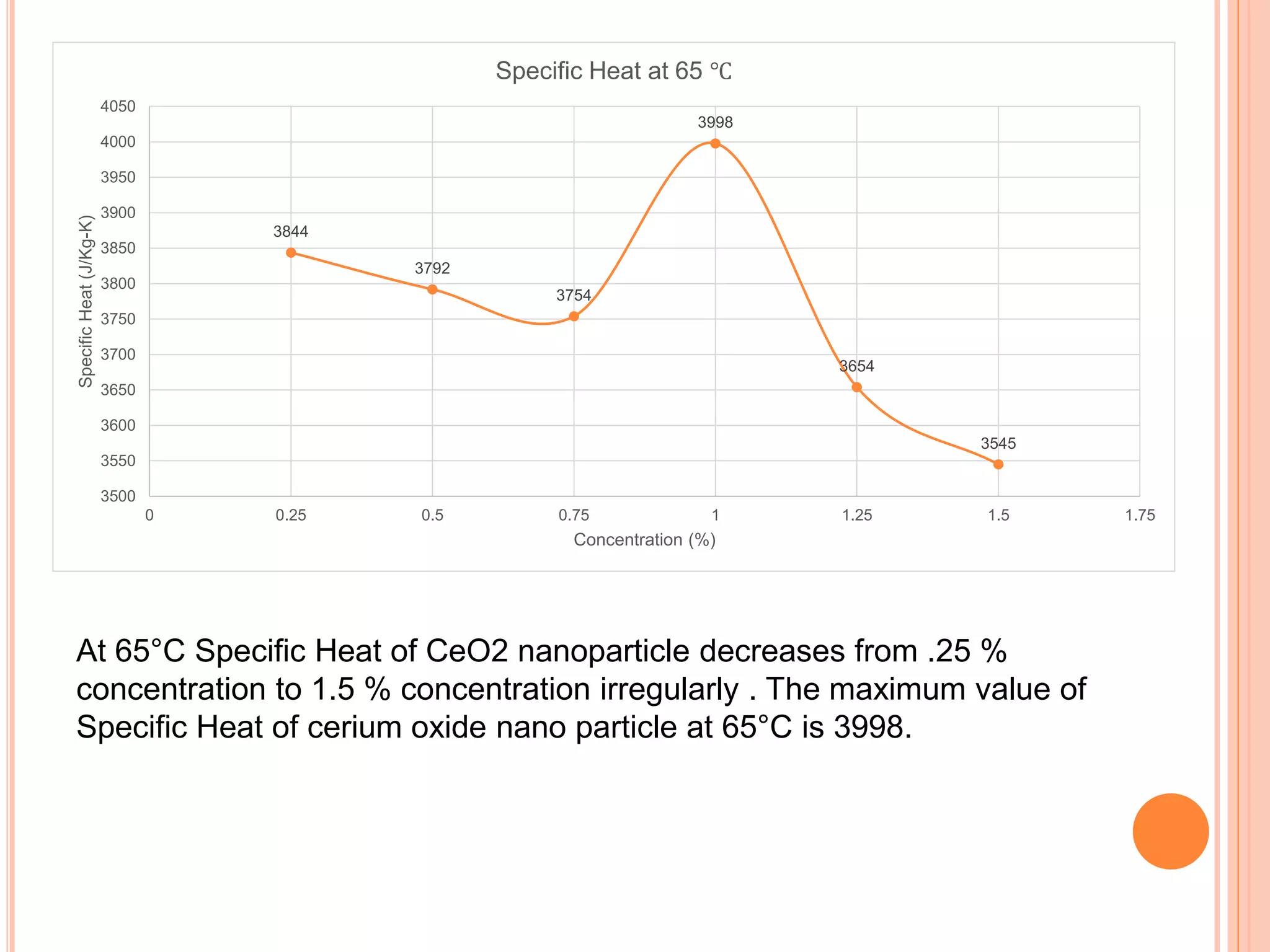
At 65°C Specific Heat of CeO2 nanoparticle decreases from .25 %
concentration to 1.5 % concentration irregularly . The maximum value of
Specific Heat of cerium oxide nano particle at 65°C is 3998.
3863
3810
3794
3723
3699
3577
3550
3600
3650
3700
3750
3800
3850
3900
0 0.25 0.5 0.75 1 1.25 1.5 1.75
SpecificHeat(J/Kg-K)
Concentration (%)
Specific Heat at 70 ℃
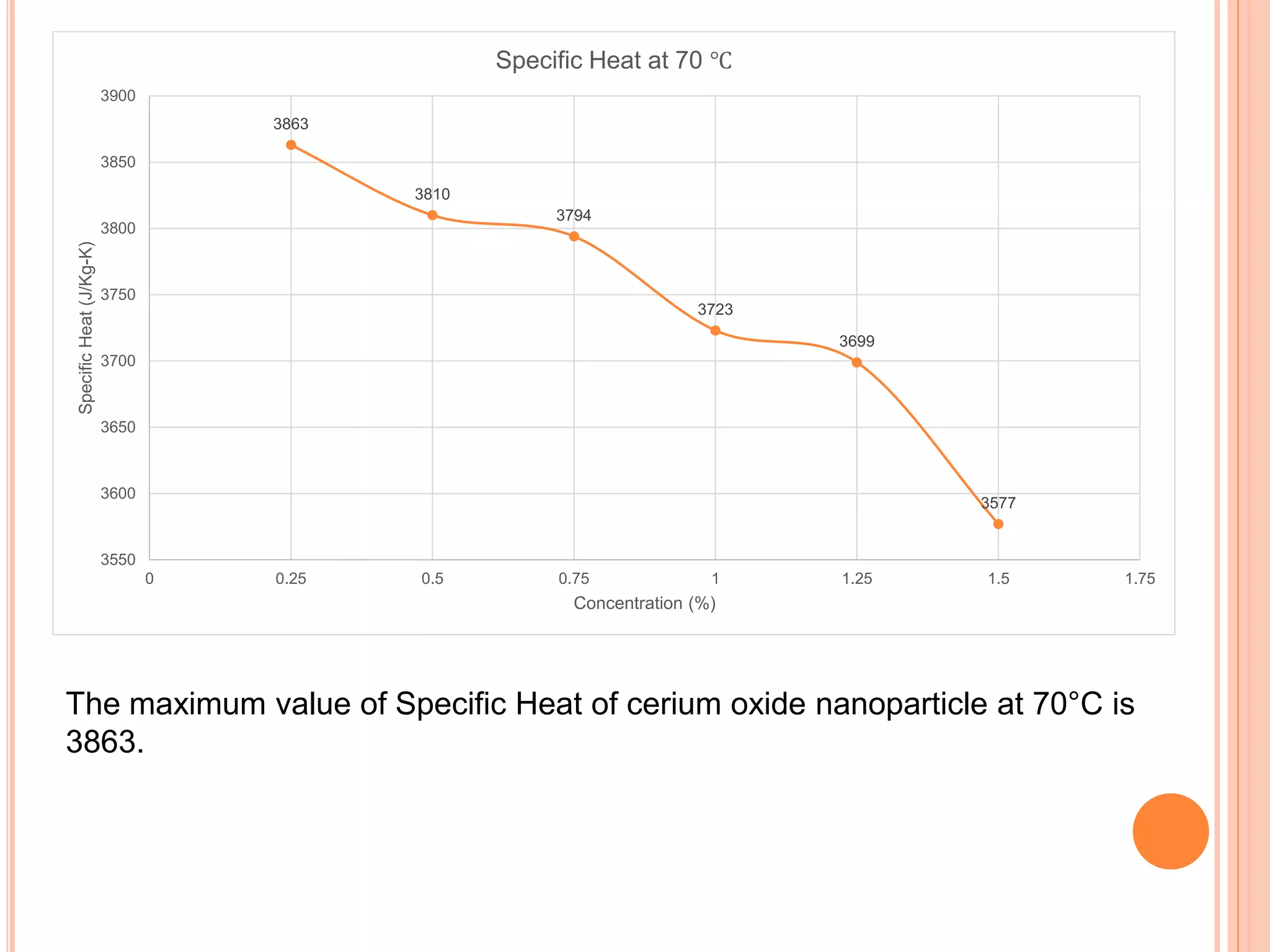
The maximum value of Specific Heat of cerium oxide nanoparticle at 70°C is
3863.
3895
3832
3808
3761
3709
3599
3550
3600
3650
3700
3750
3800
3850
3900
3950
0 0.25 0.5 0.75 1 1.25 1.5 1.75
SpecificHeat(J/Kg-K)
Concentration (%)
Specific Heat at 75 ℃
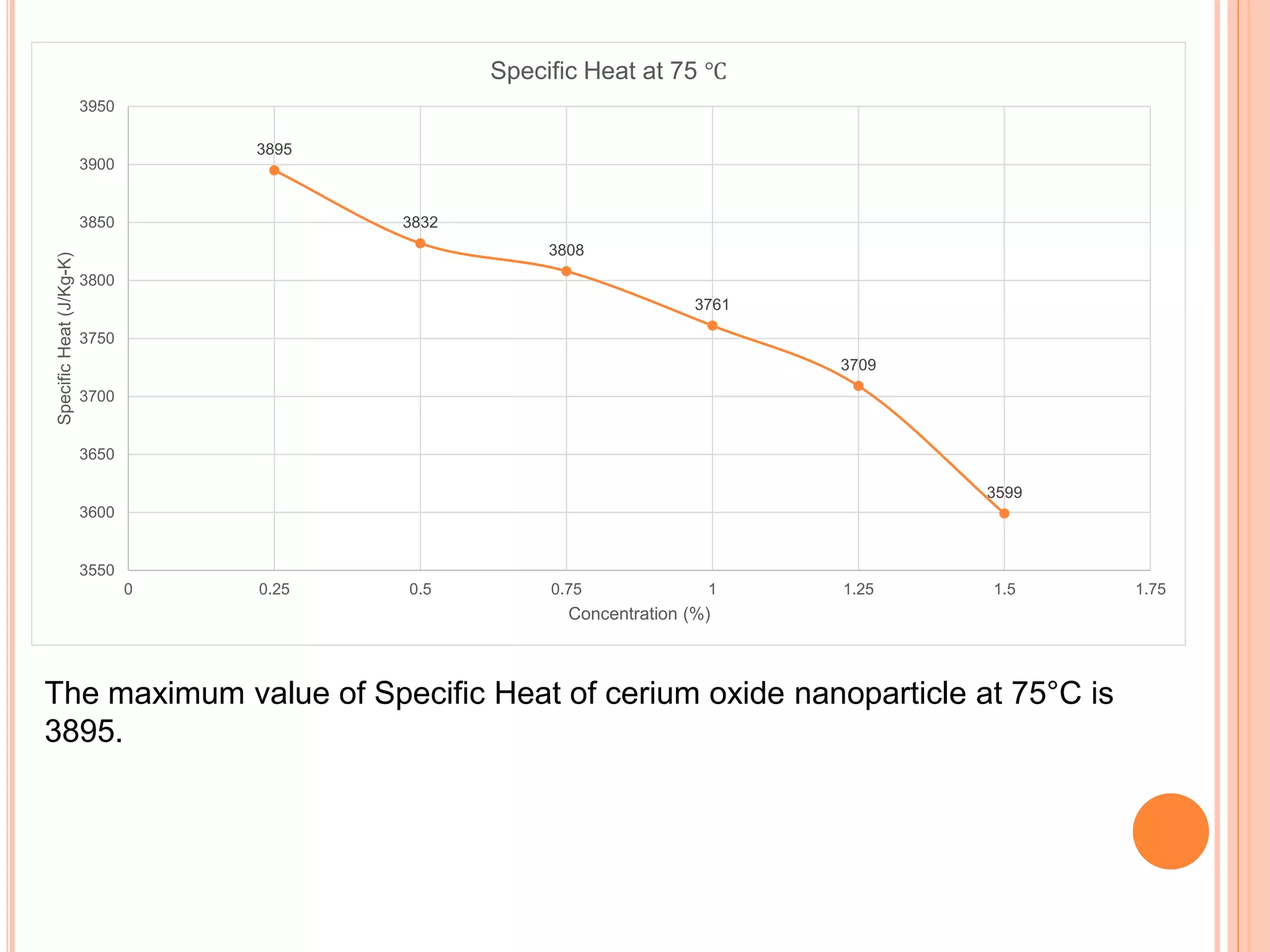
The maximum value of Specific Heat of cerium oxide nanoparticle at 75°C is
3895.
3930
3864
3824
3809
3754
3616
3600
3650
3700
3750
3800
3850
3900
3950
0 0.25 0.5 0.75 1 1.25 1.5 1.75
SpecificHeat(J/Kg-K)
Concentration (%)
Specific Heat at 80 ℃
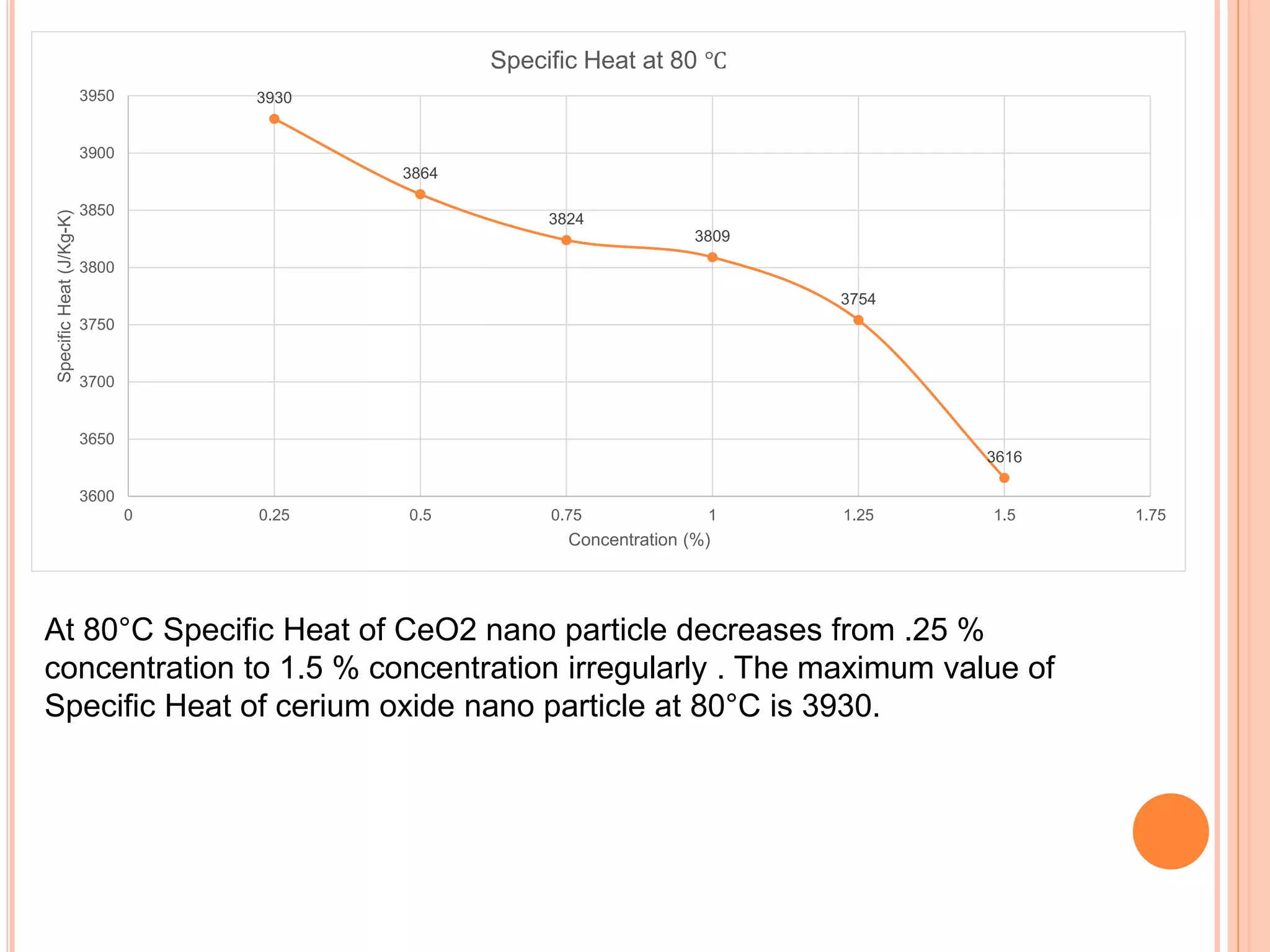
At 80°C Specific Heat of CeO2 nano particle decreases from .25 %
concentration to 1.5 % concentration irregularly . The maximum value of
Specific Heat of cerium oxide nano particle at 80°C is 3930.
3945
3879
3867
3845
3799
3670
3650
3700
3750
3800
3850
3900
3950
4000
0 0.25 0.5 0.75 1 1.25 1.5 1.75
SpecificHeat(J/Kg-K)
Concentration (%)
Specific Heat at 85 ℃
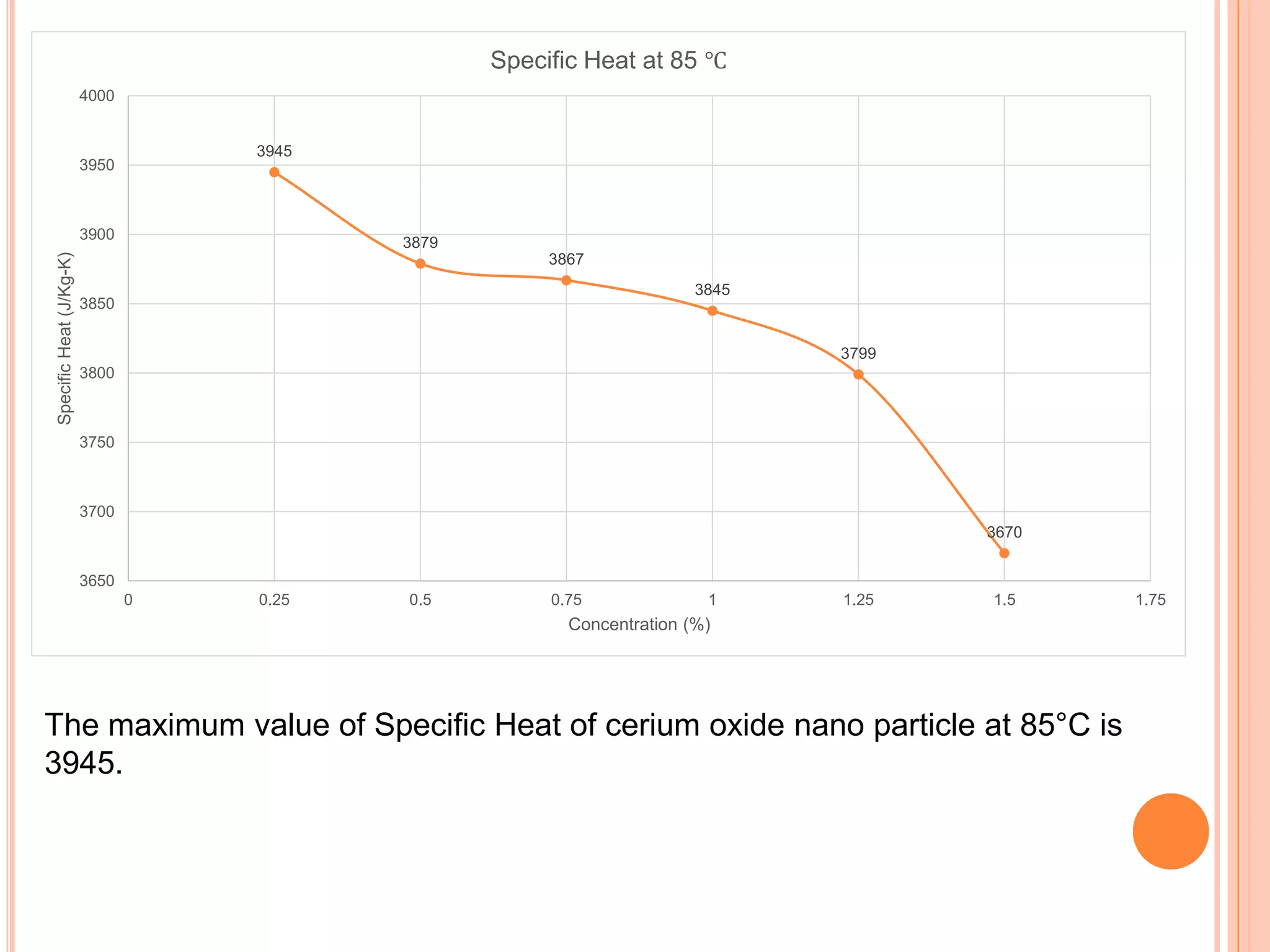
The maximum value of Specific Heat of cerium oxide nano particle at 85°C is
3945.
0.706
0.697
0.684
0.679
0.675
0.68
0.685
0.69
0.695
0.7
0.705
0.71
0 10 20 30 40 50
Thermalconductivity(w/mk)
Particle size(in nm)
0.25% Concentration at 50℃
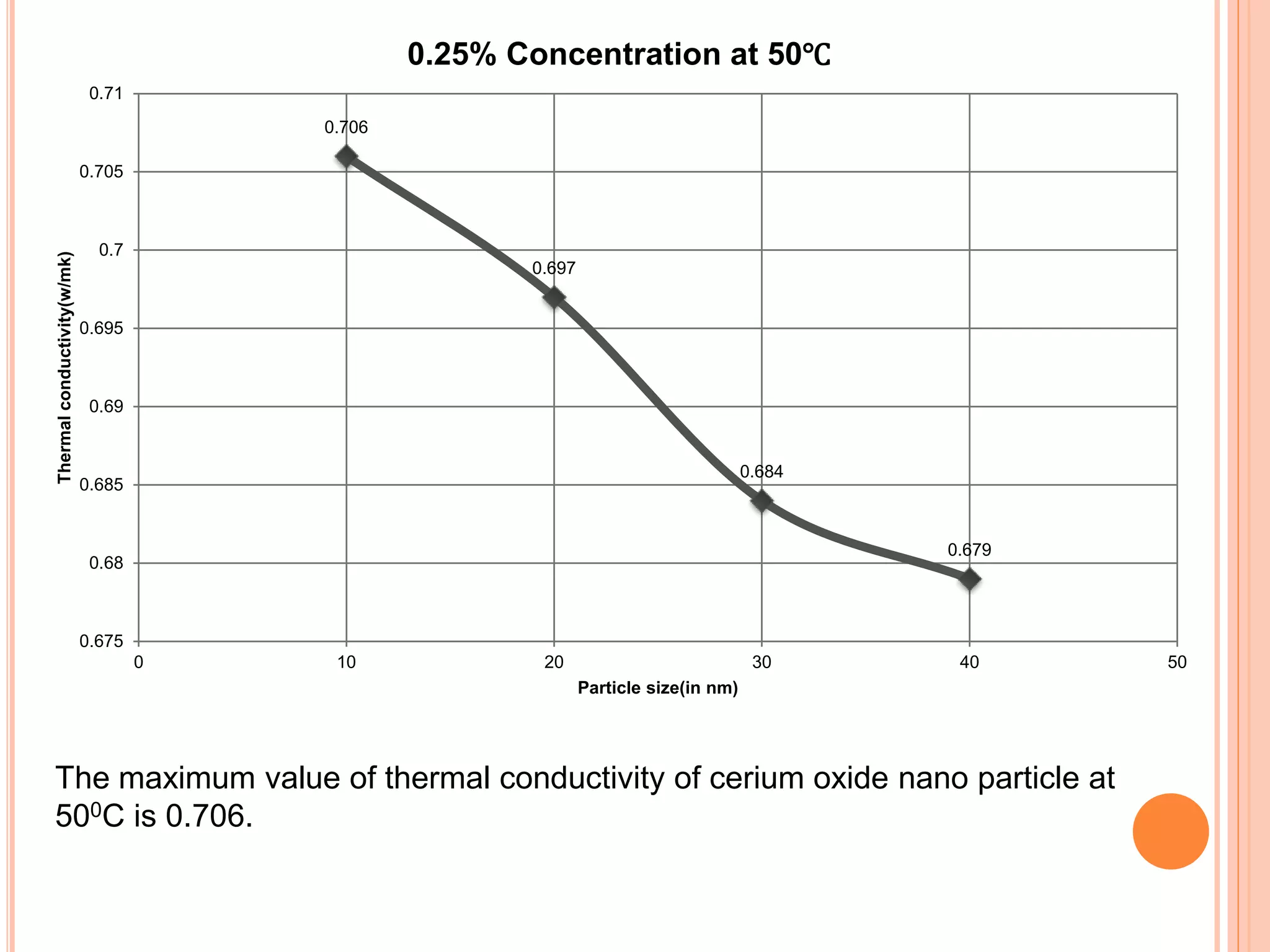
The maximum value of thermal conductivity of cerium oxide nano particle at
500C is 0.706.
0.711
0.701
0.69
0.682
0.68
0.685
0.69
0.695
0.7
0.705
0.71
0.715
0 10 20 30 40 50
Thermalconductivity(w/mk)
Particle size(in nm)
0.5% Concentration at 50℃
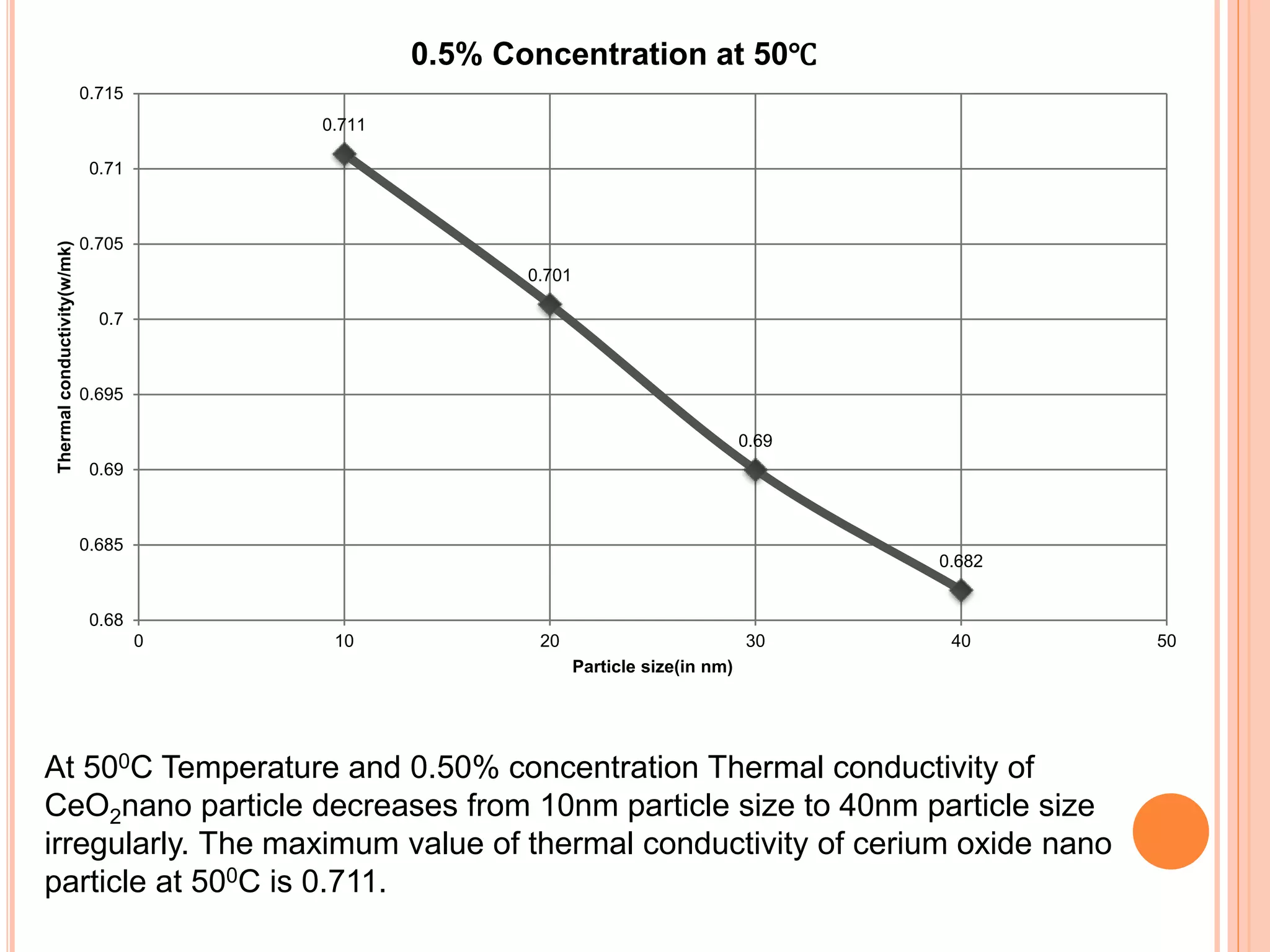
At 500C Temperature and 0.50% concentration Thermal conductivity of
CeO2nano particle decreases from 10nm particle size to 40nm particle size
irregularly. The maximum value of thermal conductivity of cerium oxide nano
particle at 500C is 0.711.
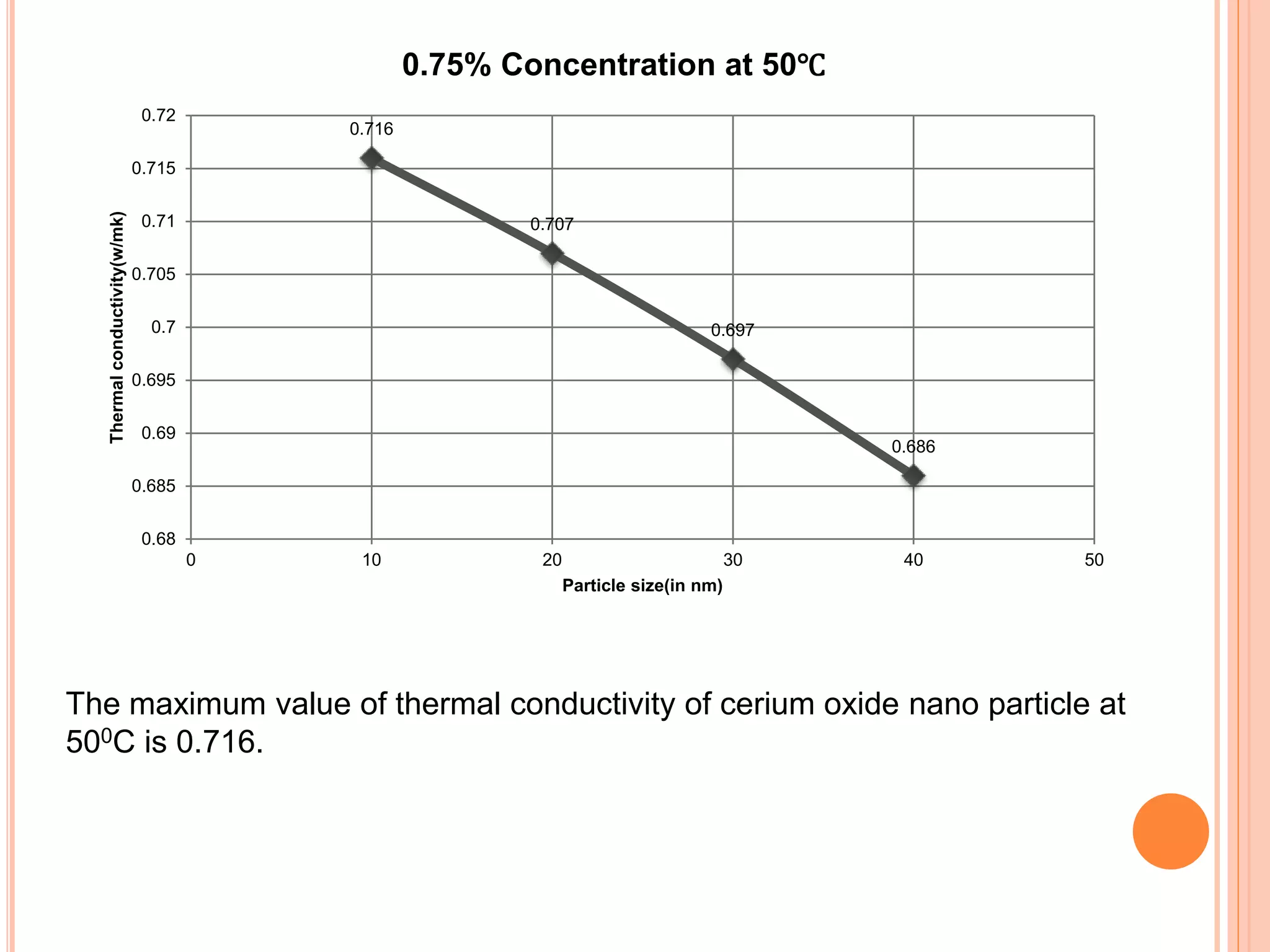
0.716
0.707
0.697
0.686
0.68
0.685
0.69
0.695
0.7
0.705
0.71
0.715
0.72
0 10 20 30 40 50
Thermalconductivity(w/mk)
Particle size(in nm)
0.75% Concentration at 50℃
The maximum value of thermal conductivity of cerium oxide nano particle at
500C is 0.716.
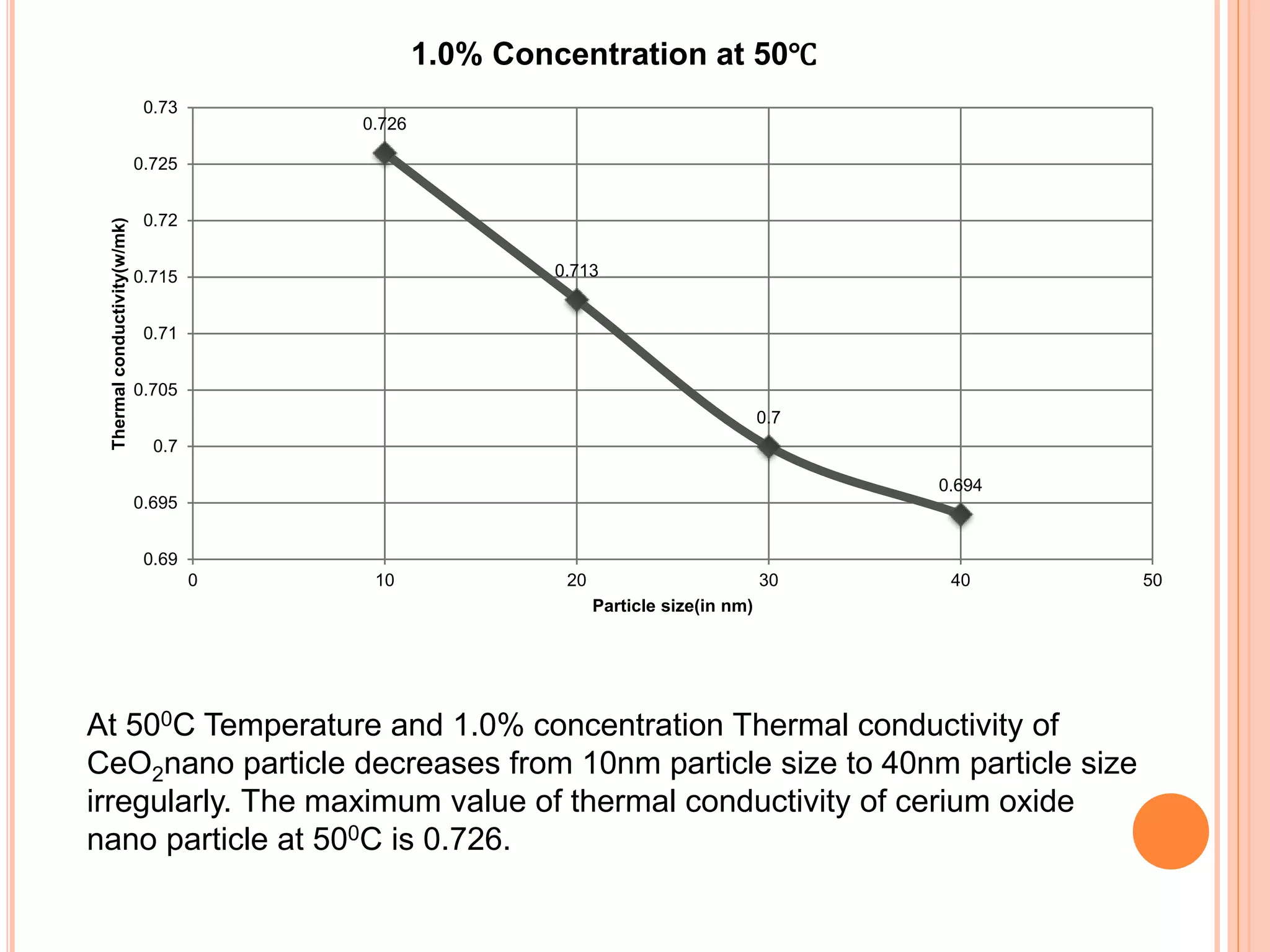
0.726
0.713
0.7
0.694
0.69
0.695
0.7
0.705
0.71
0.715
0.72
0.725
0.73
0 10 20 30 40 50
Thermalconductivity(w/mk)
Particle size(in nm)
1.0% Concentration at 50℃
At 500C Temperature and 1.0% concentration Thermal conductivity of
CeO2nano particle decreases from 10nm particle size to 40nm particle size
irregularly. The maximum value of thermal conductivity of cerium oxide
nano particle at 500C is 0.726.
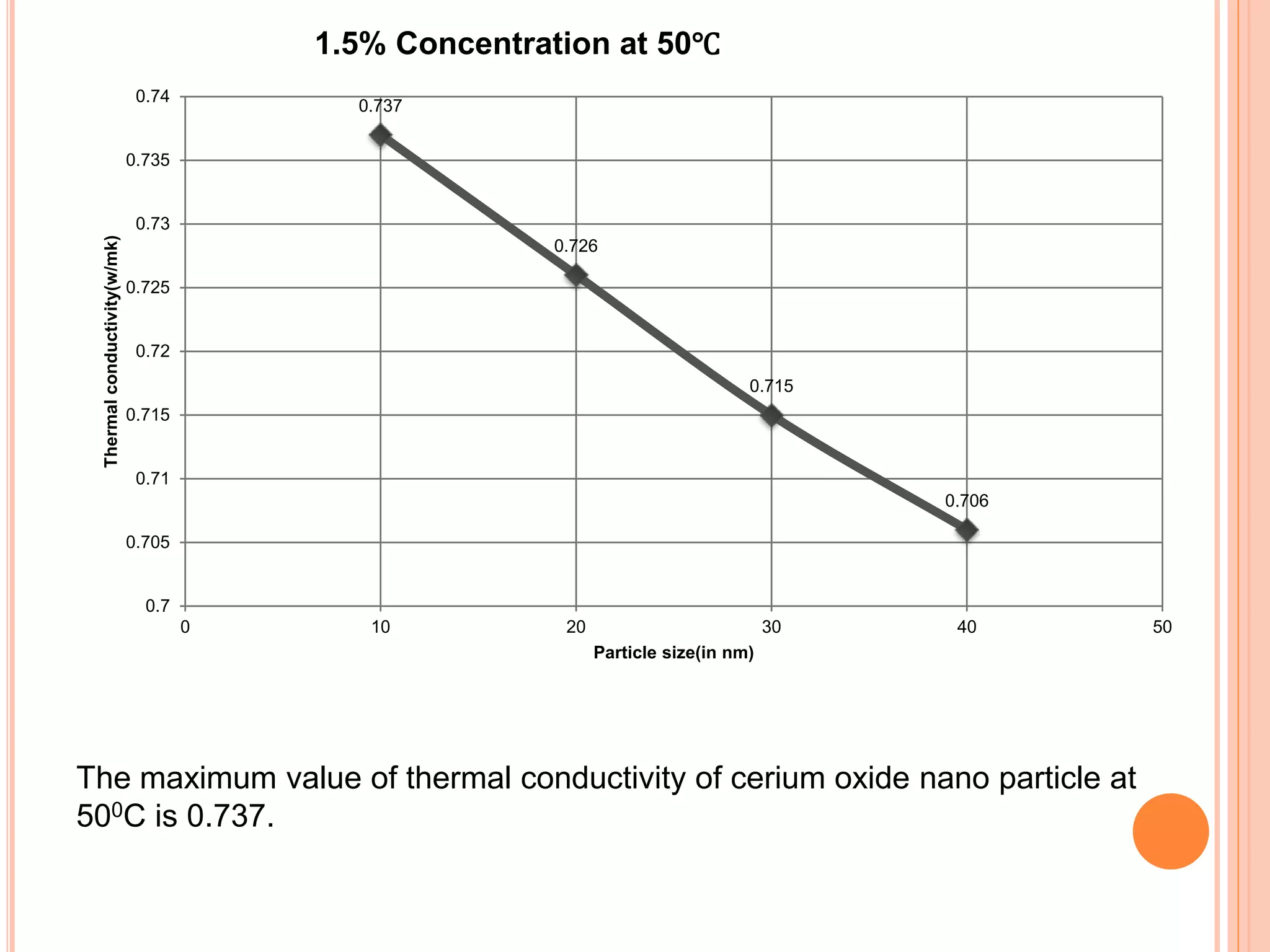
0.737
0.726
0.715
0.706
0.7
0.705
0.71
0.715
0.72
0.725
0.73
0.735
0.74
0 10 20 30 40 50
Thermalconductivity(w/mk)
Particle size(in nm)
1.5% Concentration at 50℃
The maximum value of thermal conductivity of cerium oxide nano particle at
500C is 0.737.
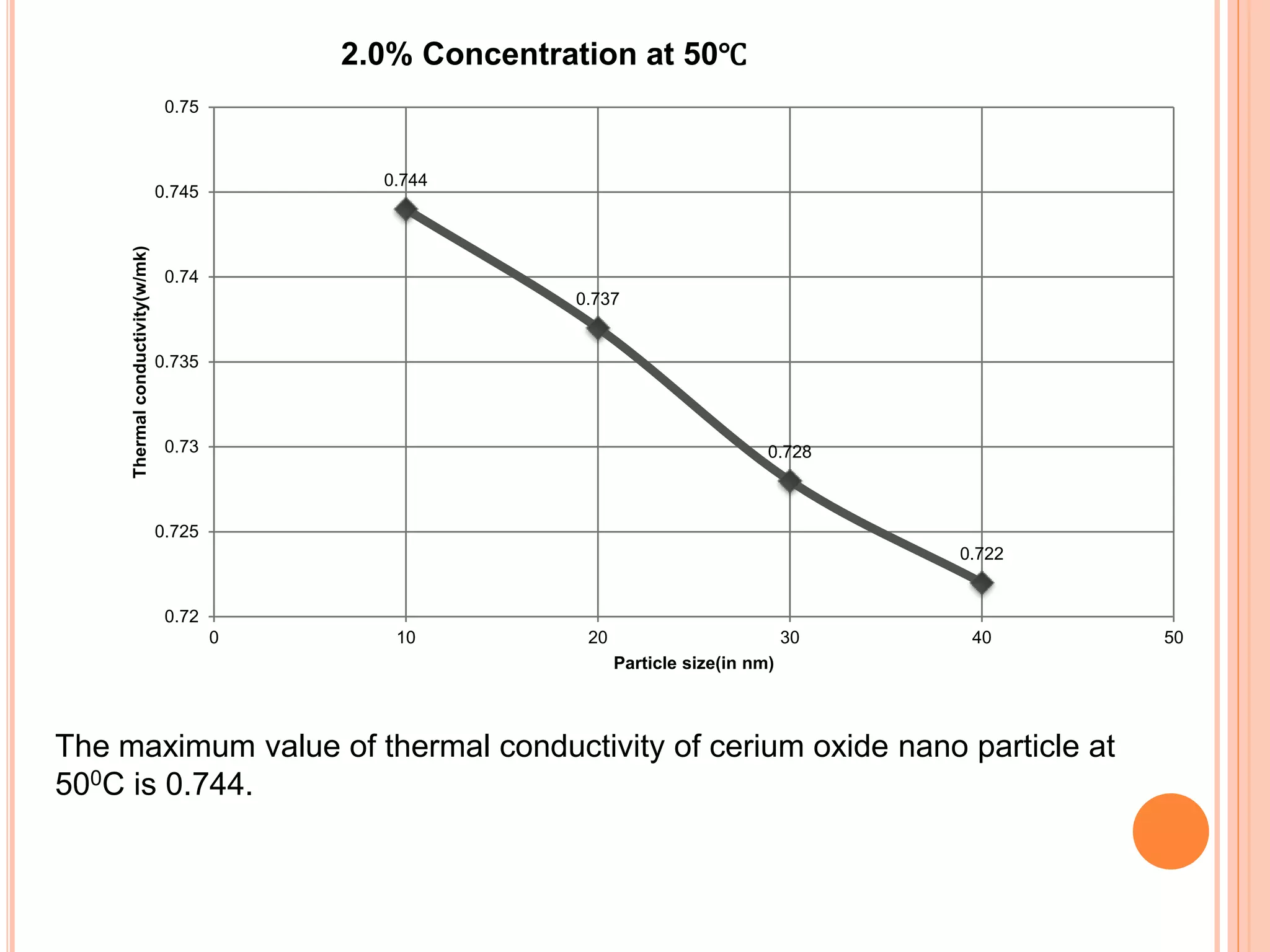
0.744
0.737
0.728
0.722
0.72
0.725
0.73
0.735
0.74
0.745
0.75
0 10 20 30 40 50
Thermalconductivity(w/mk)
Particle size(in nm)
2.0% Concentration at 50℃
The maximum value of thermal conductivity of cerium oxide nano particle at
500C is 0.744.
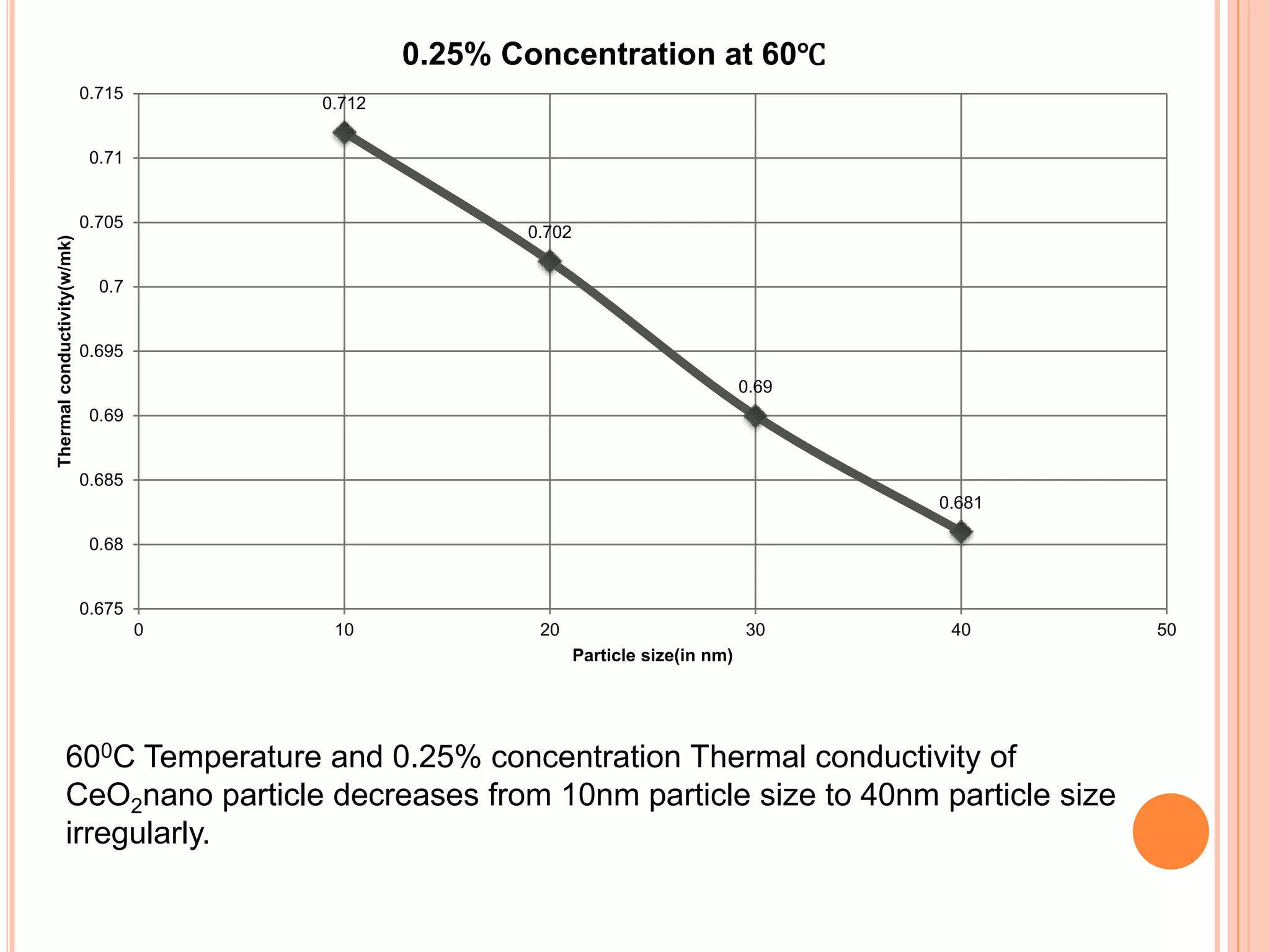
0.712
0.702
0.69
0.681
0.675
0.68
0.685
0.69
0.695
0.7
0.705
0.71
0.715
0 10 20 30 40 50
Thermalconductivity(w/mk)
Particle size(in nm)
0.25% Concentration at 60℃
600C Temperature and 0.25% concentration Thermal conductivity of
CeO2nano particle decreases from 10nm particle size to 40nm particle size
irregularly.
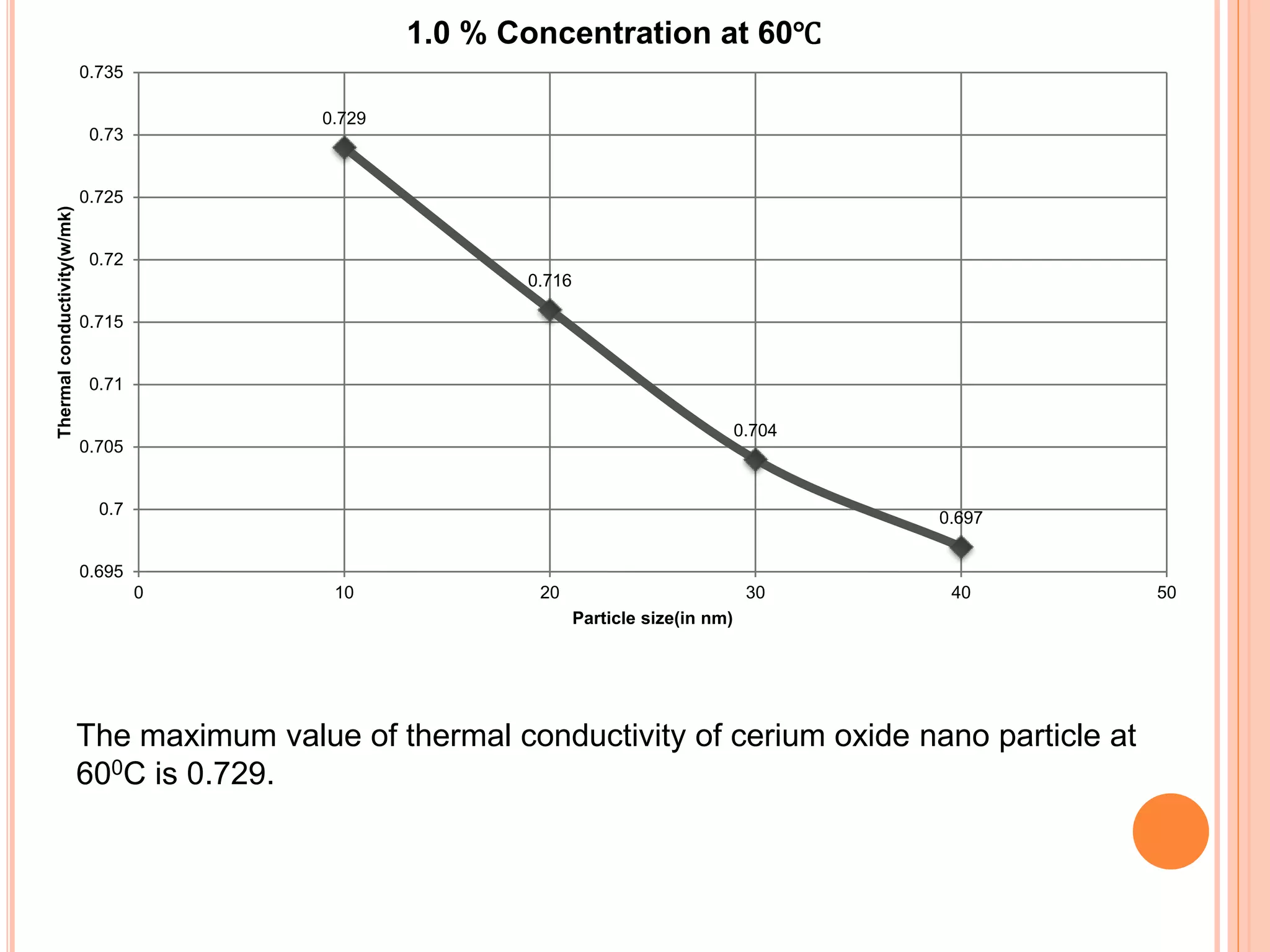
0.729
0.716
0.704
0.697
0.695
0.7
0.705
0.71
0.715
0.72
0.725
0.73
0.735
0 10 20 30 40 50
Thermalconductivity(w/mk)
Particle size(in nm)
1.0 % Concentration at 60℃
The maximum value of thermal conductivity of cerium oxide nano particle at
600C is 0.729.
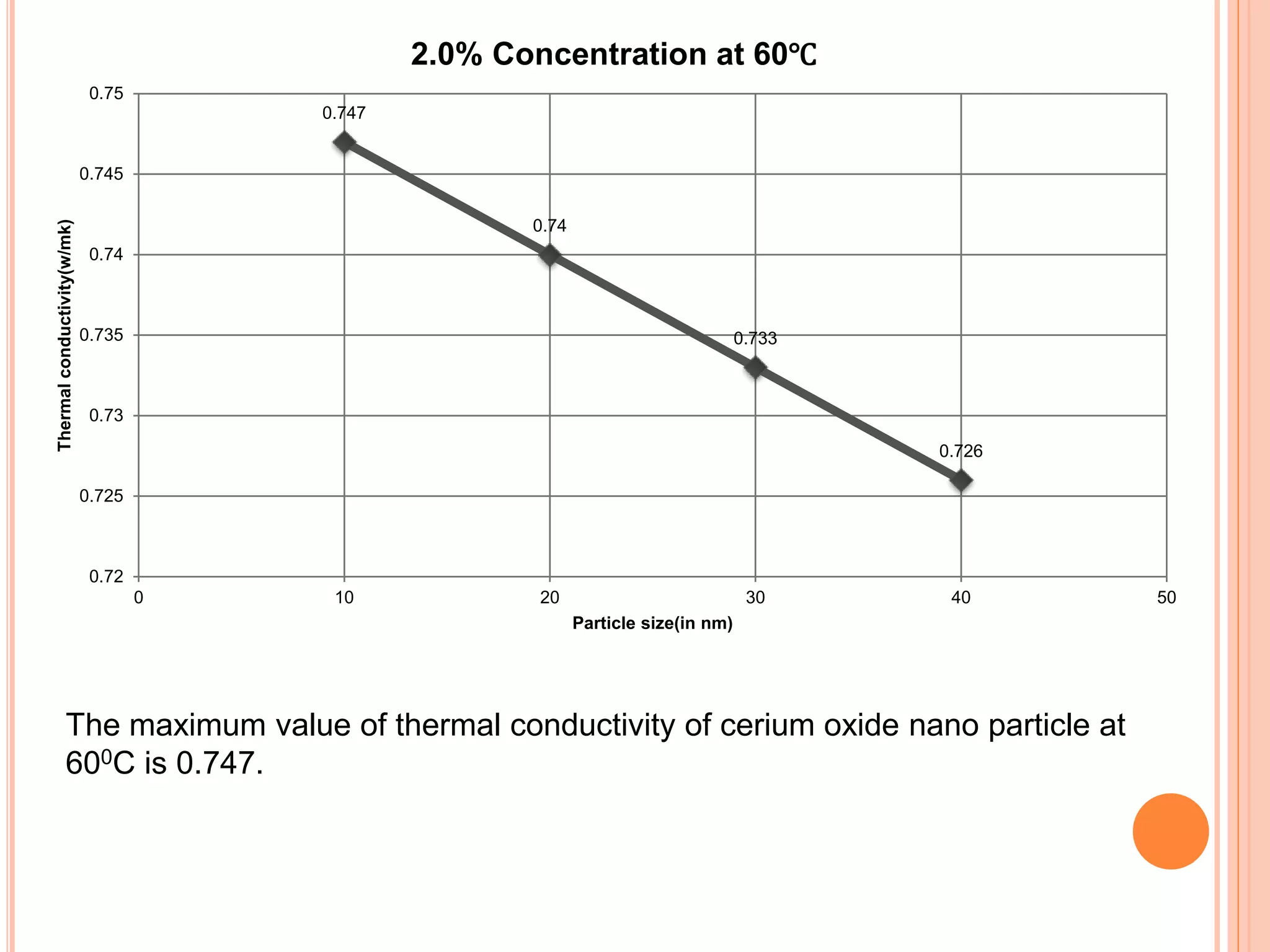
0.747
0.74
0.733
0.726
0.72
0.725
0.73
0.735
0.74
0.745
0.75
0 10 20 30 40 50
Thermalconductivity(w/mk)
Particle size(in nm)
2.0% Concentration at 60℃
The maximum value of thermal conductivity of cerium oxide nano particle at
600C is 0.747.
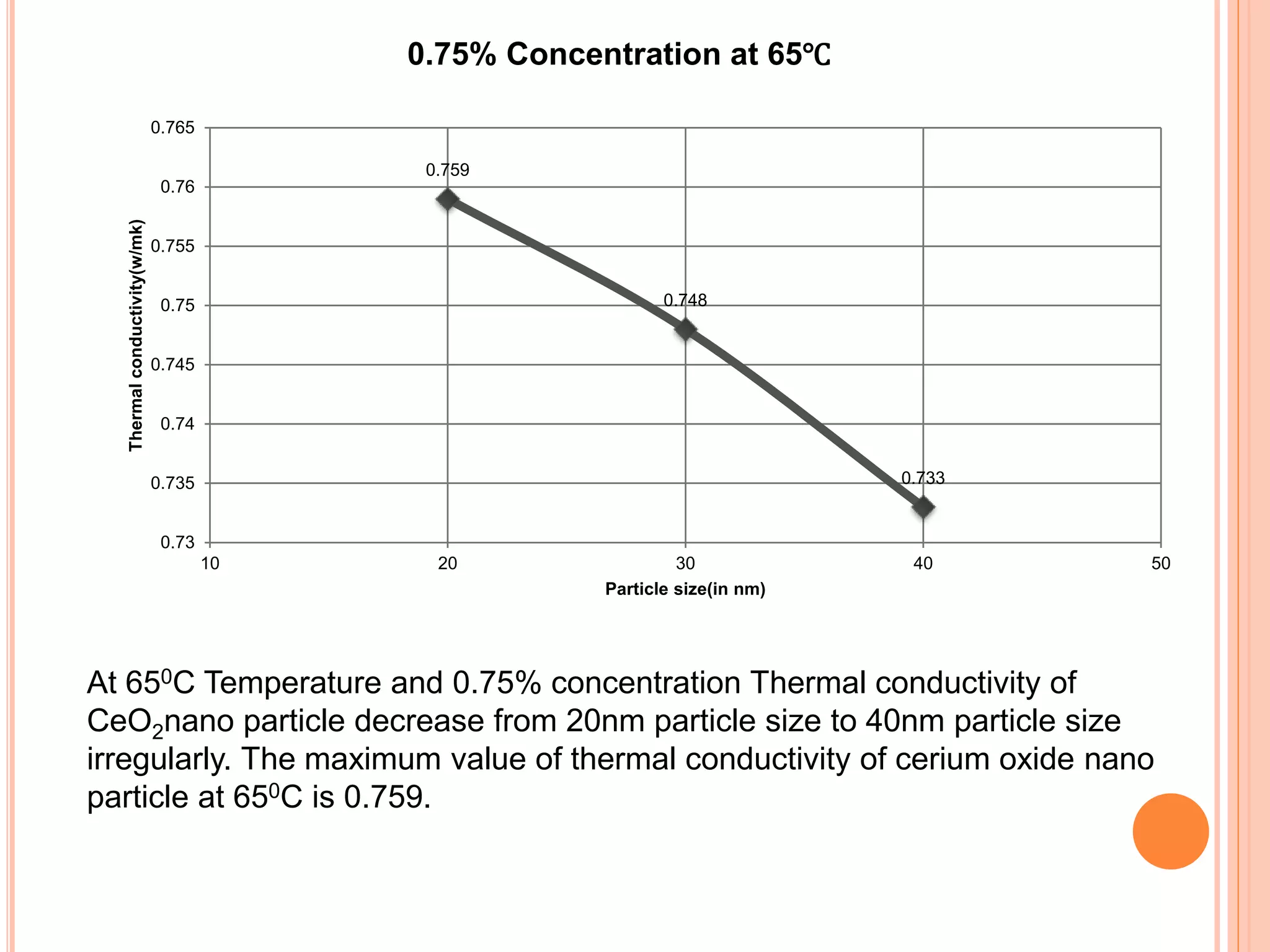
0.759
0.748
0.733
0.73
0.735
0.74
0.745
0.75
0.755
0.76
0.765
10 20 30 40 50
Thermalconductivity(w/mk)
Particle size(in nm)
0.75% Concentration at 65℃
At 650C Temperature and 0.75% concentration Thermal conductivity of
CeO2nano particle decrease from 20nm particle size to 40nm particle size
irregularly. The maximum value of thermal conductivity of cerium oxide nano
particle at 650C is 0.759.
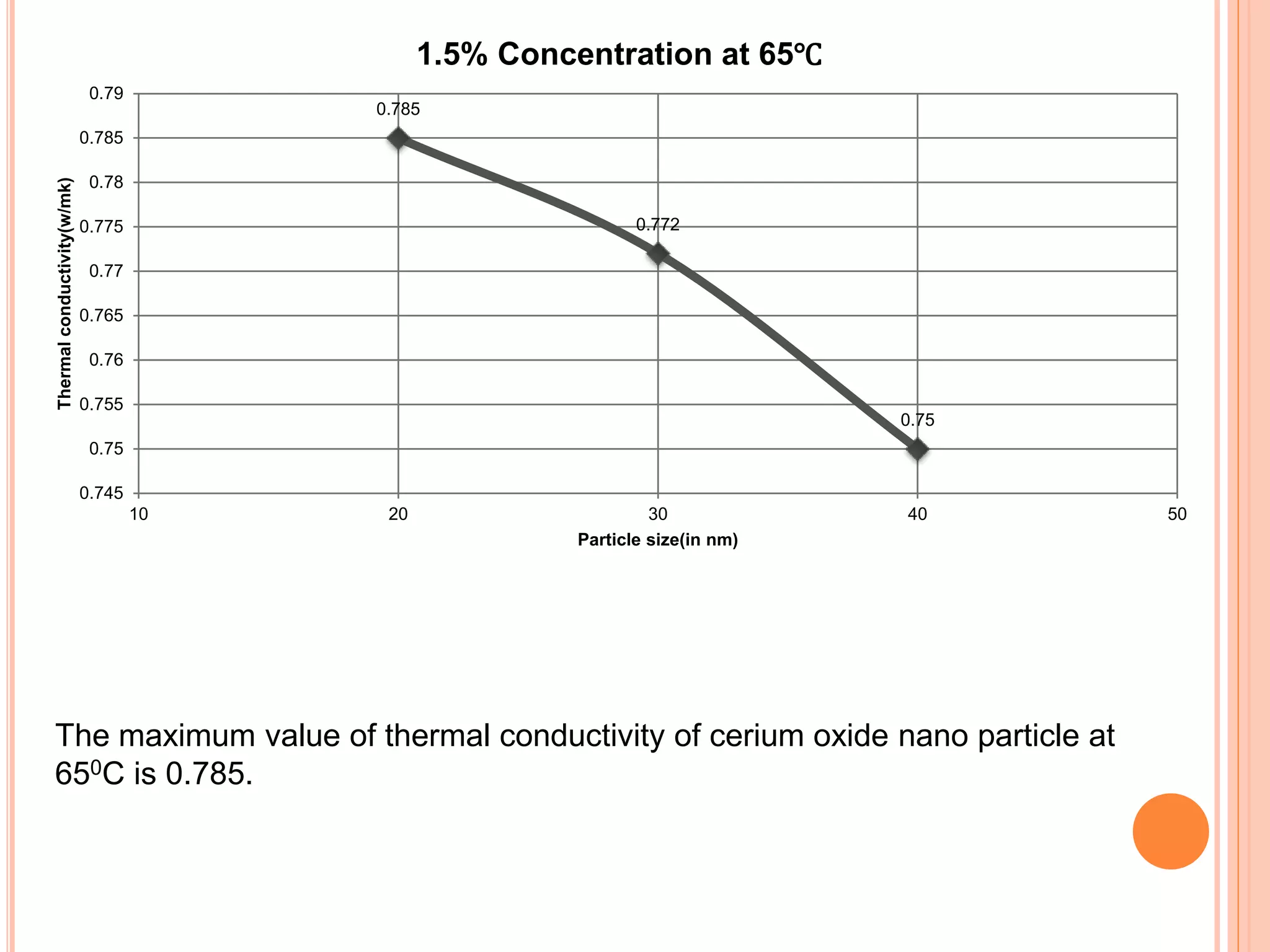
0.785
0.772
0.75
0.745
0.75
0.755
0.76
0.765
0.77
0.775
0.78
0.785
0.79
10 20 30 40 50
Thermalconductivity(w/mk)
Particle size(in nm)
1.5% Concentration at 65℃
The maximum value of thermal conductivity of cerium oxide nano particle at
650C is 0.785.
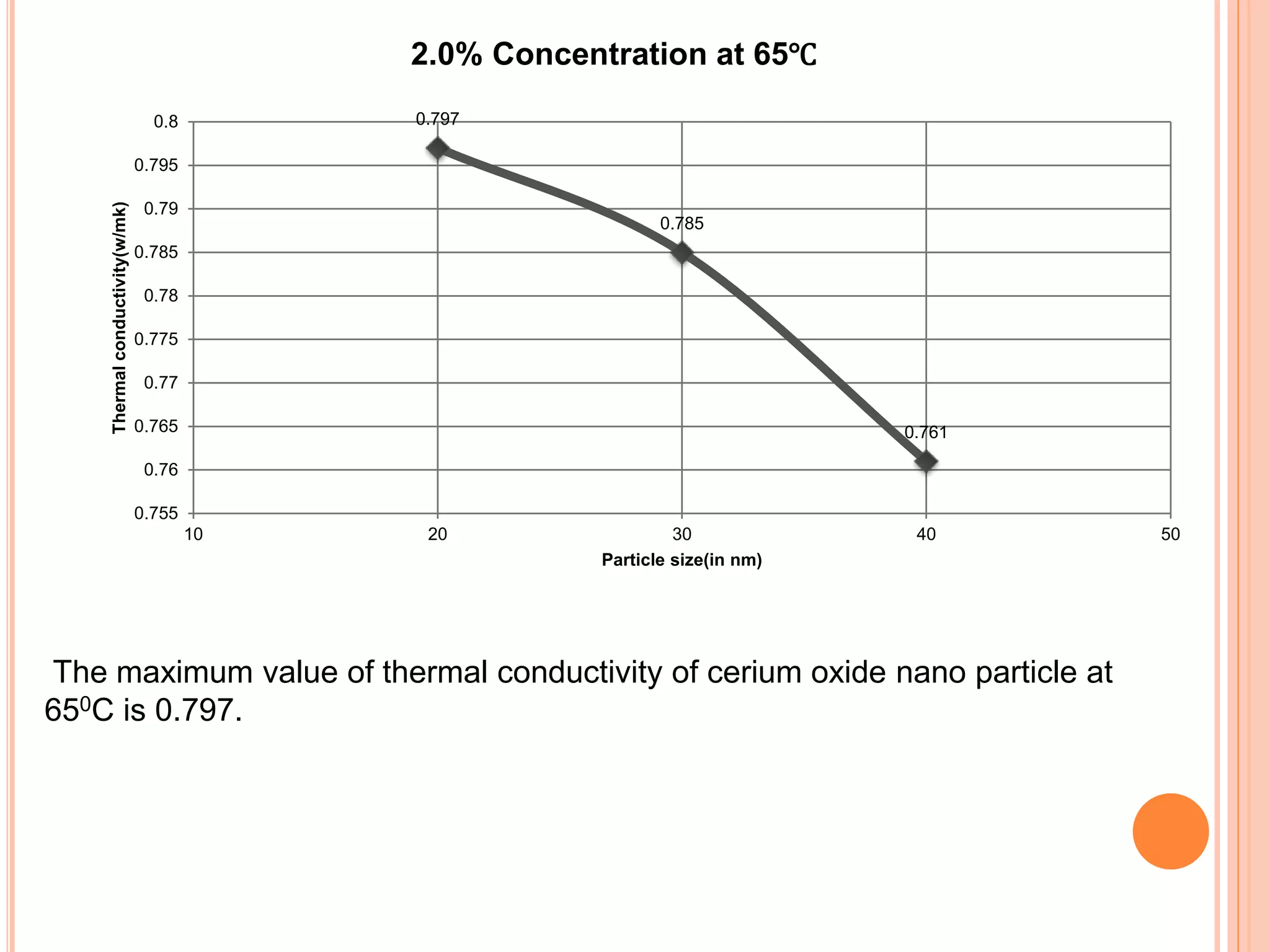
0.797
0.785
0.761
0.755
0.76
0.765
0.77
0.775
0.78
0.785
0.79
0.795
0.8
10 20 30 40 50
Thermalconductivity(w/mk)
Particle size(in nm)
2.0% Concentration at 65℃
The maximum value of thermal conductivity of cerium oxide nano particle at
650C is 0.797.
CONCLUSION
• Nanofluids play an important role for enhancing heat transfer and its research has
inspired physicists, chemists, and engineers around the world.
• The density increases with the increase in concentration of nanoparticle in solution at
same temperature and it decreases with increase in temperature at same concentration.
• The viscosity increases with the increase in concentration of nanoparticle in solution at
same temperature and it decreases with increase in temperature at same concentration.
• The thermal conductivity increases with the increase in concentration of nanoparticle
in solution at same temperature and it also increase with increase in temperature at same
concentration.
• The specific heat decreases with the increase in concentration of nano particle in
solution at same temperature and it increase with increase in temperature at same
concentration.
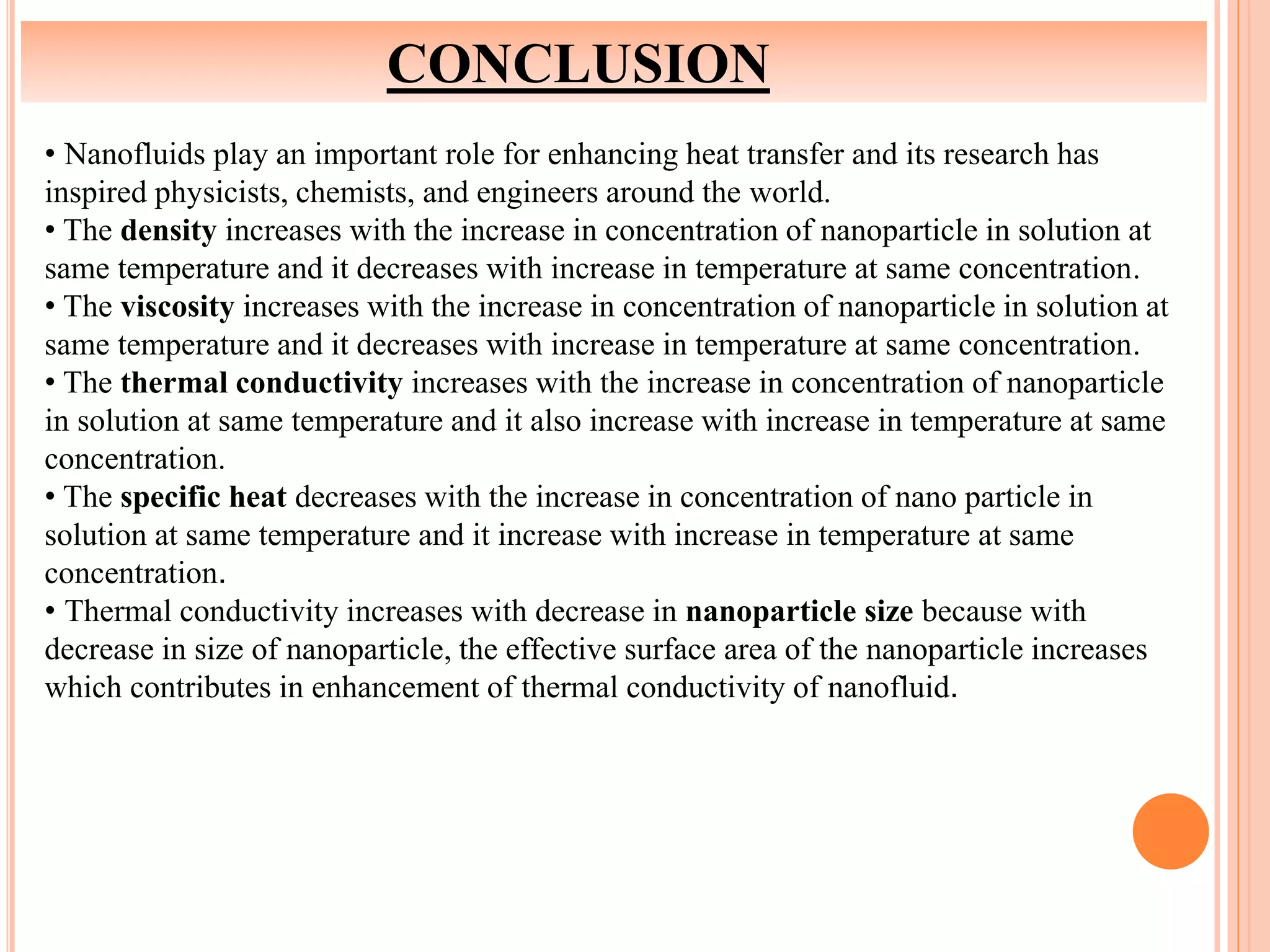
• Thermal conductivity increases with decrease in nanoparticle size because with
decrease in size of nanoparticle, the effective surface area of the nanoparticle increases
which contributes in enhancement of thermal conductivity of nanofluid.
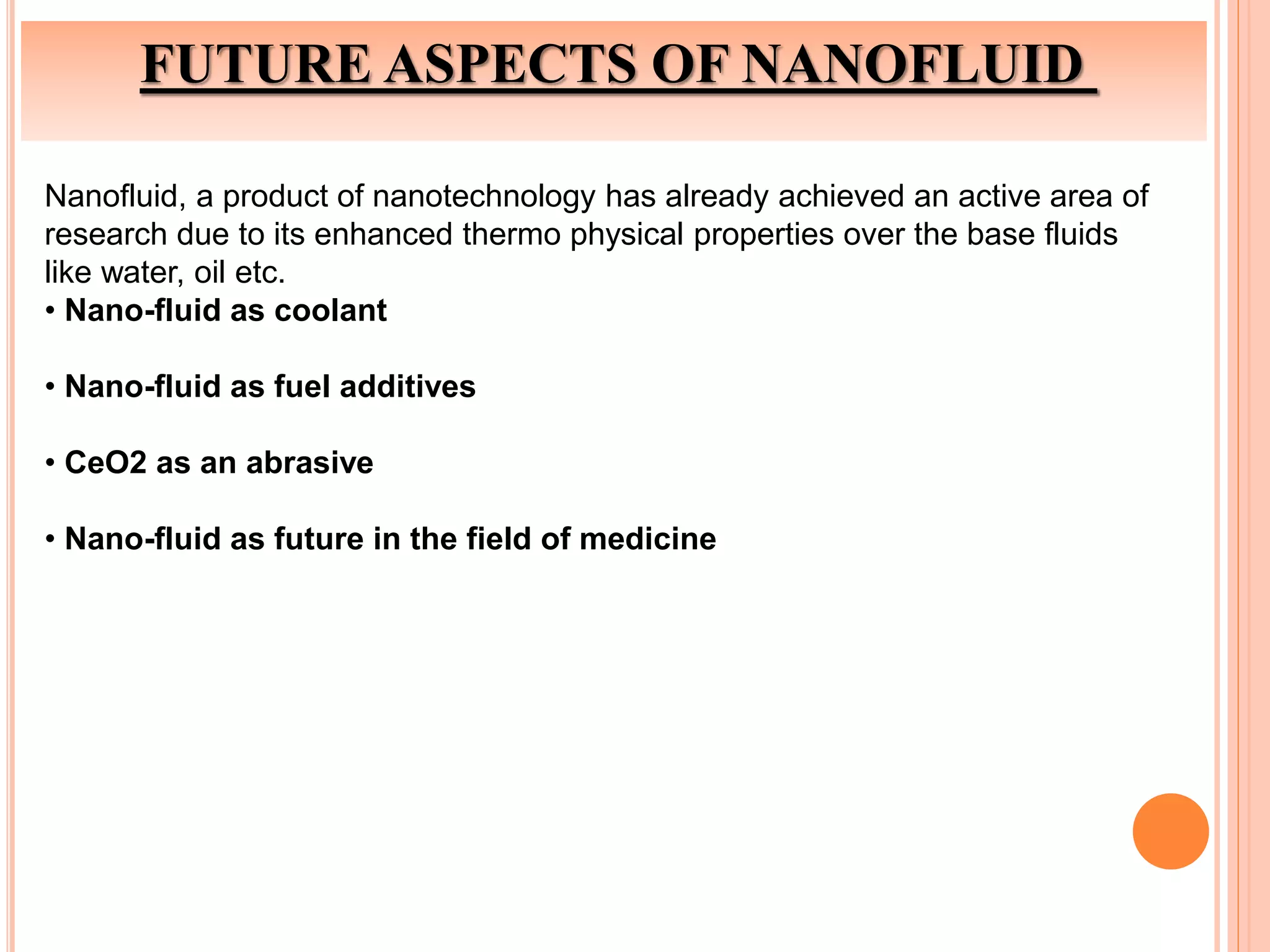
FUTURE ASPECTS OF NANOFLUID
Nanofluid, a product of nanotechnology has already achieved an active area of
research due to its enhanced thermo physical properties over the base fluids
like water, oil etc.
• Nano-fluid as coolant
• Nano-fluid as fuel additives
• CeO2 as an abrasive
• Nano-fluid as future in the field of medicine
REFERENCES
[1]. Wisut Chamsa-ard,Sridevi Brundavanam,Chun Che Fung , Derek
Fawcett and Gerrard Poinern 1,” Nanofluid Types, Their Synthesis,
Properties and Incorporation in Direct Solar Thermal Collectors: A Review”,
Nanomaterials 2017, 7, 131
[2]. Tae Il Kim , Yong Hoon Jeong, Soon Heung Chang, An experimental
study on CHF enhancement in flow boiling using Al2O3 nano-fluid, T.I. Kim
et al. / International Journal of Heat and Mass Transfer 53 (2010) 1015–1022
[3]. A.A. Mohamad, Myth about nano-fluid heat transfer enhancement, A.A.
Mohamad / International Journal of Heat and Mass Transfer 86 (2015) 397–
403
[4]. G. Narendar, A.V.S.S Kumara Swami Gupta,A. Krishnaiah,Satyanarayana
M.G.V., Experimental investigation on the preparation and applications of
Nano fluids, G. Narendar et.al./ Materials Today: Proceedings 4 (2017) 3926–
3931.
[5]. Tun-Ping Teng, Li Lin, and Chao-Chieh Yu, Preparation and
Characterization of Carbon Nanofluids by Using a Revised Water-Assisted
Synthesis Method, Journal of Nanomaterials Volume 2013, Article ID 582304
[6].Ramakoteswara Rao N1 and Leena Gahane2, ULTRASONIC AND
THERMAL CONDUCTIVITY STUDY OF ZNO NANOFLUIDS, Volume: 02
Issue: 10 October – 2017 (IJRIER)
[7].B. Wang, X. Wang, W. Lou, and J. Hao, “Rheological and tribological
properties of ionic liquid-based nanofluids 16 Journal of
Nanomaterialscontaining functionalized multi-walled carbon nanotubes,”
Journal of Physical Chemistry C, vol. 114, no. 19, pp. 8749–8754, 2010.
[8].Ved Prakash, Vinay Kumar Tyagi and Ajay Kumar Tyagi,Thermal
Conductivity and Dispersion Stability of Copper Oxide Nanofluid in
Kerosene,Ved Prakash, et al., Nano Vision, Vol.6 (2), 10-17 (2016)
[9].Murshed, S.M.S., Milanova, D., Kumar, R., 2009. An experimental study
of surface tension-dependent pool boiling characteristics of carbon
nanotubes-nanofluids. In: ASME 2009 7th International Conference on
Nanochannels, Microchannels, and Minichannels. American Society of
Mechanical Engineers, pp. 75e80
[10].Jure Ravnik, MatjazHriberšek, L. Škerget, Analysis of three-dimensional
natural convection of nanofluids by BEM, DOI:
10.1016/j.enganabound.2010.06.019
[11].Eiyad Abu-Nada, Effects of Variable Viscosity and Thermal Conductivity
of CuO-Water Nanofluid on Heat Transfer Enhancement in Natural
Convection: Mathematical Model and Simulation, Journal of Heat Transfer
132(5):052401 · May 2010

ppt on characterization and synthesis of nanofluid with base fluid water

  • 1.
    SYNTHESIS AND CHARACTERIZATIONOF NANOFLUID WITH BASE FLUID WATER INSTITUTE OF ENGINEERING AND TECHNOLOGY DEPARTMENT OF MECHANICAL ENGINEERING SESSION 2017-18 Submitted to; submitted by; Er. Rahul shukla abhay nath tiwari Asst. professor abhinay rai IET BU Jhansi abhishek singh awadesh kumar shiv pratap singh pravej alam
  • 2.
    TABLE OF CONTENTS Nanofluid and nonotechnology  Types of nanoparticle  Types of nanofluid  Cerium oxide nanoparticle  Synthesis of nanofluid  Experimentation  Environmental aspects and human safety  Result and discussion  Conclusion  Future aspects of nanofluid  References
  • 3.
    NANOFLUID AND NANOTECHNOLOGY •Nano word is originated from Latin word, which means dwarf. • 'Nano' is a prefix used to describe 'one billionth’. • Nano fluid is derived from two words that is, NANOFLUIDS = NANOPARTICLE + BASEFLUID • Nano fluid is the colloidal suspension solution of nanoparticle and base fluid. • Nano fluid has greater thermal properties in comparison to base fluid. • In 1974, Norio Taniguchi invented the term 'nanotechnology' to describe extra-high precision and ultra-fine dimensions. • Concept behind it, thermo fluids in heat exchangers for enhancement of heat transfer coefficient.
  • 4.
    TPYES OF NANOPARTICLES Atpresent nanoparticles are classified into three groups; • One Dimension (1D) nanoparticles One dimensional system (thin film or manufactured surfaces) has been used in the field of solar cells offering. • Two Dimensional (2D) nanoparticles Carbon nanotubes • Three Dimensional (3D) nanoparticles Fullerenes (Carbon 60)
  • 5.
    TYPES OF NANOFLUID Nanofluids may be classified on the basis of the nano particles suspended and the base fluid used. 1 – on the basis of nano particle – (a)– metallic nano fluid (e.g. Al, Cu, Ni) (b)- Non – metallic nano fluid (e.g. Ceo2 , CuO) 2- on the basis of fluid used – (a)- ethylene glycol (b) - Water
  • 6.
    CERIUM OXIDE NANOPARTICLE Cerium(iv)oxide, also known as ceric oxide or ceria is an oxide of the rare earth metal cerium. • It is a pale yellow white powder with the chemical formula CeO2. • The cerium oxide nanoparticles are of an average size -10-30nm. • It is insoluble in water and its crystal structure is cubic (fluorite). • It has density of magnitude 7215 kg/m³. • Its boiling and melting point 3500 and 2400 °C
  • 7.
    SYNTHESIS OF NANOFLUID Synthesisof nanofluids carried out by mixing nanoparticles with fluids, There are fundamental methods to obtain nanofluids -: • Single step method • Double step method • Gas condensation • Ion Implementation • Ball mill dispersion • Chemical vapour condensation
  • 8.
    • Single stepmethod Used makes and disperses the nanoparticles straight into a conventional base fluid best for metallic nanofluids. The preliminary materials tried for nanofluids were oxide particles, primarily because they were easy to produce and chemically stable in solution. • Double step method Two-step technique is the most cost-effective method to generate nanofluids in big scale. Nanoparticles, nanotubes, nanofibers and other non material’s used in this technique are first formed as dry powders by physical and chemical methods. • Gas Condensation Used to make nanoparticles from metals with low melting points. In this method the solid along with the liquid is fed into a colloidal mill. • Ion Implementation Used in semiconductor device fabrication and in metal finishing, as well as in materials science research. Ion implantation cause also chemical and physical changes when the ions impinge on the target at high energy.
  • 9.
    • Ball MillDispersion It is a way of modifying the conditions in which chemical reactions usually take place either by changing the reactivity. The ball milling was per from for two hours at constant milling speed of 250 rpm under controlled atmosphere. The characterization is ferformed analyzer for mapping elemental and line analysis. • Chemical Vapour Condensation Used to deposit thin solid films on surfaces. This method has tremendous flexibility in producing a wide range of materials, The precursors can be solid, liquid or gas at ambient conditions, but are delivered to the reactor as a vapour.
  • 10.
    EXPERIMENTATION • Nanoparticles areused as additives to modify heat transfer fluids to improve their performance. • Thermal Conductivity is the property of a material with the purpose of indicates its capacity to conduct heat. • Thermal conductivity of CeO2/water nanofluid was measured by using a KD2 Pro thermal property analyzer.  Thermal conductivity measurement assumes; 1. long heat basis can be treated as an infinitely long heat source. 2. the medium is both homogeneous and isotropic, and at standardized initial temperature. • Prepared nanofluids give the better thermal conductivity value of 0.681W/m K at 0.3% as compared to base fluid.
  • 11.
    Steps: • The KD2’ssensor needle contains both a heating ingredient and a thermistor. • To measure the thermal conductivity of fluids, sensor needle can be used in the range of 0.2–2 W/m K with an accuracy of ±5%. Each measurement cycle consists of 90s. During the first 30s, the instrument will equilibrate which is then followed by heating and cooling of sensor needle for 30s each. • The calibration of the sensor needle was carried out thermal conductivity of CeO2/Water. • The standard values for distilled water is 0.58 W/m K. The calibration of the KD2 Pro sensor needle was carried out at room temperature (32◦C)
  • 12.
    ENVIRONMENTAL AND HUMANSAFETY ASPECTS In recent years, due to the increased human capacity to make synthetic nanoparticles, much attention has been focused on this type of material. • Application of nanoparticles Inorganic nanoparticles also are absorbed by the cells, e.g., zinc oxide can enter bacteria. CeO2 nanoparticles can be absorbed by the cell wall of E. coli bacteria. The cell walls of bacteria have adapted physiologically to the presence of fullerenes. • Organic Colloids The colloidal materials in natural waters include particles and macromolecules that range in size from 1 nm to 1 µm. their exact composition and functions are still unclear. • Soot The processes of natural and artificial combustion that occur in mobile or fixed sources emit particles with a wide range of sizes. all the carbon black particles in the range of nanoparticles are specified by the term “soot.”
  • 13.
    • fullerenes andcarbon nanotubes fullerenes and carbon nanotubes are considered to be engineered nanoparticles, natural fullerenes and carbon nanotubes also exist in the environment. • Natural and unintentionally-produced inorganic Nanoparticles (NP) Mineral nanoparticles exist everywhere in the soil and in geological systems. Aerosols that are present in the atmosphere also are considered to be nanoparticle. • Engineered fullerenes and CNTs Most fullerenes are used in polymeric composites, such as thin membranes, and in electro-optical devices and biological applications. • Engineered polymeric NP Synthetic nanoparticles resulting from organic polymers have been used in many applications in medicine as drug-delivery devices. Different types of these nanoparticles have been studied regarding their ability to pass through brain- blood barriers.
  • 14.
    RESULT AND DISSCUSION •DENSITY The density or more precisely, the volumetric mass density, of a substance is its mass per unit volume. The symbol most often used for density is ρ. density= mass/volume The SI unit of density is Kg/m3. • VISCOSITY Viscosity is a measure of a fluid’s resistance to flow. It describes the internal friction of a moving fluid. A fluid with large viscosity resists motion because its molecular makeup gives it a lot of internal friction. Viscosity =Shear force/velocity gradient μ=τdu /dy The SI unit of viscosity, if equivalent to N-s/m2.
  • 15.
    • THERMAL CONDUCTIVITY Thermalconductivity is the property of material to conduct heat. It is evaluated primarily in terms of fourier’s law for heat conduction. In SI units, thermal conductivity is measured in W/m-K. • SPECIFIC HEAT The specific heat is the amount of heat per unit mass required to rise the temperature by 10 C. The relationship between heat and temperature change is usually expressed in the form of specific heat (c).
  • 16.
    RESULT AND DISSCUSION •Density-: The symbol most often used for density is ρ. 𝐷𝑒𝑛𝑠𝑖𝑡𝑦=mass/𝑣𝑜𝑙𝑢𝑚𝑒 SI unit of density is Kg/m3 1045 1049 1058 1063 1067 1082 1040 1045 1050 1055 1060 1065 1070 1075 1080 1085 0 0.25 0.5 0.75 1 1.25 1.5 1.75 Density(Kg/m3) Concentration (%) Density at 55 ℃ .25 % concentration the density is min that is 1045 and at 1.5% the max density is 1082.
  • 17.
    1039 1044 1051 1055 1059 1074 1035 1040 1045 1050 1055 1060 1065 1070 1075 1080 0 0.25 0.50.75 1 1.25 1.5 1.75 Density(Kg/m3) Concentration (%) Density at 60 ℃ Density increases with the increase in concentration of nanoparticle in solution.
  • 18.
    1035 1038 1046 1051 1054 1062 1030 1035 1040 1045 1050 1055 1060 1065 0 0.25 0.50.75 1 1.25 1.5 1.75 Density(Kg/m3) Concentration (%) Density at 65 ℃ Density increases with the increase in concentration of nanoparticle in solution. .25 % concentration the density is min that is 1039 and at 1.5% the max density is 1074.
  • 19.
    1017 1021 1026 1031 1036 1041 1015 1020 1025 1030 1035 1040 1045 0 0.25 0.50.75 1 1.25 1.5 1.75 Density(Kg/m3) Concentration (%) Density at 80 ℃ At .25 % concentration the density is minimum that is 1015 and at 1.5% the maximum density is 1045.
  • 20.
    1.04 1.08 1.11 1.17 1.21 1.28 1 1.05 1.1 1.15 1.2 1.25 1.3 0 0.25 0.50.75 1 1.25 1.5 1.75 Viscosity(N-s/m2) Concentration (%) Viscosity vs Concentration at 55 ℃ • Viscosity-: Viscosity is a measure of a fluid’s resistance to flow. It describes the internal friction of a moving fluid. Viscosity =Shear force / velocity gradient SI unit of viscosity, N-s/m2 The viscosity increases from 1.04 to 1.28 at 0.25% and1.5% concentrations respectively.
  • 21.
    0.76 0.79 0.81 0.83 0.84 0.98 0.7 0.75 0.8 0.85 0.9 0.95 1 0 0.25 0.50.75 1 1.25 1.5 1.75 Viscosity(N-s/m2) Concentration (%) Viscosity vs Concentration at 70 ℃ The result between viscosity and concentration at 70°C have been plotted here and the viscosity increases from 0.76 to 0.98 at0.25% and 1.5% concentrations respectively.
  • 22.
    0.72 0.76 0.78 0.8 0.81 0.84 0.7 0.72 0.74 0.76 0.78 0.8 0.82 0.84 0.86 0 0.25 0.50.75 1 1.25 1.5 1.75 Viscosity(N-s/m2) Concentration (%) Viscosity vs Concentration at 75 ℃ viscosity increases from 0.72 to 0.84 at 0.25% and 1.5% concentrations respectively.
  • 23.
    0.63 0.65 0.67 0.68 0.69 0.74 0.62 0.64 0.66 0.68 0.7 0.72 0.74 0.76 0 0.25 0.50.75 1 1.25 1.5 1.75 Viscosity(N-s/m2) Concentration (%) Viscosity vs Concentration at 80 ℃ viscosity increases from 0.63 to 0.72 at 0.25% and 1.5% concentrations respectively.
  • 24.
    0.625 0.629 0.638 0.639 0.641 0.657 0.62 0.625 0.63 0.635 0.64 0.645 0.65 0.655 0.66 0 0.25 0.50.75 1 1.25 1.5 1.75 Thermalconductivity(W/m-K) Concentration (%) Thermal conductivity at 55℃ •Thermal Conductivity-: Thermal conductivity is the property of material to conduct heat. It is evaluated primarily in terms of fourier’s law for heat conduction. In SI units, thermal conductivity is measured in W/m-K. At 55 0C Thermal conductivity of CeO2 nano particle increases from 0.25 % concentration to 1.5 % concentration irregularly.
  • 25.
    0.639 0.677 0.652 0.655 0.656 0.672 0.635 0.64 0.645 0.65 0.655 0.66 0.665 0.67 0.675 0.68 0 0.25 0.50.75 1 1.25 1.5 1.75 Thermalconductivity(W/m-K) Concentration (%) Thermal conductivity at 60 ℃ At 60 0C Thermal conductivity of CeO2 nanoparticle increases from .25 % concentration to 1.5 % concentration irregularly, The maximum value of thermal conductivity of cerium oxide nanoparticle at 60 0C is .672.
  • 26.
    0.649 0.657 0.664 0.667 0.669 0.689 0.645 0.65 0.655 0.66 0.665 0.67 0.675 0.68 0.685 0.69 0.695 0 0.25 0.50.75 1 1.25 1.5 1.75 Thermalconductivity(W/m-K) Concentration (%) Thermal conductivity at 65 ℃ The maximum value of thermal conductivity of cerium oxide nano particle at 65 0C is .669.
  • 27.
    0.679 0.689 0.694 0.699 0.705 0.729 0.67 0.68 0.69 0.7 0.71 0.72 0.73 0.74 0 0.25 0.50.75 1 1.25 1.5 1.75 Thermalconductivity(W/m-K) Concentration (%) Thermal conductivity at 75 ℃ The maximum value of thermal conductivity of cerium oxide nano particle at 75 0C is .0.729.
  • 28.
    0.692 0.706 0.715 0.717 0.719 0.747 0.68 0.69 0.7 0.71 0.72 0.73 0.74 0.75 0 0.25 0.50.75 1 1.25 1.5 1.75 Thermalconductivity(W/m-K) Concentration (%) Thermal conductivity at 80 ℃ The maximum value of thermal conductivity of cerium oxide nano particle at 80 0C is 0.747.
  • 29.
    3810 3774 3722 3653 3610 3526 3500 3550 3600 3650 3700 3750 3800 3850 0 0.25 0.50.75 1 1.25 1.5 1.75 SpecificHeat(J/Kg-K) Concentration (%) Specific Heat at 60 ℃ • Specific Heat –: The specific heat is the amount of heat per unit mass required to rise the temperature by 1 0C. The relationship between heat and temperature change is usually expressed in the form of specific heat (c). The maximum value of Specific Heat of cerium oxide nanoparticle at 60 0C is 3810.
  • 30.
    3844 3792 3754 3998 3654 3545 3500 3550 3600 3650 3700 3750 3800 3850 3900 3950 4000 4050 0 0.25 0.50.75 1 1.25 1.5 1.75 SpecificHeat(J/Kg-K) Concentration (%) Specific Heat at 65 ℃ At 65°C Specific Heat of CeO2 nanoparticle decreases from .25 % concentration to 1.5 % concentration irregularly . The maximum value of Specific Heat of cerium oxide nano particle at 65°C is 3998.
  • 31.
    3863 3810 3794 3723 3699 3577 3550 3600 3650 3700 3750 3800 3850 3900 0 0.25 0.50.75 1 1.25 1.5 1.75 SpecificHeat(J/Kg-K) Concentration (%) Specific Heat at 70 ℃ The maximum value of Specific Heat of cerium oxide nanoparticle at 70°C is 3863.
  • 32.
    3895 3832 3808 3761 3709 3599 3550 3600 3650 3700 3750 3800 3850 3900 3950 0 0.25 0.50.75 1 1.25 1.5 1.75 SpecificHeat(J/Kg-K) Concentration (%) Specific Heat at 75 ℃ The maximum value of Specific Heat of cerium oxide nanoparticle at 75°C is 3895.
  • 33.
    3930 3864 3824 3809 3754 3616 3600 3650 3700 3750 3800 3850 3900 3950 0 0.25 0.50.75 1 1.25 1.5 1.75 SpecificHeat(J/Kg-K) Concentration (%) Specific Heat at 80 ℃ At 80°C Specific Heat of CeO2 nano particle decreases from .25 % concentration to 1.5 % concentration irregularly . The maximum value of Specific Heat of cerium oxide nano particle at 80°C is 3930.
  • 34.
    3945 3879 3867 3845 3799 3670 3650 3700 3750 3800 3850 3900 3950 4000 0 0.25 0.50.75 1 1.25 1.5 1.75 SpecificHeat(J/Kg-K) Concentration (%) Specific Heat at 85 ℃ The maximum value of Specific Heat of cerium oxide nano particle at 85°C is 3945.
  • 35.
    0.706 0.697 0.684 0.679 0.675 0.68 0.685 0.69 0.695 0.7 0.705 0.71 0 10 2030 40 50 Thermalconductivity(w/mk) Particle size(in nm) 0.25% Concentration at 50℃ The maximum value of thermal conductivity of cerium oxide nano particle at 500C is 0.706.
  • 36.
    0.711 0.701 0.69 0.682 0.68 0.685 0.69 0.695 0.7 0.705 0.71 0.715 0 10 2030 40 50 Thermalconductivity(w/mk) Particle size(in nm) 0.5% Concentration at 50℃ At 500C Temperature and 0.50% concentration Thermal conductivity of CeO2nano particle decreases from 10nm particle size to 40nm particle size irregularly. The maximum value of thermal conductivity of cerium oxide nano particle at 500C is 0.711.
  • 37.
    0.716 0.707 0.697 0.686 0.68 0.685 0.69 0.695 0.7 0.705 0.71 0.715 0.72 0 10 2030 40 50 Thermalconductivity(w/mk) Particle size(in nm) 0.75% Concentration at 50℃ The maximum value of thermal conductivity of cerium oxide nano particle at 500C is 0.716.
  • 38.
    0.726 0.713 0.7 0.694 0.69 0.695 0.7 0.705 0.71 0.715 0.72 0.725 0.73 0 10 2030 40 50 Thermalconductivity(w/mk) Particle size(in nm) 1.0% Concentration at 50℃ At 500C Temperature and 1.0% concentration Thermal conductivity of CeO2nano particle decreases from 10nm particle size to 40nm particle size irregularly. The maximum value of thermal conductivity of cerium oxide nano particle at 500C is 0.726.
  • 39.
    0.737 0.726 0.715 0.706 0.7 0.705 0.71 0.715 0.72 0.725 0.73 0.735 0.74 0 10 2030 40 50 Thermalconductivity(w/mk) Particle size(in nm) 1.5% Concentration at 50℃ The maximum value of thermal conductivity of cerium oxide nano particle at 500C is 0.737.
  • 40.
    0.744 0.737 0.728 0.722 0.72 0.725 0.73 0.735 0.74 0.745 0.75 0 10 2030 40 50 Thermalconductivity(w/mk) Particle size(in nm) 2.0% Concentration at 50℃ The maximum value of thermal conductivity of cerium oxide nano particle at 500C is 0.744.
  • 41.
    0.712 0.702 0.69 0.681 0.675 0.68 0.685 0.69 0.695 0.7 0.705 0.71 0.715 0 10 2030 40 50 Thermalconductivity(w/mk) Particle size(in nm) 0.25% Concentration at 60℃ 600C Temperature and 0.25% concentration Thermal conductivity of CeO2nano particle decreases from 10nm particle size to 40nm particle size irregularly.
  • 42.
    0.729 0.716 0.704 0.697 0.695 0.7 0.705 0.71 0.715 0.72 0.725 0.73 0.735 0 10 2030 40 50 Thermalconductivity(w/mk) Particle size(in nm) 1.0 % Concentration at 60℃ The maximum value of thermal conductivity of cerium oxide nano particle at 600C is 0.729.
  • 43.
    0.747 0.74 0.733 0.726 0.72 0.725 0.73 0.735 0.74 0.745 0.75 0 10 2030 40 50 Thermalconductivity(w/mk) Particle size(in nm) 2.0% Concentration at 60℃ The maximum value of thermal conductivity of cerium oxide nano particle at 600C is 0.747.
  • 44.
    0.759 0.748 0.733 0.73 0.735 0.74 0.745 0.75 0.755 0.76 0.765 10 20 3040 50 Thermalconductivity(w/mk) Particle size(in nm) 0.75% Concentration at 65℃ At 650C Temperature and 0.75% concentration Thermal conductivity of CeO2nano particle decrease from 20nm particle size to 40nm particle size irregularly. The maximum value of thermal conductivity of cerium oxide nano particle at 650C is 0.759.
  • 45.
    0.785 0.772 0.75 0.745 0.75 0.755 0.76 0.765 0.77 0.775 0.78 0.785 0.79 10 20 3040 50 Thermalconductivity(w/mk) Particle size(in nm) 1.5% Concentration at 65℃ The maximum value of thermal conductivity of cerium oxide nano particle at 650C is 0.785.
  • 46.
    0.797 0.785 0.761 0.755 0.76 0.765 0.77 0.775 0.78 0.785 0.79 0.795 0.8 10 20 3040 50 Thermalconductivity(w/mk) Particle size(in nm) 2.0% Concentration at 65℃ The maximum value of thermal conductivity of cerium oxide nano particle at 650C is 0.797.
  • 47.
    CONCLUSION • Nanofluids playan important role for enhancing heat transfer and its research has inspired physicists, chemists, and engineers around the world. • The density increases with the increase in concentration of nanoparticle in solution at same temperature and it decreases with increase in temperature at same concentration. • The viscosity increases with the increase in concentration of nanoparticle in solution at same temperature and it decreases with increase in temperature at same concentration. • The thermal conductivity increases with the increase in concentration of nanoparticle in solution at same temperature and it also increase with increase in temperature at same concentration. • The specific heat decreases with the increase in concentration of nano particle in solution at same temperature and it increase with increase in temperature at same concentration. • Thermal conductivity increases with decrease in nanoparticle size because with decrease in size of nanoparticle, the effective surface area of the nanoparticle increases which contributes in enhancement of thermal conductivity of nanofluid.
  • 48.
    FUTURE ASPECTS OFNANOFLUID Nanofluid, a product of nanotechnology has already achieved an active area of research due to its enhanced thermo physical properties over the base fluids like water, oil etc. • Nano-fluid as coolant • Nano-fluid as fuel additives • CeO2 as an abrasive • Nano-fluid as future in the field of medicine
  • 49.
    REFERENCES [1]. Wisut Chamsa-ard,SrideviBrundavanam,Chun Che Fung , Derek Fawcett and Gerrard Poinern 1,” Nanofluid Types, Their Synthesis, Properties and Incorporation in Direct Solar Thermal Collectors: A Review”, Nanomaterials 2017, 7, 131 [2]. Tae Il Kim , Yong Hoon Jeong, Soon Heung Chang, An experimental study on CHF enhancement in flow boiling using Al2O3 nano-fluid, T.I. Kim et al. / International Journal of Heat and Mass Transfer 53 (2010) 1015–1022 [3]. A.A. Mohamad, Myth about nano-fluid heat transfer enhancement, A.A. Mohamad / International Journal of Heat and Mass Transfer 86 (2015) 397– 403 [4]. G. Narendar, A.V.S.S Kumara Swami Gupta,A. Krishnaiah,Satyanarayana M.G.V., Experimental investigation on the preparation and applications of Nano fluids, G. Narendar et.al./ Materials Today: Proceedings 4 (2017) 3926– 3931. [5]. Tun-Ping Teng, Li Lin, and Chao-Chieh Yu, Preparation and Characterization of Carbon Nanofluids by Using a Revised Water-Assisted Synthesis Method, Journal of Nanomaterials Volume 2013, Article ID 582304
  • 50.
    [6].Ramakoteswara Rao N1and Leena Gahane2, ULTRASONIC AND THERMAL CONDUCTIVITY STUDY OF ZNO NANOFLUIDS, Volume: 02 Issue: 10 October – 2017 (IJRIER) [7].B. Wang, X. Wang, W. Lou, and J. Hao, “Rheological and tribological properties of ionic liquid-based nanofluids 16 Journal of Nanomaterialscontaining functionalized multi-walled carbon nanotubes,” Journal of Physical Chemistry C, vol. 114, no. 19, pp. 8749–8754, 2010. [8].Ved Prakash, Vinay Kumar Tyagi and Ajay Kumar Tyagi,Thermal Conductivity and Dispersion Stability of Copper Oxide Nanofluid in Kerosene,Ved Prakash, et al., Nano Vision, Vol.6 (2), 10-17 (2016) [9].Murshed, S.M.S., Milanova, D., Kumar, R., 2009. An experimental study of surface tension-dependent pool boiling characteristics of carbon nanotubes-nanofluids. In: ASME 2009 7th International Conference on Nanochannels, Microchannels, and Minichannels. American Society of Mechanical Engineers, pp. 75e80 [10].Jure Ravnik, MatjazHriberšek, L. Škerget, Analysis of three-dimensional natural convection of nanofluids by BEM, DOI: 10.1016/j.enganabound.2010.06.019 [11].Eiyad Abu-Nada, Effects of Variable Viscosity and Thermal Conductivity of CuO-Water Nanofluid on Heat Transfer Enhancement in Natural Convection: Mathematical Model and Simulation, Journal of Heat Transfer 132(5):052401 · May 2010