GENERAL PHYSICS 1
TEACHER
ENGR.RAMSES
SAMPANG PUNO
- Graduate at Western
Mindanao State
University
- Registered Electrical
Engineer
- Electrical System
Designer
- Solar Installer
2.
1. WRITTEN WORKS– 25%
Long Quizzes, Short Quizzes, Small Activities, Etc.
2. PERFORMANCE TASK – 45%
Activities, Final Project, etc.
3. QUARTERLY ASSESSMENT – 30%
Midterm Exam
Final Exam
GRADING SYSTEM
3.
CLASSROOM RULES:
1. ALWAYSOBSERVE SILENCE WHEN THE TEACHER IS TALKING IN FRONT TO
UNDERSTAND THE LESSON.
2. BULLYING WILL NOT BE TOLERATED INSIDE THE CLASSROOM.
3. ATTENDANCE MUST BE CHECK AT ALL TIMES.
4. FOR EMERGENCY CONCERNS, YOU MUST RAISE YOUR HANDS AND ASK THE
TEACHER FOR THE PASSES YOU NEED.
5. BRING YOUR CALCULATOR AND NOTEBOOK FOR EVERY MEETING.
6. 10 MINUTES IS CONSIDERED AS LATE UNLESS THERE IS A VALID REASON.
7. YOUR SCORE IN EVERY EXAM IS SACRED, YOU SHALL NOT SHARE IT WITH
YOUR CLASSMATES TO AVOID BULLYING.
8. ENJOY THE PHYSICS LECTURE.
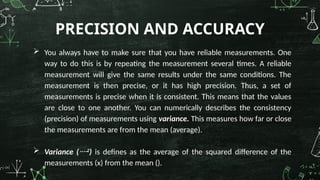
4.
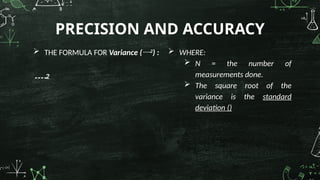
WHAT TO BRING?
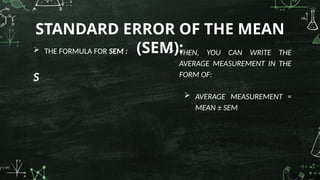
1.Scientific Calculator (991 ES PLUS)
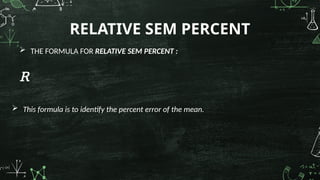
2. 2 Sets of test Notebook
(FORMULA NOTES & LECTURE
NOTES)
MODULES:
1. Measurement
2. Scalarsand Vectors
3. Kinematic Quantities
4. Uniformly Accelerated Motion
5. Motion in Two Dimensions
6. Newton’s Laws of Motion
7. Work, Power, and Mechanical Energy
UNIT 1 – The Physics of Point
Particles
9.
MODULES:
9. Rotational Motion
10.Gravity
11.MechanicalWaves
12.Fluid Mechanics
13.Temperature and Heat
14.The First Law of Thermodynamics
15.The Second Law of Thermodynamics
UNIT 2 – Physics of Extended
Bodies and Thermodynamics
10.
UNIT 1 –MODULE 1 -
Measurements
WHAT WOULD YOU LEARN AT THE END OF THE MODULE?
1. Differentiate the various systems and units of measurements.
2. Explain the standards of measurements for length, mass, and time.
3. Solve the measurement problems involving conversion of units.
4. Express measurements in scientific notation.
5. Differentiate accuracy from precision.
6. Differentiate random errors from systematic errors.
7. Use the least count concept to estimate errors associated with single measurements.
8. Estimate errors from multiple measurements of a physical quantity using variance.
9. Estimate uncertainty of a derived quantity from the estimated values and uncertainties of
directly measured quantities.
10. Estimate intercepts and slopes in data with linear dependence.
11.
SYSTEMS OF MEASUREMENT
2SYSTEMS OF A MEASUREMENT:
1. ENGLISH or BRITISH SYSTEM
2. METRIC SYSTEM or THE SI Units
12.
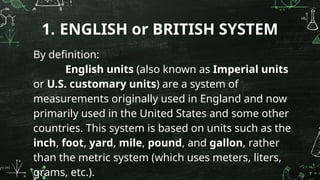
By definition:
English units(also known as Imperial units
or U.S. customary units) are a system of
measurements originally used in England and now
primarily used in the United States and some other
countries. This system is based on units such as the
inch, foot, yard, mile, pound, and gallon, rather
than the metric system (which uses meters, liters,
grams, etc.).
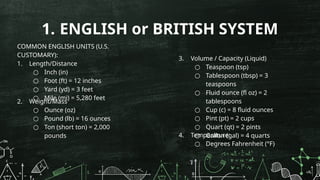
1. ENGLISH or BRITISH SYSTEM
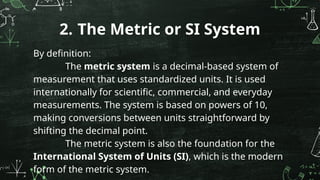
By definition:
The metricsystem is a decimal-based system of
measurement that uses standardized units. It is used
internationally for scientific, commercial, and everyday
measurements. The system is based on powers of 10,
making conversions between units straightforward by
shifting the decimal point.
The metric system is also the foundation for the
International System of Units (SI), which is the modern
form of the metric system.
2. The Metric or SI System
15.
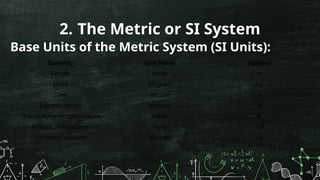
2. The Metricor SI System
Quantity Unit Name Symbol
Length meter m
Mass kilogram kg
Time second s
Electric current ampere A
Thermodynamic temperature kelvin K
Amount of substance mole mol
Luminous intensity candela cd
Base Units of the Metric System (SI Units):
16.
UNIT PREFIXES:
A prefixis a letter or a group of letters added at the
beginning of the base word to change its meaning. In
measurement, a unit prefix or metric prefix can be used in
make a new unit larger or smaller than the base unit.
2. The Metric or SI System
17.
2. The Metricor SI System
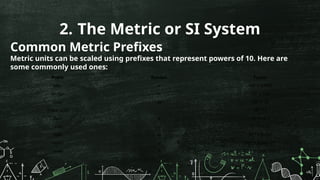
Common Metric Prefixes
Metric units can be scaled using prefixes that represent powers of 10. Here are
some commonly used ones:
Prefix Symbol Factor
kilo- k 10³ = 1,000
hecto- h 10² = 100
deca- da 10¹ = 10
(base unit) 10 = 1
⁰
deci- d 10 ¹ = 0.1
⁻
centi- c 10 ² = 0.01
⁻
milli- m 10 ³ = 0.001
⁻
micro- µ 10 = 0.000001
⁻⁶
nano- n 10 = 0.000000001
⁻⁹
18.
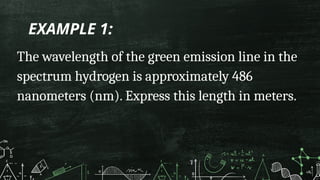
EXAMPLE 1:
The wavelengthof the green emission line in the
spectrum hydrogen is approximately 486
nanometers (nm). Express this length in meters.
19.
BY DEFINISION:
Dimensional Analysisis a mathematical technique
used in physics and engineering to analyze and convert units
from one system to another. It involves checking the
consistency of equations by comparing the dimensions (such
as length, mass, time, etc.) on both sides. It is also used to
convert units, derive formulas, and validate physical
relationships.
Dimensional analysis relies on the principle of
homogeneity, which states that only quantities with the
same dimensions can be compared, added, or subtracted.
DIMENSIONAL ANALYSIS
20.
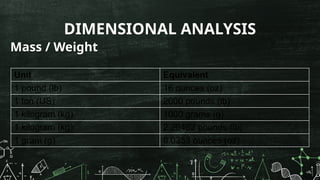
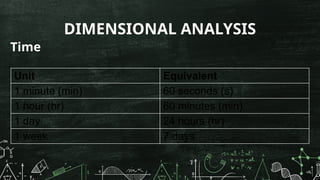
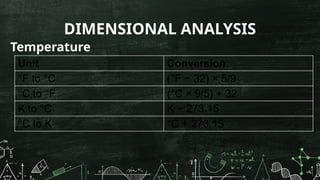
DIMENSIONAL ANALYSIS
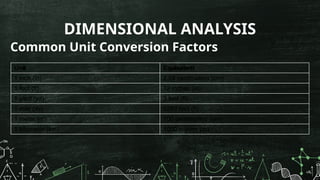
Common UnitConversion Factors
Unit Equivalent
1 inch (in) 2.54 centimeters (cm)
1 foot (ft) 12 inches (in)
1 yard (yd) 3 feet (ft)
1 mile (mi) 5280 feet (ft)
1 meter (m) 100 centimeters (cm)
1 kilometer (km) 1000 meters (m)
Unit Equivalent
1 inch (in) 2.54 centimeters (cm)
1 foot (ft) 12 inches (in)
1 yard (yd) 3 feet (ft)
1 mile (mi) 5280 feet (ft)
1 meter (m) 100 centimeters (cm)
1 kilometer (km) 1000 meters (m)
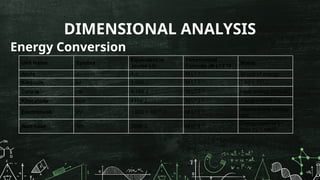
DIMENSIONAL ANALYSIS
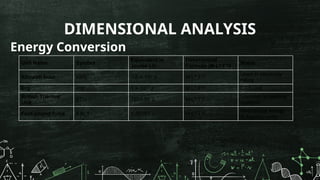
Energy Conversion
UnitName Symbol
Equivalent in
Joules (J)
Dimensional
Formula (M·L²·T ²)
⁻
Notes
Joule J 1 J M·L²·T ²
⁻ SI unit of energy
Kilojoule kJ 1,000 J M·L²·T ²
⁻ 1 kJ = 10³ J
Calorie cal 4.184 J M·L²·T ²
⁻ Heat energy (non-SI)
Kilocalorie kcal 4184 J M·L²·T ²
⁻ 1 kcal = 1000 cal
Electronvolt eV 1.602 × 10 ¹ J
⁻ ⁹ M·L²·T ²
⁻
Atomic scale energy
unit
Watt-hour Wh 3600 J M·L²·T ²
⁻
Energy used in 1
hour by 1 watt0
26.
DIMENSIONAL ANALYSIS
Energy Conversion
UnitName Symbol
Equivalent in
Joules (J)
Dimensional
Formula (M·L²·T ²)
⁻
Notes
Kilowatt-hour kWh 3.6 × 10 J
⁶ M·L²·T ²
⁻
Used in electricity
billing
Erg erg 1 × 10 J
⁻⁷ M·L²·T ²
⁻ CGS unit
British Thermal
Unit
BTU 1055.06 J M·L²·T ²
⁻
Common in heating
systems
Foot-pound force ft·lb_f 1.35582 J M·L²·T ²
⁻
Mechanical energy
in imperial units
27.
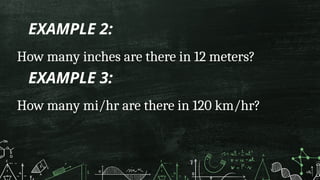
EXAMPLE 2:
How manyinches are there in 12 meters?
EXAMPLE 3:
How many mi/hr are there in 120 km/hr?
28.
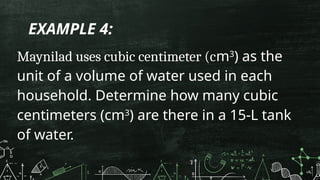
EXAMPLE 4:
Maynilad usescubic centimeter (cm3
) as the
unit of a volume of water used in each
household. Determine how many cubic
centimeters (cm3
) are there in a 15-L tank
of water.
29.
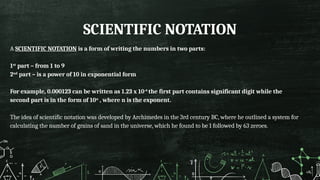
SCIENTIFIC NOTATION
A SCIENTIFICNOTATION is a form of writing the numbers in two parts:
1st
part – from 1 to 9
2nd
part – is a power of 10 in exponential form
For example, 0.000123 can be written as 1.23 x 10⁻⁴
the first part contains significant digit while the
second part is in the form of 10n
, where n is the exponent.
The idea of scientific notation was developed by Archimedes in the 3rd century BC, where he outlined a system for
calculating the number of grains of sand in the universe, which he found to be 1 followed by 63 zeroes.
Definitions
Precision: The degreeto which repeated
measurements under unchanged conditions
show the same results.
Accuracy: The degree to which a measurement
conforms to the correct value or a standard.
32.
Examples
A scalethat gives the same weight every time (e.g.,
5.00 kg) is precise.
A scale that gives the correct weight (e.g., 5.00 kg
when the true weight is 5.00 kg) is accurate.
It is possible to be precise but not accurate, and vice
versa.
33.
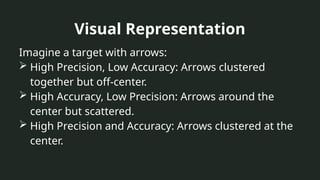
Visual Representation
Imagine atarget with arrows:
High Precision, Low Accuracy: Arrows clustered
together but off-center.
High Accuracy, Low Precision: Arrows around the
center but scattered.
High Precision and Accuracy: Arrows clustered at the
center.
34.
You alwayshave to make sure that you have reliable measurements. One
way to do this is by repeating the measurement several times. A reliable
measurement will give the same results under the same conditions. The
measurement is then precise, or it has high precision. Thus, a set of
measurements is precise when it is consistent. This means that the values
are close to one another. You can numerically describes the consistency
(precision) of measurements using variance. This measures how far or close
the measurements are from the mean (average).
Variance (2
) is defines as the average of the squared difference of the
measurements (x) from the mean ().
PRECISION AND ACCURACY
35.
THE FORMULAFOR Variance (2
) :
2
PRECISION AND ACCURACY
WHERE:
N = the number of
measurements done.
The square root of the
variance is the standard
deviation ()
36.
THE FORMULAFOR SEM :
S
STANDARD ERROR OF THE MEAN
(SEM):
THEN, YOU CAN WRITE THE
AVERAGE MEASUREMENT IN THE
FORM OF:
AVERAGE MEASUREMENT =
MEAN ± SEM
37.
THE FORMULAFOR RELATIVE SEM PERCENT :
R
RELATIVE SEM PERCENT
This formula is to identify the percent error of the mean.
38.
Find thevariance and the standard error of the mean in the following data:
[4, 8, 6, 5, 3]
EXAMPLE 1:
39.
Five ofyour classmates measured the diagonal length of the blackboard.
Classmate A measured it as 2.54 meters; Classmate B as 2.46 meters;
Classmate C as 2.65 meters; Classmate D as 2.55 meters; and Classmate E as
2.39 meters. Find the variance and the standard deviation of the
measurements. Express the average measurement in a form that includes
uncertainty.
EXAMPLE:
40.
Why It Matters
●• In scientific experiments, both precision and accuracy are essential for valid results.
● • Industries rely on accurate and precise measurements for quality control.
● • Understanding these concepts helps in improving methods and tools.
41.
Summary
● • Precisionand accuracy are distinct but related concepts.
● • Both are necessary for reliable measurement and data interpretation.
● • Aim for both in all scientific and technical work.








![ Find the variance and the standard error of the mean in the following data:
[4, 8, 6, 5, 3]
EXAMPLE 1:](https://image.slidesharecdn.com/physics-subject-for-high-school-newtons-laws-250702001006-84ea3f93/85/physics-subject-for-high-school-newtons-laws-pptx-38-320.jpg)