A-level Physics


Unit G481:
Mechanics


Units of
measurement
Units of measurement                       LOs


     To do - in pairs

     Write a list of units – names and symbols if possible – and as
     many as you can.


     To get you started:   the volt (symbol: V)


Motion
Lesson focus
  • Units of measurement


  Learning objectives
  At the end of the lesson you will be able to:

  • explain that some physical quantities consist of a numerical
    magnitude and a unit;
  • use correctly the named units listed in the specification;
  • use prefixes correctly;
  • make suitable estimates of physical quantities.


Motion
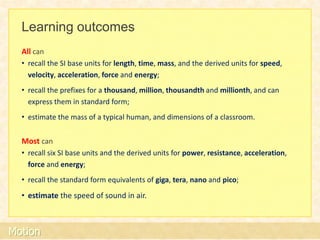
Learning outcomes
  All can
  • recall the SI base units for length, time, mass, and the derived units for speed,
    velocity, acceleration, force and energy;
  • recall the prefixes for a thousand, million, thousandth and millionth, and can
    express them in standard form;
  • estimate the mass of a typical human, and dimensions of a classroom.


  Most can
  • recall six SI base units and the derived units for power, resistance, acceleration,
    force and energy;
  • recall the standard form equivalents of giga, tera, nano and pico;
  • estimate the speed of sound in air.


Motion
Units of measurement                                  LOs


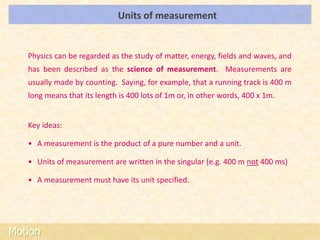
   Physics can be regarded as the study of matter, energy, fields and waves, and
   has been described as the science of measurement. Measurements are
   usually made by counting. Saying, for example, that a running track is 400 m
   long means that its length is 400 lots of 1m or, in other words, 400 x 1m.


   Key ideas:

   • A measurement is the product of a pure number and a unit.

   • Units of measurement are written in the singular (e.g. 400 m not 400 ms)

   • A measurement must have its unit specified.


Motion
Units of measurement                                LOs


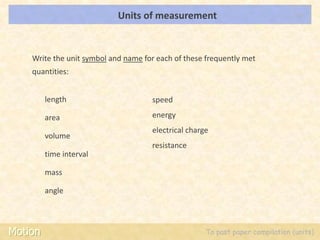
    Write the unit symbol and name for each of these frequently met
    quantities:


         length                      speed

         area                        energy
                                     electrical charge
         volume
                                     resistance
         time interval

         mass

         angle


Motion                                               To past paper compilation (units)
The SI system and base units                                 LOs


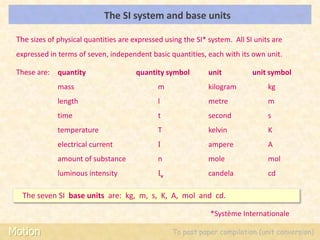
 The sizes of physical quantities are expressed using the SI* system. All SI units are
 expressed in terms of seven, independent basic quantities, each with its own unit.

 These are: quantity                   quantity symbol        unit          unit symbol
              mass                            m               kilogram           kg
              length                          l               metre              m
              time                            t               second             s
              temperature                     T               kelvin             K
              electrical current              I               ampere             A
              amount of substance             n               mole               mol
              luminous intensity              Iv              candela            cd

   The seven SI base units are: kg, m, s, K, A, mol and cd.

                                                               *Système Internationale

Motion                                             To past paper compilation (unit conversion)
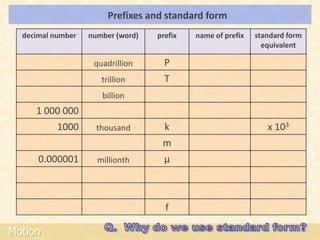
Prefixes and standard form                      LOs


  decimal number   number (word)   prefix   name of prefix   standard form
                                                               equivalent

                    quadrillion      P
                      trillion       T
                      billion
     1 000 000
           1000      thousand        k                          x 103
                                    m
      0.000001       millionth       μ


                                     f

Motion
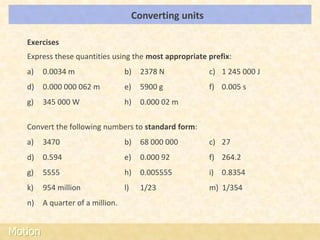
Converting units                    LOs


   Exercises
   Express these quantities using the most appropriate prefix:
   a)    0.0034 m                  b)    2378 N            c) 1 245 000 J
   d)    0.000 000 062 m           e)    5900 g            f) 0.005 s
   g)    345 000 W                 h)    0.000 02 m

   Convert the following numbers to standard form:
   a)    3470                      b)    68 000 000        c) 27
   d)    0.594                     e)    0.000 92          f) 264.2
   g)    5555                      h)    0.005555          i) 0.8354
   k)    954 million               l)    1/23              m) 1/354
   n)    A quarter of a million.


Motion
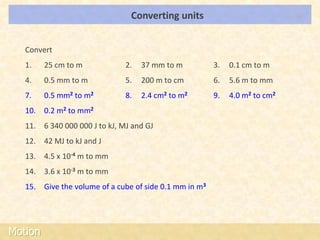
Converting units                             LOs


   Convert
   1.    25 cm to m            2.   37 mm to m          3.   0.1 cm to m
   4.    0.5 mm to m           5.   200 m to cm         6.   5.6 m to mm
   7.    0.5 mm2 to m2         8.   2.4 cm2 to m2       9.   4.0 m2 to cm2
   10. 0.2 m2 to mm2
   11. 6 340 000 000 J to kJ, MJ and GJ
   12. 42 MJ to kJ and J
   13. 4.5 x 10⁻⁴ m to mm
   14. 3.6 x 10⁻³ m to mm
   15. Give the volume of a cube of side 0.1 mm in m3


Motion
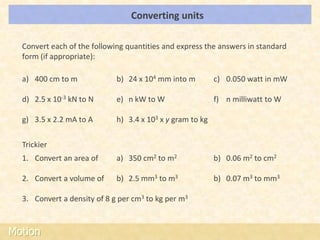
Converting units                                LOs


  Convert each of the following quantities and express the answers in standard
  form (if appropriate):

  a) 400 cm to m             b) 24 x 104 mm into m         c) 0.050 watt in mW

  d) 2.5 x 10⁻³ kN to N      e) n kW to W                  f) n milliwatt to W

  g) 3.5 x 2.2 mA to A       h) 3.4 x 10³ x y gram to kg

  Trickier
  1. Convert an area of      a) 350 cm2 to m2              b) 0.06 m2 to cm2

  2. Convert a volume of     b) 2.5 mm3 to m3              b) 0.07 m3 to mm3

  3. Convert a density of 8 g per cm3 to kg per m3


Motion
Derived units and base units                            LOs


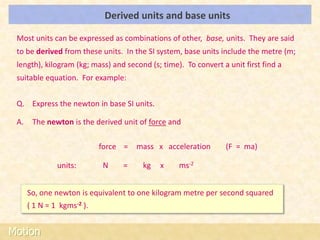
 Most units can be expressed as combinations of other, base, units. They are said
 to be derived from these units. In the SI system, base units include the metre (m;
 length), kilogram (kg; mass) and second (s; time). To convert a unit first find a
 suitable equation. For example:


 Q. Express the newton in base SI units.

 A.    The newton is the derived unit of force and

                            force =   mass x acceleration       (F = ma)

               units:       N    =     kg   x     ms-2


      So, one newton is equivalent to one kilogram metre per second squared
      ( 1 N = 1 kgms-2 ).


Motion
Derived units and base units      LOs


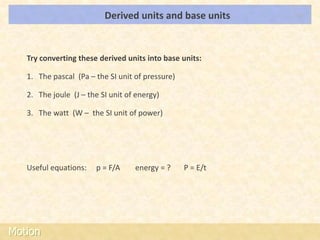
   Try converting these derived units into base units:

   1. The pascal (Pa – the SI unit of pressure)

   2. The joule (J – the SI unit of energy)

   3. The watt (W – the SI unit of power)


   Useful equations:   p = F/A     energy = ?     P = E/t


Motion
Derived units and base units                         LOs


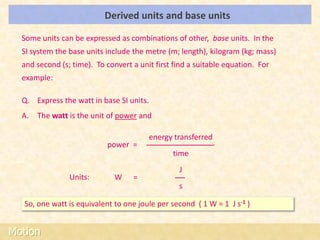
  Some units can be expressed as combinations of other, base units. In the
  SI system the base units include the metre (m; length), kilogram (kg; mass)
  and second (s; time). To convert a unit first find a suitable equation. For
  example:

  Q. Express the watt in base SI units.
  A.   The watt is the unit of power and

                                          energy transferred
                           power =
                                                time
                                                  J
                Units:        W    =
                                                  s

  So, one watt is equivalent to one joule per second ( 1 W = 1 J s-1 )


Motion
Derived units and base units                                 LOs


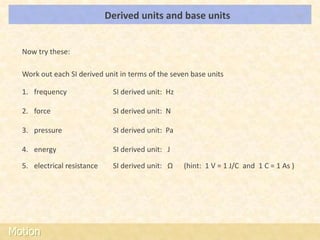
  Now try these:

  Work out each SI derived unit in terms of the seven base units

  1. frequency                SI derived unit: Hz

  2. force                    SI derived unit: N

  3. pressure                 SI derived unit: Pa

  4. energy                   SI derived unit: J

  5. electrical resistance    SI derived unit: Ω    (hint: 1 V = 1 J/C and 1 C = 1 As )


Motion
Estimation                                   LOs


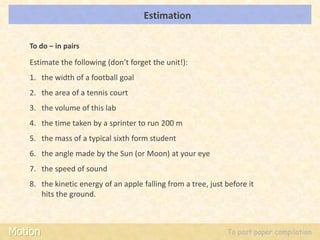
   To do – in pairs

   Estimate the following (don’t forget the unit!):
   1. the width of a football goal
   2. the area of a tennis court
   3. the volume of this lab
   4. the time taken by a sprinter to run 200 m
   5. the mass of a typical sixth form student
   6. the angle made by the Sun (or Moon) at your eye
   7. the speed of sound
   8. the kinetic energy of an apple falling from a tree, just before it
      hits the ground.


Motion                                                         To past paper compilation

Scientific units

  • 1.
  • 2.
    Units of measurement LOs To do - in pairs Write a list of units – names and symbols if possible – and as many as you can. To get you started: the volt (symbol: V) Motion
  • 3.
    Lesson focus • Units of measurement Learning objectives At the end of the lesson you will be able to: • explain that some physical quantities consist of a numerical magnitude and a unit; • use correctly the named units listed in the specification; • use prefixes correctly; • make suitable estimates of physical quantities. Motion
  • 4.
    Learning outcomes All can • recall the SI base units for length, time, mass, and the derived units for speed, velocity, acceleration, force and energy; • recall the prefixes for a thousand, million, thousandth and millionth, and can express them in standard form; • estimate the mass of a typical human, and dimensions of a classroom. Most can • recall six SI base units and the derived units for power, resistance, acceleration, force and energy; • recall the standard form equivalents of giga, tera, nano and pico; • estimate the speed of sound in air. Motion
  • 5.
    Units of measurement LOs Physics can be regarded as the study of matter, energy, fields and waves, and has been described as the science of measurement. Measurements are usually made by counting. Saying, for example, that a running track is 400 m long means that its length is 400 lots of 1m or, in other words, 400 x 1m. Key ideas: • A measurement is the product of a pure number and a unit. • Units of measurement are written in the singular (e.g. 400 m not 400 ms) • A measurement must have its unit specified. Motion
  • 6.
    Units of measurement LOs Write the unit symbol and name for each of these frequently met quantities: length speed area energy electrical charge volume resistance time interval mass angle Motion To past paper compilation (units)
  • 7.
    The SI systemand base units LOs The sizes of physical quantities are expressed using the SI* system. All SI units are expressed in terms of seven, independent basic quantities, each with its own unit. These are: quantity quantity symbol unit unit symbol mass m kilogram kg length l metre m time t second s temperature T kelvin K electrical current I ampere A amount of substance n mole mol luminous intensity Iv candela cd The seven SI base units are: kg, m, s, K, A, mol and cd. *Système Internationale Motion To past paper compilation (unit conversion)
  • 8.
    Prefixes and standardform LOs decimal number number (word) prefix name of prefix standard form equivalent quadrillion P trillion T billion 1 000 000 1000 thousand k x 103 m 0.000001 millionth μ f Motion
  • 9.
    Converting units LOs Exercises Express these quantities using the most appropriate prefix: a) 0.0034 m b) 2378 N c) 1 245 000 J d) 0.000 000 062 m e) 5900 g f) 0.005 s g) 345 000 W h) 0.000 02 m Convert the following numbers to standard form: a) 3470 b) 68 000 000 c) 27 d) 0.594 e) 0.000 92 f) 264.2 g) 5555 h) 0.005555 i) 0.8354 k) 954 million l) 1/23 m) 1/354 n) A quarter of a million. Motion
  • 10.
    Converting units LOs Convert 1. 25 cm to m 2. 37 mm to m 3. 0.1 cm to m 4. 0.5 mm to m 5. 200 m to cm 6. 5.6 m to mm 7. 0.5 mm2 to m2 8. 2.4 cm2 to m2 9. 4.0 m2 to cm2 10. 0.2 m2 to mm2 11. 6 340 000 000 J to kJ, MJ and GJ 12. 42 MJ to kJ and J 13. 4.5 x 10⁻⁴ m to mm 14. 3.6 x 10⁻³ m to mm 15. Give the volume of a cube of side 0.1 mm in m3 Motion
  • 11.
    Converting units LOs Convert each of the following quantities and express the answers in standard form (if appropriate): a) 400 cm to m b) 24 x 104 mm into m c) 0.050 watt in mW d) 2.5 x 10⁻³ kN to N e) n kW to W f) n milliwatt to W g) 3.5 x 2.2 mA to A h) 3.4 x 10³ x y gram to kg Trickier 1. Convert an area of a) 350 cm2 to m2 b) 0.06 m2 to cm2 2. Convert a volume of b) 2.5 mm3 to m3 b) 0.07 m3 to mm3 3. Convert a density of 8 g per cm3 to kg per m3 Motion
  • 12.
    Derived units andbase units LOs Most units can be expressed as combinations of other, base, units. They are said to be derived from these units. In the SI system, base units include the metre (m; length), kilogram (kg; mass) and second (s; time). To convert a unit first find a suitable equation. For example: Q. Express the newton in base SI units. A. The newton is the derived unit of force and force = mass x acceleration (F = ma) units: N = kg x ms-2 So, one newton is equivalent to one kilogram metre per second squared ( 1 N = 1 kgms-2 ). Motion
  • 13.
    Derived units andbase units LOs Try converting these derived units into base units: 1. The pascal (Pa – the SI unit of pressure) 2. The joule (J – the SI unit of energy) 3. The watt (W – the SI unit of power) Useful equations: p = F/A energy = ? P = E/t Motion
  • 14.
    Derived units andbase units LOs Some units can be expressed as combinations of other, base units. In the SI system the base units include the metre (m; length), kilogram (kg; mass) and second (s; time). To convert a unit first find a suitable equation. For example: Q. Express the watt in base SI units. A. The watt is the unit of power and energy transferred power = time J Units: W = s So, one watt is equivalent to one joule per second ( 1 W = 1 J s-1 ) Motion
  • 15.
    Derived units andbase units LOs Now try these: Work out each SI derived unit in terms of the seven base units 1. frequency SI derived unit: Hz 2. force SI derived unit: N 3. pressure SI derived unit: Pa 4. energy SI derived unit: J 5. electrical resistance SI derived unit: Ω (hint: 1 V = 1 J/C and 1 C = 1 As ) Motion
  • 16.
    Estimation LOs To do – in pairs Estimate the following (don’t forget the unit!): 1. the width of a football goal 2. the area of a tennis court 3. the volume of this lab 4. the time taken by a sprinter to run 200 m 5. the mass of a typical sixth form student 6. the angle made by the Sun (or Moon) at your eye 7. the speed of sound 8. the kinetic energy of an apple falling from a tree, just before it hits the ground. Motion To past paper compilation