DEFINITION OF UNITS AND
THE CONVERSION
FACTORS
ABDELATY AMER
DEFINITION OF UNITS AND
THE CONVERSION FACTORS

1
Importance and Types of Units

2
Fundamental Units and Prefixes

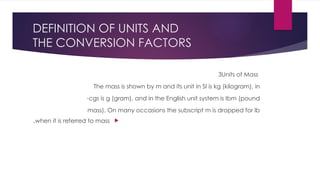
Units of Mass. 3

4
Units of Length

5
Units of Time

..
6
Units of Force

.
7
Units of Moles

8
Units of Molecular Weigh

9
Units of Pressure

10
Units of Temperature
DEFINITION OF UNITS AND
THE CONVERSION FACTORS
1
Importance and Types of Units
The petroleum industry and its research began and grew
Mainly in the United States during the last century. The rela
-
tions developed in the 1930s, 1940s, and 1950s were mainly
graphical. The best example of such methods is the Winn

nomogram developed in the late 1950s [86]
.
DEFINITION OF UNITS AND
THE CONVERSION FACTORS
.
2
Fundamental Units and Prefixes
Generally there are four fundamental quantities of length (L)
,
mass (M), time (t), and temperature (T) and when their units
are known, units of all other derived quantities can be deter
-
mined. In the SI system, units of length, mass, and tempera
-

ture are meter (m), kilogram (kg)
DEFINITION OF UNITS AND
THE CONVERSION FACTORS
3Units of Mass
The mass is shown by m and its unit in SI is kg (kilogram), in
cgs is g (gram), and in the English unit system is Ibm (pound
-
mass). On many occasions the subscript m is dropped for lb

when it is referred to mass
.
DEFINITION OF UNITS AND
THE CONVERSION FACTORS
4
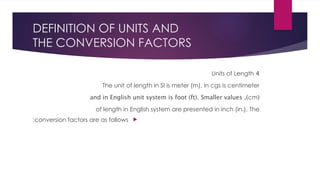
Units of Length
The unit of length in SI is meter (m), in cgs is centimeter
(
cm
,)
and in English unit system is foot (ft). Smaller values
of length in English system are presented in inch (in.). The

conversion factors are as follows
:
DEFINITION OF UNITS AND
THE CONVERSION FACTORS
.
5
Units of Time
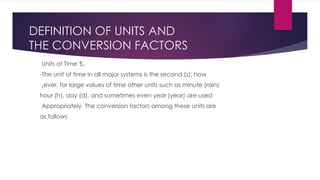
The unit of time in all major systems is the second (s); how
-
ever, for large values of time other units such as minute (rain)
,
hour (h), day (d), and sometimes even year (year) are used
Appropriately. The conversion factors among these units are
as follows
DEFINITION OF UNITS AND
THE CONVERSION FACTORS
6
Units of Force
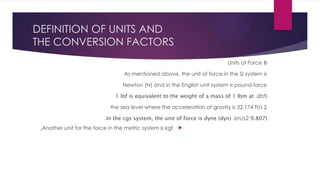
As mentioned above, the unit of force in the SI system is
Newton (N) and in the English unit system is pound-force
(
lbf
.)
1 lbf is equivalent to the weight of a mass of 1 lbm at
the sea level where the acceleration of gravity is 32.174 ft/s 2
(
9.807
m/s2
.)
In the cgs system, the unit of force is dyne (dyn)
.

Another unit for the force in the metric system is kgf
,
petroleum measurements and different units

petroleum measurements and different units

  • 1.
    DEFINITION OF UNITSAND THE CONVERSION FACTORS ABDELATY AMER
  • 2.
    DEFINITION OF UNITSAND THE CONVERSION FACTORS  1 Importance and Types of Units  2 Fundamental Units and Prefixes  Units of Mass. 3  4 Units of Length  5 Units of Time  .. 6 Units of Force  . 7 Units of Moles  8 Units of Molecular Weigh  9 Units of Pressure  10 Units of Temperature
  • 3.
    DEFINITION OF UNITSAND THE CONVERSION FACTORS 1 Importance and Types of Units The petroleum industry and its research began and grew Mainly in the United States during the last century. The rela - tions developed in the 1930s, 1940s, and 1950s were mainly graphical. The best example of such methods is the Winn  nomogram developed in the late 1950s [86] .
  • 4.
    DEFINITION OF UNITSAND THE CONVERSION FACTORS . 2 Fundamental Units and Prefixes Generally there are four fundamental quantities of length (L) , mass (M), time (t), and temperature (T) and when their units are known, units of all other derived quantities can be deter - mined. In the SI system, units of length, mass, and tempera -  ture are meter (m), kilogram (kg)
  • 5.
    DEFINITION OF UNITSAND THE CONVERSION FACTORS 3Units of Mass The mass is shown by m and its unit in SI is kg (kilogram), in cgs is g (gram), and in the English unit system is Ibm (pound - mass). On many occasions the subscript m is dropped for lb  when it is referred to mass .
  • 6.
    DEFINITION OF UNITSAND THE CONVERSION FACTORS 4 Units of Length The unit of length in SI is meter (m), in cgs is centimeter ( cm ,) and in English unit system is foot (ft). Smaller values of length in English system are presented in inch (in.). The  conversion factors are as follows :
  • 7.
    DEFINITION OF UNITSAND THE CONVERSION FACTORS . 5 Units of Time The unit of time in all major systems is the second (s); how - ever, for large values of time other units such as minute (rain) , hour (h), day (d), and sometimes even year (year) are used Appropriately. The conversion factors among these units are as follows
  • 8.
    DEFINITION OF UNITSAND THE CONVERSION FACTORS 6 Units of Force As mentioned above, the unit of force in the SI system is Newton (N) and in the English unit system is pound-force ( lbf .) 1 lbf is equivalent to the weight of a mass of 1 lbm at the sea level where the acceleration of gravity is 32.174 ft/s 2 ( 9.807 m/s2 .) In the cgs system, the unit of force is dyne (dyn) .  Another unit for the force in the metric system is kgf ,