CHEMICAL
PROCESS
PRINCIPLE-I
CHE-120
3 CREDIT HOURS Department of Chemical
Engineering,
Engr. Khurram Shahzad
LECTURE 3
Example1.2:
a. Convert 2km to miles.
b. Change 400 inch3/day to cm3/min.
Example1.3:
.
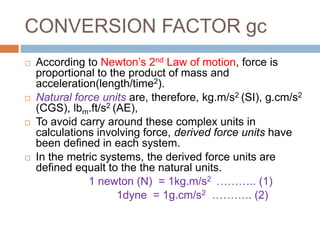
CONVERSION FACTOR gc
 According to Newton’s 2nd Law of motion, force is
proportional to the product of mass and
acceleration(length/time2).
 Natural force units are, therefore, kg.m/s2 (SI), g.cm/s2
(CGS), lbm.ft/s2 (AE),
 To avoid carry around these complex units in
calculations involving force, derived force units have
been defined in each system.
 In the metric systems, the derived force units are
defined equalt to the the natural units.
1 newton (N) = 1kg.m/s2 ……….. (1)
1dyne = 1g.cm/s2 ……….. (2)
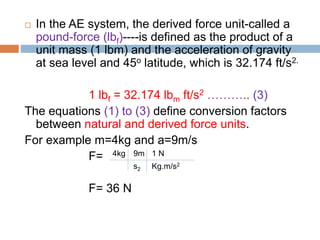
 In the AE system, the derived force unit-called a
pound-force (lbf)----is defined as the product of a
unit mass (1 lbm) and the acceleration of gravity
at sea level and 45o latitude, which is 32.174 ft/s2.
1 lbf = 32.174 lbm ft/s2 ……….. (3)
The equations (1) to (3) define conversion factors
between natural and derived force units.
For example m=4kg and a=9m/s
F=
F= 36 N
4kg 9m 1 N
s2 Kg.m/s2
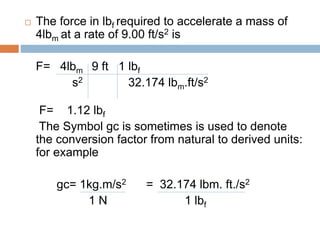
 The force in lbf required to accelerate a mass of
4lbm at a rate of 9.00 ft/s2 is
F= 4lbm 9 ft 1 lbf
s2 32.174 lbm.ft/s2
F= 1.12 lbf
The Symbol gc is sometimes is used to denote
the conversion factor from natural to derived units:
for example
gc= 1kg.m/s2 = 32.174 lbm. ft./s2
1 N 1 lbf
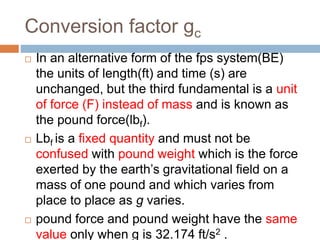
Conversion factor gc
 In an alternative form of the fps system(BE)
the units of length(ft) and time (s) are
unchanged, but the third fundamental is a unit
of force (F) instead of mass and is known as
the pound force(lbf).
 Lbf is a fixed quantity and must not be
confused with pound weight which is the force
exerted by the earth’s gravitational field on a
mass of one pound and which varies from
place to place as g varies.
 pound force and pound weight have the same
value only when g is 32.174 ft/s2 .
 Noted that
1slug= 32.174lbm
1 lbf = 32.174poundal
 Two units which have never been popular in
the two systems(foot pound second fps and
British Engineering system BE) are the
poundal (for force) and the slug(for mass).
 Both pound mass and pound force as a basic
units in same equation because they are the
units in common use.
 In the AE system the conversion of term
involve pound mass and pound force deserve
special attention.
 Let start with Newton’s law
F=C ma
Where F = force
C= a constant whose numerical value
and units depend on those selected for F, m
and a.
m= mass
a= acceleration
 In the SI system because the
numerical value associated with
conversion factor is 1, the conversion
factor seems simple, even
nonexistent, and the units are
ordinarily ignored.
 In the AE system an analogous
conversion factor is required.
 A numerical value of 1/32.174 for the
numerical value in the conversion
factor.
 The inverse of the conversion factor with the
numerical value 32.174 included is given the
special symbol gc.
gc =32.174 (ft)(lbm)/(lbf)(s2)
 The use of gc is essential in the AE system
when you need a conversion factor to adjust
units when both lbm and lbf are involved in a
calculation.
 AE system has the convenience that the
numerical value of a pound is also that a
pound force if the numerical of the ratio g/gc is
equal to 1, as it approximately in most cases.
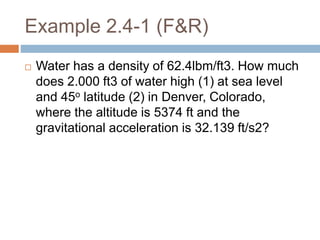
Example 2.4-1 (F&R)
 Water has a density of 62.4lbm/ft3. How much
does 2.000 ft3 of water high (1) at sea level
and 45o latitude (2) in Denver, Colorado,
where the altitude is 5374 ft and the
gravitational acceleration is 32.139 ft/s2?
Problems
Chemical principle processes

Chemical principle processes

  • 2.
    CHEMICAL PROCESS PRINCIPLE-I CHE-120 3 CREDIT HOURSDepartment of Chemical Engineering, Engr. Khurram Shahzad
  • 3.
  • 4.
    Example1.2: a. Convert 2kmto miles. b. Change 400 inch3/day to cm3/min. Example1.3: .
  • 5.
    CONVERSION FACTOR gc According to Newton’s 2nd Law of motion, force is proportional to the product of mass and acceleration(length/time2).  Natural force units are, therefore, kg.m/s2 (SI), g.cm/s2 (CGS), lbm.ft/s2 (AE),  To avoid carry around these complex units in calculations involving force, derived force units have been defined in each system.  In the metric systems, the derived force units are defined equalt to the the natural units. 1 newton (N) = 1kg.m/s2 ……….. (1) 1dyne = 1g.cm/s2 ……….. (2)
  • 6.
     In theAE system, the derived force unit-called a pound-force (lbf)----is defined as the product of a unit mass (1 lbm) and the acceleration of gravity at sea level and 45o latitude, which is 32.174 ft/s2. 1 lbf = 32.174 lbm ft/s2 ……….. (3) The equations (1) to (3) define conversion factors between natural and derived force units. For example m=4kg and a=9m/s F= F= 36 N 4kg 9m 1 N s2 Kg.m/s2
  • 7.
     The forcein lbf required to accelerate a mass of 4lbm at a rate of 9.00 ft/s2 is F= 4lbm 9 ft 1 lbf s2 32.174 lbm.ft/s2 F= 1.12 lbf The Symbol gc is sometimes is used to denote the conversion factor from natural to derived units: for example gc= 1kg.m/s2 = 32.174 lbm. ft./s2 1 N 1 lbf
  • 8.
    Conversion factor gc In an alternative form of the fps system(BE) the units of length(ft) and time (s) are unchanged, but the third fundamental is a unit of force (F) instead of mass and is known as the pound force(lbf).  Lbf is a fixed quantity and must not be confused with pound weight which is the force exerted by the earth’s gravitational field on a mass of one pound and which varies from place to place as g varies.  pound force and pound weight have the same value only when g is 32.174 ft/s2 .
  • 9.
     Noted that 1slug=32.174lbm 1 lbf = 32.174poundal  Two units which have never been popular in the two systems(foot pound second fps and British Engineering system BE) are the poundal (for force) and the slug(for mass).  Both pound mass and pound force as a basic units in same equation because they are the units in common use.
  • 10.
     In theAE system the conversion of term involve pound mass and pound force deserve special attention.  Let start with Newton’s law F=C ma Where F = force C= a constant whose numerical value and units depend on those selected for F, m and a. m= mass a= acceleration
  • 11.
     In theSI system because the numerical value associated with conversion factor is 1, the conversion factor seems simple, even nonexistent, and the units are ordinarily ignored.  In the AE system an analogous conversion factor is required.  A numerical value of 1/32.174 for the numerical value in the conversion factor.
  • 12.
     The inverseof the conversion factor with the numerical value 32.174 included is given the special symbol gc. gc =32.174 (ft)(lbm)/(lbf)(s2)  The use of gc is essential in the AE system when you need a conversion factor to adjust units when both lbm and lbf are involved in a calculation.  AE system has the convenience that the numerical value of a pound is also that a pound force if the numerical of the ratio g/gc is equal to 1, as it approximately in most cases.
  • 13.
    Example 2.4-1 (F&R) Water has a density of 62.4lbm/ft3. How much does 2.000 ft3 of water high (1) at sea level and 45o latitude (2) in Denver, Colorado, where the altitude is 5374 ft and the gravitational acceleration is 32.139 ft/s2?
  • 14.