SETTLING
AND
SEDIMENTATION
• Filtration versus settling and sedimentation:
Filtration
 The solid particles are removed from the slurry
by forcing the fluid through a filter medium, which
blocks the passage of the solid particles and allows the
filtrate to pass through.
Settling and sedimentation
 The particles are separated from the fluid by
forces acting on the particles.
Introduction (1/4)
• Applications of settling and sedimentation:
* Removal of solids from liquid sewage wastes
* Settling of solid food particles from a liquid food
Introduction (2/4)
• Free settling versus hindered settling:
Free settling
 A particle is at a sufficient distance from the
walls of the container and from other particles so that the
fall is not affected.
 Interference is less than 1% if the ratio of the particle
diameter to the container diameter is less than 1:200 or
if the particle concentration is less than 0.2 vol% in the
solution.
Hindered settling
 Occurred when the particles are crowded so that they
settle at a lower rate.
• What is sedimentation?
 The separation of a dilute slurry or suspension by
gravity settling into a clear fluid and a slurry of higher
solid content.
For a rigid particle of mass m moving in a fluid, there are
three forces acting on the body:
(1)Gravity force, Fg, acting downward
(2) Buoyant force, Fb, acting upward
s
sb
gm
gVF
ρ
ρ
ρ ==
where ρ = density of the fluid
ρs = density of the solid particle
Vs = volume of the particle
THEORY OF PARTICLE MOVEMENT THROUGH
A FLUID
mgFg =
For a rigid particle of mass m moving in a fluid, there are three forces acting
on the body:
THEORY OF PARTICLE MOVEMENT THROUGH A FLUID
(3) Drag force, FD, acting in opposite direction to the
particle motion
2
2
DD
v
ACF
ρ
=
where CD = the drag coefficient
A = the projected area of the particle
The resultant force equals the force due to acceleration.
2
2
D
v
AC
gm
mg
dt
dv
m
s
ρ
ρ
ρ
−−=
The falling of the body consists of two periods:
(1) The period of accelerated fall
 The initial acceleration period is usually very short,
of the order of a tenth of a second or so.
(2) The period of constant velocity fall
Set 0=
dt
dv
and solve the above equation for v.

AC
mg
vv
Ds
s
g
ρρ
ρρ )(2 −
==
* vg is called the free settling velocity or terminal velocity.
0
2
2
=−−=
v
AC
gm
mg
dt
dv
m D
s
ρ
ρ
ρ
THEORY OF PARTICLE MOVEMENT THROUGH A FLUID
AC
mg
vv
Ds
s
g
ρρ
ρρ )(2 −
==
For spherical particles of diameter d,
4
and
6
23
d
A
d
m s ππρ
==

D
s
g
C
dg
v
ρ
ρρ
3
)(4 −
=
THEORY OF PARTICLE MOVEMENT THROUGH A FLUID
The drag coefficient for rigid spheres has been shown to be
a function of the Reynolds number.
THEORY OF PARTICLE MOVEMENT THROUGH A FLUID
In the Stokes' law region (NRe < 1),
µρ /
2424
Re
D
vdN
C ==
gs
gss
g gv
ddvdg
C
dg
v )(
18243
)(4
3
)(4 2
D
ρρ
µµ
ρ
ρ
ρρ
ρ
ρρ
−=×
−
=
−
=
 g
d
v sg )(
18
2
ρρ
µ
−=
THEORY OF PARTICLE MOVEMENT THROUGH A FLUID
• Brownian motion: the random motion imparted to the
particle by collisions between the molecules of the fluid
surrounding the particle and the particle.
* If the particles are quite small, Brownian motion is
present.
 This movement of the particles in random
directions tends to suppress the effect of gravity.
 Settling of the particles may occur more slowly
or not at all.
THEORY OF PARTICLE MOVEMENT THROUGH A FLUID
• Brownian motion (continued)
* At particle sizes of a few micrometers, the Brownian
effect becomes appreciable and at sizes of less than
0.1 µm, the effect predominates.
 In very small particles, application of centrifugal
force helps reduce the effect of Brownian motion.
THEORY OF PARTICLE MOVEMENT THROUGH A FLUID
[Example] Many animal cells can be cultivated on the
external surface of dextran beads. These cell-laden beads
or “microcarriers” have a density of 1.02 g/cm3
and a
diameter of 150 µm. A 50-liter stirred tank is used to
cultivate cells grown on microcarriers to produce a viral
vaccine. After growth, the stirring is stopped and the
microcarriers are allowed to settle. The microcarrier-free
fluid is then withdrawn to isolate the vaccine. The tank has
a liquid height to diameter ratio of 1.5; the carrier-free
fluid has a density of 1.00 g/cm3
and a viscosity of 1.1 cP.
(a) Estimate the settling time by assuming that these beads
quickly reach their maximum terminal velocity. (b)
Estimate the time to reach this velocity.
g
d
v sg )(
18
2
ρρ
µ
−=Hint:
(To be continued)
Example: settling of dextran beads
Data: d = 150 µm = 0.015 cm; µ = 1.1 cP = 0.011 g/cm-s; ρs = 1.02
g/cm3
; ρ = 1.00 g/cm3
; g = 980 cm/s2
Solution:
g
d
v sg )(
18
2
ρρ
µ
−=
(a) Estimate the settling time by assuming that these beads quickly
reach their maximum terminal velocity.
 vg = 0.022 cm/s
Check: 103.0
011.0
015.0022.01
Re <=
××
==
µ
ρvd
N
Liquid volume, V L50
5.144
22
=





=×





= h
h
h
dt ππ
 h = 52.3 cm  Settling time s2379
cm/s0.22
cm3.52
===
gv
h
(To be continued)
(b) Estimate the time to reach the terminal velocity.
Solution (cont’d):
Force balance:
2
2
v
AC
gm
mg
dt
dv
m D
s
ρ
ρ
ρ
−−=
6
3
sd
m
ρπ
= vd
vd
vd
v
ACD µπ
ρπ
ρ
µρ
3
24
24
2
222
=

















=;
ss d
vg
g
dt
dv
ρ
µ
ρ
ρ
2
18
−−=
gv
ddt
dv
ss






−=+
ρ
ρ
ρ
µ
1
18
2 (I.C.: t = 0, v = 0)















 −
−−= t
d
g
d
v
s
s
ρ
µ
ρρ
µ 2
2
18
exp1)(
18

Example: settling of dextran beads
(To be continued)















 −
−−= t
d
g
d
v
s
s
ρ
µ
ρρ
µ 2
2
18
exp1)(
18
At steady state (t → ∞), g
d
vv sg )(
18
2
ρρ
µ
−==
 When
 When t >> 1.16 × 10⁻³
s, v = vg
g2
,1
18
vv
d
t
s
=>>
ρ
µ
 For v = 0.99vg, t = 5.34 × 10⁻³
s
#
(b) Estimate the time to reach the terminal velocity.
Solution (cont’d):
Example: settling of dextran beads
ISOPYCNIC (SAME-DENSITY) SEDIMENTATION
 To capture particles in a solution having density gradient.
 Application: determining the density of the solute or
suspended particle.
* There are three methods for establishing conditions for
isopycnic sedimentation:
(1) Layer solutions of decreasing density, starting at the
bottom of the tube.
(2) Centrifuge the solution containing a density-forming
solute (such as CsCl) at extremely high speed.
(3) Use the gradient mixing method.
[Example] You wish to capture 3 µm particles in a linear
density gradient having a density of 1.12 g/cm3
at the
bottom and 1.00 g/cm3
at the top. You layer a thin particle
suspension on the top of the 6 cm column of fluid with a
viscosity of 1.0 cp and allow particles to settle at 1 g. How
long must you wait for the particles you want (density =
1.07 g/cm3
) to sediment to within 0.1 cm of their isopycnic
level? Is it possible to determine the time required for
particles to sediment to exactly their isopycnic level?
Solution:
(a)
g
d
dt
dx
v s )(
18
2
ρρ
µ
−==
ρρ
µ
−
=
s
dx
gd
dt
18
2
(To be continued)
ρρ
µ
−
=
s
dx
gd
dt
18
2
The dependence of liquid density ρ on the distance x is:
xx 02.000.1
6
00.112.1
00.1 +=
−
+=ρ
The isopycnic level of ρ = 1.07 g/cm3
is:
cm5.3
02.0
00.107.1
=
−
=x
The time needed for the particle to sediment to 3.4 cm can
be obtained from:
∫∫ −
=
3.4
0
2
0
18
ρρ
µ
s
t
dx
gd
dt
(To be continued)
∫∫ −
=
3.4
0
2
0
18
ρρ
µ
s
t
dx
gd
dt
( ) ∫ +−××
×
= −
3.4
0
24 )02.000.1(07.1980103
01.018
x
dx
t
∫ −
−
−
=
4.3
0
02.007.0
)02.007.0(
02.0
2041
x
xd

h100.8s823,362
07.0
002.0
ln
02.0
2041
==−=
(b) It is not possible to determine the time required for
particles to sediment to exactly their isopycnic level (3.5
cm).
#
DIFFERENTIAL SETTLING (or CLASSIFICATION)
 Separation of solid particles into several size
fractions based upon the settling velocities in a medium.
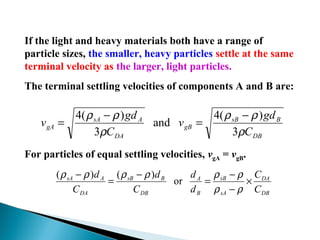
If the light and heavy materials both have a range of
particle sizes, the smaller, heavy particles settle at the same
terminal velocity as the larger, light particles.
The terminal settling velocities of components A and B are:
DB
BsB
gB
DA
AsA
gA
C
gd
v
C
gd
v
ρ
ρρ
ρ
ρρ
3
)(4
and
3
)(4 −
=
−
=
For particles of equal settling velocities, vgA = vgB.
DB
DA
sA
sB
B
A
DB
BsB
DA
AsA
C
C
d
d
C
d
C
d
×
−
−
=
−
=
−
ρρ
ρρρρρρ
or
)()(
DB
DA
sA
sB
B
A
C
C
d
d
×
−
−
=
ρρ
ρρ
In the turbulent Newton's law region, CD is constant.
ρρ
ρρ
−
−
=
sA
sB
B
A
d
d

BgB
DB
AgA
DA
dv
C
dv
C
ρ
µ
ρ
µ 24
and
24
==
For laminar Stokes’ law settling,
5.0






−
−
=
ρρ
ρρ
sA
sB
B
A
d
d

DB
DA
sA
sB
B
A
C
C
d
d
×
−
−
=
ρρ
ρρ
A
B
sA
sB
DB
DA
sA
sB
B
A
d
d
C
C
d
d
×
−
−
=×
−
−
=
ρρ
ρρ
ρρ
ρρ
DB
DA
sA
sB
B
A
C
C
d
d
×
−
−
=
ρρ
ρρ
In the turbulent Newton's law region, CD is constant,
ρρ
ρρ
−
−
=
sA
sB
B
A
d
d
For laminar Stokes’ law settling,
5.0






−
−
=
ρρ
ρρ
sA
sB
B
A
d
d
For transition flow between laminar and turbulent flow,
1
2
1
where <<





−
−
= n
d
d
n
sA
sB
B
A
ρρ
ρρ
• Settling a mixture of particles of materials A (the
heavier) and B (the lighter) with a size range of d1 to d4
for both types of material:
* Size range dA3 to dA4:
pure fraction of A
 No B particles
settle as fast as
the A particles in
this size range.
* Size range dB1 to dB2:
pure fraction of B
 No particles of A
settle as slowly.
* Size range of A particles from dA1 to dA3 and size range of B
particles from dB2 to dB4: form a mixed fraction of A and B
* Increasing the density ρ of the medium.
 The spread between dA and dB is increased.
[Example] A mixture of silica and galena ( 方鉛礦 ; PbS)
solid particles having a size range of 5.21 × 10⁻⁶
m to 2.50 ×
10-5
m is to be separated by hydraulic classification using
free settling conditions in water at 20°C. The specific
gravity of silica is 2.65 and that of galena is 7.5. Calculate
the size range of the various fractions obtained in the
settling. The water viscosity at 20°C is 1.005 × 10⁻³
Pa-s.
Solution: A particles: galena; B particles: silica
Assuming Stokes’ law settling, g
d
v sg )(
18
2
ρρ
µ
−=
 Check the validity of the Stokes’ law region.
(To be continued)
Solution (cont’d):
For the largest particle and the biggest density,
dA = 2.50 × 10⁻⁵
m and ρsA = 7.5 g/cm3
= 7500 kg/m3
g
d
v sg )(
18
2
ρρ
µ
−=
m/s1020.2)8.9)(10007500(
)10005.1(18
)1050.2( 3
3
25
gA
−
−
−
×=−
×
×
=v
Check
:
3
53
Re
10005.1
)1050.2)(1020.2(1000
−
−−
×
××
==
µ
ρvd
N = 0.0547 < 1
 O.K. with the Stokes’ law region.
(To be continued)
5.0
4
3






−
−
=
ρρ
ρρ
sA
sB
B
A
d
d
5.0
5
3
15.7
165.2
1050.2






−
−
=
× −
Ad

 dA3 = 1.260 × 10⁻⁵
m
The size range of pure A (galena) is:
dA3 = 1.260 × 10⁻⁵
m to dA4 = 2.50 × 10⁻⁵
m
For particles of equal settling
velocities,
Solution (cont’d):
5.0






−
−
=
ρρ
ρρ
sA
sB
B
A
d
d
(To be continued)

 dB2 = 1.033 × 10⁻⁵
m
The size range of pure B (silica) is:
dB1 = 5.21 × 10⁻⁶
m to dB2 = 1.033 × 10⁻⁵
m
5.0
2
1






−
−
=
ρρ
ρρ
sA
sB
B
A
d
d
5.0
2
6
15.7
165.21021.5






−
−
=
× −
Bd
The mixed-fraction size range is:
dA1 = 5.21 × 10⁻⁶
m to dA3 = 1.260 × 10⁻⁵
m
dB2 = 1.033 × 10⁻⁵
m to dB4 = 2.50 × 10⁻⁵
m
Solution (cont’d):
#
Bs 4-sedimentation

Bs 4-sedimentation

  • 1.
  • 2.
    • Filtration versussettling and sedimentation: Filtration  The solid particles are removed from the slurry by forcing the fluid through a filter medium, which blocks the passage of the solid particles and allows the filtrate to pass through. Settling and sedimentation  The particles are separated from the fluid by forces acting on the particles. Introduction (1/4)
  • 3.
    • Applications ofsettling and sedimentation: * Removal of solids from liquid sewage wastes * Settling of solid food particles from a liquid food Introduction (2/4)
  • 4.
    • Free settlingversus hindered settling: Free settling  A particle is at a sufficient distance from the walls of the container and from other particles so that the fall is not affected.  Interference is less than 1% if the ratio of the particle diameter to the container diameter is less than 1:200 or if the particle concentration is less than 0.2 vol% in the solution. Hindered settling  Occurred when the particles are crowded so that they settle at a lower rate.
  • 5.
    • What issedimentation?  The separation of a dilute slurry or suspension by gravity settling into a clear fluid and a slurry of higher solid content.
  • 6.
    For a rigidparticle of mass m moving in a fluid, there are three forces acting on the body: (1)Gravity force, Fg, acting downward (2) Buoyant force, Fb, acting upward s sb gm gVF ρ ρ ρ == where ρ = density of the fluid ρs = density of the solid particle Vs = volume of the particle THEORY OF PARTICLE MOVEMENT THROUGH A FLUID mgFg =
  • 7.
    For a rigidparticle of mass m moving in a fluid, there are three forces acting on the body: THEORY OF PARTICLE MOVEMENT THROUGH A FLUID (3) Drag force, FD, acting in opposite direction to the particle motion 2 2 DD v ACF ρ = where CD = the drag coefficient A = the projected area of the particle The resultant force equals the force due to acceleration. 2 2 D v AC gm mg dt dv m s ρ ρ ρ −−=
  • 8.
    The falling ofthe body consists of two periods: (1) The period of accelerated fall  The initial acceleration period is usually very short, of the order of a tenth of a second or so. (2) The period of constant velocity fall Set 0= dt dv and solve the above equation for v.  AC mg vv Ds s g ρρ ρρ )(2 − == * vg is called the free settling velocity or terminal velocity. 0 2 2 =−−= v AC gm mg dt dv m D s ρ ρ ρ THEORY OF PARTICLE MOVEMENT THROUGH A FLUID
  • 9.
    AC mg vv Ds s g ρρ ρρ )(2 − == Forspherical particles of diameter d, 4 and 6 23 d A d m s ππρ ==  D s g C dg v ρ ρρ 3 )(4 − = THEORY OF PARTICLE MOVEMENT THROUGH A FLUID
  • 10.
    The drag coefficientfor rigid spheres has been shown to be a function of the Reynolds number. THEORY OF PARTICLE MOVEMENT THROUGH A FLUID
  • 11.
    In the Stokes'law region (NRe < 1), µρ / 2424 Re D vdN C == gs gss g gv ddvdg C dg v )( 18243 )(4 3 )(4 2 D ρρ µµ ρ ρ ρρ ρ ρρ −=× − = − =  g d v sg )( 18 2 ρρ µ −= THEORY OF PARTICLE MOVEMENT THROUGH A FLUID
  • 12.
    • Brownian motion:the random motion imparted to the particle by collisions between the molecules of the fluid surrounding the particle and the particle. * If the particles are quite small, Brownian motion is present.  This movement of the particles in random directions tends to suppress the effect of gravity.  Settling of the particles may occur more slowly or not at all. THEORY OF PARTICLE MOVEMENT THROUGH A FLUID
  • 13.
    • Brownian motion(continued) * At particle sizes of a few micrometers, the Brownian effect becomes appreciable and at sizes of less than 0.1 µm, the effect predominates.  In very small particles, application of centrifugal force helps reduce the effect of Brownian motion. THEORY OF PARTICLE MOVEMENT THROUGH A FLUID
  • 14.
    [Example] Many animalcells can be cultivated on the external surface of dextran beads. These cell-laden beads or “microcarriers” have a density of 1.02 g/cm3 and a diameter of 150 µm. A 50-liter stirred tank is used to cultivate cells grown on microcarriers to produce a viral vaccine. After growth, the stirring is stopped and the microcarriers are allowed to settle. The microcarrier-free fluid is then withdrawn to isolate the vaccine. The tank has a liquid height to diameter ratio of 1.5; the carrier-free fluid has a density of 1.00 g/cm3 and a viscosity of 1.1 cP. (a) Estimate the settling time by assuming that these beads quickly reach their maximum terminal velocity. (b) Estimate the time to reach this velocity. g d v sg )( 18 2 ρρ µ −=Hint: (To be continued)
  • 15.
    Example: settling ofdextran beads Data: d = 150 µm = 0.015 cm; µ = 1.1 cP = 0.011 g/cm-s; ρs = 1.02 g/cm3 ; ρ = 1.00 g/cm3 ; g = 980 cm/s2 Solution: g d v sg )( 18 2 ρρ µ −= (a) Estimate the settling time by assuming that these beads quickly reach their maximum terminal velocity.  vg = 0.022 cm/s Check: 103.0 011.0 015.0022.01 Re <= ×× == µ ρvd N Liquid volume, V L50 5.144 22 =      =×      = h h h dt ππ  h = 52.3 cm  Settling time s2379 cm/s0.22 cm3.52 === gv h (To be continued)
  • 16.
    (b) Estimate thetime to reach the terminal velocity. Solution (cont’d): Force balance: 2 2 v AC gm mg dt dv m D s ρ ρ ρ −−= 6 3 sd m ρπ = vd vd vd v ACD µπ ρπ ρ µρ 3 24 24 2 222 =                  =; ss d vg g dt dv ρ µ ρ ρ 2 18 −−= gv ddt dv ss       −=+ ρ ρ ρ µ 1 18 2 (I.C.: t = 0, v = 0)                 − −−= t d g d v s s ρ µ ρρ µ 2 2 18 exp1)( 18  Example: settling of dextran beads (To be continued)
  • 17.
                    − −−= t d g d v s s ρ µ ρρ µ2 2 18 exp1)( 18 At steady state (t → ∞), g d vv sg )( 18 2 ρρ µ −==  When  When t >> 1.16 × 10⁻³ s, v = vg g2 ,1 18 vv d t s =>> ρ µ  For v = 0.99vg, t = 5.34 × 10⁻³ s # (b) Estimate the time to reach the terminal velocity. Solution (cont’d): Example: settling of dextran beads
  • 18.
    ISOPYCNIC (SAME-DENSITY) SEDIMENTATION To capture particles in a solution having density gradient.  Application: determining the density of the solute or suspended particle. * There are three methods for establishing conditions for isopycnic sedimentation: (1) Layer solutions of decreasing density, starting at the bottom of the tube. (2) Centrifuge the solution containing a density-forming solute (such as CsCl) at extremely high speed. (3) Use the gradient mixing method.
  • 19.
    [Example] You wishto capture 3 µm particles in a linear density gradient having a density of 1.12 g/cm3 at the bottom and 1.00 g/cm3 at the top. You layer a thin particle suspension on the top of the 6 cm column of fluid with a viscosity of 1.0 cp and allow particles to settle at 1 g. How long must you wait for the particles you want (density = 1.07 g/cm3 ) to sediment to within 0.1 cm of their isopycnic level? Is it possible to determine the time required for particles to sediment to exactly their isopycnic level? Solution: (a) g d dt dx v s )( 18 2 ρρ µ −== ρρ µ − = s dx gd dt 18 2 (To be continued)
  • 20.
    ρρ µ − = s dx gd dt 18 2 The dependence ofliquid density ρ on the distance x is: xx 02.000.1 6 00.112.1 00.1 += − +=ρ The isopycnic level of ρ = 1.07 g/cm3 is: cm5.3 02.0 00.107.1 = − =x The time needed for the particle to sediment to 3.4 cm can be obtained from: ∫∫ − = 3.4 0 2 0 18 ρρ µ s t dx gd dt (To be continued)
  • 21.
    ∫∫ − = 3.4 0 2 0 18 ρρ µ s t dx gd dt ( )∫ +−×× × = − 3.4 0 24 )02.000.1(07.1980103 01.018 x dx t ∫ − − − = 4.3 0 02.007.0 )02.007.0( 02.0 2041 x xd  h100.8s823,362 07.0 002.0 ln 02.0 2041 ==−= (b) It is not possible to determine the time required for particles to sediment to exactly their isopycnic level (3.5 cm). #
  • 22.
    DIFFERENTIAL SETTLING (orCLASSIFICATION)  Separation of solid particles into several size fractions based upon the settling velocities in a medium.
  • 23.
    If the lightand heavy materials both have a range of particle sizes, the smaller, heavy particles settle at the same terminal velocity as the larger, light particles. The terminal settling velocities of components A and B are: DB BsB gB DA AsA gA C gd v C gd v ρ ρρ ρ ρρ 3 )(4 and 3 )(4 − = − = For particles of equal settling velocities, vgA = vgB. DB DA sA sB B A DB BsB DA AsA C C d d C d C d × − − = − = − ρρ ρρρρρρ or )()(
  • 24.
    DB DA sA sB B A C C d d × − − = ρρ ρρ In the turbulentNewton's law region, CD is constant. ρρ ρρ − − = sA sB B A d d  BgB DB AgA DA dv C dv C ρ µ ρ µ 24 and 24 == For laminar Stokes’ law settling, 5.0       − − = ρρ ρρ sA sB B A d d  DB DA sA sB B A C C d d × − − = ρρ ρρ A B sA sB DB DA sA sB B A d d C C d d × − − =× − − = ρρ ρρ ρρ ρρ
  • 25.
    DB DA sA sB B A C C d d × − − = ρρ ρρ In the turbulentNewton's law region, CD is constant, ρρ ρρ − − = sA sB B A d d For laminar Stokes’ law settling, 5.0       − − = ρρ ρρ sA sB B A d d For transition flow between laminar and turbulent flow, 1 2 1 where <<      − − = n d d n sA sB B A ρρ ρρ
  • 26.
    • Settling amixture of particles of materials A (the heavier) and B (the lighter) with a size range of d1 to d4 for both types of material: * Size range dA3 to dA4: pure fraction of A  No B particles settle as fast as the A particles in this size range. * Size range dB1 to dB2: pure fraction of B  No particles of A settle as slowly.
  • 27.
    * Size rangeof A particles from dA1 to dA3 and size range of B particles from dB2 to dB4: form a mixed fraction of A and B * Increasing the density ρ of the medium.  The spread between dA and dB is increased.
  • 28.
    [Example] A mixtureof silica and galena ( 方鉛礦 ; PbS) solid particles having a size range of 5.21 × 10⁻⁶ m to 2.50 × 10⁻⁵ m is to be separated by hydraulic classification using free settling conditions in water at 20°C. The specific gravity of silica is 2.65 and that of galena is 7.5. Calculate the size range of the various fractions obtained in the settling. The water viscosity at 20°C is 1.005 × 10⁻³ Pa-s. Solution: A particles: galena; B particles: silica Assuming Stokes’ law settling, g d v sg )( 18 2 ρρ µ −=  Check the validity of the Stokes’ law region. (To be continued)
  • 29.
    Solution (cont’d): For thelargest particle and the biggest density, dA = 2.50 × 10⁻⁵ m and ρsA = 7.5 g/cm3 = 7500 kg/m3 g d v sg )( 18 2 ρρ µ −= m/s1020.2)8.9)(10007500( )10005.1(18 )1050.2( 3 3 25 gA − − − ×=− × × =v Check : 3 53 Re 10005.1 )1050.2)(1020.2(1000 − −− × ×× == µ ρvd N = 0.0547 < 1  O.K. with the Stokes’ law region. (To be continued)
  • 30.
    5.0 4 3       − − = ρρ ρρ sA sB B A d d 5.0 5 3 15.7 165.2 1050.2       − − = × − Ad   dA3= 1.260 × 10⁻⁵ m The size range of pure A (galena) is: dA3 = 1.260 × 10⁻⁵ m to dA4 = 2.50 × 10⁻⁵ m For particles of equal settling velocities, Solution (cont’d): 5.0       − − = ρρ ρρ sA sB B A d d (To be continued)
  • 31.
      dB2 =1.033 × 10⁻⁵ m The size range of pure B (silica) is: dB1 = 5.21 × 10⁻⁶ m to dB2 = 1.033 × 10⁻⁵ m 5.0 2 1       − − = ρρ ρρ sA sB B A d d 5.0 2 6 15.7 165.21021.5       − − = × − Bd The mixed-fraction size range is: dA1 = 5.21 × 10⁻⁶ m to dA3 = 1.260 × 10⁻⁵ m dB2 = 1.033 × 10⁻⁵ m to dB4 = 2.50 × 10⁻⁵ m Solution (cont’d): #