Analysis 101
Brian Wells
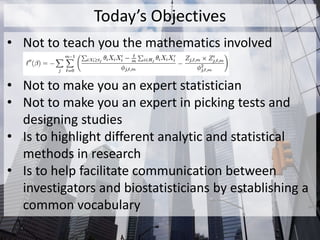
Today’s Objectives
• Not to teach you the mathematics involved
• Not to make you an expert statistician
• Not to make you an expert in picking tests and
designing studies
• Is to highlight different analytic and statistical
methods in research
• Is to help facilitate communication between
investigators and biostatisticians by establishing a
common vocabulary
Data Types
• Numerical data (quantitative)
• Measurements or counts
• Weight, blood pressure, number of medications
• Categorical data (qualitative)
• Patients sorted into categories
• Diabetic/non-diabetic
• Adherent/non-adherent
• Smoking/non-smoking
Categorical Data
• Nominal
• No explicit ordering to categories
• Blood types – A/B/AB/O
• Race/Ethnicity
• Called binary or dichotomous if 2 categories
• Gender – M/F
• Ordinal
• Defined ordering
• Cancer stage I, II, III, IV
• Non-smoker/smoker/ex-smoker
• NYHA Class
Numerical Data
• Can be further subdivided into discrete and
continuous
• Discrete variables
• Have a limited number of possible values (finite or
countably infinite)
• Gaps between possible values (whole integers)
• Ex: Number of CHF episodes, number of medications
• Continuous variables
• No gaps between possible values
• Ex: Duration of seizure, body mass index, height
Determining Data Types
• Ordinal (Categorical) v. Discrete (Numerical)
• Ordinal
• Cancer Stage I, II, III, IV
• Cancer Stage II is not 2*Stage I
• Discrete
• Number of children: 0, 1, 2…
• 4 children = 2 times 2 children
So Why Spend Time On This?
• The data types help determine which analysis to
use
• It helps determine how best to summarize the
display data
• Categorical – percent's, fractions, numbers in
categories
• Numerical – mean, median, mode, standard
deviation, variance, quartile ranges
Data Summaries
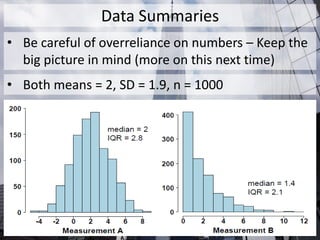
• Be careful of overreliance on numbers – Keep the
big picture in mind (more on this next time)
• Both means = 2, SD = 1.9, n = 1000
Statistical Inference
• Estimation of quantity of interest
• Estimate itself
• Quantify how good an estimate it is
• Ex: If you took more and more samples, how much
would the estimate vary?
• Hypothesis testing
Statistical Inference Example
• Proportion of people in a population who have diabetes.
N = 800
• Sample 1: 200/800 = 0.25
• We conclude that the estimated % of people with
diabetes is 25%
• But how variable is our estimate?
• We need to know the sampling distribution!
• Option 1: Take lots and lots of samples
• Sample 2: 215/800 = 26.8%
• Sample 3: 194/800 = 24.25%
• Not practical!
Statistical Inference Example
• Statistical theory
• Sample distributions for means and proportions are
normally “bell-shaped”
• From a single sample, we calculate the standard error
(variability) of our estimated mean or proportion
• Standard error measures the variability of the sample
statistic. Small SE means more precise estimate.
• SE ≠ Standard Deviation
• SD = variability of the sample data
• SE = variability of the statistic
Distributions
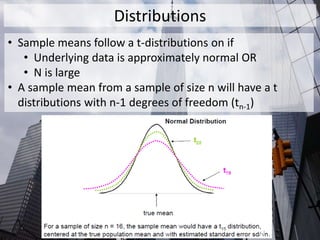
• Sample means follow a t-distributions on if
• Underlying data is approximately normal OR
• N is large
• A sample mean from a sample of size n will have a t
distributions with n-1 degrees of freedom (tn-1)
Confidence Intervals
• Assume we use our t15 distribution with n = 16, mean SBP
= 123.4 mm Hg, and SD = 14.0 mm Hg
• SE of mean = SD / √n = 3.5
• 95% CI for sample mean is then
• Mean + 2.131 (for t15 distribution) * SE
• = 123.4 ± 2.131 * SE
• = (115.9, 130.8) mm Hg
• And as N gets larger, t statistic gets smaller (t99 = 1.984),
which with the same numbers as above but with N = 100,
CI narrows to (120.6, 126.2)
• Note: It’s never incorrect to use a t-distribution as long as
the underlying population is normal or N is large
Hypothesis Testing
• Confidence intervals told us the best estimate and the
variability of the best estimate
• Hypothesis testing tells us if there really is a difference
between an observed value and another value
• From our earlier example: N = 800, we estimated that
25% of people had diabetes
• Let’s say a study 10 years prior estimated that 12% of
people had diabetes
• Has the percent of people with diabetes really changed?
Hypothesis Testing
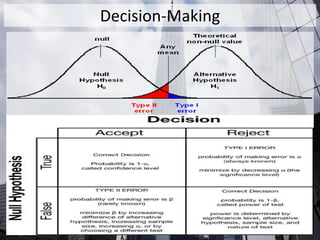
• Support the true percent of people with diabetes is 12%
• Called the null hypothesis or H0
• How likely is it that we would observe a result as or more
extreme than 25% given the true percent is 12%?
• This is the p-value, computed using normal distributions for
sample proportions and t-distribution for sample means
• If the probability is small, consult the supposition may not be
right
• Reject the null hypothesis in favor of the alternate
hypothesis Ha
• If the probability is not small, conclude that there is
insufficient evidence to reject the null hypothesis
• This is NOT the same as accepting the null or showing the
null hypothesis is true
Hypothesis Testing
• H0: True proportion is 12%
• Ha: True proportion is not 12%
• If P < 0.05, we would conclude it is not likely to observe
our data is the true proportion was 12%
• We conclude that this is sufficient evidence that the
proportion with diabetes is not 12%
• Test can be one-sided or two-sided
• One-sided ONLY ok if previous research suggests that the
proportion is larger
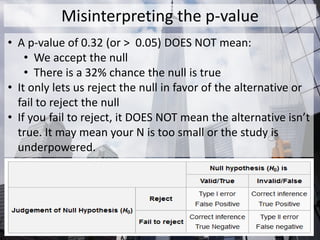
Misinterpreting the p-value
• A p-value of 0.32 (or > 0.05) DOES NOT mean:
• We accept the null
• There is a 32% chance the null is true
• It only lets us reject the null in favor of the alternative or
fail to reject the null
• If you fail to reject, it DOES NOT mean the alternative isn’t
true. It may mean your N is too small or the study is
underpowered.
Decision-Making
Other Statistics
• Some statistics are distribution-free
• Recall that t-tests/distributions depend on normality or
large N’s
• What is we don’t have one or both of these, ex: skewed
data, N is small
• We can use nonparametric methods that look at ranks,
not means
• The median is a nonparametric estimate
Nonparametric Methods
• Don’t require a particular distribution
• Well-suited to hypothesis testing
• Not as useful for point estimates or Cis
• Especially useful is data is ranks or scores – Apgar scores,
Vision (20/20, 20/40)
• Do inferences on medial values
• Hypothesis Test is Sign Test
• Assumes hypothesized value of median is correct,
except to observe about half the sample above and
half below
• Computes probability for proportion above median
Parametric v. Nonparametric
• Nonparametric are always ok to use
• Nonparametric are more conservative than parametric
• In fact, 95% CI for medians are sometimes twice as
wide as those for the mean
• If your N is fairly large, or if you know your data is normal,
parametric is always best
How To Select A Test
• Start by asking, “Am I testing for a difference or a
relationship in my data?”
Difference Testing
• Am I testing one sample or more than one sample?
• One sample – Is my data parametric?
• Yes – One sample t-test
• No – Wilcoxon Signed Rank Test
Difference Testing
• More than one sample – Is my data nominal, or
ordinal/interval/ratio?
• Nominal – Chi-Squared test
• Ordinal/interval/ratio – How many dependent
variables are there?
• Two or more – Multivariate Analysis of Variance
(MANOVA)
Difference Testing
• One – Are the measures repeated, independent, or
mixed?
• Mixed – Mixed Model ANOVA
• Independent
• How many conditions are there?
• Two conditions
• Parametric data – Independent samples t-test
• Non-parametric data – Mann-Whitney U test
• More than two
• Parametric – Between Participants (One-Way)
ANOVA
• Non-parametric – Kruskal-Wallis
• Repeated
Difference Testing
• One – Are the measures repeated, independent, or
mixed?
• Repeated
• Two Conditions
• Parametric – Paired Samples t-test
• Non-parametric – Wilcoxon Matched Pairs
• More than two conditions
• Parametric – Within Participants ANOVA
• Non-parametric – Friedman’s ANOVA
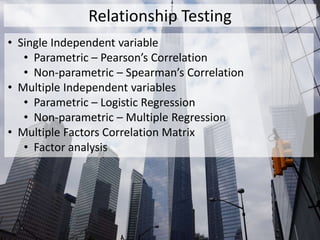
Relationship Testing
• Single Independent variable
• Parametric – Pearson’s Correlation
• Non-parametric – Spearman’s Correlation
• Multiple Independent variables
• Parametric – Logistic Regression
• Non-parametric – Multiple Regression
• Multiple Factors Correlation Matrix
• Factor analysis
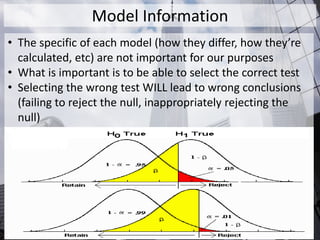
Model Information
• The specific of each model (how they differ, how they’re
calculated, etc) are not important for our purposes
• What is important is to be able to select the correct test
• Selecting the wrong test WILL lead to wrong conclusions
(failing to reject the null, inappropriately rejecting the
null)
Going Further
• There are many, many more tests we did not cover
• Durbin-Watson
• Kolmogorov-Smirnov
• Anderson-Darling
• Cox Proportional Hazards
• Kaplan-Meier Survival Analysis
• And so on…
• However, the tests presented will cover the majority of
basic studies done

Analysis 101

  • 1.
  • 2.
    Today’s Objectives • Notto teach you the mathematics involved • Not to make you an expert statistician • Not to make you an expert in picking tests and designing studies • Is to highlight different analytic and statistical methods in research • Is to help facilitate communication between investigators and biostatisticians by establishing a common vocabulary
  • 3.
    Data Types • Numericaldata (quantitative) • Measurements or counts • Weight, blood pressure, number of medications • Categorical data (qualitative) • Patients sorted into categories • Diabetic/non-diabetic • Adherent/non-adherent • Smoking/non-smoking
  • 4.
    Categorical Data • Nominal •No explicit ordering to categories • Blood types – A/B/AB/O • Race/Ethnicity • Called binary or dichotomous if 2 categories • Gender – M/F • Ordinal • Defined ordering • Cancer stage I, II, III, IV • Non-smoker/smoker/ex-smoker • NYHA Class
  • 5.
    Numerical Data • Canbe further subdivided into discrete and continuous • Discrete variables • Have a limited number of possible values (finite or countably infinite) • Gaps between possible values (whole integers) • Ex: Number of CHF episodes, number of medications • Continuous variables • No gaps between possible values • Ex: Duration of seizure, body mass index, height
  • 6.
    Determining Data Types •Ordinal (Categorical) v. Discrete (Numerical) • Ordinal • Cancer Stage I, II, III, IV • Cancer Stage II is not 2*Stage I • Discrete • Number of children: 0, 1, 2… • 4 children = 2 times 2 children
  • 7.
    So Why SpendTime On This? • The data types help determine which analysis to use • It helps determine how best to summarize the display data • Categorical – percent's, fractions, numbers in categories • Numerical – mean, median, mode, standard deviation, variance, quartile ranges
  • 8.
    Data Summaries • Becareful of overreliance on numbers – Keep the big picture in mind (more on this next time) • Both means = 2, SD = 1.9, n = 1000
  • 9.
    Statistical Inference • Estimationof quantity of interest • Estimate itself • Quantify how good an estimate it is • Ex: If you took more and more samples, how much would the estimate vary? • Hypothesis testing
  • 10.
    Statistical Inference Example •Proportion of people in a population who have diabetes. N = 800 • Sample 1: 200/800 = 0.25 • We conclude that the estimated % of people with diabetes is 25% • But how variable is our estimate? • We need to know the sampling distribution! • Option 1: Take lots and lots of samples • Sample 2: 215/800 = 26.8% • Sample 3: 194/800 = 24.25% • Not practical!
  • 11.
    Statistical Inference Example •Statistical theory • Sample distributions for means and proportions are normally “bell-shaped” • From a single sample, we calculate the standard error (variability) of our estimated mean or proportion • Standard error measures the variability of the sample statistic. Small SE means more precise estimate. • SE ≠ Standard Deviation • SD = variability of the sample data • SE = variability of the statistic
  • 12.
    Distributions • Sample meansfollow a t-distributions on if • Underlying data is approximately normal OR • N is large • A sample mean from a sample of size n will have a t distributions with n-1 degrees of freedom (tn-1)
  • 13.
    Confidence Intervals • Assumewe use our t15 distribution with n = 16, mean SBP = 123.4 mm Hg, and SD = 14.0 mm Hg • SE of mean = SD / √n = 3.5 • 95% CI for sample mean is then • Mean + 2.131 (for t15 distribution) * SE • = 123.4 ± 2.131 * SE • = (115.9, 130.8) mm Hg • And as N gets larger, t statistic gets smaller (t99 = 1.984), which with the same numbers as above but with N = 100, CI narrows to (120.6, 126.2) • Note: It’s never incorrect to use a t-distribution as long as the underlying population is normal or N is large
  • 14.
    Hypothesis Testing • Confidenceintervals told us the best estimate and the variability of the best estimate • Hypothesis testing tells us if there really is a difference between an observed value and another value • From our earlier example: N = 800, we estimated that 25% of people had diabetes • Let’s say a study 10 years prior estimated that 12% of people had diabetes • Has the percent of people with diabetes really changed?
  • 15.
    Hypothesis Testing • Supportthe true percent of people with diabetes is 12% • Called the null hypothesis or H0 • How likely is it that we would observe a result as or more extreme than 25% given the true percent is 12%? • This is the p-value, computed using normal distributions for sample proportions and t-distribution for sample means • If the probability is small, consult the supposition may not be right • Reject the null hypothesis in favor of the alternate hypothesis Ha • If the probability is not small, conclude that there is insufficient evidence to reject the null hypothesis • This is NOT the same as accepting the null or showing the null hypothesis is true
  • 16.
    Hypothesis Testing • H0:True proportion is 12% • Ha: True proportion is not 12% • If P < 0.05, we would conclude it is not likely to observe our data is the true proportion was 12% • We conclude that this is sufficient evidence that the proportion with diabetes is not 12% • Test can be one-sided or two-sided • One-sided ONLY ok if previous research suggests that the proportion is larger
  • 17.
    Misinterpreting the p-value •A p-value of 0.32 (or > 0.05) DOES NOT mean: • We accept the null • There is a 32% chance the null is true • It only lets us reject the null in favor of the alternative or fail to reject the null • If you fail to reject, it DOES NOT mean the alternative isn’t true. It may mean your N is too small or the study is underpowered.
  • 18.
  • 19.
    Other Statistics • Somestatistics are distribution-free • Recall that t-tests/distributions depend on normality or large N’s • What is we don’t have one or both of these, ex: skewed data, N is small • We can use nonparametric methods that look at ranks, not means • The median is a nonparametric estimate
  • 20.
    Nonparametric Methods • Don’trequire a particular distribution • Well-suited to hypothesis testing • Not as useful for point estimates or Cis • Especially useful is data is ranks or scores – Apgar scores, Vision (20/20, 20/40) • Do inferences on medial values • Hypothesis Test is Sign Test • Assumes hypothesized value of median is correct, except to observe about half the sample above and half below • Computes probability for proportion above median
  • 21.
    Parametric v. Nonparametric •Nonparametric are always ok to use • Nonparametric are more conservative than parametric • In fact, 95% CI for medians are sometimes twice as wide as those for the mean • If your N is fairly large, or if you know your data is normal, parametric is always best
  • 22.
    How To SelectA Test • Start by asking, “Am I testing for a difference or a relationship in my data?”
  • 23.
    Difference Testing • AmI testing one sample or more than one sample? • One sample – Is my data parametric? • Yes – One sample t-test • No – Wilcoxon Signed Rank Test
  • 24.
    Difference Testing • Morethan one sample – Is my data nominal, or ordinal/interval/ratio? • Nominal – Chi-Squared test • Ordinal/interval/ratio – How many dependent variables are there? • Two or more – Multivariate Analysis of Variance (MANOVA)
  • 25.
    Difference Testing • One– Are the measures repeated, independent, or mixed? • Mixed – Mixed Model ANOVA • Independent • How many conditions are there? • Two conditions • Parametric data – Independent samples t-test • Non-parametric data – Mann-Whitney U test • More than two • Parametric – Between Participants (One-Way) ANOVA • Non-parametric – Kruskal-Wallis • Repeated
  • 26.
    Difference Testing • One– Are the measures repeated, independent, or mixed? • Repeated • Two Conditions • Parametric – Paired Samples t-test • Non-parametric – Wilcoxon Matched Pairs • More than two conditions • Parametric – Within Participants ANOVA • Non-parametric – Friedman’s ANOVA
  • 27.
    Relationship Testing • SingleIndependent variable • Parametric – Pearson’s Correlation • Non-parametric – Spearman’s Correlation • Multiple Independent variables • Parametric – Logistic Regression • Non-parametric – Multiple Regression • Multiple Factors Correlation Matrix • Factor analysis
  • 28.
    Model Information • Thespecific of each model (how they differ, how they’re calculated, etc) are not important for our purposes • What is important is to be able to select the correct test • Selecting the wrong test WILL lead to wrong conclusions (failing to reject the null, inappropriately rejecting the null)
  • 29.
    Going Further • Thereare many, many more tests we did not cover • Durbin-Watson • Kolmogorov-Smirnov • Anderson-Darling • Cox Proportional Hazards • Kaplan-Meier Survival Analysis • And so on… • However, the tests presented will cover the majority of basic studies done