Chemical kinetics
Chemical kinetics: the study of how fast chemical reactions occur.
Specifically:
• Rates of consumption of reactants and formation of products.
• Response of chemical rates to changes in rxn conditions.
• Identification of steps through which rxn takes place.
Reasons for study
• Prediction of how quickly a rxn approaches equilibrium.
• Understanding or elucidation of rxn mechanisms.
Rate laws and reaction mechanisms
Meaning of Reaction Rate
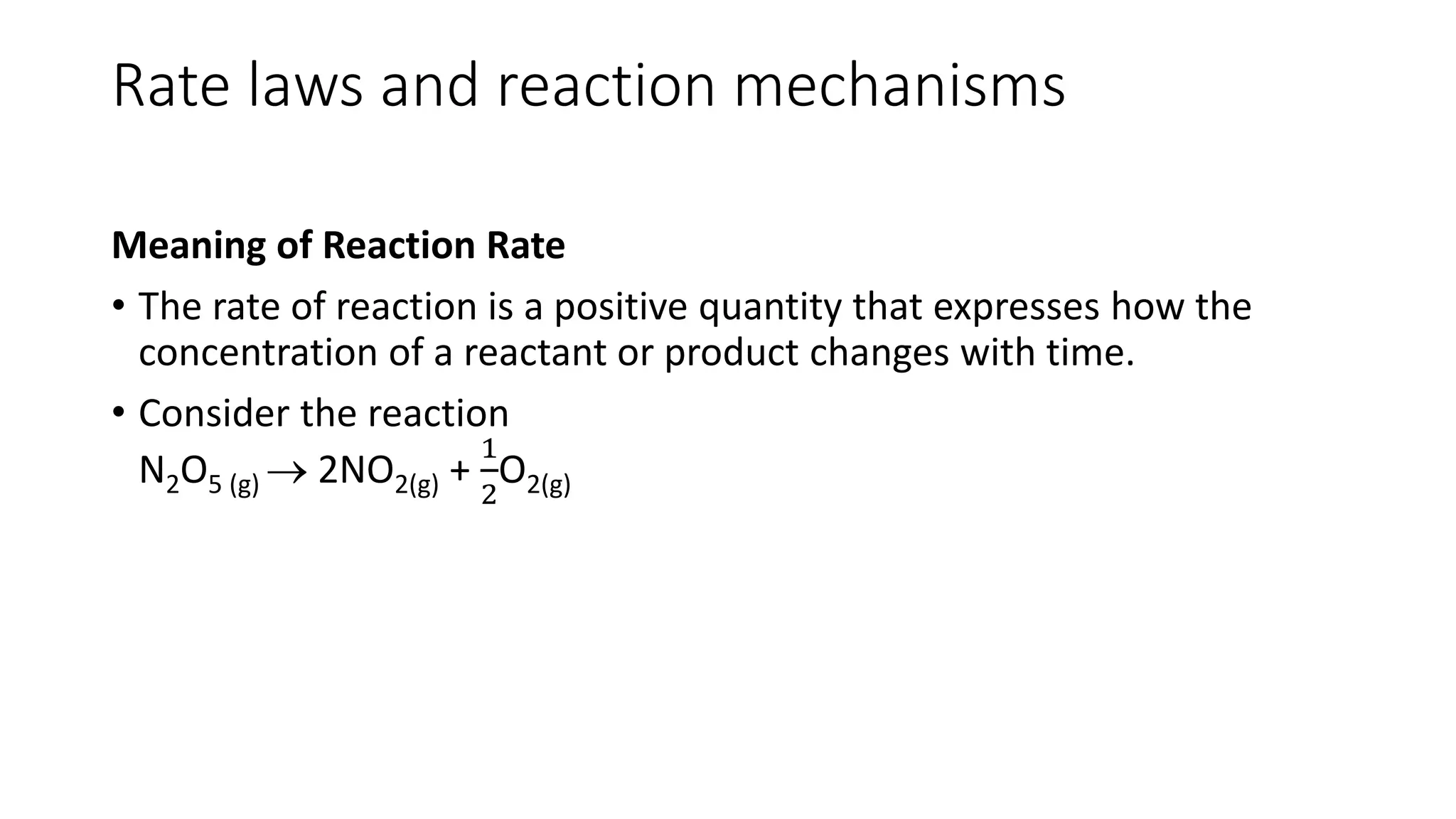
• The rate of reaction is a positive quantity that expresses how the
concentration of a reactant or product changes with time.
• Consider the reaction
N2O5 (g) → 2NO2(g) +
1
2
O2(g)
Reaction Rate
• The concentrations of NO2 and
O2 increase with time, whereas
that of N2O5 decreases. The
reaction rate is defined as
−[N2O5]
𝑡
=
 NO2
2𝑡
=
[O2]
1
2
𝑡
Expressing the Reaction Rate
• Reaction rate is measured in terms of the changes in
concentrations of reactants or products per unit time.
• For the general reaction aA +bB → cC + dD, where A,
B, C, and D represent substances in the gas phase (g)
or in aqueous solution (aq), and a, b, c, d are their
coefficients in the balanced equation
• We measure the concentration of A at t1 and at t2:
The negative sign is used because the concentration of A
is decreasing. This gives the rate a positive value.
Rate =
change in concentration of A
change in time
[A2]- [A1]
t2 - t1
= - =
−[𝐴]
𝑎𝑡
=
− B
𝑏𝑡
=
[𝐶]
𝑐𝑡
=
[𝐷]
𝑑𝑡
Expressing the Reaction Rate
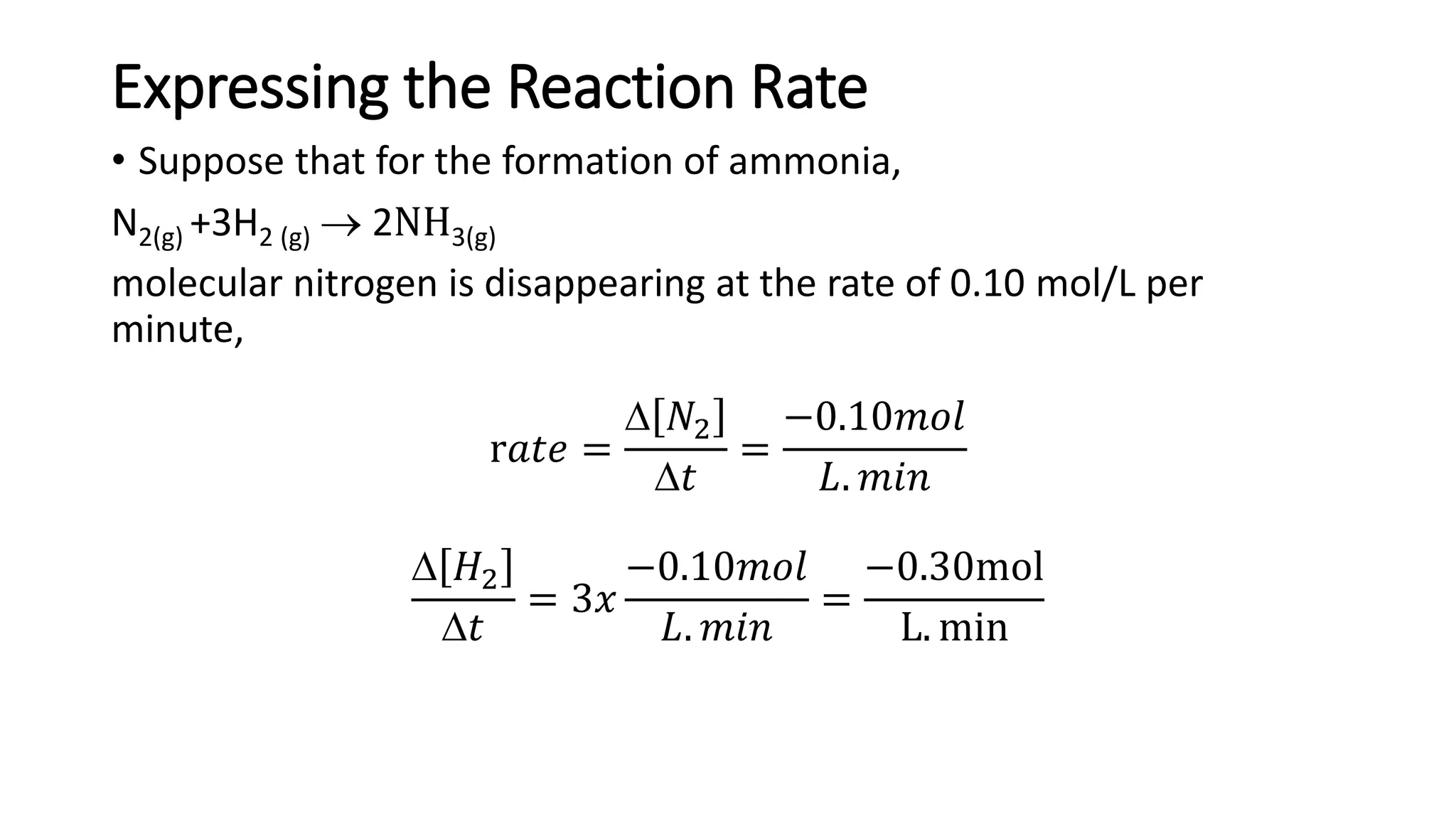
• Suppose that for the formation of ammonia,
N2(g) +3H2 (g) → 2NH3(g)
molecular nitrogen is disappearing at the rate of 0.10 mol/L per
minute,
r𝑎𝑡𝑒 =
 𝑁2
𝑡
=
−0.10𝑚𝑜𝑙
𝐿. 𝑚𝑖𝑛
 𝐻2
𝑡
= 3𝑥
−0.10𝑚𝑜𝑙
𝐿. 𝑚𝑖𝑛
=
−0.30mol
L. min
Expressing the Reaction Rate
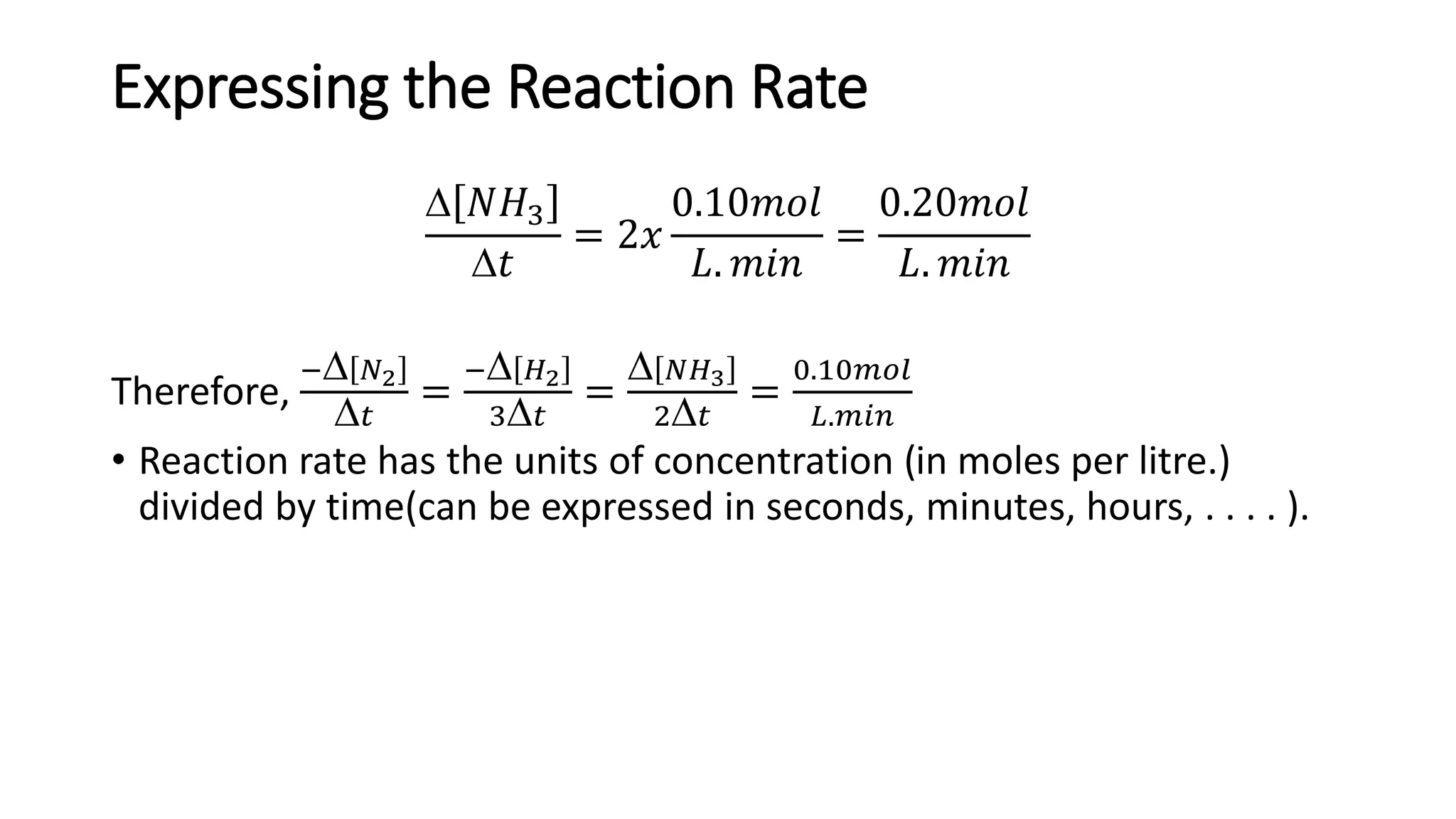
 𝑁𝐻3
𝑡
= 2𝑥
0.10𝑚𝑜𝑙
𝐿. 𝑚𝑖𝑛
=
0.20𝑚𝑜𝑙
𝐿. 𝑚𝑖𝑛
Therefore,
− 𝑁2
𝑡
=
− 𝐻2
3𝑡
=
 𝑁𝐻3
2𝑡
=
0.10𝑚𝑜𝑙
𝐿.𝑚𝑖𝑛
• Reaction rate has the units of concentration (in moles per litre.)
divided by time(can be expressed in seconds, minutes, hours, . . . . ).
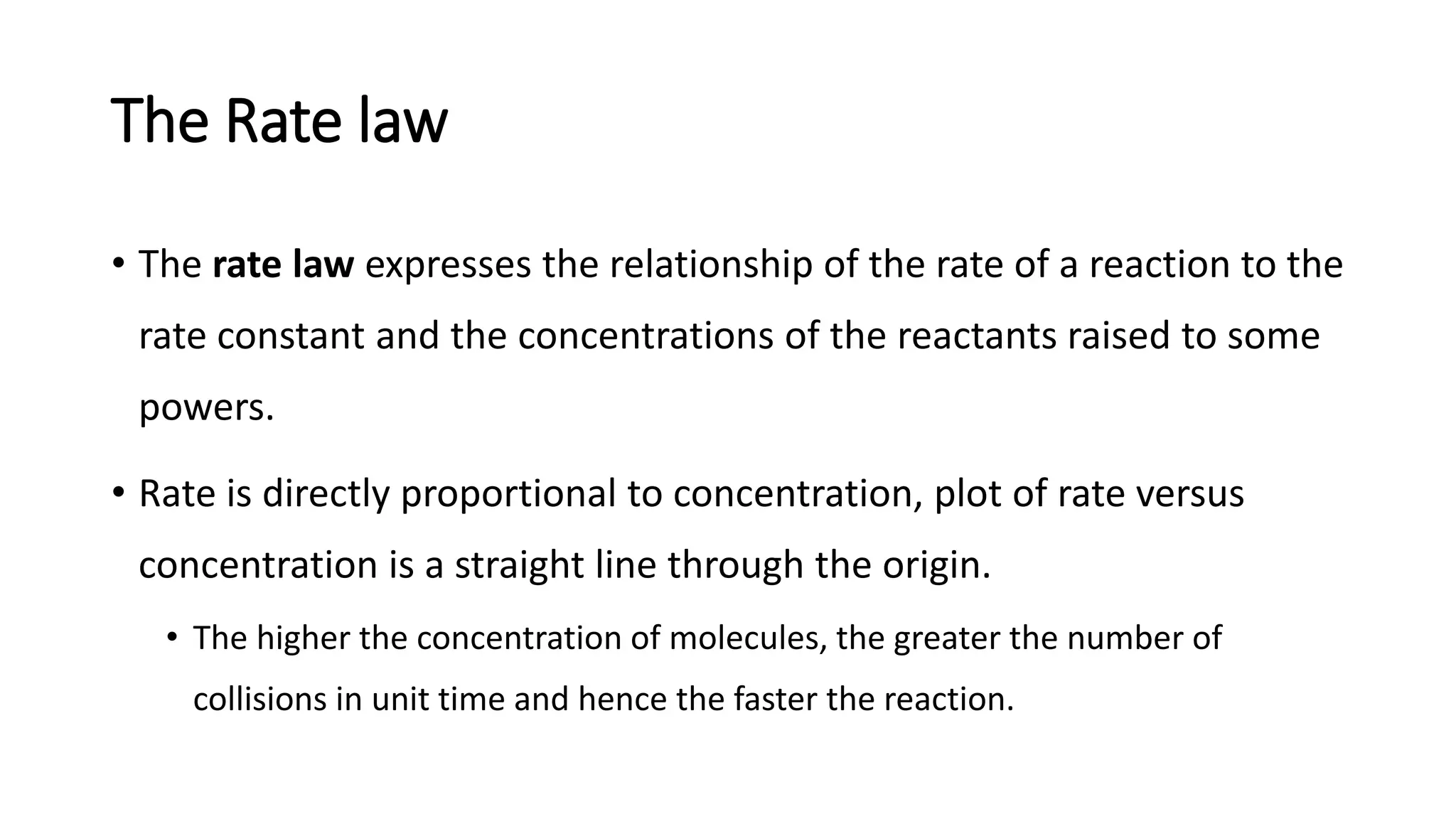
The Rate law
• The rate law expresses the relationship of the rate of a reaction to the
rate constant and the concentrations of the reactants raised to some
powers.
• Rate is directly proportional to concentration, plot of rate versus
concentration is a straight line through the origin.
• The higher the concentration of molecules, the greater the number of
collisions in unit time and hence the faster the reaction.
Rate Expression and Rate Constant
• For the decomposition of N2O5:
Rate =  = k[N2O5],
• This equation is referred to as the rate expression for the
decomposition of N2O5.
• It tells how the rate of the reaction N2O5 (g) → 2NO2(g) +
1
2
O2(g) depends
on the concentration of reactant.
Rate Expression and Rate Constant
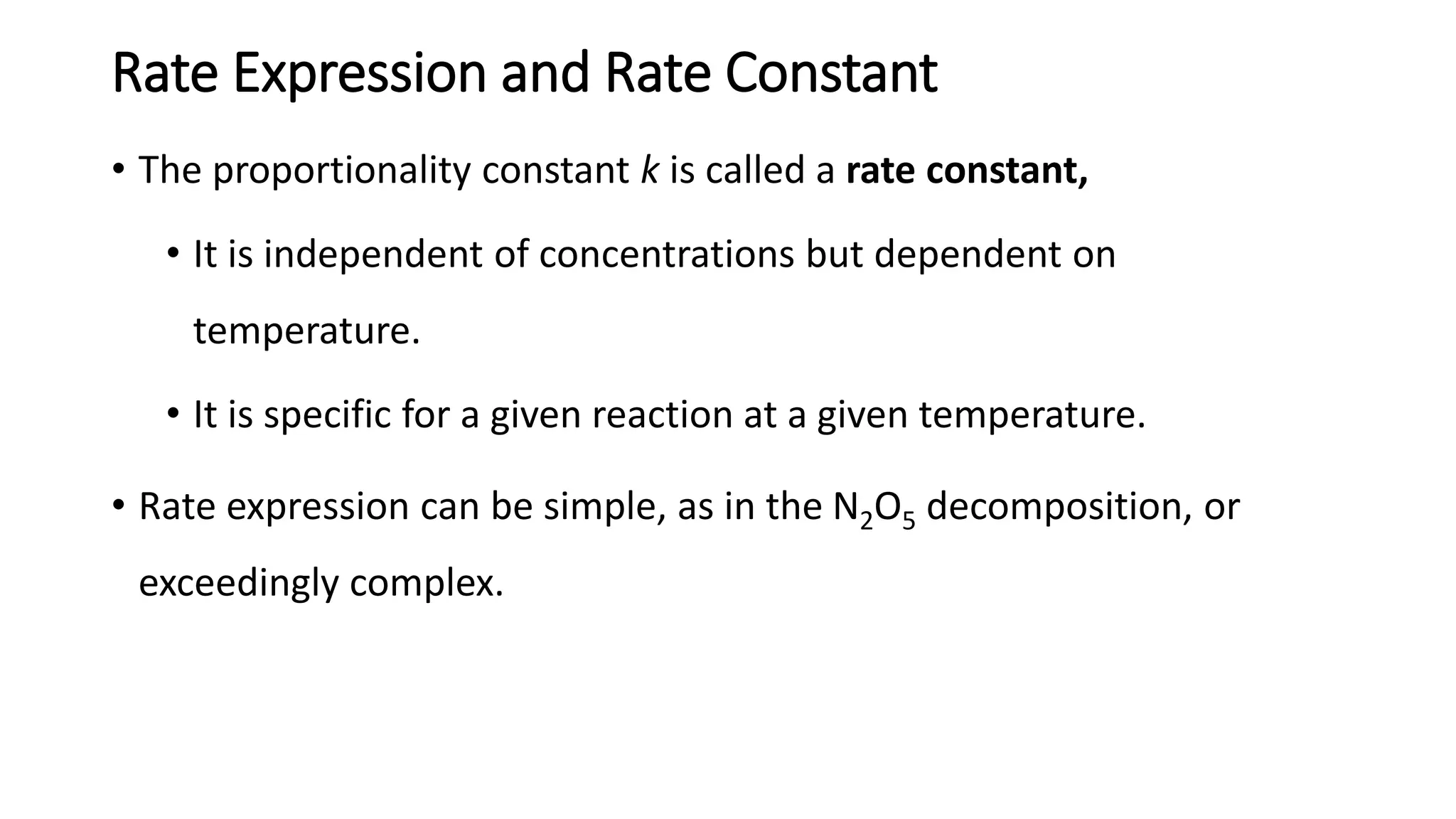
• The proportionality constant k is called a rate constant,
• It is independent of concentrations but dependent on
temperature.
• It is specific for a given reaction at a given temperature.
• Rate expression can be simple, as in the N2O5 decomposition, or
exceedingly complex.
Applications of rate laws:
• If known including k, can predict reaction rate from
concentrations
• It guides in elucidation of mechanisms (mechanism must be
consistent with observed rate law)
Order of Reaction
• For any general reaction occurring at a fixed temperature
aA + bB → cC + dD
• The rate expression has the general form
Rate = k[A]m[B]n
• The power (exponents m and n ) to which the concentration of
reactant is raised in the rate expression is called the order of
reaction.
Order of Reaction
• The values of m and n are not necessarily related in any way to the
stoichiometric coefficients a and b.
• From the concentrations of reactants and the initial reaction rates we
can determine the reaction order and then the rate constant of the
reaction.
• Reaction order is always defined in terms of reactant (not product)
concentrations.
Order of Reaction
• A reaction has an individual order “with respect to” or “in” each
reactant.
• For the simple reaction A → products:
Rate = k[A]m
• If m is 0, the reaction is said to have zeroth order (Rate independent
of concentration). If m = 1, the reaction is first-order; if m = 2, it is
second-order
Order of Reaction
• For the reaction aA + bB → cC + dD, Rate = k[A]m[B]n
• If the rate doubles when [A] doubles, the rate depends on [A]1 and
the reaction is first order with respect to A.
• If the rate quadruples when [A] doubles, the rate depends on [A]2
and the reaction is second order with respect to [A].
• If the rate does not change when [A] doubles, the rate does not
depend on [A], and the reaction is zero order with respect to A.
• Reaction order enables us to understand how the reaction depends
on reactant concentrations.
Order of reaction
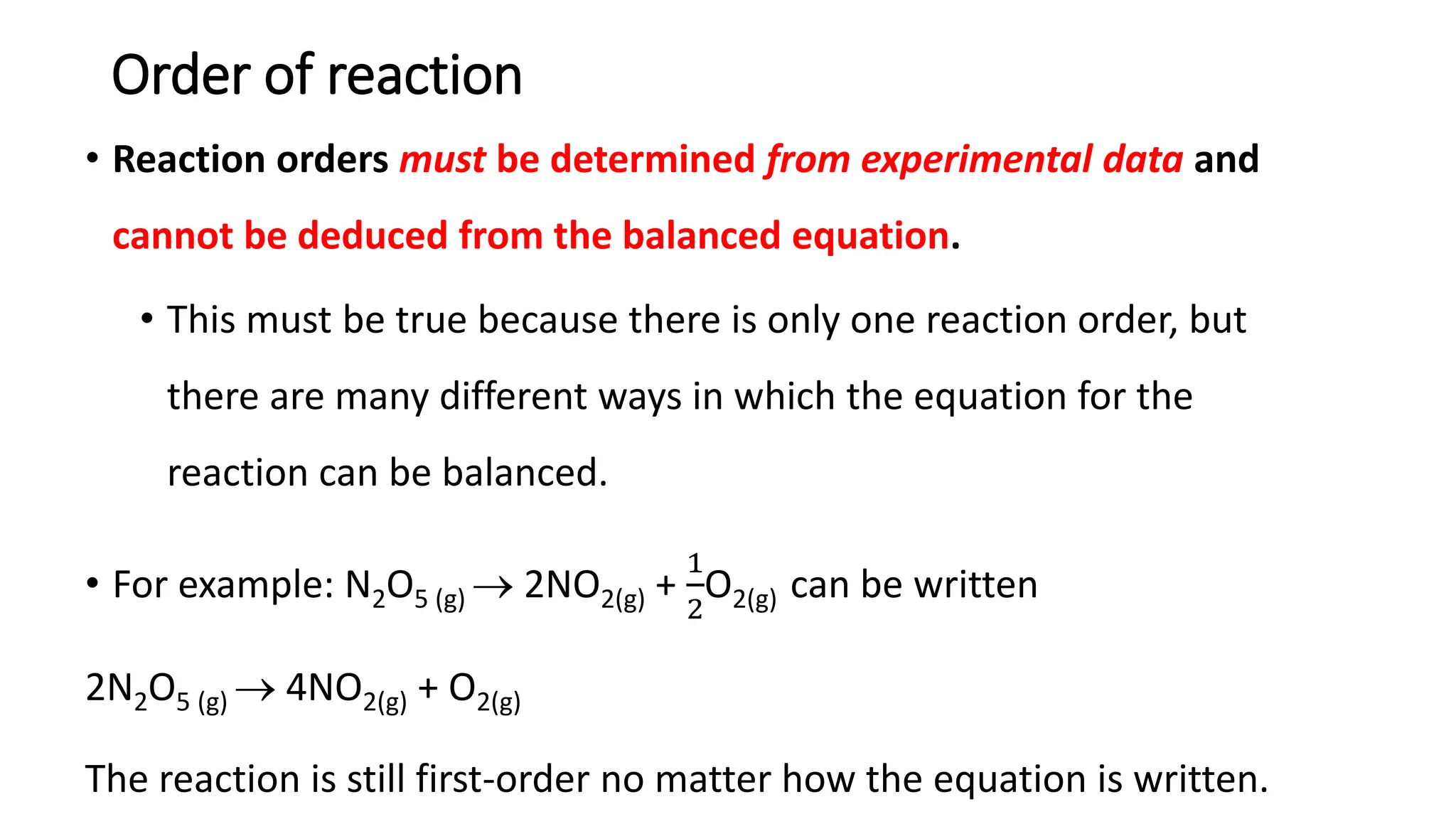
• Reaction orders must be determined from experimental data and
cannot be deduced from the balanced equation.
• This must be true because there is only one reaction order, but
there are many different ways in which the equation for the
reaction can be balanced.
• For example: N2O5 (g) → 2NO2(g) +
1
2
O2(g) can be written
2N2O5 (g) → 4NO2(g) + O2(g)
The reaction is still first-order no matter how the equation is written.
Plots of reactant concentration, [A], vs. time for first-, second-,
and zero-order reactions.
Plots of rate vs. reactant concentration, [A], for first-, second-,
and zero-order reactions.
Individual and Overall Reaction Orders
For the reaction 2NO(g) + 2H2(g) → N2(g) + 2H2O(g):
The rate law is, rate = k[NO]2[H2]
The reaction is second order with respect to NO, first
order with respect to H2 and third order overall.
Note that the reaction is first order with respect to H2
even though the coefficient for H2 in the balanced
equation is 2.
Sample Problem
SOLUTION:
Determining Reaction Orders from Rate
Laws
PLAN: We inspect the exponents in the rate law, not the coefficients
of the balanced equation, to find the individual orders. We add
the individual orders to get the overall reaction order.
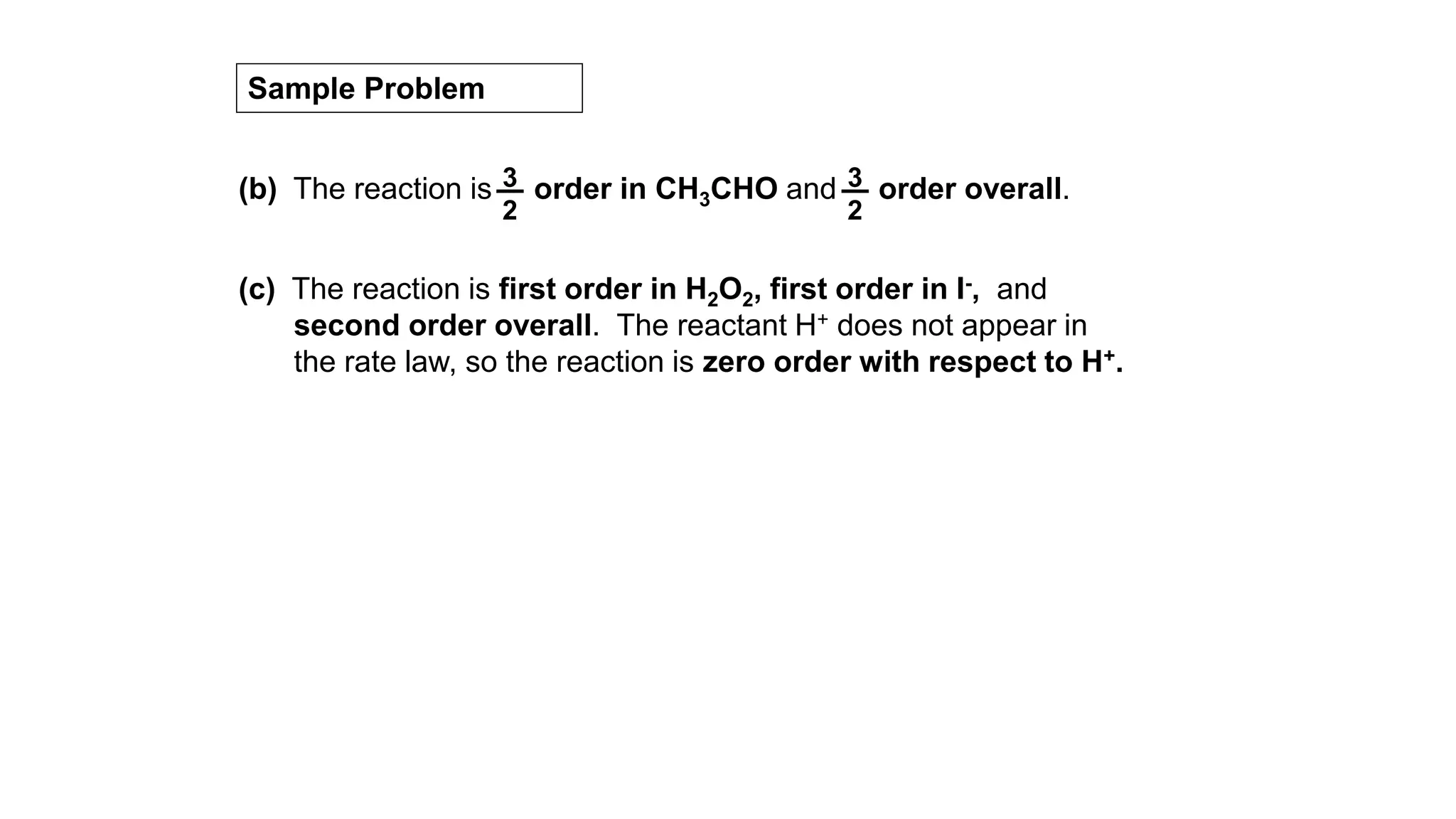
(a) The exponent of [NO] is 2 and the exponent of [O2] is 1, so the
reaction is second order with respect to NO, first order
with respect to O2 and third order overall.
PROBLEM: For each of the following reactions, use the given rate law
to determine the reaction order with respect to each
reactant and the overall order.
(a) 2NO(g) + O2(g) → 2NO2(g); rate = k[NO]2[O2]
(b) CH3CHO(g) → CH4(g) + CO(g); rate = k[CH3CHO]3/2
(c) H2O2(aq) + 3I-(aq) + 2H+(aq) →I3
-(aq) + 2H2O(l); rate = k[H2O2][I-]
Sample Problem
(b) The reaction is order in CH3CHO and order overall.
3
2
3
2
(c) The reaction is first order in H2O2, first order in I-, and
second order overall. The reactant H+ does not appear in
the rate law, so the reaction is zero order with respect to H+.
Determination of the rate law
• 1. Isolation method
• Isolate each one of the reactants in turn by having all the others in large
excess. i.e if B is in excess and the rate law is  = k[A][B]2
• Approximate [B] by [B]o.
•  = k[A][B]2 where k = k [B]o.
• Pseudo first order, k = effective rate constant for a given fixed
concentration of B.
• If A is in excess the  = k[B]2 with k = k[A]0 pseudosecond order rate
law
Determining Reaction Orders
• For the general reaction A + 2B → C + D, the rate law will have the form:
Rate = k[A]m[B]n
• To determine the values of m and n, we run a series of experiments in which
one reactant concentration changes while the other is kept constant, and we
measure the effect on the initial rate in each case.
Initial Rates for the Reaction between A and B
Experiment
Initial Rate
(mol/L·s)
Initial [A]
(mol/L)
Initial [B]
(mol/L)
1 1.75x10⁻³ 2.50x10⁻² 3.00x10⁻²
2 3.50x10⁻³ 5.00x10⁻² 3.00x10⁻²
3 3.50x10⁻³ 2.50x10⁻² 6.00x10⁻²
4 7.00x10⁻³ 5.00x10⁻² 6.00x10⁻²
[B] is kept constant for experiments 1 and 2, while [A] is doubled.
Then [A] is kept constant while [B] is doubled.
Rate 2
Rate 1
=
k[A] [B]
k[A] [B]
m
2
n
2
m
1
n
1
Finding m, the order with respect to A:
We compare experiments 1 and 2, where [B] is kept
constant but [A] doubles:
=
[A]
[A]
m
2
m
1
=
[A]2
[A]1
m
3.50x10⁻³ mol/L·s
1.75x10⁻³mol/L·s
=
5.00x10⁻² mol/L
2.50x10⁻² mol/L
m
Dividing, we get 2.00 = (2.00)m so m = 1
Rate 3
Rate 1
=
k[A] [B]
k[A] [B]
m
3
n
3
m
1
n
1
Finding n, the order with respect to B:
We compare experiments 3 and 1, where [A] is kept
constant but [B] doubles:
=
[B]
[B]
n
3
n
1
=
[B]3
[B]1
n
3.50x10⁻³ mol/L·s
1.75x10⁻³mol/L·s
=
6.00x10⁻² mol/L
3.00x10⁻² mol/L
m
Dividing, we get 2.00 = (2.00)n so n = 1
Initial Rates for the Reaction between O2 and NO
Initial Reactant
Concentrations (mol/L)
Experiment
Initial Rate
(mol/L·s) [O2] [NO]
1 3.21x10⁻³ 1.10x10⁻² 1.30x10⁻²
2 6.40x10⁻³ 2.20x10⁻² 1.30x10⁻²
3 12.48x10⁻³ 1.10x10⁻² 2.60x10⁻²
4 9.60x10⁻³ 3.30x10⁻² 1.30x10⁻²
5 28.8x10⁻³ 1.10x10⁻² 3.90x10⁻²
O2(g) + 2NO(g) → 2NO2(g) Rate = k[O2]m[NO]n
Rate 2
Rate 1
=
k[O2] [NO]
k[O2] [NO]
m
2
n
2
m
1
n
1
Finding m, the order with respect to O2:
We compare experiments 1 and 2, where [NO] is kept
constant but [O2] doubles:
=
[O2]
[O2]
m
2
m
1
=
[O2]2
[O2]1
m
6.40x10⁻³ mol/L·s
3.21x10⁻³mol/L·s
=
2.20x10⁻² mol/L
1.10x10⁻² mol/L
m
Dividing, we get 1.99 = (2.00)m or 2 = 2m, so m = 1
The reaction is first order with respect to O2.
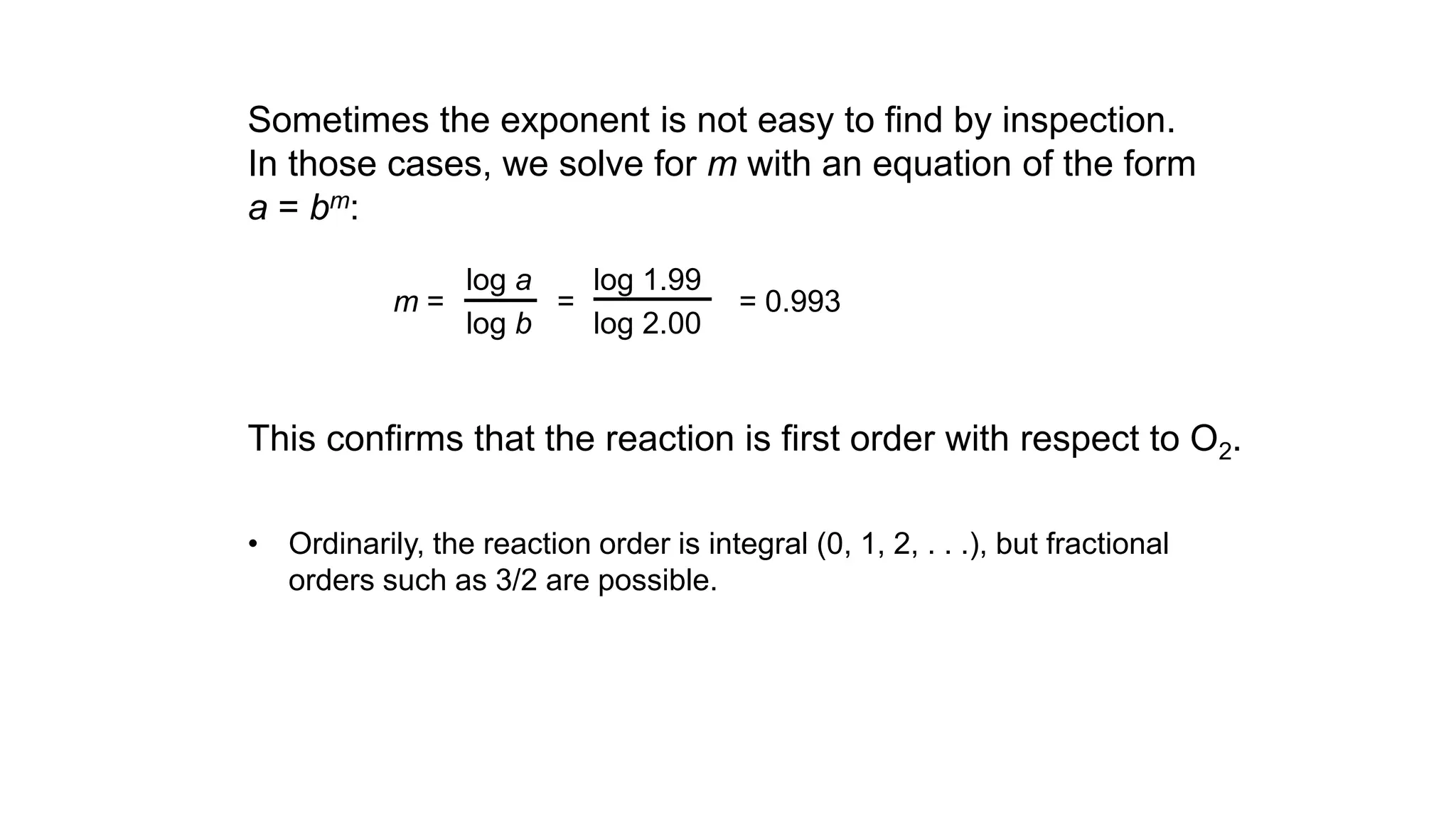
Sometimes the exponent is not easy to find by inspection.
In those cases, we solve for m with an equation of the form
a = bm:
log a
log b
m =
log 1.99
log 2.00
= = 0.993
This confirms that the reaction is first order with respect to O2.
• Ordinarily, the reaction order is integral (0, 1, 2, . . .), but fractional
orders such as 3/2 are possible.
Finding n, the order with respect to NO:
We compare experiments 1 and 3, where [O2] is kept
constant but [NO] doubles:
Rate 3
Rate 1
=
[NO]3
[NO]1
n
12.8x10⁻³ mol/L·s
3.21x10⁻³mol/L·s
=
2.60x10⁻² mol/L
1.30x10⁻² mol/L
n
Dividing, we get 3.99 = (2.00)n or 4 = 2n, so n = 2.
The reaction is second order with respect to NO.
log a
log b
n =
log 3.99
log 2.00
= = 2.00
Alternatively:
The rate law is given by: rate = k[O2][NO]2
Determining Reaction Orders from Rate Data
PROBLEM: Many gaseous reactions occur in a car engine and exhaust
system. One of these is
NO2(g) + CO(g) → NO(g) + CO2(g) rate = k[NO2]m[CO]n
Use the following data to determine the individual and
overall reaction orders:
Experiment
Initial Rate
(mol/L·s)
Initial [NO2]
(mol/L)
Initial [CO]
(mol/L)
1 0.0050 0.10 0.10
2 0.080 0.40 0.10
3 0.0050 0.10 0.20
PLAN: We need to solve the general rate law for m and for n and
then add those orders to get the overall order. We proceed by
taking the ratio of the rate laws for two experiments in which
only the reactant in question changes concentration.
SOLUTION:
rate 2
rate 1
[NO2] 2
[NO2] 1
m
=
k [NO2]m
2[CO]n
2
k [NO2]m
1 [CO]n
1
=
0.080
0.0050
0.40
0.10
=
m
16 = (4.0)m so m = 2
To calculate m, the order with respect to NO2, we compare
experiments 1 and 2:
The reaction is second order in NO2.
k [NO2]m
3[CO]n
3
k [NO2]m
1 [CO]n
1
[CO] 3
[CO] 1
n
=
rate 3
rate 1
=
0.0050
0.0050
=
0.20
0.10
n
1.0 = (2.0)n so n = 0
rate = k[NO2]2[CO]0 or rate = k[NO2]2
To calculate n, the order with respect to CO, we compare experiments
1 and 3:
The reaction is zero order in CO.
Determining Reaction Orders from Molecular
Scenes
PROBLEM: At a particular temperature and volume, two gases, A (red)
and B (blue), react. The following molecular scenes
represent starting mixtures for four experiments:
(a) What is the reaction order with respect to A? With respect to B?
The overall order?
(b) Write the rate law for the reaction.
(c) Predict the initial rate of experiment 4.
PLAN: We find the individual reaction orders by seeing how a change
in each reactant changes the rate. Instead of using
concentrations we count the number of particles.
Expt no:
Initial rate (mol/L·s)
1
0.50x10⁻⁴
2
1.0x10⁻⁴
3
2.0x10⁻⁴
4
?
SOLUTION:
(a) For reactant A (red):
Experiments 1 and 2 have the same number of particles of B, but
the number of particles of A doubles. The rate doubles. Thus the
order with respect to A is 1.
(b) Rate = k[A][B]2
(c) Between experiments 3 and 4, the number of particles of A
doubles while the number of particles of B does not change. The
rate should double, so rate = 2 x 2.0x10-4 = 4.0x10⁻⁴mol/L·s
For reactant B (blue):
Experiments 1 and 3 show that when the number of particles of B
doubles (while A remains constant), the rate quadruples. The
order with respect to B is 2.
The overall order is 1 + 2 = 3.
Units of the Rate Constant k for Several Overall Reaction
Orders
Overall
Reaction
Order
Units of k
(t in seconds)
0 mol/L·s
(or mol L-1s-1)
1 1/s (or s-1)
2 L/mol·s
(or L mol-1s-1)
3 L2/mol2·s
(or L2 mol-2s-1)
General formula:
L
mol
unit of t
order-1
Units of k =
The value of k is easily determined from experimental rate
data. The units of k depend on the overall reaction order.
Information sequence to determine the kinetic parameters of
a reaction.
Series of plots of
concentration vs.
time
Initial rates
Reaction
orders
Rate constant (k)
and actual rate law
Determine slope of tangent at t0 for
each plot.
Compare initial rates when [A] changes and
[B] is held constant (and vice versa).
Substitute initial rates, orders, and
concentrations into rate = k[A]m[B]n, and
solve for k.
Reactant Concentration and time
• The rate expression Rate =  = k[N2O5], shows how the rate of decomposition of
N2O5 changes with concentration.
• However, it is more important to know the relation between
concentration and time rather than between concentration and rate.
• you would want to know how much N2O5 is left after 5 minutes, 1 hour, or
several days
• The above equation does not provide this information.
• Using calculus, it is possible to develop integrated rate equations relating reactant
concentration to time.
First-Order Reactions
Integrated rate equations for a general
reaction A→ products
rate = −
[𝐴]
𝑡
From the rate law
rate = k[A]
Combining the two equations
rate = −
[𝐴]
𝑡
= k[A]
In differential form the eqn becomes
−
𝑑[𝐴]
𝑑𝑡
= k[A]
Rearranging
−
𝑑[𝐴]
[A]
= 𝑘𝑑𝑡
Integrating btwn 𝑡 = 0 𝑎𝑛𝑑 𝑡 = 𝑡
t = 0 can be any time when we choose
to start monitoring the change in the
concentration of A.
න
[𝐴]0
[𝐴]𝑡
𝑑[𝐴]
[A]
= −𝑘 න
0
𝑡
𝑑𝑡
− ln 𝐴 𝑡 − 𝑙𝑛 𝐴 0 = 𝑘𝑡
ln 𝐴 𝑡 = 𝑙𝑛 𝐴 0 − kt … 1
𝐴 𝑡 = [𝐴]0𝑒−𝑘𝑡 … (2)
(1) is of the form y = mx + b, linear eqn
(2) is used for predicting concentration
of A at any time after the reaction has
started
Relationship between reactant concentration and
time
• As we would expect during the
course of a reaction, the
concentration of the reactant A
decreases with time
• If we plot of In[A]t against t and
get a straight line then the
reaction is first order. Slope is
equal to −𝑘 and a y intercept
equal to 𝑙𝑛 𝐴 0
Exercise: The concentration of N2O5 in liquid bromine varied with
time as follows:
t/s 0 200 400 600 1000
[N2O5]/M 0.110 0.073 0.048 0.032 0.014
Determine the order and rate constant
Order = 1 (first order)
Rate constant = 2.1 x 10⁻³s-1
Relationship between reactant concentration and time
Example
Consider the first-order decomposition of N2O5 67°C, where k = 0.35/min.
a. What is the concentration after six minutes, starting at 0.200 M?
Solution
𝑙𝑛 N2O5 0 −ln N2O5 𝑡 = 𝑘𝑡
N2O5 𝑡 = [N2O5]0𝑒−𝑘𝑡
= 0.200𝑥𝑒−(0.35𝑥6)
= 0.024𝑚𝑜𝑙/𝐿
Relationship between reactant concentration and time
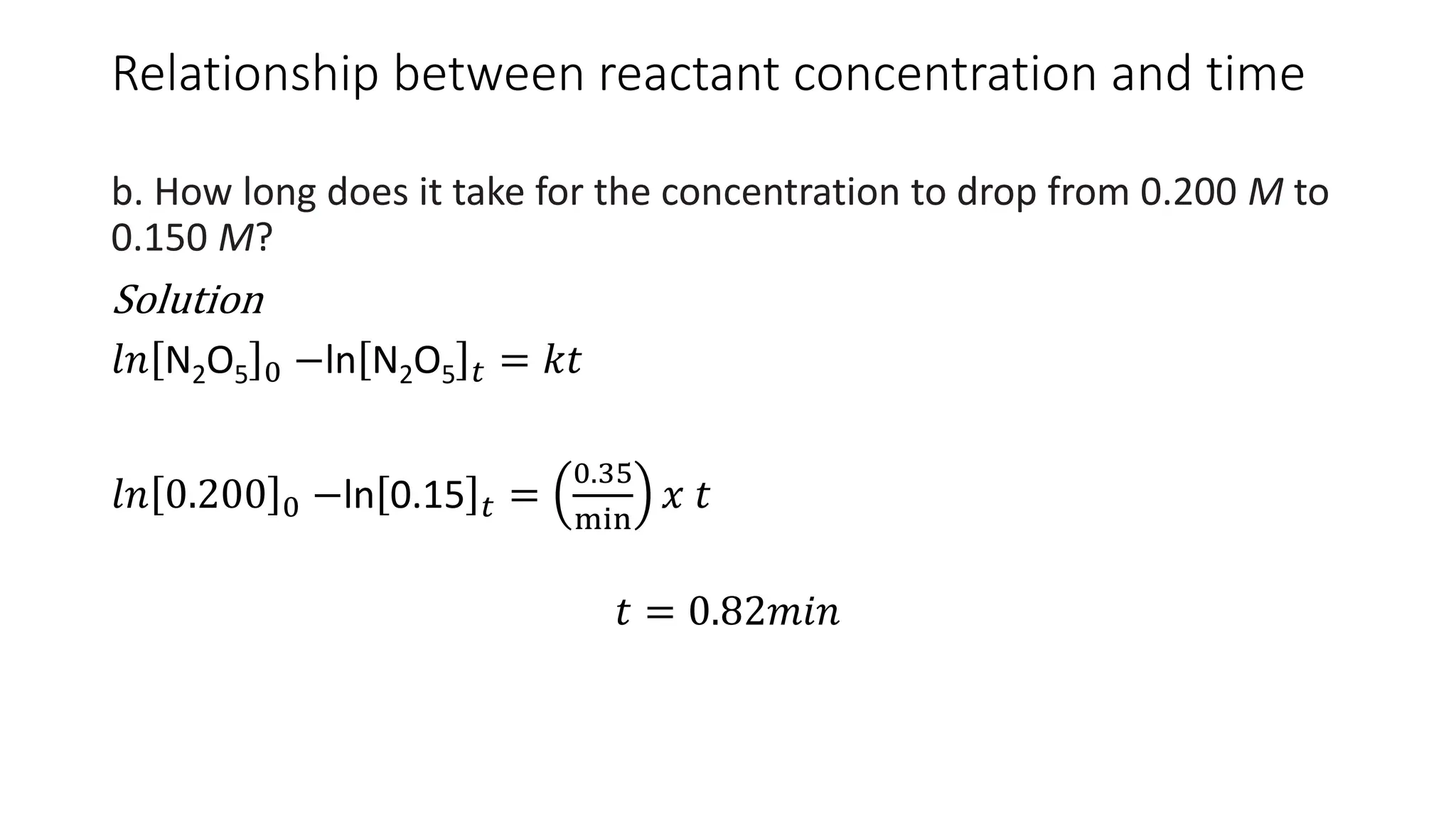
b. How long does it take for the concentration to drop from 0.200 M to
0.150 M?
Solution
𝑙𝑛 N2O5 0 −ln N2O5 𝑡 = 𝑘𝑡
𝑙𝑛 0.200 0 −ln 0.15 𝑡 =
0.35
min
𝑥 𝑡
𝑡 = 0.82𝑚𝑖𝑛
Relationship between reactant concentration and time
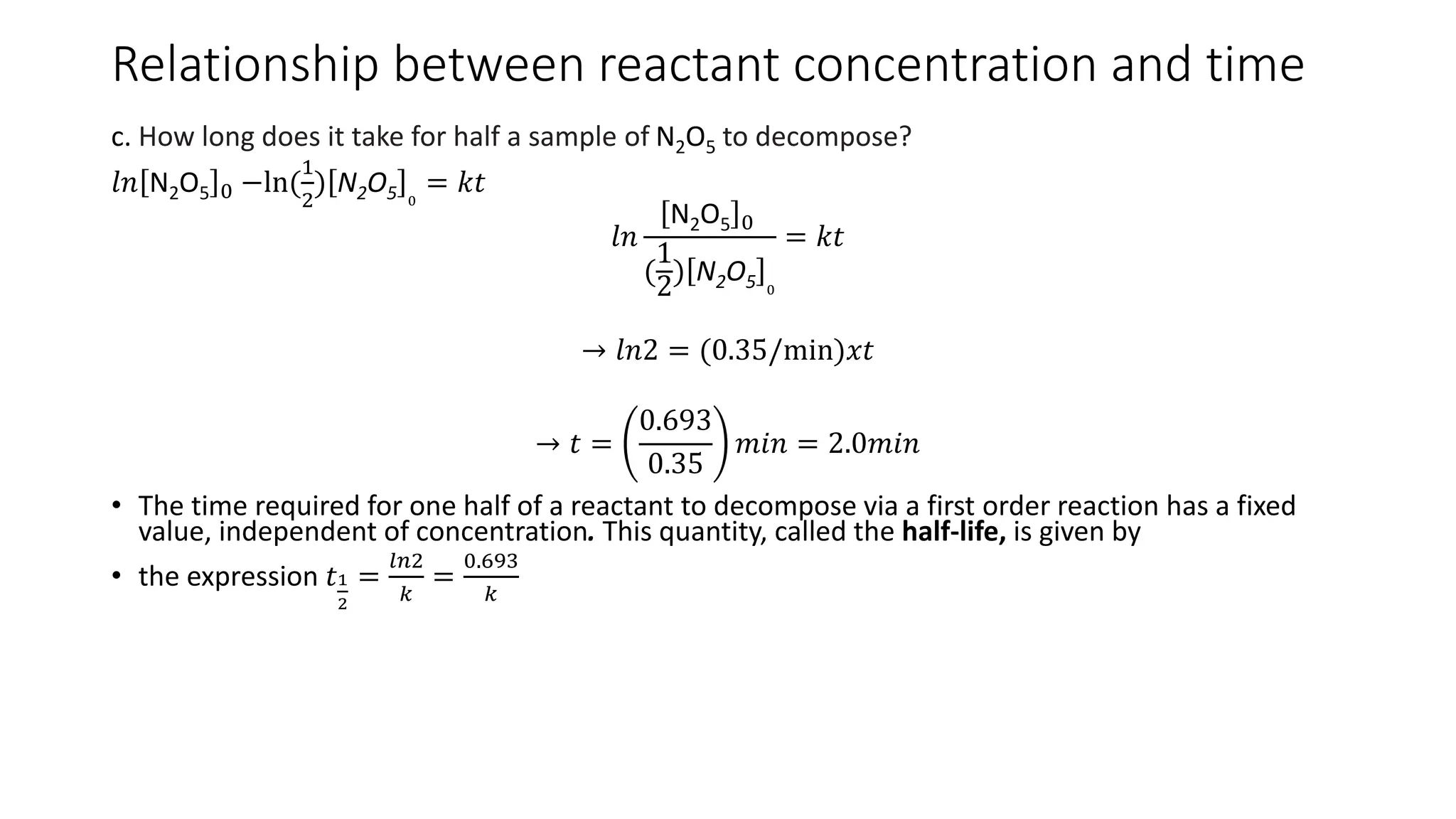
c. How long does it take for half a sample of N2O5 to decompose?
𝑙𝑛 N2O5 0 −ln(
1
2
) N2O5 0
= 𝑘𝑡
𝑙𝑛
N2O5 0
(
1
2
) N2O5 0
= 𝑘𝑡
→ 𝑙𝑛2 = (0.35/min)𝑥𝑡
→ 𝑡 =
0.693
0.35
𝑚𝑖𝑛 = 2.0𝑚𝑖𝑛
• The time required for one half of a reactant to decompose via a first order reaction has a fixed
value, independent of concentration. This quantity, called the half-life, is given by
• the expression 𝑡1
2
=
𝑙𝑛2
𝑘
=
0.693
𝑘
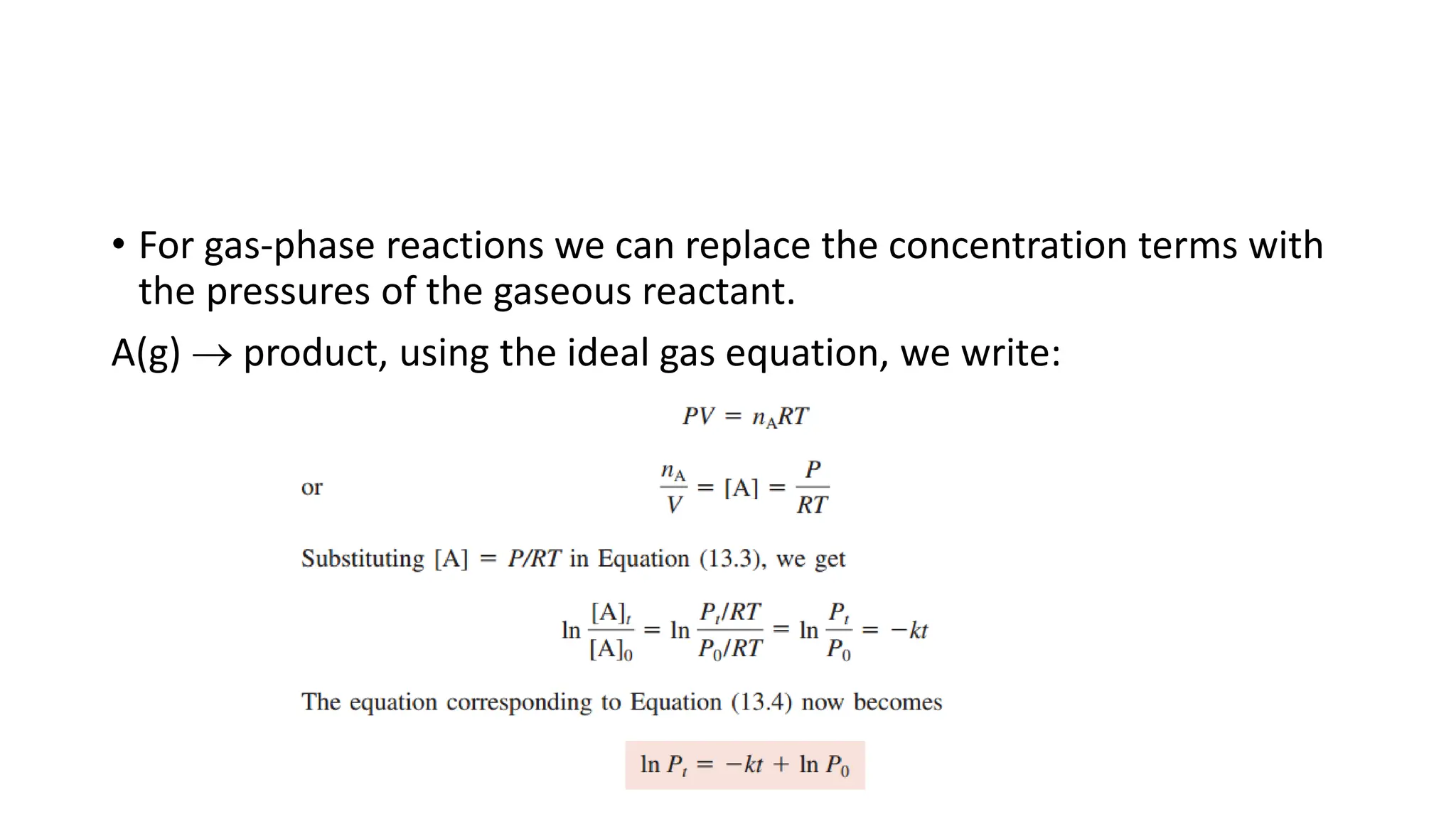
• For gas-phase reactions we can replace the concentration terms with
the pressures of the gaseous reactant.
A(g) → product, using the ideal gas equation, we write:
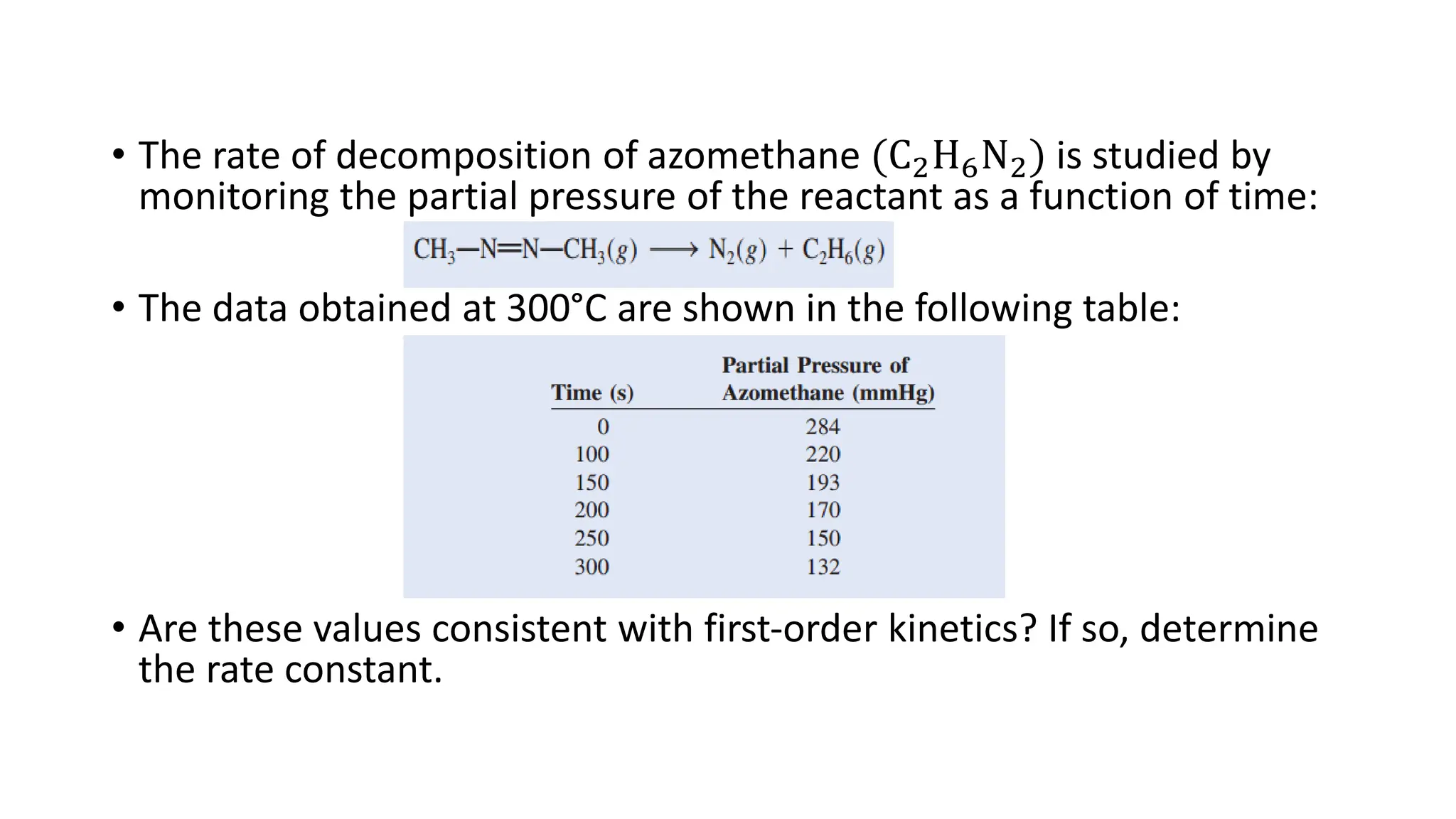
• The rate of decomposition of azomethane (C2H6N2) is studied by
monitoring the partial pressure of the reactant as a function of time:
• The data obtained at 300°C are shown in the following table:
• Are these values consistent with first-order kinetics? If so, determine
the rate constant.
• Solution
• 𝑙𝑛𝑃𝑡 = −𝑘𝑡 + 𝑙𝑛𝑃0
• A plot of ln𝑃𝑡versus t yields a straight line, so the reaction is indeed first
order. The slope of the line is given by
• the slope is equal to -k, so k =
Graphical method for finding the reaction order from the
integrated rate law.
First-order reaction
ln [A]0
[A]t
= - kt
integrated rate law
ln[A]t = -kt + ln[A]0
straight-line form
A plot of ln [A] vs. time gives a straight line for a first-order reaction.
Half-life method
• Time taken for concentration of reactant to fall to ½ its initial value.
• It’s a guide to the order of a reaction for it depends on initial concentration for
reactions of different orders.
For first order: ln 𝐴 𝑡 = 𝑙𝑛 𝐴 0 − kt
𝑙𝑛 A 0 − ln
1
2
A 0
= 𝑘𝑡1
2
𝑘𝑡 = ln
[𝐴]0
1
2
[𝐴]0
𝑡 1/2 =
𝑙𝑛2
𝑘
=
0.693
𝑘
t1/2: rapid method of measuring 1st order reaction rate
t1/2 for first order reaction is independent of the initial concentration of the
reactant.
will be constant. Not true for second order rxn.
Half-life
Example: The decomposition of ethane (C2H6) to methyl radicals is a
first-order reaction with a rate constant of 5.36𝑥10−4𝑠−1s at 700°C:
C2H6g → CH3(g)
Calculate the half-life of the reaction in minutes.
𝑡 1/2 =
0.693
𝑘
=
0.693
5.36𝑥10−4𝑠−1
= 1.29𝑥103𝑠 𝑥
1𝑚𝑖𝑛
60𝑠
= 21.5 𝑚𝑖𝑛𝑠
Second-order reaction
• A second-order reaction is a reaction whose rate depends on the concentration
of one reactant raised to the second power or on the concentrations of two
different reactants, each raised to the first power.
• Consider the reaction: A→ products
rate −
 𝐴
𝑡
= 𝑘[𝐴]2
• For the reaction A + B→ products:
rate = k A B
• The reaction is first order in A and first order in B, so it has an overall reaction
order of 2
Second-order reaction
• Integrated rate equations for a general reaction A→ products
𝑟𝑎𝑡𝑒 = −
 𝐴
𝑡
න
[𝐴]0
[𝐴]𝑡
𝑑[𝐴]
[A]2
= −𝑘 න
0
𝑡
𝑑𝑡
න 𝑥𝑛
𝑑𝑥 =
𝑥𝑛+1
𝑛 + 1
+ 𝐶
1
𝐴 𝑡
=
1
𝐴 0
+ 𝑘𝑡 … 1
𝐴 𝑡 =
𝐴 0
1 + 𝑘𝑡 𝐴 0
… 2
Second-order reaction
• A plot of
1
𝐴 𝑡
versus t gives a straight line with slope = k and y intercept =
1
𝐴 0
.
• Half-life of a second-order reaction
1
𝐴 𝑡
=
1
𝐴 0
+ 𝑘𝑡
Substitute t = t1/2, 𝐴 𝑡 =
𝐴 0
2
𝑡1/2 =
1
𝑘 𝐴 0
• The half-life of a second-order reaction is inversely proportional to the initial
reactant concentration.
• This result makes sense because the half-life should be shorter in the early stage of the
reaction when more reactant molecules are present to collide with each other.
Second-order reaction
Solution
a. To calculate the concentration of a species at a later time of a second order
reaction, we need the initial concentration and the rate constant.
Second-order reaction
b.
Graphical method for finding the reaction order from the
integrated rate law.
Second-order reaction
integrated rate law
1
[A]t
1
[A]0
- = kt
straight-line form
1
[A]t
1
[A]0
= kt +
A plot of vs. time gives a straight line for a second-order reaction.
1
[A]
Derive the relevant equations for the second order
A + B → P
Need to know integration by partial fractions.
Zero-Order Reactions
• First- and second-order reactions are the most common reaction
types. Reactions whose order is zero are rare. For a zero-order
reaction.
A→ products: 𝑟𝑎𝑡𝑒 = 𝑘[𝐴]0 = 𝑘
න
[𝐴]0
[𝐴]𝑡
𝑑[𝐴] = −𝑘 න
0
𝑡
𝑑𝑡
[𝐴]𝑡 = −𝑘𝑡 + [𝐴]0
• A plot of [𝐴]𝑡versus t gives a straight line with slope = -k and y
intercept = [𝐴]0.
Zero-Order Reactions
• The half-life of a zero-order reaction we set [𝐴]𝑡 =
[𝐴]0
2
𝑡1/2 =
𝐴 0
2𝑘
• Most of the zero-order reactions take place at solid surfaces, where
the rate is independent of concentration in the gas phase.
• A typical example is the thermal decomposition of hydrogen iodide on gold:
• When the gold surface is completely covered with HI molecules,
increasing the concentration of HI(g) has no effect on reaction rate.
Graphical method for finding the reaction order from the
integrated rate law.
Zero-order reaction
A plot of [A] vs. time gives a straight line for a first-order reaction.
integrated rate law
[A]t - [A]0 = - kt
straight-line form
[A]t = - kt + [A]0
Example
The following data were obtained for the gas-phase decomposition of hydrogen
iodide:
Is this reaction zero-, first-, or second-order in HI?
Make a plot of each concentration-time relationship.
The order of the reaction is based on the linear plot that you obtain.
1/[HI] vs time gives a linear plot. The reaction
is second-order.
Graphical determination of the reaction order for the decomposition of
N2O5.
The concentration data is used to
construct three different plots. Since the
plot of ln [N2O5] vs. time gives a straight
line, the reaction is first order.
Reactions approaching equilibrium
• All forward reactions are accompanied by their reverse reactions.
• At the start of a reaction, when little or no product is present, the rate
of the reverse reaction is negligible.
• However, as the concentration of products increases, the rate at
which they decompose into reactants becomes greater.
Reactions approaching equilibrium
• At equilibrium, the reverse rate matches the forward rate and the reactants and products are
present in abundances given by the equilibrium constant for the reaction.
• When the reaction has reached equilibrium the concentrations of A and B are [A]eq and [B]eq and
there is no net formation of either substance. It follows that k1[A]eq = k-1[B]eq and therefore that
the equilibrium constant for the reaction is related to the rate constants by
• 𝐾 =
[𝐵]𝑒𝑞
[𝐴]𝑒𝑞
=
𝑘1
𝑘−1
• If the forward rate constant is much larger than the reverse rate constant, then K >> 1. If the
opposite is true, then K << 1. This result is a crucial connection between the kinetics of a reaction
and its equilibrium properties.
Temperature and the Rate Constant
Temperature has a dramatic effect on reaction rate.
For many reactions, an increase of 10°C will double or triple the
rate.
Experimental data shows that k increases exponentially
as T increases. This is expressed in the Arrhenius
equation:
k = Ae-Ea/RT
k = rate constant
A = frequency factor
Ea = activation energy
Higher T increased rate
larger k
k = Ae-Ea/RT
k = rate constant
A = frequency factor
Ea = activation energy
Figure 16.14 Increase of the rate constant with temperature for
the hydrolysis of an ester.
Expt [Ester] [H2O] T (K) Rate
(mol/L·s)
k
(L/mol·s)
1 0.100 0.200 288 1.04x10⁻³ 0.0521
2 0.100 0.200 298 2.20x10⁻³ 0101
3 0.100 0.200 308 3.68x10⁻³ 0.184
4 0.100 0.200 318 6.64x10⁻³ 0.332
Reaction rate and k increase exponentially as T increases.
Activation Energy: R = 8.314 J/mol-K
Activation Energy
Activation Energy
•REFER TO THE PDF DOCUMENT
Calculating Activation Energy
k = Ae-Ea/RT
Ea can be calculated from the Arrhenius equation:
so ln k = ln A -
Ea 1
R T
straight-line form
k2
k1
ln = -
Ea
R
−
1
T1
1
T2
Two-Point Equation Relating k and T
Subtracting the second equation from the first eliminates lnA,
and we obtain:
Graphical determination of the activation energy.
ln k = ln A -
Ea 1
R T
Effects of temperature on reaction rates
• Plot of Ink2 versus 1/T to get A and Ea.
• A ...nearly independent of temperature.
• Ea...is the minimum energy required for a collision to result in a
reaction (the activation energy)
Example: The rate of the second order decomposition of acetaldehyde (CH3CHO)
was measured over the temperature range 700 – 1000 K and the rate constants that
were found are reported below. Find Ea and A.
• Plot In k against 1/T and expect a straight line.
• Slope is –Ea/R and intercept of extrapolation to 1/T =0 in In A.
T/K 700 730 760 790 810 840 910 1000
k(Lmol-1s-1) 0.011 0.035 0.105 0.343 0.789 2.17 20 145
Sample Problem 16.8 Determining the Energy of Activation
PROBLEM: The decomposition of hydrogen iodide,
2HI(g) → H2(g) + I2(g), has rate constants of 9.51x10⁻⁹
L/mol·s at 500. K and 1.10x10⁻⁵ L/mol·s at 600. K.
Find Ea.
PLAN: We are given two rate constants and two temperatures, so we
can use the Arrhenius equation to solve for Ea.
SOLUTION:
k2
k1
ln = -
Ea
R
1
T2
1
T1
− so Ea = -R
k2
k1
1
T1
1
T2
−
ln
-1
Ea = -(8.314 J/mol·K) ln 1.10x10⁻⁵ L/mol·s
9.51x10⁻⁹ L/mol·s
1
500. K
1
600.K
−
-1
= 1.76x10⁵ J/mol = 1.76x10² kJ/mol
Collision Theory and Concentration
The basic principle of collision theory is that particles
must collide in order to react.
An increase in the concentration of a reactant leads to
a larger number of collisions, hence increasing
reaction rate.
The number of collisions depends on the product of
the numbers of reactant particles, not their sum.
Concentrations are multiplied in the rate law, not added.

Chemical kinetics_Rate laws and reaction mechanisms.pdf

  • 1.
    Chemical kinetics Chemical kinetics:the study of how fast chemical reactions occur. Specifically: • Rates of consumption of reactants and formation of products. • Response of chemical rates to changes in rxn conditions. • Identification of steps through which rxn takes place. Reasons for study • Prediction of how quickly a rxn approaches equilibrium. • Understanding or elucidation of rxn mechanisms.
  • 2.
    Rate laws andreaction mechanisms Meaning of Reaction Rate • The rate of reaction is a positive quantity that expresses how the concentration of a reactant or product changes with time. • Consider the reaction N2O5 (g) → 2NO2(g) + 1 2 O2(g)
  • 3.
    Reaction Rate • Theconcentrations of NO2 and O2 increase with time, whereas that of N2O5 decreases. The reaction rate is defined as −[N2O5] 𝑡 =  NO2 2𝑡 = [O2] 1 2 𝑡
  • 4.
    Expressing the ReactionRate • Reaction rate is measured in terms of the changes in concentrations of reactants or products per unit time. • For the general reaction aA +bB → cC + dD, where A, B, C, and D represent substances in the gas phase (g) or in aqueous solution (aq), and a, b, c, d are their coefficients in the balanced equation • We measure the concentration of A at t1 and at t2: The negative sign is used because the concentration of A is decreasing. This gives the rate a positive value. Rate = change in concentration of A change in time [A2]- [A1] t2 - t1 = - = −[𝐴] 𝑎𝑡 = − B 𝑏𝑡 = [𝐶] 𝑐𝑡 = [𝐷] 𝑑𝑡
  • 5.
    Expressing the ReactionRate • Suppose that for the formation of ammonia, N2(g) +3H2 (g) → 2NH3(g) molecular nitrogen is disappearing at the rate of 0.10 mol/L per minute, r𝑎𝑡𝑒 =  𝑁2 𝑡 = −0.10𝑚𝑜𝑙 𝐿. 𝑚𝑖𝑛  𝐻2 𝑡 = 3𝑥 −0.10𝑚𝑜𝑙 𝐿. 𝑚𝑖𝑛 = −0.30mol L. min
  • 6.
    Expressing the ReactionRate  𝑁𝐻3 𝑡 = 2𝑥 0.10𝑚𝑜𝑙 𝐿. 𝑚𝑖𝑛 = 0.20𝑚𝑜𝑙 𝐿. 𝑚𝑖𝑛 Therefore, − 𝑁2 𝑡 = − 𝐻2 3𝑡 =  𝑁𝐻3 2𝑡 = 0.10𝑚𝑜𝑙 𝐿.𝑚𝑖𝑛 • Reaction rate has the units of concentration (in moles per litre.) divided by time(can be expressed in seconds, minutes, hours, . . . . ).
  • 7.
    The Rate law •The rate law expresses the relationship of the rate of a reaction to the rate constant and the concentrations of the reactants raised to some powers. • Rate is directly proportional to concentration, plot of rate versus concentration is a straight line through the origin. • The higher the concentration of molecules, the greater the number of collisions in unit time and hence the faster the reaction.
  • 8.
    Rate Expression andRate Constant • For the decomposition of N2O5: Rate =  = k[N2O5], • This equation is referred to as the rate expression for the decomposition of N2O5. • It tells how the rate of the reaction N2O5 (g) → 2NO2(g) + 1 2 O2(g) depends on the concentration of reactant.
  • 9.
    Rate Expression andRate Constant • The proportionality constant k is called a rate constant, • It is independent of concentrations but dependent on temperature. • It is specific for a given reaction at a given temperature. • Rate expression can be simple, as in the N2O5 decomposition, or exceedingly complex.
  • 10.
    Applications of ratelaws: • If known including k, can predict reaction rate from concentrations • It guides in elucidation of mechanisms (mechanism must be consistent with observed rate law)
  • 11.
    Order of Reaction •For any general reaction occurring at a fixed temperature aA + bB → cC + dD • The rate expression has the general form Rate = k[A]m[B]n • The power (exponents m and n ) to which the concentration of reactant is raised in the rate expression is called the order of reaction.
  • 12.
    Order of Reaction •The values of m and n are not necessarily related in any way to the stoichiometric coefficients a and b. • From the concentrations of reactants and the initial reaction rates we can determine the reaction order and then the rate constant of the reaction. • Reaction order is always defined in terms of reactant (not product) concentrations.
  • 13.
    Order of Reaction •A reaction has an individual order “with respect to” or “in” each reactant. • For the simple reaction A → products: Rate = k[A]m • If m is 0, the reaction is said to have zeroth order (Rate independent of concentration). If m = 1, the reaction is first-order; if m = 2, it is second-order
  • 14.
    Order of Reaction •For the reaction aA + bB → cC + dD, Rate = k[A]m[B]n • If the rate doubles when [A] doubles, the rate depends on [A]1 and the reaction is first order with respect to A. • If the rate quadruples when [A] doubles, the rate depends on [A]2 and the reaction is second order with respect to [A]. • If the rate does not change when [A] doubles, the rate does not depend on [A], and the reaction is zero order with respect to A. • Reaction order enables us to understand how the reaction depends on reactant concentrations.
  • 15.
    Order of reaction •Reaction orders must be determined from experimental data and cannot be deduced from the balanced equation. • This must be true because there is only one reaction order, but there are many different ways in which the equation for the reaction can be balanced. • For example: N2O5 (g) → 2NO2(g) + 1 2 O2(g) can be written 2N2O5 (g) → 4NO2(g) + O2(g) The reaction is still first-order no matter how the equation is written.
  • 16.
    Plots of reactantconcentration, [A], vs. time for first-, second-, and zero-order reactions.
  • 17.
    Plots of ratevs. reactant concentration, [A], for first-, second-, and zero-order reactions.
  • 18.
    Individual and OverallReaction Orders For the reaction 2NO(g) + 2H2(g) → N2(g) + 2H2O(g): The rate law is, rate = k[NO]2[H2] The reaction is second order with respect to NO, first order with respect to H2 and third order overall. Note that the reaction is first order with respect to H2 even though the coefficient for H2 in the balanced equation is 2.
  • 19.
    Sample Problem SOLUTION: Determining ReactionOrders from Rate Laws PLAN: We inspect the exponents in the rate law, not the coefficients of the balanced equation, to find the individual orders. We add the individual orders to get the overall reaction order. (a) The exponent of [NO] is 2 and the exponent of [O2] is 1, so the reaction is second order with respect to NO, first order with respect to O2 and third order overall. PROBLEM: For each of the following reactions, use the given rate law to determine the reaction order with respect to each reactant and the overall order. (a) 2NO(g) + O2(g) → 2NO2(g); rate = k[NO]2[O2] (b) CH3CHO(g) → CH4(g) + CO(g); rate = k[CH3CHO]3/2 (c) H2O2(aq) + 3I-(aq) + 2H+(aq) →I3 -(aq) + 2H2O(l); rate = k[H2O2][I-]
  • 20.
    Sample Problem (b) Thereaction is order in CH3CHO and order overall. 3 2 3 2 (c) The reaction is first order in H2O2, first order in I-, and second order overall. The reactant H+ does not appear in the rate law, so the reaction is zero order with respect to H+.
  • 21.
    Determination of therate law • 1. Isolation method • Isolate each one of the reactants in turn by having all the others in large excess. i.e if B is in excess and the rate law is  = k[A][B]2 • Approximate [B] by [B]o. •  = k[A][B]2 where k = k [B]o. • Pseudo first order, k = effective rate constant for a given fixed concentration of B. • If A is in excess the  = k[B]2 with k = k[A]0 pseudosecond order rate law
  • 22.
    Determining Reaction Orders •For the general reaction A + 2B → C + D, the rate law will have the form: Rate = k[A]m[B]n • To determine the values of m and n, we run a series of experiments in which one reactant concentration changes while the other is kept constant, and we measure the effect on the initial rate in each case.
  • 23.
    Initial Rates forthe Reaction between A and B Experiment Initial Rate (mol/L·s) Initial [A] (mol/L) Initial [B] (mol/L) 1 1.75x10⁻³ 2.50x10⁻² 3.00x10⁻² 2 3.50x10⁻³ 5.00x10⁻² 3.00x10⁻² 3 3.50x10⁻³ 2.50x10⁻² 6.00x10⁻² 4 7.00x10⁻³ 5.00x10⁻² 6.00x10⁻² [B] is kept constant for experiments 1 and 2, while [A] is doubled. Then [A] is kept constant while [B] is doubled.
  • 24.
    Rate 2 Rate 1 = k[A][B] k[A] [B] m 2 n 2 m 1 n 1 Finding m, the order with respect to A: We compare experiments 1 and 2, where [B] is kept constant but [A] doubles: = [A] [A] m 2 m 1 = [A]2 [A]1 m 3.50x10⁻³ mol/L·s 1.75x10⁻³mol/L·s = 5.00x10⁻² mol/L 2.50x10⁻² mol/L m Dividing, we get 2.00 = (2.00)m so m = 1
  • 25.
    Rate 3 Rate 1 = k[A][B] k[A] [B] m 3 n 3 m 1 n 1 Finding n, the order with respect to B: We compare experiments 3 and 1, where [A] is kept constant but [B] doubles: = [B] [B] n 3 n 1 = [B]3 [B]1 n 3.50x10⁻³ mol/L·s 1.75x10⁻³mol/L·s = 6.00x10⁻² mol/L 3.00x10⁻² mol/L m Dividing, we get 2.00 = (2.00)n so n = 1
  • 26.
    Initial Rates forthe Reaction between O2 and NO Initial Reactant Concentrations (mol/L) Experiment Initial Rate (mol/L·s) [O2] [NO] 1 3.21x10⁻³ 1.10x10⁻² 1.30x10⁻² 2 6.40x10⁻³ 2.20x10⁻² 1.30x10⁻² 3 12.48x10⁻³ 1.10x10⁻² 2.60x10⁻² 4 9.60x10⁻³ 3.30x10⁻² 1.30x10⁻² 5 28.8x10⁻³ 1.10x10⁻² 3.90x10⁻² O2(g) + 2NO(g) → 2NO2(g) Rate = k[O2]m[NO]n
  • 27.
    Rate 2 Rate 1 = k[O2][NO] k[O2] [NO] m 2 n 2 m 1 n 1 Finding m, the order with respect to O2: We compare experiments 1 and 2, where [NO] is kept constant but [O2] doubles: = [O2] [O2] m 2 m 1 = [O2]2 [O2]1 m 6.40x10⁻³ mol/L·s 3.21x10⁻³mol/L·s = 2.20x10⁻² mol/L 1.10x10⁻² mol/L m Dividing, we get 1.99 = (2.00)m or 2 = 2m, so m = 1 The reaction is first order with respect to O2.
  • 28.
    Sometimes the exponentis not easy to find by inspection. In those cases, we solve for m with an equation of the form a = bm: log a log b m = log 1.99 log 2.00 = = 0.993 This confirms that the reaction is first order with respect to O2. • Ordinarily, the reaction order is integral (0, 1, 2, . . .), but fractional orders such as 3/2 are possible.
  • 29.
    Finding n, theorder with respect to NO: We compare experiments 1 and 3, where [O2] is kept constant but [NO] doubles: Rate 3 Rate 1 = [NO]3 [NO]1 n 12.8x10⁻³ mol/L·s 3.21x10⁻³mol/L·s = 2.60x10⁻² mol/L 1.30x10⁻² mol/L n Dividing, we get 3.99 = (2.00)n or 4 = 2n, so n = 2. The reaction is second order with respect to NO. log a log b n = log 3.99 log 2.00 = = 2.00 Alternatively: The rate law is given by: rate = k[O2][NO]2
  • 30.
    Determining Reaction Ordersfrom Rate Data PROBLEM: Many gaseous reactions occur in a car engine and exhaust system. One of these is NO2(g) + CO(g) → NO(g) + CO2(g) rate = k[NO2]m[CO]n Use the following data to determine the individual and overall reaction orders: Experiment Initial Rate (mol/L·s) Initial [NO2] (mol/L) Initial [CO] (mol/L) 1 0.0050 0.10 0.10 2 0.080 0.40 0.10 3 0.0050 0.10 0.20
  • 31.
    PLAN: We needto solve the general rate law for m and for n and then add those orders to get the overall order. We proceed by taking the ratio of the rate laws for two experiments in which only the reactant in question changes concentration. SOLUTION: rate 2 rate 1 [NO2] 2 [NO2] 1 m = k [NO2]m 2[CO]n 2 k [NO2]m 1 [CO]n 1 = 0.080 0.0050 0.40 0.10 = m 16 = (4.0)m so m = 2 To calculate m, the order with respect to NO2, we compare experiments 1 and 2: The reaction is second order in NO2.
  • 32.
    k [NO2]m 3[CO]n 3 k [NO2]m 1[CO]n 1 [CO] 3 [CO] 1 n = rate 3 rate 1 = 0.0050 0.0050 = 0.20 0.10 n 1.0 = (2.0)n so n = 0 rate = k[NO2]2[CO]0 or rate = k[NO2]2 To calculate n, the order with respect to CO, we compare experiments 1 and 3: The reaction is zero order in CO.
  • 33.
    Determining Reaction Ordersfrom Molecular Scenes PROBLEM: At a particular temperature and volume, two gases, A (red) and B (blue), react. The following molecular scenes represent starting mixtures for four experiments: (a) What is the reaction order with respect to A? With respect to B? The overall order? (b) Write the rate law for the reaction. (c) Predict the initial rate of experiment 4. PLAN: We find the individual reaction orders by seeing how a change in each reactant changes the rate. Instead of using concentrations we count the number of particles. Expt no: Initial rate (mol/L·s) 1 0.50x10⁻⁴ 2 1.0x10⁻⁴ 3 2.0x10⁻⁴ 4 ?
  • 34.
    SOLUTION: (a) For reactantA (red): Experiments 1 and 2 have the same number of particles of B, but the number of particles of A doubles. The rate doubles. Thus the order with respect to A is 1. (b) Rate = k[A][B]2 (c) Between experiments 3 and 4, the number of particles of A doubles while the number of particles of B does not change. The rate should double, so rate = 2 x 2.0x10-4 = 4.0x10⁻⁴mol/L·s For reactant B (blue): Experiments 1 and 3 show that when the number of particles of B doubles (while A remains constant), the rate quadruples. The order with respect to B is 2. The overall order is 1 + 2 = 3.
  • 35.
    Units of theRate Constant k for Several Overall Reaction Orders Overall Reaction Order Units of k (t in seconds) 0 mol/L·s (or mol L-1s-1) 1 1/s (or s-1) 2 L/mol·s (or L mol-1s-1) 3 L2/mol2·s (or L2 mol-2s-1) General formula: L mol unit of t order-1 Units of k = The value of k is easily determined from experimental rate data. The units of k depend on the overall reaction order.
  • 36.
    Information sequence todetermine the kinetic parameters of a reaction. Series of plots of concentration vs. time Initial rates Reaction orders Rate constant (k) and actual rate law Determine slope of tangent at t0 for each plot. Compare initial rates when [A] changes and [B] is held constant (and vice versa). Substitute initial rates, orders, and concentrations into rate = k[A]m[B]n, and solve for k.
  • 37.
    Reactant Concentration andtime • The rate expression Rate =  = k[N2O5], shows how the rate of decomposition of N2O5 changes with concentration. • However, it is more important to know the relation between concentration and time rather than between concentration and rate. • you would want to know how much N2O5 is left after 5 minutes, 1 hour, or several days • The above equation does not provide this information. • Using calculus, it is possible to develop integrated rate equations relating reactant concentration to time.
  • 38.
    First-Order Reactions Integrated rateequations for a general reaction A→ products rate = − [𝐴] 𝑡 From the rate law rate = k[A] Combining the two equations rate = − [𝐴] 𝑡 = k[A] In differential form the eqn becomes − 𝑑[𝐴] 𝑑𝑡 = k[A] Rearranging − 𝑑[𝐴] [A] = 𝑘𝑑𝑡 Integrating btwn 𝑡 = 0 𝑎𝑛𝑑 𝑡 = 𝑡 t = 0 can be any time when we choose to start monitoring the change in the concentration of A. න [𝐴]0 [𝐴]𝑡 𝑑[𝐴] [A] = −𝑘 න 0 𝑡 𝑑𝑡 − ln 𝐴 𝑡 − 𝑙𝑛 𝐴 0 = 𝑘𝑡 ln 𝐴 𝑡 = 𝑙𝑛 𝐴 0 − kt … 1 𝐴 𝑡 = [𝐴]0𝑒−𝑘𝑡 … (2) (1) is of the form y = mx + b, linear eqn (2) is used for predicting concentration of A at any time after the reaction has started
  • 39.
    Relationship between reactantconcentration and time • As we would expect during the course of a reaction, the concentration of the reactant A decreases with time • If we plot of In[A]t against t and get a straight line then the reaction is first order. Slope is equal to −𝑘 and a y intercept equal to 𝑙𝑛 𝐴 0
  • 40.
    Exercise: The concentrationof N2O5 in liquid bromine varied with time as follows: t/s 0 200 400 600 1000 [N2O5]/M 0.110 0.073 0.048 0.032 0.014 Determine the order and rate constant Order = 1 (first order) Rate constant = 2.1 x 10⁻³s-1
  • 41.
    Relationship between reactantconcentration and time Example Consider the first-order decomposition of N2O5 67°C, where k = 0.35/min. a. What is the concentration after six minutes, starting at 0.200 M? Solution 𝑙𝑛 N2O5 0 −ln N2O5 𝑡 = 𝑘𝑡 N2O5 𝑡 = [N2O5]0𝑒−𝑘𝑡 = 0.200𝑥𝑒−(0.35𝑥6) = 0.024𝑚𝑜𝑙/𝐿
  • 42.
    Relationship between reactantconcentration and time b. How long does it take for the concentration to drop from 0.200 M to 0.150 M? Solution 𝑙𝑛 N2O5 0 −ln N2O5 𝑡 = 𝑘𝑡 𝑙𝑛 0.200 0 −ln 0.15 𝑡 = 0.35 min 𝑥 𝑡 𝑡 = 0.82𝑚𝑖𝑛
  • 43.
    Relationship between reactantconcentration and time c. How long does it take for half a sample of N2O5 to decompose? 𝑙𝑛 N2O5 0 −ln( 1 2 ) N2O5 0 = 𝑘𝑡 𝑙𝑛 N2O5 0 ( 1 2 ) N2O5 0 = 𝑘𝑡 → 𝑙𝑛2 = (0.35/min)𝑥𝑡 → 𝑡 = 0.693 0.35 𝑚𝑖𝑛 = 2.0𝑚𝑖𝑛 • The time required for one half of a reactant to decompose via a first order reaction has a fixed value, independent of concentration. This quantity, called the half-life, is given by • the expression 𝑡1 2 = 𝑙𝑛2 𝑘 = 0.693 𝑘
  • 44.
    • For gas-phasereactions we can replace the concentration terms with the pressures of the gaseous reactant. A(g) → product, using the ideal gas equation, we write:
  • 45.
    • The rateof decomposition of azomethane (C2H6N2) is studied by monitoring the partial pressure of the reactant as a function of time: • The data obtained at 300°C are shown in the following table: • Are these values consistent with first-order kinetics? If so, determine the rate constant.
  • 46.
    • Solution • 𝑙𝑛𝑃𝑡= −𝑘𝑡 + 𝑙𝑛𝑃0 • A plot of ln𝑃𝑡versus t yields a straight line, so the reaction is indeed first order. The slope of the line is given by • the slope is equal to -k, so k =
  • 47.
    Graphical method forfinding the reaction order from the integrated rate law. First-order reaction ln [A]0 [A]t = - kt integrated rate law ln[A]t = -kt + ln[A]0 straight-line form A plot of ln [A] vs. time gives a straight line for a first-order reaction.
  • 48.
    Half-life method • Timetaken for concentration of reactant to fall to ½ its initial value. • It’s a guide to the order of a reaction for it depends on initial concentration for reactions of different orders. For first order: ln 𝐴 𝑡 = 𝑙𝑛 𝐴 0 − kt 𝑙𝑛 A 0 − ln 1 2 A 0 = 𝑘𝑡1 2 𝑘𝑡 = ln [𝐴]0 1 2 [𝐴]0 𝑡 1/2 = 𝑙𝑛2 𝑘 = 0.693 𝑘 t1/2: rapid method of measuring 1st order reaction rate t1/2 for first order reaction is independent of the initial concentration of the reactant. will be constant. Not true for second order rxn.
  • 49.
    Half-life Example: The decompositionof ethane (C2H6) to methyl radicals is a first-order reaction with a rate constant of 5.36𝑥10−4𝑠−1s at 700°C: C2H6g → CH3(g) Calculate the half-life of the reaction in minutes. 𝑡 1/2 = 0.693 𝑘 = 0.693 5.36𝑥10−4𝑠−1 = 1.29𝑥103𝑠 𝑥 1𝑚𝑖𝑛 60𝑠 = 21.5 𝑚𝑖𝑛𝑠
  • 50.
    Second-order reaction • Asecond-order reaction is a reaction whose rate depends on the concentration of one reactant raised to the second power or on the concentrations of two different reactants, each raised to the first power. • Consider the reaction: A→ products rate −  𝐴 𝑡 = 𝑘[𝐴]2 • For the reaction A + B→ products: rate = k A B • The reaction is first order in A and first order in B, so it has an overall reaction order of 2
  • 51.
    Second-order reaction • Integratedrate equations for a general reaction A→ products 𝑟𝑎𝑡𝑒 = −  𝐴 𝑡 න [𝐴]0 [𝐴]𝑡 𝑑[𝐴] [A]2 = −𝑘 න 0 𝑡 𝑑𝑡 න 𝑥𝑛 𝑑𝑥 = 𝑥𝑛+1 𝑛 + 1 + 𝐶 1 𝐴 𝑡 = 1 𝐴 0 + 𝑘𝑡 … 1 𝐴 𝑡 = 𝐴 0 1 + 𝑘𝑡 𝐴 0 … 2
  • 52.
    Second-order reaction • Aplot of 1 𝐴 𝑡 versus t gives a straight line with slope = k and y intercept = 1 𝐴 0 . • Half-life of a second-order reaction 1 𝐴 𝑡 = 1 𝐴 0 + 𝑘𝑡 Substitute t = t1/2, 𝐴 𝑡 = 𝐴 0 2 𝑡1/2 = 1 𝑘 𝐴 0 • The half-life of a second-order reaction is inversely proportional to the initial reactant concentration. • This result makes sense because the half-life should be shorter in the early stage of the reaction when more reactant molecules are present to collide with each other.
  • 53.
  • 54.
    Second-order reaction Solution a. Tocalculate the concentration of a species at a later time of a second order reaction, we need the initial concentration and the rate constant.
  • 55.
  • 56.
    Graphical method forfinding the reaction order from the integrated rate law. Second-order reaction integrated rate law 1 [A]t 1 [A]0 - = kt straight-line form 1 [A]t 1 [A]0 = kt + A plot of vs. time gives a straight line for a second-order reaction. 1 [A]
  • 57.
    Derive the relevantequations for the second order A + B → P Need to know integration by partial fractions.
  • 58.
    Zero-Order Reactions • First-and second-order reactions are the most common reaction types. Reactions whose order is zero are rare. For a zero-order reaction. A→ products: 𝑟𝑎𝑡𝑒 = 𝑘[𝐴]0 = 𝑘 න [𝐴]0 [𝐴]𝑡 𝑑[𝐴] = −𝑘 න 0 𝑡 𝑑𝑡 [𝐴]𝑡 = −𝑘𝑡 + [𝐴]0 • A plot of [𝐴]𝑡versus t gives a straight line with slope = -k and y intercept = [𝐴]0.
  • 59.
    Zero-Order Reactions • Thehalf-life of a zero-order reaction we set [𝐴]𝑡 = [𝐴]0 2 𝑡1/2 = 𝐴 0 2𝑘 • Most of the zero-order reactions take place at solid surfaces, where the rate is independent of concentration in the gas phase. • A typical example is the thermal decomposition of hydrogen iodide on gold: • When the gold surface is completely covered with HI molecules, increasing the concentration of HI(g) has no effect on reaction rate.
  • 60.
    Graphical method forfinding the reaction order from the integrated rate law. Zero-order reaction A plot of [A] vs. time gives a straight line for a first-order reaction. integrated rate law [A]t - [A]0 = - kt straight-line form [A]t = - kt + [A]0
  • 61.
    Example The following datawere obtained for the gas-phase decomposition of hydrogen iodide: Is this reaction zero-, first-, or second-order in HI? Make a plot of each concentration-time relationship. The order of the reaction is based on the linear plot that you obtain.
  • 62.
    1/[HI] vs timegives a linear plot. The reaction is second-order.
  • 63.
    Graphical determination ofthe reaction order for the decomposition of N2O5. The concentration data is used to construct three different plots. Since the plot of ln [N2O5] vs. time gives a straight line, the reaction is first order.
  • 64.
    Reactions approaching equilibrium •All forward reactions are accompanied by their reverse reactions. • At the start of a reaction, when little or no product is present, the rate of the reverse reaction is negligible. • However, as the concentration of products increases, the rate at which they decompose into reactants becomes greater.
  • 65.
    Reactions approaching equilibrium •At equilibrium, the reverse rate matches the forward rate and the reactants and products are present in abundances given by the equilibrium constant for the reaction. • When the reaction has reached equilibrium the concentrations of A and B are [A]eq and [B]eq and there is no net formation of either substance. It follows that k1[A]eq = k-1[B]eq and therefore that the equilibrium constant for the reaction is related to the rate constants by • 𝐾 = [𝐵]𝑒𝑞 [𝐴]𝑒𝑞 = 𝑘1 𝑘−1 • If the forward rate constant is much larger than the reverse rate constant, then K >> 1. If the opposite is true, then K << 1. This result is a crucial connection between the kinetics of a reaction and its equilibrium properties.
  • 66.
    Temperature and theRate Constant Temperature has a dramatic effect on reaction rate. For many reactions, an increase of 10°C will double or triple the rate. Experimental data shows that k increases exponentially as T increases. This is expressed in the Arrhenius equation: k = Ae-Ea/RT k = rate constant A = frequency factor Ea = activation energy Higher T increased rate larger k k = Ae-Ea/RT k = rate constant A = frequency factor Ea = activation energy
  • 67.
    Figure 16.14 Increaseof the rate constant with temperature for the hydrolysis of an ester. Expt [Ester] [H2O] T (K) Rate (mol/L·s) k (L/mol·s) 1 0.100 0.200 288 1.04x10⁻³ 0.0521 2 0.100 0.200 298 2.20x10⁻³ 0101 3 0.100 0.200 308 3.68x10⁻³ 0.184 4 0.100 0.200 318 6.64x10⁻³ 0.332 Reaction rate and k increase exponentially as T increases.
  • 68.
    Activation Energy: R= 8.314 J/mol-K
  • 69.
  • 70.
  • 71.
    Calculating Activation Energy k= Ae-Ea/RT Ea can be calculated from the Arrhenius equation: so ln k = ln A - Ea 1 R T straight-line form k2 k1 ln = - Ea R − 1 T1 1 T2 Two-Point Equation Relating k and T Subtracting the second equation from the first eliminates lnA, and we obtain:
  • 72.
    Graphical determination ofthe activation energy. ln k = ln A - Ea 1 R T
  • 73.
    Effects of temperatureon reaction rates • Plot of Ink2 versus 1/T to get A and Ea. • A ...nearly independent of temperature. • Ea...is the minimum energy required for a collision to result in a reaction (the activation energy)
  • 74.
    Example: The rateof the second order decomposition of acetaldehyde (CH3CHO) was measured over the temperature range 700 – 1000 K and the rate constants that were found are reported below. Find Ea and A. • Plot In k against 1/T and expect a straight line. • Slope is –Ea/R and intercept of extrapolation to 1/T =0 in In A. T/K 700 730 760 790 810 840 910 1000 k(Lmol-1s-1) 0.011 0.035 0.105 0.343 0.789 2.17 20 145
  • 75.
    Sample Problem 16.8Determining the Energy of Activation PROBLEM: The decomposition of hydrogen iodide, 2HI(g) → H2(g) + I2(g), has rate constants of 9.51x10⁻⁹ L/mol·s at 500. K and 1.10x10⁻⁵ L/mol·s at 600. K. Find Ea. PLAN: We are given two rate constants and two temperatures, so we can use the Arrhenius equation to solve for Ea. SOLUTION: k2 k1 ln = - Ea R 1 T2 1 T1 − so Ea = -R k2 k1 1 T1 1 T2 − ln -1 Ea = -(8.314 J/mol·K) ln 1.10x10⁻⁵ L/mol·s 9.51x10⁻⁹ L/mol·s 1 500. K 1 600.K − -1 = 1.76x10⁵ J/mol = 1.76x10² kJ/mol
  • 76.
    Collision Theory andConcentration The basic principle of collision theory is that particles must collide in order to react. An increase in the concentration of a reactant leads to a larger number of collisions, hence increasing reaction rate. The number of collisions depends on the product of the numbers of reactant particles, not their sum. Concentrations are multiplied in the rate law, not added.